
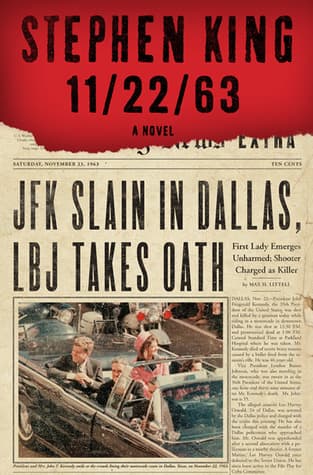
Synopsis
Covers the whole plot, including the ending.
- Difficulty
- Medium
- Pacing
- Variable
- Mood
- Immersive, Poignant, Suspenseful, Nostalgic, Romantic
- Read it if
- You love epic, character-driven stories that blend historical fiction with a compelling 'what if' premise, featuring a deep dive into the past and a poignant romance.
- Skip it if
- You prefer fast-paced thrillers without lengthy historical immersion or are not a fan of intricate plots that explore the philosophical implications of time travel.
11/22/63 Plot Summary
Covers the whole plot, including the ending.
Al's Secret and the Mission
Jake Epping, a high school English teacher in Lisbon Falls, Maine, is shown a time portal by his friend Al Templeton, who owns Al's Diner. The portal, in Al's pantry, always leads to 11:58 AM on September 9, 1958. Al, dying of lung cancer, says he has used the portal many times, trying to stop John F. Kennedy's assassination. He explains that each trip resets the timeline, meaning any changes he made are undone if he goes back. Al, having spent years in the past gathering information, is too sick to continue and asks Jake to take over. Jake, at first doubtful, is convinced after a short trip to 1958, where he saves the Dunning family from Harry's abusive father, an event Harry wrote about in a student essay. This act affects Jake and strengthens his commitment to Al's mission.
Adjusting to 1958 and the Butterfly Effect
Jake Epping, now using the name George Amberson, returns to 1958 with a detailed plan and resources from Al. He quickly learns that the past 'pushes back,' causing small problems or big obstacles when he tries to change things. His first big test comes when he tries to save the Dunning family again, more completely. He confronts Frank Dunning, leading to a fight where Frank is killed. While this saves the family, Jake experiences the 'push back' through a series of accidents. He decides to live in Jodie, Texas, to watch Lee Harvey Oswald and build a stable life while waiting for 1963. He gets a job as a high school English teacher, using his future knowledge, especially in sports betting, to fund his long stay.
Life in Jodie and the Emergence of Sadie
Jake (as George Amberson) settles into his new life in Jodie, Texas. He becomes a liked teacher at Jodie High School and makes friends. He meets Sadie Dunhill, the school librarian. Sadie is smart, kind, and beautiful, and Jake falls in love with her, despite his secret mission and knowing his life in the past is temporary. Their relationship grows, and Jake finds happiness he had not known in his original timeline. He struggles with the ethics of his deception, knowing he cannot fully share his true identity or mission with Sadie. The 'past' continues to exert subtle pressure, but his life with Sadie provides stability amidst his unusual circumstances.
The Oswald Surveillance Begins
As 1963 nears, Jake knows it is time to focus on Lee Harvey Oswald. He moves to Fort Worth, Texas, keeping his relationship with Sadie, who now works for the Fort Worth library system. He rents a room in a boarding house near Oswald's known homes and begins close observation of Oswald. He watches Oswald's volatile marriage to Marina, his unstable personality, his communist views, and his interactions with others. Jake becomes sure that Oswald is a lone wolf, driven by a need for recognition, and that he will act alone in the assassination attempt. This period is tense as Jake struggles with the moral issues of his mission and the possible results of changing history.
Attempted Assassination and Sadie's Discovery
Jake stops Oswald's attempt to kill General Edwin Walker, a test run for the JFK assassination. This works, but it leads to a violent confrontation with Oswald. In the chaos, Jake is seriously hurt, and Sadie, who followed him out of worry, finds his hidden apartment and the evidence of his watching Oswald. Overwhelmed, Sadie first struggles to understand Jake's story about time travel and his mission. However, her love for him, Jake's explanations, and the amount of evidence convince her. She becomes his confidante and helps with his mission, despite the danger and the personal toll it takes on her.
The Trauma of Sadie's Past and the Hospital Stay
While Jake recovers from his injuries, Sadie's abusive ex-husband, Johnny Clayton, finds her. Johnny is disturbed and had previously disfigured Sadie. He confronts Sadie and Jake, holding them hostage. In a desperate fight, Jake kills Johnny, but Sadie is severely wounded, losing an eye. This event further connects Jake and Sadie, but also shows the dangers and 'push back' of the past. Jake is affected by Sadie's suffering, feeling guilt for bringing her into his dangerous world. Their love deepens during the trauma, and Sadie's resolve to help Jake stop the JFK assassination strengthens, despite her injuries and lasting scars.
The Approach of November 22, 1963
With November 22, 1963, getting close, Jake and Sadie finalize their plan. They know the exact route of the presidential motorcade through Dealey Plaza and the precise timing of Oswald's actions from the Texas School Book Depository. They plan their approach carefully, considering all possibilities. Sadie, despite her recent injuries and trauma, remains determined to support Jake. They know the big risks, not only from Oswald but also from the 'past' itself, which tries to stop Jake. Tension builds as they prepare for the day, knowing that history's fate, and possibly their own lives, depends on them.
Dealey Plaza and the Assassination Attempt
On November 22, 1963, Jake and Sadie are near the Texas School Book Depository. As the presidential motorcade approaches, Jake acts. He runs into the building, confronting Lee Harvey Oswald on the sixth floor. A struggle happens, with Oswald trying to fire at the motorcade, but Jake stops him. During the fight, Sadie, who came to help, is shot and killed by a stray bullet, likely from Oswald's gun. Jake, heartbroken by Sadie's death, stops Oswald from firing at President Kennedy. The assassination is prevented, but at a huge personal cost to Jake.
The Aftermath and the New Timeline
Afterward, Jake is seen as a hero. Oswald is arrested, and President Kennedy is safe. However, the world that results is not the good one Jake had imagined. While some things are better, the 'past' has pushed back with unexpected and terrible results. The world becomes unstable, with widespread earthquakes, environmental problems, and political unrest. Changing such a big historical event has created a ripple effect that destabilizes the entire timeline. Jake realizes that stopping the assassination, though well-meant, has caused far greater chaos than the original timeline. The 'butterfly effect' has happened in a terrifying way, proving Al's earlier warnings about the past's resistance.
The Decision to Reset and the Farewell
Facing a worsening world and knowing his actions caused it, Jake decides to reset the timeline. He goes back to the portal in Lisbon Falls, Maine, knowing that re-entering will undo all his changes, including his life with Sadie and her existence. It is a heartbreaking choice; he sacrifices the love of his life and his heroic act to save the world from his interference. Before he steps through, he talks one last time with the Yellow Card Man, a mysterious figure who seems to guard the timeline. The Yellow Card Man confirms his decision is necessary and that changing fixed points is dangerous. With a heavy heart, Jake steps back into the portal, returning to his original present.
A Life Undone and a Dance Reunited
Jake returns to his original 2011, where Kennedy was killed, and Sadie never existed in his personal history. The world is as he left it, stable but without the deep love he knew. He feels Sadie's loss deeply. Later, at an event in Lisbon Falls, he sees an elderly woman honored for her community work. He recognizes her as Sadie Dunhill, now an old woman who lived a full life without him. He approaches her and, without revealing their shared past in a different timeline, asks her to dance. They share a beautiful, silent moment, a dance that goes beyond time and loss, allowing Jake to honor the love they shared in a world that no longer exists, finding a bittersweet end.
Principal Figures
Jake Epping (George Amberson)
Protagonist
A high school English teacher tasked with preventing the JFK assassination.
Jake Epping is a pragmatic, intelligent, and initially cynical English teacher who finds himself burdened with a monumental mission. He is driven by a strong moral compass and a desire to make a difference, even if it means sacrificing his own life. He struggles with the ethics of altering history and the 'butterfly effect' of his actions. His transformation from a detached observer to a deeply committed individual, capable of profound love and immense sacrifice, is central to the narrative. He is meticulous in his planning but also adaptable when the past 'pushes back.'
Relationships: Al Templeton (Mentor and friend); Sadie Dunhill (Love interest and partner in mission); Lee Harvey Oswald (Target of surveillance and antagonist)
Sadie Dunhill
Supporting
A kind and intelligent librarian who becomes the love of Jake's life.
Sadie Dunhill is a warm, intelligent, and resilient woman who works as a school librarian in Jodie, Texas. She is an anchor for Jake in the past, offering him genuine love and happiness amidst his dangerous mission. Despite a traumatic past involving an abusive ex-husband, she possesses immense strength and courage. When she learns Jake's secret, she embraces the impossible truth and becomes his loyal partner, demonstrating unwavering support and bravery, even at great personal cost. Her love for Jake is pure and unconditional, making her eventual tragic death a devastating blow.
Relationships: Jake Epping (Love interest); Johnny Clayton (Abusive ex-husband)
Al Templeton
Supporting
Diner owner and the discoverer of the time portal, who initiates Jake's mission.
Al Templeton is Jake's gruff but well-meaning friend and the owner of Al's Diner. He is the original discoverer of the rabbit hole to 1958 and spent years trying to prevent the JFK assassination before his health failed. Al is a man of conviction, deeply affected by the historical tragedy and convinced it can be averted. He provides Jake with the initial information, resources, and the impetus for the mission. His experiences in the past, particularly the 'push back' phenomenon, serve as crucial warnings for Jake, though Jake only fully understands them after his own trials.
Relationships: Jake Epping (Mentor and friend)
Lee Harvey Oswald
Antagonist
The troubled individual identified as JFK's assassin.
Lee Harvey Oswald is portrayed as a deeply disturbed, unstable, and narcissistic individual driven by a desire for recognition and a distorted sense of political ideology. Jake's extensive surveillance reveals him as a loner, abusive to his wife Marina, and prone to violent outbursts. He is not depicted as part of a larger conspiracy, but rather as a man acting out of his own twisted motivations. His volatile nature and conviction in his own importance make him a dangerous and unpredictable antagonist, embodying the 'fixed point' that the past fiercely protects.
Relationships: Jake Epping (Target of surveillance / Adversary); Marina Oswald (Wife)
Harry Dunning
Supporting
Jake's adult student whose tragic past inspires Jake's first act of intervention.
Harry Dunning is an adult student in Jake's GED class whose essay about his family's murder by his father profoundly affects Jake. Harry walks with a limp and has a speech impediment, both consequences of his father's violence. His story serves as the initial catalyst for Jake's belief in the possibility of changing the past for the better. Jake's successful intervention to save Harry's family early in the book provides a powerful, tangible example of positive change, contrasting sharply with the later, more complex consequences of altering the JFK assassination.
Relationships: Jake Epping (Student of Jake's)
Marina Oswald Porter
Supporting
Lee Harvey Oswald's Russian wife.
Marina Oswald is Lee Harvey Oswald's Russian-born wife, depicted as a long-suffering and often abused spouse. She is initially dismissive of Lee's grand plans and political aspirations, often criticizing his behavior. Jake's observations show her struggling to raise their children in poverty, constantly at the mercy of Lee's volatile moods and paranoia. She provides Jake with insights into Oswald's character and home life, helping him understand the assassin's motivations and the dynamics within their troubled household. Her testimony after the assassination is crucial to the historical record.
Relationships: Lee Harvey Oswald (Husband)
Johnny Clayton
Antagonist
Sadie Dunhill's abusive and violent ex-husband.
Johnny Clayton is Sadie Dunhill's ex-husband, a truly malevolent and abusive individual who disfigured Sadie in the past. He represents a direct threat to Sadie's safety and happiness and is a manifestation of the 'past pushing back' in a deeply personal way for Jake. His re-emergence in Sadie's life leads to a violent confrontation that results in Sadie's severe injury and Johnny's death. He serves as a reminder that danger can come from unexpected places, not just from Oswald, and that Jake's actions have consequences beyond his primary mission.
Relationships: Sadie Dunhill (Abusive ex-husband)
The Yellow Card Man
Mentioned
A mysterious figure who appears near the portal, symbolizing the timeline's guardians.
The Yellow Card Man is one of several mysterious figures, often described as 'bums' or 'drifters,' who are always present near the time portal in Lisbon Falls. They often appear to Jake with a 'yellow card' or similar insignia, and utter cryptic warnings about the dangers of changing the past. They seem to be guardians or manifestations of the timeline itself, representing the 'past pushing back' on a metaphysical level. They are not fully explained but serve as a recurring, unsettling reminder of the cosmic forces at play and the inherent dangers of time travel.
Relationships: Jake Epping (Mysterious observer/warner)
Deke Simmons
Supporting
Principal of Jodie High School and Jake's friend.
Deke Simmons is the principal of Jodie High School where Jake (as George Amberson) works as a teacher. He becomes a good friend and colleague to Jake, representing the stable and supportive community Jake builds in Jodie. Deke is a kind, fair, and respected figure, embodying the positive aspects of life in the late 1950s and early 1960s. His friendship provides Jake with a sense of normalcy and belonging, making the eventual necessity of leaving Jodie and Sadie even more painful.
Relationships: Jake Epping (Friend and colleague)
Themes & Insights
The Irreversibility of Time and the Butterfly Effect
This theme looks at the big and often bad results of changing history. Jake's first success in saving the Dunning family is compared to the global instability that comes from stopping the JFK assassination. The 'past pushes back' with more violent means, showing that changing fixed points in time can cause unexpected chaos. This theme suggests that some events, even sad ones, are important for the timeline's stability, and that trying to 'fix' history can lead to worse outcomes.
“The past does not want to be changed. It is dangerous to change the past.”
Love and Sacrifice
Jake's mission is tied to his growing love for Sadie Dunhill. Their relationship is the emotional center of the novel, showing the personal cost of his historical intervention. Jake repeatedly faces the choice between his mission and his love, ultimately sacrificing Sadie's life to save the world, and then sacrificing their shared existence to reset the timeline. This theme explores the idea that love can last through time, even if it cannot stay in one timeline, and that the biggest acts of love often involve great personal sacrifice.
“I loved Sadie Dunhill. I loved her with a passion that made me feel like a hero in an old movie, and I loved her with a terror that made me feel like a child lost in a dark forest.”
Nostalgia and the Idealized Past
The novel brings out a strong feeling for the late 1950s and early 1960s, showing it as a simpler, more innocent time before the cultural changes of later decades. Jake at first finds charm and comfort in the past, enjoying the food, music, and community. However, this good view is balanced by the realities of the era, including racism, sexism, and the constant threat of violence. The book explores how we often romanticize the past and that while there were good parts, it also had flaws and darkness.
“It was America, back when America was still pretty good. Back when people still said 'gosh' and 'golly' and meant it.”
Destiny vs. Free Will
A main tension in the novel is the debate between destiny and free will. Al believes history can be changed, while the 'past pushing back' suggests a determined force. Jake's attempts to change events are met with more resistance, implying that certain 'fixed points' in time are very hard, if not impossible, to change without bad results. The book suggests that major historical events, like the JFK assassination, might be fated, and trying to change destiny can lead to chaotic, unintended outcomes, questioning how much control humans have over history.
“Some things are fixed. Some things are not. The assassination... that's a fixed point.”
The Nature of Evil
The novel looks at the nature of evil through Lee Harvey Oswald. Instead of showing him as part of a big plot, King shows him as a product of his own inner problems: narcissism, paranoia, and a desperate need for importance. This suggests that evil can often be common, coming from individual psychological issues rather than complex schemes. The book also explores how Jake, in trying to fight this evil, must face his own capacity for violence and the moral issues of his mission.
“He was just a sad, angry little man who wanted to be a big man. And he was going to do it by killing the biggest man in America.”
Plot Devices & Literary Techniques
The Rabbit Hole (Time Portal)
A fixed portal to a specific point in the past, always resetting upon re-entry.
The 'rabbit hole' is the physical time portal located in Al Templeton's diner pantry. Its unique rules — always leading to September 9, 1958, at 11:58 AM, and resetting the timeline each time someone re-enters — are crucial to the plot. This device establishes the stakes, allowing Jake multiple attempts but ensuring that each 'run' is a fresh start, making his commitment to staying in the past for years a necessity. It also cleverly allows for the exploration of multiple 'what-if' scenarios without complicating the narrative with branching timelines, as only the most recent trip's changes persist until the next reset.
'The Past Pushes Back'
A metaphysical force resisting changes to the timeline.
This is a recurring motif and a major antagonist in itself. Whenever Jake attempts to alter a significant event, the 'past' actively resists him through a series of increasing coincidences, accidents, and obstacles. These can range from minor annoyances like flat tires to life-threatening events like car crashes or a sudden illness. This device externalizes the inherent difficulty and danger of time travel, adding a layer of supernatural suspense and reinforcing the theme that some historical events are 'fixed points' that are not meant to be changed, regardless of human intention.
The Yellow Card Men
Mysterious figures who warn against tampering with the past.
The Yellow Card Men (and similar figures) are enigmatic, recurring characters who appear near the portal and offer cryptic warnings to those who travel through time. They are often disheveled and seem to be on the periphery of society, yet possess an unnerving awareness of the time-travelers' actions. They serve as a symbolic representation of the 'past pushing back' on a more cosmic, almost sentient level. Their presence adds to the mystery and supernatural elements of the story, hinting at unseen forces that govern the fabric of time and space, reinforcing the idea that humanity is not meant to meddle with history.
Historical Intertextuality
Integration of real historical figures and events into the fictional narrative.
King meticulously weaves real historical events, figures, and cultural details of the late 1950s and early 1960s into the fictional narrative. This includes detailed accounts of Lee Harvey Oswald's life, the political climate, pop culture references, and the specific events leading up to the JFK assassination. This device grounds the speculative fiction in a sense of realism, making the 'what if' scenario more compelling and believable. It allows the reader to experience history through Jake's eyes, adding depth and authenticity to his mission and the world he inhabits.
11/22/63 Quotes
“The past is obdurate.”
“If you want to kill a man, you have to cut off his head.”
“We never know which lives we influence, or when, or why.”
“The past harmonizes with itself.”
“Sometimes the universe throws you a rope.”
“Life turns on a dime.”
“The obdurate past doesn't want to be changed.”
“You can't change the past without changing the future.”
“Love is a uniquely portable magic.”
“The past is a puzzle, and the pieces don't always fit.”
“We're all time travelers, moving forward at the same speed.”
“The butterfly effect is not just a theory; it's a warning.”
“Sometimes the right thing is the hardest thing to do.”
“History is a wheel, and we are all caught in its spokes.”
Quiz
10 questions on the plot and the characters. Each answer comes with a short explanation.
Question 1
What is the name of Jake Epping's student whose essay about a family tragedy inspires him?
- Harry Dunning
- Sadie Dunhill
- Lee Harvey Oswald
- George Amberson
Show answer
A. Harry Dunning Harry Dunning is Jake's adult GED student whose essay describes his father murdering his family with a hammer in 1958, which deeply affects Jake and motivates his initial time-travel mission.
Question 2
Where is the portal to the past located in the book?
- In Jake's classroom closet
- In Al's diner storeroom
- In a library basement
- In a Maine forest
Show answer
B. In Al's diner storeroom Al Templeton, Jake's friend who runs a diner in Lisbon Falls, reveals that his storeroom contains a portal that always opens to September 9, 1958, at 11:58 a.m.
Question 3
What alias does Jake use when he travels back to 1958?
- John Smith
- Harry Dunning
- George Amberson
- Al Templeton
Show answer
C. George Amberson Jake adopts the identity of George Amberson to blend into the past, using this name for his jobs, relationships, and mission to stop the Kennedy assassination.
Question 4
What is the primary mission that Al enlists Jake to undertake through the time portal?
- To prevent the murder of Harry Dunning's family
- To invest in future technology companies
- To stop the assassination of John F. Kennedy
- To document historical events accurately
Show answer
C. To stop the assassination of John F. Kennedy Al convinces Jake to use the portal to travel to 1958 and live in the past until 1963 to prevent Lee Harvey Oswald from assassinating President Kennedy on November 22, 1963.
Question 5
Who is Sadie Dunhill in the context of Jake's life in the past?
- A government agent monitoring time travelers
- A high school librarian who becomes Jake's love interest
- A relative of Lee Harvey Oswald
- A student in Jake's GED class
Show answer
B. A high school librarian who becomes Jake's love interest Sadie Dunhill is a librarian at the high school where Jake works in Texas; she falls in love with him (as George Amberson), and their relationship becomes central to his life in the past.
Question 6
What key rule about the time portal does Al explain to Jake?
- You can travel to any date in history
- Time resets to 1958 each time you return
- You can bring modern technology back with you
- The portal only works during full moons
Show answer
B. Time resets to 1958 each time you return Al reveals that no matter how long someone spends in the past, only two minutes pass in the present, and returning through the portal resets the timeline to September 9, 1958, erasing all changes.
Question 7
Why does Jake initially test the time portal before attempting to stop the Kennedy assassination?
- To see if he can alter major historical events
- To prevent the Dunning family murders
- To win the lottery in the past
- To meet famous historical figures
Show answer
B. To prevent the Dunning family murders Jake first uses the portal to travel to 1958 and stop Harry Dunning's father from killing his family, testing whether he can change the past and seeing the consequences of his actions.
Question 8
What is a major theme explored through Jake's experiences with time travel in the book?
- The inevitability of technological progress
- The dangers of altering the past and unintended consequences
- The superiority of modern society over the past
- The importance of preserving historical accuracy
Show answer
B. The dangers of altering the past and unintended consequences The book delves into how changing past events, even with good intentions, can lead to unforeseen and often negative outcomes, as seen when Jake's actions create ripple effects in the timeline.
Question 9
How does Jake support himself financially while living in the past from 1958 to 1963?
- By working as a high school English teacher
- By gambling on known sports outcomes
- By selling futuristic inventions
- By receiving money from Al in the present
Show answer
A. By working as a high school English teacher Jake takes a teaching job in Texas, using his skills as an educator to earn a living and maintain his cover as George Amberson while monitoring Lee Harvey Oswald.
Question 10
What does Jake discover about the 'obdurate past' as he tries to change history?
- It is easily manipulated with careful planning
- It resists change and often pushes back against alterations
- It only changes if events are minor
- It has no memory of previous timelines
Show answer
B. It resists change and often pushes back against alterations Jake learns that the past is 'obdurate'—it fights to maintain its course, creating obstacles and tragedies (like accidents or illnesses) to prevent major changes, such as stopping the assassination.
11/22/63 FAQ
What is '11/22/63' about?
The novel follows Jake Epping, a high school English teacher who discovers a time portal to 1958 in his friend Al's diner. Jake takes on the mission to prevent President John F. Kennedy's assassination, adopting the alias George Amberson. He spends years in the past, tracking Lee Harvey Oswald while building a life that includes falling in love with librarian Sadie Dunhill, all while grappling with the consequences of altering history.
Why should I read '11/22/63'?
It's a masterful blend of historical fiction, thriller, and romance that explores profound questions about fate, love, and the unintended consequences of changing the past. Stephen King creates a vivid, immersive 1958-1963 America while delivering a gripping narrative about one man's obsessive quest to save Kennedy and the personal sacrifices it demands.
What is the background/setting of '11/22/63'?
The story alternates between 2011 Lisbon Falls, Maine, and the past from 1958 to 1963, primarily in Texas (Dallas, Fort Worth, and Jodie). King meticulously recreates the late 1950s and early 1960s America, with details like sock hops, big-finned cars, segregation, Cold War tensions, and the cultural landscape leading up to Kennedy's assassination.
What are the most memorable quotes?
Key quotes include: 'The past is obdurate' (repeatedly emphasizing its resistance to change), 'Sometimes the universe throws you a rope' (Jake's reflection on second chances), and 'We never know which lives we influence, or when, or why' (highlighting the butterfly effect of time travel). Sadie's line, 'If you want to kill Hitler, you have to go back to 1889,' underscores the moral complexity of altering history.
What writing style does the author use?
Stephen King employs a first-person narrative from Jake's perspective, blending detailed historical research with a conversational, introspective tone. The prose is immersive and descriptive, capturing the nostalgia of the era while building suspense through meticulous plotting and character-driven drama, particularly in Jake's internal conflicts and relationship with Sadie.
What minor details add significant meaning?
The 'yellow card man'—a derelict who appears near the time portal—subtly represents the guardians of time and the damage caused by temporal meddling. His deterioration across resets mirrors the timeline's instability. Similarly, the repeated phrase 'the past harmonizes' hints at self-correcting mechanisms in history, such as Oswald's rifle malfunctioning when Jake first tries to intervene.
What are some subtle foreshadowing moments?
Early on, Jake's success in preventing Harry Dunning's family murder foreshadows both the possibility and peril of changing history, as it leads to unintended consequences like Harry's later death in Vietnam. Sadie's scar from a prior abusive relationship subtly parallels the violence Jake encounters, hinting at the personal costs of his mission. The portal's reset mechanism—erasing changes upon return—foreshadows the novel's tragic ending.
What unexpected character connections exist?
Jake's initial mission is sparked by Harry Dunning's essay about his family's murder, but Harry later becomes a casualty of the altered timeline, linking Jake's personal guilt to his historical quest. Sadie Dunhill, seemingly unrelated to the assassination plot, becomes central to Jake's motivations and ultimate sacrifice. Minor characters like Marina Oswald and George de Mohrenschildt provide crucial links in tracking Lee Harvey Oswald's movements.
What are unspoken character motivations?
Jake is driven not just by a desire to save Kennedy but by a deeper need for purpose and redemption, stemming from his mundane life and divorce. Al Templeton's obsession with the mission masks his guilt over failing to prevent the assassination during his own attempts. Sadie's love for Jake is intertwined with her yearning for escape from a stifling small-town life, though she remains unaware of his true identity until later.
What psychological complexities do characters exhibit?
Jake grapples with paranoia and isolation as a time traveler, constantly fearing exposure and the 'obdurate' past's retaliation. Lee Harvey Oswald is portrayed with nuanced ambiguity—lonely, manipulated, and unstable, rather than purely evil—forcing Jake to confront the humanity of his target. Sadie demonstrates resilience and trauma from past abuse, which shapes her trust issues and fierce loyalty.
What are the major emotional turning points?
Key moments include Jake falling in love with Sadie, which complicates his mission; the heart-wrenching scene where Sadie is scarred by her ex-husband, deepening their bond; Jake's realization that preventing the assassination leads to a dystopian future; and the climax where he must choose between saving Sadie or stopping Oswald, ultimately sacrificing their relationship to restore the original timeline.
How do relationship dynamics evolve?
Jake and Sadie's relationship grows from a cautious friendship into a profound, star-crossed love, tested by secrets and violence. Jake's mentorship of student Bill Turcotte shifts to a fraught partnership as Bill's instability jeopardizes the mission. The dynamic between Jake and Oswald evolves from detached observation to a personal, moral confrontation, humanizing the assassin in Jake's eyes.
Which parts remain ambiguous or open-ended?
The nature of the time portal and the 'yellow card man' are never fully explained, leaving their origins mystical. The ending implies Jake might reunite with an older Sadie in the restored timeline, but it's left uncertain whether their connection persists. The novel also ambiguously suggests whether the past's resistance is a natural force or a sentient entity punishing meddlers.
What are controversial scenes or decisions?
Jake's decision to brutally beat Sadie's ex-husband, Johnny Clayton, sparks debate over vigilantism versus justice. His final choice to undo all changes—erasing his life with Sadie and allowing Kennedy's death—is controversially tragic, questioning whether love or historical 'greater good' should prevail. Some readers also debate the portrayal of Oswald as sympathetic, which challenges traditional villain narratives.
'11/22/63' ending explained: how it ends & what it means
After preventing the assassination, Jake returns to 2011 to find a dystopian world ravaged by nuclear war and chaos, realizing that saving Kennedy led to catastrophic outcomes. He uses the portal to reset the timeline, undoing all changes, which erases his life with Sadie and allows the assassination to occur. In the restored present, he visits an elderly Sadie, who has no memory of him, but they share a dance, hinting at a lingering connection. The ending emphasizes themes of acceptance and the danger of tampering with history, suggesting that some tragedies are necessary parts of a stable reality.
About the author

Stephen Edwin King is an American author of horror, supernatural fiction, suspense, crime, science-fiction, and fantasy novels. Described as the "King of Horror", his books have sold more than 350 million copies as of 2006, and many have been adapted into films, television series, miniseries, and comic books. King has published over 65 novels/novellas, including seven under the pen name Richard Bachman, and five non-fiction books. He has also written approximately 200 short stories, most of which have been published in book collections.
Similar books
- The Time Traveler's Wife
Audrey Niffenegger
4.0 (1.6M) average on GoodreadsFantasyExplores a complex, time-spanning romance with the challenges of time travel.
- Replay
Ken Grimwood
4.2 (30k) average on GoodreadsFantasyFeatures a protagonist repeatedly reliving his life, trying to alter outcomes and grappling with consequences.
- Under the Dome
Stephen King
3.9 (257k) average on GoodreadsThrillerAnother lengthy, character-rich King novel exploring a confined, high-stakes situation with supernatural elements.
- Angels & Demons
Dan Brown
3.9 (2.7M) average on GoodreadsThrillerA Harvard symbologist races through Rome's ancient sites, deciphering cryptic clues to unmask the Illuminati and stop a vengeful plot to destroy the Vatican with a stolen antimatter weapon.
- Gone Girl
Gillian Flynn
4.1 (2.3M) average on GoodreadsThrillerA wife's sudden disappearance on her fifth anniversary reveals a web of lies and psychological warfare, exposing the secrets within a seemingly perfect marriage.
- The Girl on the Train
Paula Hawkins
3.9 (2.1M) average on GoodreadsThrillerA woman’s fascination with a seemingly perfect couple she watches from her daily train commute leads her into a dark investigation when she witnesses something that shatters their idyllic image.





Enjoyed the summary?
A summary gives you the shape of the book. The book itself has the detail, the examples and the voice.
Find 11/22/63 on AmazonAs an Amazon Associate, BookBrief earns from qualifying purchases. How we're funded