
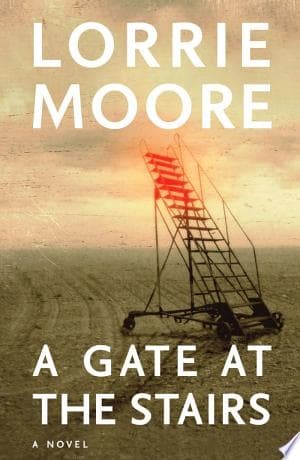
Synopsis
Covers the whole plot, including the ending.
- Difficulty
- Medium
- Pacing
- Slow
- Mood
- Melancholy, Reflective, Poignant, Darkly Humorous
- Read it if
- You appreciate literary fiction with a strong, introspective narrator and poignant exploration of grief, race, and the American experience post-9/11.
- Skip it if
- You prefer fast-paced plots or lighthearted reads, as this book is emotionally heavy and character-driven.
A Gate at the Stairs Plot Summary
Covers the whole plot, including the ending.
Arrival and First Impressions
Twenty-year-old Tassie Keltjin, a student in a Midwestern university town, thinks about her first year, especially the summer of 2001. She takes a part-time job as a nanny for Dr. Sarah Brink and her husband, Edward. They live in a large house with a locked gate at the stairs. Their adopted one-year-old daughter, an African American child named Mary-Emma, is Tassie's main responsibility. Tassie, new to the complexities of race and class, watches the family with curiosity and naivete, trying to understand their seemingly perfect but detached life. She notices the tension between Sarah and Edward, and Sarah's somewhat forced attempts to connect with Mary-Emma's racial heritage.
The Brink Family's Peculiarities
Tassie spends her days caring for Mary-Emma, whom Sarah calls 'Little' to distinguish her from her birth mother, 'Big' Mary-Emma, who is dead. Sarah often seems overwhelmed and detached, frequently worrying about Mary-Emma's development and her own mothering skills. She tries to expose Mary-Emma to African American culture, often in superficial ways, like playing specific music or buying certain books. Edward, a restaurant owner, is more distant, often absent, and seems to have a strained relationship with Sarah. Tassie starts to notice the subtle sadness and pretense in the household, which contrasts with her own simple rural upbringing. The locked gate at the stairs becomes a symbol of the family's hidden complexities.
Tassie's Personal Life and Romances
While working, Tassie also explores her own romantic life. She has a casual relationship with Reynaldo, a fellow student and musician who offers humorous, sometimes cynical, comments on her experiences. Tassie also gets involved with Frank, an older, more serious graduate student from her poetry class. She deals with the emotional challenges of these relationships, her inexperience often leading to misunderstandings and hurt. Her interactions with Reynaldo and Frank contrast with the isolated world of the Brinks, highlighting Tassie's journey of self-discovery and her attempts to define her identity outside her family and new employer.
The Introduction of the 'Babysitter'
Sarah surprises Tassie by introducing John, a young African American man, as a 'babysitter' to help care for Mary-Emma. John is initially presented as a distant relative or acquaintance, but his role and connection to the family are unclear. Tassie finds John quiet and somewhat unsettling, but also interesting. His presence adds another layer of mystery to the Brink household, especially given Sarah's earlier worries about Mary-Emma's cultural upbringing. Tassie observes John's interactions with Mary-Emma, noticing his quiet attentiveness, but also sensing a deeper, unspoken tension around his presence in the family. His arrival further complicates Tassie's understanding of the Brinks' motives and secrets.
Tassie's Brother, Robert, and the Military
The story is set after 9/11. Tassie's older brother, Robert, a gentle and somewhat aimless young man, is deeply affected by the terrorist attacks. He makes the unexpected decision to join the military, a choice that deeply worries Tassie and their parents, who are rural Wisconsin farmers. Robert's enlistment introduces themes of patriotism, sacrifice, and how national events affect individual lives. Tassie struggles to reconcile her brother's decision with her image of him, and his upcoming deployment casts a shadow over her summer, mixing her personal anxieties with the broader political climate. This decision highlights the vulnerability of young people during wartime.
The Truth About John and Edward's Secret
Tassie eventually learns the truth about John: he is Edward's biological son from an affair with Mary-Emma's birth mother, 'Big' Mary-Emma. This revelation shatters Tassie's view of the Brink family's carefully built image. It explains the strange dynamics, Sarah's anxieties, and John's unclear role. The Brinks had adopted Mary-Emma, John's half-sister, after 'Big' Mary-Emma's death. Edward's infidelity and the cover-up expose the hypocrisy and pain within the family. Tassie is horrified by the deception and the emotional burden placed on John, who is essentially a silent witness to his father's new family. This discovery marks a significant loss of innocence for Tassie.
John's Disappearance and the Aftermath
After the truth about his parentage and the tension of his situation, John disappears from the Brink household. His sudden departure leaves a void and increases the unease. Sarah and Edward are visibly shaken, though they offer little explanation. Tassie is deeply affected by John's absence, feeling guilt and helplessness. She thinks about the unspoken burdens John carried and the injustice of his situation. His disappearance shows the fragility of the Brinks' carefully maintained image and forces Tassie to confront the darker aspects of human nature and the consequences of hidden truths. The event leaves a lasting impression on Tassie, shaping her understanding of trust and betrayal.
Robert's Deployment and Tassie's Grief
Robert goes to Afghanistan, leaving Tassie and her family consumed with worry. Tassie struggles to cope with the reality of her brother being in a war zone, the news reports and constant threat of danger weighing heavily on her. She feels increasingly isolated in her grief, her everyday life at the university feeling unimportant compared to her worries about Robert. The war becomes a constant presence, a stark contrast to her academic life. Tassie's thoughts reveal her attempts to process the potential loss and the irreversible change Robert's deployment brings to their family, highlighting the personal cost of war.
The Christmas Visit and Robert's Return
Robert returns home for Christmas leave, but he is visibly changed by his experiences in Afghanistan. He is withdrawn, haunted, and struggles to reconnect with his family and his former life. Tassie observes his emotional distance and the unspoken traumas he carries. The joy of his return is lessened by the realization that he is no longer the same brother who left. His interactions are strained, and he shows signs of post-traumatic stress. This visit highlights the psychological impact of war, not only on the soldier but also on their loved ones, who must confront a stranger in the place of the person they knew.
Robert's Death and Tassie's Despair
Sadly, Robert dies by suicide shortly after returning to active duty. His death shatters Tassie and her family, leaving them in deep grief and shock. Tassie struggles to understand her brother's gentle nature with his violent end, questioning the circumstances, the war's role, and her own inability to help him. His death is a devastating blow, marking a definitive loss of innocence for Tassie and forcing her to confront the ultimate consequences of trauma and war. She deals with immense sorrow, anger, and a desperate search for meaning in the face of such an incomprehensible loss, changing her perspective on life forever.
Confronting Sarah Brink
After Robert's death, Tassie revisits the Brink household, seeking some closure or understanding, though she doesn't explicitly state her intentions. She confronts Sarah, not necessarily about John or Edward's affair, but about truth, secrets, and the fragility of life. The conversation is filled with unspoken tensions and veiled accusations. Tassie, now matured by her own grief, sees through Sarah's carefully constructed image with a clearer, more cynical eye. This confrontation, while not resolving all mysteries, allows Tassie to assert her own perspective and perhaps begin to process the disillusionment she has experienced, marking a shift in her relationship with her former employer.
Tassie's Reflection and Future
The novel ends with Tassie reflecting on her experiences from that summer and the years that followed. She acknowledges the deep impact of Robert's death and the Brink family's secrets on her development. She is no longer the naive twenty-year-old who arrived in the university town. Her narrative voice, though still with youthful longing, now carries the weight of hard-won knowledge and sorrow. Tassie looks towards her future, forever marked by the losses and revelations she has endured, but also with a new understanding of resilience and the lasting power of memory and love. The gate at the stairs, once a symbol of mystery, now represents the indelible boundaries and hidden depths of human experience.
Principal Figures
Tassie Keltjin
Protagonist
A naive yet observant college student from a farming background.
Tassie is a twenty-year-old student from a rural Wisconsin farming family, working as a nanny for the Brink family. She is intelligent, sensitive, and possesses a sharp, often humorous, internal monologue. Initially naive about the complexities of race, class, and human relationships, she is a keen observer of the world around her, particularly the subtle tensions and deceptions within the Brink household. Her rural upbringing gives her a grounded perspective, but she is also eager to learn and experience life, making her vulnerable to the lessons the summer of 2001 will teach her. She is deeply devoted to her brother, Robert.
Relationships: Robert Keltjin (Beloved older brother, source of deep love and later, profound grief.); Sarah Brink (Employer, complex and often distant figure, subject of Tassie's observations.); Edward Brink (Employer, distant and secretive, revealed to be an adulterer and father to John.); Mary-Emma (The child Tassie nannies, a symbol of the Brink family's secrets and Tassie's growing awareness.); Reynaldo (Casual romantic interest, friend, and source of cynical humor.); Frank (More serious romantic interest, graduate student.)
Robert Keltjin
Supporting
Tassie's gentle older brother, who joins the military after 9/11.
Robert is Tassie's older brother, a kind-hearted and somewhat aimless young man from a farming background. He is gentle, artistic, and initially seems to lack clear direction. However, the events of 9/11 profoundly impact him, leading him to make the surprising decision to enlist in the military. This choice marks a turning point for him and his family. His experiences in Afghanistan transform him, leaving him withdrawn and haunted. Robert embodies the personal cost of war and the devastating psychological toll it takes on individuals and their families.
Relationships: Tassie Keltjin (Younger sister, with whom he shares a deep, loving bond.); Keltjin Parents (Parents, whose lives are deeply affected by his decisions and fate.)
Dr. Sarah Brink
Supporting
Tassie's enigmatic and anxious employer, a seemingly perfect but deeply troubled woman.
Sarah is Tassie's employer, a sophisticated and seemingly composed woman who has adopted Mary-Emma. She is intelligent and articulate, but beneath her polished exterior lies deep anxiety, particularly concerning her role as a mother to an African American child and her husband's infidelity. Sarah attempts to control her environment and image, but her efforts often come across as performative or strained. She is deeply invested in maintaining appearances, even as her life unravels, and her emotional distance makes her a complex figure for Tassie to understand.
Relationships: Edward Brink (Husband, with whom she has a strained marriage marked by his infidelity.); Mary-Emma (Adopted daughter, whom she struggles to connect with authentically.); Tassie Keltjin (Nanny, an observant presence who eventually sees through Sarah's deceptions.); John (Her husband's biological son, whose presence she tolerates with unease.)
Edward Brink
Supporting
Sarah's distant husband, a restaurant owner with a hidden past.
Edward is Sarah's husband and a successful restaurant owner. He is often absent and emotionally distant, contributing to the strained atmosphere in the Brink household. Edward maintains a quiet, almost aloof demeanor, which serves to hide his significant secret: he had an affair with 'Big' Mary-Emma, resulting in a son, John, and also fathered the adopted Mary-Emma. His actions are the catalyst for much of the novel's hidden tension and the source of Sarah's profound anxieties. He embodies the hypocrisy and moral compromises that can exist beneath a veneer of respectability.
Relationships: Sarah Brink (Wife, whose trust he has betrayed through infidelity.); John (Biological son, whose existence he attempts to keep secret.); Mary-Emma (Biological daughter, adopted into his household.); 'Big' Mary-Emma (Deceased lover and mother of his children.)
Mary-Emma
Supporting
The Brink's adopted African American daughter, cared for by Tassie.
Mary-Emma is the one-year-old African American child adopted by Sarah and Edward Brink. She is the innocent focal point of the family's complex web of secrets and racial anxieties. Her presence highlights the Brinks' efforts, sometimes genuine, sometimes performative, to engage with issues of race and identity. Unbeknownst to Tassie initially, Mary-Emma is Edward's biological daughter from his affair with 'Big' Mary-Emma, making her John's half-sister. She represents the future, but also the unresolved past and the burdens of identity, both racial and familial, that she will inherit.
Relationships: Sarah Brink (Adoptive mother, who struggles with maternal connection.); Edward Brink (Adoptive and biological father, whose secret defines her origins.); John (Biological half-brother, whose presence is tied to her own story.); Tassie Keltjin (Nanny, who develops a loving bond with her.)
John
Supporting
Edward's secret son and Mary-Emma's half-brother, introduced as a 'babysitter'.
John is a quiet, enigmatic young African American man introduced by Sarah as a 'babysitter' for Mary-Emma. His true identity is gradually revealed: he is Edward's biological son from an affair with 'Big' Mary-Emma, making him Mary-Emma's half-brother. John carries the heavy burden of this secret, existing as a silent, almost ghost-like presence in his father's new family. His quiet demeanor and eventual disappearance underscore the pain of his marginalized position and the deep emotional toll of the Brink family's deceptions. He represents the hidden consequences of Edward's actions.
Relationships: Edward Brink (Biological father, who keeps his existence a secret from society.); Sarah Brink (His father's wife, who tolerates his presence with unease.); Mary-Emma (Biological half-sister.); Tassie Keltjin (Observant nanny, who eventually discovers his true identity.)
Reynaldo
Supporting
Tassie's casual boyfriend and fellow student, a musician.
Reynaldo is Tassie's casual boyfriend, a musician and fellow student. He is often humorous, providing witty and sometimes cynical commentary on Tassie's observations and experiences. Reynaldo represents a more carefree, less serious aspect of Tassie's early college life, offering a stark contrast to the heavy emotional weight of the Brink household and her family's struggles. His relationship with Tassie is light-hearted but also contributes to her understanding of romantic dynamics and personal independence.
Relationships: Tassie Keltjin (Casual romantic partner and friend.)
Frank
Supporting
Tassie's more serious romantic interest, a graduate student.
Frank is a graduate student from Tassie's poetry class who becomes a more serious romantic interest than Reynaldo. He is older, more intellectual, and represents a different kind of relationship for Tassie, one that involves deeper emotional engagement and intellectual connection. Their relationship allows Tassie to explore her own desires and vulnerabilities, and he provides a temporary anchor amidst the chaos of her personal discoveries. His presence highlights Tassie's growth and her increasing readiness for more profound emotional experiences.
Relationships: Tassie Keltjin (Serious romantic interest.)
Themes & Insights
Loss of Innocence and Disillusionment
The novel shows Tassie's journey from a naive, observant young woman to one deeply marked by grief and a cynical understanding of human nature. Her initial innocence is chipped away by the revelations of the Brink family's secrets—Edward's affair, John's true identity, and Sarah's anxieties—and then shattered by her brother Robert's tragic death. Tassie's experiences force her to confront the harsh realities of betrayal, the hidden costs of war, and life's fragility. This theme is clear in her changing narrative voice, which becomes more reflective and melancholic as the story progresses, moving from youthful optimism to a somber wisdom.
“What had been given and what had been taken away? Everything, it seemed, was both.”
The Impact of War and Trauma
The post-9/11 setting and Robert's enlistment and death are central to the novel's exploration of war's impact. Robert, a gentle and artistic soul, is changed by his military service in Afghanistan, returning home a haunted and withdrawn figure. His eventual suicide highlights the invisible wounds of war and the psychological toll it takes on soldiers and their families. Tassie's grief and struggle to understand her brother's fate show how national conflicts affect individual lives, leaving lasting scars. The war is not just a distant event but a deeply personal tragedy that reshapes her understanding of sacrifice and loss.
“The world was a place that could change in an instant, and then nothing was ever the same.”
Secrets, Deception, and Appearance vs. Reality
The Brink family's secrets are central to this theme. Their seemingly perfect, wealthy life is a facade covering Edward's infidelity, his biological son John, and the complex racial dynamics around their adopted daughter, Mary-Emma. Sarah's anxieties and forced parenting stem from her attempts to maintain this illusion. Tassie, an outsider, slowly uncovers these deceptions, revealing the moral compromises and emotional costs of living a lie. The 'gate at the stairs' itself symbolizes the hidden depths and guarded truths within the family, showing how carefully built appearances can crumble under the weight of reality.
“There was a gate at the stairs, and it was always locked. It kept things in, or it kept things out.”
Race, Identity, and Cultural Appropriation
The novel explores the complexities of race through Sarah and Edward's adoption of Mary-Emma, an African American child. Sarah's often awkward and forced attempts to expose Mary-Emma to her 'heritage' (playing specific music, buying certain books) raise questions about authenticity and cultural appropriation. The introduction of John, Edward's biological son with 'Big' Mary-Emma, further complicates these dynamics, highlighting unspoken racial and class divides. Tassie, from a mostly white rural background, observes these interactions with a growing awareness, grappling with her own understanding of racial identity and belonging in a multicultural society.
“I was learning that the world was not just white and black, but a kaleidoscope of colors, all blurring and shifting.”
Plot Devices & Literary Techniques
First-Person Retrospective Narration
Tassie Keltjin narrates the story from a future point, reflecting on past events.
The novel is told through Tassie Keltjin's first-person perspective, but crucially, it's retrospective. She narrates the events of her summer in 2001 and beyond from a future vantage point, allowing for a blend of youthful immediacy and mature reflection. This device enables Tassie to interject with foreshadowing, philosophical observations, and a deeper understanding of the significance of past events, particularly the impact of Robert's death and the Brink family's secrets. The retrospective lens allows the reader to witness Tassie's loss of innocence and her growth in real-time while also benefiting from her accumulated wisdom and grief.
Symbolism of the Gate at the Stairs
A physical gate that represents emotional barriers, secrets, and boundaries.
The literal gate at the stairs in the Brink household serves as a potent symbol throughout the novel. Initially, it represents the physical barrier protecting the child, Mary-Emma, but quickly evolves to symbolize the emotional barriers, hidden secrets, and guarded truths within the Brink family. It signifies the boundary between their carefully constructed public image and their messy private reality. For Tassie, it represents the mysteries she is trying to unravel and the limits of her understanding. After her disillusionment, the gate comes to represent the irreversible boundaries that loss and knowledge create in human experience.
Foreshadowing
Subtle hints and allusions that hint at future tragic events.
Lorrie Moore masterfully uses foreshadowing, particularly regarding Robert's fate. Tassie's narrative voice, speaking from a future perspective, often includes subtle hints about impending tragedy, such as her anxieties about Robert joining the military, references to the dangers of war, and her reflections on the fragility of life. These allusions create a pervasive sense of dread and suspense, making Robert's eventual death by suicide feel both shocking and tragically inevitable. This device deepens the emotional impact of the plot twists and reinforces the theme of loss of innocence, as Tassie's future self already knows the pain her past self is yet to endure.
Juxtaposition of Rural and Academic/Urban Settings
The contrast between Tassie's farming background and her new university town life.
The novel frequently juxtaposes Tassie's simple, grounded rural upbringing in Wisconsin with the more complex, sophisticated, and often morally ambiguous world of the Midwestern university town and the affluent Brink family. This contrast highlights Tassie's initial naiveté and her gradual awakening to class distinctions, racial tensions, and the hidden lives of others. Her farming family represents honesty and straightforwardness, while the academic/urban setting, particularly the Brinks' household, embodies pretense and hidden secrets. This device emphasizes Tassie's journey of self-discovery and her grappling with new, unfamiliar social codes and moral landscapes.
A Gate at the Stairs Quotes
“The thing about life is that you never know when it will end, and so it's best to be ready for anything.”
“Most of what you hear about the world is wrong, but the wrongness isn't a lie. It's just a different kind of truth.”
“There are times when you want to be someone else, and there are times when you want to be nowhere at all.”
“The past is a foreign country; they do things differently there.”
“Love is not a state, it's a process. It's a verb, not a noun.”
“Grief is like a house. You can live in it or you can leave it, but either way, it's always there.”
“Sometimes you have to break things to make them right.”
“The only way to make sense of the world is to admit that it doesn't make sense.”
“What you don't know can hurt you, but what you do know can hurt you more.”
“Every secret is a kind of wound.”
“The world keeps turning, whether you're ready or not.”
“To be young is to be constantly surprised by what you thought you knew.”
“There's a thin line between remembering and inventing.”
“You can never go home again, not really. Because you've changed, and so has home.”
Quiz
10 questions on the plot and the characters. Each answer comes with a short explanation.
Question 1
What is Tassie Keltjin's primary reason for moving to the university town at the beginning of the novel?
- To escape her family farm
- To pursue a career in childcare
- To attend the university as a student
- To join a new social movement
Show answer
C. To attend the university as a student Tassie moves to the university town specifically to attend the university as a student, which is where she later takes the nanny job to earn money.
Question 2
What is the name of the child Tassie nannies for?
- Sarah
- Milo
- Leo
- Lily
Show answer
B. Milo Tassie is hired to be a nanny for the young boy named Milo, who is adopted.
Question 3
What is the primary concern or fear expressed by Milo's mother, Sarah, regarding his future?
- His academic performance
- His physical health
- His racial identity and potential experiences as a Black child in America
- His social development
Show answer
C. His racial identity and potential experiences as a Black child in America Sarah expresses deep anxieties and concerns about Milo's racial identity and how he will navigate a world as a Black child, often discussing this with Tassie.
Question 4
What is the profession of Milo's father, Edward?
- A university professor
- A doctor
- A prominent lawyer
- A musician
Show answer
C. A prominent lawyer Edward is a lawyer, often portrayed as busy and somewhat detached, contributing to the family's 'glamorous' but complex facade.
Question 5
What significant global event is happening during the time Tassie is working for the family, influencing the novel's themes?
- The Vietnam War
- The Cold War
- The Iraq War (post-9/11)
- The Gulf War
Show answer
C. The Iraq War (post-9/11) The novel is set during the post-9/11 era, and the Iraq War is a significant backdrop, influencing discussions about patriotism, loss, and the state of America.
Question 6
What is the nature of the relationship between Tassie and her brother, Robert?
- They are estranged and rarely speak.
- They have a close, supportive bond, despite his eventual military service.
- They are competitive and often at odds.
- Their relationship is purely financial.
Show answer
B. They have a close, supportive bond, despite his eventual military service. Tassie and Robert share a close, affectionate, and protective sibling bond. His enlistment and subsequent experiences deeply affect Tassie.
Question 7
What specific detail about the 'gate at the stairs' becomes a recurring motif or symbol in the novel?
- It is always locked, symbolizing secrets.
- It is often left open, allowing Milo to wander into danger.
- It is elaborately decorated, signifying wealth.
- It is a magical portal to another world.
Show answer
B. It is often left open, allowing Milo to wander into danger. The literal gate at the stairs, meant to keep Milo safe, is frequently left open, symbolizing vulnerability, the porous nature of boundaries, and the failures of protection within the household.
Question 8
How does Tassie's perspective on love and relationships evolve throughout the novel, particularly in relation to her affair with Edward?
- She becomes cynical and vows never to marry.
- She learns to prioritize passion over stability.
- She develops a more nuanced understanding of the complexities, disappointments, and compromises inherent in adult relationships.
- She retreats from all romantic involvement.
Show answer
C. She develops a more nuanced understanding of the complexities, disappointments, and compromises inherent in adult relationships. Tassie's experiences, particularly her affair with Edward and observing Sarah and Edward's marriage, move her from a youthful, idealized view of love to a more mature, often disillusioned, understanding of its difficulties and compromises.
Question 9
What event fundamentally shifts Tassie's relationship with the family she works for, leading to major emotional fallout?
- Milo running away from home
- The revelation of Tassie's affair with Edward
- Tassie getting arrested for a minor offense
- Sarah accusing Tassie of stealing from them
Show answer
B. The revelation of Tassie's affair with Edward The discovery of Tassie's affair with Edward by Sarah shatters the precarious balance of the household and directly leads to Tassie's departure and a profound shift in her life.
Question 10
The novel frequently uses Tassie's internal monologue and observations to explore themes of identity. How does her rural, Midwestern background contrast with the sophisticated, intellectual world she enters?
- She completely rejects her rural roots in favor of the new lifestyle.
- She finds the intellectual world superficial and returns to her farm.
- She often feels like an outsider, observing the complexities of race, class, and politics from a unique, sometimes naive, perspective.
- Her background makes her immediately accepted and respected in the new environment.
Show answer
C. She often feels like an outsider, observing the complexities of race, class, and politics from a unique, sometimes naive, perspective. Tassie's rural upbringing often positions her as an outsider, providing a fresh, sometimes bewildered, lens through which to observe the urban, academic, and class-divided world she enters, highlighting themes of social disparity and personal growth.
A Gate at the Stairs FAQ
What is the central premise of 'A Gate at the Stairs'?
The novel follows Tassie Keltjin, a 20-year-old college student in the Midwest, who takes a summer job as a nanny for the wealthy and enigmatic household of Sarah and Edward, who have adopted a biracial toddler named Mary-Emma. Tassie's experiences with this family, set against the backdrop of post-9/11 America and the Iraq War, profoundly shape her understanding of race, class, love, and loss.
Who is Tassie Keltjin and what is her background?
Tassie Keltjin is the observant and often naive narrator, a philosophy student from a rural Wisconsin farm. She is characterized by her witty internal monologues, her earnest desire to understand the world, and her evolving perspectives on identity and relationships as she navigates her first significant experiences away from home.
Describe the family Tassie works for.
Tassie works for Sarah and Edward, a seemingly affluent and sophisticated couple. Sarah is a complex, often distant figure struggling with fertility issues and the challenges of raising an adopted biracial child, while Edward is a more reserved and somewhat mysterious presence, often absent. Their adopted daughter, Mary-Emma, is a precocious and charming toddler.
What role does the Iraq War play in the novel?
The Iraq War serves as a constant, looming backdrop, influencing the national mood and directly impacting Tassie's life through her younger brother, Jamie, who enlists. His deployment and subsequent experiences are a significant source of anxiety and grief for Tassie, highlighting the personal cost of national conflict and challenging her innocent worldview.
How does Tassie's relationship with her brother Jamie evolve?
Tassie and Jamie share a close, almost telepathic bond, rooted in their shared rural upbringing. As Jamie enlists and goes to war, Tassie's concern for him becomes a dominant emotional thread, transforming their sibling relationship into one marked by profound worry and eventually, immense sorrow, as she grapples with his wartime experiences and subsequent death.
What is the significance of the 'gate at the stairs' in the title?
The 'gate at the stairs' refers literally to the baby gate Tassie encounters in Sarah and Edward's home, protecting Mary-Emma. Metaphorically, it represents boundaries, protection, the innocence of childhood, and the barriers Tassie herself navigates between different social classes, racial identities, and stages of life, from innocence to experience.
Are there any subtle indications of Sarah's emotional state before her breakdown?
Yes, Sarah's emotional fragility is subtly hinted at through her intense focus on Mary-Emma's diet and development, her occasional sharp remarks, her preference for isolation, and her underlying tension regarding her inability to conceive biologically. These details foreshadow her eventual psychological unraveling later in the novel.
What is the significance of the character of Reynolds?
Reynolds is Tassie's primary romantic interest, a charming but ultimately unreliable older man. He represents Tassie's first foray into adult relationships and the complexities of desire, but his evasiveness and eventual abandonment of her after she becomes pregnant highlight themes of male irresponsibility and Tassie's vulnerability.
How does the novel explore racial identity, particularly through Mary-Emma?
The novel explores racial identity through Mary-Emma, a biracial child adopted by white parents, and the challenges Sarah faces in connecting with her. Tassie observes the nuances of race in a predominantly white community, reflecting on the performative aspects of Sarah's parenting and the broader societal implications of Mary-Emma's identity, especially in post-9/11 America.
Analyze Tassie's psychological journey from innocence to experience.
Tassie begins as a naive but intelligent philosophy student, viewing the world through an academic lens. Her experiences with Sarah's family, her romantic relationships, and especially her brother's death, brutally strip away her innocence, forcing her to confront profound grief, betrayal, and the harsh realities of adult life, ultimately leading to a more complex and melancholic understanding of existence.
How does Tassie cope with grief after Jamie's death?
Tassie copes with Jamie's death through a combination of emotional numbness, vivid internal monologues, and a desperate search for meaning. She revisits memories of him, tries to understand the circumstances of his passing, and grapples with the injustice of war, her grief manifesting as a profound shift in her worldview and a sense of existential despair.
What role does humor play in Tassie's narrative voice, despite the tragic events?
Tassie's narrative voice is laced with dark humor, witty observations, and self-deprecating remarks, even amidst profound tragedy. This humor serves as a coping mechanism, a way for Tassie to process overwhelming emotions and maintain a sense of intellectual distance, while also making her a more engaging and relatable character for the reader.
Is Sarah's breakdown a critique of performative parenting or a genuine psychological crisis?
Sarah's breakdown can be interpreted as both. While her initial attempts at parenting Mary-Emma sometimes appear performative, driven by societal expectations and a desire to prove herself, her subsequent mental health crisis is depicted as a genuine and deeply personal psychological unraveling, exacerbated by infertility struggles and the pressures of her affluent lifestyle.
How does the novel challenge traditional notions of family?
'A Gate at the Stairs' challenges traditional family notions through Sarah and Edward's adopted, biracial daughter and the dissolution of Tassie's own family unit due to war and loss. It explores the complexities of chosen families, the strains on biological ones, and the idea that family is defined not just by blood, but by care, connection, and shared experience, however fractured.
What is the ultimate message about love that Tassie learns?
Tassie learns that love is multifaceted, often messy, and deeply intertwined with loss and pain. She experiences romantic love's fleeting nature with Reynolds, familial love's profound depth with Jamie, and the complicated, often unrequited love for Sarah's family. Ultimately, she discovers that love, even in its absence or betrayal, leaves an indelible mark and shapes one's identity.
Does the novel offer any hope for Tassie's future?
While the novel ends on a somber note, with Tassie having endured immense loss, there is a subtle implication of resilience. Her continued introspection, her ability to articulate her experiences, and her sheer survival suggest a capacity for endurance. The hope lies in her eventual processing of grief and her potential to find meaning, even if it's a hard-won, melancholy kind of wisdom.
How does Lorrie Moore's writing style contribute to the novel's impact?
Lorrie Moore's distinctive writing style, characterized by its sharp wit, lyrical prose, clever wordplay, and poignant observations, deeply contributes to the novel's impact. Her use of fragmented sentences, internal monologues, and a blend of humor and pathos makes Tassie's voice uniquely engaging and allows for profound emotional depth amidst the narrative's tragic events.
About the author

Lorrie Moore is an American writer, critic, and essayist. She is best known for her short stories, some of which have won major awards. Since 1984, she has also taught creative writing.
Similar books
- Gilead (Oprah's Book Club)
Marilynne Robinson
3.9 (126k) average on GoodreadsFictionExplores deep introspection, faith, and the American landscape through a unique narrative voice.
- Home
Marilynne Robinson
3.1 (83) average on GoodreadsFantasyFocuses on family dynamics, secrets, and the complexities of human relationships within a specific American setting.
- Tenth of December
George Saunders
4.0 (62k) average on GoodreadsLiterary FictionFeatures a sharp, often humorous, yet deeply empathetic look at American lives and societal issues.
- Nineteen Eighty-Four
George Orwell
4.2 (5.5M) average on GoodreadsFictionWinston Smith dreams of truth and rebellion in a world where Big Brother watches all, but he confronts the terrifying power of a regime that controls not just actions, but thoughts.
- The Frozen River
Ariel Lawhon
4.4 (600k) average on GoodreadsFictionIn 1789 Maine, a heroic midwife's diary helps her expose a murder and get justice in a town that wants to silence her.
- A Man Called Ove
Fredrik Backman
4.4 (569k) average on GoodreadsFictionA stubborn widower, who lives by strict rules, finds his quiet world changed by a lively new family next door, making him face his past and find happiness in human connection.





Enjoyed the summary?
A summary gives you the shape of the book. The book itself has the detail, the examples and the voice.
Find A Gate at the Stairs on AmazonAs an Amazon Associate, BookBrief earns from qualifying purchases. How we're funded