
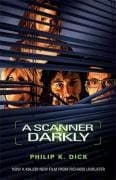
Synopsis
Covers the whole plot, including the ending.
- Difficulty
- Medium
- Pacing
- Moderate
- Mood
- Paranoid, Psychedelic, Despairing, Existential
- Read it if
- You enjoy psychological thrillers that delve into identity, paranoia, and the blurred lines between reality and illusion, with a strong science fiction bent.
- Skip it if
- You prefer straightforward narratives without ambiguity or find stories about drug addiction and mental deterioration too bleak or disturbing.
A Scanner Darkly Plot Summary
Covers the whole plot, including the ending.
The Scramble for Substance D
In a near-future Orange County, California, Bob Arctor lives in a run-down house with other drug users: Charles Freck, who is always confused, the paranoid Jerry Fabin, and Donna Hawthorne, who seems more functional. Arctor is secretly Agent Fred, an undercover narcotics officer tasked with infiltrating the Substance D trade. He is addicted to Substance D, a strong hallucinogen that causes brain damage, making his dual life harder. His agency, the Anaheim Police Department, uses 'scramble suits' to protect agents' identities during surveillance, which is necessary due to the drug's effects and the blurring lines between user and agent. His main target is Donna, whom he suspects of being a major distributor.
Jerry Fabin's Delusions
Jerry Fabin, one of Arctor's housemates, starts having severe delusions, believing his body is full of aphids. He carefully searches his skin and clothes, finding tiny specks he thinks are insects, even as Arctor tries to reason with him. This scene shows the advanced stages of Substance D addiction and its ability to distort perception and reality. Arctor, despite being an agent, feels empathy and frustration, seeing the irreversible damage to his friend, damage he himself is increasingly vulnerable to.
The Surveillance Paradox
Agent Fred, wearing his scramble suit, attends a briefing where he is assigned to surveil a major Substance D user named Bob Arctor. Fred does not know that Arctor is his own undercover identity. This creates a dangerous paradox: the agency is using him to spy on himself, a situation made possible by the scramble suit's anonymity and the compartmentalization of his brain due to Substance D. The surveillance footage shows Arctor's drug use and increasingly erratic behavior, which Fred observes with detached interest, failing to recognize himself on screen.
Breakdown and Rehabilitation
Arctor's brain damage from Substance D worsens quickly, causing cognitive impairment, memory loss, and severe disorientation. He can no longer function well as either a civilian or an agent. The agency, seeing his severe addiction and mental decline, decides to remove him from the field. He is forced into a New-Path rehabilitation facility, which is a labor camp for addicts. His identity as Agent Fred is completely removed, and he is now known only as 'Bruce,' a generic patient with no past.
Life at New-Path
'Bruce' (Arctor) lives a monotonous, dehumanizing existence in the New-Path facility. His days involve manual labor and constant surveillance by the staff. His memory is fragmented, and he struggles to recall details of his former life, including his true identity or mission. He observes other patients, also broken by Substance D, which reinforces the tragic effects of the drug. The facility's main purpose is not rehabilitation but to exploit addicts for their labor and keep them contained, away from the drug trade.
The Discovery of the Blue Flower
While doing forced labor in the fields around the New-Path facility, 'Bruce' (Arctor) finds a patch of strange, iridescent blue flowers. He vaguely remembers from his fragmented memories that these flowers are the source of Substance D. This discovery sparks a flicker of his former self, a faint memory of his mission as Agent Fred. He realizes the irony: he has been placed in a facility run by the organization that grows the drug's source, unknowingly providing the agency with crucial evidence.
Donna's Revelation
Donna Hawthorne is revealed to be an undercover agent working for the same agency as Fred. She arranged Arctor's placement in New-Path, knowing that his severe brain damage would make him harmless and allow him to infiltrate the facility without suspicion. Her goal was to use him, in his weakened state, to find the true source of Substance D, which she suspected was hidden within New-Path's operations. Arctor's discovery of the blue flowers confirms her suspicions, making him a pawn in a larger, more dangerous game.
The Final Act of Loyalty
Despite his severe cognitive impairment and nearly total loss of identity, 'Bruce' (Arctor) performs one last, crucial act as Agent Fred. He secretly picks one of the blue flowers and hides it, driven by an instinctive loyalty to his mission. He intends to give this flower to the authorities, knowing it is proof of the New-Path facility's involvement in the Substance D trade. This act represents a poignant, tragic victory for the broken agent, fulfilling his duty even in the depths of his mental decline.
The Agency's Complicity
The blue flower, given by the now completely incoherent 'Bruce' (Arctor) to his handlers, confirms the horrifying truth: the New-Path rehabilitation facilities, meant to cure addicts, are actually growing the blue flowers from which Substance D is made. This exposes a vast conspiracy where the organization fighting the drug trade is also its main supplier. The agency, in its pursuit of control and profit, has become the monster it swore to destroy, sacrificing its agents and the public.
A Scanner Darkly
The novel ends with the chilling realization of systemic corruption at the heart of anti-drug efforts. The title, 'A Scanner Darkly,' takes on its full, ominous meaning, referring to the distorted, morally compromised view through which the agency sees its mission and its agents. Fred's sacrifice and his final, heroic act of bringing the flower to light show the tragic irony of his mission: he exposed the source, but at the cost of his mind and identity, becoming another casualty in a war where the lines between good and evil, victim and perpetrator, have blurred.
Principal Figures
Bob Arctor / Agent Fred / Bruce
Protagonist
An undercover narcotics agent who becomes deeply addicted to the very drug he's fighting.
Bob Arctor is a man fractured by his dual existence. As Bob, he is a Substance D addict living in a squalid house with fellow users. As Agent Fred, he is a dedicated, if increasingly compromised, narcotics officer. He struggles with his conscience, his duty, and the relentless pull of addiction. His intelligence and observational skills are gradually eroded by Substance D, leading to a profound loss of self. He is driven by a sense of duty, even as his mind unravels, seeking to uncover the truth about the drug.
Relationships: Donna Hawthorne (Romantic interest, handler, eventual betrayer/savior); Charles Freck (Housemate, fellow addict, subject of surveillance); Jerry Fabin (Housemate, fellow addict, subject of surveillance)
Donna Hawthorne
Supporting / Undercover Agent
Arctor's enigmatic girlfriend and a key figure in the Substance D trade, with a hidden agenda.
Donna is initially presented as Arctor's girlfriend and a significant, though elusive, player in the drug scene. She appears more composed and intelligent than the other users, hinting at a deeper role. She maintains a detached, almost manipulative demeanor towards Arctor. Ultimately, she is revealed to be an undercover agent from a different, higher-level agency, using Arctor as a pawn to expose the true source of Substance D. Her motivations are complex, driven by a desire to dismantle the drug trade, even if it means sacrificing those around her.
Relationships: Bob Arctor (Romantic interest, fellow agent (unbeknownst to him), handler)
Charles Freck
Supporting
One of Arctor's housemates, known for his increasingly bizarre drug-induced delusions.
Charles Freck is a Substance D addict and one of Arctor's housemates. He is characterized by his escalating paranoia, confusion, and absurd drug-fueled ramblings. His experiences, such as the 'scramble bug' incident, highlight the profound and often darkly humorous psychological effects of Substance D. Freck serves as a tragicomic figure, embodying the drug's ability to warp perception and logic, and illustrating the slow, irreversible mental decay that Arctor himself is undergoing.
Relationships: Bob Arctor (Housemate, fellow addict, subject of surveillance)
Jerry Fabin
Supporting
Another of Arctor's housemates, plagued by vivid and disturbing hallucinations.
Jerry Fabin is a Substance D addict and housemate of Arctor, whose delusions are particularly vivid and disturbing. His conviction that his body is infested with aphids, and his desperate attempts to remove them, underscore the terrifying reality-bending power of the drug. Fabin's character serves to deepen the portrayal of Substance D's destructive effects, demonstrating the advanced stages of brain damage and the complete loss of touch with reality. He is a cautionary figure, reflecting Arctor's potential future.
Relationships: Bob Arctor (Housemate, fellow addict, subject of surveillance)
Mike
Supporting
A fellow narcotics agent and Arctor's superior, who operates behind the scramble suit.
Mike is an unseen but integral character, one of Arctor's superiors within the narcotics division. He communicates with Fred (Arctor in his scramble suit) and provides instructions and assignments. Like all agents in the department, he wears a scramble suit during briefings, maintaining total anonymity. Mike represents the bureaucratic, dehumanizing aspect of the agency, where individual identities are secondary to the mission, and even agents are kept in the dark about the full scope of operations. He is a faceless cog in the machine.
Relationships: Bob Arctor (Superior officer/subordinate)
Hank
Supporting
Another anonymous agent, part of Arctor's surveillance team.
Hank is another anonymous agent, part of the team that observes and analyzes the surveillance footage of Bob Arctor. Like Mike, he is only ever seen through the distorting lens of a scramble suit. Hank's role is primarily functional, contributing to the clinical, detached observation of Arctor's decline. He embodies the impersonal nature of the anti-drug effort, where agents are interchangeable and the human cost of the war on drugs is often overlooked or dismissed.
Relationships: Bob Arctor (Fellow agent/observer)
The New-Path Staff
Mentioned
The seemingly benevolent but ultimately complicit staff of the rehabilitation facility.
The staff members of the New-Path rehabilitation facility are portrayed as authoritarian figures who oversee the 'rehabilitation' of Substance D addicts. They maintain strict control over the patients, enforcing the monotonous routines and labor. They appear to be genuinely trying to help the addicts, but their true complicity in the drug trade is revealed later. They represent the hypocrisy and corruption embedded within the system, presenting a facade of care while actively participating in the production of the very drug they claim to combat.
Relationships: Bob Arctor (Overseers/patient)
Themes & Insights
The Nature of Identity
The novel explores the fragility of identity, especially under the influence of drugs and the demands of undercover work. Bob Arctor's struggle to maintain distinct identities as Bob, Fred, and later 'Bruce' shows how external roles and internal perception shape who we are. Substance D's brain-damaging effects physically erode Arctor's sense of self, causing memory loss and confusion, making him question which identity is real or if any part of him remains. The scramble suits further anonymize and dehumanize the agents, making them interchangeable parts of a system.
“What does a scanner see? Into the mind, down to the heart. Does it see that I am in the process of becoming a man? No. It sees that I am becoming a thing.”
The War on Drugs as a Self-Devouring System
Dick critiques the effectiveness and morality of the 'war on drugs,' showing it as a corrupt, self-perpetuating system that consumes its own agents and inadvertently makes the problem worse. The revelation that the New-Path facilities, meant for rehabilitation, are the source of Substance D exposes deep hypocrisy and systemic corruption. The agency's use of its agents as expendable assets, and the way it becomes indistinguishable from the criminals it hunts, suggests a grim cycle where the cure is worse than the disease.
“It was a war that had to be fought, but not by the people who were fighting it. Because they had become the thing they fought.”
Reality vs. Illusion
Substance D constantly blurs the lines between what is real and what is hallucination, for both the characters and the reader. The characters' drug-induced delusions, like Jerry Fabin's aphids or Freck's 'scramble bug,' are presented so vividly that they feel real within the story. Arctor's own perception becomes increasingly unreliable, making it difficult for him, and the reader, to tell truth from illusion. This theme is amplified by surveillance technology, which presents a mediated, often distorted, view of reality, questioning the nature of objective truth.
“Everything is true, everything is false. It’s all a matter of perspective.”
Loss and Sacrifice
The novel is full of a sense of loss and sacrifice. Arctor sacrifices his mind, his identity, and his sanity for a mission that turns out to be deeply compromised. His friends and housemates also lose their minds and lives to Substance D. The ending, while a form of victory, is tragic, as the truth is uncovered at a huge personal cost. This theme highlights the human toll of addiction and the often-futile sacrifices made for justice within a corrupt system.
“He had won, but what had he won? His mind, his life, his identity: all gone.”
Plot Devices & Literary Techniques
The Scramble Suit
A technological garment that constantly shifts the wearer's appearance, obscuring identity.
The scramble suit is a key piece of technology used by narcotics agents. It features a constantly changing, randomized collage of features, making the wearer utterly anonymous and impossible to identify. This device is crucial for maintaining the secrecy of undercover operations, but it also serves a deeper symbolic purpose. It represents the dehumanization and loss of identity inherent in the drug war, blurring the lines between agents and the anonymous masses they observe. It also enables the central paradox of Arctor surveilling himself, as the suit ensures his identity as Fred is completely separate from his identity as Arctor.
Substance D (Death)
A highly addictive, brain-damaging hallucinogen that drives the plot and characters.
Substance D is the central MacGuffin and antagonist of the story. It is a potent, irreversible neurotoxin that causes progressive brain damage, leading to psychosis, delusions, and eventually complete cognitive impairment. The drug's effects are meticulously detailed, from the initial euphoric 'scramble' to the debilitating 'brain rot.' It drives Arctor's addiction, motivates his mission, and ultimately defines the tragic fate of most characters. The discovery of its natural source, the blue flower, is the ultimate goal of the narrative, revealing the systemic corruption behind its proliferation.
Unreliable Narrator
The story is primarily told through the perspective of a character whose perception is compromised by drug use.
The narrative perspective often shifts between Arctor's internal thoughts and objective observations, but Arctor's increasing addiction to Substance D renders him an unreliable narrator. His memory is fragmented, his perceptions are distorted by hallucinations, and his understanding of events is often confused. This device immerses the reader in Arctor's deteriorating mental state, creating a sense of paranoia and uncertainty. It forces the reader to question what is real and what is a drug-induced delusion, mirroring Arctor's own struggle to discern truth from illusion.
Irony
The use of situational and dramatic irony to highlight the absurd and tragic aspects of the plot.
Irony is a pervasive plot device in 'A Scanner Darkly.' The most prominent example is the dramatic irony of Agent Fred being assigned to surveil Bob Arctor, unaware that they are the same person. This highlights the dehumanizing and compartmentalized nature of the agency. Situational irony is also evident in the revelation that the New-Path rehabilitation facilities, meant to cure addiction, are actually the source of Substance D. This deepens the critique of the war on drugs, portraying it as a system that paradoxically creates and perpetuates the problem it claims to solve, with tragic consequences for its participants.
A Scanner Darkly Quotes
“What does a scanner see? Into the mind, down to the soul, out to the stars. It sees all, and it sees nothing.”
“Everything in our lives, from the cars we drive to the food we eat, is being monitored, recorded, and analyzed. We are all living in a giant fishbowl.”
“The thing about being a narc is that you become a part of the problem. You're not just observing it, you're living it.”
“There are some things you can't come back from. Some places you can't leave.”
“When you don't know who you are, you can be anyone. But when you don't know who you are, you can also be no one.”
“The future is not a place we are going, but a place we are creating. And every choice we make, every action we take, is a part of that creation.”
“It's not paranoia if they really are after you.”
“Substance D. It's not just a drug, it's a way of life. A slow, agonizing way of death.”
“He knew that he was a man divided, a house split against itself. And he knew that sooner or later, one side would have to consume the other.”
“We're all just trying to get by, aren't we? In this fucked-up world, we do what we have to do.”
“The ultimate test of a man's conscience may be his willingness to make a sacrifice for those who cannot do so for themselves.”
“There was no 'outside.' There was only 'inside.' And inside was where the world was.”
“A scanner darkly. It means that you can see through people, but not clearly. You see the darkness, the flaws, the secrets, but never the full picture.”
“The past is a foreign country; they do things differently there. But the future... the future is just a black hole.”
Quiz
10 questions on the plot and the characters. Each answer comes with a short explanation.
Question 1
What is the primary effect of Substance D on the human brain?
- It enhances cognitive function and memory.
- It strengthens the links between the brain's two hemispheres.
- It destroys the links between the brain's two hemispheres.
- It temporarily paralyzes the motor cortex.
Show answer
C. It destroys the links between the brain's two hemispheres. The book explicitly states that Substance D 'destroys the links between the brain's two hemispheres,' leading to disorientation and irreversible brain damage.
Question 2
What is Bob Arctor's true identity and profession?
- He is a drug dealer trying to go straight.
- He is an undercover narcotics agent.
- He is a scientist researching Substance D.
- He is a recreational user caught in the system.
Show answer
B. He is an undercover narcotics agent. The synopsis clearly states that Bob Arctor is 'an undercover narcotics agent' working to discover the source of Substance D.
Question 3
Where is the story of 'A Scanner Darkly' primarily set?
- New York City
- San Francisco
- Los Angeles
- Seattle
Show answer
C. Los Angeles The synopsis mentions Substance D being 'on to the streets of LA,' indicating Los Angeles as the primary setting.
Question 4
What is the key paradox of Arctor's mission that leads to his addiction?
- He has to manufacture Substance D to understand its effects.
- He must pose as a user to find leads, inevitably becoming addicted.
- He needs to betray his friends to gain the trust of drug lords.
- He is forced to work for the very organization he is investigating.
Show answer
B. He must pose as a user to find leads, inevitably becoming addicted. The synopsis highlights the core conflict: 'to find any kind of lead he has to pose as a user and, inevitably, without realising what is happening, Arctor is soon as addicted as the junkies he works among.'
Question 5
What is the ultimate goal of Bob Arctor's undercover operation?
- To rehabilitate drug users in the community.
- To become a high-ranking drug lord himself.
- To discover the ultimate source of Substance D supply.
- To expose corruption within the narcotics department.
Show answer
C. To discover the ultimate source of Substance D supply. The synopsis explicitly states Arctor 'is desperate to discover the ultimate source of supply' for Substance D.
Question 6
What is the significance of the name 'Death' for Substance D?
- It's a marketing gimmick used by drug dealers.
- It indicates the drug's fatal consequences and irreversible brain damage.
- It refers to the drug's origin from a deadly plant.
- It's a code name used by the undercover agents.
Show answer
B. It indicates the drug's fatal consequences and irreversible brain damage. The text states, 'Substance D is not known as Death for nothing,' immediately followed by the description of its toxic effects leading to 'complete and irreversible brain damage,' implying its fatal nature.
Question 7
Which of the following best describes the genre blend of 'A Scanner Darkly' based on the provided text?
- Romantic Comedy, Drama, Historical Fiction
- Fantasy, Adventure, Young Adult
- Thriller, Mystery, Science Fiction
- Biographical, Self-Help, Philosophy
Show answer
C. Thriller, Mystery, Science Fiction The provided information explicitly lists the genres as 'Thriller, Mystery, Science Fiction'.
Question 8
The description implies a central theme of 'A Scanner Darkly' is the degradation of identity. How does Arctor's situation specifically exemplify this?
- His addiction makes him indistinguishable from the very people he is supposed to be investigating, blurring his professional and personal self.
- He is forced to adopt multiple aliases, causing him to forget his real name.
- The futuristic technology he uses alters his physical appearance permanently.
- His colleagues refuse to acknowledge his true identity due to his undercover role.
Show answer
A. His addiction makes him indistinguishable from the very people he is supposed to be investigating, blurring his professional and personal self. The text highlights that Arctor 'is soon as addicted as the junkies he works among,' directly tying his professional duty to his personal downfall and the loss of his distinct identity as an agent.
Question 9
What is the long-term prognosis for someone addicted to Substance D, as described in the text?
- Temporary disorientation followed by full recovery.
- Enhanced mental capabilities but physical deterioration.
- Complete and irreversible brain damage.
- Minor memory loss that can be reversed with therapy.
Show answer
C. Complete and irreversible brain damage. The text explicitly states Substance D causes 'first, disorientation and then complete and irreversible brain damage,' indicating a grim and permanent prognosis.
Question 10
Based on the provided text, what psychological conflict is central to Bob Arctor's character arc?
- The struggle between his desire for power and his moral compass.
- The internal battle against his own addiction while trying to maintain his professional duty and identity.
- His quest for love in a dystopian society.
- The conflict between loyalty to his family and his commitment to his job.
Show answer
B. The internal battle against his own addiction while trying to maintain his professional duty and identity. The synopsis details his dual role as an agent and user, stating 'Arctor is soon as addicted as the junkies he works among,' highlighting the core psychological conflict of battling his own addiction while trying to fulfill his mission.
A Scanner Darkly FAQ
What is the central premise of 'A Scanner Darkly'?
'A Scanner Darkly' centers on Bob Arctor, an undercover narcotics agent in a dystopian near-future Southern California, who becomes addicted to Substance D, the very drug he's tasked with eradicating. The novel explores the blurred lines between his identity as an agent, Fred, and his persona as a drug user, Arctor, as his mind deteriorates. This premise highlights the destructive nature of the drug and the moral compromises inherent in his mission.
Who is Fred, and how does he relate to Bob Arctor?
Fred is Bob Arctor's identity within the police force, an undercover narcotics agent. He uses a 'scramble suit' to disguise his appearance and voice during surveillance and briefings, allowing him to observe drug users, including his alter ego, Bob Arctor, without revealing his true identity. This duality creates a profound psychological split, as Fred is tasked with investigating Arctor, who is, in fact, himself.
What is Substance D, and what are its effects?
Substance D, also known as 'Death,' is a highly potent and destructive recreational drug. It progressively severs the neural connections between the brain's two hemispheres, leading to severe disorientation, cognitive impairment, and ultimately, irreversible brain damage and death. The drug is depicted as highly addictive and physically devastating, embodying the novel's themes of self-destruction and societal decay.
Who are Charles Freck and Ernie Luckman, and what role do they play?
Charles Freck and Ernie Luckman are members of Bob Arctor's drug-using circle, and they represent the typical, often pathetic, lives of Substance D addicts. Freck, in particular, has a memorable scene attempting to commit suicide but failing due to the drug's effects and his own incompetence. They provide a backdrop of the drug culture and highlight the pervasive nature of addiction in their society.
What is a 'scramble suit,' and why is it crucial to the plot?
A 'scramble suit' is an advanced technological device worn by police officers like Fred. It constantly shifts and projects millions of different faces and voices, making the wearer's identity impossible to discern. This technology is crucial because it allows Fred to maintain his anonymity while observing Arctor and his associates, but it also physically embodies the theme of fragmented identity and the dehumanizing nature of surveillance.
What is the significance of the 'New-Path' rehabilitation facility?
New-Path is a supposedly benevolent rehabilitation center for Substance D addicts, presented as a last resort for those suffering from severe brain damage. It becomes significant when Arctor, after his severe cognitive decline, is sent there. The twist reveals New-Path's true, sinister purpose: it is the hidden source of the raw materials for Substance D, using the addicts themselves as unwitting labor. This exposes the ultimate cynical exploitation at the heart of the drug trade.
How does Donna Hawthorne fit into the overall conspiracy?
Donna Hawthorne initially appears as Arctor's girlfriend and a fellow drug user, but she is later revealed to be an undercover agent herself, working for the same organization as Fred. She is the one who ultimately orchestrates Arctor's admission to New-Path, knowing his brain damage will render him harmless. Her role is crucial in uncovering the New-Path conspiracy from the inside, albeit at a great personal cost to Arctor.
What is the 'plant' that Arctor discovers at New-Path, and what does it represent?
At New-Path, the severely brain-damaged Arctor, now known as 'Bruce,' is tasked with picking a specific, small blue flower that he instinctively recognizes. This flower is the 'Mors Amatoria,' the raw material from which Substance D is synthesized. His discovery, despite his impaired state, represents a final, tragic act of agency and a profound, albeit silent, triumph in exposing the source of the drug, fulfilling his original mission.
How does Bob Arctor's identity crisis manifest psychologically?
Arctor's identity crisis manifests as a profound psychological disintegration, driven by his dual roles as addict and agent, exacerbated by Substance D. He experiences increasing paranoia, memory lapses, and a blurring of his 'Fred' and 'Arctor' personas, to the point where he is observing himself with no self-recognition. This reflects the novel's exploration of fragmented self and the loss of personal coherence under extreme duress.
Discuss the psychological impact of the scramble suit on Fred/Arctor.
The scramble suit, while offering anonymity, psychologically isolates Fred/Arctor by denying him a stable visual identity. It forces him to become an anonymous observer, reflecting his internal fragmentation. The suit physically embodies his split personality, contributing to his detachment from himself and others, and accelerating his descent into confusion as his brain deteriorates and he can no longer reconcile his multiple selves.
How does the novel explore themes of paranoia and surveillance?
'A Scanner Darkly' deeply explores paranoia through Arctor's constant fear of being watched, which is ironically justified by his own surveillance activities as Fred. The omnipresent surveillance technology, like the scramble suit and scanner, creates an atmosphere where trust is impossible and privacy is nonexistent. This reflects a society where individuals are constantly under scrutiny, blurring the lines between protector and oppressor.
What is the significance of Arctor's final, severely brain-damaged state?
Arctor's final state, reduced to a vegetable-like existence at New-Path, is deeply significant. It represents the ultimate sacrifice and tragic consequence of his mission, but also a strange, almost divine, retribution for the drug trade. Despite his profound impairment, his final act of picking the Mors Amatoria flower demonstrates a residual, unconscious drive to complete his original objective, making his sacrifice both devastating and redemptive.
Is the ending of 'A Scanner Darkly' ultimately hopeful or despairing?
The ending is largely despairing, as Arctor is left with irreversible brain damage, a victim of the very system he tried to infiltrate. However, there's a flicker of tragic hope in his final act of retrieving the Mors Amatoria, implying that his sacrifice was not entirely in vain and that the truth about New-Path might eventually be exposed. It's a bleak victory, achieved at the cost of his entire self.
How does the novel serve as a critique of the War on Drugs?
The novel serves as a scathing critique of the War on Drugs by depicting its futility and the moral compromises it demands. It shows how agents like Arctor become indistinguishable from the addicts they pursue, highlighting the corrupting influence of the conflict itself. The revelation that the rehabilitation centers are the source of the drug exposes the hypocrisy and self-perpetuating nature of the 'war,' suggesting it's more about control and profit than genuine eradication.
What is the philosophical message regarding identity in the novel?
The novel suggests that identity is fluid, fragile, and easily fragmented, especially under the influence of drugs and oppressive systems. Arctor's complete loss of self, split between Fred and Arctor, and eventually reduced to 'Bruce,' illustrates how external pressures and internal choices can erode one's core being. It questions the very nature of self and what remains when memory, coherence, and recognition are stripped away.
How does the novel's autobiographical element affect its interpretation?
Philip K. Dick's own struggles with drug addiction and his experiences living in a communal house with drug users heavily influenced the novel. This autobiographical element lends a raw, authentic, and deeply personal quality to the depiction of addiction and paranoia, making the psychological disintegration of Arctor feel particularly visceral and tragic. It transforms the narrative from pure fiction into a cautionary tale imbued with real-life pain and observation.
What is the symbolic meaning of the 'scanner darkly' title?
The title 'A Scanner Darkly' is a biblical allusion to 1 Corinthians 13:12: 'For now we see through a glass, darkly; but then face to face.' It symbolizes the distorted, incomplete, and obscured perception characters have of reality and each other, particularly through the lens of surveillance technology and drug-induced states. It reflects the novel's themes of obscured truth, fragmented identity, and the inability to truly know oneself or others.
About the author

Philip Kindred Dick, often referred to by his initials PKD, was an American science fiction writer. He wrote 44 novels and about 121 short stories, most of which appeared in science fiction magazines during his lifetime. His fiction explored varied philosophical and social questions such as the nature of reality, perception, human nature, and identity, and commonly featured characters struggling against elements such as alternate realities, illusory environments, monopolistic corporations, drug abuse, authoritarian governments, and altered states of consciousness.
Similar books
- The Manchurian Candidate
Richard Condon
4.1 (23k) average on GoodreadsPoliticsDeals with themes of brainwashing, hidden agendas, and compromised identities within a thriller framework.
- Neuromancer
William Gibson
3.9 (262k) average on GoodreadsFantasyA Scanner Darkly and Neuromancer both explore themes of surveillance and technology, but from different angles. Dick's novel is grounded in the analog paranoia of the 1970s, focusing on physical surveillance and the internal breakdown caused by drugs. Gibson's Neuromancer, a cornerstone of cyberpunk published a decade later, is deeply immersed in the digital realm, exploring artificial intelligence, virtual reality, and corporate espionage. While both question the nature of reality and identity in technologically advanced societies, Dick's concern is primarily with the human mind under duress, whereas Gibson's is with the human-technology interface and the emergent properties of cyberspace.
- Angels & Demons
Dan Brown
3.9 (2.7M) average on GoodreadsThrillerA Harvard symbologist races through Rome's ancient sites, deciphering cryptic clues to unmask the Illuminati and stop a vengeful plot to destroy the Vatican with a stolen antimatter weapon.
- Gone Girl
Gillian Flynn
4.1 (2.3M) average on GoodreadsThrillerA wife's sudden disappearance on her fifth anniversary reveals a web of lies and psychological warfare, exposing the secrets within a seemingly perfect marriage.
- The Girl on the Train
Paula Hawkins
3.9 (2.1M) average on GoodreadsThrillerA woman’s fascination with a seemingly perfect couple she watches from her daily train commute leads her into a dark investigation when she witnesses something that shatters their idyllic image.
- The Da Vinci Code
Dan Brown
3.9 (1.9M) average on GoodreadsThrillerA symbologist and a cryptologist race through European landmarks, deciphering ancient codes and uncovering a conspiracy that could rewrite the foundations of Christianity.




Enjoyed the summary?
A summary gives you the shape of the book. The book itself has the detail, the examples and the voice.
Find A Scanner Darkly on AmazonAs an Amazon Associate, BookBrief earns from qualifying purchases. How we're funded