
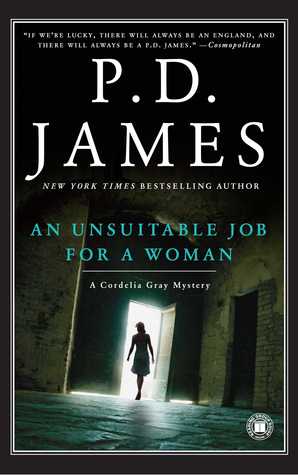
Synopsis
Covers the whole plot, including the ending.
- Difficulty
- Medium
- Pacing
- Moderate
- Mood
- Atmospheric, Melancholy, Introspective, Suspenseful
- Read it if
- You enjoy classic British detective novels with a strong sense of place, psychological depth, and a methodical, character-driven investigation.
- Skip it if
- You prefer fast-paced thrillers with constant action or clear-cut moral resolutions.
An Unsuitable Job for a Woman Plot Summary
Covers the whole plot, including the ending.
The Call from Sir Ronald
Cordelia Gray, a young private investigator, recently inherited 'Pryde's Detective Agency' after her partner, Bernie Pryde, died by suicide. While still dealing with Bernie's death and trying to manage the struggling business, she receives a call from Sir Ronald Callender. Sir Ronald, a wealthy man, hires her to investigate the apparent suicide of his son, Mark Callender. Mark, a handsome Cambridge dropout, was found dead in a small cottage in Monksmere, hanged by his own belt. Sir Ronald, though seemingly accepting the suicide verdict, suspects something else and wants Cordelia to confirm the truth for his peace of mind, specifically asking her to find out 'why' Mark died.
Arrival in Monksmere
Cordelia travels to Monksmere, a quiet, isolated village, and enters the cottage where Mark died. The cottage, owned by Mrs. Leaming, is sparsely furnished and feels sad. Cordelia carefully examines the room, noting the details of the hanging, the chair's position, and the general state of the place. She finds no clear signs of struggle or forced entry, which supports the police's suicide conclusion. However, she notices a faint trace of lipstick on Mark's mouth, a detail the police seemed to miss. This small detail makes her curious and subtly changes her view, suggesting there might be more to Mark's death.
Meeting the Witnesses
Cordelia begins interviewing people who knew Mark in Monksmere. She first speaks with Mrs. Leaming, the cottage owner, a direct and talkative woman who shares details about Mark's private nature and his short, recent stay. Mrs. Leaming mentions that Mark had been acting strangely and had a female visitor just before his death, though she couldn't identify her. Cordelia also speaks with other villagers, including the local shopkeeper and postmistress, gathering impressions of Mark as a mysterious, somewhat distant young man. Most people thought he was a loner, but the mention of a female visitor suggests a hidden personal life.
The Cambridge Connection
To understand Mark's background, Cordelia travels to Cambridge. She visits his old college, where she speaks with professors and former classmates. She learns that Mark was bright but also troubled, known for his unusual views and a dislike for authority. He had a reputation for being charming but manipulative, and for having complex relationships with women. She also discovers he had a close friendship with a fellow student, Hugh Gaveston, and that he was involved in a protest or scandal that led to him leaving college. The Cambridge interviews show a more complex and unstable Mark than the villagers had described.
The Gaveston Family
Cordelia seeks out Hugh Gaveston, Mark's closest friend from Cambridge. She visits the Gaveston family home, a large, somewhat rundown house, and meets Hugh, his sister Sarah, and their mother. Hugh is initially reserved but eventually talks about his intense friendship with Mark and how much Mark's death affected him. Sarah is more quiet, but Cordelia senses a deeper connection between Sarah and Mark than Sarah first admits. The family dynamic is tense, burdened by a past tragedy: the suicide of Hugh and Sarah's younger sister, Elizabeth, years ago. This revelation links Mark to another suicide, making Cordelia more suspicious.
Unraveling Elizabeth's Death
Cordelia looks into the details of Elizabeth Gaveston's death. She learns that Elizabeth, a sensitive and fragile girl, was infatuated with Mark. Elizabeth's suicide, by drowning, was officially ruled accidental or due to depression, but the Gaveston family always had doubts. Cordelia begins to suspect a connection between Mark's death and Elizabeth's, possibly hinting at Mark's role in Elizabeth's despair. The similarities in the situations — young, troubled people, official suicide verdicts, and lingering questions — are too strong for Cordelia to ignore, suggesting a pattern rather than isolated events.
The Truth About the Lipstick
Through careful observation, Cordelia identifies the faint lipstick trace on Mark's mouth. She realizes it belongs to Sarah Gaveston. Cordelia confronts Sarah, who then tells the truth: Sarah had visited Mark at the cottage shortly before he died. Sarah confesses that Mark had told her about his guilt over Elizabeth's suicide, admitting he had encouraged Elizabeth's affections and then cruelly rejected her, which contributed to her despair. The lipstick was from a goodbye kiss, a moment of shared grief and a desperate plea for understanding. This confession finally provides a reason for Mark's own death — overwhelming guilt.
The Confession and the Cover-up
As Cordelia pieces together the events, she realizes that Mark's death was not a suicide. The evidence, especially the chair's position and the hanging's nature, points to murder. She confronts Hugh Gaveston, who finally confesses. Hugh, consumed by grief and a desire for revenge for Elizabeth's death, had confronted Mark in the cottage. During their heated argument, Hugh, seeing Mark's genuine remorse, initially planned to let him live. However, his intense hatred and the memory of Elizabeth's suffering overwhelmed him, and he killed Mark, staging it to look like a suicide. He then called Sarah to the cottage to help him arrange the scene, including placing the lipstick to create suspicion or to involve her. Sarah, out of misguided loyalty and fear, complied.
Moral Dilemma and Decision
Cordelia faces a difficult moral choice. She has uncovered the truth: Mark Callender was murdered by Hugh Gaveston, with Sarah's help, as revenge for Elizabeth's suicide. If she reveals this, the Gaveston family will be destroyed. Sir Ronald Callender, though wanting the truth, also bears some responsibility for his son's actions and his own emotional distance. Cordelia considers the impact on everyone involved, weighing the demands of justice against the consequences of exposing a family already hurt by tragedy. She feels growing empathy for Hugh and Sarah, understanding their deep pain and their misguided attempt at justice.
The Unsuitable Verdict
Ultimately, Cordelia makes a decision that goes against the usual rules of a private investigator. She chooses not to reveal the full truth of Mark's murder. Instead, she gives Sir Ronald Callender a report that confirms Mark's death was a suicide, but adds that Mark felt deep guilt over his role in Elizabeth Gaveston's death. She explains that Mark's suicide was a form of self-punishment, driven by his conscience. While technically a lie, it gives Sir Ronald a believable explanation for his son's actions and offers some closure, without destroying the Gaveston family. Cordelia understands that sometimes, the truth is too harsh, and a changed version can serve a more compassionate purpose, marking her as an 'unsuitable' detective by traditional standards.
Principal Figures
Cordelia Gray
Protagonist
A young, inexperienced private investigator inheriting a struggling agency
Cordelia is in her early twenties, intelligent, observant, and deeply ethical. She is still grieving the suicide of her mentor and partner, Bernie Pryde, which has left her with a sense of vulnerability and a fierce determination to prove herself. Despite her inexperience, she possesses a sharp intuition and a strong moral compass. She is often underestimated due to her youth and gender, but she approaches her work with meticulousness and empathy, striving to understand the human motivations behind the crimes she investigates. She is driven by a desire for truth, but also by a deep compassion for the complexities of human suffering.
Relationships: Bernie Pryde (Deceased mentor and business partner, his suicide deeply impacts her); Sir Ronald Callender (Client, Mark's father, who hires her to investigate); Mark Callender (The deceased subject of her investigation, his story unfolds through her work)
Mark Callender
Central Figure (Deceased)
A brilliant but troubled Cambridge dropout whose death sparks the investigation
Mark is portrayed as a charismatic, intelligent, and deeply complex young man. He was a Cambridge dropout, known for his charm, intellectual arrogance, and a capacity for cruelty, particularly in his relationships. He had a profound impact on those around him, inspiring both admiration and resentment. His death is initially ruled a suicide, but Cordelia uncovers his hidden guilt over his past actions, particularly his treatment of Elizabeth Gaveston. He is the catalyst for the entire plot, and his character is revealed posthumously through the memories and perspectives of others, painting a picture of a man haunted by his own conscience.
Relationships: Sir Ronald Callender (His wealthy, emotionally distant father); Hugh Gaveston (His close friend and eventual killer); Sarah Gaveston (His confidante and brief romantic interest); Elizabeth Gaveston (A young woman he scorned, leading to her suicide)
Sir Ronald Callender
Supporting
Mark's wealthy and influential father, who hires Cordelia
Sir Ronald is a powerful and somewhat detached figure, accustomed to getting his way. He hires Cordelia not because he necessarily disbelieves the suicide verdict, but because he needs an explanation, a 'why,' for his son's death. He embodies a certain upper-class reserve, struggling to express his emotions, particularly his grief and confusion over Mark. His relationship with Mark was distant and strained, and he carries a quiet burden of regret. He represents the client's perspective, seeking closure and understanding, but ultimately accepting Cordelia's edited version of the truth.
Relationships: Mark Callender (His deceased son); Cordelia Gray (His hired private investigator)
Hugh Gaveston
Antagonist
Mark's close friend and eventual murderer, seeking revenge for his sister
Hugh is a complex and tormented character, driven by an intense love for his younger sister, Elizabeth, and a consuming hatred for Mark Callender, whom he holds responsible for her death. He is initially guarded and appears emotionally fragile, but beneath the surface lies a deep-seated anger and a capacity for violence. His actions are motivated by grief and a distorted sense of justice, leading him to take Mark's life. He represents the destructive power of unresolved grief and the blurred lines between justice and revenge. He is intelligent and articulate, but ultimately consumed by his past.
Relationships: Mark Callender (His close friend at Cambridge, later his victim); Elizabeth Gaveston (His beloved younger sister); Sarah Gaveston (His sister and accomplice)
Sarah Gaveston
Supporting
Hugh's sister and Mark's confidante, complicit in the cover-up
Sarah is a sensitive and somewhat withdrawn young woman, deeply affected by the suicides of both her sister Elizabeth and Mark. She had a complex relationship with Mark, oscillating between affection and resentment, and was aware of his manipulative tendencies. She is fiercely loyal to her family, particularly Hugh, and her actions are often driven by a desire to protect him. Her complicity in the cover-up of Mark's murder stems from a mix of fear, misguided loyalty, and a shared desire for retribution. She is a victim of circumstances, caught between her love for Mark and her loyalty to her brother.
Relationships: Hugh Gaveston (Her brother and accomplice); Elizabeth Gaveston (Her deceased younger sister); Mark Callender (Her friend and brief romantic interest)
Elizabeth Gaveston
Mentioned (Deceased)
Hugh and Sarah's younger sister, whose suicide is key to the mystery
Elizabeth is a crucial character despite being deceased before the story begins. She is portrayed as a fragile, sensitive, and somewhat naive young woman who became infatuated with Mark Callender. Her suicide, years before the main events, casts a long shadow over the Gaveston family and serves as the primary motive for Mark's murder. Her story is pieced together through the memories and guilt of others, highlighting Mark's capacity for emotional manipulation and the devastating impact of his actions. She represents innocence lost and the lasting pain of unaddressed grief.
Relationships: Hugh Gaveston (Her protective older brother); Sarah Gaveston (Her older sister); Mark Callender (The object of her affection, who ultimately scorned her)
Mrs. Leaming
Supporting
The gossipy and observant owner of the cottage where Mark died
Mrs. Leaming is a practical, somewhat nosy woman who owns the cottage where Mark Callender was found dead. She provides Cordelia with initial observations and local gossip about Mark's brief stay in Monksmere, including the detail about his female visitor. She represents the local community's perspective, offering fragmented pieces of information that Cordelia must sift through. While not directly involved in the central mystery, her observations are crucial in guiding Cordelia's investigation and raising initial questions about the official suicide verdict.
Relationships: Mark Callender (Her deceased tenant); Cordelia Gray (The investigator she provides information to)
Bernie Pryde
Mentioned (Deceased)
Cordelia's deceased mentor and former partner, whose suicide profoundly impacts her
Bernie Pryde is Cordelia's former partner and mentor, whose suicide shortly before the start of the novel leaves Cordelia to inherit Pryde's Detective Agency. His death is a constant presence in Cordelia's thoughts, shaping her understanding of suicide and loss. He taught her the trade and instilled in her a sense of professional ethics, though Cordelia ultimately deviates from his strict adherence to 'truth at all costs.' Bernie's own troubled past and his eventual suicide serve as a poignant backdrop to Cordelia's investigation into Mark Callender's death, influencing her empathy and her final decision.
Relationships: Cordelia Gray (His protégé and inheritor of his agency)
Themes & Insights
The Nature of Truth and Justice
The novel looks at the subjective nature of truth and whether absolute justice is always the kindest outcome. Cordelia faces a moral choice: reveal the full, harsh truth of Mark's murder and destroy a family already hurt by grief, or provide a partial, compassionate truth that offers closure without causing more damage. Her decision to present a modified version of events, saying Mark's death was a suicide driven by guilt, challenges the idea that a private investigator's only duty is to uncover all facts. This theme is central to Cordelia's character and the novel's 'unsuitable' title, suggesting that sometimes, compassion matters more than strict adherence to facts.
“'Truth,' he had once said, 'is a beautiful and terrible thing, and therefore has to be treated with great caution.”
Grief, Guilt, and Revenge
These strong feelings drive much of the novel's plot. Mark Callender's death is revealed to be an act of revenge by Hugh Gaveston, fueled by his grief for his sister Elizabeth and his own guilt for not protecting her. Mark himself feels deep guilt over how he treated Elizabeth, which leads to his own decline. Cordelia, still grieving Bernie's suicide, understands these emotional currents, allowing her to empathize with the characters and understand their reasons. The story shows how unchecked grief can become destructive revenge, and how guilt can be a heavy, unavoidable burden.
“He had loved his sister. He had killed Mark Callender. It was as simple and as terrible as that.”
The Burden of the Past
The past greatly affects the present in the novel. Elizabeth Gaveston's suicide, years before the main events, starts Mark's death and the entire investigation. Mark's past actions and manipulative nature at Cambridge directly cause his guilt and Hugh's desire for revenge. Cordelia herself is affected by her partner Bernie's suicide, which shapes her perspective and ethical choices. The story constantly looks back, showing how past events, unresolved emotions, and unaddressed complaints continue to influence the characters' lives, dictating their choices and fates.
“The past, she reflected, was like a long, dark corridor with no doors, only echoes.”
Femininity and Professionalism
Cordelia's gender and youth are shown as both a disadvantage and a unique strength in her job. Male characters often underestimate her and question her suitability as a young female private investigator. However, her empathetic approach, sharp observation skills, and ability to connect with people emotionally prove very valuable. Her 'unsuitable' nature allows her to see beyond the rigid rules of conventional detective work, leading her to a resolution that values compassion over strict legal justice. This theme challenges traditional gender roles in a male-dominated profession.
“An unsuitable job for a woman. Bernie's words, her challenge.”
Plot Devices & Literary Techniques
Red Herring (Lipstick Trace)
A subtle detail that initially misdirects the investigation
The faint trace of lipstick on Mark Callender's mouth is a key red herring. It initially suggests a romantic involvement or a secret liaison, leading Cordelia to consider motives related to love or betrayal. This detail, initially overlooked by the police, is crucial in convincing Cordelia that Mark's death might not be a straightforward suicide. However, the true meaning of the lipstick is later revealed to be a symbol of shared grief and a deliberate planting by Hugh and Sarah to complicate the scene, rather than a clue to a romantic entanglement. It serves to deepen the mystery and highlight Cordelia's superior observational skills.
The Unreliable Narrator (of events)
Characters' accounts of past events are often incomplete or biased
The novel largely relies on Cordelia piecing together events from the often partial, biased, or deliberately misleading accounts of other characters. Hugh and Sarah Gaveston, in particular, withhold crucial information or present a distorted version of the truth regarding Mark's death and Elizabeth's suicide. Even Sir Ronald Callender's initial request is driven by an incomplete understanding of his son. This device forces Cordelia, and the reader, to constantly question what is being told and to look for deeper, unspoken truths, emphasizing the subjective nature of memory and testimony in solving a mystery.
Symbolism of Suicide
Suicide as a recurring motif, representing different forms of despair and guilt
Suicide is a powerful and recurring symbol throughout the novel. Bernie Pryde's suicide casts a shadow over Cordelia's life and her agency, while Elizabeth Gaveston's suicide is the catalyst for the entire revenge plot. Mark Callender's death is initially presented as a suicide, and Cordelia ultimately frames it as such, albeit a guilt-driven one. Each instance of suicide, or perceived suicide, represents different facets of human despair, guilt, and the profound impact of individual actions on others. It underscores the novel's exploration of mental anguish and the moral complexities surrounding death.
The Isolated Setting (Monksmere Cottage)
A remote location that intensifies the sense of mystery and confinement
The cottage in Monksmere, where Mark Callender dies, serves as an isolated and somewhat claustrophobic setting. Its remoteness from the bustling world of Cambridge and London creates an insular atmosphere, where secrets can be kept and where the emotional drama of the Gaveston family can play out without immediate external scrutiny. This isolation intensifies the mystery, making it harder for Cordelia to gather information and emphasizing the internal struggles of the characters. It underscores the idea that the truth is hidden, not just by people, but by the very environment itself.
An Unsuitable Job for a Woman Quotes
“The dead can't speak, but they can tell tales. It's the living who decide which ones to listen to.”
“Even the most respectable people have their secrets, and sometimes it's the secrets that kill them.”
“It was a job that required a certain detachment, a willingness to look at the worst of human nature without flinching.”
“There was a particular kind of loneliness in being the one who knew too much, who saw too clearly.”
“The truth, like murder, will out. But sometimes it needs a little help.”
“People are rarely what they seem, and motives are even less so.”
“An unsuitable job for a woman, they'd said. But what job was truly suitable for anyone?”
“Grief is a strange thing. It can make you do things you never thought yourself capable of.”
“The past is never truly dead. It just lies waiting, ready to spring out when you least expect it.”
“Justice wasn't always about punishment; sometimes it was about understanding.”
“It was not enough to know who did it; one had to understand why.”
“The dead, in their silence, could be more eloquent than the living.”
“Every family has its own particular brand of madness.”
“She had chosen a life where the truth was often ugly, but at least it was real.”
Quiz
10 questions on the plot and the characters. Each answer comes with a short explanation.
Question 1
What is the official verdict regarding Mark Callender's death before Cordelia Gray is hired?
- Accidental death
- Homicide
- Suicide
- Death by natural causes
Show answer
C. Suicide The wealthy father hires Cordelia because he doesn't believe the official verdict of suicide, which is what the authorities concluded.
Question 2
What unusual detail is found on Mark Callender's mouth when his body is discovered?
- A bite mark
- A faint trace of lipstick
- A small cut
- A burn mark
Show answer
B. A faint trace of lipstick The description of Mark's body specifically mentions 'a faint trace of lipstick on his mouth,' which is a key detail that raises initial suspicions.
Question 3
Who initially hires Cordelia Gray to investigate Mark Callender's death?
- Mark's mother
- Mark's wealthy father
- A concerned friend of Mark's
- The local police department
Show answer
B. Mark's wealthy father The synopsis states that Mark's 'wealthy father hires fledgling private investigator Cordelia Gray' to look into his son's death.
Question 4
What is the name of the private investigation agency Cordelia Gray inherits and operates?
- Gray Investigations
- Pryde's Detective Agency
- London PI Services
- The Pelican Agency
Show answer
B. Pryde's Detective Agency Cordelia inherits the agency from her former boss, Bernie Pryde, and continues to run it under the name 'Pryde's Detective Agency'.
Question 5
What is Cordelia Gray's background before becoming a private investigator?
- A former police officer
- An apprentice to Bernie Pryde
- A nurse
- A journalist
Show answer
B. An apprentice to Bernie Pryde Cordelia was the assistant and apprentice to Bernie Pryde, who taught her the trade before his death.
Question 6
Where is Mark Callender's body initially found?
- In his Cambridge dorm room
- At his family estate
- In a cottage in the woods
- In a London apartment
Show answer
C. In a cottage in the woods Mark's body is discovered in a remote, dilapidated cottage, which is where he was supposedly living a reclusive life.
Question 7
What is a significant challenge Cordelia faces as a female private investigator in the novel's setting?
- Lack of physical strength
- Difficulty with technology
- Prejudice and underestimation from others
- Inability to drive a car
Show answer
C. Prejudice and underestimation from others The title itself, 'An Unsuitable Job for a Woman,' highlights the central theme of Cordelia battling societal expectations and the prejudices of male-dominated professions.
Question 8
What is the ultimate discovery Cordelia makes about Mark Callender's death?
- He died from an accidental overdose.
- He committed suicide due to academic pressure.
- He was murdered.
- He faked his own death.
Show answer
C. He was murdered. The synopsis explicitly states that Cordelia 'discovers instead is a twisting trail of secrets and sins, and the strong scent of murder,' revealing the true nature of his death.
Question 9
Which recurring theme is central to the mystery surrounding Mark Callender's life and death?
- Political espionage
- The destructive nature of family secrets and hidden pasts
- International smuggling rings
- Corporate fraud
Show answer
B. The destructive nature of family secrets and hidden pasts The narrative delves deeply into the 'secrets and sins' of Mark's family and associates, revealing how their hidden pasts directly contributed to the circumstances of his death.
Question 10
What specific method of death was initially reported for Mark Callender?
- Drowning
- Stabbing
- Hanging by the neck
- Poisoning
Show answer
C. Hanging by the neck The introduction explicitly states that Mark Callender 'died hanging by the neck,' which is the method initially attributed to suicide.
An Unsuitable Job for a Woman FAQ
What is the central mystery Cordelia Gray is initially hired to solve?
Cordelia Gray is initially hired by Sir Ronald Callender to investigate the apparent suicide of his son, Mark Callender. Sir Ronald believes Mark would not have taken his own life and wants Cordelia to uncover the true circumstances leading to his death, particularly focusing on the events of his last days.
Who is Cordelia Gray and what is her professional background at the start of the novel?
Cordelia Gray is a young, inexperienced private investigator who has recently inherited the detective agency 'Pryde's Detective Agency' after her partner, Bernie Pryde, committed suicide. She is still learning the ropes of the profession and grapples with her own moral compass while navigating complex cases.
What significant detail about Mark Callender's body first suggests foul play to Cordelia?
Upon examining the scene and Mark's body, Cordelia notices a faint trace of lipstick on his mouth, which seems inconsistent with the official suicide verdict. This subtle detail immediately raises her suspicions and prompts her to look beyond the surface explanation.
Where does Cordelia conduct the majority of her initial investigation into Mark's death?
Cordelia primarily conducts her initial investigation at the isolated cottage in Cambridge where Mark Callender died. She meticulously examines the cottage, looking for clues, and also interviews people in the immediate vicinity who might have known Mark or witnessed anything unusual.
What is the eventual conclusion Cordelia reaches regarding Mark Callender's death?
Cordelia eventually concludes that Mark Callender was murdered, not by suicide, and that the crime was orchestrated to appear as self-inflicted. Her investigation uncovers a complex web of deceit and hidden motives among those close to Mark, leading her to identify the true killer.
What is the significance of the poem 'An Unsuitable Job for a Woman' by Elizabeth Barrett Browning?
The poem, from which the book's title is derived, reflects Cordelia's internal struggle and the societal expectations placed upon her as a young woman in a traditionally male profession. It highlights her vulnerability and determination in a world that often underestimates her capabilities.
How does Bernie Pryde's suicide impact Cordelia's approach to the Mark Callender case?
Bernie Pryde's suicide leaves Cordelia with a profound sense of responsibility and a deep understanding of the complexities of self-destruction. This personal experience makes her particularly sensitive to the nuances of Mark's supposed suicide and fuels her determination to uncover the truth, even if it's painful.
What specific object in Mark's cottage serves as a crucial clue to his relationships?
The collection of carefully organized and labeled photographs of women in Mark's cottage serves as a crucial clue. These photos, particularly the one of Sophia, help Cordelia understand the nature of his manipulative relationships and the potential motives of those around him.
What role does Sophia, one of Mark's former girlfriends, play in the unfolding mystery?
Sophia is a key figure whose past relationship with Mark and her subsequent emotional state provide significant insight into Mark's character and the dynamics among his circle. Her testimony and actions, both before and after Mark's death, are pivotal in Cordelia's investigation, revealing hidden resentments and secrets.
How does Cordelia's youth and gender influence how she is perceived and treated by other characters?
Cordelia's youth and gender often lead other characters to underestimate her, treating her with condescension or dismissiveness. However, this also allows her to observe situations without immediately being seen as a threat, sometimes enabling her to gather information more discreetly.
What is the psychological impact of working on a case involving a potential suicide on Cordelia?
The case's focus on suicide deeply affects Cordelia, especially given Bernie Pryde's recent death. She grapples with the dark themes of despair and self-destruction, which not only challenge her professional detachment but also force her to confront her own vulnerabilities and the fragility of life.
How does Mark Callender's character contribute to the psychological complexity of the novel?
Mark Callender is portrayed as a manipulative and enigmatic individual whose charm masked a darker, controlling nature. His ability to draw people into his orbit and exploit their emotions creates a psychologically complex web of relationships, making it difficult to discern genuine affection from ulterior motives.
Describe the psychological state of the true killer and their motivation.
The true killer is driven by a deep-seated resentment and a desire for revenge against Mark Callender, stemming from years of emotional manipulation and perceived betrayal. Their psychological state is one of calculated coldness, masked by an outward appearance of normalcy, making their actions even more chilling.
What ethical dilemma does Cordelia face at the climax of the investigation?
At the climax, Cordelia faces a profound ethical dilemma regarding how to handle the truth she has uncovered, particularly concerning the identity of the killer. She must weigh justice against the potential consequences for innocent parties and her own moral code, questioning whether revealing everything is always the right path.
How does the ending of the novel challenge conventional notions of justice?
The ending challenges conventional notions of justice by leaving certain aspects unresolved and by suggesting that sometimes, formal legal justice may not be the only or most appropriate outcome. Cordelia's actions imply a more nuanced understanding of right and wrong, where personal responsibility and moral reckoning play a significant role.
What is the significance of the novel's title in relation to Cordelia's character arc?
The title 'An Unsuitable Job for a Woman' encapsulates Cordelia's journey of self-discovery and resilience. It highlights the patriarchal challenges she faces but ultimately underscores her competence and unique perspective, proving that her gender does not diminish her ability to excel in a demanding profession.
To what extent is Cordelia's personal history with Bernie Pryde a mirror to Mark's relationships?
Cordelia's complex relationship with Bernie Pryde, marked by his mentorship and eventual suicide, mirrors the manipulative and often destructive nature of Mark's relationships. Both instances explore themes of dependency, hidden truths, and the profound impact individuals have on one another, making Cordelia uniquely empathetic to the victims of manipulation.
What broader social commentary does P.D. James make through this novel about class and privilege?
P.D. James subtly critiques the dynamics of class and privilege through the Callender family and their associates. The novel suggests that wealth and social standing can create a sense of entitlement and enable manipulative behavior, often shielding individuals from the full consequences of their actions and complicating the pursuit of justice.
About the author

P.D. James was a British author known for her contributions to the mystery genre. Her notable works include "Death Comes to Pemberley," "Cover Her Face," "The Black Tower," "The Private Patient," and "An Unsuitable Job for a Woman," which often feature intricate plots and well-developed characters. James's writing has garnered significant recognition, including being appointed a life peer in the House of Lords.
Similar books
- Gaudy Night
Dorothy L. Sayers
4.2 (23k) average on GoodreadsHistorical FictionA classic Golden Age mystery set in academia with a strong female detective and an emphasis on intellectual deduction.
- Angels & Demons
Dan Brown
3.9 (2.7M) average on GoodreadsThrillerA Harvard symbologist races through Rome's ancient sites, deciphering cryptic clues to unmask the Illuminati and stop a vengeful plot to destroy the Vatican with a stolen antimatter weapon.
- Gone Girl
Gillian Flynn
4.1 (2.3M) average on GoodreadsThrillerA wife's sudden disappearance on her fifth anniversary reveals a web of lies and psychological warfare, exposing the secrets within a seemingly perfect marriage.
- The Girl on the Train
Paula Hawkins
3.9 (2.1M) average on GoodreadsThrillerA woman’s fascination with a seemingly perfect couple she watches from her daily train commute leads her into a dark investigation when she witnesses something that shatters their idyllic image.
- The Da Vinci Code
Dan Brown
3.9 (1.9M) average on GoodreadsThrillerA symbologist and a cryptologist race through European landmarks, deciphering ancient codes and uncovering a conspiracy that could rewrite the foundations of Christianity.
- The Guest List
Lucy Foley
3.8 (1.3M) average on GoodreadsThrillerOn a remote Irish island, a glamorous wedding descends into a deadly whodunnit when a guest is found murdered, trapping everyone with their secrets as a storm rages.





Enjoyed the summary?
A summary gives you the shape of the book. The book itself has the detail, the examples and the voice.
Find An Unsuitable Job for a Woman on AmazonAs an Amazon Associate, BookBrief earns from qualifying purchases. How we're funded