
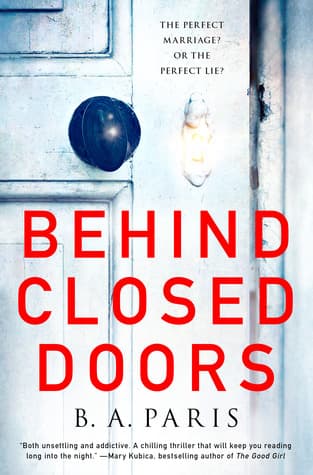
Synopsis
Covers the whole plot, including the ending.
- Difficulty
- Easy
- Pacing
- Fast
- Mood
- Suspenseful, Chilling, Dark, Tense
- Read it if
- You enjoy psychological thrillers with high stakes, a trapped protagonist, and a truly chilling villain.
- Skip it if
- You are sensitive to themes of abuse, domestic captivity, and psychological torment, or prefer less intense narratives.
Behind Closed Doors Plot Summary
Covers the whole plot, including the ending.
The Perfect Couple
Grace and Jack Angel are introduced as a perfect couple. Jack is a successful, charming lawyer, and Grace is beautiful and elegant, known for her cooking. They live in a stunning house and host grand dinner parties, impressing everyone. But early observations show troubling details: Grace never answers her phone, is always with Jack, and seems very thin despite her cooking. The story moves between the present, where Grace seems happy, and flashbacks that slowly reveal the truth behind their polished image. These early scenes set up the outward perfection and the underlying tension.
The Proposal and the Sister
Jack proposes to Grace, and she hesitates because of her strong bond with her younger sister, Millie, who has Down syndrome. Millie lives in a special needs home, and Grace is her main caregiver. Jack, however, uses Millie to his advantage, promising to build a beautiful, accessible garden for her at their future home. He describes himself as a loving, supportive husband who will welcome Millie. This promise, along with Grace's wish for a stable future for Millie, convinces her to accept Jack's proposal, unknowingly stepping into his trap. The garden becomes a symbol of her hope and, later, her confinement.
The Wedding and the Truth
The wedding is a grand event, and Grace, despite some doubts, believes she is marrying a good man. The honeymoon in Thailand quickly shatters this idea. On their wedding night, Jack shows his true, terrifying nature. He locks Grace in their hotel room, taking her phone and passport. He admits his plan to imprison her, explaining that he enjoys the power of breaking women's spirits. Grace realizes with horror that the perfect life he promised was a lie, meant to isolate and trap her. Her shock turns into a desperate fight for survival and escape.
The Red Room and Isolation
Back in their luxurious England home, Grace is immediately confined to a small, windowless room in the basement, which Jack calls her 'red room.' This room, with a bed and toilet, becomes her prison. Jack controls everything: her food, communication, and outside access. He dictates when she can be seen and how she must act during social events, threatening Millie's safety if Grace disobeys. Grace's only comfort is the faint light from the garden and her memories, as she endures psychological torture and complete isolation, her spirit slowly breaking.
The Perfect Performance
Jack often hosts elaborate dinner parties, forcing Grace to act as the devoted, elegant wife. Before each event, he dresses her, applies her makeup, and coaches her on her behavior, threatening severe harm to Millie if Grace reveals anything. Grace becomes skilled at faking happiness, smiling and talking while her mind races with terror and escape plans. These public appearances are a harrowing performance, a sharp contrast to her imprisonment. The guests, unaware, praise their perfect marriage, further showing the deception and Grace's deep isolation.
Millie's Garden
The accessible garden Jack promised for Millie is built, but it becomes a cruel symbol of Grace's captivity. Jack allows Millie to visit the garden during the day, believing she is staying with her sister. Grace can only watch from her basement window, her heart aching. She knows Millie is unaware of her suffering, and Jack uses Millie's presence in the garden to torment Grace, knowing how much she loves her sister. The garden, initially a source of hope, becomes a stark reminder of Jack's manipulation and the devastating effect on her bond with Millie.
The Birthday and the Painting
For Millie's birthday, Jack allows Grace to paint a picture for her. Grace uses this chance, hoping to show her situation. She paints a garden scene but includes subtle, disturbing details: a figure trapped behind bars, a distorted expression, and a hidden message. She hopes Millie, with her unique perception, might understand, or that the painting might cause suspicion. However, Jack intercepts the painting, recognizing her attempt to communicate. He punishes her severely, showing his complete control and crushing her hopes of outside help, deepening her despair.
The Growing Desperation
As months pass, Grace's desperation grows. She tries various escape attempts, but Jack's careful planning and constant watch stop every effort. Her physical health worsens from malnutrition and stress, and her mental state is pushed to its limits by the psychological torture. She lives in constant fear for Millie's safety, which Jack uses against her. The story emphasizes her deep loneliness and the crushing weight of her situation, as she tries to stay sane and find a way out, knowing time is running out.
The Neighbor's Curiosity
A new neighbor, Esther, moves in next door and, unlike others, starts to notice odd things about Jack and Grace's relationship. She observes Grace's strange behavior, the bars on the bedroom window, and their constant togetherness. Esther's growing unease offers a glimmer of hope for Grace, suggesting an outside view might finally break through Jack's carefully built facade. However, Jack is good at turning away suspicion, and Grace is too scared to risk drawing attention to Esther, knowing it could put Millie in greater danger. Esther's quiet observations put external pressure on Jack's control.
The Final Plan
Grace, pushed to her breaking point, realizes she must take a drastic step. She carefully plans her escape, using every detail she has observed about Jack's routines and weaknesses. Her plan involves faking a severe illness to make Jack drop his guard, then giving him a sedative, and finally, causing his death. This is a high-stakes, all-or-nothing effort, as failure means certain death for her and potential harm to Millie. The story builds intense suspense as Grace prepares for her final, desperate gamble, knowing this is her one chance at freedom.
The Dinner Party and the Deception
Grace puts her plan into action during one of Jack's elaborate dinner parties. She pretends to be very ill, forcing Jack to bring her water and medicine. While he is distracted, she slips a powerful sedative into his drink. As the evening goes on, Jack becomes increasingly drowsy. After the guests leave, Grace makes sure he is fully incapacitated. She then carefully stages the scene, making it look as though Jack, drunk, accidentally fell down the stairs, suffering a fatal injury. This is the critical moment of her escape, requiring immense courage and precision.
Freedom and a New Beginning
With Jack dead, Grace carefully covers her tracks, ensuring no evidence points to foul play. She then leaves the house, taking only what she needs. Her first priority is Millie. She arranges for Millie to be moved to a new, safe home where she can thrive. Grace then disappears, taking on a new identity and starting a new life, free from Jack's terror. She reflects on her ordeal, the strength she found, and the unbreakable bond with Millie that motivated her survival. The ending shows Grace finally regaining her freedom, with the scars of her past, but with new hope and purpose.
Principal Figures
Grace Angel (née Bertram)
Protagonist
A beautiful, intelligent woman trapped in a sadistic marriage.
Grace is initially portrayed as a charming, elegant woman, but beneath the surface, she is fiercely protective of her younger sister, Millie. She possesses remarkable resilience, intelligence, and an inner strength that allows her to endure unimaginable psychological and physical torment. Her love for Millie is her primary motivator, driving her to survive and eventually plan her escape. She is observant and strategic, slowly gathering information and planning her ultimate act of defiance.
Relationships: Jack Angel (Husband and sadistic captor); Millie Bertram (Younger sister, her primary motivation and reason for living)
Jack Angel
Antagonist
A charming, wealthy lawyer who is secretly a sadistic psychopath.
Jack is a highly intelligent, charismatic, and outwardly perfect man who uses his charm and wealth to manipulate those around him. Beneath his polished exterior lies a deeply disturbed individual with a profound desire for control and a sadistic pleasure in breaking women's spirits. He is meticulous in his planning, leaving no detail to chance in his elaborate scheme to imprison Grace. He is devoid of empathy, utterly convinced of his superiority, and relishes in psychological torture, using Grace's love for Millie as his ultimate weapon.
Relationships: Grace Angel (Wife and victim); Millie Bertram (Grace's sister, used as leverage against Grace)
Millie Bertram
Supporting
Grace's younger sister with Down syndrome, her innocent and vulnerable motivation.
Millie is Grace's younger sister, who has Down syndrome. She is sweet, loving, and innocent, completely unaware of the horrors Grace is enduring. Millie represents everything good and pure in Grace's life and serves as Grace's strongest motivation to survive and escape. Her vulnerability is mercilessly exploited by Jack, who uses threats against her to control Grace. Grace's fierce devotion to Millie is the emotional core of the story, highlighting the depth of familial love and sacrifice.
Relationships: Grace Angel (Older sister and primary caregiver); Jack Angel (Brother-in-law, who uses her as a pawn)
Esther
Supporting
A new neighbor who notices the unsettling dynamics of Jack and Grace's marriage.
Esther is a new neighbor who moves in next door to Jack and Grace. Unlike others, she is observant and possesses a keen sense of intuition. She begins to notice subtle discrepancies in Grace's behavior and the unusual nature of the Angels' relationship, such as Grace's constant unavailability and the bars on the window. Her growing suspicion provides a brief glimmer of hope for Grace, representing the potential for outside intervention, though Grace is too afraid to directly seek her help. Esther's role highlights the theme of appearances versus reality.
Relationships: Grace Angel (Neighbor, observing her plight); Jack Angel (Neighbor, whom she finds unsettling)
Diane
Mentioned
Grace's friend from her past, a reminder of her lost life.
Diane is a friend from Grace's past, occasionally mentioned or seen briefly before Grace's imprisonment. She represents the life Grace had before Jack, a life of freedom, friendships, and normalcy. Diane tries to contact Grace, initially concerned about her sudden inaccessibility, but is always put off by Jack. Her attempts to reach Grace underscore Grace's complete isolation and the effectiveness of Jack's control. She serves as a poignant reminder of what Grace has lost.
Relationships: Grace Angel (Friend from before her marriage)
Themes & Insights
Appearances vs. Reality
The main theme of the novel is the sharp contrast between the perfect image Jack and Grace show the world and the horrific reality of Grace's imprisonment. Their luxurious home, grand dinner parties, and Jack's charm all create the illusion of an ideal marriage. This theme appears in scenes where Grace must act as the 'happy wife' during social events, smiling and talking while secretly terrified for Millie's safety. The unsuspecting guests, like Esther's initial observations, are completely fooled, showing how easily evil can hide behind a perfect appearance.
“Everyone knows a couple like Jack and Grace. He has looks and wealth, she has charm and elegance. You might not want to like them, but you do.”
Control and Power
Jack's main goal is an overwhelming desire for absolute control and power over another person. He carefully plans Grace's captivity, taking away her identity, freedom, and independence. This theme is clear in his constant watch, the locked doors, the confiscation of her phone and passport, and his control over her food and communication. He enjoys breaking Grace's spirit, using threats against Millie to ensure her obedience. Grace's struggle is a fight to regain her freedom and resist his complete power, ending with her ultimate act of taking control of her own life.
“I want to watch you break, Grace. I want to see the light go out of your eyes.”
Love and Sacrifice
Grace's strong love for her sister, Millie, drives her survival and eventual escape. She initially marries Jack, swayed by his promise to care for Millie, and endures great suffering mainly to protect her. This theme is shown powerfully when Grace tries to send a coded message through a painting for Millie's birthday, risking severe punishment. Her final plan to escape and ensure Millie's long-term safety, even if it meant sacrificing her own life, shows the deepness of her family love and the sacrifices she will make for those she cares about.
“Millie was my anchor, the one thing that kept me tethered to life, to hope.”
Resilience and Survival
Despite severe psychological and physical torture, Grace shows remarkable resilience and a strong will to survive. This theme appears in her inner resistance, her refusal to be completely broken, and her careful planning for escape. Even when her hope fades, she holds onto the thought of Millie, which fuels her determination. Her ability to maintain a normal appearance during dinner parties while secretly planning shows her strength and strategic thinking under extreme pressure. Her final success is proof of the human spirit's ability to endure and overcome great hardship.
“He thought he could break me. But he didn't know how strong I was, how much I had to live for.”
Plot Devices & Literary Techniques
Dual Narrative (Past and Present)
Alternating timelines slowly reveal the sinister truth behind the perfect marriage.
The novel employs a dual narrative structure, shifting between Grace's present life with Jack and flashbacks to their courtship and early marriage. The present-day scenes depict the chilling reality of her captivity, while the flashbacks gradually reveal Jack's manipulative nature and the subtle signs Grace missed. This device creates suspense, allowing the reader to piece together the puzzle of how Grace became trapped, simultaneously building empathy for her current plight and highlighting the insidious nature of Jack's deception.
The 'Red Room'
A windowless basement room that symbolizes Grace's physical and psychological imprisonment.
The 'red room' is the windowless, locked basement room where Jack confines Grace. This specific setting serves as a powerful symbol of her complete lack of freedom and her psychological torture. It is a physical manifestation of Jack's control, a place where Grace is stripped of her identity and autonomy. The claustrophobic nature of the room emphasizes her isolation and despair, making her brief ventures upstairs for dinner parties even more jarring and highlighting the stark contrast between her public and private existence.
Millie's Garden
A symbol of hope twisted into a tool of psychological torment.
Jack's promise to build an accessible garden for Millie is what initially convinces Grace to marry him. The garden, therefore, represents hope, love, and a future for Millie. However, once Grace is imprisoned, the garden becomes a cruel tool of psychological torment. Grace can see Millie in the garden from her basement window, but cannot reach her. This turns a symbol of love into a constant reminder of her captivity and the danger Millie is in, deepening Grace's despair and fueling her ultimate desire for revenge and freedom.
The Perfect Facade
The meticulously maintained public image of a perfect couple, masking a horrifying reality.
The 'perfect facade' is the elaborate illusion Jack and Grace maintain for the outside world. This device is crucial to the plot, as it explains why no one suspects Grace's plight. Jack is charming and wealthy, and Grace is forced to play the role of the doting wife during dinner parties. This outward perfection prevents any intervention, making Grace's escape incredibly difficult. It also highlights the theme of appearances versus reality and the insidious nature of domestic abuse that can hide in plain sight.
Behind Closed Doors Quotes
“There are two kinds of people in this world. The ones who walk into a room and say, 'Here I am,' and the ones who walk in and say, 'Ah, there you are.'”
“Every marriage has its secrets. But theirs is a secret that could destroy them both.”
“He doesn't need to lock me in a room. He's locked me in his life.”
“People always want to believe the best in others, especially when they're charming.”
“He loved the idea of me, not the real me.”
“The perfect couple. Everyone said so. And that was the problem.”
“Sometimes the most beautiful things hide the darkest secrets.”
“He had taken everything from me. My freedom, my voice, my hope.”
“Fear can be a powerful motivator, but so can hope.”
“The silence was his weapon, and I was his prisoner.”
“You never truly know what goes on behind closed doors.”
“He was a master of manipulation, and I was his masterpiece.”
“I had to become someone else to survive. Someone he wouldn't expect.”
“The most dangerous lies are the ones we tell ourselves.”
Quiz
10 questions on the plot and the characters. Each answer comes with a short explanation.
Question 1
What is the primary reason Grace cannot leave the house or communicate freely with others?
- She has a debilitating illness that confines her.
- Jack keeps her imprisoned and controls all her communications.
- She is a recluse by nature and prefers to stay indoors.
- She is working on a secret project that requires her full attention.
Show answer
B. Jack keeps her imprisoned and controls all her communications. Grace is held captive by Jack, who has installed bars on windows, confiscated her phone, and monitors her every move, preventing her from leaving or contacting anyone.
Question 2
What is the name of Grace's younger sister, who has Down syndrome?
- Mia
- Millie
- Daisy
- Sophie
Show answer
B. Millie Grace's beloved younger sister is named Millie, and her well-being is a central factor in Jack's manipulation of Grace.
Question 3
What is Jack's profession, which contributes to his wealth and public image?
- A renowned artist
- A successful lawyer specializing in human rights
- A prominent surgeon
- A celebrated chef
Show answer
B. A successful lawyer specializing in human rights Jack is a highly successful lawyer who specializes in defending women who have been victims of abuse, which ironically gives him a perfect public facade.
Question 4
What specific object does Jack use to signal to Grace that she is under his control, even in public?
- A specific phrase whispered in her ear
- A subtle squeeze of her hand
- A tap on her knee under the table
- A specific look or gesture with his eyes
Show answer
C. A tap on her knee under the table Jack taps Grace's knee under the table as a silent, chilling signal to remind her of his presence and control, even when they are in company.
Question 5
What is Jack's ultimate plan for Millie, which Grace desperately tries to prevent?
- To send her to a boarding school abroad.
- To institutionalize her in a facility far away.
- To bring her to live with them permanently, under his control.
- To arrange an assisted living situation for her with a distant relative.
Show answer
C. To bring her to live with them permanently, under his control. Jack plans to bring Millie to live with them, knowing that this would give him complete control over both sisters, and Grace understands the horror this would entail for Millie.
Question 6
How does Grace manage to communicate a hidden message to Esther, her friend, during a dinner party?
- She slips a note into Esther's handbag.
- She writes a message on a napkin and leaves it in the restroom.
- She secretly passes Esther her phone with a pre-typed message.
- She uses the painting Grace made of Millie, with a hidden detail.
Show answer
D. She uses the painting Grace made of Millie, with a hidden detail. Grace subtly paints the word 'HELP' into Millie's scarf in a painting she gives to Esther, a desperate attempt to signal her distress.
Question 7
What is the significance of the locked red room in Jack's house?
- It's Jack's office where he conducts his legal work.
- It's a wine cellar for his expensive collection.
- It's the room where Jack tortures and imprisons Grace.
- It's a storage room for valuable antiques.
Show answer
C. It's the room where Jack tortures and imprisons Grace. The red room is the literal 'behind closed doors' where Jack subjects Grace to unimaginable cruelty and imprisonment, highlighting the 'perfect lie' of their marriage.
Question 8
What specific detail about Grace's appearance often draws comments and contributes to the facade of her 'perfect' life?
- Her elaborate, expensive jewelry.
- Her constantly changing, stylish hairstyles.
- Her slim figure, despite her reputation as an excellent cook.
- Her flawless, youthful skin.
Show answer
C. Her slim figure, despite her reputation as an excellent cook. Many comment on Grace's slimness, which is a direct result of Jack's control over her food intake, contrasting sharply with the elaborate meals she's forced to prepare for guests.
Question 9
What is the crucial element Grace uses to finally trap Jack, turning his own methods against him?
- She records his confessions on a hidden device.
- She fakes her own death to escape his grasp.
- She drugs him and locks him in his own 'red room'.
- She contacts the police with irrefutable evidence.
Show answer
C. She drugs him and locks him in his own 'red room'. Grace drugs Jack with sleeping pills, then locks him in the red room, replicating his own imprisonment tactics against him, ensuring his demise by starvation.
Question 10
What theme is most prominently explored through Grace's ordeal and Jack's public persona?
- The pursuit of wealth and social status.
- The deceptive nature of appearances and the hidden realities of domestic abuse.
- The power of forgiveness and redemption.
- The challenges of long-distance relationships.
Show answer
B. The deceptive nature of appearances and the hidden realities of domestic abuse. The novel's core theme is the stark contrast between the 'perfect' facade of Jack and Grace's marriage and the horrific abuse Grace endures behind closed doors, highlighting how appearances can completely mask a sinister reality.
Behind Closed Doors FAQ
What is the central premise of 'Behind Closed Doors'?
The novel centers on Jack and Grace Angel, who appear to have a perfect marriage and an enviable life. However, beneath the surface of their seemingly idyllic relationship, Grace is a prisoner in her own home, meticulously controlled and abused by her charming and manipulative husband, Jack.
Who are the main characters in the story?
The primary characters are Grace Angel, the protagonist trapped in an abusive marriage, and Jack Angel, her wealthy, charming, yet psychopathic husband. Millie, Grace's younger sister with Down syndrome, also plays a crucial role as Grace's motivation for escape.
What makes Jack and Grace's marriage appear so 'perfect' to outsiders?
Jack's wealth, good looks, and charming demeanor, combined with Grace's elegance and their seemingly devoted connection, create an illusion of perfection. They host elegant dinner parties, present a united front, and never appear apart, leading others to believe they are deeply in love.
What are some early clues that something is wrong in their marriage?
Early clues include Grace's inability to answer her phone or meet friends for coffee, her constant presence by Jack's side, her extreme thinness despite cooking elaborate meals, and the unsettling detail of bars on one of the bedroom windows, which is later explained away by Jack.
What is Jack's ultimate goal with Grace and Millie?
Jack's ultimate goal is to keep Grace imprisoned and terrorized, deriving pleasure from her fear and control. He plans to eventually bring Millie to live with them after Grace breaks her spirit, intending to extend his sadistic control over Millie as well, fueled by a deep-seated hatred for people with disabilities.
How does Grace communicate her plight without alerting Jack?
Grace attempts to communicate her plight subtly, such as trying to leave a note in a friend's handbag during a dinner party, and later, more directly, by strategically placing a painting of a red dress in the window where Millie will eventually see it, triggering a memory from their childhood.
What is the significance of the red dress and the painting?
The red dress is a recurring symbol of Grace's and Millie's bond and a pre-arranged signal for distress. Grace painted Millie wearing the red dress as a child, and later uses a painting of it in the window as a desperate, pre-planned signal to Millie that she needs help, relying on Millie's keen memory.
What is the true purpose of the 'red room' in Jack's house?
The 'red room' is Jack's torture chamber, where he keeps Grace locked up, often in the dark, subjecting her to psychological torment and starvation. It symbolizes her complete loss of freedom and the horrifying reality of her imprisonment, far removed from the elegant facade of the rest of the house.
How does Jack's backstory contribute to his psychopathic tendencies?
Jack's backstory reveals a childhood marked by a profound hatred for his sister, who had Down syndrome, and a desire to control. This early experience, particularly his resentment and the satisfaction he derived from her misery, laid the groundwork for his adult psychopathy and his specific target of Millie.
Analyze Grace's decision-making process throughout her captivity.
Grace's decision-making is initially driven by fear and survival, but her motivation shifts to protecting Millie. She endures immense suffering, meticulously planning her escape and Jack's demise, demonstrating remarkable resilience and strategic thinking under extreme duress, prioritizing Millie's safety above all else.
What psychological manipulation techniques does Jack employ?
Jack employs gaslighting, isolation, surveillance, fear-mongering, and the constant threat of harm to Millie to control Grace. He systematically chips away at her self-worth and autonomy, making her believe escape is impossible and that he is always one step ahead.
How does Grace's relationship with Millie serve as her primary source of strength and motivation?
Millie is Grace's only family and her reason for living. The thought of Millie falling into Jack's hands, combined with Grace's fierce protective instinct, fuels her endurance, resilience, and elaborate escape plan. Millie's innocent love and trust are Grace's ultimate anchors.
Was Grace justified in her final actions against Jack?
This is a key debate. Many readers argue Grace was entirely justified, acting in self-defense and to protect Millie from a clear and present danger posed by a dangerous psychopath. She had exhausted all other options and faced a life of torture or death.
Could Grace have sought help from others more effectively?
While Grace made several attempts, Jack's meticulous control, surveillance, and the isolation he imposed made seeking help incredibly difficult. Any overt attempt would have put her and Millie in immediate danger, forcing her to rely on covert, long-term planning.
What is the significance of the novel's ending, particularly Grace's reflection?
The ending signifies Grace's liberation and the reclaiming of her life, even if it's under the shadow of her past actions. Her reflection indicates a complex mix of relief, trauma, and the understanding that she made an impossible choice to survive and protect her sister, finding a new kind of peace.
How does the novel explore themes of appearance versus reality?
The novel is a masterclass in this theme, presenting Jack and Grace's 'perfect' marriage as a meticulously constructed facade. It constantly contrasts the idyllic outward perception with the horrifying reality of abuse, control, and imprisonment hidden behind closed doors.
Is there any ambiguity regarding Jack's true nature or motives?
No, the novel leaves little ambiguity about Jack's nature. He is unequivocally portrayed as a sadistic psychopath, driven by a desire for control and a deep-seated hatred, particularly towards individuals with disabilities, stemming from his childhood experiences.
About the author

B.A. Paris is a British author known for her gripping psychological thrillers. Her debut novel, 'Behind Closed Doors,' became an international bestseller, lauded for its suspenseful plot and exploration of dark relationships. She continues to captivate readers with novels like 'Bring Me Back,' solidifying her reputation in the domestic noir genre.
Similar books
- The Girl on the Train
Paula Hawkins
3.9 (2.1M) average on GoodreadsThrillerFeatures a female protagonist in a domestic thriller with dark secrets and a sense of unease.
- Gone Girl
Gillian Flynn
4.1 (2.3M) average on GoodreadsThrillerExplores the dark underbelly of a seemingly perfect marriage and features a manipulative, controlling character.
- Angels & Demons
Dan Brown
3.9 (2.7M) average on GoodreadsThrillerA Harvard symbologist races through Rome's ancient sites, deciphering cryptic clues to unmask the Illuminati and stop a vengeful plot to destroy the Vatican with a stolen antimatter weapon.
- The Da Vinci Code
Dan Brown
3.9 (1.9M) average on GoodreadsThrillerA symbologist and a cryptologist race through European landmarks, deciphering ancient codes and uncovering a conspiracy that could rewrite the foundations of Christianity.
- The Guest List
Lucy Foley
3.8 (1.3M) average on GoodreadsThrillerOn a remote Irish island, a glamorous wedding descends into a deadly whodunnit when a guest is found murdered, trapping everyone with their secrets as a storm rages.
- The Shining
Stephen King
4.2 (1.1M) average on GoodreadsThrillerA recovering alcoholic accepts a caretaking job at a snow-bound, haunted hotel, where his son's psychic abilities reveal the sinister forces that drive him to madness and terrorize his family.





Enjoyed the summary?
A summary gives you the shape of the book. The book itself has the detail, the examples and the voice.
Find Behind Closed Doors on AmazonAs an Amazon Associate, BookBrief earns from qualifying purchases. How we're funded