
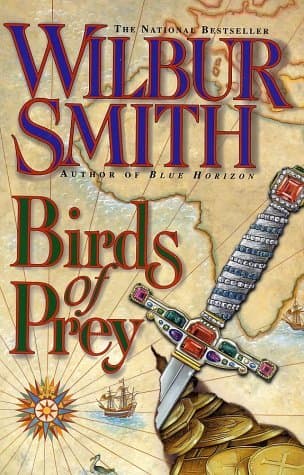
Synopsis
Covers the whole plot, including the ending.
- Difficulty
- Medium
- Pacing
- Fast
- Mood
- Action-packed, Adventurous, Gritty, Epic
- Read it if
- You enjoy swashbuckling historical adventures with naval battles, high stakes, and a focus on family legacy and revenge.
- Skip it if
- You prefer character-driven stories over plot-heavy action, or are sensitive to graphic depictions of historical violence, piracy, and sexual assault.
Birds of Prey Plot Summary
Covers the whole plot, including the ending.
The Ambush at Agulhas Cape
In 1667, Sir Francis Courtney, an experienced privateer, and his young son, Hal, command the fighting caravel 'Lady Edwina' off the dangerous Agulhas Cape. They are hunting the treasure-laden galleons of the Dutch East India Company. Their target, the 'Oosterland', a large Dutch merchantman, appears. After a tense chase and a brutal boarding, the Courtneys and their crew overpower the Dutch, capturing the ship and its valuable cargo. During the fight, Hal shows his skill in combat and earns his father's respect, though he also sees the harshness of naval warfare, including the death of a close friend. This first win shows their ability and sets the stage for future fights.
Return to the Cape and a New Commission
Sir Francis and Hal bring the captured 'Oosterland' to the British settlement at the Cape of Good Hope. Their success is met with praise, but also with the rivalry of the Dutch Governor, Van der Decken, who sees their privateering as an act of war. Sir Francis is then approached by Lord Albemarle, the British commander, with a new, secret mission: to sail north to the Red Sea and disrupt French and Dutch trade routes, specifically targeting a rumored French treasure fleet. This mission is risky, involving unknown waters and powerful European rivals, but the promise of riches and strategic advantage for England is too great to refuse.
Voyage to the Red Sea and Ethiopian Encounters
The 'Lady Edwina' begins the long journey around the Horn of Africa, facing violent storms and the constant threat of scurvy and disease. They eventually reach the Red Sea, a region controlled by various local powers and contested by European fleets. Here, they meet the Ethiopian Queen, Zenobia, and her navy. Initially, there is tension, but Sir Francis, through diplomacy and a show of strength, forms an alliance with Zenobia against their common European enemies. Hal also begins to navigate complex political situations and becomes interested in Ethiopia's culture.
The Serpent's Lair and the French Trap
Following information from Zenobia, the Courtneys find the French naval base at Massawa, a harbor known as 'The Serpent's Lair'. They observe a large French fleet, including warships and the rumored treasure galleons. However, their reconnaissance mission goes wrong. Captain Dubois, the French commander, expecting an attack, sets a trap. Hal and a small landing party are ambushed during a scouting mission, and Hal is captured. This setback is a major blow to Sir Francis, who is now torn between his mission and the need to rescue his son.
Hal's Imprisonment and Escape Attempt
Hal is imprisoned within the French fortress at Massawa, subjected to brutal conditions and interrogation by Captain Dubois. Despite the torture, Hal refuses to betray his father's plans. During his captivity, he befriends Seraphina, who is also held captive by Dubois. Seraphina, a skilled infiltrator and survivor, reveals her own reasons for escape. Together, they plan an escape, using their knowledge of the fortress and help from locals. Their attempt is dangerous, leading to a fight for freedom within the fortress walls.
The Battle for Massawa
Sir Francis, unwilling to abandon his son, plans an assault on Massawa, despite being outnumbered. He coordinates with Queen Zenobia, who provides forces and knowledge of the local terrain. The attack is launched under cover of darkness, a chaotic land and sea battle. The 'Lady Edwina' engages the French warships, while Sir Francis leads a landing party to breach the fortress and rescue Hal. The battle rages with heavy casualties on both sides, ending in a confrontation between Sir Francis and Captain Dubois, and the flight of Hal and Seraphina.
The Pursuit of the Treasure Fleet
Having rescued Hal and damaged the French base, the Courtneys now focus on the main objective: the French treasure fleet. Captain Dubois, having expected their goal, tries to slip away with the remaining galleons, laden with riches. A chase begins across the Red Sea, a test of seamanship, endurance, and strategy. The 'Lady Edwina', despite battle damage, is pushed to its limits, constantly harassing the larger, slower French ships, seeking an opportunity to strike and claim the wealth.
The Final Confrontation and the Prize
The chase ends in a final confrontation in a narrow strait. Sir Francis corners the French treasure fleet, forcing them into a battle. The 'Lady Edwina', with help from Zenobia's ships, engages the remaining French warships and the armed treasure galleons. The battle is fierce, a close-quarters fight involving cannon fire, boarding, and hand-to-hand combat. Hal again shows his bravery and leadership, fighting alongside his father. The Courtneys are victorious, capturing the treasure fleet and securing a large prize for England, but not without losses.
The Aftermath and New Beginnings
After the battle, the Courtneys count their spoils and mourn their dead. Sir Francis, though victorious, is tired from the conflict and the weight of command. Hal, having grown through the trials, looks towards his own future as a privateer and leader. Seraphina, having played a role, must decide her path forward, her connection with Hal deepening. The treasure is secured, but the cost of its acquisition is clear. The novel ends with the Courtneys looking towards new horizons, their legacy as seafarers established, and the promise of further adventures.
Return to the Cape and Unfinished Business
The victorious Courtneys, with their captured treasure, return to the Cape of Good Hope. Their arrival creates a stir, further increasing tensions with the Dutch Governor, Van der Decken, who resents their success. Sir Francis delivers his prize to the British authorities, solidifying his reputation and influence. Hal, now a proven leader, deals with his growing feelings for Seraphina, whose mysterious past continues to intrigue him. The Courtneys, though celebrating their victory, know that their exploits have made them powerful enemies, and the struggle for maritime power in the region is far from over, hinting at future conflicts and adventures.
Principal Figures
Sir Francis Courtney
Protagonist
A legendary English privateer and father of Hal.
Sir Francis Courtney is a seasoned, cunning, and formidable privateer, driven by a deep loyalty to England and a desire for wealth and adventure. He is a brilliant tactician, a skilled seaman, and a ruthless fighter when necessary, but also possesses a strong sense of honor and a profound love for his son, Hal. His leadership inspires fierce loyalty in his crew. He is often pragmatic, making difficult choices for the greater good of his mission and his family, and is willing to challenge authority when he believes it necessary.
Relationships: Hal Courtney (Father-son; mentor-protégé); Queen Zenobia (Strategic alliance, mutual respect); Captain Dubois (Arch-rival, military adversary)
Hal Courtney
Protagonist
Sir Francis's brave and ambitious son, learning the ways of the sea.
Hal Courtney is the young, impetuous, and courageous son of Sir Francis. Initially eager to prove himself, he matures significantly throughout the story, learning the harsh realities of naval warfare, leadership, and diplomacy. He possesses his father's fighting spirit and intelligence but also develops his own moral compass. His experiences, from brutal combat to imprisonment and falling in love, forge him into a capable and respected leader, prepared to carry on the Courtney legacy. He is driven by a desire to earn his father's respect and make his own mark.
Relationships: Sir Francis Courtney (Son-father; mentee-mentor); Seraphina (Romantic interest, fellow captive, ally); Captain Dubois (Captor, adversary)
Seraphina
Supporting
A mysterious and resourceful woman, held captive by the French.
Seraphina is an enigmatic and resourceful woman encountered by Hal during his imprisonment. Her background is shrouded in mystery, but she proves to be intelligent, brave, and highly skilled in survival and infiltration. She is a survivor, driven by her own hidden motives and a desire for freedom. Her beauty and resilience captivate Hal, and she becomes a crucial ally in his escape and subsequent adventures. Despite her mysterious nature, she demonstrates loyalty and courage, making her an invaluable, if unpredictable, companion.
Relationships: Hal Courtney (Romantic interest, fellow captive, ally); Captain Dubois (Captor, tormentor)
Captain Dubois
Antagonist
The cunning and ruthless French commander.
Captain Dubois is the primary antagonist, a brilliant and ruthless French naval officer. He is a formidable adversary, known for his strategic mind, his cunning traps, and his unwavering loyalty to France. Dubois is cruel and unforgiving, especially towards his enemies, as demonstrated by his treatment of Hal. He views the Courtneys as a direct threat to French interests and is determined to thwart them at any cost. His personal rivalry with Sir Francis adds a layer of intensity to their military confrontations, driven by a desire for supremacy and national pride.
Relationships: Sir Francis Courtney (Arch-nemesis, military adversary); Hal Courtney (Captor, tormentor)
Queen Zenobia
Supporting
The powerful and enigmatic Queen of Ethiopia.
Queen Zenobia is the formidable and regal ruler of an Ethiopian kingdom. She is a shrewd politician, a skilled military leader, and fiercely protective of her people and her territory. Zenobia commands a powerful navy and possesses extensive knowledge of the Red Sea region. Initially wary of the European privateers, she forms a strategic alliance with Sir Francis Courtney against their common enemies, the French and Dutch. Her enigmatic presence and powerful influence add a unique cultural dimension to the narrative, highlighting the complex geopolitical landscape of the era.
Relationships: Sir Francis Courtney (Strategic alliance, mutual respect); Hal Courtney (Ally, intrigued by his bravery)
Lord Albemarle
Supporting
The British commander who commissions Sir Francis.
Lord Albemarle is a high-ranking British naval commander and a representative of the Crown. He is a pragmatic and authoritative figure, responsible for commissioning Sir Francis Courtney for the critical mission to the Red Sea. He recognizes Sir Francis's unique skills and daring, despite the unorthodox nature of privateering. Albemarle represents the larger political and strategic interests of England, using the Courtneys to further British influence and undermine rival European powers. He is a man of status and power, operating within the strictures of naval hierarchy.
Relationships: Sir Francis Courtney (Commander-subordinate (unofficially), patron-privateer)
Van der Decken
Antagonist
The Dutch Governor at the Cape of Good Hope.
Van der Decken is the arrogant and resentful Dutch Governor at the Cape of Good Hope. He represents the entrenched Dutch power in the region and views the British privateers, especially the Courtneys, as a direct threat to Dutch trade and sovereignty. He is a constant source of political tension and antagonism, often attempting to undermine Sir Francis through bureaucratic means or veiled threats. His character embodies the fierce rivalry between the British and Dutch empires for control of vital trade routes and colonial territories.
Relationships: Sir Francis Courtney (Political adversary, rival)
Mansur
Supporting
A loyal and skilled member of the 'Lady Edwina' crew.
Mansur is a long-serving and highly skilled member of the 'Lady Edwina' crew, often serving as a key lieutenant to Sir Francis. He is a man of few words but immense loyalty and competence, particularly adept at sailing and navigation. Mansur is a trusted confidante and a steady presence amidst the chaos of battle and adventure. He represents the reliable backbone of the privateer crew, embodying the camaraderie and unwavering dedication found among seasoned seafarers.
Relationships: Sir Francis Courtney (Loyal crewman, trusted lieutenant); Hal Courtney (Mentor figure, fellow crewman)
Themes & Insights
The Nature of Piracy and Privateering
The novel looks at the blurred lines between legal warfare and piracy in the 17th century. Sir Francis Courtney operates under a letter of marque, making his actions legal under British law, yet his methods—raiding, plundering, and killing—are like those of pirates. The story shows how national interests justified acts that would otherwise be criminal, showing the hypocrisy and brutality in this system. This theme is clear from the opening scene with the capture of the 'Oosterland', where the violence is sanctioned by the British flag, yet is savage.
“What is piracy to the Dutchman is patriotism to the Englishman, and a fortune to the man who seizes it.”
Father-Son Legacy and Identity
A main theme is the relationship between Sir Francis and Hal Courtney, and Hal's journey to create his own identity while living in his father's shadow. Hal wants to prove his worth and earn his father's respect, often taking risks. Sir Francis, in turn, struggles with protecting his son while also letting him grow into a capable leader. Their bond is tested by the dangers they face, from shared combat to Hal's capture and rescue, ultimately strengthening their connection as Hal becomes a seafarer.
“He saw the fire in his son's eyes, the same fire that had driven him through a lifetime of storm and battle. Hal was truly his own.”
Imperial Rivalry and Geopolitical Struggle
The story is set against the rivalry between England, the Netherlands, and France for control of trade routes and colonial territories. The Courtneys' actions are not just for personal gain but serve the strategic interests of the British Empire. This is clear in the constant fights with Dutch ships off the Cape and the mission to disrupt French trade in the Red Sea. The novel shows the global scale of these conflicts, from the tip of Africa to the Horn of Africa, as European powers fought for power.
“The sea was a chessboard, and every ship a pawn in the great game of empires.”
Survival and Resilience
The characters, especially the Courtneys and Seraphina, face extreme challenges—brutal combat, imprisonment, harsh weather, and the constant threat of death. Their ability to endure, adapt, and fight back against odds shows human resilience. Hal's survival in French captivity and Seraphina's resourcefulness in dire situations show this theme. The crew of the 'Lady Edwina' also shows fortitude, pushing their ship and bodies to the limit across vast, dangerous oceans, showing the will needed to survive in such an era.
“To survive the sea, you must become as unforgiving as the sea itself.”
Plot Devices & Literary Techniques
The Letter of Marque
A legal document authorizing privateering.
The Letter of Marque is a crucial plot device that legitimizes the Courtneys' actions, distinguishing them from common pirates. It grants them official permission from the English Crown to attack and seize enemy vessels, allowing them to operate within a legal framework despite engaging in acts of violence and plunder. This device highlights the political complexities of the era, where state-sanctioned piracy was a tool of foreign policy, allowing the protagonists to act with official backing while pursuing their own fortunes and serving national interests.
The Hidden Treasure Fleet
The ultimate prize and driving force of the main mission.
The rumored French treasure fleet serves as the primary MacGuffin and the central objective for the Courtneys' perilous journey to the Red Sea. Its immense value provides a powerful motivation for both the protagonists and the antagonist, Captain Dubois, driving much of the plot's action. The pursuit, discovery, and eventual battle for this fleet generate high stakes and propels the narrative forward, culminating in the climactic confrontation. The treasure represents not only wealth but also strategic power for whichever nation secures it.
The Enigmatic Ally (Queen Zenobia)
An unexpected and powerful non-European ally.
Queen Zenobia functions as an enigmatic ally, introducing a non-European perspective and power dynamic into the story. Her presence allows for the exploration of local politics and cultures, and her strategic alliance with the Courtneys provides crucial intelligence and military support against the French. This device expands the geographical and political scope of the narrative beyond the traditional European rivalries, offering the protagonists new resources and challenges, and adding an element of exoticism and cultural exchange to their adventure.
The Treacherous Seas (Agulhas Cape, Red Sea)
The dangerous maritime environment as a constant antagonist.
The treacherous seas, particularly the notorious Agulhas Cape and the challenging Red Sea, act as a constant, non-human antagonist. They present formidable obstacles through storms, hidden reefs, and vast distances, testing the seamanship and endurance of the characters and their vessels. This device heightens the stakes of the journey, making every voyage a battle for survival against nature itself. It emphasizes the skill and bravery required to navigate these waters, adding realism and tension to the maritime adventures.
Birds of Prey Quotes
“The wind was a living thing, tearing at the sails, whipping the spray into their faces, a relentless, roaring beast.”
“There was a certain exhilaration in facing death, a sharpening of the senses, a clarity of thought that was rarely achieved in the mundane world.”
“Power was not given, it was taken. And once taken, it had to be defended with every fiber of one's being.”
“The sea was a fickle mistress, offering bounty with one hand and snatching life with the other.”
“Revenge was a cold dish, but it tasted sweet when finally served.”
“He carried the scent of powder and salt, the indelible marks of a man who had lived by the sword and the sea.”
“To be truly free, one had to be willing to lose everything.”
“The roar of cannons was the music of their world, a brutal symphony of destruction and glory.”
“History was written by the victors, but the truth often lay buried with the vanquished.”
“Love, like gold, was a treasure to be guarded fiercely, for it could be stolen as easily as it was given.”
“The line between courage and madness was often blurred in the heat of battle.”
“He knew the smell of fear, a bitter, metallic tang that clung to men like a shroud.”
“The world was a dangerous place, and only the strong, the cunning, and the utterly ruthless survived.”
“Every man carried his own private hell, and some wore it openly for all to see.”
Quiz
10 questions on the plot and the characters. Each answer comes with a short explanation.
Question 1
In what year does the story of 'Birds of Prey' primarily begin?
- 1642
- 1667
- 1688
- 1701
Show answer
B. 1667 The book explicitly states that the year is 1667 when Sir Francis Courtney and Hal are on patrol.
Question 2
What is the name of the settlement at the southern tip of Africa mentioned in the synopsis?
- Cape Town
- Port Elizabeth
- Good Hope
- Mossel Bay
Show answer
C. Good Hope The synopsis states the quest sweeps them from 'the settlement of Good Hope at the southern tip of Africa'.
Question 3
Which company's treasure-laden galleons are Sir Francis Courtney and Hal initially waiting to ambush?
- British East India Company
- Portuguese India Company
- Dutch East India Company
- French East Indies Company
Show answer
C. Dutch East India Company The synopsis clearly states they are 'lying in wait for one of the treasure-laden galleons of the Dutch East India Company'.
Question 4
What is the name of Sir Francis Courtney's son, who accompanies him on patrol?
- Hugh
- Harry
- Hal
- Henry
Show answer
C. Hal The synopsis introduces 'Sir Francis Courtney and his son Hal' as being on patrol.
Question 5
Where does the 'quest for adventure and the spoils of war' take the Courtneys, besides the southern tip of Africa?
- The Persian Gulf
- The Red Sea
- The Great Horn of Ethiopia
- The Arabian Sea
Show answer
C. The Great Horn of Ethiopia The synopsis mentions the quest sweeps them 'from the settlement of Good Hope at the southern tip of Africa to the Great Horn of Ethiopia far to the north'.
Question 6
What type of ship are Sir Francis Courtney and Hal using for their patrol?
- A frigate
- A galleon
- A fighting caravel
- A merchant brig
Show answer
C. A fighting caravel The synopsis describes them 'on patrol in their fighting caravel off the Agulhas Cape'.
Question 7
According to the synopsis, what was permitted under international maritime law at the time the story is set?
- Exclusive trading rights
- Acts of piracy, rape, and murder
- The establishment of new colonies
- The seizure of enemy naval vessels only
Show answer
B. Acts of piracy, rape, and murder The synopsis states 'at a time when international maritime law permitted acts of piracy, rape, and murder otherwise punishable by death'.
Question 8
The struggle for what two primary things on the high seas is re-created through the Courtneys' part in the story?
- Trade routes and diplomatic influence
- Naval dominance and political power
- Supremacy and riches
- Exploration and scientific discovery
Show answer
C. Supremacy and riches The synopsis mentions 'thrillingly re-creates their part in the struggle for supremacy and riches on the high seas'.
Question 9
What specific geographical feature off South Africa is mentioned as their patrol area?
- Cape of Storms
- Table Bay
- Agulhas Cape
- Cape Point
Show answer
C. Agulhas Cape The synopsis states they are 'on patrol in their fighting caravel off the Agulhas Cape of South Africa'.
Question 10
What type of narrative qualities does the synopsis attribute to Wilbur Smith's storytelling in 'Birds of Prey'?
- Slow-paced introspection and subtle character development
- Colorful and exciting, crackling with tension and drama
- Minimalist prose and abstract philosophical themes
- Documentary-style factual recounting of historical events
Show answer
B. Colorful and exciting, crackling with tension and drama The synopsis praises Wilbur Smith for spinning 'a colorful and exciting tale, crackling with tension and drama'.
Birds of Prey FAQ
What is the primary setting and time period for 'Birds of Prey'?
'Birds of Prey' is primarily set in 1667, beginning off the Agulhas Cape of South Africa. The narrative then expands to cover the settlement of Good Hope and extends far north to the Great Horn of Ethiopia, encompassing various maritime locations on the high seas.
Who are the main protagonists at the beginning of the story and what is their initial goal?
The main protagonists are Sir Francis Courtney and his son, Hal Courtney. They are introduced on patrol in their fighting caravel, aiming to intercept and plunder a treasure-laden galleon belonging to the Dutch East India Company, returning from the Orient.
What is the significance of 'international maritime law' in the context of the book's opening premise?
The book highlights that in 1667, international maritime law permitted acts that would otherwise be considered piracy, rape, and murder. This legal loophole provides a historical justification for the Courtneys' initial actions and sets the tone for the violent and opportunistic world they inhabit.
How does the book establish the Courtney family's legacy?
Wilbur Smith introduces Sir Francis and Hal Courtney as a new generation of the 'indomitable Courtneys,' immediately linking them to the family's established reputation for strength and adventure. Their actions throughout the book contribute to and re-create their part in the struggle for supremacy and riches on the high seas.
What kind of antagonists do Sir Francis and Hal Courtney face?
Beyond the Dutch East India Company, the Courtneys face a myriad of antagonists including rival pirates, treacherous captains, indigenous tribes, and the harsh, unforgiving elements of the sea itself. Their quest for spoils and power often puts them in direct conflict with well-armed and ruthless opponents.
Are there any subtle foreshadowing elements regarding Hal's future leadership?
From early on, Hal's keen observational skills, strategic thinking during battles, and growing assertiveness, often challenging his father's decisions or proposing alternative tactics, subtly foreshadow his eventual emergence as a formidable leader in his own right, distinct from Sir Francis.
What is the significance of the 'fighting caravel' in relation to naval technology of the era?
The fighting caravel, while perhaps slightly anachronistic for 1667 as a primary warship, symbolizes the agility and adaptability of the Courtneys. Its smaller size and maneuverability allow them to engage larger, slower galleons effectively, highlighting their reliance on skill and daring over sheer firepower.
How does the book subtly critique or comment on the era's colonial expansion?
While celebrating the adventurers, the book subtly critiques colonial expansion by showing the brutal exploitation of resources, the displacement and subjugation of native populations, and the morally ambiguous nature of the 'riches' being pursued. The Dutch East India Company itself is portrayed as a powerful, often ruthless, colonial entity.
What role does the 'settlement of Good Hope' play beyond a geographical marker?
The settlement of Good Hope serves as a volatile hub for trade, re-supply, and information exchange, but also as a microcosm of colonial society. It's a place where alliances are forged and broken, where the Courtneys encounter both allies and enemies, and where the brutal realities of the era's power struggles are evident on land.
Analyze the psychological impact of constant danger and violence on Hal Courtney.
Hal Courtney, growing up amidst constant danger and violence, develops a hardened resolve and a pragmatic, often ruthless, worldview. While it fuels his survival instincts and leadership qualities, it also forces him to confront the moral ambiguities of his actions, potentially leading to a desensitization to suffering or a complex internal struggle.
How does the father-son dynamic between Sir Francis and Hal evolve psychologically throughout their adventures?
Initially, Hal views Sir Francis as an infallible figure, but as Hal matures and faces his own trials, he begins to challenge his father's authority and methods. This evolution represents a psychological shift from pupil to peer, marked by both respect and burgeoning independence, vital for Hal to forge his own identity.
Discuss the psychological motivations behind the characters' pursuit of 'spoils of war.'
The pursuit of 'spoils of war' is driven by a complex mix of motivations: pure avarice, the desire for status and power in a brutal world, and the need for security in an insecure era. For some, it's also about proving worth, escaping poverty, or even a twisted sense of adventure and freedom from societal norms.
How does the book explore the concept of 'loyalty' among pirates and privateers?
Loyalty in 'Birds of Prey' is often depicted as a fragile, transactional commodity, heavily influenced by personal gain and fear. While there are moments of genuine camaraderie, characters frequently betray each other for treasure or survival, highlighting the precarious nature of alliances in their cutthroat world.
Is the portrayal of 'international maritime law' as permitting piracy and murder historically accurate or a dramatic embellishment?
While the term 'international maritime law' as a codified system is anachronistic, the sentiment is largely historically accurate. During this period, privateering (state-sanctioned piracy) was common, and the line between legal and illegal acts on the high seas was incredibly blurred, often dependent on the flag flown and the political climate, making the book's premise plausible.
How does the novel balance the romanticized adventure with the harsh realities of the era?
The novel masterfully balances romanticized adventure with harsh realities by presenting thrilling sea battles and exotic locales alongside vivid descriptions of brutal violence, disease, and moral compromises. This dual approach allows readers to experience the excitement while acknowledging the grim, unforgiving nature of 17th-century maritime life.
Does 'Birds of Prey' glorify violence, or does it merely depict it as a historical reality?
While the book contains graphic depictions of violence inherent to its historical setting and genre, it generally depicts it as a harsh reality rather than glorifying it. The consequences of violence, both physical and psychological, are often explored, showing its brutal and often tragic impact on characters, rather than solely celebrating it.
What is the overarching theme regarding the nature of power and wealth in the book?
The overarching theme is that power and wealth in this era are often acquired through ruthless means, and maintaining them requires constant vigilance and further acts of aggression. The book suggests that while these pursuits bring temporary satisfaction, they also come with a heavy cost, isolating individuals and perpetuating cycles of violence.
How does the journey from South Africa to Ethiopia contribute to the narrative's symbolic meaning?
The extensive journey from South Africa to the Great Horn of Ethiopia symbolizes the vastness of the Courtneys' ambitions and the boundless opportunities and dangers of the unexplored world. It also represents a geographical and perhaps spiritual quest for ultimate freedom, wealth, and mastery over their destiny, pushing them to the very limits of their known world.
To what extent can Sir Francis Courtney be considered a 'hero' given the morally ambiguous actions described?
Sir Francis Courtney's status as a 'hero' is highly debatable. While he displays courage and leadership, his actions often include piracy, murder, and exploitation, which are morally reprehensible by modern standards. He can be seen as a product of his time, a 'hero' within the brutal context of 17th-century maritime warfare, but certainly not an unblemished moral figure.
About the author

Wilbur Smith was a South African author known for his historical fiction set in Africa. His notable works include "River God," "When the Lion Feeds," "Birds of Prey," and "Monsoon," which explore themes of adventure and survival against the backdrop of the continent's rich history and landscapes. Smith's storytelling often reflects his deep connection to Africa.
Similar books
- Master and Commander
Patrick O'Brian
4.1 (48k) average on GoodreadsHistorical FictionFocuses on naval warfare, detailed ship operations, and the camaraderie and conflict among officers.
- Angels & Demons
Dan Brown
3.9 (2.7M) average on GoodreadsThrillerA Harvard symbologist races through Rome's ancient sites, deciphering cryptic clues to unmask the Illuminati and stop a vengeful plot to destroy the Vatican with a stolen antimatter weapon.
- Gone Girl
Gillian Flynn
4.1 (2.3M) average on GoodreadsThrillerA wife's sudden disappearance on her fifth anniversary reveals a web of lies and psychological warfare, exposing the secrets within a seemingly perfect marriage.
- The Girl on the Train
Paula Hawkins
3.9 (2.1M) average on GoodreadsThrillerA woman’s fascination with a seemingly perfect couple she watches from her daily train commute leads her into a dark investigation when she witnesses something that shatters their idyllic image.
- The Da Vinci Code
Dan Brown
3.9 (1.9M) average on GoodreadsThrillerA symbologist and a cryptologist race through European landmarks, deciphering ancient codes and uncovering a conspiracy that could rewrite the foundations of Christianity.
- The Guest List
Lucy Foley
3.8 (1.3M) average on GoodreadsThrillerOn a remote Irish island, a glamorous wedding descends into a deadly whodunnit when a guest is found murdered, trapping everyone with their secrets as a storm rages.





Enjoyed the summary?
A summary gives you the shape of the book. The book itself has the detail, the examples and the voice.
Find Birds of Prey on AmazonAs an Amazon Associate, BookBrief earns from qualifying purchases. How we're funded