
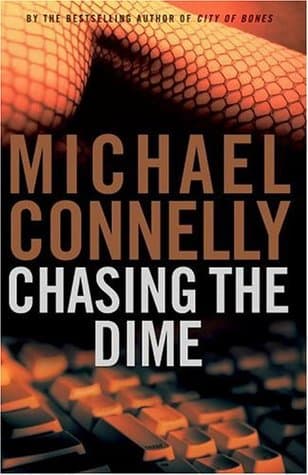
Synopsis
Covers the whole plot, including the ending.
- Difficulty
- Medium
- Pacing
- Moderate
- Mood
- Suspenseful, Dark, Obsessive, Gritty
- Read it if
- You enjoy tech-savvy thrillers with a compelling mystery, a morally ambiguous protagonist, and a dive into the darker corners of the internet.
- Skip it if
- You prefer traditional detective stories without a civilian protagonist, or are sensitive to themes of prostitution and violence.
Chasing the Dime Plot Summary
Covers the whole plot, including the ending.
A New Number, A New Obsession
Henry Pierce, a smart but recently dumped tech entrepreneur, moves into a new apartment after his girlfriend, Sarah, kicks him out. His company, Cypress Systems, is seeking venture capital, a process he calls 'chasing the dime.' After connecting his new phone, he finds several messages from men, all for a woman named Lilly. The messages suggest Lilly is an escort, and one mentions 'her number' being 'on the site.' Despite his business and personal demands, Henry finds himself intrigued by the messages, feeling a strong need to understand who Lilly is and why he is getting her calls.
The First Clues and a Dangerous Website
Driven by curiosity, Henry begins to investigate Lilly. He calls one of the numbers from the messages, pretending to be a client, and is directed to an escort website called 'The Velvet Dolls.' He finds Lilly's profile, with photos, and realizes she is a high-priced escort. The website also lists the phone number he now has, confirming he inherited Lilly's old number. As he looks deeper, he discovers that Lilly's profile shows her as 'unavailable' and that the messages he is getting are from men who do not know this, suggesting Lilly has vanished or is in trouble. This makes him even more determined to find her.
A Plea for Help and a Missing Person
Among the many messages, Henry gets one disturbing voicemail from a man named Frank, who sounds increasingly desperate and worried about Lilly's safety. Frank mentions being at the Peninsula Hotel and urges Lilly to call him. This message makes Henry believe Lilly is in real trouble. Feeling a moral duty, Henry decides to report Lilly missing to the LAPD. He speaks with Detective Joe Reynolds, who first dismisses Henry's concerns, seeing it as likely an escort simply moving on, especially given Henry's weak connection to Lilly through a recycled phone number.
Encountering the Underworld
Not discouraged by the police's doubt, Henry takes his investigation offline. He tracks down Lilly's last known address, an apartment building in Hollywood. While watching the building, he meets a threatening man named 'Bolo,' who seems to be watching the place. Bolo confronts Henry, warning him to stay away from Lilly's business. This encounter confirms Henry's suspicion that Lilly's disappearance is not simple and that dangerous people are involved. He realizes he has entered a world far from his tech life, a world where his usual rules do not apply, and where his actions are being watched.
The Discovery of Frank's Body
Henry's persistence leads him to the Peninsula Hotel, where Frank had left his desperate messages. He learns that Frank Farris, a wealthy businessman, was staying there and has been found dead in his room. The police say it was suicide, but Henry, remembering Frank's frantic voicemails, suspects murder. He believes Frank was killed because of his connection with Lilly and that his death is linked to her disappearance. This discovery raises the stakes of Henry's quest, turning it into a murder investigation, with him now possibly a target.
A Web of Deception and Digital Clues
Using his tech skills, Henry looks deeper into The Velvet Dolls website. He discovers a complex network of servers and encrypted communications, suggesting a highly organized illegal operation. He also uncovers evidence that Lilly was not just an escort but was involved in something more dangerous, possibly blackmailing powerful clients. He thinks Lilly might have been collecting sensitive information from her high-profile clients, making her a problem for those who wanted to use or control her. This revelation provides a strong reason for her disappearance and Frank's death, pointing to a cover-up.
Becoming a Suspect
As Henry gets closer to the truth, he becomes a suspect in Frank Farris's murder. Detective Reynolds, now taking Henry more seriously, considers him a person of interest due to his strong interest in Lilly and his presence near the crime scene. At the same time, the people behind The Velvet Dolls, including Bolo and his associates, see Henry as a threat to their operation. Henry finds himself caught between the law and a dangerous criminal group, alone and vulnerable. He realizes he must clear his name while continuing his search for Lilly, who he believes holds the key to everything.
The Confrontation and the Truth About Lilly
Henry's investigation leads him to confront the person behind The Velvet Dolls and Lilly's disappearance: a man named Maxwell. Maxwell reveals that Lilly was blackmailing powerful clients and had found a larger conspiracy involving illegal data harvesting and political manipulation. He admits to arranging Frank's death and trying to frame Henry. Henry learns that Lilly was not just a victim but an active participant who became too dangerous to control. The confrontation escalates, putting Henry in danger as he tries to expose Maxwell and his network.
A Violent Escape and a Calculated Risk
During the confrontation with Maxwell and his enforcers, Henry is attacked but manages to escape. He realizes that his only chance for survival and justice is to use his tech skills to expose the entire criminal operation. He gathers the evidence he has collected, including the data Lilly had and his own findings about The Velvet Dolls' network. He carefully plans how to release this information to the authorities and the public, knowing that simply handing it over might not be enough to protect him or ensure the truth comes out. It is a high-stakes risk with his life on the line.
Justice and Aftermath
Henry successfully leaks the evidence, exposing Maxwell's operation, the blackmail scheme, and the murders. The revelations lead to the arrests of Maxwell and his associates. Detective Reynolds, finally convinced of Henry's innocence, helps him with the legal aftermath. While Lilly is never found alive, her story and the truth behind her disappearance are revealed. Henry, changed by his journey, finds a sense of closure and purpose. He risked everything, not for money, but for justice and to help a woman he never met, ultimately finding a new direction for his own life.
Chasing the Dime Characters
Henry Pierce
Protagonist
A brilliant but socially awkward tech entrepreneur obsessed with finding a missing escort.
Henry Pierce is a highly intelligent, detail-oriented tech CEO who founded Cypress Systems. He is driven by logic and data, often struggling with interpersonal relationships, as evidenced by his recent breakup with Sarah. His life revolves around 'chasing the dime' – securing funding for his company. However, his accidental inheritance of Lilly's phone number ignites an unexpected obsession, pulling him out of his comfort zone and into a dangerous underworld. He is initially naive but possesses an unyielding moral compass and a keen investigative mind.
Relationships: Sarah (Ex-girlfriend, initially providing emotional support but growing distant due to Henry's obsession.); Lilly (The missing escort, an object of Henry's obsession and the catalyst for his transformation.); Detective Joe Reynolds (Initially skeptical police detective, later a reluctant ally.)
Lilly
Catalyst/Mentioned
A high-end escort whose disappearance triggers Henry's investigation.
Lilly is the enigmatic figure at the heart of the mystery. Known through her phone messages and online profile, she is portrayed as a beautiful, high-priced escort with a dangerous secret. She is not merely a victim but an active, intelligent woman who leveraged her position to gather compromising information on powerful clients, potentially for blackmail. Her ambition and risk-taking ultimately lead to her undoing, but her actions set in motion the entire plot, drawing Henry into a world he never imagined. She represents the hidden dangers and moral complexities of the digital age.
Relationships: Henry Pierce (Her accidental successor to her phone number, obsessed with her disappearance.); Frank Farris (A client who became deeply concerned for her safety.); Maxwell (The mastermind behind the escort service, who saw her as a threat.)
Detective Joe Reynolds
Supporting
The LAPD detective initially dismissive of Henry, later involved in the murder investigation.
Detective Joe Reynolds is a seasoned LAPD detective, initially skeptical and dismissive of Henry Pierce's claims about a missing escort. He views Henry as an eccentric civilian with an overactive imagination, adhering to standard police procedure. As the body count rises and Henry provides increasingly credible (though circumstantial) evidence, Reynolds slowly begins to take him seriously. He represents the official, structured world of law enforcement, contrasting with Henry's unorthodox, tech-driven investigation. Reynolds is pragmatic and by-the-book, a foil to Henry's impulsive and intuitive methods.
Relationships: Henry Pierce (Initially dismissive, later a cautious collaborator and investigator of Henry.)
Sarah
Supporting
Henry's ex-girlfriend, who struggles with his increasing obsession.
Sarah is Henry Pierce's former girlfriend, who has recently broken up with him due to his obsessive work habits and emotional detachment. She represents Henry's connection to a 'normal' life and provides a benchmark for his emotional state. Initially, she offers a degree of support and concern for Henry, but as his obsession with Lilly grows, she becomes increasingly frustrated and worried, unable to understand or accept his dangerous pursuit. Her role highlights Henry's isolation and the personal cost of his investigation.
Relationships: Henry Pierce (Ex-girlfriend, concerned but ultimately alienated by his obsession.)
Frank Farris
Supporting/Victim
A client of Lilly's who becomes concerned for her safety and is later murdered.
Frank Farris is a wealthy businessman and one of Lilly's regular clients. His desperate voicemails to Lilly, left on Henry's new phone, are crucial in establishing the escalating danger surrounding her. Frank genuinely cares for Lilly and becomes increasingly worried when she disappears. His murder, initially staged as a suicide, is the first major turning point in Henry's investigation, confirming that Lilly's disappearance is linked to a violent crime. He represents the human cost of the criminal enterprise Lilly was involved with.
Relationships: Lilly (A client and friend, deeply concerned for her well-being.); Henry Pierce (His voicemails become critical clues for Henry.)
Maxwell
Antagonist
The cunning and ruthless mastermind behind The Velvet Dolls and Lilly's disappearance.
Maxwell is the primary antagonist, a cold and calculating individual who operates The Velvet Dolls, a high-end escort service that also serves as a front for blackmail and illicit data gathering. He is highly intelligent, technologically savvy, and utterly ruthless, willing to eliminate anyone who threatens his sophisticated operation, including Lilly and Frank. Maxwell represents the corrupting influence of power and the dangers of the digital underworld. He is a master manipulator, using technology and human weakness to his advantage, making him a formidable opponent for Henry.
Relationships: Lilly (His employee who became a liability.); Henry Pierce (His primary adversary, whom he attempts to silence and frame.); Bolo (His enforcer and subordinate.)
Bolo
Supporting/Antagonist
A menacing enforcer working for Maxwell.
Bolo is a physically imposing and threatening figure who acts as Maxwell's enforcer. He is the muscle of the operation, tasked with intimidating those who get too close to the truth, including Henry. His presence provides a tangible sense of danger and violence, contrasting with the more cerebral nature of Maxwell's crimes. Bolo's confrontations with Henry are physical and menacing, demonstrating the real-world threats Henry faces outside of his digital investigation. He embodies the brutal reality of the criminal underworld.
Relationships: Maxwell (His subordinate and enforcer.); Henry Pierce (An antagonist who physically threatens Henry.)
Chasing the Dime Themes
Obsession and Redemption
Henry Pierce's initial curiosity quickly becomes an all-consuming focus on Lilly's disappearance. This focus, born from a desire to solve a puzzle and fueled by a growing sense of moral duty, ultimately helps him find redemption. He sacrifices his work, personal life, and safety, changing from a detached tech mogul into a man driven by a deep need for justice. The search for Lilly allows Henry to face his own emotional emptiness and find purpose beyond 'chasing the dime,' as seen when he risks everything to expose Maxwell's network, even when it offers no direct personal gain.
“He had chased the dime his whole life, but this was different. This was about a ghost, a whisper, a woman he had never met, and it was consuming him.”
The Dark Side of Technology and Connectivity
The novel explores how technology, while connecting people, also allows for anonymity and complex criminal activity. Lilly's escort service, 'The Velvet Dolls,' operates online, allowing for discreet transactions and the collection of private digital information. Henry's recycled phone number, a seemingly harmless detail, becomes the accidental entry point to a hidden world of digital exploitation, blackmail, and murder. The internet shields criminals like Maxwell, making their operations harder to trace and their victims more vulnerable. This highlights the ethical problems and dangers of an increasingly connected world.
“The internet was a vast ocean, and in its deepest trenches, the monsters swam unseen.”
Identity and Anonymity
The idea of identity is central, especially through Lilly. Her online image as an escort is carefully made, allowing her to operate anonymously while collecting information on powerful people. Henry himself first uses anonymity to investigate, pretending to be a client. However, as he goes deeper, his own identity as a 'mark' or a 'suspect' becomes unclear and dangerous. The story questions how much of one's true self is shown or hidden by digital identities and how easy it is to become someone else, or to be seen as someone else, in the digital age. The recycled phone number itself shows a blending of identities.
“He was just a number, a ghost in the machine, but the machine was real, and it was deadly.”
Justice vs. Law
Henry Pierce's journey shows the tension between formal legal processes and the pursuit of true justice. The LAPD, through Detective Reynolds, is initially bound by procedure and doubt, unable to act on Henry's 'hunches' or circumstantial evidence. Henry, however, operates outside the law, driven by a personal sense of right and wrong. He takes risks, bends rules, and conducts his own investigation because official channels are too slow or unwilling to acknowledge the truth. This dynamic shows that sometimes, justice requires individuals to go beyond normal limits to uncover the truth, even at great personal cost, as seen in Henry's decision to leak information rather than solely rely on the police.
“The law had its rules, its blinders. Justice, sometimes, had to find its own way.”
Plot Devices & Literary Techniques
The Recycled Phone Number
A seemingly innocuous detail that serves as the inciting incident and central mystery.
Henry Pierce receiving Lilly's old phone number is the primary plot device that kickstarts the entire narrative. It acts as the accidental portal through which Henry enters a dangerous world. Without this specific detail, Henry would never have received the mysterious voicemails, and the plot would not exist. It's a classic 'wrong number' trope elevated to a thriller mechanism, highlighting how seemingly random events can have profound consequences and how digital residue can lead to unexpected connections.
The Voicemails
Audio recordings that provide crucial clues and build suspense.
The voicemails left for Lilly are more than just messages; they are fragments of a developing mystery. They provide Henry with his initial clues, establish Lilly's profession, and, most importantly, convey the escalating concern and desperation of her clients, particularly Frank. The audio format adds an intimate, unsettling quality, allowing the reader (and Henry) to hear the fear and urgency in the callers' voices, building suspense and driving Henry's obsession. They are a direct, unfiltered link to the unfolding danger.
The Velvet Dolls Website
A digital platform that serves as both a setting and a source of information.
The Velvet Dolls website is a central plot device, representing the dark underbelly of digital connectivity. It's where Henry finds Lilly's profile, confirming her identity as an escort and providing visual context. More significantly, it's the digital hub of Maxwell's criminal enterprise, a front for his blackmail schemes. Henry's technological expertise allows him to 'hack' and analyze the site, uncovering deeper layers of the conspiracy. The website functions as a virtual crime scene and a crucial source of evidence, demonstrating how digital forensics can unravel complex plots.
Henry's Technological Expertise
The protagonist's specialized skills that enable his investigation.
Henry Pierce's background as a tech entrepreneur and his advanced computer skills are a critical plot device. Unlike a traditional detective, Henry relies on digital forensics, data analysis, and online investigation to uncover clues. His ability to trace IP addresses, analyze website infrastructure, and understand encrypted communications allows him to delve into aspects of the crime that conventional police methods might miss. This expertise not only drives the plot forward but also positions Henry as a unique kind of investigator, leveraging modern tools to solve a contemporary mystery.
Chasing the Dime Quotes
“Every case has a tell, a tiny ripple in the fabric of the story that points the way.”
“The phone was ringing. It had been ringing for two days. He had finally decided to answer it.”
“There was a fine line between being a successful businessman and a lonely one.”
“Sometimes you have to break the rules to find the truth.”
“He was chasing a ghost, a whisper in the wires.”
“The past is never really dead. It just waits for the right moment to come back and haunt you.”
“In the digital world, anonymity was a weapon and a shield.”
“Fear was a powerful motivator, often more powerful than money.”
“He didn't just solve problems; he anticipated them, created solutions before the client even knew there was a problem.”
“The city was a million stories, all playing out simultaneously, some intersecting, some never touching.”
“He was a man who dealt in information, and information was power.”
“Sometimes the simplest explanation was the one you least wanted to believe.”
“The only way out was through, no matter how dark the path.”
“He had built an empire on bits and bytes, but he was losing his grip on reality.”
Quiz
10 questions on the plot and the characters. Each answer comes with a short explanation.
Question 1
What is the initial reason Henry Pierce receives messages intended for 'Lilly'?
- He accidentally swapped phones with someone.
- He bought a new telephone that previously belonged to Lilly.
- His new apartment's landline number was previously Lilly's.
- Lilly intentionally forwarded her calls to his number.
Show answer
B. He bought a new telephone that previously belonged to Lilly. Henry Pierce receives the messages because he has just plugged in his new telephone, and the messages waiting for him are clearly not intended for him, indicating the number previously belonged to someone else.
Question 2
What is the primary professional pursuit Henry Pierce is engaged in at the beginning of the story?
- Developing a new social media platform.
- Fund-raising for his technology company.
- Investigating cybercrime for the police.
- Writing a book about the tech industry.
Show answer
B. Fund-raising for his technology company. The synopsis states that the company Henry founded is headed into the most critical phase of fund-raising, and he's been 'chasing the dime' in a technological battle.
Question 3
What significant personal event has just occurred in Henry Pierce's life when the story begins?
- He got a major promotion at work.
- He won a large sum of money.
- He was thrown out by his girlfriend.
- He decided to retire early.
Show answer
C. He was thrown out by his girlfriend. The synopsis clearly states, 'Pierce has just been thrown out by his girlfriend and moved into a new apartment,' setting the stage for his personal state at the start.
Question 4
What is the primary motivation that drives Henry Pierce to investigate the messages for Lilly?
- He believes Lilly is a competitor in his tech battle.
- He is intrigued by the mystery and feels something is wrong.
- He is legally obligated to report suspicious activity.
- He hopes to use the information for his company's benefit.
Show answer
B. He is intrigued by the mystery and feels something is wrong. The text states, 'But he can't get the messages for a woman named Lilly out of his head: 'Uh, yes, hello, my name is Frank. I'm at the Peninsula. Room six twelve. So give me a call when you can.' Something is wrong. Pierce probes, investigates...' indicating his intrigue and sense of unease.
Question 5
What is the nature of the 'world' Henry enters when he starts looking for Lilly?
- High-stakes international espionage.
- A world of escorts, websites, sex, and secret passions.
- Underground scientific research.
- A secret society of tech billionaires.
Show answer
B. A world of escorts, websites, sex, and secret passions. The synopsis explicitly states, 'The world he enters is one of escorts, websites, sex, and secret passions,' describing the new environment he finds himself in.
Question 6
How does Henry Pierce's expertise and success from his professional life translate into the world he enters while pursuing Lilly?
- His tech skills make him invaluable in this new world.
- His success and expertise mean nothing in this new landscape.
- He quickly adapts his business strategies to this new environment.
- He gains immediate respect due to his wealth and influence.
Show answer
B. His success and expertise mean nothing in this new landscape. The text highlights this contrast: 'But in pursuing Lilly, Pierce has entered a landscape where his success and expertise mean nothing. He is a mark, an outsider...' demonstrating his disadvantage.
Question 7
What is the metaphorical meaning of 'chasing the dime' as described in the synopsis?
- Searching for loose change to make ends meet.
- Doing whatever it takes to win a technological battle for millions.
- Trying to find a small, insignificant clue in a large mystery.
- Engaging in casual, low-stakes gambling.
Show answer
B. Doing whatever it takes to win a technological battle for millions. The synopsis clarifies this by stating, 'He's been 'chasing the dime' - doing all it takes to come out first in a technological battle whose victor will make millions.'
Question 8
What dangerous situations does Henry Pierce face as a consequence of pursuing Lilly?
- He becomes a target of corporate espionage and loses his company.
- He becomes the victim of astonishing violence and the chief suspect in a murder case.
- He is blackmailed by Lilly's associates and forced into hiding.
- He loses all his money and becomes homeless.
Show answer
B. He becomes the victim of astonishing violence and the chief suspect in a murder case. The synopsis states, 'He is a mark, an outsider, and soon he is also the victim of astonishing violence, the chief suspect in a murder case, and fighting for his life against forces he can barely discern.'
Question 9
What role does Lilly ultimately come to play for Henry Pierce, beyond just being the object of his search?
- She becomes a rival in his business endeavors.
- She becomes the key that might fix his broken life.
- She turns out to be an undercover agent working against him.
- She helps him regain his lost fortune.
Show answer
B. She becomes the key that might fix his broken life. The synopsis describes this transformation: 'To Pierce, she becomes the key that might fix a broken life,' suggesting a deeper, personal significance.
Question 10
What is the central contrast highlighted between Henry Pierce's initial life and the one he enters by pursuing Lilly?
- From a life of poverty to one of extreme wealth.
- From a life driven by work and technological success to one where his expertise means nothing and he's an outsider.
- From a solitary existence to a life surrounded by friends and family.
- From a quiet, rural setting to a bustling urban environment.
Show answer
B. From a life driven by work and technological success to one where his expertise means nothing and he's an outsider. The text directly states, 'leaving behind a life driven by work to track down and help a woman he has never met,' and later, 'in pursuing Lilly, Pierce has entered a landscape where his success and expertise mean nothing. He is a mark, an outsider.' This highlights the stark contrast.
Chasing the Dime FAQ
What is the central premise of 'Chasing the Dime'?
The central premise revolves around Henry Pierce, a tech entrepreneur who, after moving into a new apartment and acquiring a new phone number, begins receiving cryptic messages intended for a woman named Lilly. These messages, initially a distraction from his own life and business struggles, pull him into a dangerous investigation to find Lilly, despite never having met her.
Who is Henry Pierce and what is his professional background?
Henry Pierce is the founder of a tech company specializing in internet security software, specifically a firewall application. He is deeply immersed in the competitive world of Silicon Valley startups, 'chasing the dime' to secure crucial funding and beat rivals in a high-stakes technological race.
What prompts Henry to get involved in Lilly's mystery, given his own professional and personal problems?
Henry is initially intrigued by the messages, which provide a distraction from his recent breakup with Sarah and the immense pressure of his business. The increasingly urgent and unsettling nature of the calls, particularly those from 'Frank,' piques his curiosity and a nascent desire to do something meaningful, pulling him away from his self-absorbed, work-driven existence.
Who is Lilly and what is her connection to the mysterious phone calls?
Lilly is a high-end escort whose phone number was inadvertently reassigned to Henry. She is the subject of the calls because she has gone missing, prompting her clients and associates to try and locate her through her last known contact number, which now belongs to Henry.
What is the significance of the phrase 'chasing the dime' in the context of the book?
'Chasing the dime' refers to Henry Pierce's relentless pursuit of success and funding in the cutthroat tech industry, where millions are at stake. It symbolizes his prior life's singular focus on wealth and professional triumph, contrasting sharply with his later pursuit of Lilly, which is driven by a different kind of urgency.
How does Henry's expertise in technology both help and hinder his investigation into Lilly's disappearance?
Henry's tech expertise allows him to trace IP addresses, understand online communities, and navigate the internet's hidden corners, which is crucial for finding Lilly. However, his reliance on logic and data initially blinds him to the more visceral, dangerous realities of the world he enters, making him an outsider and a target for those who operate outside the digital realm.
Are there any subtle clues early on that suggest the true nature of Lilly's disappearance or the dangers involved?
Yes, the increasing desperation in the callers' voices, particularly Frank's, and the mention of 'the site' for Lilly, subtly hint at a world far more complex and dangerous than Henry initially perceives. The abruptness of Lilly's disappearance, without any farewell to her clients, also suggests foul play rather than a simple departure.
What role does Henry's ex-girlfriend, Sarah, play in the story, beyond their breakup?
Sarah's role is primarily to highlight Henry's isolated state and the emptiness of his life before Lilly. Their breakup serves as the catalyst for his move and acquiring the new number. She also represents the life he's leaving behind, a life driven by ambition rather than human connection, and her absence underscores his newfound solitude.
How does Henry's initial motivation to find Lilly evolve throughout the novel?
Initially, Henry is driven by curiosity and a desire for distraction from his own problems. As he delves deeper, his motivation transforms into a genuine concern for Lilly's safety and a need for redemption, moving from a detached observer to someone personally invested in her fate, seeing her as a potential key to fixing his own 'broken life.'
What psychological impact does entering the world of escorts and secret passions have on Henry?
Entering this world forces Henry to confront uncomfortable truths about human desire, vulnerability, and exploitation. It shatters his sheltered, tech-centric worldview, exposing him to a grittier reality where his usual metrics of success are meaningless. This exposure leads to a profound re-evaluation of his values and purpose.
How does Henry's character demonstrate a shift from intellectual pursuit to primal survival instinct?
Henry begins as an intellectual, solving problems through code and logic. However, as he faces astonishing violence and becomes a murder suspect, he is forced to abandon his cerebral approach and rely on more primal survival instincts, fighting for his life against physical threats and shadowy forces he cannot easily compute or control.
What psychological need does Henry fulfill by pursuing Lilly, given her status as an 'object of desire'?
By pursuing Lilly, Henry fulfills a need for purpose and connection that was absent in his work-driven life. While Lilly is an 'object of desire' for others, for Henry, she becomes an object of salvation – a means to escape his own emotional emptiness and find meaning by helping another, thereby giving his own existence a new, vital direction.
Is Lilly's role more symbolic than literal in the story, representing a catalyst for Henry's transformation?
Lilly serves both a literal and symbolic role. Literally, she is a missing person Henry is trying to find. Symbolically, she represents the human connection and purpose that Henry lacks, acting as a catalyst for his transformation from a cold, ambitious entrepreneur to a man willing to risk everything for someone he doesn't know, ultimately 'fixing' his broken life.
Does the novel suggest a critique of the tech world or modern society's reliance on technology?
The novel subtly critiques the isolating nature of the tech world, showing how Henry's success has come at the cost of personal connection and empathy. It also highlights how technology, while enabling communication and information access, can also facilitate illicit activities and create a veneer of anonymity that masks real-world dangers.
What is the ultimate 'dime' Henry Pierce is chasing by the end of the book, and how has it changed?
Initially, the 'dime' was financial success and professional triumph in the tech industry. By the end, the 'dime' Henry is chasing has transformed into something far more profound: personal redemption, a sense of purpose, and the chance to make a meaningful human connection, even if it means sacrificing his old life and facing extreme danger.
How does the ending challenge or reinforce the reader's perception of justice within the narrative?
The ending often challenges the reader's perception of justice by demonstrating that the legal system isn't always capable of delivering it, especially when dealing with hidden networks and powerful, shadowy figures. Henry often has to operate outside conventional justice, suggesting that true resolution sometimes requires personal sacrifice and unorthodox methods.
What message does the book convey about finding purpose outside of traditional success metrics?
The book strongly conveys that true purpose and fulfillment often lie beyond conventional success metrics like wealth and career achievement. Henry's journey illustrates that by stepping out of his comfort zone and dedicating himself to a cause beyond self-interest, he finds a deeper meaning in life that his previous pursuits never offered.
About the author

Michael Connelly is an American author known for his crime fiction novels. His notable works include The Lincoln Lawyer, The Black Echo, The Poet, The Gods of Guilt, The Black Ice, and The Brass Verdict, which often feature complex characters and intricate plots. Connelly's writing frequently explores themes of justice and morality within the legal system.
Similar books
- The Lincoln Lawyer
Michael Connelly
4.2 (193k) average on GoodreadsThrillerFeatures a protagonist navigating the morally gray areas of Los Angeles, with a focus on procedural detail and an intricate plot.
- Digital Fortress
Dan Brown
3.7 (561k) average on GoodreadsThrillerExplores the intersection of technology, government secrets, and high-stakes mystery, with a focus on digital clues and a race against time.
- The Da Vinci Code
Dan Brown
3.9 (1.9M) average on GoodreadsThrillerWhile Chasing the Dime focuses on digital mysteries and personal obsession, Dan Brown's The Da Vinci Code (2003) also features an academic thrust into a complex, high-stakes mystery. Brown's novel, however, relies more on historical conspiracies and ancient symbols, creating a global chase, whereas Connelly's scope is more contained, focusing on a personal quest rooted in contemporary technology and identity. Both utilize a rapid pace and intricate plotting, but Brown's work often faces criticism for historical inaccuracies, a charge less frequently leveled at Connelly's more grounded thrillers.
- Angels & Demons
Dan Brown
3.9 (2.7M) average on GoodreadsThrillerA Harvard symbologist races through Rome's ancient sites, deciphering cryptic clues to unmask the Illuminati and stop a vengeful plot to destroy the Vatican with a stolen antimatter weapon.
- Gone Girl
Gillian Flynn
4.1 (2.3M) average on GoodreadsThrillerA wife's sudden disappearance on her fifth anniversary reveals a web of lies and psychological warfare, exposing the secrets within a seemingly perfect marriage.
- The Girl on the Train
Paula Hawkins
3.9 (2.1M) average on GoodreadsThrillerA woman’s fascination with a seemingly perfect couple she watches from her daily train commute leads her into a dark investigation when she witnesses something that shatters their idyllic image.





Enjoyed the summary?
A summary gives you the shape of the book. The book itself has the detail, the examples and the voice.
Find Chasing the Dime on AmazonAs an Amazon Associate, BookBrief earns from qualifying purchases. How we're funded