
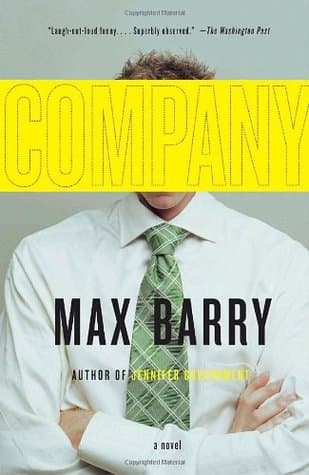
Synopsis
Covers the whole plot, including the ending.
- Difficulty
- Easy
- Read it if
- You're a professional who has ever felt a profound sense of meaninglessness or absurdity in your workplace, or you enjoy satirical critiques of corporate culture and bureaucracy.
- Skip it if
- You prefer serious, actionable business advice, or you dislike dark humor and cynical takes on professional life.
Company Quotes
“My job is to find people who are passionate about something, and then give them a chance to be passionate about it here.”
“The problem with being good at something is that you end up doing it for the rest of your life.”
“If you don't know what you're doing, you're probably doing it right.”
“Most people don't want to change. They just want to complain about how things are.”
“The company isn't a family. It's a machine. And you're a cog.”
“It's not about being smart. It's about being able to pretend you're smart until someone else believes it.”
“People don't quit bad jobs; they quit bad bosses.”
“The only thing worse than being ignored is being micromanaged.”
“We sell convenience. People will pay for anything that makes their lives easier, even if it makes them lazier.”
“The first rule of business is that there are no rules, only consequences.”
“Success is just a series of failures you learned from.”
“The most dangerous thing in business is not knowing who your real competition is.”
“You can't motivate people to do something they don't want to do. You can only create an environment where they want to do it.”
“The biggest lie in corporate life is that your work matters.”
Quiz
10 questions on the plot and the characters. Each answer comes with a short explanation.
Question 1
What is Stephen Jones's initial goal upon joining Zephyr Holdings?
- To uncover the company's true product.
- To climb the corporate ladder.
- To expose the irrationality of company policy.
- To find out who is stealing the donuts.
Show answer
B. To climb the corporate ladder. Stephen Jones initially joins Zephyr Holdings with the ambition to climb the corporate ladder, a common goal for new hires in many companies.
Question 2
What unusual characteristic does the receptionist at Zephyr Holdings possess?
- She is the CEO's daughter.
- She is paid significantly more than other employees to do nothing.
- She is the only one who knows what the company sells.
- She is responsible for managing the company's finances.
Show answer
B. She is paid significantly more than other employees to do nothing. One of the earliest indicators of Zephyr's bizarre corporate culture is that the beautiful receptionist is paid twice as much as anybody else to do nothing.
Question 3
What do the sales representatives at Zephyr Holdings use as manuals?
- Traditional sales handbooks.
- Proprietary company documents.
- Self-help books.
- Customer testimonials.
Show answer
C. Self-help books. The sales reps at Zephyr Holdings use self-help books as their manuals, highlighting the unconventional and often nonsensical nature of the company's operations.
Question 4
What is the primary source of office intrigue mentioned early in the book?
- A new product launch.
- Missing donuts.
- A corporate espionage plot.
- A dispute over office space.
Show answer
B. Missing donuts. Missing donuts are explicitly stated as the cause of office intrigue, demonstrating the trivial yet consuming nature of the employees' concerns within Zephyr.
Question 5
Which of the following best describes the company's 'product' as the employees understand it?
- A complex financial instrument.
- An intangible service.
- A physical consumer good.
- No one knows exactly what they are selling.
Show answer
D. No one knows exactly what they are selling. A central absurdity of Zephyr Holdings is that 'no one knows exactly what they are selling,' which is a key element of the company's 'irrational rationality.'
Question 6
What is the overarching theme Max Barry explores through the 'irrational rationality' of Zephyr Holdings?
- The importance of strong leadership in a corporation.
- The absurdity and dehumanizing aspects of modern corporate culture.
- The benefits of a flat organizational hierarchy.
- The challenges of product development in a competitive market.
Show answer
B. The absurdity and dehumanizing aspects of modern corporate culture. The book uses Zephyr's bizarre practices to satirize and critique the often senseless and dehumanizing aspects of modern corporate life and bureaucracy.
Question 7
How does Stephen Jones's perspective evolve regarding his initial corporate ambitions?
- He remains focused on climbing the ladder, adapting to Zephyr's unique rules.
- He becomes disillusioned and finds himself 'descending deeper into the irrational rationality of company policy.'
- He successfully identifies and implements strategies to improve the company's efficiency.
- He leaves Zephyr Holdings to start his own, more rational business.
Show answer
B. He becomes disillusioned and finds himself 'descending deeper into the irrational rationality of company policy.' The synopsis clearly states that while Jones originally wanted to climb the corporate ladder, he now finds himself 'descending deeper into the irrational rationality of company policy,' indicating a shift from ambition to bewilderment and deeper involvement in the company's absurdities.
Question 8
What is the significance of the CEO's absence or invisibility at Zephyr Holdings?
- It suggests a highly efficient, self-managing organization.
- It highlights the lack of clear direction and accountability within the company structure.
- It implies the CEO is a reclusive genius focused solely on innovation.
- It is a common practice in modern corporate environments.
Show answer
B. It highlights the lack of clear direction and accountability within the company structure. The fact that 'no one has seen the CEO' is a strong indicator of the company's dysfunctional hierarchy and lack of transparent leadership, contributing to its overall irrationality.
Question 9
How does the novel 'Company' use humor to convey its message about corporate life?
- Through slapstick comedy and exaggerated physical gags.
- By presenting mundane corporate scenarios in a dry, observational style.
- Through satirical exaggeration of common business practices and absurd logical conclusions.
- By featuring witty banter and clever wordplay among the characters.
Show answer
C. Through satirical exaggeration of common business practices and absurd logical conclusions. The book achieves its humor by taking typical corporate absurdities (like self-help manuals for sales, or donut theft as high intrigue) to their logical, yet ridiculous, extremes, creating a satirical critique of the business world.
Question 10
What is the ultimate 'telling' aspect that Stephen Jones discovers about Zephyr Holdings?
- The company is a front for illegal activities.
- The company's true product is its employees' labor, regardless of output.
- The CEO is a brilliant strategist who secretly manipulates the market.
- The company is a social experiment designed to study human behavior.
Show answer
B. The company's true product is its employees' labor, regardless of output. The book ultimately reveals that Zephyr Holdings is a self-sustaining entity where the primary 'product' is the generation of tasks and the consumption of employee time, effectively making the employees themselves the product of the company's existence, a meta-commentary on corporate purpose.
Company FAQ
What is 'Company' by Max Barry about?
'Company' is a satirical novel by Max Barry that follows new hire Stephen Jones as he navigates the absurd and increasingly bizarre corporate culture of Zephyr Holdings. It explores themes of corporate bureaucracy, the meaninglessness of modern work, and the search for purpose within a dysfunctional system.
Does Zephyr Holdings operate like a real company?
While Zephyr Holdings presents itself as a typical corporation, its internal operations are far from conventional. The book exaggerates many aspects of corporate life to highlight the inherent absurdities and irrationalities that can exist within large organizations, making it a highly stylized and humorous take on business.
What is the 'irrational rationality' of company policy mentioned in the book?
The 'irrational rationality' refers to the illogical and often contradictory rules and behaviors that become normalized and even expected within the company. Policies that seem nonsensical from an outside perspective are rigidly adhered to and justified internally, creating a unique and often comical corporate logic.
How does 'Company' differ from other business satires like 'Dilbert' or 'Office Space'?
'Company' takes a more surreal and existential approach to corporate satire compared to 'Dilbert' or 'Office Space.' While sharing themes of workplace absurdity, Barry's novel delves deeper into the philosophical implications of a company that seems to exist for its own sake, rather than a clear product or service, pushing the boundaries of realism.
Does Stephen Jones ever find out what Zephyr Holdings actually sells?
Part of the central mystery and humor of the book revolves around the ambiguity of Zephyr Holdings' product. Stephen Jones, along with most employees, struggles to understand what the company actually produces or sells, which contributes to the novel's commentary on the often-abstract nature of modern work.
Is 'Company' a good book for someone working in a corporate environment?
Yes, 'Company' is often highly recommended for individuals in corporate roles as it provides a humorous and often cathartic reflection on the absurdities of office life. Many readers find its exaggerated scenarios relatable and insightful, offering a fresh perspective on the daily grind.
What role do the missing donuts play in the office intrigue?
The missing donuts serve as a microcosm of the larger corporate dysfunction and a catalyst for office drama. This seemingly trivial incident escalates into a significant point of contention and investigation, highlighting how minor issues can consume disproportionate attention within a bureaucratic environment.
Does 'Company' offer any practical business advice?
While 'Company' is a work of fiction and satire, it implicitly offers insights into the pitfalls of corporate culture, poor communication, and meaningless work. It serves more as a cautionary tale and a mirror to corporate life rather than a source of direct business strategies.
What is the significance of the beautiful receptionist being paid more to do nothing?
The receptionist's role is a key example of the company's 'irrational rationality' and its detached logic. Her high salary for seemingly no work underscores the arbitrary nature of value and compensation within the company, challenging conventional notions of productivity and merit.
About the author

Max Barry is an Australian author known for his satirical fiction that often explores themes of corporate culture and language. His notable works include "Lexicon," which delves into the power of words, "Jennifer Government," a dystopian tale set in a world dominated by corporations, and "Company," a humorous take on the corporate workplace.
Similar books
- Catch-22
Joseph Heller
4.0 (723k) average on GoodreadsHistorical FictionExplores the absurdities of self-serving, illogical systems and bureaucratic traps.
- Then We Came to the End
Joshua Ferris
3.5 (31k) average on GoodreadsLiterary FictionFerris's novel, like Barry's, delves into the existential ennui and absurdities of office life, specifically focusing on the gradual decline of a Chicago advertising agency. Both books use the office setting to explore themes of identity, purpose, and the human condition within corporate confines. However, Ferris's approach is often more melancholic and character-driven, focusing on the internal lives and relationships of the employees as their world crumbles, whereas Barry's "Company" maintains a more detached, darkly comedic, and systemic critique of the corporate structure itself.
- Steve Jobs
Walter Isaacson
4.1 (957k) average on GoodreadsBusinessSteve Jobs was a visionary who fused creativity and technology to revolutionize six industries and shape our digital world.
- Freakonomics: A Rogue Economist Explores the Hidden Side of Everything
Steven D. Levitt
4.0 (709k) average on GoodreadsBusinessThis book uses economic principles to reveal the surprising incentives behind everything from drug dealing and real estate to cheating teachers and the decline of crime.
- The Tipping Point: How Little Things Can Make a Big Difference
Malcolm Gladwell
4.0 (690k) average on GoodreadsBusinessMalcolm Gladwell explains how small, targeted actions can start widespread changes in trends, behaviors, and ideas.
- Outliers: The Story of Success
Malcolm Gladwell
4.2 (556k) average on GoodreadsBusinessMalcolm Gladwell argues that true success is not just about individual talent, but about the hidden advantages of culture, opportunity, and unique experiences that shape extraordinary lives.






Enjoyed the summary?
A summary gives you the shape of the book. The book itself has the detail, the examples and the voice.
Find Company on AmazonAs an Amazon Associate, BookBrief earns from qualifying purchases. How we're funded