
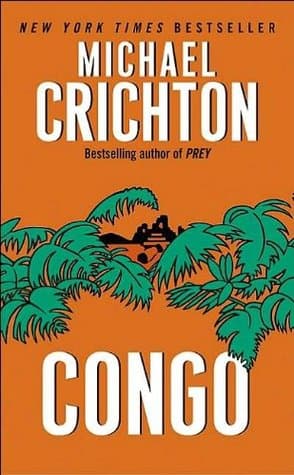
Synopsis
Covers the whole plot, including the ending.
- Difficulty
- Medium
- Pacing
- Fast
- Mood
- Suspenseful, Adventurous, Dangerous, Mysterious
- Read it if
- You love fast-paced adventure, scientific thrillers, and survival stories with a touch of ancient mystery and killer primates.
- Skip it if
- You prefer character-driven dramas over plot-heavy action, or are sensitive to graphic violence and intense peril.
Congo Plot Summary
Covers the whole plot, including the ending.
The Ill-Fated Zinj Expedition and Karen Ross's Investigation
The story begins with the horrific end of an Earth Resources Technology Services (ERTS) expedition in the Virunga region of the Congo. Eight American geologists are killed, their camp destroyed, and their bodies mutilated. Karen Ross, the Congo Project Supervisor for ERTS in Houston, receives a blurry video transmission of the aftermath. It shows the devastation and a fleeting, dark, man-shaped blur. The company urgently wants to recover the expedition's newly discovered blue diamonds, which are needed for advanced computer technology. Ross suspects foul play beyond local wildlife and begins to assemble a new team. She is driven by the need to secure the diamond mine and understand the mysterious deaths. The previous expedition's satellite link was severed after the attack, leaving many questions about the true nature of the threat.
Amy the Gorilla and the Lost City of Zinj
In San Francisco, primatologist Peter Elliot works with Amy, a lowland gorilla trained in American Sign Language. She has a vocabulary of 620 signs. Amy has been acting more aggressively and erratically, having vivid nightmares and drawing disturbing images of a lost city and menacing gorillas. Peter's colleague, Richard, uses a computer to analyze Amy's drawings. They look remarkably like an ancient Portuguese print from 1642 depicting the legendary Lost City of Zinj. This city was thought to be the source of King Solomon's mines, specifically blue diamonds. Peter begins to connect Amy's behavior to her ancestral memory and the possible location of Zinj, believing her drawings are a key to understanding her distress and the lost city.
Forming the Expedition and the Journey to Africa
Karen Ross sees the possible connection between Amy's drawings and the lost diamond mine. She recruits Peter Elliot and Amy to join her new expedition. Charles Munro, an experienced big-game hunter and guide with much knowledge of the region, also joins them. Homolka, a Dutch geophysicist with a personal interest in Zinj, is also part of the team. The expedition flies to Africa, where they immediately face political instability and dangerous warlords. Their initial attempts to get a permit and transport are full of danger, including a harrowing encounter with heavily armed local militias and the destruction of their plane. These early challenges show the extreme risks involved in going into the remote and volatile Congolese jungle.
Navigating the Jungle and Amy's Growing Agitation
After their plane is destroyed, the expedition must trek on foot into the dense, unforgiving Congo rainforest. Munro is very helpful, guiding them through dangerous terrain and negotiating with cautious local tribes. Amy acts more agitated as they get closer to Zinj; her nightmares become more intense, and her drawings more frantic. She signs about 'bad gorillas' and 'fire,' showing a deep fear and a connection to something violent in her past or ancestral memory. Peter struggles to fully understand her signs, but he recognizes the growing urgency in her communication, which seems to guide them, though fearfully, towards a specific location.
The First Encounter with the Grey Gorillas
As the expedition goes deeper, they begin to find evidence of the previous ERTS team, including their destroyed equipment and fragmented remains. They soon have their first horrifying encounter with the 'grey gorillas' – a previously unknown, highly aggressive, and intelligent species of primate with unusually light fur and a tendency for violence. These gorillas are larger and more organized than typical gorillas, attacking with calculated ferocity. The team realizes that these are the 'bad gorillas' Amy has been signing about. This encounter confirms Ross's suspicions about the true nature of the threat and makes their mission more urgent, as they are now hunted by these formidable creatures.
Discovery of the Lost City of Zinj
Amy's increasingly specific signs and drawings match the ancient Portuguese map. Guided by these, the expedition finally finds the ruins of the Lost City of Zinj. The city is ancient, overgrown, and partially submerged, but its complex architecture and many mining tunnels are clear. Homolka, the geophysicist, reveals his true motivation: he has been obsessed with Zinj for years, believing it is the source of legendary blue diamonds. The team realizes the city was a sophisticated mining operation, built by an ancient civilization to extract the precious blue diamonds, and that the grey gorillas are linked to its history.
The Purpose of the Grey Gorillas and the Diamond Mine
Inside Zinj, the team discovers the chilling truth: the grey gorillas were not just wild animals. They were genetically engineered or selectively bred guardians of the diamond mines, a defense created by the ancient civilization. These gorillas are very intelligent, territorial, and have a unique vocalization that disorients and attacks human perception. They are drawn to the blue diamonds and fiercely protect the mine. The previous ERTS team was killed for trying to take the diamonds, and now the grey gorillas see Ross's expedition as the same threat. The team finds large deposits of blue diamonds, confirming the city's purpose and the immense value of their discovery to ERTS.
Trapped in Zinj and the Volcanic Threat
As the team tries to navigate the ruins and get samples of the blue diamonds, the grey gorillas relentlessly attack them. The gorillas use advanced tactics, ambushing them from hidden passages and using their disorienting vocalizations. At the same time, the region becomes seismically active, and a nearby volcano begins to erupt, threatening to destroy Zinj and bury everyone in it. The double threat of the enraged grey gorillas and the impending natural disaster creates a desperate race against time. The team is trapped, with their escape routes blocked or collapsing, and their numbers decreasing.
The Final Confrontation and Escape
In a climactic struggle, the surviving members of the expedition, including Ross, Peter, and Munro, fight their way through the collapsing city, fending off waves of grey gorillas. They use various means, including sound-based weapons and explosives, to defend themselves and create an escape path. Homolka, driven by greed, tries to hoard diamonds but is killed by the gorillas. Amy, initially terrified, helps Peter understand the gorillas' patterns and even uses her own learned aggression to deter some of them. Lava flows and volcanic ash consume Zinj, burying the city and the remaining grey gorillas.
Aftermath and Resolution
Ross, Peter, and Amy are the only survivors of the expedition. They escape Zinj just as the volcano completely engulfs it, wiping the lost city and its secrets from the map. A search party eventually rescues them. Ross, with some diamond samples, returns to ERTS, but the company's plans to exploit the region are stopped by Zinj's destruction and the impossibility of further access. Peter continues his work with Amy, who, after the traumatic experience, shows signs of returning to her more docile self, though changed by her ancestral journey. The events of Zinj remain a secret, a reminder of the dangers of corporate greed and the mysteries of the wild.
Principal Figures
Karen Ross
Protagonist
ERTS Congo Project Supervisor, driven by corporate objectives and survival.
Karen Ross is a brilliant, ambitious, and highly analytical project supervisor for Earth Resources Technology Services (ERTS). Her primary motivation is the recovery of the blue diamonds and the successful completion of her corporate mission. She is pragmatic, often cold, and initially dismissive of Peter Elliot's primatology work, viewing it as secondary to her objectives. However, as the expedition progresses, she demonstrates remarkable resilience, strategic thinking, and a growing understanding of the dangers they face, adapting her rigid corporate mindset to the brutal realities of the jungle. Her arc involves a subtle shift from pure corporate ambition to a deeper appreciation for life and the unknown.
Relationships: Peter Elliot (professional collaboration, initially skeptical, later mutual respect); Charles Munro (professional guide, relies on his expertise); Homolka (colleague, later distrusts his motives)
Peter Elliot
Protagonist
Primatologist and guardian of Amy, seeking to understand gorilla communication and behavior.
Peter Elliot is a dedicated primatologist, deeply committed to his research on gorilla communication, particularly with Amy. He is intelligent, compassionate, and possesses a strong ethical compass. His initial motivation for joining the expedition is to understand Amy's erratic behavior and to protect her, but he soon becomes embroiled in the larger mystery of Zinj. He is often at odds with Ross's purely mercenary approach, valuing life and scientific discovery over corporate profit. His expertise in primatology is crucial for understanding the grey gorillas and for communicating with Amy, making him an indispensable member of the team.
Relationships: Amy (primary caregiver and research partner, deep emotional bond); Karen Ross (professional collaboration, often conflicting viewpoints); Richard (research colleague)
Amy
Supporting
A highly intelligent lowland gorilla fluent in American Sign Language.
Amy is a unique lowland gorilla, the subject of Peter Elliot's research, capable of communicating through 620 signs in American Sign Language. She is intelligent, sensitive, and exhibits a range of human-like emotions. Her nightmares and drawings of a lost city and violent gorillas are the initial catalyst for the expedition to Zinj. As they approach the ancestral home of her species, her behavior becomes increasingly agitated, yet her signs and memories prove invaluable in guiding the team and understanding the nature of the grey gorillas. She is a vital link between the human world and the wild, and her journey is one of rediscovering her heritage.
Relationships: Peter Elliot (deep bond, caregiver and interpreter); Karen Ross (initially viewed as an asset, later a fellow survivor)
Charles Munro
Supporting
Experienced big-game hunter and expedition guide.
Charles Munro is a seasoned big-game hunter, mercenary, and professional guide with extensive experience in the African wilderness. He is pragmatic, cynical, and highly skilled in survival, navigation, and combat. Munro is initially hired for his expertise in the dangerous Congolese environment and proves to be an invaluable asset, often saving the team from various perils. He possesses a deep understanding of the local cultures and the dangers of the jungle, and while he is primarily motivated by payment, he also demonstrates a strong sense of professionalism and a surprising loyalty to the expedition's survival. He is the team's anchor in the face of the unknown.
Relationships: Karen Ross (professional guide, respects her resolve); Peter Elliot (professional associate, sometimes annoyed by his idealism)
R.B. Travis
Supporting
ERTS CEO, driven by corporate greed and ruthless ambition.
R.B. Travis is the CEO of Earth Resources Technology Services (ERTS) and Karen Ross's superior. He is a ruthless, profit-driven corporate executive whose sole focus is securing the blue diamonds from Zinj for their value in advanced computing. He demonstrates little regard for human life, viewing the previous expedition's deaths as an acceptable loss in the pursuit of immense profit. Travis pushes Ross relentlessly, prioritizing the company's financial interests above all else. He represents the unchecked ambition and moral compromises of corporate power, serving as a distant but powerful antagonist to the expedition's human element.
Relationships: Karen Ross (boss and subordinate, highly demanding)
Professor Homolka
Supporting
Dutch geophysicist obsessed with the Lost City of Zinj and its diamonds.
Professor Homolka is a Dutch geophysicist who joins the expedition under false pretenses. His true motivation is not scientific curiosity for ERTS, but a lifelong obsession with finding the Lost City of Zinj and its legendary blue diamonds for his own personal gain. He is manipulative, deceitful, and ultimately driven by extreme greed. Homolka's hidden agenda and his knowledge of Zinj's history are initially helpful, but his avarice eventually leads to his downfall, as he attempts to betray the team and hoard diamonds during the volcanic eruption, resulting in his death by the grey gorillas. He embodies the corrupting influence of greed.
Relationships: Karen Ross (colleague, later antagonist); Peter Elliot (colleague, later antagonist)
Richard
Supporting
Peter Elliot's research colleague, aiding in computer analysis of Amy's drawings.
Richard is Peter Elliot's colleague in San Francisco, assisting him with his primatology research. He is primarily responsible for the technological aspects of their work, including the computer analysis of Amy's drawings. Richard plays a crucial role in the early stages of the plot by confirming the connection between Amy's images and the ancient Portuguese map of Zinj. He provides the initial scientific validation that propels the narrative forward, bridging the gap between Amy's unique communication and the historical mystery of the lost city. He remains at the research facility, providing remote support and analysis.
Relationships: Peter Elliot (research colleague and friend)
The Grey Gorillas
Antagonist
A highly aggressive, intelligent, and genetically distinct species of gorilla.
The grey gorillas are the primary antagonists of the story, a unique and previously unknown species of gorilla inhabiting the Lost City of Zinj. They are larger, lighter-furred, and far more intelligent and aggressive than typical gorillas, possessing a unique, disorienting vocalization. The novel reveals they were likely bred or trained by the ancient civilization of Zinj to guard the diamond mines, making them fierce and effective protectors. Their attacks are organized and brutal, driven by an instinct to defend their territory and the blue diamonds. They represent a primal, evolved threat, a perfect killing machine designed for a specific purpose.
Relationships: Humans (expedition members) (predator-prey, territorial defenders)
Themes & Insights
Corporate Greed vs. Scientific Ethics
This theme explores the destructive results of unchecked corporate ambition when it conflicts with scientific ethics and human values. ERTS, driven by the immense profit potential of blue diamonds, ignores the dangers and moral implications. R.B. Travis's ruthless orders to Karen Ross show this. Peter Elliot, in contrast, represents the ethical scientist concerned with animal welfare and genuine discovery. The novel shows how the pursuit of profit can lead to exploitation, disregard for life, and ultimately, self-destruction, as seen in Homolka's fate and the expedition's near-annihilation.
“He was a businessman. He had no interest in science, or in gorillas, or in Africa. He was interested in blue diamonds.”
The Dangers of Unnatural Intervention
The novel examines the dangers of genetic manipulation and selective breeding, especially with the grey gorillas. These creatures are not natural but were engineered by the ancient civilization of Zinj to be fierce guardians of their diamond mines. This theme suggests that changing nature, even for seemingly good reasons (like protecting wealth), can create unforeseen and uncontrollable monsters. The grey gorillas are a perversion of natural evolution, a weapon that eventually consumes its creators' legacy and threatens anyone who trespasses. Their existence is a warning about playing God.
“These were not ordinary gorillas. They were something else entirely. Something created.”
Communication and Misunderstanding
A central theme is the complexities and limits of communication, both between species and within a species. Peter's work with Amy shows the potential for understanding between humans and animals through sign language, yet even with Amy, misunderstandings happen. The grey gorillas communicate with unique, disorienting vocalizations that humans cannot understand but are designed to attack. This theme also applies to the human characters, where corporate language often hides true intent (Travis), and personal goals lead to deceit (Homolka). The inability to fully understand the grey gorillas' motives or the ancient civilization's warnings adds greatly to the expedition's danger.
“She was trying to tell him something important, something terrifying, but the words were not enough.”
The Primal Instinct vs. Civilization
The conflict between humanity's civilized appearance and its underlying primal instincts is a recurring idea. The expedition goes into the 'dark continent,' a place where modern technology and social norms quickly break down. Characters like Munro embody a more primal, survival-driven mindset, while others like Ross and Peter must shed their civilized ways to survive. Amy's journey back to her ancestral home triggers primal memories and behaviors, showing the deep instincts within all creatures. The grey gorillas, a product of ancient civilization, are a technologically enhanced primal force, blurring the lines between nature and human intervention.
“In the Congo, all the rules were different. All the assumptions were wrong.”
The Allure and Danger of the Unknown
The Lost City of Zinj and its blue diamonds are the ultimate unknown, a powerful draw for both scientific curiosity and ruthless exploitation. The mystery of the previous expedition's deaths, the existence of the grey gorillas, and the ancient civilization's secrets all contribute to this theme. The characters are drawn into a world beyond their understanding, where established scientific and societal norms do not apply. The 'unknown' is both a source of immense potential (the diamonds) and catastrophic danger. It ultimately consumes Zinj and its secrets, reminding humanity that some mysteries are best left alone.
“The jungle did not forgive. It simply absorbed.”
Plot Devices & Literary Techniques
Amy's Sign Language and Drawings
A unique form of communication that serves as a key plot driver and source of clues.
Amy's ability to communicate through American Sign Language and her vivid, disturbing finger paintings are central to the plot. Her 'signs' about 'bad gorillas' and her drawings of the lost city directly guide Peter and, subsequently, the entire expedition towards Zinj. This device bridges the gap between animal instinct and human understanding, providing crucial, albeit often cryptic, information. It allows for exposition of the grey gorillas' nature and the city's location, making Amy an active participant rather than just a subject of study, and adding a unique layer to the mystery.
The Blue Diamonds
The MacGuffin that drives corporate ambition and fuels the expedition's peril.
The blue diamonds are the primary MacGuffin of the story, serving as the ultimate prize that motivates ERTS and Professor Homolka. Their immense value for advanced computing technology fuels the corporate greed that initiates and sustains the dangerous expedition. The diamonds are not merely a valuable commodity; they are intrinsically linked to the history of Zinj and the purpose of the grey gorillas. Their presence creates conflict, justifies the risks, and ultimately leads to the destruction of the city and many lives, symbolizing the corrupting power of wealth.
The Lost City of Zinj
A mythical, ancient city that is the central setting and source of the conflict.
The Lost City of Zinj functions as both a setting and a powerful symbolic plot device. It is the destination, the origin of the blue diamonds, and the birthplace of the grey gorillas. Its ancient, mysterious nature imbues the narrative with a sense of wonder and dread. Zinj represents a forgotten civilization's hubris, their attempt to control nature (the gorillas), and their ultimate downfall. The city's eventual destruction by the volcanic eruption provides a definitive, cataclysmic end to the conflict and ensures its secrets remain buried, reinforcing the theme of the dangers of the unknown.
The Grey Gorillas' Vocalizations
A unique, disorienting sound that serves as a weapon and defense mechanism.
The grey gorillas' unique, high-frequency vocalizations are a distinct plot device. These sounds are not just communication but a form of attack, designed to disorient, confuse, and incapacitate humans, making them vulnerable. This physiological weapon adds a terrifying and unique element to the conflict, distinguishing the grey gorillas from ordinary primates. It highlights the advanced nature of their 'engineering' and presents a challenge that cannot be overcome by conventional means, forcing the team to adapt and innovate their defensive strategies.
Congo Quotes
“The greatest enemy of knowledge is not ignorance, it is the illusion of knowledge.”
“The jungle is not a place for the faint of heart. It is a place of death, and it will kill you if you let it.”
“We are not here to conquer nature, but to understand it.”
“The past is not dead. It is not even past.”
“In the jungle, there are no second chances.”
“Technology is a tool, not a solution.”
“The truth is often stranger than fiction, especially in the Congo.”
“Fear is the mind-killer. It is the little-death that brings total obliteration.”
“Every expedition into the unknown is a journey into the self.”
“The diamonds are not the treasure; the knowledge is.”
“In the heart of darkness, light can be the most dangerous thing.”
“Survival is not about strength, but about adaptation.”
“The line between civilization and savagery is thinner than we think.”
“Some mysteries are better left unsolved.”
Quiz
10 questions on the plot and the characters. Each answer comes with a short explanation.
Question 1
What is the primary reason the expedition team is sent into the Congo at the beginning of the novel?
- To search for rare minerals for industrial use
- To investigate the mysterious deaths of eight American geologists
- To study the behavior of wild gorillas in their natural habitat
- To explore ancient ruins for archaeological purposes
Show answer
B. To investigate the mysterious deaths of eight American geologists The expedition is launched after Karen Ross watches a video showing the aftermath of the brutal killings of eight geologists at their camp near the Lost City of Zinj, prompting an urgent investigation into what caused their deaths.
Question 2
What unique ability does Amy, the gorilla, possess that makes her crucial to the story?
- She can speak fluent English
- She has a vocabulary of 620 signs, the most ever learned by a primate
- She can predict the weather accurately
- She has telepathic communication with other animals
Show answer
B. She has a vocabulary of 620 signs, the most ever learned by a primate Amy is a gorilla trained by primatologist Peter Elliot to use sign language, with a vocabulary of 620 signs, which is a record for primates. This ability becomes key as her drawings and behavior provide clues about the Lost City of Zinj.
Question 3
What ancient artifact does Amy's drawings match, linking her to the Congo expedition?
- A Mayan calendar from 500 AD
- A Portuguese print dating back to 1642
- An Egyptian hieroglyphic tablet
- A Roman map of Africa
Show answer
B. A Portuguese print dating back to 1642 Amy's erratic fingerpaintings accurately depict images from a brittle Portuguese print from 1642, which shows an ancient lost city. This connection prompts her inclusion in the expedition to the Congo.
Question 4
Who is Karen Ross in the context of the Congo expedition?
- A journalist covering the story
- The Congo Project Supervisor who monitors the initial geologist camp
- A local guide hired for the journey
- A government official blocking the expedition
Show answer
B. The Congo Project Supervisor who monitors the initial geologist camp Karen Ross is the Congo Project Supervisor for the company involved. She is the one who watches the gruesome video transmission of the geologists' camp destruction, which sets the main plot in motion.
Question 5
What is the 'Lost City of Zinj' in the novel?
- A modern city hidden in the jungle
- A legendary ruin in the African rain forest near where the geologists were killed
- A fictional city in Europe mentioned in Amy's drawings
- A base camp set up by the expedition team
Show answer
B. A legendary ruin in the African rain forest near where the geologists were killed The Lost City of Zinj is a legendary ancient ruin located deep in the Congo rain forest. It is the site near where the initial geologist expedition is killed, and it becomes a central location in the story as the new team investigates.
Question 6
How does the initial geologist expedition die, as suggested early in the book?
- From a disease outbreak in the camp
- In a sudden and brutal attack captured on video
- Due to starvation and exposure
- In a landslide caused by heavy rains
Show answer
B. In a sudden and brutal attack captured on video The eight American geologists are mysteriously and brutally killed in minutes, with the aftermath shown in a video transmission watched by Karen Ross. The attack is swift and violent, leaving the camp destroyed and bodies scattered.
Question 7
What role does Peter Elliot play in the story?
- He is a geologist leading the initial expedition
- He is a primatologist who works with Amy and joins the Congo expedition
- He is a government agent investigating the deaths
- He is a historian specializing in Portuguese artifacts
Show answer
B. He is a primatologist who works with Amy and joins the Congo expedition Peter Elliot is a primatologist based in San Francisco who has trained Amy, the gorilla. When Amy's drawings link to the Lost City of Zinj, he becomes involved in the new expedition to the Congo to help interpret her signs and behavior.
Question 8
What is a central theme explored in 'Congo' regarding technology and nature?
- The harmony between advanced technology and natural environments
- The dangers and limitations of technology when facing primal, unknown forces
- The superiority of human innovation over animal instincts
- The ethical use of technology in wildlife conservation
Show answer
B. The dangers and limitations of technology when facing primal, unknown forces The novel often contrasts advanced technology, such as video transmissions and expedition gear, with the primal, mysterious dangers of the Congo rain forest. This theme highlights how technology can fail or be inadequate against ancient, natural threats.
Question 9
Why is Amy taken along on the Congo expedition, despite the risks?
- To serve as a mascot for the team's morale
- Because her drawings and sign language may provide crucial insights into the lost city and its dangers
- To test her survival skills in the wild
- As part of a scientific experiment on primate adaptation
Show answer
B. Because her drawings and sign language may provide crucial insights into the lost city and its dangers Amy is included because her ability to communicate through signs and her drawings that match the ancient Portuguese print suggest she has knowledge or a connection to the Lost City of Zinj. The team hopes she can help navigate or understand the mysteries they encounter.
Question 10
What does the 'man-shaped blur' in the video transmission of the geologists' camp imply early in the story?
- It is a survivor of the attack trying to escape
- It suggests the presence of an unknown, possibly non-human, attacker
- It is a technical glitch in the video feed
- It shows one of the geologists still alive and moving
Show answer
B. It suggests the presence of an unknown, possibly non-human, attacker The grainy, dark, man-shaped blur moving in the video amidst the destruction hints at the mysterious and brutal nature of the attack. It creates suspense by suggesting an unknown entity or force responsible for the deaths, which becomes a key mystery in the plot.
Congo FAQ
What is 'Congo' by Michael Crichton about?
'Congo' follows a high-stakes expedition into the African rainforest to investigate the brutal massacre of eight American geologists near the lost city of Zinj. The team, led by project supervisor Karen Ross and including primatologist Peter Elliot with his signing gorilla Amy, uncovers ancient secrets and faces deadly threats from both natural and technological dangers.
Why should I read 'Congo'?
Readers should dive into 'Congo' for its gripping blend of techno-thriller suspense, scientific intrigue, and jungle adventure. Crichton masterfully weaves cutting-edge 1980s technology (like satellite communications and primate language research) with the mystery of a lost civilization, creating a page-turner that explores human ambition and the unknown.
What is the background/setting of 'Congo'?
The story is set primarily in the dense, remote rainforest of the Congo Basin in Central Africa, with key scenes in San Francisco and Houston. The expedition ventures into the Virunga region, near volcanic mountains and the ruins of Zinj—a fictional diamond-rich city built by a lost civilization, shrouded in danger and isolation.
What are the most memorable quotes from 'Congo'?
Notable quotes include Karen Ross's pragmatic line, 'In the jungle, there are no second chances,' highlighting the perilous setting, and Peter Elliot's reflection on Amy: 'She wasn't just a gorilla; she was a window into another world.' These capture the book's themes of survival and interspecies connection.
What writing style does Michael Crichton use in 'Congo'?
Crichton employs a fast-paced, journalistic style with technical detail, blending real science (e.g., primatology and geology) with fiction. He uses faux documents like transcripts and reports to add realism, creating a tense, immersive narrative that feels like a documentary thriller.
What minor details add significant meaning in 'Congo'?
Amy's fingerpainting of city ruins—matching a 1642 Portuguese print—subtly hints at her ancestral memory or a shared primate history with the lost civilization. The grainy video blur of a 'man-shaped' figure foreshadows the reveal of the aggressive gray gorillas, tying technology to primal threats.
What are some subtle foreshadowing moments in 'Congo'?
Early mentions of the expedition's high-tech equipment failing in the rainforest foreshadow the team's vulnerability. Amy's erratic behavior and violent drawings mirror the later attacks by gray gorillas, suggesting an instinctual warning buried in her primate psyche.
What unexpected character connections exist in 'Congo'?
Amy's ability to communicate via sign language unexpectedly bridges human and primate worlds, revealing that the gray gorillas are descended from the same ancient lineage that built Zinj. This connection turns her from a research subject into a key to understanding the city's mysteries and survival.
What are unspoken character motivations in 'Congo'?
Karen Ross is driven by a deep-seated need to prove herself in a male-dominated field, masking her fear with cold efficiency. Peter Elliot's attachment to Amy goes beyond science; he seeks to validate her intelligence as a way to reconcile human superiority with primate kinship.
What psychological complexities do characters exhibit in 'Congo'?
Karen Ross displays a conflict between logical control and underlying trauma from the initial massacre, pushing her to risk everything for success. Peter Elliot grapples with ethical dilemmas, treating Amy as both a colleague and a protected being, blurring lines between observation and empathy.
What are the major emotional turning points in 'Congo'?
Key moments include the horror of discovering the geologists' massacre via video, Amy's breakthrough in identifying the gray gorillas as threats through signing, and the climax where the team must destroy the diamond mines to escape—forcing them to abandon wealth for survival.
How do relationship dynamics evolve in 'Congo'?
Karen and Peter start as skeptical allies but develop mutual respect through shared crises, with Karen softening her rigidity and Peter embracing decisive action. Amy's bond with Peter deepens from dependency to partnership, as she actively aids the team, highlighting interspecies trust.
Which parts of 'Congo' remain ambiguous or open-ended?
The exact origin of the gray gorillas—whether they were bred by the Zinj civilization or evolved naturally—is left unclear. The fate of the lost city's builders and the full extent of Amy's ancestral memories are hinted at but not fully explained, leaving room for speculation.
What are controversial scenes or decisions in 'Congo'?
The team's decision to use lethal force against the gray gorillas sparks debate on animal rights versus human survival. Karen's prioritization of the mission over immediate evacuation after attacks raises ethical questions about corporate greed and scientific responsibility in dangerous settings.
'Congo' ending explained: how it ends & what it means
The survivors escape by triggering a volcanic eruption to destroy the diamond mines and gray gorillas, sacrificing immense wealth for safety. The ending implies that human ambition often leads to self-destruction, with nature reclaiming its secrets—Amy's return to the wild symbolizes a retreat from exploited knowledge.
About the author

Michael Crichton was an American author and filmmaker known for his contributions to the science fiction genre. His notable works include Jurassic Park, The Andromeda Strain, Timeline, Sphere, Congo, and State of Fear, many of which explore themes of technology and its impact on society. Crichton's writing often blends scientific concepts with thrilling narratives, making him a significant figure in contemporary literature.
Similar books
- Jurassic Park
Michael Crichton
4.0 (803k) average on GoodreadsThrillerAnother Crichton classic featuring scientific expeditions gone wrong, intelligent animals, and high-stakes survival.
- The Ruins
Scott Smith
3.6 (32k) average on GoodreadsThrillerFeatures a group of people trapped in a hostile, isolated environment facing an unknown, deadly threat.
- Angels & Demons
Dan Brown
3.9 (2.7M) average on GoodreadsThrillerA Harvard symbologist races through Rome's ancient sites, deciphering cryptic clues to unmask the Illuminati and stop a vengeful plot to destroy the Vatican with a stolen antimatter weapon.
- Gone Girl
Gillian Flynn
4.1 (2.3M) average on GoodreadsThrillerA wife's sudden disappearance on her fifth anniversary reveals a web of lies and psychological warfare, exposing the secrets within a seemingly perfect marriage.
- The Girl on the Train
Paula Hawkins
3.9 (2.1M) average on GoodreadsThrillerA woman’s fascination with a seemingly perfect couple she watches from her daily train commute leads her into a dark investigation when she witnesses something that shatters their idyllic image.
- The Da Vinci Code
Dan Brown
3.9 (1.9M) average on GoodreadsThrillerA symbologist and a cryptologist race through European landmarks, deciphering ancient codes and uncovering a conspiracy that could rewrite the foundations of Christianity.




Enjoyed the summary?
A summary gives you the shape of the book. The book itself has the detail, the examples and the voice.
Find Congo on AmazonAs an Amazon Associate, BookBrief earns from qualifying purchases. How we're funded