
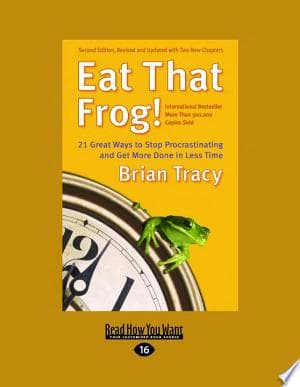
Core Idea
- Difficulty
- Easy
- Read it if
- You struggle with procrastination, feel overwhelmed by your to-do list, or want a straightforward, actionable system to improve your daily productivity and focus on high-impact tasks.
- Skip it if
- You are looking for deep psychological insights into procrastination or complex productivity frameworks; this book offers practical, direct tactics rather than extensive theoretical exploration.
Key Takeaways from Eat That Frog!
Eat the Biggest Frog First
Tackle your most important, most challenging task at the start of your day.
The main idea of 'Eat That Frog!' is that your 'frog' is your biggest, most important task. This is the task you are most likely to put off, but it will have the greatest positive effect on your life or work. By tackling and finishing this task first thing in the morning, you build momentum, reduce stress, and ensure important work gets done. This is not just about clearing your plate; it is about choosing high-value activities over low-value ones. The good feeling from finishing a big task early in the day sets a positive tone and frees up mental energy for your other duties. This keeps the most important work from being pushed aside by less important distractions.
“If it's your job to eat a frog, it's best to do it first thing in the morning. And if it's your job to eat two frogs, it's best to eat the biggest one first.”
In the book: Tracy doesn't cite specific studies but relies on the common human tendency to procrastinate on difficult tasks. He argues that the feeling of accomplishment after tackling the 'frog' provides a self-reinforcing positive feedback loop.
Try this: Identify your single most important task for tomorrow before you go to bed tonight. The next morning, before checking emails, social media, or engaging in any other activity, dedicate yourself entirely to completing that task. Do not move on until it is finished.
Related ideas: priority-management
Plan Your Day the Night Before
Invest a few minutes to organize your next day's tasks for clarity and focus.
Good daily planning is essential for productivity. Tracy highlights the benefit of writing down your to-do list for the next day at the end of the current workday. This simple habit lets your subconscious mind work on your tasks overnight, often leading to clearer solutions and a more focused approach when you start your day. It removes the wasted time and mental energy spent trying to decide what to do next. A well-organized list means you can immediately start productive work, instead of getting sidetracked by small decisions or distractions. This forward-thinking planning changes reactive chaos into deliberate, purposeful action, ensuring your most important tasks are not forgotten.
“Every minute you spend in planning saves ten minutes in execution.”
In the book: Tracy refers to this as the '6 P's Formula': Proper Prior Planning Prevents Poor Performance. He asserts that the act of writing solidifies intentions and improves execution.
Try this: Each evening, take 10-15 minutes to create a detailed to-do list for the next day. List all tasks, then prioritize them using the A-B-C-D-E method (explained in a later takeaway). This clears your mind and prepares you for immediate action upon waking.
Related ideas: time-management, task-prioritization
Apply the 80/20 Rule Relentlessly
Focus on the vital few tasks that yield the majority of your results.
The Pareto Principle, or the 80/20 Rule, is a helpful way to look at your productivity. Tracy says that a small part of your tasks will lead to most of your valuable results. The key insight here is that not all tasks are equally important. Many people get busy with low-value activities, feeling productive without actually making progress on their most important goals. By consciously finding and focusing your energy on the 20% of tasks that produce 80% of your results, you can greatly increase what you achieve. This rule encourages strong prioritization and avoiding 'busy work' that has little real impact.
“Always resist the temptation to clear up small things first. Remember the 80/20 Rule: 20 percent of your activities will account for 80 percent of your results.”
In the book: Tracy applies the Pareto Principle (80/20 Rule) to nearly every aspect of work and life, from sales (20% of customers provide 80% of revenue) to tasks (20% of tasks produce 80% of results).
Try this: Before starting any task, ask yourself: 'Is this part of the 20% of activities that will give me 80% of my desired results?' If not, question its importance or delegate it. Prioritize your 'A' tasks (most important) using this filter.
Related ideas: pareto-principle, strategic-focus
Use the A-B-C-D-E Method
Categorize your tasks by importance and urgency for clear action.
Once you have a list of tasks, the next step is to prioritize them well. The A-B-C-D-E method gives a simple yet strong way to do this. 'A' tasks are your 'frogs'—the most important, high-value tasks you must do. 'B' tasks are important but less critical than 'A's, with minor consequences if not done. 'C' tasks are nice to do but have no real consequences. 'D' tasks are ones you can delegate, freeing up your time for 'A' tasks. 'E' tasks are those you can remove completely, as they offer little value. This system makes you think carefully about the true value and urgency of each item on your list, preventing the common mistake of doing easy 'C' tasks before crucial 'A's.
“The ABCDE Method is a powerful priority-setting technique that you can use every single day.”
In the book: Tracy frames this as a practical, actionable method to immediately apply to any to-do list, ensuring that time is always spent on the most impactful activities.
Try this: After creating your daily task list, go through each item and assign it a letter: A (must do), B (should do), C (nice to do), D (delegate), E (eliminate). Crucially, never do a 'B' task until all 'A' tasks are complete, and so on.
Related ideas: task-management, prioritization-framework
Focus on Key Result Areas
Identify and excel in the specific outcomes you are responsible for.
To be truly productive, you must understand what 'results' mean in your role. Key Result Areas (KRAs) are the specific outcomes you are responsible for, and by which your performance is measured. If you are unsure about your KRAs, it is easy to get lost in busywork that does not help your main goals. Tracy urges people to identify 5-7 KRAs and then rate themselves on a scale of 1-10 for each. This self-assessment shows weak areas that, if improved, would greatly boost overall performance and value. Mastering your KRAs means consistently delivering on your most critical responsibilities, which is what high productivity is about.
“Your key result areas are the results you absolutely, positively have to get to fulfill your responsibilities.”
In the book: Tracy suggests asking your boss for clarification on your KRAs if they aren't clear, emphasizing that clarity is paramount for effective work.
Try this: List 5-7 key result areas for your job or personal goals. For each KRA, rate your current performance from 1-10. Then, identify one 'frog' task that, if completed, would significantly improve your score in your lowest-rated KRA.
Related ideas: performance-metrics, goal-setting
Practice Single Handling
Concentrate all your energy on one task until it is 100% complete.
In a time of constant distractions and multitasking, 'single handling' is a strong solution. This rule means starting one important task and giving it your full, undivided attention until it is completely finished. The negative effects of switching tasks—lost time, more errors, and lower quality—are often underestimated. By committing to single handling, you build momentum, reach flow states, and produce better work in less time. It takes discipline to avoid checking emails, answering texts, or switching to another task, but the reward in efficiency and effectiveness is significant. This method is especially important for your 'frog' tasks.
“Once you begin an important task, discipline yourself to stick with it until it is 100 percent complete.”
In the book: Tracy notes that the average person is interrupted every 8 minutes and takes 17 minutes to return to the original task, highlighting the time-wasting nature of constant interruptions.
Try this: When you start your 'frog' task, eliminate all distractions (turn off notifications, close unnecessary tabs, inform colleagues). Work on that single task without interruption until it is fully completed. Break it down if necessary, but don't switch tasks.
Related ideas: deep-work, focus-techniques
Motivate Yourself with Vision
Maintain a clear mental picture of your goals and the benefits of achieving them.
Productivity is not just about techniques; it is also about staying motivated. Tracy stresses the importance of having a clear, strong vision for your future and understanding the benefits that will come from reaching your goals. When you face a difficult 'frog,' reminding yourself of the bigger purpose and the positive outcomes gives you the drive to push through. This is not just wishful thinking; it is a smart way to link daily tasks to long-term goals, making the effort feel worthwhile. A strong vision acts as a powerful internal motivator, helping you overcome procrastination and keep going through challenges, ensuring your daily actions match your ultimate desired future.
“The clearer you are about what you want and the benefits of achieving it, the more motivated and determined you will be.”
In the book: Tracy frequently refers to the idea that successful people have clear goals and visions, and they review them regularly to maintain motivation.
Try this: Take time each morning to visualize your most important long-term goal as if it has already been achieved. Feel the emotions of success. Connect your 'frog' task for the day directly to how it contributes to this larger vision, reinforcing its importance.
Related ideas: goal-visualization, self-motivation
Develop a Sense of Urgency
Cultivate a bias for action and a reputation for getting things done quickly.
A 'sense of urgency' in Tracy's view does not mean frantic rushing, but rather a proactive, results-focused mindset. It means developing an inner drive to start and finish important tasks without needless delay. People with a strong sense of urgency are known for their speed and reliability; they do not wait for perfect conditions or outside pressure. This mindset creates positive momentum, reduces the chance of procrastination, and often leads to higher output. It also shows competence and efficiency, opening up more opportunities. By consciously pushing yourself to act quickly on high-value tasks, you build a habit of quick execution that supports ongoing productivity.
“Develop a sense of urgency. The faster you move, the more energy you have.”
In the book: Tracy observes that top performers in any field tend to move faster and complete tasks more quickly than average performers, often developing a 'get-it-done' reputation.
Try this: When a new task or idea comes up, ask yourself, 'Can I start this now?' or 'How quickly can I move on this?' Avoid 'later' or 'tomorrow.' Push yourself to begin immediately, even if it's just a small step, to build momentum.
Related ideas: proactivity, action-bias
Upgrade Your Skills Constantly
Continuously learn and improve in your key result areas to stay effective.
To stay highly productive and valuable, you cannot remain still. The world changes constantly, and what worked yesterday might not be enough tomorrow. Tracy emphasizes the importance of continuous learning and self-improvement, especially in your Key Result Areas. By spending time reading, taking courses, listening to audio programs, or getting mentorship, you improve your abilities, find more efficient methods, and become more valuable. This commitment to lifelong learning is not a luxury but a must for sustained high performance. It ensures that your 'frogs' become easier to eat as your skills and knowledge grow, keeping you at the forefront of your field.
“Your ability to learn and grow is unlimited. Your potential to be more and do more is infinite.”
In the book: Tracy consistently advocates for dedicating specific time each day to learning, such as 30-60 minutes of reading in one's field, as a habit of highly successful people.
Try this: Identify one skill or knowledge area that, if improved, would significantly boost your performance in your most important KRA. Dedicate 30 minutes each day (e.g., during commute, lunch break) to learning or practicing that skill through books, podcasts, or online courses.
Related ideas: lifelong-learning, skill-development
Pressure Yourself to Perform
Set deadlines and create internal urgency to optimize your work output.
While outside pressures exist, Tracy argues for the power of self-imposed pressure. By setting clear, firm deadlines for yourself—especially for your 'frog' tasks—you create a sense of urgency that encourages action and prevents procrastination. This is not about stress; it is about using the psychological tendency to work more efficiently under a set time limit. When you commit to a deadline, your mind and body tend to meet the challenge, finding ways to finish the task within the given time. This method also involves holding yourself accountable, perhaps by sharing your deadlines with a colleague or mentor, adding an extra layer of commitment and ensuring important work gets done.
“You can use this method to accelerate yourself and virtually guarantee that you complete your most important tasks on schedule.”
In the book: Tracy suggests treating every task as if it has a deadline, and even creating artificial deadlines for tasks that lack them, to harness the power of time pressure.
Try this: For your next major 'frog' task, set a specific, challenging, but achievable deadline. Write it down and commit to it. If possible, share this deadline with a trusted colleague or mentor to add an element of external accountability.
Related ideas: self-discipline, accountability
Eat That Frog! Quotes
“The first rule of frog eating is this: If you have to eat two frogs, eat the ugliest one first.”
“If you eat a live frog first thing every morning, you'll have the satisfaction of knowing that's probably the worst thing that's going to happen to you all day long.”
“The key to success is action.”
“Your ability to select your most important task, and then to start on it and get it done, faster and better, is the key to your success.”
“Resist the temptation to clear up small things first.”
“One of the very best ways to stop procrastinating and get more done is to practice the 'power of one.'”
“Always work from a list.”
“The more clearly you can see your goals, the more effective you will be in achieving them.”
“Think on paper.”
“The ability to concentrate single-mindedly on one thing, until it is complete, is the true key to high achievement.”
“There is never enough time to do everything, but there is always enough time to do the most important thing.”
“Your greatest asset is your earning ability.”
“Never interrupt yourself.”
“Practice the 'ABCDE Method' continually.”
Quiz
10 questions on the main ideas. Each answer comes with a short explanation.
Question 1
According to Brian Tracy in 'Eat That Frog!', what is the primary metaphor for your most important, difficult task that you're most likely to procrastinate on?
- The Elephant
- The Frog
- The Mountain
- The Dragon
Show answer
B. The Frog The central metaphor of the book is 'eating the frog,' which represents tackling your biggest, most unpleasant task first thing in the morning.
Question 2
What is the 'Rule of Three' as described by Brian Tracy?
- Focus on three major goals at a time to avoid overwhelm.
- Identify the three most important tasks that account for 90% of your value.
- Three things are required for success: clarity, competence, and commitment.
- Your three most important tasks contribute 90% of your value to your company or life.
Show answer
D. Your three most important tasks contribute 90% of your value to your company or life. The 'Rule of Three' emphasizes that typically, three tasks contribute the vast majority (90%) of your value, and these should be prioritized.
Question 3
Which of the following is NOT one of the 21 methods discussed in 'Eat That Frog!'?
- The Law of Forced Efficiency
- The Pareto Principle (80/20 Rule)
- The Pomodoro Technique
- The ABCDE Method
Show answer
C. The Pomodoro Technique While the Pomodoro Technique is a popular productivity method, it is not one of the specific 21 methods outlined by Brian Tracy in 'Eat That Frog!'. The other options are indeed concepts or methods from the book.
Question 4
What does Brian Tracy advise regarding planning your day?
- Plan your day first thing in the morning before starting any tasks.
- Plan your day the night before.
- Plan your day weekly to save time.
- Detailed planning is often a form of procrastination; just start.
Show answer
B. Plan your day the night before. Tracy strongly advocates for planning your day the night before, which allows your subconscious mind to work on your plans overnight and helps you hit the ground running the next morning.
Question 5
The 'ABCDE Method' in 'Eat That Frog!' is used for what purpose?
- To set long-term career goals.
- To delegate tasks effectively.
- To prioritize items on a daily to-do list.
- To analyze the root cause of procrastination.
Show answer
C. To prioritize items on a daily to-do list. The ABCDE Method is a powerful daily prioritization technique where tasks are assigned labels (A=most important, B=important but less than A, C=nice to do, D=delegate, E=eliminate) to ensure the most crucial tasks are tackled first.
Question 6
What is the 'Law of Forced Efficiency' as applied in the book?
- There is never enough time to do everything, but there is always enough time to do the most important thing.
- The more pressure you have, the more efficient you become.
- You must force yourself to be efficient, even when you don't feel like it.
- Efficiency is a learned skill that must be practiced daily.
Show answer
A. There is never enough time to do everything, but there is always enough time to do the most important thing. The Law of Forced Efficiency states, 'There is never enough time to do everything, but there is always enough time to do the most important thing.' It forces you to focus on what truly matters.
Question 7
Brian Tracy emphasizes the importance of 'Continuous Learning.' How does he suggest achieving this?
- Reading at least one book per week.
- Attending workshops and seminars regularly.
- Committing to lifelong learning by reading, listening to audio programs, and taking courses.
- Only learning new skills directly related to your current job.
Show answer
C. Committing to lifelong learning by reading, listening to audio programs, and taking courses. Tracy stresses the importance of continuous learning through various means like reading books, listening to educational audio programs, and taking courses to keep your skills sharp and relevant.
Question 8
What is the primary benefit of developing a sense of urgency, according to the book?
- It helps you appear busy and important to others.
- It makes you work faster, even on unimportant tasks.
- It helps you overcome procrastination and get more important things done faster.
- It allows you to delegate tasks more effectively.
Show answer
C. It helps you overcome procrastination and get more important things done faster. Developing a sense of urgency means starting immediately and working fast on your most important tasks, which is a key strategy for overcoming procrastination and increasing output.
Question 9
What does Brian Tracy mean by 'Upgrade Your Key Skills'?
- Learn how to use new software programs for your computer.
- Identify the skills that limit your ability to achieve your most important goals and work to improve them.
- Focus only on developing completely new skills, ignoring existing ones.
- Outsource tasks that require skills you don't possess.
Show answer
B. Identify the skills that limit your ability to achieve your most important goals and work to improve them. Upgrading key skills involves identifying your limiting constraints or weakest skills that hold you back from achieving your most important goals and then actively working to improve them.
Question 10
Tracy states, 'The key to high levels of performance and productivity is for you to develop the habit of _________.'
- working longer hours
- delegating everything possible
- tackling your major task first thing each morning
- multitasking effectively
Show answer
C. tackling your major task first thing each morning This quote directly relates to the core message of the book: developing the habit of 'eating your frog' – tackling your major task first thing each morning – is the key to high performance.
Eat That Frog! FAQ
What is the main idea behind 'Eat That Frog!'?
The core concept of 'Eat That Frog!' is to tackle your most important and challenging task first thing in the morning. By completing your 'frog' early, you gain momentum and ensure that crucial work gets done, even if other distractions arise later in the day.
Does the 'Eat That Frog!' method actually work for everyone?
While the effectiveness can vary by individual and their specific work environment, many people find the 'Eat That Frog!' method highly effective for increasing productivity. It encourages focus on high-impact tasks and helps overcome procrastination, making it a widely applicable strategy.
What is a 'frog' in the context of Brian Tracy's book?
In 'Eat That Frog!', a 'frog' refers to your biggest, most important task, the one you are most likely to procrastinate on if you don't do it first. It's the task that will have the greatest positive impact on your life or work if completed.
How is 'Eat That Frog!' different from other productivity books like 'Getting Things Done'?
'Eat That Frog!' focuses intensely on prioritizing and immediately executing your single most important task, offering 21 actionable techniques for this purpose. 'Getting Things Done' (GTD) provides a broader, more comprehensive system for organizing all aspects of your work and life, emphasizing capturing, clarifying, organizing, reflecting, and engaging.
What are the 3 D's of decision-making mentioned in the book?
The book emphasizes the 'Three D's' for effective task management: Decision, Discipline, and Determination. You must decide what needs to be done, have the discipline to start and continue, and the determination to see it through to completion.
Can 'Eat That Frog!' be applied to personal life goals as well?
Absolutely. The principles in 'Eat That Frog!' are highly adaptable and can be applied to any area where you need to overcome procrastination and achieve important goals, whether professional or personal. Identifying your 'personal frog' and tackling it first can significantly improve progress in your personal life.
What if I have multiple 'frogs' to eat?
If you have multiple important tasks, Brian Tracy advises you to rank them by importance and tackle the biggest, most impactful 'frog' first. If you have two equally important tasks, eat the uglier one first. The key is to focus on one at a time until it's complete.
What is the 'Law of Forced Efficiency'?
The 'Law of Forced Efficiency' states that 'There is never enough time to do everything, but there is always enough time to do the most important thing.' This principle encourages you to focus on high-value activities and accept that you cannot do it all, but you can do what matters most.
About the author

Brian Tracy is a renowned motivational speaker and author specializing in personal development and business success. He is best known for his bestselling book "Eat That Frog!: 21 Great Ways to Stop Procrastinating and Get More Done in Less Time," which has been translated into numerous languages. Tracy has authored over 70 books and has trained millions of people worldwide in sales, management, and personal effectiveness.
Similar books
- Getting Things Done: The Art of Stress-Free Productivity
David Allen
4.0 (129k) average on GoodreadsBusinessOffers a comprehensive system for organizing tasks and projects, complementing 'Eat That Frog!'s focus on priority execution.
- The 7 Habits of Highly Effective People: Powerful Lessons in Personal Change
Stephen R. Covey
4.1 (524k) average on GoodreadsBusinessProvides a broader framework for personal and professional effectiveness, with principles that support 'Eat That Frog!'s tactical advice.
- Atomic Habits: An Easy & Proven Way to Build Good Habits & Break Bad Ones
James Clear
4.3 (126k) average on GoodreadsBusinessFocuses on building small, consistent habits for significant long-term results, which can be applied to implementing the 'Eat That Frog!' method.
- The Power of Habit: Why We Do What We Do in Life and Business
Charles Duhigg
4.1 (343k) average on GoodreadsBusiness - The Lean Startup: How Today's Entrepreneurs Use Continuous Innovation to Create Radically Successful Businesses
Eric Ries
4.1 (235k) average on GoodreadsBusinessLearn how to manage startups through rapid experimentation, validated learning, and constant adjustment, building sustainable businesses instead of untested plans.
- Deep Work
Cal Newport
4.2 (192k) average on GoodreadsProductivityAchieve great things in a distracting world by focusing intensely and reducing unimportant tasks.



Enjoyed the summary?
A summary gives you the shape of the book. The book itself has the detail, the examples and the voice.
Find Eat That Frog! on AmazonAs an Amazon Associate, BookBrief earns from qualifying purchases. How we're funded