
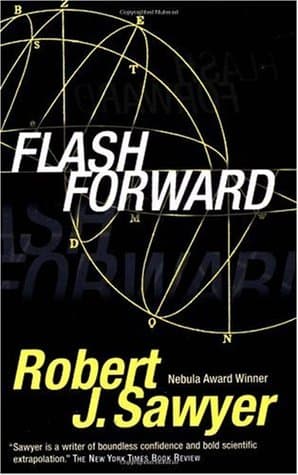
Synopsis
Covers the whole plot, including the ending.
- Difficulty
- Medium
- Pacing
- Moderate
- Mood
- Thought-provoking, Suspenseful, Philosophical, Intriguing
- Read it if
- You enjoy thought-provoking science fiction that explores the nature of time, free will, and destiny with a thrilling mystery at its core.
- Skip it if
- You prefer fantasy over hard science fiction or dislike stories that delve into philosophical implications of future-seeing events.
Flashforward Plot Summary
Covers the whole plot, including the ending.
The Global Blackout
On October 21, 2009, at 11:18 a.m. Eastern Time, a global event happens: every human on Earth loses consciousness for two minutes and seventeen seconds. The world falls into chaos as planes crash, cars collide, and many lives are lost. Dr. Lloyd Simcoe, a physicist at CERN, and his fiancée, Dr. Michiko Maruyama, are among the survivors. During the blackout, everyone experiences a 'flashforward' – a vivid, personal vision of their life about 21 years in the future. The aftermath is a mix of terror, confusion, and dread as humanity deals with this shared, involuntary peek into their destinies.
Unraveling the Mystery at CERN
Dr. Lloyd Simcoe, head of the ATLAS experiment at CERN, quickly thinks the flashforward event is linked to the Large Hadron Collider (LHC). His team, including Michiko Maruyama, begins an intense investigation into the LHC's data from the blackout. They discover unusual energy readings and a peculiar quantum fluctuation that coincided with the global unconsciousness. The scientific community is initially skeptical, but the evidence Lloyd's team uncovers gradually points to a deliberate or accidental experiment with exotic particles as the trigger, suggesting the flashforward might be a side effect of a fundamental physics event.
The Personal Aftermath: Lloyd's Vision
Lloyd Simcoe's flashforward shows him a future in 2030 where he lives with a different woman, not Michiko. This vision deeply disturbs him and creates immediate tension in his relationship with Michiko, who also saw her own future but is reluctant to share details. Lloyd struggles with the implications of this predetermined future, questioning free will and the stability of his current life. The vision introduces a personal dilemma, forcing him to confront the potential end of his engagement and the existence of a future he neither anticipated nor desired, despite its apparent clarity.
Michiko's Secret and the Quantum Entanglement
Michiko Maruyama's flashforward is far more disturbing than Lloyd's. She sees herself committing suicide in 2030, a vision that fills her with dread and a desperate desire to prevent it. She keeps this vision a secret from Lloyd, fearing that revealing it might inadvertently make it come true. This secrecy creates a growing rift between them. Meanwhile, the CERN team, led by Lloyd, continues to analyze the blackout data, eventually concluding that the event was caused by a quantum entanglement phenomenon, possibly involving exotic matter, which momentarily linked all human consciousnesses to a point in the future.
The Rise of D. Gibbons
A shadowy figure named D. Gibbons begins to communicate with various media outlets and scientific institutions, claiming to have predicted the flashforward event long before it happened. He presents himself as an expert on quantum mechanics and the nature of time, offering cryptic clues and theories that align with some of the CERN team's findings, yet his motives remain unclear. Gibbons's sudden appearance adds another layer of mystery to the global phenomenon, suggesting a deeper, possibly conspiratorial, aspect to the blackout. His pronouncements further fuel public anxiety and debate about fate versus free will.
Public Reaction and Societal Impact
The global flashforward event plunges society into unprecedented chaos. Governments struggle to maintain order as people react in extreme ways to their visions. Some, seeing happy futures, become complacent; others, seeing tragic or non-existent futures, fall into despair or nihilism. Suicides increase, marriages dissolve, and the economy falters as people abandon their current lives based on their future knowledge. The very fabric of society is threatened by the loss of the unknown and the perceived inevitability of destiny, leading to widespread moral and ethical dilemmas across all cultures.
Searching for D. Gibbons
Convinced that D. Gibbons holds vital information about the flashforward, Lloyd and Michiko decide to track him down independently. Their investigation leads them through a maze of online forums, academic papers, and obscure scientific communities. They suspect Gibbons might be more than just a theorist, possibly someone directly involved in the event or possessing a deeper, more personal understanding of its mechanics. Their pursuit is driven by a desperate hope that Gibbons can provide a way to understand, or even alter, their foretold futures, especially Michiko's grim vision.
The Nature of Time and Free Will
As the CERN team delves deeper, they hypothesize that the flashforward was not merely a vision but a momentary, collective quantum entanglement with the future. This implies a universe where time is not strictly linear, and future events might exist in a probabilistic state. This scientific explanation challenges traditional notions of free will, suggesting that while the future might be 'seen,' it is not necessarily immutable. The debate rages among the scientists: is the future fixed, or can conscious choices in the present alter the trajectory glimpsed during the blackout?
Confronting D. Gibbons
Lloyd and Michiko eventually locate D. Gibbons, who is a brilliant but reclusive physicist named Dimitri Gibbons. He reveals that he was working on a radical theory of time and quantum entanglement, and that the flashforward was not an accident but a deliberate, though uncontrolled, consequence of his experimental work with the LHC. Gibbons explains that he was attempting to prove the existence of a 'future state' accessible through quantum means, but the global blackout was an unforeseen, large-scale side effect. He believes the visions are real but not necessarily deterministic.
The Second Flashforward and Michiko's Choice
As the story progresses, a second, much shorter flashforward event occurs, lasting only a few seconds. This time, it is a ripple effect from the original event, and it provides Michiko with a crucial update to her future vision. Instead of seeing her suicide, she now sees herself making a different choice, influenced by her present actions and her conversations with Lloyd and Gibbons. This second vision gives her hope and reinforces the idea that free will can indeed triumph over predetermined destiny. She makes a decision that directly counters her initial, tragic flashforward.
The Aftermath and Redefining Destiny
In the wake of the second flashforward and the revelations from Dimitri Gibbons, humanity slowly begins to heal and redefine its understanding of destiny. The scientific community, now with a clearer understanding of the event's mechanics, explains that while the future can be glimpsed, it is not fixed. People start to realize that their choices in the present hold power. Lloyd and Michiko, having navigated their personal challenges, find a renewed sense of purpose and hope, believing that love and agency can alter even the most seemingly inevitable futures. The world, though scarred, looks towards a future where awareness of possibility empowers rather than paralyzes.
Principal Figures
Dr. Lloyd Simcoe
Protagonist
A brilliant physicist at CERN who investigates the flashforward event.
Lloyd Simcoe is a dedicated and highly intelligent physicist, the head of the ATLAS experiment at CERN. Driven by scientific curiosity and a strong sense of responsibility, he becomes the central figure in unraveling the mystery of the global blackout. His logical and analytical mind is constantly at odds with the emotional turmoil caused by his personal flashforward, which shows him a future without his fiancée, Michiko. He is initially a firm believer in scientific determinism but is forced to confront the complexities of free will and destiny.
Relationships: Dr. Michiko Maruyama (Fiancée and colleague, their relationship is strained by their differing flashforwards.); Dimitri Gibbons (Initially a mysterious figure, later revealed as the catalyst of the flashforward and a scientific rival/collaborator.)
Dr. Michiko Maruyama
Protagonist
Lloyd's fiancée and a fellow physicist, whose flashforward presents a terrifying personal challenge.
Michiko Maruyama is an equally brilliant physicist and Lloyd's fiancée, working alongside him at CERN. She is deeply compassionate and emotionally driven, which makes her flashforward—a vision of her own suicide—particularly devastating. This grim prophecy leads her to secrecy and despair, creating a significant barrier in her relationship with Lloyd. Her struggle embodies the central conflict of the book: the battle between predetermined fate and the desire for free will. Her journey is one of profound internal conflict and the search for agency.
Relationships: Dr. Lloyd Simcoe (Fiancée and colleague, their love is tested by the flashforward and her secret.); Dimitri Gibbons (An enigmatic figure whose theories and actions directly impact her understanding of her future.)
Dimitri Gibbons
Antagonist/Supporting
The reclusive physicist responsible for the flashforward event.
Dimitri Gibbons is a reclusive but extraordinarily brilliant theoretical physicist. He is the enigmatic figure who, through his radical experiments with the Large Hadron Collider, inadvertently triggers the global flashforward. Gibbons is driven by an intense desire to understand the fundamental nature of time and consciousness, pushing the boundaries of scientific ethics. He initially presents as a shadowy, almost antagonistic figure, but later reveals his true intentions and scientific theories, which are crucial to understanding the event. He serves as both the cause of the crisis and a key to its resolution.
Relationships: Dr. Lloyd Simcoe (Scientific rival and reluctant collaborator, sharing a common goal to understand the flashforward.); Dr. Michiko Maruyama (His actions directly impact her life, and his theories offer her a path to change her future.)
Theo Tsevang
Supporting
A member of Lloyd's team at CERN.
Theo Tsevang is a dedicated and competent member of Lloyd Simcoe's team at CERN. He plays a vital role in analyzing the data from the Large Hadron Collider to pinpoint the cause of the global blackout. Theo represents the diligent, methodical aspect of scientific inquiry, often providing practical insights and technical support crucial to the investigation. His flashforward is not explicitly detailed, allowing him to serve as a more objective scientific voice amidst the personal turmoil of Lloyd and Michiko.
Relationships: Dr. Lloyd Simcoe (Colleague and subordinate, respected member of his research team.)
Samantha Simcoe
Mentioned
The woman Lloyd sees in his flashforward.
Samantha Simcoe is the woman Lloyd sees living with him in his flashforward vision of 2030. Her existence in his future creates immediate tension and doubt in his relationship with Michiko. She represents the potential alternative future that Lloyd must reconcile with, a future seemingly predetermined and outside his current choices. While she does not appear in the present narrative, her presence in Lloyd's vision is a powerful catalyst for his personal conflict and exploration of destiny.
Relationships: Dr. Lloyd Simcoe (His future partner in the flashforward, whose existence challenges his present relationship.)
Themes & Insights
Free Will vs. Determinism
The central philosophical debate of the novel is whether the future glimpsed in the flashforward is fixed and unchangeable, or if individuals retain the ability to alter their destinies. Michiko's struggle with her suicide vision and Lloyd's unsettling vision of a future without her show this conflict. The scientific explanation of the flashforward as a quantum entanglement, rather than an absolute prophecy, allows for the possibility of modifying one's future through present choices, as Michiko ultimately attempts to do. The book explores the psychological and societal impact of believing one's future is already written.
“Perhaps the future isn't something we're hurtling towards, but something we're creating with every decision we make.”
The Nature of Time and Reality
The flashforward event forces humanity, particularly the scientists at CERN, to reconsider their understanding of time. The idea that all consciousnesses could simultaneously glimpse a specific point in the future suggests a non-linear, perhaps even block-universe, model of time. The novel explores complex quantum physics concepts, like entanglement and the many-worlds interpretation, to explain how such an event might be possible. This theme challenges conventional perceptions of cause and effect, suggesting that reality is far more complex and interconnected than previously imagined, with future possibilities existing concurrently with the present.
“Time isn't a river, flowing in one direction. It's more like an ocean, with currents and eddies, and sometimes, a glimpse of the distant shore.”
The Impact of Knowledge and Secrecy
The knowledge gained from the flashforward has profound and often destructive effects. Michiko's decision to keep her suicide vision secret from Lloyd shows how fear of a predetermined future can lead to isolation and strain relationships. Conversely, the public revelation of individual futures causes widespread societal chaos, as people react impulsively to their visions, leading to despair, recklessness, and the breakdown of institutions. The novel explores the ethical implications of possessing such foreknowledge, questioning whether some truths are better left unknown, or if knowledge, even if painful, ultimately leads to greater understanding and adaptation.
“Knowing your future isn't a gift. It's a burden, a weight that can crush the present.”
Science and Ethics
The novel examines the ethical boundaries of scientific research, particularly through the actions of Dimitri Gibbons. His ambitious experiments with the Large Hadron Collider, driven by a desire to understand time, inadvertently trigger a global catastrophe. This raises questions about the responsibility of scientists when their pursuit of knowledge has unforeseen and far-reaching consequences for all of humanity. Lloyd Simcoe and his team represent a more cautious, reactive approach to scientific discovery, attempting to understand and mitigate the effects of Gibbons's actions, highlighting the tension between radical innovation and ethical oversight in scientific endeavors.
“The pursuit of knowledge is noble, but the consequences of that pursuit are often beyond our control.”
Plot Devices & Literary Techniques
The Global Blackout
The inciting incident that triggers the entire plot and its philosophical questions.
The global blackout is the central plot device, a catastrophic event where all seven billion people on Earth simultaneously lose consciousness for two minutes and seventeen seconds. This event serves as the catalyst for every subsequent plot point, from the scientific investigation at CERN to the personal and societal crises that unfold. It's not just a physical event but a mechanism for delivering the 'flashforwards,' providing each character and the audience with a concrete, yet mysterious, glimpse into a potential future, thereby launching the core themes of free will versus determinism.
Flashforward Visions
Personal glimpses into the future, driving character arcs and societal conflict.
The flashforward visions are the direct result of the global blackout. Each person experiences a unique, personal vision of their life approximately 21 years in the future. These visions are the primary source of conflict and character development. They directly impact relationships, career choices, and mental states, forcing characters like Lloyd and Michiko to confront deeply personal dilemmas. On a societal level, the collective knowledge of these futures creates widespread panic, despair, and a re-evaluation of human agency, serving as a powerful engine for the novel's philosophical exploration.
The Large Hadron Collider (LHC)
The scientific instrument at the heart of the flashforward's cause.
The LHC at CERN functions as the scientific explanation and origin point for the flashforward event. It is the setting where Lloyd and Michiko work and where the anomalous quantum fluctuations responsible for the blackout are detected. The LHC grounds the fantastical premise in a plausible (within the sci-fi genre) scientific context, linking the global event to cutting-edge physics experiments. It represents both the pinnacle of human scientific achievement and the potential for unintended, world-altering consequences, embodying the theme of science and ethics.
Dimitri Gibbons's Theories
The scientific framework that explains the flashforward and its implications.
Dimitri Gibbons's theories on quantum mechanics, time, and consciousness provide the scientific underpinning for the flashforward event. Initially presented as cryptic pronouncements, his explanations of quantum entanglement and the accessibility of future states are crucial for the characters and the reader to understand how such an event could occur. These theories move the narrative beyond mere science fiction into a deeper exploration of theoretical physics, offering a potential mechanism for free will to operate even within a seemingly predetermined future, thereby resolving the central philosophical conflict.
Flashforward Quotes
“All of humanity got a glimpse of the future. The future. Not a future, but the future.”
“If you knew your exact future, would you live your present differently?”
“The universe is a strange and beautiful place, and we are only just beginning to understand its secrets.”
“Love, it turns out, is a more powerful motivator than the certainty of death.”
“The irony was that in seeing their future, many people had lost their present.”
“There are no accidents, only events whose causes are still unknown.”
“Even a glimpse of tomorrow can shatter the foundations of today.”
“The greatest fear isn't of the unknown, but of the known, if that known is terrible.”
“Humanity's greatest strength is its adaptability, its capacity to find meaning even in chaos.”
“What if free will isn't about changing the future, but about how you react to the one you've seen?”
“The universe doesn't care about our plans. It has its own.”
“Sometimes, the only way to save the world is to risk everything.”
“The future is not a wall, but a window. We can look through it, but we can also choose what we do on this side.”
“Knowledge is power, but sometimes, ignorance is bliss, especially when the knowledge is of your own demise.”
Quiz
10 questions on the plot and the characters. Each answer comes with a short explanation.
Question 1
What is the precise duration of the global blackout event in 'Flashforward'?
- One minute and forty-five seconds
- Two minutes and seventeen seconds
- Three minutes and ten seconds
- Two minutes and thirty seconds
Show answer
B. Two minutes and seventeen seconds The core event of the book, the global blackout, lasted exactly two minutes and seventeen seconds.
Question 2
What is the primary effect experienced by all seven billion people on Earth during the blackout?
- They heard a mysterious, unified hum.
- They gained a new, shared language.
- They experienced a glimpse of their individual future.
- They felt a profound sense of peace and tranquility.
Show answer
C. They experienced a glimpse of their individual future. During the blackout, everyone on Earth experienced a 'flashforward' – a vision of their own future.
Question 3
Which of the following is NOT mentioned as an immediate consequence of the global blackout?
- Planes falling from the sky
- People tumbling down staircases
- Massive global power grid failure leading to permanent outages
- Cars plowing into each other
Show answer
C. Massive global power grid failure leading to permanent outages While power outages would occur, the immediate consequences listed in the summary are related to people losing consciousness in motion, not a permanent grid failure.
Question 4
What scientific research facility is central to investigating the flashforward event?
- CERN's Large Hadron Collider
- NASA's Jet Propulsion Laboratory
- The SETI Institute
- The European Space Agency
Show answer
A. CERN's Large Hadron Collider The novel centers around the physicists at CERN and their experiments with the Large Hadron Collider, which is implicated in causing the flashforward.
Question 5
Who is the primary protagonist and lead physicist investigating the flashforward phenomenon?
- Michiko Komura
- Lloyd Simcoe
- Theo Tso
- Dimitri Noh
Show answer
B. Lloyd Simcoe Lloyd Simcoe is the main character, a physicist at CERN who leads the investigation into the cause of the global blackout.
Question 6
What is the timeframe into the future that the flashforward visions generally extend?
- One week
- One month
- Twenty-one and a half years
- Five years
Show answer
C. Twenty-one and a half years The flashforwards show a specific moment in the future, approximately twenty-one and a half years from the present day of the blackout.
Question 7
The 'interlocking mosaic' of future visions is described as threatening to 'unravel the present'. What major thematic conflict does this highlight?
- The conflict between technological advancement and natural disasters.
- The struggle between free will and determinism.
- The global economic impact of a sudden population decrease.
- The ethical implications of human cloning.
Show answer
B. The struggle between free will and determinism. The knowledge of the future, and whether individuals can change their predicted destinies, is a central thematic conflict exploring free will versus determinism.
Question 8
What specific type of particle physics experiment is theorized to have caused the flashforward event?
- A high-energy neutrino burst
- A dark matter detection experiment
- An attempt to detect quantum gravity effects via a specific particle collision
- A superstring theory verification test
Show answer
C. An attempt to detect quantum gravity effects via a specific particle collision The CERN scientists were conducting an experiment to detect quantum gravity effects, involving the collision of particles that created a momentary 'gravity wave' that propagated backward in time.
Question 9
How do some characters react to their flashforward visions, particularly if they see themselves doing something undesirable or not seeing anything at all?
- They universally accept their future as unchangeable fate.
- They become highly motivated to ensure their vision comes true, regardless of its nature.
- They experience widespread panic, depression, and even suicide, or become determined to alter their future.
- They immediately forget their visions upon waking, making them irrelevant.
Show answer
C. They experience widespread panic, depression, and even suicide, or become determined to alter their future. The flashforwards cause immense psychological distress. Many people try to change their futures, while others fall into despair, especially those who saw themselves dead or saw nothing at all.
Question 10
What is the ultimate fate or resolution regarding the predictability of the flashforward visions by the end of the novel?
- The visions are proven to be entirely accurate and unchangeable.
- The visions are revealed to be collective hallucinations with no basis in reality.
- The visions are shown to be mutable, implying that free will can alter the future, but with consequences.
- The scientific community concludes the visions are a random, meaningless anomaly.
Show answer
C. The visions are shown to be mutable, implying that free will can alter the future, but with consequences. A key resolution of the novel is the exploration and eventual demonstration that while the visions are real, the future is not entirely predetermined; actions in the present can alter the future, though perhaps not without unforeseen effects.
Flashforward FAQ
What is the central premise of 'Flashforward'?
The core premise involves all seven billion people on Earth simultaneously blacking out for exactly two minutes and seventeen seconds. During this global blackout, everyone experiences a flashforward vision of their own life exactly 21.5 years in the future, leading to widespread societal disruption and personal crises as people grapple with their predetermined destinies.
Who are the main protagonists leading the investigation into the flashforward event?
The primary protagonists are Dr. Lloyd Simcoe and Dr. Theo Procopides, two physicists working at CERN in Switzerland. They are instrumental in detecting the cosmic ray burst that caused the flashforward and lead the scientific effort to understand its origins and implications, while also dealing with their own personal future visions.
What immediate catastrophic effects did the global blackout cause?
The blackout caused widespread death and chaos globally. Millions perished as planes crashed, cars collided, and individuals fell from heights or drowned. Essential services failed, and infrastructure was severely impacted, highlighting humanity's vulnerability to such a sudden, universal event.
How long was the duration of the flashforward vision itself, and what future point did it show?
The flashforward vision lasted for precisely two minutes and seventeen seconds, mirroring the duration of the global blackout. Each person saw a glimpse of their life exactly 21.5 years into the future from the date of the blackout, providing a specific, if often cryptic, window into their destiny.
What is the significance of the 'Q-flash' and its connection to the flashforward event?
The Q-flash refers to a burst of exotic quantum particles, specifically a 'tau-neutrino burst,' detected by the Large Hadron Collider at CERN. This burst is identified as the direct cause of the global blackout and the subsequent flashforward visions, originating from a nearby supernova.
What specific detail about Theo Procopides' future vision causes him distress and secrecy?
Theo's flashforward vision shows him alive and well, but it also reveals a significant, unexpected change in his personal life. He sees himself with a different woman, not his current fiancée Michiko Maruyama, which causes him immense emotional turmoil and prompts him to keep his vision a secret from Michiko for a long time.
How does Michiko Maruyama's flashforward vision contrast with Theo's, and what does she do about it?
Michiko's flashforward shows her alive and happy, but without Theo. She sees herself with a child, but the father is not Theo. This vision, combined with Theo's evasiveness, leads her to independently investigate and ultimately discover the truth about Theo's future and their impending separation, prompting her to accept their fate and move on.
What role does the 'D.O.D.A.' (Department of Designated Arrivals) play in the aftermath of the flashforward?
The D.O.D.A. is a government agency established to manage the chaos and social implications arising from the flashforwards. Its primary task is to track and monitor individuals who did not experience a flashforward, as this implies they will die before the future date, leading to ethical dilemmas and societal panic.
How does the concept of free will versus determinism become a central psychological conflict for the characters?
The flashforward event forces characters to confront whether their futures are immutable or if they retain free will to alter their destiny. This creates profound psychological distress, as many struggle to accept or defy their visions, leading to changes in behavior, relationships, and life choices, questioning the very nature of existence.
Describe the psychological impact of the flashforward on those who saw themselves dead in the future.
Individuals who saw themselves dead experienced immense despair, hopelessness, and often fatalistic behavior. Some fell into deep depression, while others engaged in reckless acts, believing their fate was sealed. The knowledge of their impending death stripped many of the will to live or plan for a future they wouldn't see.
How does Lloyd Simcoe's flashforward vision affect his personal life and relationship with his fiancée?
Lloyd's flashforward shows him with a different woman and a child, not his fiancée, Ashley. This revelation deeply wounds him and Ashley, creating a chasm in their relationship. Lloyd grapples with guilt and the perceived inevitability of their breakup, leading to a strained and ultimately dissolved engagement, fulfilling aspects of the vision.
What is the 'Domino Effect' that the flashforward visions initiate in society?
The 'Domino Effect' refers to the chain reactions of societal and personal changes triggered by people acting on their flashforward visions. For example, stock market crashes occurred as people divested based on future knowledge, and relationships dissolved as individuals saw different partners, leading to a cascading unraveling of the present social fabric.
Is the flashforward event ultimately proven to be deterministic, or do characters find ways to alter their fates?
The book largely suggests a strong element of determinism, with many characters finding their visions coming true despite their attempts to defy them. However, there are subtle ambiguities and interpretations that allow for the possibility of minor deviations or for characters to understand their visions in a way that allows for personal growth, even if the major events remain fixed.
What philosophical questions about time and causality does the novel raise?
The novel deeply explores questions of linear versus non-linear time, the nature of causality, and whether the future is fixed or malleable. It forces readers and characters to ponder if knowing the future makes it inevitable, or if consciousness itself can influence the timeline, challenging conventional understandings of temporal mechanics.
How does the ending of the novel provide a resolution or further questions regarding the flashforward phenomenon?
The ending of the novel provides a scientific explanation for the flashforward, attributing it to a specific cosmic event. While it resolves the 'how,' it leaves lingering questions about the ultimate 'why' and the broader implications for humanity's understanding of its place in the universe, emphasizing that while the event is explained, its philosophical impact endures.
What is the significance of the final 'second flashforward' experienced by some characters?
The 'second flashforward' is a crucial plot twist where some characters experience a brief glimpse of an even further future, sometimes contradicting or clarifying their initial vision. This event suggests that time is more complex than initially understood, possibly hinting at multiple timelines or a more dynamic future than a single, fixed path, adding another layer of mystery.
Does the novel suggest any potential benefits or positive outcomes from the flashforward event?
While the immediate aftermath is catastrophic, the novel subtly suggests some positive outcomes. It forces humanity to unite in a global scientific endeavor, accelerates technological advancements in quantum physics, and for some individuals, the visions act as a catalyst for personal growth, self-reflection, or a re-evaluation of priorities, albeit through painful means.
About the author

Robert J. Sawyer is a Canadian science fiction author known for exploring complex themes in his works. His notable books include "Flashforward," which inspired a television series, "Humans," and "Mindscan," each delving into the implications of technology and consciousness. Sawyer's contributions to the genre have earned him multiple awards, including the Hugo and Nebula Awards.
Similar books
- Recursion
Blake Crouch
4.2 (109k) average on GoodreadsThrillerExplores memory, time, and the ripple effects of altering past events.
- Doomsday Book
Connie Willis
4.0 (49k) average on GoodreadsFantasyWillis's novel also involves time travel and glimpses into the future, but it is primarily concerned with historical immersion and the challenges of scientific research under adverse conditions. Sawyer's Flashforward directly tackles a global, instantaneous precognitive event and its immediate, widespread consequences, making it a more direct exploration of collective destiny and individual choice.
- Angels & Demons
Dan Brown
3.9 (2.7M) average on GoodreadsThrillerA Harvard symbologist races through Rome's ancient sites, deciphering cryptic clues to unmask the Illuminati and stop a vengeful plot to destroy the Vatican with a stolen antimatter weapon.
- Gone Girl
Gillian Flynn
4.1 (2.3M) average on GoodreadsThrillerA wife's sudden disappearance on her fifth anniversary reveals a web of lies and psychological warfare, exposing the secrets within a seemingly perfect marriage.
- The Girl on the Train
Paula Hawkins
3.9 (2.1M) average on GoodreadsThrillerA woman’s fascination with a seemingly perfect couple she watches from her daily train commute leads her into a dark investigation when she witnesses something that shatters their idyllic image.
- The Da Vinci Code
Dan Brown
3.9 (1.9M) average on GoodreadsThrillerA symbologist and a cryptologist race through European landmarks, deciphering ancient codes and uncovering a conspiracy that could rewrite the foundations of Christianity.





Enjoyed the summary?
A summary gives you the shape of the book. The book itself has the detail, the examples and the voice.
Find Flashforward on AmazonAs an Amazon Associate, BookBrief earns from qualifying purchases. How we're funded