
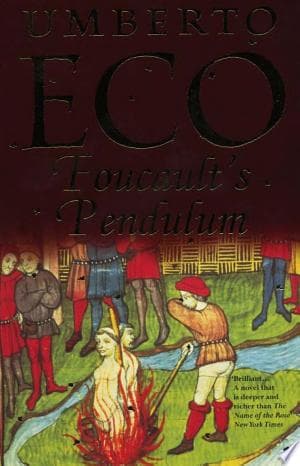
Synopsis
Covers the whole plot, including the ending.
- Difficulty
- Hard
- Pacing
- Slow
- Mood
- Intellectual, Conspiratorial, Philosophical, Mystical, Darkly Humorous
- Read it if
- You enjoy complex, intellectually stimulating thrillers that blend history, philosophy, and meta-fiction, and don't mind a challenging read with numerous historical and esoteric references.
- Skip it if
- You prefer straightforward plots, fast-paced action, or dislike lengthy philosophical digressions and extensive historical exposition.
Foucault's Pendulum Plot Summary
Covers the whole plot, including the ending.
The Pendulum and the Premise
The story begins with Casaubon, one of the three main characters, hiding in the Conservatoire des Arts et Métiers in Paris, under Foucault's Pendulum, on the eve of St. John's Day. He is waiting for a dangerous encounter, thinking about the complex history that led him there. He remembers a cryptic phone call warning him of danger and telling him to be at this location. This opening creates suspense and intellectual curiosity, hinting at a vast, hidden conspiracy and the personal danger the narrator faces. Casaubon's thoughts frame the intricate story that is about to unfold, setting the stage for a look into esotericism, history, and the power of narrative.
Milanese Miscellany
The story flashes back to Casaubon's past as a PhD student in medieval history, specializing in the Knights Templar. He takes a job at Garamond, a vanity press in Milan, where he works with two other cynical editors, Belbo and Diotallevi. They sort through many unusual manuscripts, many of which discuss occult theories, secret societies, and elaborate conspiracy theories. This constant exposure to strange ideas, from Rosicrucianism to ancient astronaut theories, gradually desensitizes them and sharpens their ability to find patterns, even false ones. This period establishes the intellectual environment that will later allow them to create their own elaborate game.
Colonel Ardenti's Tale
Colonel Ardenti, a retired military officer and amateur occultist, brings Garamond a manuscript detailing a fantastical conspiracy involving the Knights Templar. He claims the Templars did not vanish but went underground, controlling world events for centuries. Ardenti's theory involves a hidden treasure, a secret society called the 'Tres' (meaning 'Three'), and a plan for world control. He presents what he believes is a genuine Templar document, a coded message, which he thinks contains clues to their secret. The editors, especially Belbo, are initially amused and dismissive. But Ardenti's conviction and the boldness of his claims spark a fascination, even as they mock his ideas. Ardenti's sudden disappearance and later death, first thought to be an accident, become the first hint that their amusement might have serious consequences.
The Genesis of The Plan
After Ardenti's disappearance, the three editors—Casaubon, Belbo, and Diotallevi—decide to create their own ultimate conspiracy theory, a game they call 'The Plan.' Driven by their cynical amusement with the endless occult manuscripts and a desire to outdo the wildest theories, they begin to combine historical events, secret societies, and mystical concepts. They feed random data, historical facts, and their own invented connections into a powerful computer called Abulafia, designed to find patterns. Their goal is to build a narrative so compelling and complex it explains everything, linking the Templars, Rosicrucians, Illuminati, and other groups into one grand, unified, and entirely fictitious scheme for world domination. This intellectual exercise is initially a private joke, a way to pass the time.
Abulafia and the Web of Connections
The computer Abulafia becomes central to their game. The editors input historical figures, events, and occult symbols, using the program to generate connections and interpretations. Abulafia, designed to find patterns, begins to produce increasingly elaborate and seemingly plausible links between different elements, strengthening the editors' fabricated narrative. They meticulously craft a 'Plan' that involves the Templars secretly surviving and creating a vast network of secret societies, ending in a grand ritual to achieve ultimate power. Creating The Plan becomes addictive, blurring the lines between their playful invention and potential real-world implications. They even assign themselves roles within their invented hierarchy, deepening their involvement in the game.
The Plan Takes Shape
As The Plan develops, the editors invent specific details: a global network of secret societies, coded messages hidden in historical texts, and a specific date and location for a climactic ritual that will grant participants ultimate knowledge or power. They include elements from various real-world occult traditions, historical figures, and even personal stories, creating a narrative that is both complex and unsettlingly coherent. They develop the idea of the 'Tres' as the ultimate manipulators, a concept borrowed from Ardenti but greatly expanded. This period marks the peak of their creative collaboration, as they build a world of intricate deception, unaware that their creation will soon attract genuine believers and dangerous attention.
First Signs of Danger
The editors begin to realize their game is not so private when a mysterious group, the TdC (Templars de la Croix), shows an unsettling interest in their invented Plan. These individuals, who genuinely believe in various occult conspiracies, interpret the editors' playful fabrications as real revelations. They start contacting the editors, seeking more information and confirming details the editors merely invented. This unexpected turn is the first serious sign that their game has gone out of control, attracting dangerous individuals willing to act on the fictional narrative. The playful intellectual exercise begins to become a source of real anxiety and fear for Casaubon, Belbo, and Diotallevi.
Belbo's Betrayal and Disappearance
Belbo, the most cynical and perhaps most sensitive of the three, grows increasingly disturbed by the escalating reality of their game. He tries to distance himself from The Plan, but his knowledge makes him a target. He tries to confess the truth to a woman named Lia, but she dismisses it as another one of his elaborate stories. Eventually, Belbo is lured to a remote location, possibly by the TdC, under the pretense of a meeting about The Plan. He disappears, leaving a cryptic message that suggests he has been taken or is in grave danger. His disappearance is a turning point, changing the intellectual game into a desperate fight for survival for Casaubon and Diotallevi, who now realize the true extent of their peril.
The Confrontation at the Conservatoire
Casaubon, having received the warning call and instructions to go to the Conservatoire, finds himself trapped under Foucault's Pendulum. He is confronted by the TdC, led by a charismatic and terrifying figure known as Agliè. These individuals are fervent believers in The Plan, convinced that Casaubon and his friends possess the final pieces of their puzzle. They interrogate Casaubon, demanding the 'truth' about the Templar treasure and the ultimate ritual. The scene is tense and claustrophobic, highlighting the disconnect between the editors' intellectual game and the dangerous fanaticism of the TdC. Casaubon realizes the full horror of their creation, as the fictional narrative has now become a dangerous reality for those who believe in it.
The Ritual and Belbo's Fate
During the confrontation, the TdC performs a bizarre ritual, believing they are enacting the final stages of The Plan. They reveal Belbo, who has been captured and is suspended, seemingly as a sacrifice. In a desperate attempt to make them see reason, Belbo tries to explain that The Plan is a fabrication, a mere game. However, his pleas are misinterpreted by the fervent believers as part of the ritual or a final test. The TdC, blinded by their faith in the conspiracy, proceed with their actions, leading to Belbo's tragic death. This climactic scene shows the novel's central theme: the dangerous power of belief and how easily fiction can become a fatal reality when embraced by the gullible and fanatical.
Aftermath and Reflection
Casaubon manages to escape the Conservatoire, deeply traumatized by Belbo's death and the horrifying realization of what their intellectual game had caused. He spends time reflecting on truth, fiction, and the human need to find patterns, even where none exist. He considers the fine line between playful invention and dangerous delusion, and how easily a fabricated narrative can take on a life of its own, consuming both its creators and its believers. The experience changes him, forever marked by the consequences of their pride and the terrifying power of an idea. He understands that the universe may not have a plan, but humans are compelled to create one, often with dire consequences.
Foucault's Pendulum Characters
Casaubon
Protagonist
A cynical medievalist drawn into a dangerous conspiracy.
Casaubon is a scholar of medieval history, specializing in the Knights Templar. He is intelligent, analytical, and initially quite cynical, viewing the world of occult manuscripts with detached amusement. His academic background makes him adept at spotting historical patterns and inconsistencies, but also makes him susceptible to the intellectual challenge of creating 'The Plan.' He acts as the primary narrator, his reflections framing the entire story. He is more cautious than Belbo and Diotallevi, but equally complicit in the game's creation.
Relationships: Belbo (Friend and co-conspirator); Diotallevi (Friend and co-conspirator); Lia (Lover and intellectual confidante)
Jacopo Belbo
Protagonist
A jaded, melancholic editor with a hidden sensitivity.
Belbo is an editor at Garamond, known for his cynical wit, literary aspirations (unfulfilled), and a deep-seated melancholia. He is the most creative and imaginative of the three, often contributing the most fantastical elements to 'The Plan.' Despite his outward cynicism, he possesses a profound sensitivity and a secret desire for something transcendent, which ultimately makes him more vulnerable to the game's insidious power. He communicates his inner thoughts through a personal computer, Abulafia, which he also uses for 'The Plan.'
Relationships: Casaubon (Friend and co-conspirator); Diotallevi (Friend and co-conspirator); Lia (Object of unrequited affection/confidante)
Diotallevi
Protagonist
A mystical-leaning editor with a fascination for Kabbalah.
Diotallevi is the third editor, distinct from Belbo and Casaubon due to his more spiritual and mystical inclinations. He has a particular interest in Kabbalah and numerology, which he brings to bear on the construction of 'The Plan.' While also cynical about the manuscripts they receive, he approaches the game with a slightly more earnest intellectual curiosity about the underlying structures of reality and belief. He is pragmatic but also deeply entangled in the intellectual web they weave, contributing a unique perspective to their fabricated conspiracy.
Relationships: Casaubon (Friend and co-conspirator); Belbo (Friend and co-conspirator)
Colonel Ardenti
Supporting
The eccentric catalyst for 'The Plan.'
Colonel Ardenti is a retired military officer and a fervent believer in a grand Templar conspiracy. He presents his manuscript to Garamond, detailing a complex, though ultimately unsubstantiated, theory about the Templars' continued existence and their secret plan. His intense conviction and the mysterious circumstances of his disappearance and death serve as the initial spark for the editors' game. He represents the kind of 'crackpot' they usually mock, yet his story proves to have a dangerous allure.
Relationships: Casaubon (Acquaintance, source of initial inspiration); Belbo (Acquaintance, source of initial inspiration)
Lia
Supporting
Casaubon's lover and a voice of skeptical reason.
Lia is Casaubon's girlfriend, a practical and grounded woman who works in publishing. She provides a crucial counterpoint to the increasingly convoluted and esoteric discussions of the three editors. She is intelligent and perceptive, able to see through the editors' intellectual games and offer common-sense explanations for phenomena they deem mystical. She represents a voice of reason and sanity in a world increasingly consumed by paranoia and fabricated connections, attempting to ground Casaubon in reality.
Relationships: Casaubon (Lover); Belbo (Acquaintance, recipient of Belbo's unrequited affection)
Agliè
Antagonist
A mysterious, ancient-seeming occultist and leader of the TdC.
Agliè is a enigmatic and seemingly ageless figure who first appears as a consultant on occult matters for Garamond. He is deeply versed in esoteric traditions and legends, and gradually reveals himself to be the leader of the TdC (Templars de la Croix), a group of genuine believers in the very conspiracy the editors fabricated. He is highly manipulative, charismatic, and utterly convinced of the reality of 'The Plan,' making him a truly dangerous antagonist who believes he is acting on divine knowledge.
Relationships: Casaubon (Antagonist, intellectual adversary); Belbo (Antagonist, victimizer)
Abulafia
Mentioned
Belbo's computer, used to generate 'The Plan.'
Abulafia is the name Belbo gives to his personal computer, a powerful machine capable of processing and connecting vast amounts of data. It serves as a literal plot device, allowing the editors to feed in disparate facts and theories and generate complex, interwoven narratives. The computer's ability to find patterns, however arbitrary, becomes central to the creation of 'The Plan,' highlighting how technology can amplify and legitimize even the most baseless connections. It's named after Abraham Abulafia, a medieval Kabbalist.
Foucault's Pendulum Themes
The Seduction of Conspiracy
The novel explores the human tendency to find patterns and meaning, even when they don't exist. The editors, initially cynical, become drawn into the game of creating 'The Plan,' showing how easily one can fall for the appeal of a grand, unifying theory. This is clear when Casaubon, despite knowing it's a game, feels drawn to the 'truth' of The Plan. It culminates in the TdC's dangerous fanaticism, showing how a made-up story can become a fatal reality for those who believe it completely.
“A conspiracy is a much more enduring and stronger thing than a government. Governments fall, but a conspiracy remains.”
The Power of Narrative and Interpretation
Eco shows how stories, both factual and fictional, shape our understanding of the world. The editors' creation of 'The Plan' is an act of narrative construction, showing how historical facts can be reinterpreted to fit a desired story. The novel shows that 'truth' often lies in interpretation, and a compelling narrative can be more powerful than objective reality. This is clear in how the TdC fully embraces and acts upon the editors' fictional creation, demonstrating the powerful and dangerous nature of a well-crafted, even false, narrative.
“Any text can be interpreted in an infinity of ways.”
Cynicism vs. Belief
The protagonists start as jaded cynics, mocking those who believe in occult conspiracies. However, their intellectual game forces them to confront the human need for belief and the dangers of both extreme cynicism and blind faith. Belbo, in particular, struggles with this tension, moving between cynical detachment and a secret desire for transcendence. The tragic outcome of the story suggests that while cynicism can protect one from delusion, it can also lead to a dangerous underestimation of the power of genuine belief in others.
“When you invent, you're not inventing reality; you're inventing a story.”
History as a Palimpsest
The novel treats history not as a fixed record but as a flexible text, a palimpsest where new meanings can be written over old ones. The editors' 'Plan' is essentially an act of rewriting history, finding hidden connections and secret meanings in existing historical documents and events. This theme is central to Casaubon's academic background and his interest in the Templars, a group whose history is already full of mystery and multiple interpretations. The book suggests that history is always open to interpretation, and these interpretations can be shaped, or even entirely made up, to serve a particular narrative.
“History is not a text, but a series of codes that can be deciphered in various ways.”
Plot Devices & Literary Techniques
Foucault's Pendulum
A physical manifestation of universal motion and a symbol of cosmic order.
The Foucault's Pendulum at the Conservatoire des Arts et Métiers serves as both a literal and symbolic anchor for the novel. Literally, it's Casaubon's hiding place and the site of the climax. Symbolically, it represents the earth's rotation and the universe's predictable, observable laws. Its constant, silent swing contrasts sharply with the chaotic, conspiratorial 'Plan' the characters invent. It acts as a counterpoint to the human desire to impose a hidden, complex order on the universe, suggesting that perhaps the most profound truths are the simplest ones, constantly present and observable.
Abulafia (The Computer)
A tool that automates the creation of arbitrary connections.
Abulafia is a powerful computer program used by the editors to process and link disparate pieces of information. It acts as a metaphor for the human mind's ability to find patterns and create narratives, but also highlights how technology can amplify this tendency to dangerous extremes. By feeding it random data and asking it to find connections, the editors inadvertently create a 'truth' that becomes compelling precisely because the computer, a supposedly objective tool, generates it. Abulafia legitimizes their fiction, blurring the lines between random data and meaningful patterns.
The 'Plan'
A fabricated, all-encompassing conspiracy theory.
The 'Plan' is the central plot device, an elaborate, entirely fictional conspiracy theory invented by the three editors. It functions as a meta-narrative, reflecting and satirizing the very occult manuscripts they edit. Initially a game, it gradually takes on a life of its own, becoming real for the genuine believers (the TdC). The Plan demonstrates the dangerous power of narrative construction, showing how a well-crafted fiction can become indistinguishable from reality for those who desperately seek meaning and order in the world. It is the engine of both the intellectual amusement and the ultimate tragedy of the story.
Intertextuality and Allusion
Extensive references to historical, mythological, and philosophical texts.
Eco employs pervasive intertextuality, weaving in countless allusions to historical events, esoteric traditions, philosophical concepts, and literary works. This device enriches the narrative by grounding the fictional 'Plan' in a dense tapestry of real-world knowledge, making the fabricated conspiracy seem more plausible. It also serves as a meta-commentary on the nature of knowledge itself, suggesting that all understanding is built upon prior texts and interpretations. The sheer volume of references challenges the reader to distinguish between genuine historical fact and clever narrative fabrication, mirroring the characters' own struggle.
Foucault's Pendulum Quotes
“The greatest enemy of truth is very often not the lie—deliberate, contrived and dishonest—but the myth—persistent, persuasive and unrealistic.”
“That's what the world is, after all: an endless, inscrutable, obscure manuscript, crisscrossed with deletions, lacunae, and marginalia, and all of it in a secret code.”
“Anyone who wants to be a Magus does not practice the Greater Ritual, but only the Lesser: he learns how to read.”
“A conspiracy is a much more enduring explanation than chance.”
“Every secret must be spoken, and every speech must be secret.”
“The world is a text, and texts want to be interpreted.”
“Only a fool can be a perfect master of the obvious.”
“To invent a conspiracy is to invent a world.”
“Order is not a principle, but a condition.”
“The only way to escape a conspiracy is to become part of it.”
“Truth is not found, but made.”
“What is a text, after all, but a machine for generating interpretations?”
“The desire to find a hidden pattern, a secret design, is one of the most powerful engines of human thought.”
“When you want to invent a mystery, you first create a coincidence.”
Quiz
10 questions on the plot and the characters. Each answer comes with a short explanation.
Question 1
What is the name of the powerful computer system the protagonists use to invent connections between their data entries?
- The Abulafia
- The Golem
- The Illuminator
- The Hermetic Engine
Show answer
A. The Abulafia The computer system, central to their game of creating connections, is named Abulafia, after Abraham Abulafia, a Kabbalist.
Question 2
Which of the following characters is NOT one of the three main book editors who create 'The Plan'?
- Casaubon
- Belbo
- Liard
- Diotallevi
Show answer
C. Liard The three main editors are Casaubon, Belbo, and Diotallevi. Liard is a character who provides some of the initial inspiration for their game.
Question 3
What specific historical artifact or location is Foucault's Pendulum itself, in the context of the novel, primarily associated with?
- The Templars' hidden treasure
- The Conservatoire des Arts et Métiers in Paris
- An ancient Rosicrucian library
- A secret Masonic lodge in London
Show answer
B. The Conservatoire des Arts et Métiers in Paris The novel opens and largely revolves around Casaubon hiding beneath Foucault's Pendulum in the Conservatoire des Arts et Métiers in Paris, a real location where a Foucault's Pendulum demonstrates the Earth's rotation.
Question 4
What is the primary motivation for the three editors to begin constructing 'The Plan'?
- To expose a real, dangerous conspiracy they have uncovered.
- To create a comprehensive historical document for their publishing house.
- To amuse themselves by inventing a 'master conspiracy' from the ludicrous manuscripts they read.
- To fulfill a commission from a wealthy, eccentric patron.
Show answer
C. To amuse themselves by inventing a 'master conspiracy' from the ludicrous manuscripts they read. Their initial motivation is boredom and a cynical amusement derived from the flood of crackpot occult manuscripts. They decide to create the ultimate conspiracy theory for fun.
Question 5
What role does Colonel Ardenti play in the initial setup of 'The Plan'?
- He is the wealthy patron funding their research.
- He provides them with a detailed, compelling conspiracy story that inspires their game.
- He is one of the editors' colleagues who warns them against their game.
- He attempts to steal the Abulafia computer for his own purposes.
Show answer
B. He provides them with a detailed, compelling conspiracy story that inspires their game. Colonel Ardenti visits the editors with his own elaborate conspiracy theory about the Templars, which serves as a significant catalyst for the editors to start their own game.
Question 6
What is the name of the publishing house where Casaubon, Belbo, and Diotallevi work?
- Garzanti Editore
- Bompiani
- Manutius
- Adelphi Edizioni
Show answer
C. Manutius The publishing house where the three protagonists work is called Manutius, named after the famous Venetian printer Aldus Manutius.
Question 7
How does Belbo primarily record his personal thoughts, observations, and initial contributions to 'The Plan' before the Abulafia is fully utilized?
- He uses a series of encrypted email exchanges with Casaubon.
- He dictates them into a voice recorder he carries everywhere.
- He types them into his old Olivetti computer, which he considers a 'sacred' machine.
- He writes them in a secret journal hidden in his office.
Show answer
C. He types them into his old Olivetti computer, which he considers a 'sacred' machine. Belbo famously uses his old Olivetti personal computer to store his 'files' and musings, which he later uploads to the Abulafia.
Question 8
The novel heavily explores the concept of 'hermetic semiosis' or 'pan-semiosis'. What does this concept essentially entail in the context of the book?
- The belief that all signs and symbols have a single, definitive meaning.
- The idea that everything is interconnected and can be interpreted as a sign pointing to a hidden, ultimate truth.
- A scientific method for deciphering ancient, lost languages.
- The study of how secret societies communicate through coded messages.
Show answer
B. The idea that everything is interconnected and can be interpreted as a sign pointing to a hidden, ultimate truth. Hermetic semiosis, or pan-semiosis, is the theme that drives the conspiracy theories in the book: the belief that all phenomena, symbols, and historical events are interconnected and signify a vast, hidden cosmic plan, often without any real basis.
Question 9
What is the ultimate fate of Belbo, one of the three editors, at the climax of the novel?
- He escapes with Casaubon and goes into hiding.
- He is killed by the Diabolicals, hanged from Foucault's Pendulum.
- He successfully convinces the conspirators that 'The Plan' is a hoax.
- He betrays his friends and joins the 'Diabolicals'.
Show answer
B. He is killed by the Diabolicals, hanged from Foucault's Pendulum. In a tragic turn, Belbo is captured and hanged from Foucault's Pendulum by the 'Diabolicals' (the conspirators who believe 'The Plan' is real), believing he holds the key to the Templar secret.
Question 10
What significant philosophical concept, often associated with the dangers of excessive interpretation, does the novel implicitly critique through the unfolding of 'The Plan'?
- Empiricism and the reliance on observational data.
- The inherent objectivity of historical accounts.
- The postmodern tendency to find meaning and connection where none objectively exists, leading to self-fulfilling prophecies.
- Rationalism and the pursuit of logical consistency.
Show answer
C. The postmodern tendency to find meaning and connection where none objectively exists, leading to self-fulfilling prophecies. The novel is a profound critique of postmodern excess in interpretation, demonstrating how the relentless search for hidden connections and meanings, even when fabricating them, can lead to dangerous and self-destructive outcomes, blurring the lines between fiction and reality.
Foucault's Pendulum FAQ
What is the core premise of 'Foucault's Pendulum' and who are the main protagonists?
The novel centers on three jaded Milanese editors—Casaubon, Belbo, and Diotallevi—who work at a vanity press, Manuzio. Overwhelmed by submissions detailing esoteric conspiracies, they decide to invent their own 'Plan' by feeding random historical and occult data into a computer, thinking it's a harmless game, only to find their fiction becoming terrifyingly real.
What role does the 'Plan' play in the narrative, and how does it evolve?
The 'Plan' is a fictional, elaborate conspiracy concocted by the protagonists, linking various historical secret societies like the Knights Templar, Rosicrucians, and Jesuits, to a grand scheme for global domination and rediscovering a lost Templar treasure. It evolves from a cynical joke into a perceived reality for those who believe in it, drawing real-world consequences and violence.
Who is Colonel Ardenti, and what is his significance to the plot?
Colonel Ardenti is a mysterious, elderly man who presents the editors with an incoherent but compelling theory about a Templar treasure hidden in Brazil. His subsequent disappearance and presumed death act as the catalyst for the editors to begin constructing their own 'Plan,' initially inspired by his convoluted ideas.
Where does the titular Foucault's Pendulum appear in the story, and what does it symbolize?
The Foucault's Pendulum is located in the Conservatoire des Arts et Métiers in Paris, where Casaubon hides at the novel's beginning and end. It symbolizes the Earth's constant, indifferent rotation and the relativity of all fixed points, serving as a cosmic counterpoint to humanity's desperate search for absolute truths and hidden connections.
What is the ultimate 'truth' the protagonists are searching for, and do they find it?
The protagonists are initially searching for the truth behind Ardenti's disappearance and later, the truth of whether their fabricated 'Plan' has a real-world counterpart. They ultimately discover that there is no single 'truth' behind the Plan; it is a self-fulfilling prophecy created by belief and interpretation, leading to tragic consequences rather than enlightenment.
What is the significance of the computer 'Abulafia' and its name?
Abulafia is the powerful computer used by the editors to cross-reference their vast database of occult texts and historical events, generating 'connections' for their 'Plan.' Its name is a nod to Abraham Abulafia, a medieval Kabbalist known for his mystical techniques involving letter combinations to achieve ecstatic states, mirroring the computer's role in creating meaning from arbitrary data.
How does the novel subtly critique the concept of historical objectivity?
The novel critiques historical objectivity by demonstrating how readily disparate facts can be woven into a coherent, yet entirely fictional, narrative through selective interpretation and the imposition of a preconceived pattern. The editors' 'Plan' highlights that history, especially when dealing with secret societies, is often more about the stories we tell ourselves than verifiable facts.
What is the role of the character Lia, and what does she represent in contrast to the editors?
Lia is Casaubon's girlfriend, a grounded and pragmatic historian who attempts to bring common sense and rational explanation to the editors' increasingly convoluted 'Plan.' She represents a voice of reason and skepticism, offering sensible, often mundane, explanations for phenomena the editors attribute to grand conspiracies, contrasting with their descent into self-generated mysticism.
What is the significance of the Templar 'treasure' in the context of the novel?
The Templar 'treasure' in the novel is not a physical hoard of gold or jewels, but rather a metaphorical 'secret' or 'knowledge' about a forgotten energy source or method of control. Its true significance lies in its power as a MacGuffin, driving the plot and the desperate actions of various groups who believe in its existence, whether it's real or not.
How does Belbo's personal history and his unfulfilled literary ambitions influence his involvement in the 'Plan'?
Belbo, a frustrated writer who believes he lacks the true genius for literature, pours his creative energy and intellectual cynicism into constructing the 'Plan.' His diaries, filled with his self-doubt and reflections on his past, reveal a deep-seated longing for meaning and recognition, which he paradoxically finds and loses within the very conspiracy he helps invent.
Discuss the psychological impact of the 'Plan' on the three editors, particularly Casaubon.
The 'Plan' gradually erodes the editors' initial detachment, blurring the lines between their intellectual game and reality. Casaubon, initially the most skeptical, finds himself increasingly drawn into the labyrinthine logic, experiencing paranoia and fear as external events seem to validate their fiction. The psychological toll is a loss of innocence and a descent into a world where their own creation threatens their lives.
How does the novel explore the psychology of belief and confirmation bias?
The novel masterfully illustrates how belief, once established, fuels confirmation bias. Characters, including the editors and the 'Diabolicals,' interpret every new piece of information, no matter how unrelated, as further proof of the 'Plan.' This demonstrates the human mind's tendency to seek patterns and validate existing beliefs, even when those patterns are entirely fabricated.
What psychological vulnerabilities do the 'Diabolicals' exploit, and how do they differ from the editors?
The 'Diabolicals' exploit a deep-seated human need for meaning, belonging, and a sense of cosmic significance, particularly in those who feel disenfranchised or crave secret knowledge. Unlike the editors, who initially approach the 'Plan' with cynical detachment, the Diabolicals are true believers who have already committed to a worldview where such grand conspiracies are real, making them susceptible to manipulation.
Is the 'Plan' truly dangerous, or is it the belief in the 'Plan' that creates the danger?
The novel strongly suggests that it is the belief in the 'Plan,' rather than the 'Plan' itself, that creates the danger. The 'Plan' is a fiction, but when enough people believe it, act upon it, and kill for it, it becomes a terrifying reality. Eco argues that the power of interpretation and the human need for grand narratives can manifest real-world violence and chaos.
Does 'Foucault's Pendulum' offer a definitive answer to the existence of real conspiracies?
No, the novel deliberately avoids offering a definitive answer to the existence of real conspiracies. Instead, it serves as a cautionary tale about the human propensity to invent and believe in them. It suggests that even if real conspiracies exist, the obsessive search for them can lead one to create and become trapped within a self-generated, equally dangerous, fictional one.
How does the ending of the novel reflect its core philosophical themes?
The tragic ending, with Belbo's death and Casaubon awaiting his own fate, underscores the novel's core themes: the futility of seeking absolute truth in a relative world, the destructive power of invented narratives, and the danger of intellectual games turning deadly serious. Casaubon's final acceptance of the meaningless, yet beautiful, rotation of the Pendulum reflects a surrender to the indifference of the universe.
What is the novel's commentary on the nature of knowledge and information in the modern age?
The novel, written before the internet's widespread adoption, presciently comments on the overwhelming nature of information and the ease with which disparate data can be connected to form any desired narrative. It warns against uncritical consumption of information and the seductive power of pattern recognition, highlighting how readily 'knowledge' can be manufactured and manipulated.
What is the 'true' secret or message that Belbo leaves behind in his final writings?
Belbo's final writings do not reveal a 'true' secret of the Plan, but rather a deeply personal and poignant reflection on his life, his regrets, and his unfulfilled desires. His ultimate message is one of longing for authentic experience and genuine connection, lamenting how the intellectual game of the 'Plan' consumed him and prevented him from truly living.
About the author

Umberto Eco was an Italian medievalist, philosopher, semiotician, novelist, cultural critic, and political and social commentator. In English, he is best known for his popular 1980 novel The Name of the Rose, a historical mystery combining semiotics in fiction with biblical analysis, medieval studies and literary theory, as well as Foucault's Pendulum, his 1988 novel which touches on similar themes.
Similar books
- The Da Vinci Code
Dan Brown
3.9 (1.9M) average on GoodreadsThrillerExplores a modern-day conspiracy rooted in ancient secrets and religious history, albeit with a much faster pace and simpler prose.
- The Name of the Rose
Umberto Eco
4.1 (301k) average on GoodreadsHistorical FictionShares Eco's dense, erudite style, historical setting, and blend of mystery with philosophical and semiotic exploration.
- Angels & Demons
Dan Brown
3.9 (2.7M) average on GoodreadsThrillerA Harvard symbologist races through Rome's ancient sites, deciphering cryptic clues to unmask the Illuminati and stop a vengeful plot to destroy the Vatican with a stolen antimatter weapon.
- Gone Girl
Gillian Flynn
4.1 (2.3M) average on GoodreadsThrillerA wife's sudden disappearance on her fifth anniversary reveals a web of lies and psychological warfare, exposing the secrets within a seemingly perfect marriage.
- The Girl on the Train
Paula Hawkins
3.9 (2.1M) average on GoodreadsThrillerA woman’s fascination with a seemingly perfect couple she watches from her daily train commute leads her into a dark investigation when she witnesses something that shatters their idyllic image.
- The Guest List
Lucy Foley
3.8 (1.3M) average on GoodreadsThrillerOn a remote Irish island, a glamorous wedding descends into a deadly whodunnit when a guest is found murdered, trapping everyone with their secrets as a storm rages.






Enjoyed the summary?
A summary gives you the shape of the book. The book itself has the detail, the examples and the voice.
Find Foucault's Pendulum on AmazonAs an Amazon Associate, BookBrief earns from qualifying purchases. How we're funded