
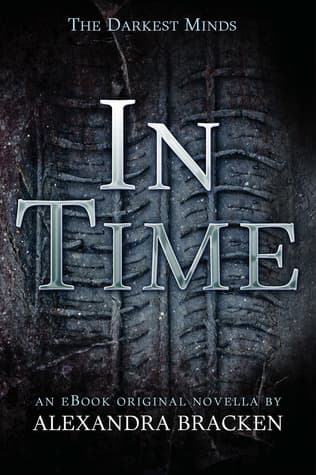
Synopsis
Covers the whole plot, including the ending.
- Difficulty
- Easy
- Pacing
- Fast
- Mood
- Suspenseful, Hopeful, Action-packed, Melancholy
- Read it if
- You're a fan of 'The Darkest Minds' series and want to understand Gabe's backstory and his connection to the main narrative before reading 'Never Fade'.
- Skip it if
- You prefer standalone stories or haven't read 'The Darkest Minds' and don't want spoilers or context gaps.
In Time Plot Summary
Covers the whole plot, including the ending.
A Desperate Start
Gabe, a young man, lives in a small, struggling town. He lost his mother to fever and his father to the PSFs. He works at a broken-down gas station, barely surviving, always wary of the PSFs and bounty hunters who might target him. His only hope is to become a skiptracer, a dangerous job tracking missing children. He carries the pain of losing his younger brother, Jude, who was taken to a 'rehabilitation camp' and never returned. This loss drives his desperation to escape.
The First Assignment
Gabe attends a skiptracer recruitment meeting, a grim event held in a backroom. He is one of the few desperate applicants. Despite his lack of experience, he gets his first assignment: a young girl named Suzume, described as 'mute' and 'difficult.' The handler, a cynical man, gives few details, only emphasizing the reward. Gabe feels uneasy about tracking a child, especially one so vulnerable, but the money and a chance to leave his bleak life behind outweigh his doubts. He receives a photo and a last known location, beginning his dangerous journey.
Tracking Suzume
Gabe starts his first skiptracer mission, following the few clues to a remote, run-down house outside town. The house looks empty, with overgrown weeds and broken windows, suggesting a quick departure. He approaches carefully, alert, his heart pounding with fear and resolve. Inside, he finds signs of recent life—a half-eaten meal, scattered toys, and a child's drawing—suggesting Suzume and her guardians were recently there. The house's silence is unsettling, making him feel both closer to his target and more aware of his new job's dangers.
A Hidden Discovery
After a tense search, Gabe finds Suzume hiding in a secret compartment under the floorboards. She is small, with striking black hair and eyes that seem wise. She does not speak, as described, but her silence is calm, not fearful. As he tries to get her out, he notices a subtle shift around them—a brief shimmer in the air, a faint hum. He dismisses it as his imagination or nerves, but it is the first hint of Suzume's unusual abilities, marking her as one of the Psi kids.
The Revelation of Powers
As Gabe tries to catch Suzume, she shows him her true nature as a Psi. Instead of speaking, she communicates through detailed, almost holographic projections of images and memories, showing him parts of her past, her fear, and her wish for safety. She can subtly manipulate objects and perceptions, creating small illusions and blocking his attempts to grab her. Gabe is stunned, realizing he is not dealing with an ordinary runaway. He faces a child with powers, the kind the PSFs hunt, making his mission far more dangerous and ethically complex than he expected.
A Moral Dilemma
Suzume's abilities and silent pleas for understanding leave Gabe with a tough moral choice. He knows turning her in means sending her to a 'rehabilitation camp,' a fate he suspects is like what happened to his brother, Jude. The idea of contributing to such an injustice, especially after seeing her vulnerability and unique communication, sickens him. The promised reward now seems tainted. His need to escape his past clashes with his growing sense of responsibility toward this powerful, yet innocent, child. He questions everything he thought about his new job.
The PSFs Arrive
Just as Gabe considers his next move, the rumble of approaching vehicles breaks the quiet. PSF agents, in dark uniforms, surround the house, having tracked Suzume. Gabe realizes he is trapped, caught between his duty and his conscience. Suzume, sensing danger, becomes agitated, her powers flaring in defensive bursts, causing objects to shift and lights to flicker. The situation quickly escalates, with both Gabe and Suzume now targets, showing the harsh reality of their world and the constant threat to children like Suzume.
An Unexpected Alliance
With the PSFs closing in, Gabe makes a clear choice. Instead of handing Suzume over, he grabs her hand, showing he will protect her. He shields her as the agents storm the house, his skiptracer training kicking in not to capture, but to escape. Suzume, understanding, uses her powers to create distractions, confusing the agents and buying them precious seconds. This act forms an unspoken alliance between them, changing their relationship from captor and captive to allies against a common, powerful enemy. They must escape together.
The Escape
Gabe and Suzume make a desperate escape, scrambling through the back of the house and into the surrounding woods. The PSFs pursue them relentlessly, their shouts and radio crackle echoing through the trees. Suzume continues to use her abilities, creating distractions and confusing their pursuers, while Gabe uses his knowledge of the local terrain and his instincts to lead them deeper into the wilderness. The chase is dangerous, but their combined efforts—Gabe's physical skills and Suzume's unique gifts—allow them to outmaneuver the agents, for now. They find a temporary hiding spot, exhausted but safe.
A New Path
Hiding in the woods, Gabe and Suzume share a quiet understanding. Suzume, still silent, projects an image of a journey, a path forward, implicitly asking Gabe to join her. Gabe looks at the small, powerful girl and realizes his life has changed. His dream of being a skiptracer for personal gain is gone, replaced by a new goal: protecting Suzume and, perhaps, making up for his past and finding a new kind of family. They set off together, two unlikely companions united by circumstances and a shared need to survive in a world that fears and hunts people like Suzume. Their journey into the unknown has begun.
Principal Figures
Gabe
Protagonist
A desperate young man turned protector of a Psi child.
Gabe is a pragmatic and resourceful young man, hardened by the loss of his family—his mother to illness, his father to the PSFs, and his younger brother, Jude, to a 'rehabilitation camp.' He's driven by a desire to escape his bleak circumstances and the constant threat of the PSFs. Initially, he's willing to become a skiptracer, a bounty hunter of children, out of desperation. However, beneath his tough exterior lies a strong moral compass and a capacity for compassion, especially when confronted with the vulnerability of others. He's observant and quick-thinking, traits that serve him well in his dangerous new life.
Relationships: Suzume (Initially captor/captive, evolves into protector/protected and allies.); Jude (Younger brother, presumed lost to a camp, a source of Gabe's guilt and motivation.)
Suzume
Supporting
A silent Psi child with powerful telekinetic and communicative abilities.
Suzume is a young girl with extraordinary Psi abilities, specifically a form of telekinesis and the power to project thoughts and memories as images. She is described as mute, communicating entirely through these projections, which adds to her mystique and vulnerability. Despite her young age, she possesses a remarkable calmness and intelligence, understanding complex situations and expressing deep emotions without words. She is a target of the PSFs, making her existence a constant struggle for survival. Her resilience and unique way of interacting with the world make her a compelling and central figure in Gabe's transformation.
Relationships: Gabe (Initially target/hunter, evolves into protected/protector and allies.)
Jude
Mentioned
Gabe's lost younger brother, a catalyst for his actions.
Jude is Gabe's younger brother, who was taken to a 'rehabilitation camp' by the PSFs. His fate is unknown, but Gabe presumes the worst. Jude represents Gabe's greatest loss and a significant source of his guilt and underlying trauma. The memory of Jude fuels Gabe's initial desperation to escape his circumstances and later influences his decision not to turn Suzume over to the authorities, as he fears she would suffer a similar fate. Though never appearing directly, Jude's absence is a powerful motivational force for Gabe.
Relationships: Gabe (Older brother, deeply missed and mourned.)
Skiptracer Handler
Supporting
The cynical recruiter for the skiptracer program.
The skiptracer handler is a gruff, unsympathetic man who recruits desperate individuals like Gabe into the dangerous profession of tracking down children. He embodies the callousness and moral decay of the world, viewing children like Suzume as mere commodities for bounty. He provides minimal information and shows no concern for the welfare of either the skiptracers or their targets. His brief appearance highlights the grim reality of the 'rehabilitation camp' system and the desperation that drives people to participate in it.
PSF Agents
Antagonist
The relentless government forces hunting Psi children.
The Psi Special Forces (PSFs) are the omnipresent, oppressive government agency responsible for identifying, capturing, and interning children with Psi abilities. They are depicted as cold, efficient, and ruthless, operating with little regard for human rights. Their presence instills fear and represents the systemic oppression within the story's world. They are the primary antagonistic force, constantly pursuing Psi children like Suzume and anyone who harbors them. Their actions drive much of the plot's tension and danger.
Relationships: Gabe (Antagonistic, actively pursuing him after he protects Suzume.); Suzume (Antagonistic, their primary target.)
Themes & Insights
The Morality of Survival
This theme explores the ethical compromises people make to survive in a desperate world. Gabe initially becomes a skiptracer, a bounty hunter of children, out of desperation and a desire to escape his bleak life and the trauma of losing his family. He pursues Suzume driven by this need. However, after meeting Suzume and seeing her vulnerability and unique communication, his moral compass is challenged. He ultimately chooses to protect her, sacrificing his immediate survival instincts for a higher moral principle, as shown when he shields her from the PSFs and helps her escape.
“He knew what happened in those camps. He knew because of Jude. And the thought of sending this small, silent girl to the same fate… it made his stomach clench.”
The Power of Compassion and Connection
In a world of fear and oppression, the story highlights the impact of compassion and unexpected connections. Gabe, initially hardened and focused on self-preservation, changes when faced with Suzume's silent vulnerability and unique communication. His empathy for her, especially considering his lost brother, leads him to defy his original mission. Their bond, formed through shared danger and mutual protection, moves beyond their initial roles as captor and captive. This shows that even in the darkest times, human connection and kindness can be strong forces. Their joint escape, where they rely on each other's strengths, illustrates this.
“He grabbed her hand, a silent promise. He wouldn't let them take her.”
Loss and Trauma
The ongoing theme of loss and trauma shapes the characters and their motivations. Gabe carries the heavy burden of losing his mother, father, and especially his younger brother, Jude, due to the oppressive regime. This past trauma fuels his desperation to escape and influences his moral choices. The world itself is scarred by economic collapse and political oppression, creating an atmosphere of constant fear and loss for everyone. Suzume also suffers loss, separated from her guardians and constantly hunted, which contributes to her silent, watchful nature. Their shared experiences of loss create an unspoken understanding between them.
“Every time he saw a child, he thought of Jude. A ghost that followed him everywhere.”
The Dehumanization of the 'Other'
This theme explores how society demonizes and persecutes those seen as different or threatening, specifically children with Psi abilities. The PSFs represent institutional dehumanization, viewing Psi children as dangerous anomalies to be 'rehabilitated' or eliminated. The skiptracer program further illustrates this, turning children into bounties and encouraging people to betray them for profit. Suzume's silence and unique abilities, while extraordinary, make her a target. The story implicitly critiques how fear of the unknown leads to systematic oppression and the erosion of basic human rights, forcing characters like Gabe to confront their involvement in such systems.
“They called them 'Skiptracers.' Hunters of children. He hadn't thought much of it then, only of the money.”
Plot Devices & Literary Techniques
The Skiptracer Program
A government-sanctioned bounty system for tracking Psi children.
The skiptracer program is a crucial plot device that thrusts Gabe into the central conflict. It serves as a mechanism to introduce Gabe to Suzume and to force him into a moral dilemma. By making him a 'hunter' of children, the program immediately establishes the oppressive nature of the world and the desperation of its inhabitants. It also highlights the dehumanization of Psi children, as they are reduced to targets for monetary gain. The program's existence is the catalyst for Gabe's journey and his eventual transformation from a participant in the system to a resistor.
Suzume's Muteness and Psi Abilities
A unique form of communication and powers that drive the plot and character development.
Suzume's muteness, coupled with her Psi abilities to project images and memories, is a powerful plot device. It forces Gabe to engage with her on a deeper, non-verbal level, fostering empathy and understanding. Her abilities are not just a source of danger (making her a target for the PSFs) but also a means of communication and self-defense, allowing her to convey her story and protect herself during the escape. This unique form of interaction challenges Gabe's preconceptions and is central to his moral awakening, as he sees her as a sentient being rather than just a 'score'.
The 'Rehabilitation Camps'
Off-screen institutions for Psi children, representing a looming threat and past trauma.
The 'rehabilitation camps' are a significant plot device, even though they are never directly shown. They represent the ultimate threat to Psi children and serve as a constant reminder of the world's cruelty. For Gabe, the memory of his brother Jude being taken to one of these camps is a deep-seated trauma that heavily influences his decision to protect Suzume. The camps are a powerful motivator for both fear and defiance, pushing characters to extreme measures to avoid them. They symbolize the systematic oppression and the unknown, terrifying fate of those deemed 'different'.
In Time Quotes
“The only way out was through. And sometimes, through meant facing the things you'd rather leave buried.”
“We were not meant to be broken. We were meant to break free.”
“Sometimes, the hardest part of being brave was not doing the thing, but living with what came after.”
“Hope was a dangerous thing to hold onto, especially when you had nothing else.”
“Our abilities weren't a curse. They were a weapon. And it was time we learned how to use them.”
“There’s a difference between being lost and choosing to wander.”
“Fear was a current, but it didn't have to pull you under.”
“You don't get to choose your past, but you can choose your future.”
“Every secret had a weight, and some were heavy enough to sink you.”
“Love wasn't a weakness. It was the only thing that made us strong enough to keep fighting.”
“The world wasn't going to save itself. We had to be the ones to do it.”
“Sometimes, the monster was the one you saw in the mirror.”
“Silence could be a weapon, or it could be a cage.”
“We were all just trying to find our way back home, even if we didn't know where home was anymore.”
Quiz
10 questions on the plot and the characters. Each answer comes with a short explanation.
Question 1
What is the primary motivation for Gabe to leave his small town and attempt to become a skiptracer?
- To find his long-lost family members.
- To escape his tragic past and the devastation of the economic crash.
- To join a resistance movement against the government.
- To pursue a career in law enforcement.
Show answer
B. To escape his tragic past and the devastation of the economic crash. Gabe's life was devastated by the economic crash, and becoming a skiptracer was his only option to escape his tragic past.
Question 2
What makes Gabe's first skiptracer assignment particularly challenging?
- The target is a high-ranking government official.
- The target is a young girl who won't speak.
- He has to travel across state lines without authorization.
- He is being pursued by rival skiptracers.
Show answer
B. The target is a young girl who won't speak. His first score, a young girl who won't speak, makes his already almost impossible task all the more difficult.
Question 3
Which of the following best describes the genre of 'In Time'?
- Historical Fiction
- Mystery Thriller
- Fantasy, Science Fiction, Young Adult, Romance
- Contemporary Drama
Show answer
C. Fantasy, Science Fiction, Young Adult, Romance The book description explicitly lists Fantasy, Science Fiction, Young Adult, and Romance as its genres.
Question 4
How does the 'young girl who won't speak' impact Gabe's life?
- She leads him to a hidden treasure.
- She causes him to abandon his skiptracer career entirely.
- She changes his life in ways he could never imagine.
- She helps him become a more efficient skiptracer.
Show answer
C. She changes his life in ways he could never imagine. The description states that the young girl 'changes his life in ways he could never imagine,' highlighting her profound impact.
Question 5
What major event is mentioned as having devastated Gabe's life?
- A natural disaster.
- A war.
- The economic crash.
- A personal tragedy unrelated to societal events.
Show answer
C. The economic crash. The text clearly states, 'Gabe's life has been devastated in the wake of the economic crash.'
Question 6
What is the significance of 'In Time' in relation to 'The Darkest Minds' series?
- It is a prequel to 'The Darkest Minds' providing character backstories.
- It is a standalone story set in the same universe but with different characters.
- It is a short story that connects 'The Darkest Minds' to its sequel, 'Never Fade'.
- It is an alternative ending to 'The Darkest Minds'.
Show answer
C. It is a short story that connects 'The Darkest Minds' to its sequel, 'Never Fade'. The description specifies it is 'an exciting short story that connects The Darkest Minds to its much-anticipated sequel, Never Fade.'
Question 7
What does the term 'skiptracer' imply about the nature of the society in 'In Time'?
- That there is a thriving space exploration program.
- That there are individuals who are 'skipped' or missing, requiring specialized trackers, suggesting a chaotic or controlled environment.
- That people are constantly moving between different time periods.
- That society values highly skilled athletes who 'skip' over obstacles.
Show answer
B. That there are individuals who are 'skipped' or missing, requiring specialized trackers, suggesting a chaotic or controlled environment. A skiptracer typically refers to someone who tracks down people who have 'skipped' or gone missing, often in the context of debt or legal obligations, implying a society with significant social upheaval or control.
Question 8
What is the implied emotional state of Gabe at the beginning of the story, given his motivation to become a skiptracer?
- Joyful and optimistic.
- Content and settled.
- Desperate and seeking escape.
- Ambitious and power-hungry.
Show answer
C. Desperate and seeking escape. His life being 'devastated' and his need to 'escape his tragic past' strongly imply a desperate and seeking-escape emotional state.
Question 9
The title 'In Time' could subtly hint at what thematic element, considering its connection to 'The Darkest Minds' series?
- The importance of punctuality in a dystopian society.
- The urgency of events, the passage of time, or characters running out of time.
- The concept of time travel as a central plot device.
- A focus on historical events within the series' timeline.
Show answer
B. The urgency of events, the passage of time, or characters running out of time. Given the 'much-anticipated sequel' and the nature of YA dystopian stories, 'In Time' often implies urgency, impending events, or characters operating under time constraints rather than literal time travel or punctuality.
Question 10
What specific characteristic of the 'young girl' is highlighted as making Gabe's task difficult and changing his life?
- Her exceptional intelligence.
- Her unique physical abilities.
- Her inability or refusal to speak.
- Her advanced technological skills.
Show answer
C. Her inability or refusal to speak. The text explicitly states, 'a young girl who won't speak, but who changes his life in ways he could never imagine.'
In Time FAQ
What is the basic premise of 'In Time'?
'In Time' follows Gabe, a young man whose life was ruined by an economic crash. He seeks to become a skiptracer, a dangerous job involving tracking down people. His first target is a silent young girl, who profoundly impacts his life.
Who is the main protagonist of the story?
The main protagonist is Gabe, a character driven by a tragic past stemming from the economic crash. He's trying to make a new life for himself by becoming a skiptracer, despite the moral ambiguities of the profession.
What is a 'skiptracer' in the context of this story?
A skiptracer is someone who tracks down individuals, often for a bounty or to fulfill a contract. For Gabe, it's a desperate measure to escape his dire circumstances, highlighting the harsh realities of the post-crash world.
Who is the mysterious girl Gabe is tasked with finding?
The mysterious girl is Suzume, also known as Zu, a character from 'The Darkest Minds' series. She is a silent, powerful Psi who significantly influences Gabe's journey and understanding of the world.
How does 'In Time' connect to 'The Darkest Minds' series?
'In Time' serves as a crucial bridge between 'The Darkest Minds' and 'Never Fade', providing insight into Zu's activities and whereabouts after the events of the first book and before her reunion with the main group.
What specific 'hidden detail' reveals Zu's abilities to Gabe?
Zu's abilities are subtly revealed when she interacts with electronics, causing them to malfunction or react in unusual ways without physical contact. This hints at her being an Orange, a powerful Psi with electrokinetic abilities.
How does Gabe's perception of the government's role in the economic crash influence his actions?
Gabe harbors deep resentment towards the government, believing their policies exacerbated the economic crash and ruined his family's life. This fuels his desperation to escape the system, even if it means becoming a skiptracer, initially aligning him with those who hunt the very children the government fears.
What is the significance of the necklace Zu wears?
Zu's necklace is a significant hidden detail, likely a memento from her past with Ruby and the others, symbolizing her connection to her friends and her identity as a Psi. It's a small piece of her history that she carries with her, even in her silent state.
How does Gabe's initial motivation for becoming a skiptracer evolve throughout the story?
Initially, Gabe is motivated by self-preservation and a desire to escape his tragic past. However, his encounter with Zu gradually shifts his perspective, moving him towards empathy and a desire to protect her, challenging his original mercenary intentions.
What is the psychological impact of Zu's silence on Gabe?
Zu's silence initially frustrates Gabe, but it also forces him to observe and interpret her non-verbal cues more closely. This deepens his understanding and empathy for her, allowing him to connect with her on a more profound, non-verbal level.
How does the story subtly hint at the broader world of Psi abilities beyond Zu's?
The story alludes to the existence of other Psi children through the widespread fear and government efforts to track them down. While Zu is the only Psi directly featured, the context of her capture implies a larger population of similarly gifted individuals.
What internal conflict does Gabe face regarding his duty as a skiptracer versus his growing bond with Zu?
Gabe grapples with the moral dilemma of fulfilling his contract to deliver Zu versus his developing protective feelings for her. This internal struggle highlights his inherent goodness and challenges his hardened exterior, forcing him to choose between his personal gain and doing what's right.
Could Gabe have chosen a different path than becoming a skiptracer given his circumstances?
While the story emphasizes Gabe's desperation, it invites interpretation on whether other, less morally ambiguous paths were truly unavailable or if his perception of limited options was a product of his trauma and societal pressures. This is open to debate.
Is Gabe's eventual decision to protect Zu purely selfless, or are there underlying motivations?
While Gabe's decision appears selfless, one could argue it's also driven by a desire for redemption and to find meaning beyond his tragic past. Protecting Zu offers him a chance to act heroically and regain a sense of purpose, making it a complex interplay of motivations.
How does the 'romance' element, if any, manifest in this short story?
The 'romance' in 'In Time' is subtle and not a primary focus, manifesting more as a deep, protective bond and burgeoning affection between Gabe and Zu. It's a connection built on shared vulnerability and mutual understanding rather than overt romantic gestures.
What is the overarching message about hope and resilience conveyed through Gabe and Zu's interaction?
The story conveys a powerful message about finding hope and resilience even in the bleakest circumstances. Gabe, scarred by his past, finds a new purpose in protecting Zu, while Zu, despite her trauma, demonstrates an enduring spirit that inspires him.
How does the setting of a post-economic crash world influence the character's choices?
The desolate, economically devastated setting directly limits opportunities and forces characters like Gabe into extreme measures, such as becoming a skiptracer. It underscores the desperation and lack of safety that pervades their lives, making survival a constant struggle.
What foreshadowing is present regarding Zu's future role in the series?
Zu's demonstrated resilience, resourcefulness, and the profound impact she has on Gabe, despite her silence, subtly foreshadow her growth into a more active and significant character in 'Never Fade' and beyond, hinting at her untapped potential.
About the author

Alexandra Bracken is a "New York Times" bestselling author of "The Darkest Minds" series, which was adapted into a feature film. Her other notable works include the "Passenger" series and "In Time." Bracken's fiction often explores themes of power, identity, and survival within fantastical or dystopian settings.
Similar books
- The Darkest Minds
Alexandra Bracken
4.2 (148k) average on GoodreadsFantasyDirect prequel/companion, shares characters and world.
- Shatter Me
Tahereh Mafi
4.0 (291k) average on GoodreadsFantasyFeatures young adults with powers on the run from an oppressive government.
- Legend
Marie Lu
4.0 (7k) average on GoodreadsFantasyDystopian setting with a focus on a young protagonist navigating a corrupt system.
- Outlander
Diana Gabaldon
4.2 (824k) average on GoodreadsFantasySimilar in the sudden displacement of a protagonist into an unfamiliar historical context and the blend of historical detail with fantastical elements (time travel). However, In Time is distinctly YA, focusing on Etta's personal growth and a more direct, quest-driven plot, whereas Outlander delves into more mature themes and complex historical politics.
- Harry Potter and the Sorcerer's Stone
J.K. Rowling
4.5 (7M) average on GoodreadsFantasyRescued from a miserable life under the stairs, an orphaned boy discovers he's a wizard destined for a magical school, where he uncovers a dangerous secret tied to the dark wizard who murdered his parents.
- The Hunger Games
Suzanne Collins
4.3 (6.4M) average on GoodreadsFantasyIn a future where children fight to the death on live television, Katniss Everdeen volunteers for the arena, turning a death sentence into a fight for survival and a spark of rebellion.





Enjoyed the summary?
A summary gives you the shape of the book. The book itself has the detail, the examples and the voice.
Find In Time on AmazonAs an Amazon Associate, BookBrief earns from qualifying purchases. How we're funded