
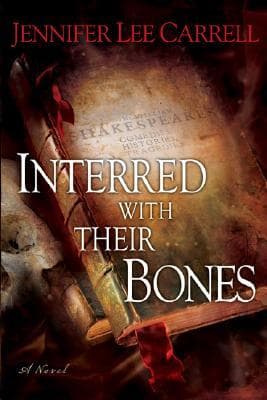
Synopsis
Covers the whole plot, including the ending.
- Difficulty
- Medium
- Pacing
- Fast
- Mood
- Suspenseful, Mysterious, Adventurous, Intellectually Stimulating
- Read it if
- You enjoy fast-paced literary thrillers with historical elements, secret societies, and intricate puzzles.
- Skip it if
- You prefer character-driven narratives over plot-driven ones, or find historical literary mysteries unengaging.
Interred with Their Bones Plot Summary
Covers the whole plot, including the ending.
The Globe Ablaze and a Mentor's Demise
Before a new production of *Hamlet* at the reconstructed Globe Theatre, Shakespeare scholar and director Kate Stanley meets her mentor, Professor Rosalind Howard, known as Roz. Roz tells Kate she has made a major discovery about Shakespeare and gives her a mysterious wooden box, promising more details after the show. During the performance, the Globe Theatre catches fire and burns down. In the chaos, Kate learns that Roz has been found dead, murdered like King Hamlet – venom poured into her ear. This event begins Kate's dangerous journey into literary secrets and murder.
The First Clue: A Coded Message
After Roz's murder, Kate opens the mysterious box. Inside are unrelated items: a copy of Shakespeare's First Folio with unusual notes, a strange key, and a parchment with an encoded message. With help from her colleague and friend, Ben, Kate starts to decipher Roz's clues. The message, hidden in Shakespearean text, points to a secret society and a lost manuscript, suggesting Roz's death was not random but part of a larger, dangerous game. The police, led by Inspector Jeremy Silver, initially suspect Kate due to her connection to Roz and the strange events.
Pursuit to Harvard and a Library Fire
Following Roz's clues, which hint at Harvard University, Kate travels there. She seeks out another Shakespearean scholar, Professor Julian Finch, a rival of Roz's. Before Kate can explain, Finch is found dead, burned in a library fire, a death like Joan of Arc's execution in *Henry VI, Part 1*. This second murder confirms Kate's fear that a killer is recreating Shakespearean deaths and targeting those connected to the secret. The killer, called 'the Bard Killer' by the media, seems to be a step ahead.
An Alliance with the Enigmatic Jeremy Silver
Initially suspicious of Kate, Inspector Jeremy Silver follows her to Harvard. As more bodies appear and the Shakespearean motifs become clear, Silver takes Kate's claims more seriously. He sees the murder pattern and realizes Kate is not the killer, but a potential target and key to the mystery. They form an alliance. Silver provides official resources and protection, while Kate's knowledge of Shakespeare helps decipher the killer's next move. Their combined efforts are important in their race against time.
The Secret Society and the 'Lost Play'
As Kate studies Roz's clues, she finds references to an old secret society, the 'Sons of Shakespeare,' or similar, dedicated to preserving or controlling Shakespeare's true legacy. This society seems to have known about a lost play or manuscripts that could rewrite literary history. Roz was about to expose this secret, which is why she was targeted. Kate realizes the stakes are higher than a literary discovery; powerful forces are at play, willing to kill to keep their secrets hidden.
The Clues Lead West: Arizona
The deciphered clues, woven into Shakespeare's works and historical documents, point to the American West, specifically Arizona. This unexpected turn moves the chase from libraries to arid landscapes. The killer, still close behind, seems to anticipate their moves. Kate and Silver must adapt to this new environment, understanding that the final piece of the puzzle, and perhaps the killer's motive, lies in this setting.
Confrontation in the Desert
The final confrontation happens in the desolate Arizona landscape, at a remote, abandoned mine. The killer, a disillusioned former Shakespearean scholar, sets the scene to resemble the banquet from *Titus Andronicus*, with macabre symbolism. Kate uses her intelligence and Shakespeare knowledge to outmaneuver the killer, who wants to 'correct' Shakespeare's legacy and punish those he deems unworthy. Silver arrives, leading to a tense standoff where Kate's life is in danger.
Unveiling the Hidden Manuscript
During the struggle, the hidden manuscript's location is revealed. It is not a lost play, but a collection of documents, letters, and annotated texts that suggest Shakespeare was not the sole author of his plays, or that the plays held hidden philosophical or political messages for a select few. The manuscript challenges the basis of Shakespearean scholarship and the established literary canon, revealing a truth the secret society had guarded for centuries. Its discovery promises to change how the Bard is understood.
The Killer's Motive and Capture
The killer, driven by a devotion to Shakespeare's 'true' legacy and a sense of betrayal by academia, believed they were purifying the Bard's work by eliminating those who had 'misunderstood' or 'corrupted' it. Their elaborate murders were a twisted homage and warning. After a struggle, aided by Inspector Silver, Kate subdues the killer. Police arrive, and the killer is apprehended, ending the Shakespearean-themed murders that terrorized the literary world.
Aftermath and a New Beginning
Afterward, Kate considers the implications of the unearthed manuscript. The academic world is shaken by the revelation, sparking debates that will reshape Shakespearean studies. Kate, having survived the deadly hunt, becomes a central figure in this new era of scholarship. She reflects on Roz's legacy, the sacrifices made, and the pursuit of truth. While the immediate threat is gone, the challenges of interpreting and presenting the new information, and the ongoing scrutiny from the secret society, suggest her journey is not over.
Interred with Their Bones Characters
Kate Stanley
Protagonist
A brilliant Shakespeare scholar and theatre director thrust into a deadly literary mystery.
Kate Stanley is a dedicated and passionate Shakespeare scholar, known for her sharp intellect and deep understanding of the Bard's works. She is a theatre director at the Globe and deeply respects her mentor, Rosalind Howard. Initially pragmatic and academic, she is forced to become resourceful and brave when she finds herself at the center of a murder investigation and a high-stakes treasure hunt. Her love for Shakespeare is her greatest asset, allowing her to decipher the killer's intricate clues.
Relationships: Rosalind Howard (mentor and friend); Jeremy Silver (initially antagonist, then reluctant ally and romantic interest); Ben (colleague and trusted friend)
Rosalind Howard (Roz)
Supporting/Catalyst
Kate's eccentric mentor whose groundbreaking discovery ignites the plot.
Professor Rosalind Howard, or Roz, is an unconventional and brilliant Shakespearean scholar. She is fiercely independent and driven by a relentless pursuit of truth, often challenging conventional academic thought. Her profound discovery, which she attempts to share with Kate, leads directly to her murder and sets the entire plot in motion. Though she dies early in the story, her presence and clues guide Kate throughout the entire journey, revealing her deep love for Shakespeare and her courage.
Relationships: Kate Stanley (devoted mentee); Julian Finch (academic rival)
Inspector Jeremy Silver
Supporting/Love Interest
A pragmatic London detective who reluctantly aids Kate in her quest.
Inspector Jeremy Silver is a methodical and somewhat cynical detective from Scotland Yard. Initially, he views Kate as a prime suspect in Roz's murder, struggling to believe her fantastical claims about Shakespearean clues and secret societies. However, as the body count rises and the pattern of murders becomes undeniable, he grudgingly accepts Kate's narrative. He provides a grounded, investigative counterpoint to Kate's academic pursuits, eventually becoming a crucial ally and developing a romantic interest in her.
Relationships: Kate Stanley (initially antagonist, then reluctant ally and romantic interest)
The Bard Killer (revealed as a disillusioned scholar)
Antagonist
A fanatical scholar who meticulously recreates Shakespearean deaths.
The Bard Killer is a highly intelligent, deeply disturbed individual with an encyclopedic knowledge of Shakespeare. Driven by a twisted sense of justice and a desire to 'purify' Shakespeare's legacy, they believe they are punishing those who have misunderstood or corrupted the Bard's true meaning. Their methods are elaborate and theatrical, mimicking specific deaths from Shakespeare's plays. The killer's motivation stems from a profound disillusionment with the academic world and a perceived betrayal of Shakespearean ideals.
Relationships: Kate Stanley (target and intellectual rival); Rosalind Howard (victim)
Ben
Supporting
Kate's loyal colleague and friend, providing technical and moral support.
Ben is a fellow academic and a trusted friend of Kate Stanley. He possesses strong research skills and is adept at technology, often helping Kate decipher complex codes and navigate online databases. He is steadfastly loyal to Kate, offering moral support and practical assistance throughout her dangerous journey. While not directly involved in the action, his unwavering belief in Kate and his technical expertise are invaluable, providing a crucial anchor for Kate in her tumultuous quest.
Relationships: Kate Stanley (colleague and trusted friend)
Professor Julian Finch
Supporting/Victim
A rival Shakespearean scholar at Harvard, another victim of the Bard Killer.
Professor Julian Finch is a prominent Shakespearean scholar at Harvard University, known for his more traditional and often confrontational academic approach. He was a rival of Rosalind Howard's, engaging in intellectual debates and often dismissive of her more unorthodox theories. His brief appearance in the story serves to further the plot, as he becomes the second victim of the Bard Killer, his death mirroring a Shakespearean execution. His murder highlights the escalating danger and confirms the killer's pattern.
Relationships: Rosalind Howard (academic rival); Kate Stanley (brief, strained acquaintance)
The Secret Society (Sons of Shakespeare)
Mentioned/Antagonist
An ancient, powerful organization guarding a long-held secret about Shakespeare.
This enigmatic society, possibly named the 'Sons of Shakespeare' or similar, is an ancient and powerful organization with deep roots in academic and political circles. They have secretly guarded a profound truth about Shakespeare's works for centuries, willing to go to extreme lengths, including murder, to protect their secrets. Their influence is subtle but far-reaching, and they represent a formidable, overarching threat that Kate must contend with, even after the killer is caught. They embody the institutional resistance to radical historical revelations.
Relationships: Rosalind Howard (target of their secrecy); Kate Stanley (unwitting challenger of their power)
Interred with Their Bones Themes
The Nature of Truth and Legacy
The novel explores how truth, especially historical and literary truth, can be fluid and dangerous. Kate's journey is a quest for a truth about Shakespeare that could dismantle centuries of accepted scholarship. The secret society represents forces that control or suppress certain truths to maintain an established legacy, while the killer's actions highlight the fanaticism that can arise from a belief in absolute truth. The discovery of the lost manuscript forces a re-evaluation of who Shakespeare was and the origins of his genius.
“What is truth? said jesting Pilate, and would not stay for an answer.”
Obsession and Fanaticism
Obsession appears in different forms throughout the story. Kate's academic passion for Shakespeare drives her quest, but the killer's devotion to the Bard's 'true' legacy fuels the murders. The killer's recreation of Shakespearean deaths shows an extreme, warped literary obsession, turning admiration into violence. The secret society also shows a collective obsession with maintaining a specific narrative, willing to kill to preserve their version of truth, showing the dangers when passion becomes fanaticism.
“Madness in great ones must not unwatched go.”
The Power of Storytelling and Literature
Shakespeare's plays are not just background; they shape the plot. The novel shows literature's power to inspire, conceal, and even dictate human actions. Clues are hidden in Shakespeare's words, murders are inspired by his tragedies, and the mystery centers on a lost work that could rewrite literary history. The story itself is structured like a Shakespearean quest, showing how stories can transcend time and affect reality.
“All the world's a stage, and all the men and women merely players.”
The Conflict Between Academia and Reality
Kate, a scholar, is forced from academia into a dangerous real-world thriller. The novel highlights the contrast between intellectual pursuits and the realities of violence and conspiracy. Her academic knowledge, while important for deciphering clues, often does not prepare her for physical threats. The killer's actions, stemming from academic disillusionment, blur the lines between scholarly debate and violent confrontation, suggesting that even abstract ideas can have deadly consequences when taken to extremes.
“There are more things in heaven and earth, Horatio, Than are dreamt of in your philosophy.”
Plot Devices & Literary Techniques
The Shakespearean Puzzle
A series of cryptic clues embedded in Shakespeare's works, guiding the protagonist.
Roz's initial discovery and the subsequent clues left for Kate form an elaborate Shakespearean puzzle. These clues are not straightforward but are hidden within the text of Shakespeare's plays, sonnets, and historical documents, requiring deep literary knowledge to decipher. This device drives the entire plot, leading Kate from one location to the next and slowly revealing the larger conspiracy. It also serves to highlight Kate's expertise and immerse the reader in the world of Shakespearean scholarship.
Mirroring Shakespearean Deaths
The killer meticulously recreates murder scenes from Shakespeare's plays.
This device creates a chilling and distinctive pattern for the murders. Each victim is killed in a manner that directly references a death from a Shakespearean play – Roz's poisoning like King Hamlet, Finch's burning like Joan of Arc. This not only provides a macabre signature for the killer but also serves as a crucial set of clues for Kate, allowing her to anticipate the killer's next moves and understand their twisted motives. It elevates the thriller aspect by making the literary context an active element of the danger.
The Lost Manuscript
A legendary, hidden document that promises to rewrite literary history.
The lost manuscript is the ultimate MacGuffin, the treasure that everyone is either seeking to find or to suppress. Its existence is hinted at early on and drives much of the characters' actions. It represents the potential for a seismic shift in understanding Shakespeare and his legacy. The nature of the manuscript – whether a lost play, evidence of co-authorship, or a code – remains a mystery until the climax, keeping the stakes high and the reader engaged in the intellectual pursuit.
The Secret Society
An ancient, clandestine organization protecting or controlling Shakespeare's true legacy.
The secret society acts as an overarching, shadowy antagonist, representing the established power structures that resist radical historical and literary truths. Their existence adds a layer of conspiracy and danger beyond the immediate threat of the killer, suggesting that even after the murderer is caught, powerful forces remain at play. This device provides a broader context for the mystery, hinting at centuries of hidden knowledge and the lengths to which institutions will go to protect their narratives.
Interred with Their Bones Quotes
“The past is a place you can visit, but you can’t live there. It’s always best to leave a forwarding address.”
“Every secret has a shelf life. Some just last longer than others.”
“Sometimes the greatest betrayals are committed by those who believe they are doing good.”
“The dead don't tell tales, but they leave clues.”
“Knowledge is a dangerous thing if you don't know how to wield it.”
“The truth is rarely simple, and never convenient.”
“History is written by the victors, but sometimes the vanquished leave their own annotations.”
“There's a fine line between obsession and dedication, and I think I've tap-danced across it a few times.”
“Fear can make people do terrible things, but it can also reveal what they truly value.”
“The past isn't dead. It's not even past. It's just waiting for someone to dig it up.”
“Sometimes the most dangerous thing you can do is ask the right question.”
“Shakespeare understood the human heart, its darkness and its light, better than anyone.”
“Trust is a fragile thing, easily broken and almost impossible to fully repair.”
“Every artifact tells a story, if you know how to listen.”
Quiz
10 questions on the plot and the characters. Each answer comes with a short explanation.
Question 1
What is the initial significant event that sets the plot in motion, involving the Globe Theatre and Kate's mentor?
- The opening night of a new play written by Kate Stanley.
- The burning of the Globe Theatre and the subsequent murder of Rosalind Howard.
- Rosalind Howard publicly announcing a new Shakespeare discovery.
- Kate Stanley finding a complete, lost Shakespeare manuscript.
Show answer
B. The burning of the Globe Theatre and the subsequent murder of Rosalind Howard. The burning of the Globe and Roz's murder, mirroring Hamlet's father, are the catalysts for Kate's investigation.
Question 2
Who is Kate Stanley's eccentric mentor who gives her a mysterious box?
- Ophelia Howard
- Gertrude Howard
- Rosalind Howard
- Cordelia Howard
Show answer
C. Rosalind Howard Kate's mentor is Rosalind Howard, who is found murdered after giving Kate the box.
Question 3
How is Rosalind Howard's murder staged, according to the book's description?
- As a scene from Romeo and Juliet, with poison.
- As the death of King Lear, abandoned in a storm.
- Precisely in the manner of Hamlet's father.
- As the drowning of Ophelia.
Show answer
C. Precisely in the manner of Hamlet's father. Roz's murder is explicitly stated to be staged 'precisely in the manner of Hamlet's father,' which is a key plot detail.
Question 4
What kind of discovery does Rosalind Howard claim to have made before her death?
- A new theory about Shakespeare's true identity.
- A groundbreaking discovery related to a long-lost work of Shakespeare.
- Evidence of a conspiracy against Shakespeare.
- A previously unknown portrait of William Shakespeare.
Show answer
B. A groundbreaking discovery related to a long-lost work of Shakespeare. Rosalind claims to have made a 'groundbreaking discovery' concerning a 'long-lost work of Shakespeare,' which drives the treasure hunt.
Question 5
What is Kate Stanley's profession as described in the book's synopsis?
- A detective specializing in art theft.
- A Shakespeare scholar and theater director.
- An archivist at the British Library.
- A historical fiction novelist.
Show answer
B. A Shakespeare scholar and theater director. Kate Stanley is identified as a 'Shakespeare scholar and theater director,' which makes her uniquely qualified for the puzzle.
Question 6
The clues Kate follows are hidden within what medium?
- Ancient maps of London.
- Medieval illuminated manuscripts.
- The words of Shakespeare.
- Cryptic messages left in Rosalind's diary.
Show answer
C. The words of Shakespeare. The synopsis states Kate must 'decipher a tantalizing string of clues, hidden in the words of Shakespeare.'
Question 7
Which of the following locations is NOT mentioned as part of Kate's deadly treasure hunt?
- London
- Harvard
- The American West
- Stratford-upon-Avon
Show answer
D. Stratford-upon-Avon The synopsis lists 'London to Harvard to the American West' as locations, but Stratford-upon-Avon is not mentioned.
Question 8
What is the primary literary treasure that Kate is racing to unlock, potentially 'literary history’s greatest secret'?
- The true identity of the Dark Lady of the Sonnets.
- A previously unknown autobiography of Shakespeare.
- A long-lost work of Shakespeare.
- Proof that Shakespeare did not write his own plays.
Show answer
C. A long-lost work of Shakespeare. The central mystery revolves around finding a 'long-lost work of Shakespeare' that could be 'literary history’s greatest secret.'
Question 9
Beyond finding literary gold, what other immediate danger does Kate face?
- Being accused of Rosalind's murder.
- Financial ruin due to the Globe's destruction.
- Evading a killer who stages Shakespearean murders.
- Losing her academic position at a prestigious university.
Show answer
C. Evading a killer who stages Shakespearean murders. The synopsis clearly states Kate is on a 'desperate race... just to stay alive' and 'races to evade a killer and decipher a tantalizing string of clues.'
Question 10
The synopsis compares 'Interred with Their Bones' to which other bestselling literary adventure novels?
- The Da Vinci Code and Angels & Demons.
- The Thirteenth Tale and The Historian.
- Gone Girl and The Girl with the Dragon Tattoo.
- A Discovery of Witches and The Night Circus.
Show answer
B. The Thirteenth Tale and The Historian. The synopsis explicitly states the book 'is poised to become the next bestselling literary adventure in the tradition of The Thirteenth Tale and The Historian.'
Interred with Their Bones FAQ
What is the central mystery that Kate Stanley investigates in 'Interred with Their Bones'?
Kate Stanley investigates the murder of her mentor, Rosalind Howard, who was killed in a manner replicating King Hamlet's death. This murder sets Kate on a treasure hunt to uncover Rosalind's groundbreaking discovery, which is believed to be a lost Shakespeare manuscript, and to identify the killer who is meticulously staging murders based on Shakespearean tragedies.
Who is Rosalind Howard and what role does she play in the initial plot?
Rosalind Howard is Kate Stanley's eccentric mentor, a Shakespeare scholar who claims to have made a groundbreaking discovery. She gives Kate a mysterious box just before the Globe Theatre burns down and she is found murdered, initiating the entire high-stakes treasure hunt and mystery for Kate.
Where does the treasure hunt for the lost Shakespeare manuscript take Kate Stanley?
Kate's treasure hunt takes her from London, specifically the Globe Theatre and various historical sites, across the Atlantic to Harvard University in the United States, and further into the American West. Each location holds crucial clues hidden within Shakespearean texts that guide her closer to the truth.
What kind of clues does Kate Stanley follow to unravel the mystery?
Kate follows a tantalizing string of clues hidden within the words of Shakespeare's plays and sonnets. These clues are often riddles or references that lead her to specific locations, historical artifacts, or other literary puzzles that piece together Rosalind's discovery and the killer's motive.
How are the murders in the book connected to Shakespeare's works?
The murders in the book are meticulously staged by the killer to replicate extravagant death scenes from Shakespeare's tragedies. Rosalind Howard, for instance, is murdered precisely in the manner of King Hamlet's father, setting a chilling pattern for subsequent victims and clues.
What is the significance of the Globe Theatre burning down at the beginning of the novel?
The burning of the Globe Theatre is significant as it coincides with Rosalind Howard's murder, creating a dramatic and chaotic backdrop for the start of the mystery. It also symbolizes the destruction of a connection to Shakespeare's past, while simultaneously hinting at a new, perhaps controversial, discovery emerging from the ashes.
Are there any historical figures or real Shakespearean controversies woven into the plot?
Yes, the novel delves into historical figures and real Shakespearean controversies, particularly the authorship debate surrounding Shakespeare's plays. The potential discovery of a lost manuscript challenges established literary history, touching upon long-standing theories and historical figures associated with such debates.
How does the American West setting connect to the Shakespearean mystery?
The American West setting, while seemingly disparate from Shakespearean England, plays a crucial role as it likely houses a key piece of the puzzle or a hidden legacy related to the lost manuscript. It suggests a transatlantic journey of the discovery, possibly linking early American history or settlers to the Shakespearean secret.
What is the true nature of the 'groundbreaking discovery' Rosalind Howard made?
Rosalind Howard's 'groundbreaking discovery' is strongly implied to be a lost Shakespeare manuscript, potentially a play or a collection of works that could rewrite literary history. The exact contents are the ultimate goal of the treasure hunt and the motive behind the murders.
How does Kate Stanley's background as a Shakespeare scholar and theater director influence her investigation?
Kate's background as a Shakespeare scholar and theater director is crucial to her investigation, allowing her to decipher the intricate literary clues that would be impenetrable to others. Her deep understanding of Shakespeare's language, themes, and historical context enables her to connect the dots and anticipate the killer's next move, which is also rooted in Shakespearean logic.
What psychological impact do the meticulously staged Shakespearean murders have on Kate?
The meticulously staged Shakespearean murders have a profound psychological impact on Kate, creating a constant sense of dread and urgency. She isn't just solving a mystery; she's immersed in a macabre play orchestrated by the killer, blurring the lines between fiction and reality and forcing her to confront the darker aspects of human nature mirrored in Shakespeare's tragedies.
How does the novel explore themes of obsession and legacy through its characters?
The novel explores themes of obsession and legacy through characters like Rosalind, whose lifelong dedication led to her discovery and death, and the killer, whose obsession with Shakespeare manifests in deadly ways. Kate herself becomes obsessed with uncovering the truth and preserving Rosalind's legacy, highlighting how literary and personal legacies drive extreme actions.
In what ways does Kate Stanley evolve psychologically throughout her perilous journey?
Kate Stanley evolves psychologically from a scholar focused on academic pursuits to a resourceful and determined survivor. The life-threatening stakes force her to develop courage, quick thinking, and a willingness to confront danger, pushing her beyond the confines of her intellectual world and revealing an inner strength she didn't know she possessed.
Does the novel suggest a definitive answer to the Shakespeare authorship question, or leave it open to interpretation?
The novel likely leans towards suggesting a definitive answer to the Shakespeare authorship question, or at least presenting a compelling alternative through the lost manuscript. However, given the nature of literary thrillers, it might also leave some aspects open to interpretation, allowing readers to ponder the implications of the discovery and the enduring mystery of genius.
What deeper message might the author be conveying about the nature of truth and history in 'Interred with Their Bones'?
The author might be conveying a deeper message about the fluidity and contested nature of truth and history. The discovery of a lost manuscript challenges established narratives, suggesting that history is often incomplete and subject to reinterpretation, and that what we believe to be true can be dramatically altered by new evidence.
How does the title 'Interred with Their Bones' relate to the central themes of the book?
The title 'Interred with Their Bones' (a line from Julius Caesar) relates profoundly to the central themes by suggesting that secrets, truths, and legacies are often buried and forgotten with the dead. It alludes to the lost Shakespearean work being metaphorically 'interred' until Kate unearths it, and also to the victims whose secrets are buried with them.
Is the killer's motivation purely about the lost manuscript, or are there deeper personal reasons?
While the lost manuscript is certainly a primary driver, the killer's motivation likely extends beyond mere possession. Their meticulous staging of Shakespearean murders suggests a deep, possibly twisted, personal connection to Shakespeare's works, a desire for recognition, or a twisted sense of justice related to the authorship debate or their own history.
What is the significance of Hamlet in particular, given the initial murder and the Globe production?
Hamlet's significance is profound, as its themes of revenge, madness, betrayal, and hidden truths deeply resonate with the plot. The initial murder of Rosalind mirroring King Hamlet's death sets the tone, and the play's intricate layers of deception and philosophical inquiry mirror Kate's own journey to uncover the truth and confront a cunning adversary.
Similar books
- The Da Vinci Code
Dan Brown
3.9 (1.9M) average on GoodreadsThrillerFeatures a scholar solving a historical/religious mystery with a secret society and high stakes.
- The Thirteenth Tale
Diane Setterfield
4.0 (272k) average on GoodreadsFantasyLiterary mystery with a focus on uncovering hidden truths and secrets within a historical context.
- The Historian
Elizabeth Kostova
3.8 (242k) average on GoodreadsThrillerCombines historical research, academic mystery, and an international quest for a hidden truth.
- Angels & Demons
Dan Brown
3.9 (2.7M) average on GoodreadsThrillerA Harvard symbologist races through Rome's ancient sites, deciphering cryptic clues to unmask the Illuminati and stop a vengeful plot to destroy the Vatican with a stolen antimatter weapon.
- Gone Girl
Gillian Flynn
4.1 (2.3M) average on GoodreadsThrillerA wife's sudden disappearance on her fifth anniversary reveals a web of lies and psychological warfare, exposing the secrets within a seemingly perfect marriage.
- The Girl on the Train
Paula Hawkins
3.9 (2.1M) average on GoodreadsThrillerA woman’s fascination with a seemingly perfect couple she watches from her daily train commute leads her into a dark investigation when she witnesses something that shatters their idyllic image.




Enjoyed the summary?
A summary gives you the shape of the book. The book itself has the detail, the examples and the voice.
Find Interred with Their Bones on AmazonAs an Amazon Associate, BookBrief earns from qualifying purchases. How we're funded