
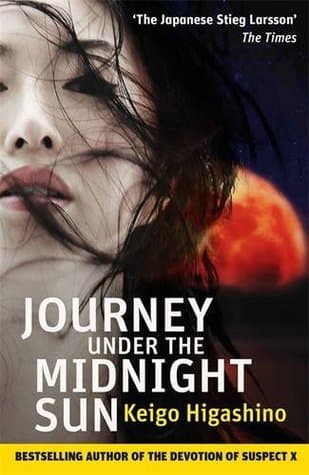
Synopsis
Covers the whole plot, including the ending.
- Difficulty
- Medium
- Pacing
- Slow
- Mood
- Dark, Introspective, Suspenseful, Melancholy
- Read it if
- You enjoy complex, character-driven mysteries spanning decades, with a focus on psychological manipulation and the dark side of ambition.
- Skip it if
- You prefer fast-paced, action-oriented thrillers or stories with clear-cut heroes and villains.
Journey Under the Midnight Sun Plot Summary
Covers the whole plot, including the ending.
The Murder in the Abandoned Building
In October 1973, Kirisawa Yosuke, a pawnshop owner, is found stabbed to death in an abandoned building in Osaka. Detective Sasagaki Junzo is assigned to the case. The prime suspect is Nishimoto Fumiyo, a hostess at a local club, due to her financial difficulties and a previous affair with Kirisawa. Nishimoto's son, Ryo, and Kirisawa's daughter, Yukiho (then known as Yasuko), are both children at the time. Sasagaki observes Ryo, who seems unusually composed, and Yukiho, who appears distressed. The investigation initially focuses on Fumiyo, but a solid alibi involving a theater visit with her son makes direct charges difficult. Sasagaki, however, feels an unsettling connection between the two children and the crime, a feeling that will haunt him for decades.
Fumiyo's Suicide and the Lingering Suspicions
As the police continue to investigate Kirisawa's murder, Nishimoto Fumiyo commits suicide by carbon monoxide poisoning in her apartment. She leaves a note confessing to the murder of Kirisawa, claiming it was self-defense during an attempted rape. This confession closes the case officially, much to Sasagaki's frustration. He believes there are too many inconsistencies, particularly regarding her son Ryo's behavior and the lack of a clear motive for suicide if she was truly innocent, or if she was guilty, why she waited. Sasagaki continues to observe Ryo from a distance, noting his unusual intelligence and detachment, and a subtle but persistent connection he maintains with Yukiho, even as they attend different schools.
Yukiho's Adoption and Early Manipulations
Following her father's murder and her mother's subsequent suicide, Yukiho is adopted by her aunt, Kirihara Yaeko, and her husband, who own a successful fabric store. Now known as Kirihara Yukiho, she excels academically and socially, but subtle signs of her manipulative nature emerge. During middle school, she orchestrates a situation where a rival, Saori, is framed for shoplifting, ruining her reputation. Ryo, now attending a different school, is vaguely implicated in providing the means for this manipulation, though his involvement remains an unspoken understanding between them. Sasagaki, now retired but still fixated on the Kirisawa case, hears whispers of Yukiho's sharp intelligence and her ability to control situations.
The College Years and the Photo Scandal
Years later, Yukiho attends a prestigious university, where she becomes involved with a young man named Matsuura. She is beautiful and popular, but her past remains a mystery to her peers. A rival, Kawashima Eriko, begins to investigate Yukiho's background, uncovering details about her difficult childhood. Ryo, who has now become involved in the adult entertainment industry, helps Yukiho by orchestrating a compromising photo scandal involving Eriko. The photos are anonymously distributed, destroying Eriko's reputation and forcing her to drop out of school. This incident solidifies Sasagaki's belief that Ryo and Yukiho are working in tandem, with Ryo acting as Yukiho's 'shadow'.
Yukiho's First Marriage and Business Acumen
After graduating, Yukiho marries Takamiya Makoto, a promising young man from a wealthy family with an established textile company. She quickly proves to be an invaluable asset to his career and the family business, demonstrating exceptional business acumen and social grace. However, her ambition and control gradually become apparent. Ryo, meanwhile, continues his shadowy activities, running a video game arcade and a computer software company, both of which serve as fronts for illegal activities, including hacking and data theft. Sasagaki, now a private investigator, continues to follow their parallel lives, noting how Yukiho's success often coincides with unexplained misfortunes befalling those who stand in her way.
The Death of Takamiya's Father and the Business Takeover
Takamiya's father, the patriarch of the textile company, falls ill and dies under suspicious circumstances, though no foul play is officially proven. His death allows Yukiho and Makoto to assume greater control of the company. Yukiho systematically eliminates any potential threats to their power, including a rival executive who is framed for embezzlement and forced out. Makoto, increasingly bewildered by his wife's ruthlessness and the string of coincidences that benefit her, begins to feel trapped. Sasagaki, still observing, sees Yukiho's actions as a pattern: anyone who could expose her past or impede her ascent quickly meets a downfall, often with Ryo's unseen assistance.
Makoto's Realization and the Breakdown of the Marriage
Makoto eventually uncovers evidence of Yukiho's manipulation and her connection to Ryo. He realizes that his entire life, including his marriage, has been a meticulously crafted facade designed by Yukiho for her own advancement. He discovers that Yukiho has been having an affair with a business associate, and that she has been systematically draining his family's assets. Devastated and fearing for his safety, Makoto attempts to gather enough evidence to expose her. However, before he can act, he is involved in a 'car accident' that leaves him severely injured and unable to speak or move, effectively silencing him. Sasagaki suspects Ryo's involvement in the accident.
Yukiho's Second Marriage and Fashion Empire
After divorcing the now-incapacitated Makoto, Yukiho marries Koga Kazunari, a wealthy man from a prominent family, further elevating her social standing. She uses her charm and business acumen to establish her own high-end fashion brand, 'R & Y' (Ryo & Yukiho, though the meaning is hidden), which quickly becomes highly successful. Her ambition knows no bounds, and she carefully cultivates an image of elegance and sophistication. Ryo, still operating in the shadows, continues to provide her with information and eliminate obstacles, ensuring her continued ascent. Sasagaki notes that despite her outward success, Yukiho remains an enigma, her past meticulously erased and her true self hidden behind a polished facade.
The Magazine Investigation and Sasagaki's Renewed Efforts
A magazine journalist, Shinohara, begins investigating Yukiho's past after hearing rumors about her rapid rise and the unusual circumstances surrounding her previous relationships. Shinohara uncovers some of the darker aspects of Yukiho's past and her connection to various incidents. This renewed public scrutiny brings the Kirisawa murder case back into Sasagaki's mind. Now an elderly but still sharp detective, Sasagaki collaborates with Shinohara, sharing his decades-long suspicions about Yukiho and Ryo. They piece together the intricate web of deceit and manipulation that has defined both their lives, realizing that Ryo has consistently acted as Yukiho's protector and enabler.
The Final Confrontation and Ryo's Sacrifice
Sasagaki and Shinohara gather enough evidence to confront Yukiho. As the police close in on Ryo, who is now running a successful computer company, he realizes his time is up. During a raid on Yukiho's fashion show, Ryo appears, drawing attention away from Yukiho. Cornered by the police, he commits suicide by jumping from a high floor, taking his secrets with him. His final act is to protect Yukiho, ensuring she remains untouched by their shared past. As Yukiho watches Ryo's body, she walks past without a glance, her face devoid of emotion, leaving Sasagaki to ponder the dark nature of their bond, like a journey under a midnight sun where one casts no shadow.
Journey Under the Midnight Sun Characters
Detective Sasagaki Junzo
Protagonist
Obsessed detective pursuing a cold case for decades
Sasagaki is the primary detective assigned to the Kirisawa murder in 1973. From the outset, he harbors deep suspicions about the official conclusion of the case, particularly regarding Ryo and Yukiho. He is persistent, meticulous, and deeply ethical, unable to let go of the feeling that justice was not served. Even after retirement, he continues to informally investigate, driven by a profound sense of unease and a desire to understand the truth behind the two children's lives. His decades-long pursuit forms the backbone of the narrative, connecting the various incidents.
Relationships: Nishimoto Ryo (Suspect, lifelong subject of investigation); Kirihara Yukiho (Suspect, lifelong subject of investigation); Shinohara (Journalist, later collaborator in investigation)
Nishimoto Ryo (later Kirihara Ryo)
Antagonist/Supporting
The victim's son, Yukiho's silent, criminal protector
Ryo is the son of Nishimoto Fumiyo and a key figure in the Kirisawa murder. Taciturn and intelligent, he develops a dark, symbiotic relationship with Yukiho. He operates in the shadows, using his sharp mind and ruthlessness to commit crimes, manipulate situations, and eliminate obstacles for Yukiho's advancement. He runs various illicit businesses, including a video game arcade and a computer software company, which serve as fronts for his illegal activities. His actions are always in service of Yukiho, acting as her 'shadow' and protector, ensuring she can thrive in the light.
Relationships: Kirihara Yukiho (Deeply entwined, protective, and criminal partnership); Nishimoto Fumiyo (Mother (victim of his early manipulation)); Detective Sasagaki Junzo (His pursuer)
Kirihara Yukiho (formerly Yasuko)
Antagonist
The main suspect's daughter, a brilliant and ruthless social climber
Yukiho is the daughter of Kirisawa Yosuke. After her father's murder and mother's suicide, she is adopted and renamed. She is exceptionally beautiful, intelligent, and outwardly charming, but beneath the surface lies a cold, manipulative, and utterly ruthless ambition. She systematically destroys rivals, climbs social ladders through strategic marriages, and builds a fashion empire, always with Ryo's unseen assistance. Her life is a meticulously crafted performance, erasing her past and projecting an image of perfection, making her a formidable and elusive adversary for Sasagaki.
Relationships: Nishimoto Ryo (Deeply entwined, manipulative, and criminal partnership); Takamiya Makoto (First husband, manipulated and discarded); Koga Kazunari (Second husband, used for social advancement); Detective Sasagaki Junzo (Her pursuer)
Nishimoto Fumiyo
Supporting/Mentioned
Ryo's mother and initial murder suspect
Fumiyo is a hostess at a local club and the mother of Ryo. She was having an affair with Kirisawa Yosuke and becomes the prime suspect in his murder. Her financial struggles and connection to Kirisawa make her a plausible culprit. She later commits suicide, leaving a confession that officially closes the Kirisawa case, much to Sasagaki's skepticism. Her death is a pivotal event, removing a key witness and allowing Ryo and Yukiho's dark partnership to continue unchecked. Her character primarily serves as the initial catalyst for the long-running mystery.
Relationships: Nishimoto Ryo (Son, whose actions contributed to her demise); Kirisawa Yosuke (Lover, murder victim)
Kirisawa Yosuke
Mentioned
The initial murder victim and Yukiho's father
Kirisawa Yosuke is a pawnshop owner whose murder in 1973 sets the entire plot in motion. He is Yukiho's biological father. His death, initially attributed to Nishimoto Fumiyo, remains shrouded in mystery for decades, becoming the cold case that Sasagaki obsessively pursues. Though only appearing briefly in the initial scenes, his murder is the foundational event from which all subsequent manipulations and crimes by Ryo and Yukiho spring. His character is a constant, though unseen, presence, representing the unresolved past that haunts Sasagaki.
Relationships: Kirihara Yukiho (Daughter, whose life is irrevocably shaped by his death); Nishimoto Fumiyo (Lover)
Takamiya Makoto
Supporting
Yukiho's first husband, a victim of her manipulation
Makoto is a promising young man from a wealthy family, heir to a textile company, who marries Yukiho. Initially charmed by her beauty and intelligence, he slowly becomes aware of her ruthless ambition and manipulative nature. He serves as a tragic figure, a casualty of Yukiho's relentless social climbing. His eventual discovery of Yukiho's true self and her connection to Ryo leads to his incapacitation, silencing him and further solidifying Yukiho's power. His story highlights the destructive impact of Yukiho's machinations on those closest to her.
Relationships: Kirihara Yukiho (Husband, later victim of her manipulation); Nishimoto Ryo (Unseen accomplice in his downfall)
Koga Kazunari
Supporting
Yukiho's second husband, a stepping stone for her ambition
Koga Kazunari is Yukiho's second husband, a wealthy individual from a prominent family. He represents another rung on Yukiho's social and financial ladder. Unlike Makoto, his character is less developed, primarily serving to illustrate Yukiho's continued pattern of marrying for advancement and consolidating power. He is seemingly unaware or chooses to ignore the darker aspects of Yukiho's past, allowing her to further establish her fashion brand and elevate her social standing. His marriage to Yukiho demonstrates her unwavering commitment to her goals.
Relationships: Kirihara Yukiho (Husband, used for social and financial gain)
Shinohara
Supporting
Magazine journalist who collaborates with Sasagaki
Shinohara is a magazine journalist who begins investigating Yukiho's past, drawn by the intriguing rumors surrounding her rapid rise and the unusual circumstances of her life. He acts as a catalyst in the latter part of the book, bringing renewed scrutiny to Yukiho and indirectly reigniting Sasagaki's active investigation. His research uncovers crucial pieces of information that align with Sasagaki's decades-old suspicions, leading to their eventual collaboration. He represents the public's growing awareness of Yukiho's enigmatic nature.
Relationships: Detective Sasagaki Junzo (Collaborator in the investigation); Kirihara Yukiho (Subject of his investigation)
Kawashima Eriko
Supporting
Yukiho's college rival, targeted by manipulation
Eriko is a college peer of Yukiho who becomes a rival, particularly when she starts investigating Yukiho's mysterious past. Her curiosity and attempts to uncover the truth about Yukiho make her a target. She is ultimately framed in a compromising photo scandal orchestrated by Ryo at Yukiho's behest, leading to her humiliation and withdrawal from university. Eriko's experience illustrates Yukiho's ruthlessness and Ryo's effectiveness in eliminating threats to Yukiho's reputation and advancement, even at a young age.
Relationships: Kirihara Yukiho (College rival, victim of manipulation); Nishimoto Ryo (The one who orchestrated her downfall)
Journey Under the Midnight Sun Themes
The Nature of Evil and Manipulation
The novel explores the calculated and insidious nature of evil, as embodied by Yukiho and Ryo. Yukiho's charm and intelligence mask a cold, ruthless ambition, while Ryo operates as her silent, criminal enabler. Their crimes are not born of passion but of a strategic desire for power and self-preservation. The book shows how they systematically destroy lives, manipulate circumstances, and erase their pasts, creating a facade of respectability while committing heinous acts. This theme shows how evil can flourish under the guise of normalcy and success.
“Sasagaki felt as if he was chasing a ghost, a shadow that never fully materialized but whose presence was undeniable.”
Obsession and Justice
Detective Sasagaki's decades-long pursuit of the truth behind the Kirisawa murder shows the theme of obsession and the relentless quest for justice. Despite the case being officially closed, Sasagaki's intuition and moral compass compel him to continue investigating, even into his retirement. His obsession is not merely professional but deeply personal, driven by a sense of unease about the two children and the injustices he perceives. His unwavering dedication highlights the idea that true justice, even if delayed, is worth the lifelong pursuit, contrasting sharply with the legal system's limitations.
“He knew, deep down, that the truth was still out there, hiding in the shadows of those two children's lives.”
Identity and Deception
A central theme is the construction and concealment of identity through deception. Yukiho meticulously crafts an entirely new identity, shedding her past and presenting herself as elegant, successful, and blameless. Ryo, too, lives a life of constant deception, operating in the shadows and adopting various personas to facilitate Yukiho's ascent. The novel explores how individuals can completely reinvent themselves, erasing their true origins and actions, and the psychological toll this takes. It also questions what constitutes a 'true' self when one's entire existence is built on lies and manipulation.
“Her life was a meticulously woven tapestry of lies, each thread carefully placed to hide the darkness beneath.”
The Corrupting Power of the Past
The novel illustrates how a single traumatic event in the past—the Kirisawa murder—corrupts and defines the future lives of Ryo and Yukiho. Their actions, though seemingly separate, are linked to that initial incident. The past is not merely forgotten; it actively shapes their dark partnership and their relentless pursuit of a life free from its shadow. However, the past also relentlessly pursues them through Sasagaki, showing that secrets, no matter how deeply buried, can eventually resurface and demand reckoning. The inability to escape their origins fuels their destructive path.
“The midnight sun cast no shadows, but their past was a shadow that clung to them, no matter how bright the light.”
Symbiotic Relationships and Codependency
The dark, unspoken bond between Ryo and Yukiho forms a powerful example of a destructive symbiotic relationship. Ryo acts as Yukiho's 'shadow,' committing crimes and eliminating obstacles, while Yukiho thrives in the light of her manufactured success. Their lives are so intertwined that one cannot exist without the other, yet their connection is devoid of genuine affection, driven instead by a shared secret and a mutual need for survival and advancement. This theme explores the extreme lengths of codependency and how such a bond can become a force of immense destruction.
“He was her shadow, and she, his midnight sun; one could not exist without the other, yet they never truly touched.”
Plot Devices & Literary Techniques
Dual Perspective/Shifting Focus
The narrative shifts between Sasagaki and the lives of Ryo and Yukiho.
The novel employs a shifting narrative focus rather than a single first-person or omniscient perspective. It primarily follows Detective Sasagaki's investigation, but also dedicates significant sections to the experiences and perspectives of various characters whose lives intersect with Yukiho and Ryo. This allows the reader to witness the consequences of Ryo and Yukiho's actions without directly entering their minds, maintaining their enigmatic quality. It also builds suspense as the reader, like Sasagaki, pieces together fragments of information from different viewpoints to understand the central mystery.
Elliptical Narrative/Time Jumps
Gaps in the timeline, focusing on key incidents over decades.
The story spans over twenty years, but it does not follow a continuous, day-by-day account. Instead, the narrative jumps through time, focusing on pivotal incidents in Ryo and Yukiho's lives, often separated by years. These gaps force the reader (and Sasagaki) to infer the connections and motivations, creating a sense of mystery and demonstrating the long-term, calculated nature of their actions. The elliptical structure emphasizes the enduring impact of the initial crime and how it slowly unravels over decades.
The 'Shadow' Motif
Ryo as Yukiho's unseen, criminal protector.
The concept of a 'shadow' is a pervasive motif. Ryo is repeatedly portrayed as Yukiho's shadow – always present, always acting on her behalf, but never in the light. He commits the heinous acts that allow her to shine brightly and maintain her pristine image. This device highlights the symbiotic nature of their relationship, where one exists solely to enable the other, and explores the idea that behind every dazzling success, there might be a hidden, darker force at play. It underscores his self-sacrificing, yet terrifyingly criminal, devotion.
The 'Midnight Sun' Metaphor
Symbolizing a life without shadows or moral clarity.
The title 'Journey Under the Midnight Sun' acts as a powerful metaphor for Ryo and Yukiho's lives. A midnight sun casts no shadows, symbolizing a world where moral clarity is absent, and darkness and light are indistinguishable. For Yukiho, it represents her ability to operate without leaving a trace, her past erased, her true self hidden. For Ryo, it signifies his existence in perpetual darkness, enabling Yukiho's 'light' without ever stepping into it himself. It encapsulates their morally ambiguous, hidden existence where traditional notions of good and evil are blurred.
The Unreliable Narrator (of events)
Readers piece together truth from fragmented and often manipulated accounts.
While not a single unreliable character narrator, the overall narrative presents an 'unreliable' picture of events through the eyes of those around Yukiho and Ryo. The reader, much like Sasagaki, is presented with fragmented information, manipulated situations, and characters who are often deceived. We never truly get inside the minds of Ryo or Yukiho, forcing us to interpret their motives and actions from external observations and the consequences they leave behind. This device enhances the mystery and the chilling nature of their calculated deceptions.
Journey Under the Midnight Sun Quotes
“There are two kinds of lies: those that are told to deceive others, and those that are told to deceive oneself.”
“The past is like a shadow. It follows you no matter where you go.”
“People often mistake silence for weakness. But sometimes, silence is the strongest weapon of all.”
“The more you try to hide something, the more it wants to be found.”
“Even in the darkest night, there is always a flicker of light, however small.”
“Justice isn't always about what's legal. Sometimes, it's about what's right.”
“We all wear masks, some more elaborate than others. But eventually, the true face is revealed.”
“The greatest prison is a mind that cannot forgive itself.”
“Sometimes, the most dangerous people are those who seem the most ordinary.”
“A secret shared is no longer a secret.”
“The truth is a stubborn thing. It has a way of coming out, no matter how deeply it's buried.”
“Love can be a powerful motivator, for good or for ill.”
“To live in the shadows is to never truly live.”
“Every choice we make creates a ripple, affecting not just ourselves, but everyone around us.”
Quiz
10 questions on the plot and the characters. Each answer comes with a short explanation.
Question 1
In what year does the initial murder of Yosuke Kirihara occur?
- 1983
- 1973
- 1993
- 1963
Show answer
B. 1973 The story begins in 1973 with the discovery of Yosuke Kirihara's body in an abandoned building in Osaka, setting off the decades-long investigation.
Question 2
What is the name of the detective who becomes obsessed with the Kirihara case?
- Kaga
- Sasagaki
- Shibazaki
- Togami
Show answer
B. Sasagaki Detective Sasagaki is the unflappable investigator assigned to the initial case, and he pursues it with an enduring obsession over two decades.
Question 3
Which city serves as the primary setting for the story?
- Tokyo
- Kyoto
- Osaka
- Sapporo
Show answer
C. Osaka The murder of Yosuke Kirihara takes place in an abandoned building in Osaka, and much of the subsequent events and investigations occur in and around this city.
Question 4
What is the relationship between Ryo Kirihara and Yukiho Karasawa (later Horiuchi/Takamiya)?
- They are distant cousins who meet by chance.
- They are half-siblings unaware of their relation.
- They are the son of the victim and the daughter of the main suspect, inextricably linked to the crime.
- They were childhood friends who lost touch.
Show answer
C. They are the son of the victim and the daughter of the main suspect, inextricably linked to the crime. Ryo is the son of the murdered Yosuke Kirihara, and Yukiho is the daughter of Fumiyo Karasawa, who was initially suspected. Their lives become intertwined and their connection is central to the mystery.
Question 5
How does the narrative structure of 'Journey Under the Midnight Sun' primarily unfold?
- It is told from the first-person perspective of Ryo Kirihara.
- It is a linear narrative primarily from Detective Sasagaki's point of view.
- It follows a series of seemingly unrelated events and characters whose connections gradually become clear over two decades.
- It uses flashbacks extensively to reveal the past.
Show answer
C. It follows a series of seemingly unrelated events and characters whose connections gradually become clear over two decades. The novel is unique in that it doesn't directly follow Ryo or Yukiho's inner thoughts. Instead, it observes their lives and the lives of those around them through various third-person perspectives over twenty years, with Sasagaki's investigation serving as a connecting thread.
Question 6
Which of the following best describes the central theme of the 'midnight sun' metaphor in the book?
- The idea of a love that never fades, even in darkness.
- The relentless pursuit of justice that never sees an end.
- A life lived entirely in darkness, relying on another for light, or a hidden existence.
- The beauty found in desolate, remote places.
Show answer
C. A life lived entirely in darkness, relying on another for light, or a hidden existence. The 'midnight sun' metaphor refers to a life lived without independent light, where one person acts as the hidden 'sun' for another, allowing them to operate in a perpetual state of darkness or secrecy, never fully exposed to the truth.
Question 7
What kind of business does Ryo Kirihara become involved in as an adult?
- A successful chain of restaurants.
- A legitimate electronics repair shop.
- Various illicit activities, including computer hacking and intellectual property theft.
- A prominent real estate development firm.
Show answer
C. Various illicit activities, including computer hacking and intellectual property theft. Ryo is consistently involved in the criminal underworld, using his intelligence for various illicit activities, particularly in the realm of technology and information theft, often to benefit Yukiho's ventures.
Question 8
What key characteristic defines Yukiho's social and professional life as she grows up?
- Her unwavering loyalty to her childhood friends.
- Her constant struggle with poverty and social prejudice.
- Her exceptional ability to adapt, charm, and manipulate to ascend socially and professionally, often at others' expense.
- Her dedication to charity work and helping the less fortunate.
Show answer
C. Her exceptional ability to adapt, charm, and manipulate to ascend socially and professionally, often at others' expense. Yukiho is portrayed as exceptionally beautiful, intelligent, and ambitious. She uses these traits to meticulously craft her image and advance her position in society, often leaving a trail of ruined lives or compromised individuals in her wake, all while maintaining a facade of innocence.
Question 9
How does Detective Sasagaki finally piece together the truth about the Kirihara murder after decades?
- A deathbed confession from a minor character involved in the initial crime.
- He finds a hidden diary belonging to Yosuke Kirihara detailing the events.
- By meticulously connecting seemingly disparate incidents and observing the patterns in Ryo and Yukiho's lives.
- A sudden, unexpected breakthrough in forensic technology decades later.
Show answer
C. By meticulously connecting seemingly disparate incidents and observing the patterns in Ryo and Yukiho's lives. Sasagaki's persistence pays off as he connects various seemingly unrelated crimes and misfortunes that occur around Ryo and Yukiho, eventually deducing their symbiotic relationship and their roles in the initial murder and subsequent cover-ups.
Question 10
What is the ultimate fate of Ryo Kirihara in the novel?
- He escapes justice and lives a quiet life abroad.
- He is finally arrested and imprisoned for his crimes.
- He sacrifices himself to protect Yukiho, falling from a building.
- He commits suicide after confessing his crimes to Sasagaki.
Show answer
C. He sacrifices himself to protect Yukiho, falling from a building. In a climactic moment, as Sasagaki closes in, Ryo jumps from a building to his death, protecting Yukiho by destroying evidence and preventing her direct implication, illustrating his complete devotion and her ability to remain unblemished.
Journey Under the Midnight Sun FAQ
What is Journey Under the Midnight Sun about?
Journey Under the Midnight Sun follows the lives of Ryo Kirihara and Yukiho Karasawa over nearly two decades, inextricably linked by the unsolved murder of Ryo's father in 1973. Detective Sasagaki pursues this cold case with an almost obsessive dedication, slowly uncovering the dark, manipulative partnership between Ryo and Yukiho as they navigate society, leaving a trail of ruined lives and unexplained incidents in their wake, all while maintaining their public facades.
Why should I read Journey Under the Midnight Sun?
You should read Journey Under the Midnight Sun for its unique narrative structure, spanning two decades without directly showing the protagonists' inner thoughts, forcing the reader to deduce their motivations and the depth of their connection through the consequences of their actions. It's a masterful slow-burn thriller that explores themes of crime, survival, and the profound darkness that can exist beneath a polished exterior, offering a deeply unsettling and thought-provoking experience.
What is the background/setting of Journey Under the Midnight Sun?
The story is set primarily in Osaka, Japan, spanning from 1973 into the early 1990s. It vividly portrays the changing Japanese society over these decades, from the economic boom to the rise of technology and changing fashion trends, all while the dark undercurrents of the unsolved murder and the protagonists' activities persist, often exploiting the very opportunities presented by societal shifts.
What writing style does the author use?
Keigo Higashino employs a detached, observational writing style, presenting events primarily through the perspectives of supporting characters and Detective Sasagaki, rather than the main culprits, Ryo and Yukiho. This objective approach creates a sense of dread and mystery, as the reader is left to infer the true nature of their relationship and their actions through their impact on others, building suspense gradually over many years.
What minor details add significant meaning?
The recurring motif of light and shadow is crucial; Ryo consistently operates in the shadows, orchestrating schemes, while Yukiho thrives in the 'midnight sun,' projecting an image of purity and success, using Ryo's darkness to achieve her goals. Another detail is the specific skills each develops – Ryo's expertise in electronics and hacking, and Yukiho's in fashion and business – which perfectly complement their criminal enterprise.
What are some subtle foreshadowing moments?
Early on, Sasagaki notes the unusual composure of both young Ryo and Yukiho after the murder, a subtle hint at their shared, deeper involvement. The repeated instances of people around Yukiho experiencing 'bad luck' or 'accidents' whenever she desires something, such as the mysterious fire at her first fashion store, subtly foreshadow her ruthless and manipulative nature, often facilitated by Ryo's unseen actions.
What unexpected character connections exist?
The most significant unexpected connection is that the victim, Ryo's father, was having an affair with Yukiho's mother. This revelation, though not fully disclosed until much later, provides the initial, deeply disturbing link between the two children, setting the stage for their symbiotic and destructive partnership, born from a shared trauma and a desire to bury their past.
What are unspoken character motivations?
Ryo's primary unspoken motivation seems to be an unwavering devotion to Yukiho, acting as her 'shadow' to ensure her success and protect her from the dark truths of their past. Yukiho, while appearing driven by ambition and a desire for a respectable life, is implicitly motivated by a deep-seated trauma and a need for control, using Ryo's loyalty and ruthlessness to erase any threats to her carefully constructed facade.
What psychological complexities do characters exhibit?
Yukiho exhibits profound psychological complexity through her chilling ability to compartmentalize and project an image of innocence and charm while orchestrating malicious acts. Ryo, on the other hand, embodies a complex blend of loyalty, nihilism, and quiet desperation, finding purpose only in serving Yukiho, even as he sacrifices his own life and morality to facilitate her ascent, never seeking personal gain or recognition.
What are the major emotional turning points?
While the book avoids overt emotional displays from Ryo and Yukiho, a major turning point for the reader's understanding is when Detective Sasagaki starts connecting seemingly unrelated incidents – such as copyright infringement, blackmail, and even a sexual assault – back to the orbit of Ryo and Yukiho, solidifying the realization of their profound and sinister partnership.
How do relationship dynamics evolve?
The central relationship between Ryo and Yukiho evolves from a childhood bond forged in shared trauma to a sophisticated, mutually dependent criminal partnership. Ryo becomes Yukiho's silent protector and enabler, always in the background, while Yukiho becomes the public face, benefiting from Ryo's actions. Their dynamic is less romantic and more akin to two halves of a single, dark entity, with an unspoken, absolute understanding.
Which parts remain ambiguous or open-ended?
The true nature of Ryo and Yukiho's personal feelings for each other remains largely ambiguous. While their actions clearly demonstrate a deep, almost symbiotic connection, the narrative never explicitly confirms whether their bond is rooted in love, trauma, or a shared pathology. Their ultimate motivations beyond mere survival and ambition are left for the reader to interpret.
What are controversial scenes or decisions?
Yukiho's actions involving her adoptive mother, who becomes gravely ill after Yukiho expresses a desire to inherit her assets, and the various instances of blackmail and manipulation, are morally controversial. The most disturbing are the implied sexual assaults, orchestrated by Ryo to compromise rivals or ensure Yukiho's dominance, which highlight the extreme lengths they go to protect their secrets and advance their positions.
Journey Under the Midnight Sun ending explained: how it ends & what it means
The novel culminates with Detective Sasagaki finally cornering Yukiho at the opening of her new fashion store, having pieced together the full extent of her and Ryo's crimes. In a final act of devotion and self-sacrifice, Ryo jumps to his death, protecting Yukiho by destroying the evidence (a pair of scissors used in a past crime) that would directly link them. Yukiho's reaction – she doesn't even turn to look at him, simply asking, 'Did something happen?' – signifies her ultimate detachment and the complete success of her carefully constructed facade, leaving Sasagaki with a hollow victory and the profound realization that Ryo was indeed her 'shadow,' without whom she cannot exist in the light.
Similar books
- The Devotion of Suspect X
Keigo Higashino
4.1 (33k) average on GoodreadsThrillerFeatures Higashino's signature blend of intricate plotting and psychological depth, focusing on the lengths one goes to protect another.
- The Silent Patient
Alex Michaelides
4.1 (507k) average on GoodreadsThrillerExplores dark psychological themes and a central mystery driven by a character's silence and hidden past.
- Gone Girl
Gillian Flynn
4.1 (2.3M) average on GoodreadsThrillerInvolves a meticulously crafted facade, a manipulative female protagonist, and a sprawling investigation into a disturbing relationship.
- Angels & Demons
Dan Brown
3.9 (2.7M) average on GoodreadsThrillerA Harvard symbologist races through Rome's ancient sites, deciphering cryptic clues to unmask the Illuminati and stop a vengeful plot to destroy the Vatican with a stolen antimatter weapon.
- The Girl on the Train
Paula Hawkins
3.9 (2.1M) average on GoodreadsThrillerA woman’s fascination with a seemingly perfect couple she watches from her daily train commute leads her into a dark investigation when she witnesses something that shatters their idyllic image.
- The Da Vinci Code
Dan Brown
3.9 (1.9M) average on GoodreadsThrillerA symbologist and a cryptologist race through European landmarks, deciphering ancient codes and uncovering a conspiracy that could rewrite the foundations of Christianity.





Enjoyed the summary?
A summary gives you the shape of the book. The book itself has the detail, the examples and the voice.
Find Journey Under the Midnight Sun on AmazonAs an Amazon Associate, BookBrief earns from qualifying purchases. How we're funded