
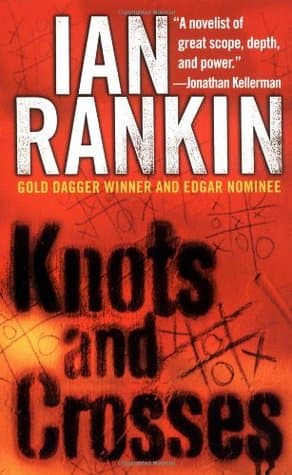
Synopsis
Covers the whole plot, including the ending.
- Difficulty
- Medium
- Pacing
- Moderate
- Mood
- Dark, Brooding, Suspenseful, Psychological
- Read it if
- You enjoy dark, character-driven police procedurals with a troubled detective and a strong sense of place, exploring themes of trauma and the lasting impact of the past.
- Skip it if
- You prefer light-hearted mysteries or shy away from psychological depth and a somewhat bleak atmosphere.
Knots and Crosses Plot Summary
Covers the whole plot, including the ending.
A Gruesome Discovery and Rebus's Troubled Past
The novel opens with the discovery of a young girl's body, Vicky Miller, in an Edinburgh park, strangled with a series of knots in her shoelaces. Detective Sergeant John Rebus is assigned to the case, which quickly becomes complicated by the apparent lack of motive or connection to the victim. At the same time, Rebus begins receiving anonymous, disturbing letters containing matchstick crosses and drawings of knotted string, stirring up suppressed memories of his past, particularly his time in the SAS and a traumatic incident involving his younger brother, Michael. His ex-wife, Rhona, and daughter, Sammy, live separately, adding to his isolation and internal turmoil. The initial investigation yields few leads, putting pressure on the police force.
A Second Victim and Escalating Anxiety
Soon after Vicky Miller's murder, another young girl, Janice Kent, is found dead in similar circumstances – strangled with knotted shoelaces. The killer's pattern is established, and the city is gripped by fear. The police investigation intensifies, but without clear forensic evidence or a discernible link between the victims, progress is slow. Rebus finds himself increasingly consumed by the case and tormented by the anonymous letters, which seem to echo details of the murders and his own hidden past. His colleagues, particularly Detective Inspector Gill Templer, notice his erratic behavior and growing obsession, though Rebus keeps the letters a secret, fearing they might implicate him or reveal his instability.
Rebus's Past Haunts Him
Through fragmented flashbacks, the reader learns about Rebus's brutal SAS training, specifically an exercise involving sensory deprivation and psychological manipulation designed to break recruits. This experience, combined with a childhood incident where he accidentally caused his younger brother, Michael, to fall and suffer a severe head injury, makes up Rebus's deep-seated guilt and psychological trauma. The anonymous letters, with their cryptic symbols and allusions to knots and crosses, act as triggers, making Rebus question his own sanity and whether he might unknowingly be connected to the killer. He begins to suspect the letters are from someone who knows his deepest secrets.
The Media Frenzy and a Third Murder
The 'Knots and Crosses Killer' becomes a sensationalized topic in the media, with tabloids fanning public fear and criticizing the police's inability to catch the perpetrator. The pressure on Rebus and the investigation team mounts. A third young girl, Heather Davies, is abducted and murdered, again with the signature knotted shoelaces. The pattern is clear: young, innocent girls, strangled, with no apparent connection. Rebus's obsession with the case grows, and he starts to see connections between the knots in the victims' shoelaces and the knots in his own mind, fueled by the relentless anonymous letters. He feels a desperate urgency to solve the case, not just for the victims, but for his own peace of mind.
A Breakthrough and a Suspect
After extensive canvassing and forensic work, the investigation yields a potential suspect: Alan McInnes, a man with a history of sexual offenses and a connection to one of the victims through a neighborhood association. McInnes becomes the primary focus of the police, and Rebus is part of the team conducting surveillance and preparing for an arrest. While McInnes fits the profile of a lone predator, Rebus still feels an uneasy sense that something is missing, or that the anonymous letters are leading him down a different path. The letters continue to arrive, becoming more personal and accusatory, making Rebus increasingly paranoid.
Rebus's Desperate Search for Answers
Ignoring official protocols, Rebus secretly investigates the origins of the anonymous letters, driven by a desperate need to understand their connection to him. He revisits old haunts, contacts former SAS colleagues, and even travels to the care facility where his brother, Michael, resides. During his visits with Michael, Rebus is confronted with the lasting impact of his childhood accident. Michael, though mentally impaired, occasionally utters cryptic phrases that resonate with the themes of the letters. Rebus begins to suspect that the letter-writer is someone intimately familiar with his family history and his time in the SAS, leading him to question everyone around him.
The Interrogation of McInnes and a False Lead
Alan McInnes is arrested and brought in for interrogation. Despite mounting circumstantial evidence, McInnes maintains his innocence. The interrogation is intense, but McInnes's demeanor and lack of a definitive confession leave Rebus uneasy. While his colleagues are confident they have their man, Rebus's intuition, coupled with the persistent anonymous letters, tells him the case is not closed. He feels a growing conviction that McInnes is either a scapegoat or part of a larger, more complex scheme. Rebus continues his solitary quest for the true perpetrator, increasingly isolated from his colleagues who believe the case is solved.
The Revelation of the Letter Writer's Identity
Driven by a cryptic clue in one of the letters and a memory from his childhood, Rebus has a sudden revelation. He realizes the letter writer is his own brother, Michael. Michael, despite his mental limitations, has been manipulating events, fueled by a distorted memory of his childhood accident and a deep-seated resentment towards Rebus. Michael, having overheard Rebus's conversations and knowing his troubled past, orchestrated the 'knots and crosses' motif to torment his brother and draw him into the investigation. The realization is a profound shock, forcing Rebus to confront the devastating consequences of his past actions.
The Confrontation and Michael's Motive
Rebus confronts Michael at the care facility. During the tense encounter, Michael, in a fragmented but chilling confession, reveals his role in the murders. He explains that he chose his victims based on their superficial resemblance to a girl from their childhood or to punish Rebus indirectly. He meticulously planned the 'knots and crosses' motif, drawing on their shared history and Rebus's SAS training, to specifically target his brother psychologically. Michael’s motive is rooted in a twisted desire for revenge and to make Rebus acknowledge his past guilt over the accident, believing Rebus had deliberately harmed him. The confession is a devastating blow to Rebus, confirming his worst fears.
The Aftermath and Rebus's Burden
Following Michael's confession, Rebus arranges for his arrest. The news sends shockwaves through the police department, completely exonerating Alan McInnes. Rebus is left to grapple with the horrific truth: his own brother is a serial killer, and his personal history directly fueled the crimes. The public is informed of the killer's identity, and the media frenzy shifts. Rebus, though praised for solving the case, is inwardly shattered. The novel concludes with Rebus carrying the immense burden of his brother's actions and the unresolved trauma of his past, forever changed by the 'knots and crosses' that entangled his life and family.
Principal Figures
Detective Sergeant John Rebus
Protagonist
A troubled Edinburgh detective haunted by his past, investigating a series of serial murders linked to his own life.
John Rebus is a cynical, world-weary detective with a sharp mind but a deeply troubled psyche. He's a former SAS soldier, a past he rarely discusses but which profoundly shaped him, particularly a traumatic sensory deprivation exercise. He struggles with guilt over a childhood accident that left his younger brother, Michael, mentally impaired, and his failed marriage to Rhona. Rebus often operates outside conventional police procedures, driven by intuition and a relentless pursuit of truth. He's an alcoholic, a chain-smoker, and prone to brooding, often alienating colleagues. The anonymous 'knots and crosses' letters directly target his vulnerabilities, forcing him to confront his deepest fears and secrets.
Relationships: Michael Rebus (Younger brother, victim of a childhood accident, later revealed as the serial killer); Rhona Rebus (Ex-wife, mother of his daughter Sammy); Sammy Rebus (Daughter, whom he loves but struggles to connect with); DI Gill Templer (Colleague and superior, with whom he has a complex, sometimes adversarial, working relationship and a hint of romantic tension); DS Brian Holmes (Junior colleague, often exasperated by Rebus's methods)
Michael Rebus
Antagonist
John Rebus's younger brother, mentally impaired from a childhood accident, who becomes the serial killer.
Michael Rebus is the younger brother of John Rebus, living in a care facility due to a mental impairment suffered in a childhood accident for which John feels immense guilt. He is initially presented as a tragic figure, a victim of circumstance. However, he is gradually revealed to be the cunning and manipulative serial killer, driven by a deep-seated resentment and a desire to torment his brother. He uses the 'knots and crosses' motif and the details of Rebus's SAS past to specifically target John. His actions are a twisted form of revenge, making Rebus confront the pain he believes John inflicted upon him. His intelligence, though fragmented, is used for malicious ends.
Relationships: John Rebus (Older brother, his primary target for psychological torment and revenge); Rhona Rebus (Former sister-in-law)
DI Gill Templer
Supporting
Rebus's superior and colleague, an ambitious and competent detective who often clashes with his unconventional methods.
Detective Inspector Gill Templer is a professional and ambitious officer who supervises Rebus on the murder investigation. She is intelligent and capable, representing a more by-the-book approach to policing. While she respects Rebus's investigative skills, she is often frustrated by his maverick tendencies, his secretiveness, and his seemingly self-destructive behavior. She is observant of his deteriorating mental state but unaware of the full extent of his personal torment until the climax. Templer serves as a foil to Rebus, highlighting his isolation and the consequences of his actions. There's an underlying, unspoken tension between them, hinting at a potential future relationship.
Relationships: John Rebus (Colleague and superior, with a complex working relationship and mutual, often unspoken, respect); DS Brian Holmes (Junior colleague)
Rhona Rebus
Supporting
John Rebus's ex-wife, who provides a link to his past and his strained family life.
Rhona Rebus is John Rebus's ex-wife and the mother of their daughter, Sammy. She represents the domestic life Rebus has largely lost due to his dedication to his work and his personal demons. She cares for Rebus but is exasperated by his self-destructive habits and emotional distance. Her interactions with Rebus often highlight his inability to connect emotionally and his deep-seated guilt. She provides a glimpse into his past family life and the impact his career and personal struggles have had on those closest to him. While not directly involved in the murder investigation, her presence underscores Rebus's isolation.
Relationships: John Rebus (Ex-husband, still cares for him but has moved on); Sammy Rebus (Daughter)
Sammy Rebus
Supporting
John Rebus's young daughter, a symbol of his lost innocence and a source of his paternal love and guilt.
Sammy Rebus is John and Rhona's young daughter. She is largely absent from the direct plot but serves as a crucial emotional anchor for Rebus. Her innocence and vulnerability contrast sharply with the grim reality of the murders and Rebus's dark world. Rebus's love for Sammy is one of his few redeeming qualities, and his desire to protect her, both physically and from his own dark secrets, is a subtle motivator. Her presence reminds Rebus of the life he could have had and the family he has, in many ways, sacrificed.
Relationships: John Rebus (Father, whom she loves); Rhona Rebus (Mother)
DS Brian Holmes
Supporting
A junior detective working under Rebus and Templer, often providing comic relief and a more conventional police perspective.
Detective Sergeant Brian Holmes is a younger, more conventional detective working alongside Rebus and Templer. He is generally competent but often bewildered and frustrated by Rebus's unconventional methods, his brooding nature, and his resistance to teamwork. Holmes represents the more traditional, procedural side of police work. He often provides a contrast to Rebus's dark intensity, sometimes offering a lighter tone or a more grounded perspective. He is loyal to his superiors but struggles to understand Rebus's complex character.
Relationships: John Rebus (Senior colleague, whom he respects but often finds frustrating); DI Gill Templer (Superior)
Alan McInnes
Mentioned
The initial primary suspect in the murders, a man with a history of sexual offenses.
Alan McInnes is a man with a prior record of sexual offenses who becomes the prime suspect in the 'knots and crosses' murders due to circumstantial evidence and his proximity to one of the victims. He is arrested and interrogated, fitting the profile of a lone predator. However, Rebus's intuition and the continuing anonymous letters cast doubt on his guilt, and he is eventually exonerated when the true killer is revealed. McInnes serves as a red herring, demonstrating the police's initial focus and the ease with which a seemingly obvious suspect can mislead an investigation.
Vicky Miller, Janice Kent, Heather Davies
Mentioned
The young female victims of the serial killer, whose deaths drive the plot.
Vicky Miller, Janice Kent, and Heather Davies are the three young girls who are brutally murdered by the 'knots and crosses' killer. Their deaths are the central mystery of the novel, driving the police investigation and Rebus's personal quest. They are innocent victims, chosen by Michael Rebus for their superficial resemblance to a girl from his and John's childhood, or simply as a means to torment his brother. Their murders highlight the dark underbelly of Edinburgh and the devastating impact of the killer's actions on the community and on Rebus himself.
Themes & Insights
Trauma and Repressed Memory
The novel explores how past traumas, particularly Rebus's SAS training and the childhood accident involving Michael, shape and haunt an individual. Rebus actively suppresses these memories, but the 'knots and crosses' letters force him to confront them. The fragmented flashbacks and Rebus's psychological distress show the lasting impact of unresolved trauma on mental health and behavior. Michael's actions are also a direct result of his own trauma and distorted memories, showing how past events can fester and lead to destructive outcomes for all involved.
“He knew the knots. He knew the crosses. He knew the signs. And they were leading him back into his own past, a past he had worked hard to forget.”
Guilt and Redemption
Guilt is a central driving force for Rebus, stemming from his perceived responsibility for Michael's accident. This guilt shows up as self-destructive behavior and an obsessive dedication to his work. The anonymous letters use this guilt, pushing him to the brink. Michael's motivation for the murders is also rooted in a twisted sense of grievance and a desire to make Rebus pay for his perceived wrongs. The novel questions whether true redemption is possible for Rebus, given the tragic outcome, or if he is condemned to perpetually carry the burden of his past.
“The guilt was a constant companion, a shadow that never quite left his side.”
Family Secrets and Betrayal
The core of the mystery is within the Rebus family's hidden history. The childhood accident involving Michael is a long-held secret that affects both brothers. Michael's eventual revelation as the killer and the letter writer is a betrayal, turning the most intimate familial bond into a source of terror and manipulation. The novel shows how unresolved family conflicts and unspoken resentments can fester over decades, leading to devastating consequences. The 'knots' symbolize these tangled family ties and secrets.
“Blood. It was always blood, wasn't it? The ties that bind, the ties that strangle.”
The Nature of Evil
'Knots and Crosses' looks into the unsettling idea that evil can emerge from unexpected places, even within one's own family. Michael Rebus, initially seen as a victim, transforms into a calculating and vengeful killer. His motives are personal and psychological, rather than purely random, suggesting a more complex and disturbing form of evil that is intimately tied to the protagonist's own life. The novel explores how trauma and resentment can warp a mind, leading to acts of extreme violence and manipulation, challenging common ideas of villainy.
“Evil wasn't always a stranger in the dark. Sometimes, it was someone you knew. Someone you loved.”
The Detective's Burden and Isolation
Rebus is the isolated detective, burdened by the horrors he witnesses and his own personal demons. His inability to confide in colleagues, his strained family relationships, and his self-destructive habits all contribute to his profound loneliness. The anonymous letters specifically target his isolation, making him question his sanity. This theme highlights the psychological toll of police work, especially on those who look into the darkest parts of human nature, and how it can separate them from the 'normal' world.
“He was alone with the knots, alone with the crosses, alone with the darkness inside him.”
Plot Devices & Literary Techniques
Anonymous Letters
Cryptic messages that torment Rebus and provide clues to the killer's identity and motive.
The anonymous letters, containing matchstick crosses and drawings of knotted string, serve as a crucial plot device. They are not merely taunts from the killer but are specifically designed to psychologically torment Rebus by referencing his hidden past and SAS training. These letters act as a direct link between Rebus and the killer, fueling his obsession and paranoia. They also function as a narrative device to reveal fragments of Rebus's repressed memories and ultimately lead him to the shocking truth of his brother's involvement, making the case deeply personal.
Flashbacks and Fragmented Memories
Non-linear glimpses into Rebus's traumatic past, revealing the origins of his psychological distress.
The novel utilizes fragmented flashbacks to Rebus's time in the SAS, particularly a sensory deprivation exercise, and to the childhood accident involving his brother, Michael. These non-linear glimpses are triggered by the anonymous letters and the details of the murders. They serve to gradually reveal the source of Rebus's deep-seated guilt and psychological trauma, building suspense and providing context for his erratic behavior. This device allows the reader to piece together Rebus's past alongside him, creating a strong sense of empathy and understanding for his complex character.
'Knots and Crosses' Motif
A recurring symbolic pattern that links the murders to Rebus's personal history.
The motif of 'knots and crosses' is central to the novel. The victims are found with their shoelaces tied in intricate knots, and the anonymous letters contain matchstick crosses and drawings of knotted string. The knots symbolize tangled problems, psychological binds, and the inescapable ties of family and fate. The crosses evoke religious symbolism, guilt, and the burdens Rebus carries. This motif is not just the killer's signature but a deeply personal code designed to resonate with Rebus's specific traumas, particularly his SAS training and the childhood accident, making the murders a direct attack on his psyche.
Red Herring (Alan McInnes)
A seemingly obvious suspect who diverts the police investigation and heightens the eventual reveal.
Alan McInnes serves as a classic red herring in the plot. With a history of sexual offenses and circumstantial connections to the victims, he becomes the primary suspect for the police. His arrest and interrogation create a false sense of resolution for most of the investigative team. This device is crucial for highlighting Rebus's unique intuition and his isolation from his colleagues, as he is the only one who senses that McInnes is not the true killer. The red herring ultimately makes the revelation of Michael Rebus as the killer even more shocking and impactful.
Knots and Crosses Quotes
“The past, like a corpse, would always surface eventually.”
“He knew that feeling of being an outsider looking in, watching the world go by and wondering how to get a ticket.”
“Edinburgh was a city of ghosts, and Rebus often felt like one of them.”
“Sometimes the only way to find the truth was to stir up a whole lot of lies.”
“There was a darkness in people, a knot of evil, that you could never quite untangle.”
“He was a man who lived in the shadows, and the shadows were beginning to close in.”
“The city had a way of keeping its secrets, even from those who thought they knew it best.”
“Every secret had a price, and someone always ended up paying it.”
“He'd seen enough death to know that it rarely brought closure, only more questions.”
“Some knots were meant to be tied, others to be cut.”
“The past wasn't dead; it was just sleeping, waiting for someone to wake it up.”
“There was a certain kind of madness in trying to make sense of the senseless.”
“You could run from your past, but you couldn't hide from yourself.”
Quiz
10 questions on the plot and the characters. Each answer comes with a short explanation.
Question 1
What is the primary city where the murders in 'Knots and Crosses' are taking place?
- Glasgow
- London
- Edinburgh
- Dundee
Show answer
C. Edinburgh The story is set in Edinburgh, a 'fascinating locale' that is central to Rebus's character and the atmosphere of the novel.
Question 2
Before becoming an Edinburgh cop, what elite British military unit did John Rebus serve in?
- Royal Marines
- SAS
- Parachute Regiment
- Special Boat Service
Show answer
B. SAS The book explicitly states that John Rebus 'once served in Britain's elite SAS,' a detail that contributes to his complex past and skills.
Question 3
What kind of objects are often left with the victims of the serial killer in 'Knots and Crosses'?
- Chess pieces
- Knots and crosses
- Playing cards
- Religious symbols
Show answer
B. Knots and crosses The title of the book, 'Knots and Crosses,' directly refers to the signature items left by the killer, which are crucial to the mystery.
Question 4
What is John Rebus's primary internal struggle or coping mechanism mentioned in the description?
- His desire for promotion
- His addiction to gambling
- Hiding from his memories
- His fear of public speaking
Show answer
C. Hiding from his memories The description highlights Rebus as a cop 'who hides from his memories,' indicating a significant internal conflict that shapes his character.
Question 5
What type of communication does Rebus initially ignore, which later proves to be significant?
- Anonymous phone calls
- Crank letters
- Graffiti messages
- Encrypted emails
Show answer
B. Crank letters Rebus 'ignores a series of crank letters' early on, which are later revealed to be connected to the killer and his past, forming a key plot point.
Question 6
The description suggests Rebus is 'tied to a maniac by an invisible knot of blood.' What does this imply about his connection to the killer?
- They are distant relatives.
- Rebus has a personal, perhaps past, connection to the killer or the crimes.
- Rebus is physically wounded by the killer.
- They share the same blood type.
Show answer
B. Rebus has a personal, perhaps past, connection to the killer or the crimes. The phrase 'invisible knot of blood' and 'he's the man who's got all the pieces to the puzzle' strongly suggest a deep, personal, and possibly subconscious connection between Rebus and the killer, rather than a literal one.
Question 7
What is a prominent theme regarding Rebus's professional life, as indicated by the description?
- His rapid career advancement
- His struggle with authority and missed promotions
- His exemplary teamwork skills
- His desire to retire early
Show answer
B. His struggle with authority and missed promotions The text states Rebus 'misses promotions,' indicating a theme of professional stagnation or friction with the police hierarchy due to his personal issues or methods.
Question 8
What specific type of distress does Rebus experience as the killings mount, according to the description?
- Fear of public speaking
- Feverish shrieks from within his own mind
- Panic attacks in crowded places
- Insomnia due to external noise
Show answer
B. Feverish shrieks from within his own mind The description notes that Rebus 'cannot stop the feverish shrieks from within his own mind,' emphasizing his deep psychological torment and the mental toll the case takes on him.
Question 9
The description mentions Rebus is 'the man who's got all the pieces to the puzzle.' What does this suggest about his role in solving the mystery?
- He is the only detective working on the case.
- He possesses unique insights or a personal connection that makes him crucial to understanding the killer's motives and identity.
- He is literally assembling a physical puzzle related to the case.
- He is responsible for evidence collection at the crime scenes.
Show answer
B. He possesses unique insights or a personal connection that makes him crucial to understanding the killer's motives and identity. This phrase, combined with the 'invisible knot of blood,' strongly implies Rebus's unique, personal, and perhaps subconscious understanding of the killer and the crimes, positioning him as the key to unraveling the mystery due to his past or psychological makeup.
Question 10
What aspect of John Rebus's character is highlighted as making him a 'compellingly complex detective hero'?
- His perfect track record of solving every case quickly.
- His clear-cut moral compass and unwavering optimism.
- His hidden memories, missed promotions, and internal struggles.
- His youthful enthusiasm and eagerness to please superiors.
Show answer
C. His hidden memories, missed promotions, and internal struggles. The description explicitly states he is 'compellingly complex' due to elements like 'hides from his memories, misses promotions and ignores a series of crank letters,' all pointing to his flawed, human, and multi-layered nature.
Knots and Crosses FAQ
What is 'Knots and Crosses' about?
'Knots and Crosses' introduces Detective Inspector John Rebus as he investigates a series of brutal murders targeting young girls in Edinburgh. The killer leaves behind cryptic notes with knots and crosses, and Rebus soon realizes he has a personal, traumatic connection to the case, forcing him to confront suppressed memories from his past.
Why should I read 'Knots and Crosses'?
You should read 'Knots and Crosses' to experience the origin of one of modern crime fiction's most iconic detectives, John Rebus. It offers a dark, atmospheric journey through Edinburgh, a complex protagonist grappling with his past, and a gripping mystery that blends psychological tension with police procedural elements, setting the stage for a celebrated series.
What is the background/setting of 'Knots and Crosses'?
The book is set in Edinburgh, Scotland, primarily in the late 1980s. The city's atmospheric closes, historic architecture, and contrasting modern developments provide a stark backdrop to the grim murders. Rebus's world is one of smoky pubs, police stations, and the grittier side of urban life.
What are the most memorable quotes?
One memorable theme is Rebus's internal struggle, often reflected in lines about his 'feverish shrieks from within his own mind.' Another is the description of Edinburgh itself, often portrayed as a city with a dual nature, both beautiful and harboring darkness, mirroring Rebus's own complexities.
What writing style does the author use?
Ian Rankin employs a gritty, realistic, and often melancholic writing style. He uses rich descriptions of Edinburgh's atmosphere and Rebus's internal landscape, blending sharp dialogue with introspective narration. The prose is direct yet evocative, building tension and delving deep into character psychology.
What minor details add significant meaning?
The seemingly innocuous crank letters Rebus receives earlier in the book, which he initially dismisses, turn out to be crucial. These letters, filled with unsettling drawings of knots and crosses, are direct communications from the killer and are intrinsically linked to Rebus's suppressed childhood trauma and the motive behind the murders.
What are some subtle foreshadowing moments?
Rebus's recurring nightmares and fragmented memories of a childhood incident, which he struggles to piece together, subtly foreshadow his deep personal connection to the killer. The increasing intensity of his psychological distress and the symbolic nature of the killer's 'knots and crosses' hint at a hidden past that will inevitably resurface.
What unexpected character connections exist?
The most significant unexpected connection is between Rebus and the killer, Kevin. They grew up together in the same children's home, and the murders are a twisted re-enactment of childhood games and traumas, directly involving Rebus as a participant in their shared, buried past.
What are unspoken character motivations?
Rebus's unspoken motivation to solve the case, beyond duty, is a deep-seated need to understand and atone for his own past trauma. He is driven by guilt and a subconscious pull towards the darkness he senses is connected to him, pushing him to confront memories he'd rather keep buried.
What psychological complexities do characters exhibit?
John Rebus exhibits profound psychological complexity, struggling with PTSD from his SAS service and a repressed childhood trauma. He uses alcohol and isolation as coping mechanisms, displaying self-destructive tendencies while simultaneously possessing a sharp, intuitive mind for solving crimes. The killer, Kevin, also shows severe psychological damage, driven by a need for revenge and recognition stemming from his traumatic upbringing.
What are the major emotional turning points?
A major emotional turning point occurs when Rebus begins to truly recall snippets of his childhood with Kevin, realizing the horrifying personal link to the killer. Another is his confrontation with his brother, Michael, which forces more uncomfortable truths about their shared past into the open, shattering Rebus's carefully constructed mental barriers.
How do relationship dynamics evolve?
Rebus's relationship with his estranged wife, Rhona, and daughter, Sammy, deteriorates further due to his obsession with the case and his internal turmoil. His interactions with his brother, Michael, become increasingly strained and confrontational as buried family secrets surface, revealing a history of neglect and trauma that shaped them both.
Which parts remain ambiguous or open-ended?
While the killer is identified, the full extent of the psychological damage inflicted upon Rebus by his childhood experiences, and how he will cope with these revelations moving forward, remains somewhat open-ended. The long-term impact on his relationships and mental health is left for future exploration.
What are controversial scenes or decisions?
One controversial aspect could be Rebus's initial dismissal of the crank letters, which allows the killer to continue his spree for a time. His often-unorthodox and sometimes reckless methods, bordering on vigilantism, could also be seen as controversial, though they are often effective.
'Knots and Crosses' ending explained: how it ends & what it means
The book ends with Rebus confronting and capturing Kevin, the serial killer, revealing that Kevin was his childhood friend from the same children's home. The 'knots and crosses' were part of a game they played, which Kevin twisted into a deadly ritual. Rebus finally unearths his repressed memories, understanding his own role and the trauma they both endured. The ending signifies Rebus's forced awakening to his past, forever altering his perception of himself and his world, and setting him on a path of self-discovery and continued struggle.
About the author

Sir Ian James Rankin is a Scottish crime writer and philanthropist, best known for his Inspector Rebus novels.
Similar books
- The Cuckoo's Calling
Robert Galbraith
3.9 (482k) average on GoodreadsThrillerFeatures a complex, flawed detective and a gritty, urban setting.
- Angels & Demons
Dan Brown
3.9 (2.7M) average on GoodreadsThrillerA Harvard symbologist races through Rome's ancient sites, deciphering cryptic clues to unmask the Illuminati and stop a vengeful plot to destroy the Vatican with a stolen antimatter weapon.
- Gone Girl
Gillian Flynn
4.1 (2.3M) average on GoodreadsThrillerA wife's sudden disappearance on her fifth anniversary reveals a web of lies and psychological warfare, exposing the secrets within a seemingly perfect marriage.
- The Girl on the Train
Paula Hawkins
3.9 (2.1M) average on GoodreadsThrillerA woman’s fascination with a seemingly perfect couple she watches from her daily train commute leads her into a dark investigation when she witnesses something that shatters their idyllic image.
- The Da Vinci Code
Dan Brown
3.9 (1.9M) average on GoodreadsThrillerA symbologist and a cryptologist race through European landmarks, deciphering ancient codes and uncovering a conspiracy that could rewrite the foundations of Christianity.
- The Guest List
Lucy Foley
3.8 (1.3M) average on GoodreadsThrillerOn a remote Irish island, a glamorous wedding descends into a deadly whodunnit when a guest is found murdered, trapping everyone with their secrets as a storm rages.





Enjoyed the summary?
A summary gives you the shape of the book. The book itself has the detail, the examples and the voice.
Find Knots and Crosses on AmazonAs an Amazon Associate, BookBrief earns from qualifying purchases. How we're funded