
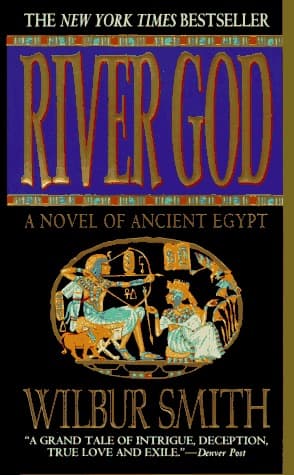
Synopsis
Covers the whole plot, including the ending.
- Difficulty
- Medium
- Pacing
- Variable
- Mood
- Epic, Adventurous, Romantic, Violent, Grand
- Read it if
- You enjoy sweeping historical epics with strong characters, political intrigue, forbidden romance, and detailed portrayals of ancient civilizations.
- Skip it if
- You dislike lengthy novels, graphic descriptions of war and violence, or stories with a significant focus on ancient Egyptian mythology and societal structures.
River God Plot Summary
Covers the whole plot, including the ending.
The Childhood of Taita and Lostris
The story begins with Taita, a brilliant and multi-talented eunuch slave, serving the young Princess Lostris. Taita, a skilled scribe, physician, architect, and artist, records the events of their lives. Lostris is a spirited and beautiful girl, and Taita is deeply devoted to her. They spend their early years in the palace, where Taita educates Lostris and observes the political actions of Pharaoh Mamose VIII and his Vizier, Nembet. Taita also introduces Lostris to Tanus, a brave and honorable young warrior, who quickly captures Lostris's heart, despite their social differences. Their forbidden love begins to grow under Taita's watchful eye, setting the stage for future conflicts and loyalties.
The Rise of Tanus and the Royal Hunt
Tanus, a skilled and courageous warrior, distinguishes himself during a royal hunt when he saves Pharaoh Mamose VIII from a charging lion. This act of bravery earns him the Pharaoh's gratitude and a promotion, allowing him more access to the royal court, and to Lostris. Taita, initially concerned about their forbidden love, sees the genuine affection between Tanus and Lostris and subtly helps their meetings. However, the Pharaoh, unaware of their secret romance, has already declared that Lostris will marry the powerful and ambitious Lord Intef, a cruel and corrupt nobleman who poses a significant threat to Tanus and Egypt's stability. This declaration casts a shadow over their developing love.
Lostris's Marriage and the Hyksos Threat
Lostris is forced to marry Lord Intef in a grand ceremony, a union that deeply saddens her and Tanus. Taita, always loyal, stays by Lostris's side, providing comfort and a way for her to secretly communicate with Tanus. Egypt's political situation darkens as the Hyksos invaders, led by the ruthless Salitis, begin their march, conquering the northern territories. Pharaoh Mamose VIII, increasingly frail and indecisive, struggles to unite his generals against the approaching enemy. Tanus, despite his heartbreak, dedicates himself to defending Egypt, rising through the military ranks and showing his strategic skill in skirmishes against the Hyksos, becoming a symbol of hope for the struggling kingdom.
The Pharaoh's Death and the Exodus South
Pharaoh Mamose VIII, weakened by illness and the ongoing war, dies, leaving a power vacuum and a fragmented kingdom. Before his death, he names his young son, Nemus, as his successor, with Lostris as regent. As the Hyksos conquer Memphis, Lostris, following a prophecy and Taita's strategic advice, plans a daring exodus of loyal Egyptians and their most valuable treasures south along the Nile. Tanus, leading the remaining loyal forces, provides a crucial rearguard, fighting desperate battles to protect the fleeing convoy. Taita, with his knowledge and ingenuity, manages the logistics of this massive undertaking, ensuring the survival of their people and the royal lineage, as they seek refuge in the difficult lands beyond the First Cataract.
Life in Exile and the Birth of Memnon
In the harsh but secure lands of southern Egypt, beyond the Hyksos' reach, Lostris and her people establish a new settlement. Life is challenging, but Taita's resourcefulness and Tanus's leadership ensure their survival. During this period, Lostris gives birth to a son, Memnon. While officially declared Intef's son, Taita knows the truth: Memnon is Tanus's son, conceived during a secret meeting before the exodus. This secret is closely guarded, important for the boy's safety and future claim to the throne. Taita dedicates himself to raising Memnon, teaching him the virtues of a true king, while Tanus continues to lead the military, preparing for the day they can reclaim Egypt from the Hyksos.
Taita's Quest for the Lost Treasures
Realizing the need for resources and ancient knowledge to reclaim Egypt, Taita undertakes dangerous solo missions into Hyksos-occupied territory. He uses his disguise and cunning to infiltrate enemy camps, gather intelligence, and recover sacred artifacts and texts that were stolen during the invasion. These expeditions are full of danger, forcing Taita to use all his skills as a spy, warrior, and magician. He often encounters Lord Intef, who has allied himself with the Hyksos, and manages to outwit him. Taita's successful recovery of these treasures not only boosts the morale of their exiled people but also provides crucial tactical advantages and spiritual guidance for their eventual return.
The Training of Memnon and the Army
As Memnon grows, Taita meticulously trains him in all aspects of kingship, warfare, and statecraft, preparing him to lead Egypt. Tanus, meanwhile, rebuilds and trains a strong new Egyptian army from the loyalists who followed Lostris into exile. He teaches them discipline, advanced tactics, and a fierce loyalty to the exiled royal house. Taita also helps the military effort, designing innovative weapons and siege engines. The bond between Taita, Tanus, Lostris, and Memnon strengthens, forming the core of the resistance. They carefully plan their strategy for retaking Egypt, knowing the odds are against them, but driven by a shared dream of liberation.
The Battle of Thebes and Intef's Downfall
The time for reclamation finally arrives. Tanus, leading the renewed Egyptian army, begins a series of strategic campaigns, slowly pushing northwards. Their first major objective is Thebes, which has fallen under the control of Lord Intef, who rules as a puppet for the Hyksos. The battle for Thebes is fierce, showing the superior training and morale of Tanus's forces. Taita's strategic insights and engineering skill are invaluable in overcoming the city's defenses. During the battle, Tanus confronts Intef, leading to a dramatic showdown where Intef is defeated and killed, avenging the wrongs committed against Lostris and the royal family. This victory is a significant turning point, boosting the morale of the Egyptian people.
The Final Push and Tanus's Sacrifice
With Thebes secured, the Egyptian army continues its push north, liberating more cities and provinces from Hyksos control. Tanus, always at the forefront, leads his troops with courage and tactical brilliance. However, during a crucial siege, Tanus sustains a mortal wound while protecting Lostris and Memnon from a collapsing wall. Despite Taita's desperate attempts to save him, Tanus's injuries are too severe. In his dying moments, he and Lostris share a farewell, their love lasting to the very end. His sacrifice inspires the army and Memnon to fully embrace his destiny as the future Pharaoh, vowing to complete his father's mission.
Memnon's Reign and the New Egypt
Following Tanus's death, Memnon, now a young man, becomes king, fulfilling the prophecy and the hopes of his people. With Taita as his loyal advisor and mentor, Memnon proves to be a wise, just, and powerful Pharaoh. He successfully drives out the remaining Hyksos invaders, uniting the Two Lands once more. Taita dedicates his remaining years to serving Memnon, helping him rebuild Egypt, restore its temples, and begin a new era of peace and prosperity. Lostris, though grieving Tanus, finds solace in her son's reign and Egypt's stability. Taita continues to record their history, ensuring that the legacy of those who fought for Egypt's freedom will never be forgotten, finding his own fulfillment in the service of his beloved Lostris and her lineage.
Principal Figures
Taita
Protagonist
The brilliant and multi-talented eunuch slave and scribe.
Taita is a highly intelligent and resourceful eunuch slave, renowned for his skills as a scribe, physician, architect, artist, and even a magician. Despite his physical mutilation and social status, he possesses immense inner strength, loyalty, and a deep, unspoken love for Lady Lostris. He is the ultimate problem-solver, strategist, and chronicler of the events, often acting as the true driving force behind the survival and eventual resurgence of Egypt. His compassion and ingenuity are unmatched, making him indispensable to Lostris and later, Memnon.
Relationships: Lostris (Deep, unconditional love and devotion, mentor-student bond.); Tanus (Respect, alliance, and shared goal of protecting Lostris and Egypt.); Memnon (Mentor, surrogate father, and loyal advisor.)
Lady Lostris
Protagonist
The beautiful and spirited princess, destined for both love and royalty.
Lostris is a beautiful, intelligent, and strong-willed princess, born into royalty but possessing a rebellious spirit. She is deeply in love with Tanus, a love forbidden by her station. Despite being forced into a politically advantageous marriage, she remains fiercely loyal to her true love and her people. She displays remarkable resilience and leadership during the exodus and exile, inspiring her followers. Her emotional strength and determination are key to the survival of the royal lineage and the eventual reclaiming of Egypt.
Relationships: Taita (Deep trust, affection, and reliance; he is her closest confidant.); Tanus (True, passionate, and enduring love.); Memnon (Loving mother, strong bond of protection and hope.); Lord Intef (Forced marriage, hatred, and revulsion.)
Tanus
Protagonist
The brave and honorable warrior, Lostris's true love.
Tanus is a courageous, honorable, and highly skilled warrior, revered for his military prowess and leadership. He is deeply devoted to Lostris, his forbidden love, and to the protection of Egypt. Despite his initial lower status, he rises through the ranks due to his bravery and strategic genius. He embodies the ideals of heroism and sacrifice, consistently putting the well-being of his people and his beloved above his own. His unwavering loyalty and military leadership are crucial to the fight against the Hyksos.
Relationships: Lostris (True, passionate, and enduring love.); Taita (Respect, alliance, and shared goal of protecting Lostris and Egypt.); Memnon (Father (secretly), mentor, and inspiration.)
Memnon
Supporting
Lostris and Tanus's son, destined to become Pharaoh.
Memnon is the son of Lostris and Tanus, though officially recognized as Intef's son. He is raised and educated by Taita, growing into a strong, intelligent, and just young man. He inherits his father's courage and his mother's spirit, along with Taita's wisdom. He is the future hope of Egypt, destined to reclaim the throne and unite the Two Lands. His journey is one of growth and the acceptance of his royal destiny, guided by the love and sacrifice of those around him.
Relationships: Lostris (Mother, source of love and inspiration.); Tanus (Father (secretly), role model, and hero.); Taita (Mentor, surrogate father, and trusted advisor.)
Lord Intef
Antagonist
The cruel and ambitious Vizier, Lostris's forced husband.
Lord Intef is a powerful, cruel, and corrupt nobleman, driven by insatiable ambition and greed. He is Lostris's forced husband and a constant source of torment for her and a rival to Tanus. He schemes and manipulates to gain power, eventually aligning himself with the Hyksos invaders. He embodies treachery and moral decay, serving as a primary obstacle to the protagonists' goals. His actions contribute significantly to the suffering and challenges faced by Lostris and her loyalists.
Relationships: Lostris (Husband (forced), tormentor.); Tanus (Rival, enemy.)
Pharaoh Mamose VIII
Supporting
The aging and indecisive Pharaoh.
Pharaoh Mamose VIII is the aging and increasingly frail ruler of Egypt at the beginning of the story. He is well-meaning but often indecisive and easily swayed by his corrupt advisors, particularly Lord Intef. His inability to effectively counter the Hyksos threat leads to the downfall of his kingdom. He represents the fading glory of the old Egyptian order and the need for a stronger, more decisive leader to emerge.
Relationships: Lostris (Daughter, later regent.); Tanus (Initially a grateful patron, later unaware of his relationship with Lostris.)
Salitis
Antagonist
The ruthless and cunning leader of the Hyksos invaders.
Salitis is the formidable and merciless leader of the Hyksos invaders. He is a skilled military commander and a brutal conqueror who systematically dismantles the Egyptian kingdom. He represents the external threat that forces the Egyptians into exile and drives the narrative of reclamation. His presence signifies the existential danger facing Egypt and the formidable challenge that Tanus and later Memnon must overcome.
Rasfer
Supporting
Tanus's loyal and brave second-in-command.
Rasfer is a loyal and courageous warrior, serving as Tanus's most trusted second-in-command. He is a steadfast companion in battle and a reliable ally throughout the long struggle against the Hyksos. His unwavering support for Tanus and the royal family exemplifies the loyalty found among the Egyptian forces. He is a testament to the bonds forged in warfare and shared adversity.
Relationships: Tanus (Loyal subordinate and trusted friend.); Lostris (Loyal to her and the royal lineage.)
Themes & Insights
Love and Sacrifice
The novel explores the lasting power of love, both romantic and platonic, and the sacrifices made for it. The forbidden love between Lostris and Tanus drives much of the story, leading to daring acts and heartbreaking decisions. Taita's unconditional love for Lostris motivates his lifelong devotion and countless acts of ingenuity and self-preservation for her and her lineage. Tanus's ultimate sacrifice for Lostris and Memnon shows the depth of this theme, showing how love can inspire heroism and shape destinies, even in the face of great challenges and personal loss.
“My love for Lostris was the very air that I breathed, the blood that flowed in my veins, the reason for my being.”
Loyalty and Duty
Loyalty is a central part of the story, shown in Taita's unwavering devotion to Lostris, Tanus's commitment to Egypt and the royal house, and the soldiers' dedication to their commanders. Despite chaos and betrayal, characters like Taita and Tanus consistently put their duty to their people and their chosen family above personal gain or safety. This theme is especially clear during the exodus, where many choose to follow Lostris into exile, showing their steadfast loyalty in uncertain and dangerous times. It highlights the strength of community bonds and the importance of honor in a crisis.
“Though a slave, my loyalty to the Lady Lostris was stronger than any oath sworn by a free man.”
Resilience and Rebirth
The story shows the human spirit's ability to endure and rebuild after devastation. The entire Egyptian civilization is forced into exile and faces near annihilation by the Hyksos. However, guided by Taita and led by Lostris and Tanus, they not only survive but carefully plan and execute a campaign to reclaim their homeland. This theme is embodied in the difficult journey south, the establishment of a new settlement, and the eventual resurgence of a united Egypt under Memnon, showing that even from defeat, a stronger future can emerge.
“From the ashes of defeat, we would forge a new kingdom, stronger and more glorious than before.”
The Nature of Power and Leadership
The novel explores different forms of power and leadership. Pharaoh Mamose VIII's weak and indecisive rule leads to Egypt's downfall, contrasting sharply with Lostris's strong, compassionate leadership and Tanus's strategic military skill. Taita uses a different kind of power—that of intellect, knowledge, and subtle manipulation—which proves more effective than brute force or inherited authority. Memnon's rise, guided by Taita, signifies the transition to a new, enlightened form of kingship, based on wisdom, justice, and the welfare of the people, rather than just birthright or tyranny.
“True power lies not in the crown, but in the wisdom and courage of the heart.”
Plot Devices & Literary Techniques
The Narrator (Taita)
First-person perspective through the eyes of the primary chronicler.
The entire story is told from the first-person perspective of Taita, the eunuch slave. This device allows for an intimate and highly detailed account of events, filtered through Taita's unique blend of observation, intelligence, and personal devotion. His role as a scribe means he is actively recording the history as it unfolds, giving the narrative an authentic, almost historical document feel. It also allows the author to explore Taita's inner thoughts, complex emotions, and his unparalleled access to the private lives of the royal family, providing insights that no other character could offer.
Prophecy
Foreshadowing and divine guidance for the future of Egypt.
Prophecies, often relayed through Taita's interpretations of ancient texts or mystical visions, serve to foreshadow key events and guide the protagonists' actions. The prophecy of a new pharaoh uniting the Two Lands after a period of darkness provides hope and direction during their exile. It imbues their struggle with a sense of divine purpose, motivating them to endure hardships and make sacrifices. The prophecies also add an element of destiny to the narrative, suggesting that certain events are preordained, even as characters exercise their free will.
The Exodus
A grand-scale journey and metaphor for survival and rebirth.
The forced exodus of Lostris and her loyal followers south along the Nile is a major plot device. It serves as a physical journey that tests the characters' endurance and leadership, forcing them to adapt to harsh new environments. Metaphorically, it represents the death of the old Egypt and the painful birthing process of a new one. This epic journey allows for the development of new military strategies, the training of a new generation, and the forging of stronger bonds among the survivors, laying the groundwork for their eventual return and reclamation of their homeland.
The Secret Parentage of Memnon
A hidden truth that dictates the future of the kingdom.
The secret that Memnon is the son of Tanus, not Lord Intef, is a crucial plot device. This secret is closely guarded by Taita and Lostris, as revealing it too early would endanger Memnon and undermine his claim to the throne. It creates dramatic tension and provides a powerful motivation for Taita to protect Memnon and ensure his ascent. This hidden truth underpins the entire narrative of reclaiming the throne, tying the personal love story of Lostris and Tanus directly to the political destiny of Egypt.
River God Quotes
“As a boy, I had been taught that the gods were just and that the world was orderly. As a man, I knew that the gods were capricious and the world was chaos.”
“The river is a living god, and like all gods, it demands sacrifice.”
“Love is a dangerous thing, even more so when it is forbidden.”
“A king without a queen is only half a ruler, and a queen without a king is a ship without a rudder.”
“The desert, like a beautiful woman, can lure you to your doom with its silent promise of peace.”
“There are some wounds that even time cannot heal, only hide.”
“To truly know a man, you must see him in his hour of greatest triumph and his moment of deepest despair.”
“Gold is a curse, a magnet for greed, and a destroyer of men's souls.”
“The greatest magic lies not in spells and potions, but in the power of a determined heart.”
“Even the mightiest pharaoh is but a servant of the gods and the river.”
“Memory is a fickle mistress, sometimes a comfort, often a torment.”
“A good general understands the terrain, but a great general understands the hearts of his men.”
“The stars are the eyes of the gods, watching our every folly and our every triumph.”
“To build something grand, you must first dream it in the grandest terms.”
Quiz
10 questions on the plot and the characters. Each answer comes with a short explanation.
Question 1
Who is the narrator of 'River God'?
- Tanus
- Lostris
- Taita
- Pharaoh Tamose
Show answer
C. Taita The story is told through the eyes of Taita, the brilliant and devoted eunuch slave, who serves Lostris and chronicles her life.
Question 2
What is the primary goal of Tanus at the beginning of the novel, related to Egypt's political state?
- To conquer Nubia for Pharaoh Tamose.
- To reunite the two halves of Egypt.
- To overthrow Pharaoh Tamose and seize the throne.
- To lead an expedition to discover the source of the Nile.
Show answer
B. To reunite the two halves of Egypt. Tanus's main ambition, and the decree of the gods, is for him to lead Egypt's army to reunite the Kingdom's shared halves, Upper and Lower Egypt.
Question 3
What is the forbidden object of desire for Tanus, mentioned in the book's description?
- The Pharaoh's crown
- A vast gold mine in the desert
- The Lady Lostris
- Immortality from the gods
Show answer
C. The Lady Lostris The description explicitly states that Tanus seeks 'possession of the Lady Lostris, a rare beauty... destined for the adoration of a nation, and the love of one extraordinary man'.
Question 4
Why is Taita castrated and made a eunuch?
- He was born that way due to a rare condition.
- It was a punishment for a crime he committed against a noble family.
- He was castrated at a young age to serve the royal household, specifically as a guardian and tutor.
- He chose castration as a spiritual sacrifice to the gods.
Show answer
C. He was castrated at a young age to serve the royal household, specifically as a guardian and tutor. Taita was castrated as a young boy to serve the royal household, a common practice for those intended to be trusted guardians and advisors to royal women.
Question 5
What significant artistic skill does Taita possess, beyond his intelligence and medical knowledge?
- He is a master stonemason and architect.
- He is a renowned sculptor and painter.
- He is a skilled musician, particularly with the lyre.
- He is an exceptional weaver of tapestries.
Show answer
B. He is a renowned sculptor and painter. Taita is not only intelligent and medically astute but also an incredibly talented artist, particularly as a sculptor and painter, often creating beautiful pieces for Lostris.
Question 6
What is the primary reason Pharaoh Tamose chooses to marry Lostris, despite her love for Tanus?
- He genuinely loves Lostris and is unaware of her feelings for Tanus.
- Her family holds significant political power and wealth, making it a strategic alliance.
- He wants to spite Tanus, whom he views as a rival.
- He believes marrying Lostris will bring divine favor and stability to his reign.
Show answer
B. Her family holds significant political power and wealth, making it a strategic alliance. Lostris comes from a powerful and ancient noble lineage, and marrying her provides Pharaoh Tamose with a crucial political alliance and legitimacy for his rule.
Question 7
What critical 'secret' does Taita possess regarding Lostris and her children?
- He knows the true location of a hidden treasure belonging to Lostris's family.
- He knows that Lostris's children are not fathered by Pharaoh Tamose, but by Tanus.
- He has discovered a prophecy that foretells Lostris's eventual ascension to the throne.
- He knows that Lostris is secretly plotting against Pharaoh Tamose.
Show answer
B. He knows that Lostris's children are not fathered by Pharaoh Tamose, but by Tanus. Taita is privy to the secret that Lostris's children, particularly the firstborn, are actually Tanus's, a secret he meticulously guards to protect Lostris and her lineage.
Question 8
What major engineering feat does Taita oversee and design for the escape of the royal court from Egypt?
- The construction of a vast, hidden underground city.
- The creation of a massive fleet of specially designed barges to navigate the cataracts of the Nile.
- The building of an impregnable fortress in the desert.
- The development of a new type of chariot for rapid desert travel.
Show answer
B. The creation of a massive fleet of specially designed barges to navigate the cataracts of the Nile. When Egypt is invaded, Taita designs and oversees the construction of a unique fleet of shallow-draft barges, capable of being dragged over the Nile's cataracts, crucial for the escape of the royal family and many Egyptians.
Question 9
What is the ultimate fate of Tanus?
- He becomes the new Pharaoh of a united Egypt.
- He is killed in battle while defending Lostris and the royal family.
- He retires to a peaceful life with Lostris after the war.
- He is betrayed by Lostris and exiled from Egypt.
Show answer
B. He is killed in battle while defending Lostris and the royal family. Tanus dies heroically in battle, defending Lostris and the remnants of the Egyptian court during their long exile and struggle against the Hyksos invaders.
Question 10
What does the 'River God' in the title primarily refer to, beyond a literal interpretation of the Nile?
- A specific deity worshipped by the ancient Egyptians.
- The enduring spirit and lifeblood of Egypt, represented by the Nile, and its influence on the characters' destinies.
- A mythical creature that Taita encounters during his travels.
- Tanus, as a god-like warrior whose fate is tied to the river.
Show answer
B. The enduring spirit and lifeblood of Egypt, represented by the Nile, and its influence on the characters' destinies. The Nile is the lifeblood of Egypt, dictating its history, culture, and the very survival of its people. The 'River God' signifies this profound, almost divine influence the river has on the land and the destinies of the characters.
River God FAQ
What is the central conflict driving the plot of 'River God'?
The central conflict revolves around the forbidden love between the warrior Tanus and the Lady Lostris, who is destined to become Pharaoh Mamose's Great Royal Wife. Their struggle for a future together is set against the backdrop of Egypt's political instability and the Hyksos invasion, which forces them into a perilous journey up the Nile.
Who is Taita and what is his role in the story?
Taita is a brilliant eunuch slave, Lostris's personal attendant, and a master of many arts including medicine, engineering, poetry, and magic. He serves as the primary narrator, protector, and mentor to Lostris and her children, orchestrating many of the key events and inventions that ensure their survival and eventual return to Egypt.
What major historical event forms a significant part of the book's setting?
The book is set during a period of great upheaval in ancient Egypt, specifically the invasion and occupation by the Hyksos, a foreign people from the north. This event forces the royal court and many Egyptians to flee south up the Nile, leading to years of exile and a long, arduous journey to reclaim their homeland.
How does the relationship between Tanus and Lostris evolve throughout their exile?
Despite Lostris marrying Pharaoh Mamose, her love for Tanus remains steadfast. They secretly continue their affair, conceiving two children, Memnon and Tehuti, whom they raise as Mamose's heirs. Their love is tested by separation, war, and the constant threat of discovery, but ultimately it is the driving force behind their hope for returning to Egypt.
What is the significance of the Scroll of Bek in the narrative?
The Scroll of Bek is a crucial ancient text detailing the location of legendary hidden riches and powerful magical artifacts. Taita deciphers it over many years, believing it holds the key to restoring Egypt's power and securing Lostris's legacy, ultimately guiding their quest for the treasure and their return.
Are there any subtle clues about Memnon's true parentage before Taita explicitly reveals it?
Yes, Taita often observes Memnon's striking resemblance to Tanus, noting his martial prowess, leadership qualities, and fair hair, which are traits not shared with Pharaoh Mamose. Lostris's deep emotional attachment to Memnon, sometimes disproportionate to her affection for Mamose, also hints at the secret.
What hidden technological innovations does Taita introduce or perfect?
Taita invents and perfects several crucial technologies, including the composite bow, which gives the Egyptian army a significant advantage in battle. He also develops advanced surgical techniques, sophisticated irrigation systems, and ingenious methods for quarrying and transporting massive stone blocks for building projects, showcasing his incredible intellect.
What is the true nature of the 'gods' in the context of the story, particularly regarding Taita's understanding?
While the common people and even the pharaohs believe in literal gods, Taita, with his scientific and rational mind, often interprets divine intervention as natural phenomena or the result of his own carefully planned manipulations. He uses the belief in gods to inspire his people and intimidate enemies, effectively acting as a hidden hand of destiny.
How does Lostris cope with the emotional burden of her forbidden love and royal duties?
Lostris copes by embracing her role as a queen and mother, finding strength in her children and her people. However, she often struggles with melancholy and regret, finding solace only in her secret rendezvous with Tanus and the unwavering devotion of Taita. Her artistic expression, particularly her love for music and dance, also provides an outlet for her complex emotions.
Analyze Taita's motivations for his lifelong devotion to Lostris. Is it purely loyalty, or something deeper?
Taita's devotion transcends mere loyalty; it's a profound, almost paternal love, intertwined with his own ambition to shape Egypt's destiny through her and her lineage. As a eunuch, his love is intellectual and spiritual, finding fulfillment in protecting and guiding Lostris, seeing her as the embodiment of his life's purpose and legacy.
How does Tanus's warrior persona mask his inner vulnerabilities and desires?
Tanus presents himself as an unyielding, honorable warrior, dedicated to Egypt and his pharaoh, which often forces him to suppress his personal desires. Beneath this stoic exterior, he harbors a deep, passionate love for Lostris and a profound sense of duty, which frequently puts him in conflict with his own heart and the expectations placed upon him.
Discuss the ethical implications of Taita's manipulations and deceptions, even when for a 'good' cause.
Taita's manipulations, such as orchestrating Lostris's affair with Tanus and concealing Memnon's parentage, raise ethical questions. While his ultimate goal is Egypt's welfare and Lostris's happiness, he often overrides individual agency and truth. His actions highlight a utilitarian philosophy, where the end justifies the means, but at the cost of honesty and personal choice for others.
What is the symbolic significance of the Nile River in 'River God'?
The Nile symbolizes life, sustenance, journey, and the very essence of Egypt itself. It is the literal path of their exile and return, a source of both peril and prosperity. Its cycles mirror the cycles of Egyptian history – decline, exile, and eventual rebirth – making it a constant, powerful presence throughout the narrative.
How does the author use the historical setting to enhance the themes of love and destiny?
The historical setting of ancient Egypt, with its rigid social hierarchy, divine pharaohs, and belief in destiny, provides a dramatic backdrop for the forbidden love between Tanus and Lostris. The societal constraints amplify their struggle, making their defiance of 'destiny' and their pursuit of love against all odds even more poignant and heroic.
What role does the character of Rasfer play, and how does his fate reflect the themes of justice?
Rasfer is a cruel, ambitious, and morally corrupt noble who serves as a primary antagonist, embodying greed and treachery. His eventual gruesome death, orchestrated by Taita, serves as a brutal form of poetic justice, reinforcing the theme that evil deeds, though sometimes benefiting from temporary success, will ultimately meet a fitting, often violent, end.
How does the concept of 'ma'at' (cosmic order and justice) manifest in the story, particularly through Taita's actions?
Taita, though often acting outside conventional morality, ultimately strives to restore 'ma'at' to Egypt by ensuring the rightful heir, Memnon, takes the throne and by driving out the Hyksos invaders. His intricate plans and manipulations are all directed towards re-establishing the cosmic balance and order that was disrupted by the foreign invasion and internal corruption.
Describe the relationship between Lostris and her children, Memnon and Tehuti, and how it differs for each.
Lostris's relationship with Memnon is intensely protective and loving, as he is the secret child of her true love, Tanus, and her hope for Egypt's future. Her relationship with Tehuti, her younger daughter, is also loving but perhaps less burdened by the weight of destiny, allowing for a more straightforward maternal bond.
What is the significance of the 'Blue Crocodile' and its role in the narrative?
The 'Blue Crocodile' is a legendary, massive crocodile that Taita encounters and eventually 'tames' or at least establishes a unique understanding with. It serves as a symbol of the untamed, ancient power of the Nile and nature, and Taita's ability to interact with it highlights his mystical connection to the natural world, further enhancing his 'magical' persona.
About the author

Wilbur Smith was a South African author known for his historical fiction set in Africa. His notable works include "River God," "When the Lion Feeds," "Birds of Prey," and "Monsoon," which explore themes of adventure and survival against the backdrop of the continent's rich history and landscapes. Smith's storytelling often reflects his deep connection to Africa.
Similar books
- The Bronze Bow
Elizabeth George Speare
4.0 (20k) average on GoodreadsChildren'sWhile set in a different ancient period, it shares themes of rebellion, loyalty, and a young protagonist's journey against oppression.
- Angels & Demons
Dan Brown
3.9 (2.7M) average on GoodreadsThrillerA Harvard symbologist races through Rome's ancient sites, deciphering cryptic clues to unmask the Illuminati and stop a vengeful plot to destroy the Vatican with a stolen antimatter weapon.
- Gone Girl
Gillian Flynn
4.1 (2.3M) average on GoodreadsThrillerA wife's sudden disappearance on her fifth anniversary reveals a web of lies and psychological warfare, exposing the secrets within a seemingly perfect marriage.
- The Girl on the Train
Paula Hawkins
3.9 (2.1M) average on GoodreadsThrillerA woman’s fascination with a seemingly perfect couple she watches from her daily train commute leads her into a dark investigation when she witnesses something that shatters their idyllic image.
- The Da Vinci Code
Dan Brown
3.9 (1.9M) average on GoodreadsThrillerA symbologist and a cryptologist race through European landmarks, deciphering ancient codes and uncovering a conspiracy that could rewrite the foundations of Christianity.
- The Guest List
Lucy Foley
3.8 (1.3M) average on GoodreadsThrillerOn a remote Irish island, a glamorous wedding descends into a deadly whodunnit when a guest is found murdered, trapping everyone with their secrets as a storm rages.





Enjoyed the summary?
A summary gives you the shape of the book. The book itself has the detail, the examples and the voice.
Find River God on AmazonAs an Amazon Associate, BookBrief earns from qualifying purchases. How we're funded