
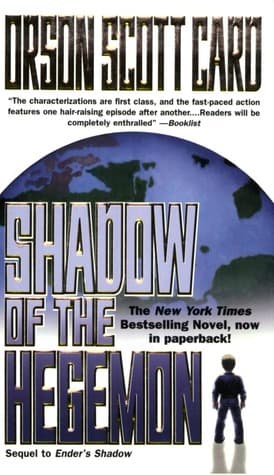
Synopsis
Covers the whole plot, including the ending.
- Difficulty
- Medium
- Pacing
- Moderate
- Mood
- Intriguing, Strategic, Suspenseful, Political
- Read it if
- You want to see the political aftermath of a global war through the eyes of brilliant child strategists, with complex geopolitical maneuvering and high stakes.
- Skip it if
- You're looking for Ender Wiggin's direct story or prefer less focus on political intrigue and more on direct combat.
Shadow of the Hegemon Plot Summary
Covers the whole plot, including the ending.
The Aftermath and the Rise of Peter
After the Formic War, Battle School closes, and the children who saved humanity return to Earth. Their skills and strategic brilliance make them valuable assets and targets for the world's nations. Bean, living in India with Sister Carlotta, barely escapes an assassination attempt by Russian agents. Realizing the danger, he seeks out Peter Wiggin, Ender's older brother, who has begun influencing global politics under the pseudonym 'Locke.' Peter, seeing a chance to consolidate power and establish peace, agrees to help Bean protect the other Battle School children, many of whom are being kidnapped by various groups.
The Kidnapping of the Dragon Army
The kidnappings continue, targeting members of Ender's Dragon Army. Hot Soup, Alai, Petra Arkanian, and others are abducted, mostly by Achilles de Flandres. Achilles is a manipulative and psychopathic former Battle School student who resents Ender and his friends. Having gained favor with the Russian government, Achilles uses their resources to capture the children, intending to exploit their genius for his own geopolitical goals. Bean, with Peter's intelligence network, works to track Achilles and understand his scheme, realizing the threat Achilles poses to global stability and the lives of his friends.
Bean's Investigation and Achilles's Motives
Bean uses his intelligence to look into Achilles's past, finding his history of manipulation, murder, and psychological warfare, dating back to his time on the streets of Rotterdam. He learns that Achilles is not just serving Russia but using them to create a global power vacuum he can fill. Achilles's strategy involves starting regional conflicts, especially between Russia and India, to distract the world while he gains control over the kidnapped children and their strategic minds. Bean realizes the true danger: Achilles is not just a kidnapper, but a budding hegemon with an effective plan.
Peter's Political Maneuvers
While Bean tracks Achilles, Peter Wiggin, as 'Locke,' works to establish a global information network and a credible voice for peace and reason. He publishes influential essays and participates in online forums, guiding public opinion and fostering international cooperation. He uses his understanding of human psychology and global politics to counteract the rising tensions Achilles fuels. Peter's goal is not just to rescue the children but to prevent a global war and set the groundwork for a unified Earth government, where he sees himself as the ultimate leader, a benevolent hegemon.
The India-Russia Conflict
Achilles manipulates events, leading to a diplomatic crisis between India and Russia. He stages incidents and feeds misinformation to both sides, using the kidnapped Battle School children's strategic advice (often given under duress) to make the conflict seem unavoidable. The world watches as two nuclear powers prepare for war. Bean, in a race against time, realizes that Achilles's plan is succeeding and that the lives of his friends and billions of others are at stake. He increases his efforts to find Achilles and devise a counter-strategy.
Bean's Counter-Strategy
Bean, with Peter's intelligence, discovers that Achilles is holding the children in a secret facility in Ukraine, disguised as a scientific research center. He understands that a direct military assault is too risky and could harm the children. Instead, Bean forms a plan: to publicly expose Achilles's actions and true identity, discrediting him and forcing his Russian patrons to abandon him. He plans to use the global communication networks Peter is building to broadcast the truth, hoping to turn public opinion and international support against Achilles.
The Rescue of the Children
With Peter's diplomatic pressure and the impending exposure, Bean begins the rescue operation. He infiltrates Achilles's facility, using his physical abilities and strategic genius. He navigates the security systems and confronts Achilles's guards. After a tense standoff and clever maneuvers, Bean frees Alai, Petra, Hot Soup, and the other kidnapped children. The rescue is a victory against Achilles and restores hope for the children's safety. However, Achilles himself escapes, vowing revenge.
Achilles's Escape and Peter's Ascension
Despite the successful rescue, Achilles de Flandres evades capture, disappearing. His escape leaves a lingering threat, but his immediate power base is shattered. At the same time, Peter Wiggin's 'Locke' persona gains global recognition. His essays and diplomatic efforts, especially in defusing the India-Russia crisis, position him as a voice of reason and a potential leader for a unified Earth. The world, tired of conflict, begins to look to Locke for guidance, setting the stage for Peter's long-term goal of becoming the Hegemon, the benevolent ruler of a peaceful, unified world.
The Children's Future and Bean's Role
The rescued Battle School children are debriefed and begin recovering from their ordeal. They are safe but affected by Achilles's manipulation. Bean, though relieved, understands that the fight for global stability is not over. He chooses to continue working with Peter, recognizing Peter's ambition and his ability to bring about lasting peace, even through his own manipulation. Bean becomes Peter's trusted advisor and operative, dedicating his intellect to Peter's vision of a unified Earth, even as he deals with his own unique biological condition and his future.
The Shadow of the Hegemon
With Achilles neutralized (for now) and the Battle School children mostly safe, Peter Wiggin continues his ascent to power. His 'Locke' persona is now a globally recognized figure, advocating for international cooperation and peaceful conflict resolution. He uses his growing influence to dismantle existing power structures and build new ones that align with his vision of a unified world. The stage is set for Peter to become the Hegemon, the supreme ruler of Earth, a position he believes is necessary to prevent future wars. Bean remains his loyal, though sometimes questioning, shadow, the brilliant mind behind many of Peter's strategic successes.
Principal Figures
Bean (Julian Delphiki)
Protagonist
Ender's most brilliant commander, now a key player in Earth's politics.
Bean is an extraordinarily intelligent and physically enhanced former Battle School student, one of Ender's most trusted commanders. He is driven by a profound sense of loyalty to his friends and a desire to protect humanity from itself. Despite his small stature, his mind operates at an accelerated rate, allowing him to process information and strategize with unparalleled speed and depth. He often struggles with his identity and the implications of his genetic modifications, feeling a sense of alienation but also a powerful responsibility.
Relationships: Peter Wiggin (Strategic alliance and uneasy partnership; Bean is Peter's most trusted operative.); Sister Carlotta (Protective guardian and mentor during his early life.); Achilles de Flandres (Mortal enemy and intellectual rival.); Alai (Close friend and fellow Battle School veteran.)
Peter Wiggin
Deuteragonist / Aspiring Hegemon
Ender's older brother, a manipulative genius aiming to unify Earth under his rule.
Peter Wiggin is Ender's older brother, a brilliant but ruthlessly manipulative individual who was deemed too dangerous for Battle School. He possesses an uncanny understanding of human psychology and geopolitics. Operating under the pseudonym 'Locke,' he seeks to consolidate global power, believing that only a single, benevolent hegemon can prevent humanity from destroying itself. His ambition is immense, but he genuinely believes his actions are for the greater good, even if they involve intricate schemes and moral compromises.
Relationships: Bean (Strategic alliance and uneasy partnership; Peter relies heavily on Bean's intellect.); Ender Wiggin (Complex sibling rivalry; Peter resents Ender's fame but also respects his abilities.); Valentine Wiggin (Sister and intellectual collaborator ('Demosthenes').)
Achilles de Flandres
Antagonist
A psychopathic former Battle School student who seeks global power through chaos.
Achilles is a deeply disturbed and psychopathic former Battle School student with a history of manipulation, cruelty, and murder. He harbors an intense inferiority complex and a thirst for power, particularly over those he perceives as superior. He is incredibly cunning and charismatic, able to ingratiate himself with powerful figures while secretly pursuing his own agenda of global destabilization. His methods are ruthless, and he views human lives as mere pawns in his grand strategic game.
Relationships: Bean (Mortal enemy and intellectual rival.); Russian Government (Temporary alliance, used as a tool for his own ambitions.); Battle School Children (Victims of his kidnapping and manipulation.)
Alai
Supporting
Ender's close friend and a brilliant strategist, kidnapped by Achilles.
Alai is one of Ender's closest friends and a highly intelligent Battle School graduate, known for his calm demeanor and strategic prowess. He is a Muslim and a deeply moral individual, often serving as a grounding force among his peers. He represents the innocent victims of Achilles's machinations, enduring captivity with resilience. His capture is a major catalyst for Bean's actions.
Relationships: Bean (Close friend and fellow Battle School veteran.); Ender Wiggin (Close friend and commander.); Petra Arkanian (Friend and fellow Battle School veteran.)
Petra Arkanian
Supporting
A skilled Battle School commander, kidnapped by Achilles.
Petra is one of the few female commanders in Battle School, known for her sharp intellect, leadership, and piloting skills. She is strong-willed and independent, a valuable asset to any team. Her kidnapping by Achilles highlights the vulnerability of even the most capable Battle School graduates to Earth's political machinations. She struggles with the psychological impact of her captivity.
Relationships: Bean (Friend and fellow Battle School veteran.); Alai (Friend and fellow Battle School veteran.)
Sister Carlotta
Supporting
Bean's former guardian and a compassionate nun.
Sister Carlotta is a kind and morally upright nun who discovered and advocated for Bean early in his life. She acted as his guardian and protector, recognizing his extraordinary intelligence and ensuring his placement in the Battle School program. She continues to care for Bean and provides him with emotional support and a moral compass, even as he becomes entangled in global politics. She represents the ethical considerations amidst the ruthless pursuit of power.
Relationships: Bean (Guardian, mentor, and confidante.)
Hot Soup
Supporting
A loyal Dragon Army soldier, kidnapped by Achilles.
Hot Soup is a loyal and capable member of Ender's Dragon Army. While not as prominent as some other characters, his kidnapping underscores the widespread nature of Achilles's scheme to capture all of Ender's former commanders. He represents the broader group of Battle School children who become pawns in the post-war power struggle.
Relationships: Bean (Fellow Battle School veteran.); Alai (Fellow Battle School veteran.)
General Graff
Mentioned
The former head of the Battle School, now in political exile.
General Graff was the visionary and controversial director of the Battle School, responsible for shaping Ender and his commanders. Though not physically present in this book, his legacy looms large. He is now in political exile, having been tried and acquitted for his role in the Formic War. His methods, though harsh, saved humanity, and his absence from the current political landscape leaves a vacuum that Peter and Achilles attempt to fill.
Relationships: Ender Wiggin (Mentor and father figure.); Bean (Mentor and handler.)
Themes & Insights
The Nature of Leadership and Hegemony
The novel explores different forms of leadership, contrasting Peter Wiggin's manipulative but unifying vision with Achilles's chaotic and self-serving ambition. It questions whether a single, powerful leader (a hegemon) is necessary for global peace, and what moral compromises are acceptable. Peter believes that only a unified Earth under his control can prevent endless wars, a concept he argues through his 'Locke' essays. Achilles seeks to create chaos to seize power for personal gain. The book forces readers to consider if a 'benevolent dictator' is an acceptable price for peace.
“Peace is not the absence of war, but the presence of justice. And for justice, sometimes you need a strong hand.”
Child Soldiers and Post-War Trauma
The Battle School children, saviors of humanity, are deeply affected by their experiences. They cannot return to normal lives but are seen as valuable assets or dangerous weapons by world powers. Their kidnappings and manipulation by Achilles highlight the trauma they carry and the exploitation they face. Characters like Alai and Petra, despite their brilliance, are vulnerable and scarred, showing that even heroes are not immune to the psychological and political fallout of war. Their struggle for normalcy and safety is a central emotional thread.
“We saved the world, and now the world wants to eat us alive.”
The Burden of Genius
Bean and Peter Wiggin, both with extraordinary intelligence, are burdened by their gifts. Bean's accelerated metabolism and vast intelligence isolate him, making him feel different and alone. Yet, it also compels him to solve the world's problems. Peter's genius drives his ambition for control, believing he alone can prevent global catastrophe. The novel explores the responsibility that comes with such intelligence, and how it can be used for both immense good and dangerous manipulation. Their brilliance makes them both targets and saviors, highlighting the double-edged sword of exceptional cognitive ability.
“Sometimes I think my brain is a curse, not a gift. It sees too much, too clearly.”
Manipulation and Information Warfare
The conflict between Peter and Achilles is largely fought through manipulation and control of information, rather than direct military engagement. Peter uses his 'Locke' persona to shape public opinion and foster international cooperation. Achilles spreads misinformation and incites conflict to destabilize nations. The novel shows how words, media, and strategic leaks can be as powerful, if not more so, than armies in a post-Formic War world. It highlights the dangers of propaganda and the importance of discerning truth in a complex political landscape, where perception often outweighs reality.
“The greatest weapon is not the bomb, but the truth. Or what people believe to be the truth.”
Plot Devices & Literary Techniques
The 'Locke' and 'Demosthenes' Personas
Online identities used by Peter and Valentine Wiggin to influence global politics.
These online aliases serve as the primary tools for Peter and Valentine Wiggin to manipulate public opinion and global events. 'Locke,' created by Peter, advocates for peace and a unified world government, subtly positioning Peter as a benevolent leader. 'Demosthenes,' created by Valentine, often takes a more alarmist and nationalistic stance, creating a dialectic that Peter can then exploit. These personas allow the Wiggin siblings to exert immense influence without revealing their true identities, acting as a powerful form of information warfare.
Bean's Enhanced Biology
Bean's genetically engineered body and accelerated metabolism.
Bean's unique genetic modifications, which give him an accelerated metabolism, enhanced strength, and a rapidly aging body, serve as both a superpower and a ticking clock. His physical and mental abilities are far beyond human norms, allowing him to perform feats of intellect and agility. However, his rapid aging also creates a profound sense of urgency and mortality, driving his actions and adding a layer of personal tragedy to his heroic efforts. It provides a constant internal conflict and shapes his worldview.
The Battle School Children as Pawns
Ender's former commanders become targets and tools for geopolitical power struggles.
The former Battle School children, despite their role in saving humanity, are treated as highly valuable, yet disposable, resources by Earth's nations. Their strategic genius makes them desirable assets, leading to their systematic kidnapping and exploitation by figures like Achilles. This device highlights the moral ambiguity of treating child heroes as mere weapons or political leverage, emphasizing the post-war world's descent into a new kind of conflict where human intellect is the most coveted resource.
The Shadow of Ender Wiggin
Ender's absence and the impact of his legacy on Earth.
Though Ender Wiggin himself is absent from Earth, his presence is constantly felt through his legacy. The entire premise of the book, the conflict over his former commanders, stems directly from his victory and subsequent departure. Characters constantly reference him, compare themselves to him, or seek to emulate his strategic brilliance. Ender's 'shadow' creates a power vacuum and a standard against which all other leaders are measured, driving the ambitions of both Peter and Achilles.
Shadow of the Hegemon Quotes
“The price of security is eternal vigilance.”
“You can't be a hero unless you're willing to die for something.”
“Power is not given, it is taken.”
“It is not enough to defeat your enemy. You must also defeat their ideas.”
“Sometimes the only way to save someone is to let them go.”
“The greatest weapon is not a bomb, but a mind.”
“Every secret is a potential weapon.”
“Fear makes people predictable. And predictability is a weakness.”
“There are no innocent bystanders in a war.”
“The past is a weapon, if you know how to wield it.”
“To truly know someone, you must know what they are willing to die for.”
“Peace is just the time between wars.”
“Every choice has a consequence, and some consequences are irreversible.”
“The world is not fair, but it can be made just.”
Quiz
10 questions on the plot and the characters. Each answer comes with a short explanation.
Question 1
Which character is the first to be kidnapped after the Battle School closes?
- Petra Arkanian
- Alai
- Shen
- Dink Meeker
Show answer
B. Alai Alai is the first of Ender's Dragon Army to be kidnapped, which prompts Bean to seek help.
Question 2
What is the name of the organization Peter Wiggin uses to manipulate global politics?
- The Hegemony
- The Free People of Earth
- The Hegemon's Shadow
- The Children of the Mind
Show answer
. While Peter eventually becomes the Hegemon, he doesn't use a specific named organization for his initial manipulations, rather he uses his persona as 'Locke' and direct influence. This question is a bit of a trick, as the book focuses on his rise rather than a pre-existing organization he controls.
Question 3
Where does Ender Wiggin go after the war, refusing to return to Earth?
- He remains in space, traveling with the Speaker for the Dead.
- He goes to live on a colony world.
- He is in hiding on Earth.
- He joins the new International Fleet.
Show answer
A. He remains in space, traveling with the Speaker for the Dead. Ender chooses not to return to Earth, instead traveling through space as the 'Speaker for the Dead' to understand the Formics.
Question 4
Which country is responsible for the initial kidnappings of Ender's former army members?
- Russia
- China
- India
- The United States
Show answer
B. China The initial kidnappings, particularly of Alai, are orchestrated by China, aiming to secure these child prodigies for their own strategic advantage.
Question 5
What is the primary motivation behind the various nations' desire to control Ender's former child soldiers?
- To study their advanced psychology.
- To use their strategic genius as military and political assets.
- To punish them for their actions during the war.
- To protect them from potential threats.
Show answer
B. To use their strategic genius as military and political assets. The nations view the Battle School children not just as heroes, but as living weapons and strategic masterminds who can be used to gain global power.
Question 6
What is Bean's primary physical characteristic that sets him apart from others?
- He has unusually large eyes.
- He is exceptionally tall for his age.
- He is significantly smaller than average, a result of genetic modification.
- He has a distinctive birthmark on his face.
Show answer
C. He is significantly smaller than average, a result of genetic modification. Bean is genetically engineered to be small but incredibly intelligent and fast-thinking, a key aspect of his character and later plot points.
Question 7
Which of these Battle School children is NOT mentioned as being kidnapped or targeted for control in the early parts of the book?
- Suriyawong
- Petra Arkanian
- Dink Meeker
- Shen
Show answer
A. Suriyawong While many of Ender's army are targeted, Suriyawong is not explicitly mentioned among the early kidnappings or specific targets in the narrative, unlike Petra, Dink, and Shen.
Question 8
What is Peter Wiggin's ultimate goal throughout the events of 'Shadow of the Hegemon'?
- To rescue all of the kidnapped children.
- To become the Hegemon and unite Earth under his rule.
- To find Ender and bring him back to Earth.
- To dismantle all global governments.
Show answer
B. To become the Hegemon and unite Earth under his rule. Peter's ambition from the very beginning, even before the events of this book, is to gain control of Earth and become the Hegemon, a goal he actively pursues with Bean's help.
Question 9
What is the primary role Bean takes on in assisting Peter Wiggin?
- He acts as Peter's bodyguard.
- He becomes Peter's chief strategist and intelligence gatherer.
- He serves as a public face for Peter's political movement.
- He leads military operations on Peter's behalf.
Show answer
B. He becomes Peter's chief strategist and intelligence gatherer. Bean's brilliant strategic mind is invaluable to Peter, making him Peter's primary strategist and the one who gathers crucial intelligence to manipulate global events.
Question 10
What is the significance of the Battle School children being 'more than heroes; they are potential weapons'?
- It highlights the moral dilemma of child soldiers.
- It underscores the shift from external alien threats to internal human conflict, making the children valuable assets in a new kind of war.
- It suggests they possess latent superhuman abilities.
- It is a literal description of new weaponry they control.
Show answer
B. It underscores the shift from external alien threats to internal human conflict, making the children valuable assets in a new kind of war. With the alien threat gone, the strategic brilliance of the Battle School children becomes a resource for nations vying for power, turning them into targets and tools in Earth's political struggles.
Shadow of the Hegemon FAQ
What is the primary conflict driving the plot of 'Shadow of the Hegemon'?
The primary conflict is the struggle for global dominance among Earth's nations, now that the alien Formic threat is gone. Each nation seeks to control the brilliant child-soldiers from Battle School, especially Ender Wiggin's Dragon Army, viewing them as strategic assets and potential weapons to achieve political and military superiority.
Who is Bean, and what role does he play in the initial events of the book?
Bean is one of Ender Wiggin's most brilliant lieutenants from Dragon Army, known for his exceptional intellect and small stature. He is the only one of Ender's former team who manages to evade capture when the other Dragon Army members are systematically kidnapped, making him the sole free agent who can seek help and unravel the conspiracy.
How does Peter Wiggin become involved in the events, and what are his motivations?
Peter Wiggin, Ender's older brother, is already a significant player in global politics, anonymously influencing events through his 'Locke' persona on the nets. He becomes directly involved when Bean seeks his help after the kidnappings. Peter's motivation is to establish a lasting world peace under his own rule, believing he is the only one capable of preventing endless war and achieving a stable global order.
What happens to the other members of Ender's Dragon Army, such as Petra Arkanian and Alai?
Petra Arkanian, Alai, and the other members of Dragon Army are systematically kidnapped by various international factions immediately after their return to Earth. They are held captive and manipulated, with different countries attempting to exploit their strategic genius for their own political and military agendas, forcing Bean and Peter to track them down and rescue them.
What is the significance of the 'Hegemon' title in the book's context?
The 'Hegemon' is the designated world leader responsible for maintaining peace and preventing global conflict. The title signifies ultimate political authority and control over Earth. The struggle to become and maintain the position of Hegemon is central to the geopolitical maneuvering throughout the novel, with Peter Wiggin ultimately aspiring to this role.
How does Graff's past involvement with Battle School affect his current political standing?
Colonel Graff, the former director of Battle School, is initially on trial for his controversial methods, particularly his manipulation of Ender Wiggin and the child soldiers. His past actions make him a politically charged figure, but his deep understanding of the children and their capabilities also makes him a valuable, albeit complicated, ally to Peter and Bean, providing insights into the children's value and potential exploiters.
What is the true nature of Achilles's relationship with Bean, and how does it evolve?
Achilles is Bean's former tormentor from the streets of Rotterdam, a manipulative and psychopathic individual. Their relationship is one of intense rivalry and hatred, with Achilles constantly trying to undermine and destroy Bean. Achilles's brilliance makes him a formidable antagonist, and his reappearance as a high-ranking operative for Russia escalates their personal conflict into a global struggle.
How do the various world powers (e.g., Russia, China, India) attempt to leverage the Battle School children?
Each world power attempts to leverage the Battle School children by kidnapping them and either coercing them into service or attempting to extract their strategic knowledge. Russia, for example, uses Achilles and attempts to control Petra. China and India also seek to acquire these 'assets' to gain an advantage in the new global power struggle, highlighting the children's immense strategic value.
What is the significance of the Locke Proposal, and how does Peter use it?
The Locke Proposal is a sophisticated geopolitical strategy for achieving world peace through a unified global government, anonymously authored by Peter Wiggin under the pseudonym 'Locke.' Peter uses it to subtly manipulate international opinion and lay the groundwork for his eventual rise to power, presenting himself as the only one capable of implementing such a vision and preventing global war.
How does Bean's physical condition (his small size and accelerated metabolism) impact his psychological state and decision-making?
Bean's unique physical condition, a result of genetic manipulation, gives him extraordinary intelligence but also means he will die young. This awareness creates a sense of urgency and a drive to achieve as much as possible, making him ruthless and determined. Psychologically, it fuels his ambition and his desire to leave a lasting legacy, influencing his willingness to take extreme risks.
Analyze the psychological differences between Ender and Peter Wiggin, as seen through the lens of 'Shadow of the Hegemon.'
Ender is characterized by empathy and a desire for peace, often haunted by the violence he commits, even when necessary. Peter, in contrast, is driven by a cold, calculating ambition and a willingness to manipulate and dominate. While both are brilliant, Ender seeks to avoid conflict, whereas Peter actively orchestrates it to achieve his vision of world order, showing a stark contrast in their ethical frameworks.
How does the trauma of Battle School affect the children's ability to reintegrate into normal society?
The children's experiences at Battle School, where they were trained as child soldiers and forced to make life-or-death decisions, profoundly traumatize them. They struggle to reintegrate into normal society because they perceive the world through a strategic lens, finding everyday life mundane and lacking the intense purpose they once had. This makes them vulnerable to manipulation and exploitation by those who understand their unique skillset.
Discuss the psychological impact of being a 'weapon' on characters like Petra and Alai after their capture.
After their capture, Petra and Alai experience severe psychological distress. Being treated as strategic assets rather than individuals, and forced to potentially work against their former comrades, violates their sense of loyalty and purpose. The manipulation and isolation inflict a deep sense of betrayal and powerlessness, further compounding their Battle School trauma and making them question their own identities.
To what extent is Peter Wiggin's ambition for global control a selfless act for humanity versus a personal desire for power?
This is a central interpretive question. Peter genuinely believes his rule will bring lasting peace and prevent catastrophic wars, suggesting a selfless motivation. However, his methods are often ruthless and manipulative, indicating a strong personal desire for power and control. It's likely a complex blend: he believes his way is best for humanity, but also enjoys the immense power required to implement that vision.
Is Ender's absence from Earth a form of abdication or a necessary step for his own healing and the world's development?
Ender's absence can be interpreted as both. It is an abdication of direct responsibility for Earth's governance, allowing others like Peter to step into the void. However, it is also a necessary step for his own psychological healing from the Formic War, as he carries immense guilt. Furthermore, his absence allows Earth to develop its own political solutions without his overwhelming presence, which might stifle independent growth.
How does the book critique the idea of 'child prodigies' and their ethical treatment?
The book heavily critiques the exploitation of child prodigies, showing how their extraordinary abilities make them targets for manipulation and abuse by adults. It highlights the ethical dilemmas of using children as tools for war and political gain, demonstrating the psychological damage inflicted and the moral bankruptcy of treating young geniuses as mere strategic assets, rather than individuals with rights and needs.
Discuss the moral ambiguities of Bean's alliance with Peter Wiggin, given Peter's history and methods.
Bean's alliance with Peter is morally ambiguous because Peter is manipulative and ruthless, a stark contrast to Ender's more empathetic approach. While Peter's goals (world peace) may seem noble, his methods are often questionable, involving deception and exploitation. Bean, driven by pragmatism and a desire to protect his friends, chooses to align with Peter because he sees him as the most effective path to achieving their immediate goals, even if it means compromising his own ethical principles.
Does 'Shadow of the Hegemon' suggest that war is an inevitable part of human nature, even without an external threat?
'Shadow of the Hegemon' strongly suggests that conflict and competition are deeply ingrained in human nature. With the external Formic threat gone, humanity immediately turns its aggressive tendencies inward, leading to a new era of geopolitical struggle. The book implies that even the absence of a common enemy does not guarantee peace, highlighting humanity's inherent drive for power and dominance.
About the author

Orson Scott Card is an American writer known best for his science fiction works. He is the first and only person to win both a Hugo Award and a Nebula Award in consecutive years, winning both awards for both his novel Ender's Game (1985) and its sequel Speaker for the Dead (1986). A feature film adaptation of Ender's Game, which Card co-produced, was released in 2013. Card also wrote the Locus Fantasy Award-winning series The Tales of Alvin Maker (1987–2003).
Similar books
- Ender's Shadow
Orson Scott Card
4.3 (154k) average on GoodreadsFantasyDirect prequel, follows Bean's perspective leading up to and during the Formic War.
- Speaker for the Dead
Orson Scott Card
4.1 (225k) average on GoodreadsFantasyContinues Ender's story, but also explores complex moral and social themes in a post-war universe.
- The Moon Is a Harsh Mistress
Robert A. Heinlein
4.2 (113k) average on GoodreadsPoliticsFeatures brilliant strategists and political revolutionaries challenging established powers.
- The Hunger Games
Suzanne Collins
4.3 (6.4M) average on GoodreadsFantasyWhile both feature young protagonists in high-stakes, politically charged environments, 'The Hunger Games' offers a more emotionally visceral and direct critique of societal oppression and exploitation, focusing on survival and rebellion. 'Shadow of the Hegemon' leans more into intellectual strategy and geopolitical maneuvering, with its child characters acting as political architects rather than reluctant rebels.
- Dune
Frank Herbert
4.2 (766k) average on GoodreadsFantasyBoth novels delve into complex political systems, power struggles, and the emergence of influential figures. However, 'Dune' is more expansive in its philosophical and ecological themes, exploring destiny, religion, and human evolution on a grander scale. 'Shadow of the Hegemon' maintains a tighter focus on post-war geopolitics and the immediate consequences of the Bugger War, with its political intrigue being more grounded in contemporary international relations rather than speculative future societies.
- Harry Potter and the Sorcerer's Stone
J.K. Rowling
4.5 (7M) average on GoodreadsFantasyRescued from a miserable life under the stairs, an orphaned boy discovers he's a wizard destined for a magical school, where he uncovers a dangerous secret tied to the dark wizard who murdered his parents.




Enjoyed the summary?
A summary gives you the shape of the book. The book itself has the detail, the examples and the voice.
Find Shadow of the Hegemon on AmazonAs an Amazon Associate, BookBrief earns from qualifying purchases. How we're funded