
Synopsis
Covers the whole plot, including the ending.
- Difficulty
- Medium
- Pacing
- Moderate
- Mood
- Suspenseful, Dark, Obsessive, Psychological
- Read it if
- You enjoy psychological thrillers with deep dives into obsession, past secrets, and escalating suspense, especially if you like a protagonist facing a personal crisis orchestrated by a mysterious woman.
- Skip it if
- You prefer fast-paced action thrillers over psychological tension, or if you dislike stories where the main character's sanity and moral compass are constantly tested.
Sleep No More Plot Summary
Covers the whole plot, including the ending.
The Mysterious Encounter
John Waters, a seemingly ordinary and successful businessman, is at a charity gala with his wife, Anne, when he meets a stunning, enigmatic woman. She approaches him and whispers "Soon" into his ear. This interaction shatters John's composure, bringing back forgotten memories. He becomes visibly shaken, concerning Anne. The woman vanishes, leaving John disoriented and afraid, haunted by the sudden return of a past he thought was buried. This encounter begins his descent into a psychological maze.
A Past Unveiled
The word "Soon" unlocks John's repressed memories of a passionate and destructive affair with Mallory Jordan, a captivating and manipulative woman from his past. He recalls their intense connection, the intoxicating thrill, and the slow realization of Mallory's dark, possessive nature. Flashbacks show their secret meetings, the lies he told Anne, and Mallory's dangerous games. John had believed he broke free from her and that she was gone for good, but the gala encounter confirms his deepest fears: Mallory is back, and she is coming for him.
The Shadow of Obsession
Mallory's return is not subtle. John starts receiving cryptic messages, unsettling phone calls, and finds subtle signs of her presence near his home and office. His stable and happy family life with Anne and their children, David and Maggie, begins to crack under the pressure of his increasing paranoia and secrecy. Anne notices his erratic behavior, his withdrawn nature, and his unexplained absences, leading to growing suspicion and tension in their marriage. John is torn between protecting his family and confronting his past, knowing that revealing the truth could destroy everything he holds dear.
The Game Begins
Mallory's true intentions become clear: she wants John back, and she will dismantle his entire life to get him. She creates situations that make John appear unstable or guilty to Anne, sowing doubt and distrust. She manipulates his business dealings, subtly harming his professional reputation. John realizes he is trapped in a dangerous psychological game where Mallory sets the rules, and his family's safety is the prize. He is forced to confront her directly, leading to a series of secret meetings that reignite the dangerous chemistry and fear he once felt for her.
Unraveling the Truth
Desperate to understand Mallory's reasons and stop her, John begins to investigate her past. He discovers a history of similar obsessive relationships, leaving a trail of broken lives. He learns about her troubled upbringing, her manipulative tendencies, and her psychological fragility hidden by an alluring facade. This investigation reveals that John is not her first victim, but perhaps the one she never truly let go of. The more he uncovers, the more he realizes the depth of her pathology and the extreme lengths she will go to possess what she desires.
Anne's Growing Suspicion
Anne's patience wears thin as John's behavior becomes more erratic and secretive. She notices his lies, his evasiveness, and the fear in his eyes. Their strong marriage begins to crack. She confronts him, demanding to know what is happening, but John, fearing Mallory's revenge, still cannot bring himself to reveal the full truth about his past affair. His inability to confide in Anne creates a gap between them, making him feel more isolated and vulnerable to Mallory's schemes. Anne suspects an affair, but the truth is far more sinister.
The Stakes Escalate
Mallory's tactics become more aggressive and terrifying. She begins to target John's children, David and Maggie, making her presence known in their lives in subtle yet chilling ways. A note in David's backpack, a strange encounter near Maggie's school—these incidents confirm John's worst fears: Mallory will stop at nothing, even if it means harming his family. This direct threat to his children removes any remaining doubt in John's mind; he must end Mallory's reign of terror, even if it means sacrificing himself or his reputation.
The Confession
Driven to the brink by Mallory's escalating threats, John finally breaks down and confesses everything to Anne. He reveals the full, sordid details of his past affair with Mallory, her obsessive nature, and her current campaign of terror. The confession devastates Anne, who feels betrayed and deeply hurt by his infidelity and long secrecy. Their marriage reaches a breaking point, but Anne, despite her pain, begins to understand the true danger they are all in. This moment of truth, while painful, is a turning point, as it brings Anne into the struggle against Mallory.
The Confrontation
With Anne now aware of the danger, John plans to confront Mallory and end her torment. He uses his knowledge of her psychological profile and her need for control to lure her into a trap, hoping to expose her or force her hand. The scene is set in a location important to their past, a place where their affair once thrived. The tension is strong as John waits, knowing that this confrontation could either free him and his family or lead to their destruction. Mallory, confident in her ability to manipulate, walks directly into his snare.
The Final Stand
The confrontation between John and Mallory is a brutal psychological and physical battle. Mallory, cornered but still dangerous, reveals the full extent of her twisted love and her inability to let go. She threatens John's family, pushing him to his limit. The fight becomes a desperate struggle for survival, not just for John, but for Anne and the children. The climax is violent and tragic, resulting in Mallory's death. The exact circumstances are ambiguous, leaving John haunted by the event, but her reign of terror is over.
Aftermath and Consequences
In the aftermath, John and Anne are left to pick up the pieces of their shattered lives. The police investigation into Mallory's death is intense, and John is a primary suspect, forcing him to relive the nightmare. While he is ultimately cleared, the ordeal leaves deep scars. Their marriage is severely tested, requiring immense effort and counseling to heal the wounds of betrayal and fear. The children are traumatized, and the family must navigate a long road to recovery, forever changed by Mallory Jordan's shadow. John is freed from Mallory's physical presence but forever marked by her psychological grip.
Principal Figures
John Waters
Protagonist
A family man haunted by a dangerous past obsession.
John Waters is initially presented as a successful, stable businessman and devoted family man. He projects an image of normalcy and control, but beneath the surface lies a buried history of intense passion and dangerous infidelity. He is intelligent, resourceful, and deeply loves his wife, Anne, and their children. His primary drive is to protect his family, which forces him to confront the dark secrets of his past. He is wracked with guilt over his affair with Mallory and the lies he told, making him vulnerable to her manipulations.
Relationships: Anne Waters (Wife, initially loving but strained by John's secrets and eventual betrayal, later a partner in survival.); Mallory Jordan (Ex-lover, obsessive, manipulative, and dangerous antagonist.); David Waters (Son, target of Mallory's threats.); Maggie Waters (Daughter, target of Mallory's threats.)
Mallory Jordan
Antagonist
A beautiful, manipulative woman with a pathological obsession with John Waters.
Mallory Jordan is a stunningly beautiful and charismatic woman who masks a deeply disturbed and obsessive personality. She is intelligent, cunning, and exceptionally skilled at psychological manipulation, using her allure to draw people into her orbit. Her love for John is not healthy; it is possessive, destructive, and all-consuming. She believes John belongs to her and will stop at nothing to reclaim him, regardless of the destruction she causes. Her actions are driven by a profound sense of entitlement and an inability to accept rejection, stemming from a troubled past.
Relationships: John Waters (Ex-lover, object of her pathological obsession.)
Anne Waters
Supporting
John's loyal wife, whose trust is shattered but ultimately fights for her family.
Anne Waters is John's devoted wife and the mother of their children. She is initially portrayed as loving, supportive, and trusting. She represents the stable, happy life John built after his affair with Mallory. As John's behavior becomes erratic, Anne's intuition and concern grow into suspicion and hurt. She is strong-willed and resilient, demonstrating immense courage when faced with the truth of John's past and the danger threatening her family. Her journey involves profound betrayal and pain, but also a fierce determination to protect her children.
Relationships: John Waters (Husband, initially loving, then strained by betrayal, ultimately working towards reconciliation.); David Waters (Son.); Maggie Waters (Daughter.)
David Waters
Supporting
John and Anne's son, indirectly affected by Mallory's threats.
David is John and Anne's son, a typical child whose life is suddenly overshadowed by the sinister presence of Mallory Jordan. He is a secondary victim of Mallory's psychological warfare, experiencing subtle but unsettling intrusions into his daily life. His innocence and vulnerability highlight the extreme danger Mallory poses and fuel John's desperate efforts to protect his family. He represents the tangible stakes of John's struggle.
Relationships: John Waters (Father.); Anne Waters (Mother.); Maggie Waters (Sister.)
Maggie Waters
Supporting
John and Anne's daughter, also targeted by Mallory.
Maggie is John and Anne's daughter, younger than David. Like her brother, she is an innocent bystander caught in the crossfire of John and Mallory's past. Mallory's attempts to infiltrate the children's lives are particularly terrifying when directed at Maggie, emphasizing the antagonist's ruthlessness. Her safety is a major driving force for John, illustrating the depth of his paternal love and fear.
Relationships: John Waters (Father.); Anne Waters (Mother.); David Waters (Brother.)
Themes & Insights
The Destructive Nature of Obsession
The main theme is how unchecked obsession can destroy lives. Mallory Jordan's pathological fixation on John Waters consumes her and threatens to destroy John's entire existence. Her 'love' is not love but a desperate need for control, leading her to stalk, manipulate, and terrorize John and his family. This theme shows in Mallory's relentless pursuit, her inability to accept rejection, and her willingness to cause suffering to get what she wants. John himself experiences a milder obsession, first with Mallory, and later with protecting his family, which drives him to extreme measures. The novel clearly shows the suffocating hold of such an emotion.
“'Some loves are not meant to be, not because they are wrong, but because they are too strong. They burn everything in their path.'”
The Weight of Past Secrets
The novel shows how past actions and secrets can haunt and unravel a person's present life. John Waters's buried affair with Mallory Jordan, which he thought was long over, resurfaces to devastate his carefully built life. His initial attempts to suppress this past only make him more vulnerable to Mallory's manipulations. The secrecy around his infidelity strains his marriage with Anne, leading to distrust and pain. The story emphasizes that unresolved conflicts and unconfessed truths rarely stay buried, eventually needing to be faced, often with bad consequences. It highlights the importance of honesty and facing one's past.
“'The past isn't dead. It isn't even past.'”
The Fragility of Family and Trust
John's happy family life with Anne and their children is shown as a sanctuary, but it proves fragile when faced with external threats and internal deceit. Mallory's campaign targets the foundations of John's family—his marriage, his children's safety, and Anne's trust. The revelation of John's past affair shatters Anne's faith in him, creating a deep gap between them. The novel explores the immense effort needed to rebuild trust and the lasting scars that betrayal leaves on a family. It shows how easily love and security can be lost when secrets and danger enter the home.
“'Trust, once broken, is like a shattered mirror. You can glue it back together, but the cracks will always show.'”
The Nature of Identity and Self-Deception
John Waters's journey is about facing his true identity, which he had separated. He saw himself as a good husband and father, effectively suppressing the reckless, passionate man who had an affair with Mallory. Mallory's return forces him to acknowledge this darker part of himself. The novel explores how people build identities and the dangers of self-deception, especially when denying uncomfortable truths about one's character or past actions. John's struggle to reconcile his past self with his present self is a key part of his psychological torment and eventual growth.
“'We are all the sum of our choices, even the ones we try to forget.'”
Plot Devices & Literary Techniques
The Unreliable Memory
John's initial inability to fully recall his past affair fuels the mystery and his internal conflict.
John Waters's repressed memories of his affair with Mallory Jordan are a crucial plot device. The initial encounter with Mallory only triggers fragments, leaving John disoriented and the reader in suspense. This unreliable memory creates a sense of psychological horror, as John struggles to differentiate between reality and hallucination, and to piece together the full scope of his past. It also allows for a gradual reveal of Mallory's manipulative nature and the intensity of their relationship, building tension and keeping the reader guessing about the true extent of John's culpability and Mallory's pathology.
Psychological Manipulation
Mallory's primary weapon is her ability to control and torment John's mind.
Mallory Jordan's mastery of psychological manipulation is the driving force of the narrative's suspense. She doesn't resort to brute force but subtly infiltrates John's life, sowing seeds of doubt, fear, and paranoia. Her tactics include cryptic messages, engineered coincidences, and exploiting John's guilt and Anne's insecurities. This device creates a constant atmosphere of dread, as John can never be sure if what he's experiencing is real or another one of Mallory's elaborate mind games. It forces John to question his own sanity and makes him appear unstable to those around him, isolating him further.
The 'Soon' Motif
A single word acts as a sinister catalyst and recurring threat.
The word "Soon," whispered by Mallory to John at the beginning of the novel, serves as a powerful and chilling motif. It acts as the inciting incident, immediately establishing a sense of impending doom and triggering John's buried memories. Throughout the story, variations of this word or the implied threat of its meaning recur, reminding John (and the reader) of Mallory's constant presence and her unwavering determination. It embodies the slow, creeping dread of her obsession, signaling that her plans are always in motion and that John's reprieve is only temporary, maintaining high tension.
The Vulnerable Family
John's wife and children serve as tangible stakes and targets for the antagonist.
The presence of John's seemingly perfect family—his loving wife Anne and their two young children, David and Maggie—serves as a crucial plot device to heighten the stakes. Mallory's threats are not just against John's life or reputation, but against the very people he holds dearest. By targeting his children and systematically undermining his marriage, Mallory forces John into desperate action. This device makes the conflict deeply personal and emotionally resonant, transforming John's struggle from a personal battle into a fight for his family's survival, ensuring the reader is invested in the outcome.
Sleep No More Quotes
“There are some things in life you can never outrun, no matter how fast you are.”
“The truth is a stubborn thing. It doesn't care about your convenience or your comfort.”
“Every secret has a shelf life. Some just last longer than others.”
“Fear makes people do terrible things, but love can make them do even worse.”
“Memory is a tricky thing. It can be a comfort, or it can be a cage.”
“Sometimes the greatest betrayals come from those you trust the most.”
“The past isn't dead. It's not even past. It's just waiting for you to dig it up.”
“Justice is a luxury few can afford, and even fewer truly receive.”
“There's a thin line between protecting someone and controlling them.”
“Grief is a silent killer, and it leaves more victims than any bullet.”
“The human heart is capable of remarkable kindness and unspeakable cruelty.”
“Some wounds never heal. You just learn how to live with the scars.”
“The truth has a way of finding its own voice, no matter how hard you try to silence it.”
“You can never truly know a person until you see what they're willing to lose.”
Quiz
10 questions on the plot and the characters. Each answer comes with a short explanation.
Question 1
What is the single word a beautiful stranger says to John Waters that shatters his seemingly perfect life?
- Remember
- Soon
- Hello
- Obsession
Show answer
B. Soon The synopsis explicitly states that John Waters's life comes crashing down with one word from a beautiful stranger: 'Soon.'
Question 2
What is John Waters's initial profession or status before his life is disrupted?
- Struggling artist
- Unemployed
- Successful businessman
- Detective
Show answer
C. Successful businessman The description states, 'John Waters is a successful businessman and a happy family man.'
Question 3
What is the primary danger that John Waters faces as he confronts his past?
- Financial ruin
- Physical harm from a rival
- Being plunged into the darkest side of love and passion
- A public scandal exposing his business practices
Show answer
C. Being plunged into the darkest side of love and passion The summary states that the memory of his past obsession 'now plunges him into the darkest side of love and passion.'
Question 4
The novel is described as exploring the dangers of what specific psychological state?
- Amnesia
- Obsession
- Paranoia
- Depression
Show answer
B. Obsession The first sentence of the description clearly states, 'The #1 New York Times bestselling author of the Penn Cage series explores the dangers of obsession in this gripping psychological thriller.'
Question 5
What specific type of novel is 'Sleep No More' categorized as?
- Historical fiction
- Science fiction
- Thriller, Mystery
- Romantic comedy
Show answer
C. Thriller, Mystery The genre is explicitly listed as 'Thriller, Mystery' at the beginning of the provided information.
Question 6
The synopsis implies that John Waters had previously believed he had done what regarding his past obsession?
- Ignored it completely
- Shared it with his family
- Escaped it
- Confronted it successfully
Show answer
C. Escaped it The text states, '...of an obsession that he thought he had escaped.'
Question 7
Which acclaimed author provided a quote for 'Sleep No More', comparing it to 'HIGH EXPLOSIVES'?
- James Patterson
- Lee Child
- Stephen King
- Michael Connelly
Show answer
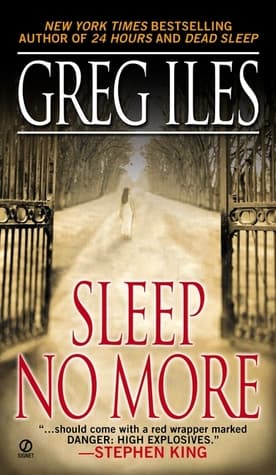
C. Stephen King The provided text includes a direct quote from Stephen King: 'This novel should come with a red wrapper marked DANGER: HIGH EXPLOSIVES.'
Question 8
What is the name of the series that Greg Iles is also known for, as mentioned in the description?
- The Alex Cross series
- The Jack Reacher series
- The Penn Cage series
- The Harry Bosch series
Show answer
C. The Penn Cage series The description introduces Greg Iles as 'The #1 New York Times bestselling author of the Penn Cage series'.
Question 9
How does the author characterize John Waters's family life before the disruption?
- Strained and distant
- Non-existent, as he lives alone
- Happy and stable
- Turbulent and full of secrets
Show answer
C. Happy and stable The description states, 'John Waters is a successful businessman and a happy family man...' implying his family life was content.
Question 10
The phrase 'psychological thriller' suggests the narrative will heavily focus on what aspect of the characters?
- Their physical prowess and combat skills
- Their internal states, motivations, and mental struggles
- Their social standing and public reputation
- Their financial dealings and business strategies
Show answer
B. Their internal states, motivations, and mental struggles A psychological thriller primarily delves into the minds of its characters, their emotional and mental states, and the internal conflicts that drive the plot, rather than external action or social status.
Sleep No More FAQ
What is the central premise of 'Sleep No More'?
The novel centers on John Waters, a seemingly content family man and successful businessman, whose life is upended when a single word, 'Soon,' from a beautiful stranger named Mallory triggers a buried memory of a past obsession. This encounter forces him to confront a dangerous love and passion from his youth that he believed he had long escaped, pulling him into a dark psychological spiral.
Who is John Waters and what is his initial state at the beginning of the book?
John Waters is presented as a successful businessman, running a thriving company, and a devoted family man, happily married with children. He believes he has achieved a stable and fulfilling life, having put his tumultuous past firmly behind him, until Mallory's reappearance shatters this carefully constructed facade.
How does Mallory re-enter John's life and what is her initial impact?
Mallory re-enters John's life through a chance encounter where she utters the single word 'Soon,' a deeply significant trigger from their shared past. This word immediately shatters John's sense of security, pulling him back into the intense, dangerous obsession they once shared and signaling that his past is far from over.
What kind of 'obsession' does John confront from his past?
John confronts a powerful, almost destructive romantic obsession with Mallory from his youth, characterized by intense passion, dangerous games, and a blurring of lines between love and control. This past relationship was not merely a youthful romance but a consuming force that shaped his early life and left deep psychological scars.
What role do John's family play in the unfolding drama?
John's wife and children represent the stable, 'normal' life he built to escape his past with Mallory, making them innocent bystanders caught in the crossfire. As Mallory's influence grows, his family's safety and his relationship with them become increasingly jeopardized, forcing John to protect them from the fallout of his resurfacing obsession.
Are there any subtle clues early on that hint at John's unstable past, even before Mallory appears?
Yes, Iles subtly weaves in John's underlying restlessness and a certain guardedness about his youth, suggesting that his present happiness is perhaps too perfect or hard-won. There are fleeting moments of internal monologue where he dismisses certain memories a little too quickly, hinting at suppressed trauma or unresolved issues.
What is the significance of the word 'Soon' in the context of John and Mallory's past?
The word 'Soon' was a private code or promise between John and Mallory during their intense early relationship, symbolizing their planned reunion or the initiation of a new, often dangerous, phase of their games. Its reintroduction by Mallory is a direct psychological trigger, reactivating their shared history and the power dynamics embedded within it.
Are there any specific literary allusions or motifs that echo the themes of obsession or madness in the book?
The novel subtly draws on classic noir tropes and elements of gothic romance, where a man's ordered life is upended by a femme fatale figure from his past. The recurring imagery of dreams and sleeplessness, as suggested by the title, also mirrors John's deteriorating mental state and the haunting nature of his memories.
How does the narrative structure build suspense and contribute to the psychological thriller aspect?
The narrative often shifts between John's present-day turmoil and vivid flashbacks to his youth with Mallory, gradually revealing the intensity and danger of their past relationship. This non-linear structure creates a sense of dread and mystery, making the reader piece together the origins of his obsession alongside John's unraveling sanity.
How does John's character arc demonstrate the psychological impact of unresolved trauma?
John's initial calm exterior quickly cracks under the pressure of Mallory's return, revealing a deep-seated vulnerability and an inability to truly escape his past. His increasing paranoia, erratic behavior, and struggle to maintain his current life illustrate how unresolved trauma can lie dormant for years, only to resurface with devastating psychological consequences.
What psychological mechanisms does Mallory employ to manipulate John?
Mallory expertly uses John's deep-seated emotional connection, guilt, and lingering desire against him, playing on his weaknesses and past experiences. She employs gaslighting, psychological games, and the reintroduction of their shared 'language' to reassert her dominance and draw him back into their destructive dynamic.
How does the book explore the fine line between love and obsession?
The novel delves into the destructive nature of an obsessive relationship, where the lines between genuine affection, control, and self-destruction become blurred. John's inability to break free from Mallory, despite the clear danger, highlights how intense emotional entanglement can masquerade as love while being deeply unhealthy and consuming.
In what ways does John's perception of reality become distorted throughout the story?
As Mallory's influence grows, John begins to question his own memories, sanity, and the loyalty of those around him. The constant psychological torment, combined with his lack of sleep, leads to vivid hallucinations, paranoia, and an inability to distinguish between what is real and what is a product of his tormented mind.
Is Mallory a purely villainous character, or is there a more nuanced interpretation of her motivations?
While Mallory's actions are undeniably destructive and manipulative, the novel offers glimpses into her own troubled past and the complex psychological wounds that drive her. Some might interpret her as a product of her own trauma, seeking to reclaim a sense of power or connection through John, rather than purely malicious intent.
What is the ultimate message about the nature of memory and its reliability in 'Sleep No More'?
The book strongly suggests that memory is highly subjective and easily manipulated, especially when intertwined with deep emotional trauma and obsession. John's struggle to recall events accurately, and Mallory's ability to twist his past, highlights how our personal narratives can be unreliable and susceptible to psychological influence.
Does the ending offer a definitive resolution for John, or is it open to interpretation?
The ending provides a resolution to the immediate external conflict, but John's psychological state and the long-term impact of his ordeal are left with a degree of ambiguity. While the physical threat may be gone, the scars of his obsession and the trauma he endured suggest that a complete return to his former self is unlikely, leaving readers to ponder his future.
How does the title 'Sleep No More' relate to the themes of the novel?
The title directly reflects John's descent into a sleepless, nightmarish existence as his past obsession resurfaces. It signifies his loss of peace, his inability to rest due to guilt, fear, and paranoia, and the haunting nature of his memories that deprive him of mental and physical respite.
Could John have truly escaped his past without Mallory's reappearance, or was it an inevitability?
This is debatable. The novel implies that John had successfully suppressed his past, but the intensity of his initial reaction to Mallory suggests the obsession was merely dormant, not resolved. Her reappearance acted as a catalyst, but the underlying psychological vulnerabilities and unresolved trauma were always present, making a true escape perhaps impossible without deeper self-confrontation.
About the author

Greg Iles is an American author known for his fiction, particularly in the thriller genre. His notable works include "Natchez Burning," "The Quiet Game," "The Bone Tree," "Mississippi Blood," and "Sleep No More," which often explore themes of crime and Southern history. Iles's writing is characterized by intricate plots and deep character development.
Similar books
- Gone Girl
Gillian Flynn
4.1 (2.3M) average on GoodreadsThrillerFeatures a complex, manipulative female antagonist and a male protagonist caught in a web of lies and past secrets.
- The Silent Patient
Alex Michaelides
4.1 (507k) average on GoodreadsThrillerA psychological thriller centered on unraveling a dark past and hidden motives, with a strong sense of impending doom.
- The Girl on the Train
Paula Hawkins
3.9 (2.1M) average on GoodreadsThrillerExplores themes of obsession, unreliable memory, and a protagonist whose life is upended by a mysterious encounter.
- The Likeness
Tana French
4.0 (126k) average on GoodreadsThriller"Sleep No More" shares French's focus on deep psychological immersion and the moral ambiguities surrounding crime. However, French often delves deeper into the internal lives of even minor characters, creating a more uniformly rich psychological landscape, whereas Iles occasionally prioritizes plot over secondary character development.
- Angels & Demons
Dan Brown
3.9 (2.7M) average on GoodreadsThrillerA Harvard symbologist races through Rome's ancient sites, deciphering cryptic clues to unmask the Illuminati and stop a vengeful plot to destroy the Vatican with a stolen antimatter weapon.
- The Da Vinci Code
Dan Brown
3.9 (1.9M) average on GoodreadsThrillerA symbologist and a cryptologist race through European landmarks, deciphering ancient codes and uncovering a conspiracy that could rewrite the foundations of Christianity.






Enjoyed the summary?
A summary gives you the shape of the book. The book itself has the detail, the examples and the voice.
Find Sleep No More on AmazonAs an Amazon Associate, BookBrief earns from qualifying purchases. How we're funded