
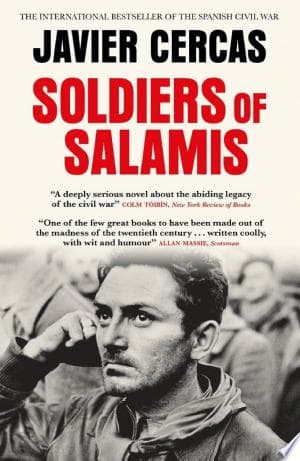
Synopsis
Covers the whole plot, including the ending.
- Difficulty
- Medium
- Pacing
- Moderate
- Mood
- Reflective, Historical, Thought-provoking, Melancholic
- Read it if
- You enjoy historical fiction blended with journalistic investigation, exploring moral dilemmas and the human cost of war.
- Skip it if
- You prefer fast-paced thrillers or straightforward historical narratives without meta-fictional elements.
Soldiers of Salamis Plot Summary
Covers the whole plot, including the ending.
The Writer's Predicament
Javier Cercas, a writer struggling with writer's block and a failing marriage, is encouraged by his editor, Conchi, to write about Rafael Sánchez Mazas, a Falangist writer who survived a firing squad in the Spanish Civil War. Cercas initially resists, finding the topic too political and uninteresting. However, Conchi insists that Sánchez Mazas's escape, especially the unknown militiaman who spared his life, has a unique human element that could appeal to readers and offer a new view of the conflict. She believes this untold story could help him overcome his writing slump and renew his passion for writing.
The Survival of Sánchez Mazas
Cercas begins his research, looking into the final days of the Spanish Civil War. He learns that on January 30, 1939, Rafael Sánchez Mazas was one of fifty Nationalist prisoners set to be executed by Republican forces in the Sanctuary of Collell. During the chaotic firing squad, Sánchez Mazas escaped into the thick forest. A militiaman from the search party found him hiding. Instead of killing him, the militiaman simply looked him in the eye and walked away, telling his comrades, 'There's no one here.' Sánchez Mazas then hid for several days with the help of local Republican supporters, the 'Children of the Forest,' before rejoining Nationalist lines. This act of mercy becomes the main puzzle Cercas wants to solve.
The Children of the Forest
Cercas travels to the area where Sánchez Mazas hid, looking for people who might know about his escape. He interviews several elderly men, the 'Children of the Forest,' who, as teenagers, had helped shelter Sánchez Mazas. These men, despite their Republican views, gave food and shelter to the Falangist writer, showing an unexpected act of humanity during the brutal conflict. Their stories show the moral difficulties of the war, where personal kindness sometimes went beyond political loyalty. Cercas notes their hesitation to speak openly, suggesting the lasting pain and divisions of the past. Their accounts confirm the main details of Sánchez Mazas's survival and the local help he received.
The Search for the Unknown Soldier
As Cercas reconstructs Sánchez Mazas's escape, he shifts his focus from the Falangist writer to the anonymous Republican militiaman who chose not to kill him. This soldier, for Cercas, represents a deep act of moral courage and becomes the true hero of the story. Driven to understand this unique moment of grace, Cercas begins a dedicated search to identify the militiaman. He searches through archives, interviews veterans, and follows every lead, hoping to find a name and face for this mysterious figure. The search becomes an almost spiritual journey for Cercas, who believes finding the soldier will reveal a deeper truth about human nature and the war itself.
Sánchez Mazas's Post-War Life
Cercas investigates Rafael Sánchez Mazas's life after the Civil War. He finds that Sánchez Mazas became an important figure in Franco's government, serving as a minister and a cultural leader for the Falange. He helped shape the official story of the Nationalist victory. Despite his high position, Sánchez Mazas never publicly recognized the militiaman who saved him, nor did he fully tell the details of his escape in a way that highlighted the act of mercy. This omission makes Cercas think about Sánchez Mazas's character and his selective memory, further strengthening the writer's belief that the unknown soldier's story is the more compelling and morally important one.
Miralles's Introduction
During his research, Cercas meets Jaume Miralles, a Republican veteran living in France. Miralles fought in the International Brigades and survived several concentration camps. He is at first unwilling to talk about the war, burdened by his past and the memory of lost friends. However, as Cercas explains his search for the unknown soldier, Miralles's manner subtly changes. He has a quiet dignity and a deep understanding of the war's human cost. Cercas begins to suspect that Miralles might know something about the militiaman, or even be the person he is looking for, or at least a close friend.
Miralles's Story
Miralles, though never directly confirming his role in Sánchez Mazas's escape, shares his own broken but clear memories of the war. He talks about the friendship, the brutality, and the disappointment of the Republican cause. He describes his experiences fighting on different fronts, his capture, and his later imprisonment in French concentration camps, where he saw terrible suffering. His story is less about specific events and more about the emotional and psychological cost of war. Cercas listens closely, putting together Miralles's character and looking for clues that might connect him to the key moment in Collell. Miralles's strength and quiet pain deeply affect Cercas.
The Unspoken Truth
As Cercas spends more time with Miralles, a strong, unspoken understanding grows between them. Miralles never directly admits to being the militiaman who spared Sánchez Mazas, nor does he deny it. However, his reactions, his deep humanity, and his hidden hints strongly suggest he was at Collell. Cercas sees Miralles's physical and emotional scars, recognizing the deep weight of his experiences. He realizes that a direct confession might not be needed and even disrespectful, given Miralles's quiet dignity and the burden of his past. The truth, for Cercas, lies in Miralles's character rather than in a verbal confirmation.
The Significance of Miralles
Cercas concludes that whether Miralles was the exact militiaman or not, he represents the spirit of that unknown soldier – a man who, in the midst of war's dehumanizing chaos, chose humanity. Miralles becomes for Cercas a symbol of the many anonymous heroes whose acts of courage and compassion were ignored by official history. He represents the 'defeated' side, whose stories were suppressed or forgotten. Cercas realizes that his book is no longer just about Sánchez Mazas's survival, but about honoring the moral integrity of people like Miralles, whose quiet heroism offered a different story from the main historical accounts of the Spanish Civil War. Miralles's existence confirms Cercas's initial feeling about the true heart of the story.
The Writer's Transformation
The research and writing of 'Soldiers of Salamis' deeply affect Javier Cercas. His initial doubt and creative block turn into a renewed sense of purpose and a deeper understanding of history, memory, and morality. The search for the unknown soldier, and his meetings with figures like Miralles, force him to question his own ideas about heroism and the nature of truth. His personal life also seems to find a new balance as he commits to this meaningful project. The book becomes more than a historical account; it is a personal journey for Cercas, leading to his artistic and personal renewal.
The Book's Reception and Legacy
After its completion and publication, 'Soldiers of Salamis' receives critical praise and becomes a notable literary success. Cercas reflects on the book's reception, noting how it started conversations about the Spanish Civil War, memory, and the often-ignored stories of the defeated. He acknowledges that while he may never definitively prove Miralles was the militiaman, telling the story, giving voice to the voiceless, is what truly matters. The book's impact is not in providing clear answers, but in asking deep questions about humanity, forgiveness, and the complex link between individual actions and historical stories. It challenges readers to rethink their understanding of heroism and the complex truths of the past.
Soldiers of Salamis Characters
Javier Cercas
Protagonist
A struggling writer who embarks on a quest to uncover a forgotten act of heroism from the Spanish Civil War.
Javier Cercas begins the novel as a jaded, creatively blocked writer, grappling with a failing marriage and a sense of disillusionment. He is initially reluctant to delve into the Spanish Civil War, viewing it as a tired and politically divisive subject. However, as he researches the story of Rafael Sánchez Mazas and the unknown militiaman, he undergoes a profound personal and professional transformation. He is driven by a quest for truth and a desire to honor forgotten heroes, becoming deeply empathetic and morally engaged.
Relationships: Conchi (Editor and friend, who pushes him to write the story); Miralles (A key informant and potential embodiment of the unknown soldier, with whom he forms a deep, unspoken bond); Rafael Sánchez Mazas (The subject of his initial research, whose story becomes a catalyst for a deeper quest)
Rafael Sánchez Mazas
Central Figure (initial focus)
A Falangist ideologue and writer who miraculously survived a Republican firing squad.
Rafael Sánchez Mazas was a prominent intellectual and co-founder of the Falange, a fascist political party in Spain. During the final days of the Civil War, he was captured by Republicans and nearly executed but was spared by an unknown militiaman. After the war, he became a minister in Franco's regime and a celebrated figure among Nationalists. He is depicted as an articulate and complex character, whose survival story is initially presented as a heroic feat, but Cercas's investigation gradually reveals a more nuanced and potentially self-serving interpretation of his post-war narrative.
Relationships: Javier Cercas (The subject of Cercas's initial journalistic inquiry); The Unknown Militiaman (His rescuer, whose act of mercy he never publicly acknowledged)
Miralles (Jaume Miralles)
Supporting / Embodiment of Heroism
A Republican veteran and former International Brigades fighter, who Cercas believes might be the unknown militiaman.
Jaume Miralles is an elderly Republican veteran living in France, a survivor of the International Brigades and various concentration camps. He is a man of quiet dignity, burdened by the immense trauma and losses of the war. While he never explicitly confirms being the militiaman who spared Sánchez Mazas, his character, his experiences, and his profound humanity strongly suggest he embodies the spirit of that act of mercy. He represents the 'defeated' side of the war, whose heroism and suffering have largely been overlooked by official history. His stoicism and moral integrity deeply impress Cercas.
Relationships: Javier Cercas (The recipient of his fragmented memories and the catalyst for Cercas's profound understanding of the war); The Unknown Militiaman (He is strongly implied to be, or at least represents, this figure)
Conchi
Supporting
Javier Cercas's editor, who encourages him to pursue the story of Sánchez Mazas.
Conchi is Cercas's editor and a pragmatic, insightful woman. She plays a crucial role in initiating Cercas's journey, recognizing the potential of the Sánchez Mazas story to be more than just a historical account, but a deeply human one. She pushes Cercas out of his creative slump and provides a grounding, professional influence throughout his research. Her belief in the story's inherent power and her encouragement are vital to Cercas's eventual success.
Relationships: Javier Cercas (His editor and friend, a professional and personal confidante)
The Children of the Forest
Supporting / Collective
Young Republican sympathizers who secretly sheltered Sánchez Mazas during his escape.
These are the elderly men whom Cercas interviews, who, as boys, provided food and refuge to Sánchez Mazas in the forest after his escape. Despite their Republican affiliations, they demonstrated acts of kindness and humanity towards a man who was politically their enemy. Their testimonies provide crucial details about Sánchez Mazas's survival and highlight the complex moral landscape of the Civil War, where individual compassion could transcend ideological divides. They represent the ordinary people caught in the conflict.
Relationships: Javier Cercas (Informants for his research); Rafael Sánchez Mazas (His unexpected saviors during his escape)
The Unknown Militiaman
Symbolic / Pivotal Figure
The anonymous Republican soldier who spared Rafael Sánchez Mazas's life.
This figure is never explicitly identified but is the catalyst for Cercas's entire investigation and the moral heart of the novel. He is a Republican militiaman who, upon finding Sánchez Mazas hiding in the forest, chose not to kill him, instead declaring 'There's no one here' and walking away. This act of mercy, committed in the heat of battle and ideological hatred, represents a profound moment of humanity and moral courage. He embodies the idea of a 'true hero' for Cercas, whose story has been silenced by history.
Relationships: Rafael Sánchez Mazas (His life-saver); Javier Cercas (The object of Cercas's quest and a symbol of forgotten heroism)
Soldiers of Salamis Themes
Memory and History
The novel explores how history is made, remembered, and forgotten, especially concerning the Spanish Civil War. Cercas grapples with official stories versus individual, often suppressed, memories. He shows how the winners write history, which silences certain stories, such as that of the unknown militiaman or the 'Children of the Forest.' The broken nature of memory, the reluctance of survivors like Miralles to speak, and the protagonist's own struggle to put the past together all highlight how elusive and personal historical truth is. The book itself is an act of historical recovery, trying to give voice to those who were ignored.
“History is a matter of fragments, of scraps, of conjectures, of doubts, of things that are never entirely clear.”
Heroism and Moral Courage
A main theme is the rethinking of heroism. The novel compares the traditional, politically approved heroism of figures like Rafael Sánchez Mazas (a Falangist leader) with the quiet, moral courage of the unknown militiaman and, finally, Miralles. Cercas argues that true heroism is not in grand political acts or military wins, but in individual acts of humanity, mercy, and integrity, especially when facing extreme violence and strong hatred. The militiaman's choice to spare an enemy's life is presented as the greatest act of heroism, one that goes beyond the brutal logic of war and party lines.
“Perhaps the greatest heroes are those who are never recognized, those who perform an act of humanity when it is hardest.”
The Nature of Truth and Fiction
Cercas, as both the author and the main character, constantly blurs the lines between journalistic investigation, historical fact, and fictional narrative. He acknowledges the difficulties in rebuilding the past, especially when relying on broken memories and conflicting accounts. The novel questions whether absolute historical truth is ever possible, suggesting that a writer's role might be to create a 'truth' that feels right emotionally and morally, even if some details remain unconfirmed. The lack of clarity around Miralles's identity as the unknown soldier is a prime example of this interplay, where the spirit of the truth is more important than factual certainty.
“A writer is someone who, rather than telling the truth, invents it, or rather, invents a truth.”
Reconciliation and Forgiveness
The act of the unknown militiaman sparing Sánchez Mazas's life is a deep gesture of reconciliation and forgiveness, even if the recipient never acknowledged it. The novel subtly explores the possibility of healing the deep wounds left by the Civil War, not by forgetting, but by understanding and recognizing acts of humanity from all sides. Cercas's search itself can be seen as an attempt to bridge divides and encourage a more complex understanding of the conflict, moving beyond simple victim-perpetrator stories. Miralles's quiet dignity, a victim of the war yet free of bitterness, further shows this theme.
“Sometimes, the greatest act of courage is not to kill, but to let live.”
Plot Devices & Literary Techniques
Metafiction
The author is also the protagonist, blurring the lines between reality and narrative.
Javier Cercas, the author of the novel, is also the central character, Javier Cercas, a writer researching the story. This metafictional approach allows the novel to explore the process of writing, the challenges of historical research, and the subjective nature of truth. It makes the reader privy to Cercas's doubts, frustrations, and moral dilemmas, immersing them in the creation of the story itself. This device also allows for self-reflection on the ethics of storytelling and the responsibility of the writer.
Frame Narrative
The contemporary investigation frames the historical events of the Spanish Civil War.
The story is structured with Javier Cercas's contemporary investigation into the past forming the outer frame. Within this frame, the historical events of Rafael Sánchez Mazas's escape and the Spanish Civil War are recounted. This allows the novel to move fluidly between past and present, showing how historical events continue to resonate and shape the present. The frame narrative emphasizes the ongoing effort to understand and interpret history, rather than presenting it as a static, resolved entity.
The Unreliable Narrator (Subtle)
While Cercas strives for truth, his personal biases and the subjective nature of memory subtly influence the narrative.
Although Cercas is earnest in his pursuit of truth, the narrative implicitly acknowledges the inherent subjectivity of his quest. He relies on fragmented memories, conflicting testimonies, and his own interpretations. The ambiguity surrounding Miralles's identity as the unknown soldier highlights this. Cercas's desire for a 'hero' influences his interpretation, making the narrative a personal truth rather than an objective historical account. This challenges the reader to consider the constructed nature of any historical or personal story.
The Quest Motif
Cercas embarks on a journey to find a person and uncover a moral truth.
The novel is structured around Javier Cercas's quest to identify the unknown militiaman who saved Sánchez Mazas. This quest is not merely a journalistic investigation but a deeply personal and moral journey. It drives the plot forward, leading Cercas to various locations and encounters, and ultimately transforms him. The quest represents a search for meaning, for a forgotten act of humanity, and for a deeper understanding of the Spanish Civil War's complex legacy, transcending simple factual retrieval.
Soldiers of Salamis Quotes
“There are battles that are won in defeat and defeats that are won in victory.”
“The past is never dead. It's not even past.”
“To forget is to die a little.”
“We are all the children of our circumstances.”
“The truth is always more complex than we imagine.”
“Perhaps courage is simply the ability to go on when you can't.”
“History is not what happened, but what we remember.”
“Every man has his own war, his own defeat, his own victory.”
“Sometimes the greatest acts of humanity are committed by the most unexpected people.”
“The dead speak, but only if we listen.”
“There are no heroes, only men who do what they have to do.”
“Memory is a fragile and treacherous thing.”
“In war, the lines between good and evil often blur.”
“To understand the present, you must confront the past.”
Quiz
10 questions on the plot and the characters. Each answer comes with a short explanation.
Question 1
In the opening scene, what event are the fifty prominent Nationalist prisoners subjected to?
- Interrogation by the Republican forces
- A forced march to a labor camp
- Execution by firing squad
- Release as part of a prisoner exchange
Show answer
C. Execution by firing squad The book begins with fifty prominent Nationalist prisoners, including Rafael Sanchez Mazas, being executed by firing squad in the final moments of the Spanish Civil War.
Question 2
Which specific historical figure, a writer and fascist, manages to escape the initial execution?
- Javier Cercas
- Rafael Sanchez Mazas
- The unknown militiaman
- Francisco Franco
Show answer
B. Rafael Sanchez Mazas Rafael Sanchez Mazas, a writer and fascist, is among the prisoners but manages to escape into the forest after the guns fire.
Question 3
What is the immediate danger Rafael Sanchez Mazas faces after escaping into the forest?
- Starvation and exposure to the elements
- Attack by wild animals
- A search party and their dogs hunting him down
- Getting lost in the unfamiliar terrain
Show answer
C. A search party and their dogs hunting him down After escaping, Sanchez Mazas can hear a search party and their dogs actively hunting him down in the forest.
Question 4
Who does Sanchez Mazas encounter in the forest, facing death for the second time?
- A fellow escaped prisoner
- A sympathetic local farmer
- An unknown militiaman
- His own reflection in a stream
Show answer
C. An unknown militiaman While hiding, Sanchez Mazas finds himself looking into the eyes of an unknown militiaman, who discovers him.
Question 5
What surprising action does the unknown soldier take when he finds Sanchez Mazas?
- He immediately shoots him
- He captures him and takes him back to the firing squad
- He simply turns and walks away
- He offers him food and water
Show answer
C. He simply turns and walks away Against expectations, the unknown soldier, upon finding Sanchez Mazas, simply turns and walks away, sparing his life.
Question 6
What becomes of Rafael Sanchez Mazas after his escape and encounter?
- He is recaptured and executed later
- He disappears into obscurity
- He becomes a national hero
- He flees the country and lives in exile
Show answer
C. He becomes a national hero After his miraculous escape, Rafael Sanchez Mazas becomes a national hero.
Question 7
What is the primary motivation of the author, Javier Cercas, in sifting through the evidence?
- To prove Sanchez Mazas was innocent of his fascist ties
- To sensationalize the story for commercial success
- To establish what happened and identify the true hero
- To discredit the official historical accounts of the war
Show answer
C. To establish what happened and identify the true hero Javier Cercas sifts the evidence to establish what happened, realizing that the true hero might be the soldier who chose not to shoot Sanchez Mazas.
Question 8
What central question does the author, Javier Cercas, ponder regarding the unknown soldier?
- What was the soldier's rank and unit?
- Why did he spare him, and might he still be alive?
- Was the soldier following secret orders?
- Did the soldier later regret his decision?
Show answer
B. Why did he spare him, and might he still be alive? Cercas's central questions revolve around the unknown soldier: 'Who was he? Why did he spare him? And might he still be alive?'
Question 9
The book suggests a re-evaluation of heroism. Who does Cercas realize might be the *true* hero of the story?
- Rafael Sanchez Mazas for his survival
- The militiaman who chose not to shoot Sanchez Mazas
- The Nationalist leaders who fought in the war
- The author himself for uncovering the story
Show answer
B. The militiaman who chose not to shoot Sanchez Mazas Cercas realizes that the true hero may not be Sanchez Mazas at all, but the soldier who chose not to shoot him, highlighting a different kind of bravery.
Question 10
What historical conflict serves as the backdrop for the entire narrative of 'Soldiers of Salamis'?
- World War I
- World War II
- The Spanish Civil War
- The Napoleonic Wars
Show answer
C. The Spanish Civil War The entire story is set in the context of the final moments of the Spanish Civil War.
Soldiers of Salamis FAQ
What is the central historical event that 'Soldiers of Salamis' revolves around?
The novel centers on an incident during the final days of the Spanish Civil War, specifically the execution of fifty prominent Nationalist prisoners near Collell. Among them, Falangist writer Rafael Sánchez Mazas miraculously escapes a firing squad and is later spared by an unknown Republican militiaman.
Who is Rafael Sánchez Mazas and what role does he play in the narrative?
Rafael Sánchez Mazas was a real-life Falangist ideologue and writer, a close associate of José Antonio Primo de Rivera. In the novel, he is the Nationalist prisoner who survives the execution and is later spared by a militiaman, becoming a national hero in Francoist Spain, revered for his 'miraculous' escape.
Who is the narrator of the story and what is his primary objective?
The narrator is a fictionalized version of Javier Cercas himself, a struggling writer and journalist. His primary objective is to investigate the story of Sánchez Mazas's escape, not just to recount it, but to uncover the identity of the Republican soldier who spared him and understand the motivations behind that act of mercy.
What is the 'Soldiers of Salamis' in the context of Sánchez Mazas's own writings?
'Soldiers of Salamis' refers to a speech or concept by Sánchez Mazas, invoking the ancient Greek battle where a small force of Athenians defeated the mighty Persian fleet. He used this metaphor to glorify the Falangist struggle and its perceived heroic, sacrificial nature against overwhelming odds.
How does the novel blend fiction and non-fiction?
The novel masterfully blurs the lines between fact and fiction. It uses real historical figures like Sánchez Mazas and events from the Spanish Civil War, but the narrator's investigation, his encounters, and the eventual identification of Miralles are largely fictionalized to explore deeper truths about memory, heroism, and war.
What is the significance of the character of Miralles?
Miralles is the most crucial 'hidden detail' and the central figure the narrator seeks. He is the fictionalized Republican veteran, a 'last hero' of the losing side, who is eventually identified as the likely militiaman who spared Sánchez Mazas. His life story, marked by exile and forgotten heroism, contrasts sharply with Sánchez Mazas's posthumous fame.
How does the novel subtly critique the official Francoist narrative of the Civil War?
The novel critiques the official narrative by highlighting the 'forgotten' heroes and the complexities of the war. By focusing on Miralles, a Republican veteran who performed an act of profound humanity, it challenges the one-sided glorification of Falangist figures like Sánchez Mazas and exposes the silences and omissions in the victor's history.
What is the role of the 'bosque de los gudaris' (forest of the Basques) in the story?
The 'bosque de los gudaris' is the forest where Sánchez Mazas hides after his escape and where he encounters the Republican militiaman. It's a symbolic space of refuge, pursuit, and a moment of profound moral choice, representing the chaos and the potential for individual agency amidst the brutality of war.
How does the narrator's personal life and struggles influence his quest?
The narrator, Javier Cercas, is depicted as a writer facing a creative block and personal struggles, including a recent separation. His quest to uncover the truth about Sánchez Mazas and Miralles becomes a journey of self-discovery, a way to find meaning and purpose, and ultimately to reconnect with the moral complexities of his nation's past.
What psychological impact does the act of sparing an enemy have on the characters involved?
For Sánchez Mazas, being spared is a profound, life-altering experience, though he rarely speaks of it directly, perhaps due to its moral ambiguity or the shame of being vulnerable. For Miralles, the act of mercy is a quiet, personal truth he carries, a moment of profound humanity that defines him, yet remains largely unrecognized by history.
How does the novel explore the concept of heroism?
The novel challenges conventional notions of heroism. It contrasts the 'official' heroism of Sánchez Mazas, celebrated for his survival and ideology, with the 'true' heroism of Miralles, an act of selfless humanity performed in anonymity. It suggests that genuine heroism often lies in moral choice and compassion, not just military valor or political allegiance.
What is the psychological burden of memory and historical trauma for the characters?
The characters, particularly Miralles and the other veterans, carry the psychological burden of war's memories, marked by loss, exile, and the trauma of conflict. The narrator's quest itself is an attempt to grapple with Spain's collective historical trauma, to confront the uncomfortable truths and reconcile with a past that continues to resonate.
Is the identity of the militiaman who spared Sánchez Mazas definitively proven in the book?
No, the identity of the militiaman is never definitively proven with irrefutable historical evidence. The narrator pieces together testimonies and circumstantial evidence to strongly suggest that Miralles was the soldier, but the ambiguity remains. This reinforces the novel's theme that history often leaves gaps and that some truths are only accessible through interpretation and empathy.
What is the novel's stance on the nature of truth in historical narratives?
The novel suggests that historical truth is complex, often subjective, and rarely monolithic. It argues that official narratives frequently omit or distort crucial details, and that 'truth' can be found not just in facts, but also in individual experiences, moral choices, and the act of storytelling itself. The search for truth is ongoing and interpretive.
How does the structure of the novel, with its multiple layers and narrators, contribute to its themes?
The novel's layered structure, combining fictionalized journalistic investigation, historical accounts, and personal reflections, mirrors its thematic exploration of memory, truth, and the past. The shifting perspectives and narrative voices highlight the fragmented nature of history and the challenge of constructing a coherent story from disparate sources.
What larger message about war and reconciliation does 'Soldiers of Salamis' convey?
'Soldiers of Salamis' conveys a powerful message about the possibility of humanity and reconciliation even amidst the brutality of war. It suggests that acts of individual compassion, like the one performed by Miralles, can transcend ideological divides and offer a path towards healing and understanding, rather than perpetuating cycles of hatred and vengeance.
How does the novel comment on the legacy of the Spanish Civil War in contemporary Spain?
The novel deeply comments on the enduring legacy of the Spanish Civil War, highlighting how its wounds and unresolved issues continue to affect contemporary Spain. It underscores the importance of confronting the past, acknowledging all victims, and challenging the 'pact of forgetting' to achieve true national reconciliation and a more complete historical understanding.
What is the significance of the final scene where the narrator meets Miralles?
The final scene where the narrator meets Miralles is highly significant. It's the culmination of his quest, a moment of profound emotional connection where the narrator feels he has found the 'true hero.' Miralles's quiet dignity and his subtle acknowledgment of the past, without explicitly confirming his role, provides a powerful and poignant closure to the story, emphasizing the quiet grace of his heroism.
About the author
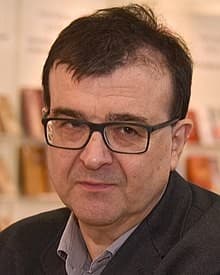
Javier Cercas Mena is a Spanish writer and professor of Spanish literature at the University of Girona, Spain.
Similar books
- The Shadow of the Wind
Carlos Ruiz Zafón
4.3 (462k) average on GoodreadsFantasyExplores post-Civil War Spain with a literary mystery.
- Homage to Catalonia
George Orwell
4.1 (43k) average on GoodreadsPoliticsNon-fiction account of the Spanish Civil War, offering historical context.
- Atonement
Ian McEwan
4.4 (70) average on GoodreadsDeals with memory, truth, and the impact of war on individual lives, with a meta-narrative element.
- Nineteen Eighty-Four
George Orwell
4.2 (5.5M) average on GoodreadsFictionWinston Smith dreams of truth and rebellion in a world where Big Brother watches all, but he confronts the terrifying power of a regime that controls not just actions, but thoughts.
- The Frozen River
Ariel Lawhon
4.4 (600k) average on GoodreadsFictionIn 1789 Maine, a heroic midwife's diary helps her expose a murder and get justice in a town that wants to silence her.
- A Man Called Ove
Fredrik Backman
4.4 (569k) average on GoodreadsFictionA stubborn widower, who lives by strict rules, finds his quiet world changed by a lively new family next door, making him face his past and find happiness in human connection.





Enjoyed the summary?
A summary gives you the shape of the book. The book itself has the detail, the examples and the voice.
Find Soldiers of Salamis on AmazonAs an Amazon Associate, BookBrief earns from qualifying purchases. How we're funded