
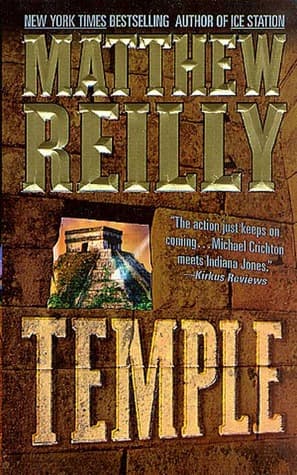
Synopsis
Covers the whole plot, including the ending.
- Difficulty
- Medium
- Pacing
- Fast
- Mood
- Action-packed, Suspenseful, Intense, Cataclysmic
- Read it if
- You enjoy high-octane thrillers with ancient mysteries, advanced technology, and non-stop action.
- Skip it if
- You prefer character-driven stories over plot-driven action, or dislike graphic violence and intense pacing.
Temple Plot Summary
Covers the whole plot, including the ending.
The Discovery and the Recruit
In the remote Peruvian jungle, a US Army Special Forces team, led by Captain Sarah Bell, finds an ancient Incan temple. Inside, they see strange carvings and a unique stone idol that gives off unusual energy. In Washington D.C., William Race, a smart but disgraced linguist, is recruited by General Schofield of the US Army. Schofield reveals that the idol, called the 'Huaca,' is believed to be from space and has immense, possibly destructive power. Race's knowledge of ancient languages is needed to decipher clues to its location and purpose, as the US military wants to secure it before it falls into the wrong hands.
The Journey to Peru
Race is flown to Peru and meets his military escort and the realities of jungle operations. He meets Captain Bell, who is at first unsure about his academic background but respects his knowledge. The team, including Sergeant 'Gunny' Gus, a cynical soldier, begins their trek through the Amazon rainforest, following Schofield's initial coordinates. Race struggles with the physical demands and constant threats of the jungle, but his drive to understand the Huaca's secrets keeps him going. They face natural obstacles and signs of others in the area, increasing the tension.
First Contact and Conflict
As Race's team gets closer to the temple, they find signs of hostile forces: a German mercenary group led by Colonel Horst Richter. Richter is also looking for the Huaca, working for an unknown powerful entity. A firefight breaks out, causing casualties on both sides. Race, new to combat, is forced to fight, relying on the soldiers for protection. They also find ancient Incan booby traps and defenses designed to protect the temple, showing the Incans knew of the Huaca's danger and actively hid it.
Deciphering the Clues
Under constant threat, Race works to decipher the Incan hieroglyphs and pictograms on stone tablets and temple walls. He discovers that the Huaca is not just an idol but a device of immense power, able to control fundamental forces. The Incans, according to the texts, were its guardians, tasked with preventing its activation. The writings describe a prophecy of global destruction if the Huaca is misused, making their mission even more urgent. Race realizes the 'treasure' is not power, but preventing disaster.
The Lost City of Paititi
Following Race's interpretations, the team finds the lost city of Paititi, a wonder of ancient engineering hidden in the jungle. The city is a maze of temples, plazas, and sophisticated traps, more advanced than anything they've seen. As they move towards the central temple where the Huaca is believed to be, they face deadly pressure plates, poisoned darts, collapsing floors, and automated defenses. The German mercenaries are close behind, forcing the US team to move quickly while also dealing with the city's guardians.
The Indigenous Guardians
Within Paititi, Race's team meets a small, isolated tribe, the last descendants of the Incans who guarded the Huaca. Led by a wise elder, they are at first hostile, seeing all outsiders as threats. Race, using his language skills and knowledge of their history, communicates with them, explaining their shared goal of preventing the Huaca's misuse. He earns their trust by showing respect for their traditions and understanding of the prophecies. The tribe, though small, knows the temple's layout and defenses, offering help against the mercenaries.
The Race for the Huaca
The US team, now helped by the indigenous guardians, and Richter's mercenaries meet at the central chamber where the Huaca is. A brutal battle breaks out inside the ancient temple. The indigenous warriors, using their knowledge of the terrain and traditional weapons, fight alongside the US soldiers against the mercenaries. Captain Bell shows strong combat leadership, while Race, an academic, uses his wit and understanding of the temple's mechanics to help his allies. Casualties increase on all sides as the fight for the prize intensifies.
Richter's Betrayal and the Huaca's Power
Colonel Richter, despite heavy losses, reaches the Huaca. It is revealed that he works for a global organization, not just for himself, and their goal is to use the Huaca as a weapon. Richter tries to activate the idol, following instructions. As he does, the Huaca begins to hum with ominous energy, causing seismic tremors and strange atmospheric phenomena in the temple. Race realizes Richter is causing a catastrophic event, and the ancient Incan prophecies of planetary destruction begin to appear, threatening to tear reality apart.
Race's Desperate Act
With the Huaca humming with destructive energy, Race understands that simply taking it is not enough; it must be deactivated or stabilized. Using all his linguistic and mythological knowledge, combined with his observations of the Huaca's unique properties, he attempts a desperate, complex sequence of actions to disarm it. This involves manipulating ancient mechanisms and chanting forgotten words, all while the temple crumbles around him and Richter's remaining forces try to stop him. Race faces the immense strain of the Huaca's power, risking his life to prevent a global disaster.
The Aftermath and the Secret
Race deactivates the Huaca, but at a cost to himself and the temple. The destructive energy fades, leaving the chamber devastated but the world safe. Richter is either killed or captured, and his organization's plans are stopped. The remaining US soldiers and indigenous guardians secure the area. General Schofield arrives to oversee the cleanup. Race insists that the Huaca's secrets must be re-buried and protected, arguing that humanity is not ready for such power. The US Army, recognizing the danger, agrees to hide the Huaca's existence and location again, ensuring it remains a buried secret.
Temple Characters
William Race
Protagonist
A brilliant but disgraced linguist forced into a mission to save the world.
William Race is a highly intelligent, albeit socially awkward, linguist and former classics professor. He possesses an encyclopedic knowledge of ancient languages, mythology, and history. Initially cynical and resistant to military authority, Race is driven by an insatiable curiosity and a deep-seated academic integrity. He is not a soldier but proves his courage through intellect and an unwavering commitment to understanding and preventing catastrophe. His past disgrace, though hinted at, fuels his desire for redemption and to prove his worth.
Relationships: Captain Sarah Bell (professional alliance, evolving into mutual respect and trust); General Schofield (superior officer, employer, and initial antagonist); Sergeant 'Gunny' Gus (comrade-in-arms, protector, and cynical mentor)
Captain Sarah Bell
Supporting
A pragmatic and highly capable US Army Special Forces officer.
Captain Sarah Bell is a seasoned and tough Special Forces officer, leading her team with unwavering resolve and tactical brilliance. She is highly disciplined, physically formidable, and initially skeptical of Race's academic background in a combat zone. However, she quickly recognizes his invaluable intellectual contributions and becomes his staunch protector and ally. Bell is driven by her duty and a strong moral compass, always prioritizing her team's safety and the mission's success. She represents the military's best attributes: courage, loyalty, and adaptability.
Relationships: William Race (professional alliance, evolving into mutual respect and trust); Sergeant 'Gunny' Gus (subordinate officer, trusted team member); General Schofield (superior officer)
Colonel Horst Richter
Antagonist
A ruthless German mercenary leader seeking the Huaca for a shadowy organization.
Colonel Horst Richter is a cold, calculating, and highly experienced mercenary commander. He is utterly ruthless, driven by a combination of financial gain and an unwavering loyalty to his mysterious employers. Richter exhibits a brutal efficiency in combat and shows no mercy to his opponents or even his own men if they fail. He embodies the destructive potential of human greed and ambition when combined with advanced military training. His pursuit of the Huaca is relentless, making him a formidable and dangerous adversary for Race and his team.
Relationships: William Race (primary adversary); Captain Sarah Bell (military opponent)
Sergeant 'Gunny' Gus
Supporting
A cynical but loyal Special Forces veteran.
Sergeant 'Gunny' Gus is a grizzled, experienced Special Forces soldier with a dry wit and a perpetually cynical outlook. Despite his jaded demeanor, he is fiercely loyal to his comrades and highly skilled in combat. Gus acts as a protector and sometimes a reluctant mentor to Race, often providing comic relief through his sarcastic remarks but always stepping up when danger arises. He represents the common soldier's perspective, grounded in practical survival and a healthy skepticism of grand schemes, yet ultimately committed to doing what's right.
Relationships: William Race (comrade-in-arms, protector, and cynical mentor); Captain Sarah Bell (superior officer, trusted leader)
General Schofield
Supporting
The high-ranking US Army general who initiates the mission.
General Schofield is a powerful and authoritative figure within the US Army. He is the mastermind behind the mission to retrieve the Huaca, driven by a deep concern for national and global security. Schofield is pragmatic and willing to use unconventional methods, including coercing Race into service. While he initially appears somewhat detached, his concern for the Huaca's potential for destruction is genuine. He represents the overarching military establishment and its efforts to control dangerous, unknown threats.
Relationships: William Race (superior officer, recruiter); Captain Sarah Bell (superior officer)
The Indigenous Elder
Supporting
The wise leader of the last Incan guardians of the Huaca.
The Indigenous Elder is the venerable and wise leader of the isolated tribe within Paititi, the direct descendants of the Huaca's original guardians. He possesses an intimate knowledge of the temple's history, its defenses, and the prophecies surrounding the Huaca. Initially wary of outsiders, he is ultimately convinced by Race's sincerity and shared purpose. The Elder embodies ancient wisdom, spiritual connection to the land, and the long-held responsibility of protecting humanity from the Huaca's power. His guidance is crucial to navigating the temple and understanding the idol's true nature.
Relationships: William Race (cultural and ideological ally, recipient of ancient knowledge); Captain Sarah Bell (reluctant ally in battle)
The Shadowy Global Organization
Antagonist
The mysterious, powerful entity behind Colonel Richter's operation.
This unnamed, enigmatic global organization is the true puppet master behind Colonel Richter's pursuit of the Huaca. Their motivations are unclear but imply a desire for immense power, control, or perhaps a warped vision of global order through the weaponization of the alien artifact. They operate with vast resources and a global reach, pulling strings from the shadows. Their existence highlights the broader, more insidious threats that extend beyond simple mercenary greed, suggesting a deep-seated conspiracy to exploit ancient, dangerous technologies.
Relationships: Colonel Horst Richter (employer and pawn)
Temple Themes
The Peril of Ancient Power
The novel explores the idea that some ancient artifacts have power beyond human understanding. The Huaca, an alien device, is not a treasure to be desired, but a planet-killer the Incans rightly tried to bury. This theme appears when Race deciphers the Incan warnings, revealing prophecies of global destruction if the Huaca is misused, and ends with Richter trying to activate it, causing seismic events and threatening to unravel reality.
“Some treasures are meant to stay buried.”
Science vs. Superstition (and their convergence)
The story first contrasts the military's practical, scientific approach with ancient cultures' beliefs. Race, a linguist, bridges this gap, translating ancient 'mythology' into warnings about real, destructive technology. The Incans' 'gods' and 'prophecies' are shown to be their scientific understanding and historical accounts of the Huaca's true, catastrophic potential. This connection is key when Race uses both ancient rituals and scientific understanding to disarm the Huaca, showing that advanced ancient knowledge can seem like 'magic' to modern science.
“What they called magic, we would call physics.”
Human Greed and Ambition
Human greed and ambition are a central theme, shown by Colonel Richter and the organization he serves. Their relentless search for the Huaca, despite its clear danger, highlights humanity's tendency to seek power at any cost. Richter's willingness to sacrifice lives and risk global disaster for an unknown agenda shows the corrupting influence of unchecked ambition. This sharply contrasts with the selfless duty of the Incans and Race's team to protect the world, rather than exploit it.
“Man's desire for power will always outweigh his fear of consequences.”
The Burden of Knowledge and Responsibility
Race, the linguist, carries the heavy burden of understanding the Huaca's true nature and the catastrophic results if it is unleashed. His knowledge, initially academic, becomes a deep responsibility for the world's fate. The indigenous guardians also carry this burden, having protected the Huaca for centuries. The theme explores the moral problem of having dangerous knowledge and the need to act responsibly, even at great personal cost, to prevent its misuse. Ultimately, the decision to re-bury the Huaca means accepting this eternal responsibility.
“To know is to bear the weight of the world.”
Plot Devices & Literary Techniques
MacGuffin (The Huaca)
A mysterious, powerful object that drives the plot.
The Huaca serves as the central MacGuffin of the story. It is an ancient, extraterrestrial idol with immense, destructive power that all factions are seeking. Its true nature and capabilities are gradually revealed throughout the narrative, driving the characters' motivations and the escalating conflict. While its specific powers are critical to the climax, the primary function of the Huaca as a plot device is to set the entire adventure in motion and provide a tangible goal for both the protagonists and antagonists, without necessarily being fully understood by the audience until later.
Ancient Prophecy/Warning
Pre-existing texts foretelling future events or dangers.
The ancient Incan texts and prophecies discovered by Race are a crucial plot device. They don't just provide clues to the Huaca's location but, more importantly, warn of its cataclysmic potential if activated. These prophecies elevate the stakes from a simple treasure hunt to a race against global destruction. They serve to deepen the mystery, provide exposition about the Huaca's history, and establish a sense of impending doom, guiding Race's actions and reinforcing the urgency of his mission to prevent the prophesied apocalypse.
Fish out of Water
A character placed in an unfamiliar and challenging environment.
William Race embodies the 'fish out of water' trope. As an academic linguist, he is completely unsuited for the harsh realities of jungle warfare and survival. His initial discomfort, physical ineptitude, and reliance on the soldiers for protection highlight the stark contrast between his intellectual world and the brutal physical demands of the mission. This device generates both humor and tension, emphasizing the extraordinary nature of his task and making his eventual contributions, based purely on intellect, all the more impactful and heroic.
The Unseen Mastermind
A powerful, mysterious antagonist operating from the shadows.
The shadowy global organization that employs Colonel Richter acts as the unseen mastermind. This device creates a sense of a larger, more insidious threat beyond the immediate conflict, implying that the struggle for the Huaca is part of a grander, more dangerous scheme. By keeping the true leaders and their ultimate motivations obscured, the device fosters suspense and suggests that even after the immediate threat is dealt with, a deeper, more pervasive danger still lurks, potentially for future stories or as a lasting sense of unease.
Temple Quotes
“The secret, he knew, was not to think about it. Not to dwell on the impossible odds, the certain death that awaited them. Just to do it.”
“History, he had learned, was often written by the victors, and sometimes, the victors were very, very good at lying.”
“There were some things, he reflected, that even modern technology couldn't prepare you for. Like a screaming, six-ton gorilla.”
“Every legend, no matter how outlandish, had a kernel of truth at its heart. It was just a matter of digging deep enough to find it.”
“The jungle didn't care about your plans, your maps, or your advanced training. It just wanted to consume you.”
“Sometimes, the greatest treasures weren't gold or jewels, but knowledge. Knowledge that could change the world.”
“Fear was a luxury they couldn't afford. Not now. Not ever.”
“The past wasn't dead; it was just waiting. Waiting to be found, waiting to be understood.”
“He understood then that true power wasn't about weapons or armies, but about controlling information.”
“The line between genius and madness was often blurry, especially when dealing with the truly ancient.”
“To survive, sometimes you had to do things you never thought yourself capable of. Unspeakable things.”
“The greatest dangers were often the ones you couldn't see, the ones that lurked in the shadows of your own mind.”
“He knew, with a chilling certainty, that some doors were meant to remain closed. And some secrets, buried forever.”
“The world was a far stranger place than anyone truly understood, filled with wonders and horrors beyond imagination.”
Quiz
10 questions on the plot and the characters. Each answer comes with a short explanation.
Question 1
What is the primary role of William Race, the protagonist, when he is first introduced by the U.S. Army?
- He is an expert in ancient Incan warfare tactics.
- He is a linguist enlisted to decipher clues to the idol's location.
- He is a geologist specializing in extraterrestrial minerals.
- He is a mercenary hired for his combat skills.
Show answer
B. He is a linguist enlisted to decipher clues to the idol's location. William Race is explicitly described as an American linguist enlisted by the U.S. Army to decipher the clues to the idol's location.
Question 2
According to the description, what is unique about the stone from which the idol is carved?
- It glows in the dark.
- It is a rare stone not found on Earth.
- It is made from solidified volcanic ash.
- It changes color based on temperature.
Show answer
B. It is a rare stone not found on Earth. The description states, 'Carved from a rare stone not found on Earth, the idol possesses elements more destructive than any nuclear bomb.'
Question 3
To the Incan people, what does the hidden idol primarily symbolize?
- A lost treasure of gold and jewels.
- The ultimate symbol of their spirit.
- A map to other ancient ruins.
- A warning against invaders.
Show answer
B. The ultimate symbol of their spirit. The text states, 'To the Incan people, it is still the ultimate symbol of their spirit.'
Question 4
What is the potential destructive capability of the idol, according to the U.S. Army's understanding?
- It can cause localized earthquakes.
- It has elements more destructive than any nuclear bomb, a virtual planet killer.
- It can summon ancient Incan warriors.
- It can create illusions to disorient enemies.
Show answer
B. It has elements more destructive than any nuclear bomb, a virtual planet killer. The description highlights the idol's power: 'possesses elements more destructive than any nuclear bomb--a virtual planet killer.'
Question 5
Where has the idol been hidden for four centuries?
- In a secret vault beneath the Vatican.
- In the jungles of Peru.
- Deep within the Sahara Desert.
- On a remote island in the Pacific.
Show answer
B. In the jungles of Peru. The first sentence specifies, 'Four centuries ago, a precious idol was hidden in the jungles of Peru.'
Question 6
What is the 'first rule of survival' that Race's team will discover they are breaking by penetrating the temple?
- Always bring enough supplies.
- Some treasures are meant to stay buried.
- Never trust ancient maps.
- Always have a clear escape route.
Show answer
B. Some treasures are meant to stay buried. The text explicitly states: 'Soon they'll discover that to penetrate the temple of the idol is to break the first rule of survival. Because some treasures are meant to stay buried.'
Question 7
What is the ultimate consequence if the idol falls into the 'wrong hands'?
- It could lead to a global economic collapse.
- It could mean the end of mankind.
- It could awaken ancient Incan spirits.
- It could cause a localized natural disaster.
Show answer
B. It could mean the end of mankind. The description warns, 'In the wrong hands it could mean the end of mankind.'
Question 8
What does the phrase 'forces are ready to kill to keep it that way' imply about the idol's current state and the security surrounding it?
- The idol is protected by natural geological formations.
- There are active, sentient groups or individuals willing to use lethal force to prevent the idol from being unearthed.
- The idol is guarded by ancient traps and curses.
- The local wildlife is unusually aggressive near the temple.
Show answer
B. There are active, sentient groups or individuals willing to use lethal force to prevent the idol from being unearthed. The phrase directly suggests active, hostile entities: 'forces are ready to kill to keep it that way,' indicating a direct threat from those who wish the idol to remain hidden.
Question 9
The synopsis mentions that Race's team 'has arrived--but they're not alone.' What does this detail foreshadow for the plot?
- They will encounter friendly local guides.
- They will face competition or opposition from other parties seeking the idol.
- They will discover another U.S. Army team already there.
- They will find ancient Incan spirits guarding the temple.
Show answer
B. They will face competition or opposition from other parties seeking the idol. The phrase 'but they're not alone' in a thriller context typically foreshadows the presence of rivals or antagonists also pursuing the same objective, leading to conflict.
Question 10
The idol is described as possessing 'the unfathomable--and cataclysmic--power of the gods.' How does this description elevate the stakes beyond just a 'planet killer' weapon?
- It implies the idol can only be wielded by divine beings.
- It suggests the power is not merely destructive but also holds an unpredictable, possibly supernatural, and overwhelming force that defies human comprehension and control.
- It means the idol requires a sacrifice to activate its power.
- It indicates the idol grants immortality to its wielder.
Show answer
B. It suggests the power is not merely destructive but also holds an unpredictable, possibly supernatural, and overwhelming force that defies human comprehension and control. The term 'power of the gods' and 'unfathomable' suggests a force that transcends conventional understanding and might possess qualities beyond simple physical destruction, hinting at cosmic or supernatural capabilities that are inherently unpredictable and beyond human mastery.
Temple FAQ
What is the central artifact that drives the plot of 'Temple'?
The central artifact is an ancient idol, carved from a rare, non-Earth stone, hidden deep within the Peruvian jungles. It is revered by the Incan people as a symbol of their spirit and holds catastrophic power, described as a 'planet killer' due to its destructive elements.
Who is William Race and what is his primary role in the story?
William Race is an American linguist enlisted by the U.S. Army to decipher ancient clues leading to the idol's location. He initially views the idol as a potential apocalyptic device, tasked with understanding and potentially neutralizing its threat.
What is the significance of the idol to the Incan people?
To the Incan people, the idol is not merely a treasure but the ultimate symbol of their spirit and heritage, carefully hidden and protected for centuries. They are prepared to defend it fiercely against any who would disturb its resting place.
What kind of destructive power does the idol possess?
The idol possesses elements more destructive than any nuclear bomb, capable of causing a global catastrophe – effectively, a 'planet killer'. Its power is described as 'unfathomable and cataclysmic', akin to the power of gods.
What challenges do Race's team face upon arriving in the Andes?
Upon arriving in the foothills of the Andes, Race's team discovers they are not alone and face numerous adversaries determined to prevent them from reaching the idol. They soon learn that penetrating the temple means breaking a fundamental rule of survival, as powerful forces are ready to kill to keep the treasure buried.
Are there other factions besides the U.S. Army and the Incans vying for the idol?
Yes, the narrative strongly implies the presence of other parties or factions who are also aware of the idol's existence and power, and are actively pursuing it. These rival groups contribute significantly to the intense conflict and danger faced by Race's team.
What specific historical or mythological elements from Incan culture are integrated into the puzzle of the idol's location?
The clues to the idol's location are deeply intertwined with Incan history, mythology, and linguistic patterns, requiring William Race's specialized knowledge to decipher. These elements go beyond simple maps, likely involving ancient prophecies, rituals, or astronomical alignments specific to the Incan civilization.
How does the 'non-Earth stone' origin of the idol influence its perceived power and threat?
The idol's origin from a 'non-Earth stone' significantly elevates its perceived power and threat, suggesting extraterrestrial or unearthly capabilities beyond human comprehension. This detail implies its destructive force is not of terrestrial design, making it even more mysterious and dangerous.
Is there a 'guardian' entity or group specifically tasked with protecting the idol, beyond just the general Incan people?
Yes, the narrative hints at specific 'forces ready to kill' to keep the idol buried, suggesting a dedicated, perhaps ancient, order or group of guardians whose sole purpose is to protect the idol. These guardians likely employ sophisticated traps and defenses, not just traditional combat.
How does William Race's perspective on the idol evolve throughout his quest?
Initially viewing the idol as a purely destructive, apocalyptic device, Race's perspective likely shifts as he delves deeper into its history and significance. He may come to understand its cultural importance or even question the true nature of its 'power' beyond simple destruction, perhaps seeing it as a misunderstood force.
What psychological toll does the constant threat of 'planet killer' power have on Race and his team?
The constant awareness of the idol's 'planet killer' potential undoubtedly creates immense psychological pressure, fostering paranoia, fear, and moral dilemmas within Race and his team. This extreme threat likely pushes them to their mental and emotional limits, forcing difficult decisions under duress.
How does the ancient Incan belief system clash or align with the modern, scientific understanding of the idol's power?
The ancient Incan reverence for the idol as a 'symbol of their spirit' likely clashes dramatically with the modern scientific assessment of it as a 'planet killer'. This conflict highlights a fundamental difference in understanding and purpose, with the Incans perhaps seeing its power as sacred or spiritual, while modern science fears its raw destructive capability.
What motivates the individuals within the 'forces ready to kill' to protect the idol so fiercely?
The motivations of the 'forces ready to kill' are likely complex, stemming from a deep-seated commitment to ancient traditions, a spiritual duty to their ancestors, or a profound understanding of the idol's potential for misuse. They are driven by a fierce belief that the idol must remain undisturbed for the good of humanity or their people.
Is the idol's 'power of the gods' literal or metaphorical in the context of the story?
The 'power of the gods' could be interpreted both literally and metaphorically. While its 'planet killer' capabilities suggest a literal, catastrophic force, the Incan reverence might imply a metaphorical or spiritual power that transcends mere destruction, possibly influencing human fate or the natural world in profound ways.
Does the book suggest that the idol was deliberately hidden to protect humanity, or simply lost to time?
The phrasing 'some treasures are meant to stay buried' strongly suggests the idol was deliberately hidden to protect humanity from its catastrophic power, rather than merely being lost. The 'forces ready to kill' to keep it buried reinforce the idea of intentional concealment and ongoing guardianship.
What is the ethical dilemma presented by the U.S. Army's involvement in retrieving such a dangerous artifact?
The U.S. Army's involvement presents a significant ethical dilemma: are they seeking to secure and neutralize a threat, or do they intend to harness its power for their own purposes? This raises questions about military intervention in ancient cultures and the responsibility of governments when faced with immense, uncontrollable power.
How does the concept of 'unfathomable power' challenge the characters' understanding of reality?
The 'unfathomable power' of the idol challenges the characters' understanding of reality by introducing a force that defies known scientific principles and human comprehension. This can lead to existential crises, questioning of established beliefs, and a profound realization of humanity's insignificance in the face of such cosmic forces.
Could the idol's 'destructive elements' also possess a constructive or transformative aspect?
While primarily described as destructive, the 'elements more destructive than any nuclear bomb' could, in a twisted sense, also possess a transformative or constructive aspect, perhaps capable of reshaping matter or life on a fundamental level. This duality might be a key secret, where destruction is merely one manifestation of a deeper, more complex power.
About the author

Matthew Reilly is an Australian author known for his fast-paced action and adventure novels. His notable works include "Ice Station," "Temple," "Scarecrow," and "Contest," which often feature intricate plots and thrilling scenarios. Reilly's writing has garnered a dedicated readership, particularly in the realm of fiction.
Similar books
- Ice Station
Matthew Reilly
4.1 (30k) average on GoodreadsThrillerShares Reilly's signature high-stakes action, military thriller elements, and rapid pacing.
- The Da Vinci Code
Dan Brown
3.9 (1.9M) average on GoodreadsThrillerFeatures a linguist protagonist, ancient puzzles, and a race against time to uncover a powerful secret.
- Angels & Demons
Dan Brown
3.9 (2.7M) average on GoodreadsThrillerA Harvard symbologist races through Rome's ancient sites, deciphering cryptic clues to unmask the Illuminati and stop a vengeful plot to destroy the Vatican with a stolen antimatter weapon.
- Gone Girl
Gillian Flynn
4.1 (2.3M) average on GoodreadsThrillerA wife's sudden disappearance on her fifth anniversary reveals a web of lies and psychological warfare, exposing the secrets within a seemingly perfect marriage.
- The Girl on the Train
Paula Hawkins
3.9 (2.1M) average on GoodreadsThrillerA woman’s fascination with a seemingly perfect couple she watches from her daily train commute leads her into a dark investigation when she witnesses something that shatters their idyllic image.
- The Guest List
Lucy Foley
3.8 (1.3M) average on GoodreadsThrillerOn a remote Irish island, a glamorous wedding descends into a deadly whodunnit when a guest is found murdered, trapping everyone with their secrets as a storm rages.





Enjoyed the summary?
A summary gives you the shape of the book. The book itself has the detail, the examples and the voice.
Find Temple on AmazonAs an Amazon Associate, BookBrief earns from qualifying purchases. How we're funded