
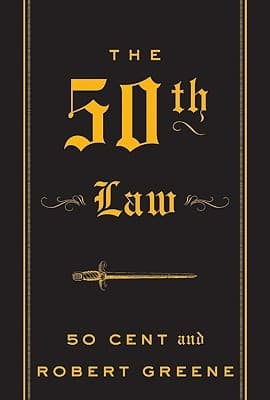
Core Idea
- Difficulty
- Medium
- Read it if
- You want to cultivate a fearless, assertive mindset for business and life, learn to leverage adversity, and operate with radical self-reliance. You appreciate biographical insights blended with strategic philosophy.
- Skip it if
- You prefer gentle, collaborative approaches to leadership and personal development, or are uncomfortable with concepts like strategic aggression and intimidation. You are looking for a purely academic or theoretical read.
Key Takeaways from The 50th Law
Embrace Mortality to Live Fearlessly
Confronting death's inevitability liberates you to pursue your ambitions without reservation.
The main idea of 'The 50th Law' is to fully accept that we will die. 50 Cent says our deepest fears often come from an unconscious dread of death or failure, which stops us from taking necessary risks. By facing and accepting that life is temporary, we can let go of these worries. This doesn't mean being careless, but understanding that the worst possible outcome—death itself—will happen to everyone. Once this is truly understood, the fear of smaller failures, rejections, or setbacks loses its power. This allows for bolder decisions and a more real, unrestrained pursuit of goals. This mindset creates a sense of urgency and purpose, turning potential problems into challenges instead of impossible barriers.
“When you accept the fact that you're going to die, it liberates you. You no longer fear death. You no longer fear anything.”
In the book: 50 Cent's own near-fatal shooting experience, where he survived nine gunshot wounds, solidified his conviction that life is fleeting and must be lived to its fullest without succumbing to fear.
Try this: Regularly reflect on your mortality (e.g., journaling about what you would regret not doing if you died tomorrow). When faced with a daunting decision, visualize the worst-case scenario and then the absolute worst-case (death), to diminish the fear of the actual potential negative outcome.
Related ideas: mortality-acceptance, fearlessness, risk-taking
Operate from 'Ground Zero'
Maintain an objective, detached perspective, seeing reality as it is, not as you wish it to be.
Operating from 'Ground Zero' means being extremely realistic. This is a cold objectivity that lets you judge situations without emotional bias, wishful thinking, or ego. It involves removing all false ideas about yourself, others, and the world to see the plain truth. This view is essential for good strategy and decisions, as it prevents self-deception and allows for accurate danger assessment and opportunity finding. 50 Cent learned this on the streets, where misjudging a situation could be deadly. In business, it means understanding market changes, competitor strengths, and your own weaknesses without sugarcoating, helping you adapt and respond precisely instead of reacting based on false hope or pride.
“You must always operate from a position of Ground Zero, seeing the world as it is, not as you want it to be. This means stripping away all illusions.”
In the book: 50 Cent's early experiences in drug dealing, where he had to constantly assess dangers, alliances, and market conditions with extreme realism to survive and profit.
Try this: Before making a major decision, list all facts, even uncomfortable ones, about the situation. Seek dissenting opinions from trusted advisors. Practice 'pre-mortems' where you imagine the project has failed and work backward to identify potential causes.
Related ideas: realism, objectivity, emotional-detachment
Cultivate Radical Self-Reliance
Depend on yourself above all others, as true power stems from internal strength and independence.
The book strongly emphasizes being self-reliant. In a world of changing loyalties and unpredictable events, putting your future entirely in the hands of others leads to weakness and disappointment. 50 Cent's journey shows that while working with others can be good, you alone are responsible for your success and survival. This isn't about being alone, but about building the inner strength and resourcefulness to handle problems on your own. It means becoming skilled in your work, building your own resources, and being ready to stand alone when needed. This mindset builds resilience and prevents the paralyzing feeling of helplessness when outside support fails.
“The greatest danger is to depend on others, to imagine that they will come to your rescue. In the end, you are on your own.”
In the book: 50 Cent's experience with record labels, where he learned that even his closest allies had their own agendas, forcing him to take control of his career, marketing, and business ventures to ensure his own success.
Try this: Identify areas where you are overly dependent on others (e.g., finances, skills, emotional support). Develop a plan to acquire those skills or build those resources yourself. Practice making decisions independently, even small ones, to strengthen your self-trust.
Related ideas: self-reliance, independence, autonomy
Convert Adversity into Advantage
View every setback, challenge, or threat as an opportunity for growth and strategic leverage.
A main lesson from 'The 50th Law' is to change problems strategically. Instead of being stopped by problems, the authors suggest actively finding ways to turn them into advantages. This involves a shift in mindset: seeing every obstacle as a chance to learn, adapt, or even get ahead of competitors who might give in to the same pressures. 50 Cent consistently used his street credibility, his controversies, and even his injuries to build his brand and story. This active approach to challenges builds great resilience and innovation, turning possible weaknesses into unique strengths and giving a competitive edge in any area.
“You must see challenges and adversity as opportunities, as raw material to forge something new and powerful.”
In the book: 50 Cent's use of his shooting incident and 'gangsta' image, which could have been career-ending, to create a compelling, authentic persona that resonated with millions and fueled his music and business ventures.
Try this: When facing a problem, instead of immediately looking for a solution to 'fix' it, brainstorm ways it could be turned into a unique selling point, a learning experience, or a way to differentiate yourself. For example, a budget constraint could force innovative, cost-effective solutions.
Related ideas: resilience, opportunity-mindset, strategic-advantage
Master the Art of Aggression (Controlled)
Channel your internal drive and anger into focused, strategic action rather than impulsive outbursts.
The book separates destructive, uncontrolled aggression from a strong, strategic form. This 'controlled aggression' is an inner fire, a constant drive to reach goals, overcome resistance, and assert your will. It means directing anger, ambition, and frustration into productive energy instead of letting it become impulsive rage or self-sabotage. 50 Cent's life story shows this, as he used his anger at his situation and rivals to fuel his tireless work ethic, creative output, and business deals. This skill allows one to project confidence and determination, intimidating competitors and inspiring supporters, while keeping a clear, strategic mind.
“Aggression is not necessarily violence; it is a force of will, an intense inner drive to get what you want, to overcome obstacles.”
In the book: 50 Cent's relentless pursuit of a record deal, his aggressive marketing tactics for 'Get Rich or Die Tryin'', and his fierce business dealings, all driven by an intense desire to succeed and prove himself against doubters.
Try this: Identify situations where you feel frustrated or angry. Instead of reacting impulsively, pause and reframe that energy into a concrete action plan to address the source of the frustration. Use competitive feelings to fuel extra effort in your work or training.
Related ideas: ambition, drive, willpower, assertiveness
Connect with the 'Source'
Maintain a continuous, unfiltered connection to reality and the streets, understanding where true power resides.
For 50 Cent, the 'source' represents the raw reality of the streets, the people's feelings, and the real experiences that shaped him. The book says that many successful people lose touch with this 'source' as they gain wealth and status. This separation leads to a loss of relevance, an inability to accurately judge public opinion, and eventually, a decline in influence. Keeping this connection, whether it's literal street knowledge or a deep understanding of your customers and market reality, provides a valuable wellspring of insight, authenticity, and power. It ensures your creations and strategies stay grounded and connect with the people you want to reach.
“Never lose your connection to the source, to the streets, to the people who made you. That's where your power comes from.”
In the book: 50 Cent's continued connection to his roots in Queens, New York, and his understanding of urban culture, which allowed him to create music and products that authentically spoke to his audience, even as he became a multi-millionaire.
Try this: Regularly seek out unfiltered feedback from your target audience or customers. Spend time in environments that challenge your comfort zone and expose you to different realities. Avoid becoming isolated in an echo chamber of like-minded individuals.
Related ideas: authenticity, groundedness, market-insight, street-smarts
Master the Art of Intimidation (Strategic Presence)
Cultivate an aura of confidence and unwavering resolve that naturally commands respect and discourages challenges.
Strategic intimidation, as discussed in 'The 50th Law,' is not about brute force or open threats. It is about building a presence so confident and determined that it naturally discourages opposition. This involves steady confidence, a reputation for keeping your word, and an almost noticeable sense of fearlessness. By showing this aura, you create psychological power, making competitors hesitant to challenge you and inspiring confidence in your allies. 50 Cent mastered this by never showing weakness, always following through on his threats and promises, and keeping an unshakeable manner, whether in a boardroom or on the streets. This 'soft' intimidation is a strong tool for staying in control and reaching goals without direct conflict.
“Your presence alone should be enough to make people think twice. It's not about being loud, it's about projecting an impenetrable confidence.”
In the book: 50 Cent's consistent persona, both in his music and public appearances, of someone who is not to be trifled with, who stands his ground, and who has a history of overcoming formidable opponents, thereby creating a deterrent effect.
Try this: Practice confident body language, maintain eye contact, and speak with clear, measured tones. Focus on delivering on your commitments to build a reputation for reliability and strength. Learn to control your emotional reactions in high-pressure situations.
Related ideas: presence, confidence, reputation, psychological-leverage
Expand Your Territory (Constant Growth)
Never settle for current successes; continually seek new domains and opportunities for expansion.
The book promotes a constant pursuit of growth and expansion, seeing stagnation as a form of decline. 50 Cent's career shows this: from music to film, clothing lines, vitamin water, and other businesses. He never rested on his music success but always sought to diversify his income and influence. This idea suggests that real power is not just about holding a position, but about continuously gaining new ground—whether it's skills, markets, or relationships. It's about keeping an entrepreneurial spirit, always looking for the next challenge and opportunity to broaden your scope and impact, thus securing your future against unexpected changes.
“Once you conquer one territory, you must immediately look to the next. Stagnation is death.”
In the book: 50 Cent's transition from a highly successful music career into diverse business ventures like G-Unit clothing, Vitaminwater, and film production, demonstrating a constant drive to expand beyond his initial domain.
Try this: Regularly assess your current skills and identify new ones that could open up future opportunities. Look for adjacent markets or new product lines that complement your existing endeavors. Dedicate time each week to exploring new ideas or industries.
Related ideas: growth-mindset, diversification, entrepreneurship, innovation
Own Your Narrative
Control your story and public perception to shape your image and influence how others see you.
In an age of constant information and public scrutiny, controlling and carefully creating your story is vital. 50 Cent understood this deeply, using his music, interviews, and public image to tell his story on his own terms. This involves actively shaping how you are seen, managing the message, and strategically highlighting aspects that serve your goals while downplaying or reframing those that don't. Letting others define you makes you vulnerable to misrepresentation, gossip, and rivals' agendas. By becoming the master of your own story, you build a strong brand, keep control over your public image, and ensure your legacy is shaped by your intentions, not by outside forces.
“If you don't control your own narrative, someone else will, and they'll never tell it in your favor.”
In the book: 50 Cent's use of his early life struggles, his near-death experience, and his street credibility as central themes in his music and marketing, which he meticulously controlled to forge his iconic 'gangsta' image and narrative.
Try this: Actively manage your online presence. Craft a concise and compelling personal brand statement. When facing criticism or controversy, respond strategically to reframe the narrative in a way that aligns with your values and goals, rather than letting others dictate the story.
Related ideas: brand-management, public-perception, storytelling, reputation-management
Cultivate a Sense of Urgency
Act with decisive speed and a clear understanding of time's finite nature to seize opportunities.
The book creates a strong sense of urgency, viewing time as a valuable and limited resource that must be used with maximum efficiency. Delay and hesitation are seen as deadly enemies, letting opportunities slip away and rivals gain ground. 50 Cent's fast rise in the music industry, from signing a deal to releasing his first album, shows this philosophy of quick action. This is not about rushing blindly, but about recognizing opportunities and acting quickly and strategically. A sense of urgency fuels productivity, sharpens focus, and ensures that one is always moving forward, maximizing every moment to achieve ambitious goals before time runs out.
“Time is the ultimate currency. Don't waste it. Move with a sense of urgency, as if every moment counts.”
In the book: 50 Cent's rapid rise to fame after being discovered by Eminem and Dr. Dre, where he capitalized on the momentum by quickly releasing hit singles and his debut album, 'Get Rich or Die Tryin'', without delay.
Try this: Set tight deadlines for yourself and adhere to them. Practice making decisions quickly, even if imperfect, and then course-correcting. Identify your most valuable hour of the day and dedicate it to your most critical task.
Related ideas: time-management, decisiveness, opportunity-seizing, productivity
The 50th Law Quotes
“Fear is a natural reaction to moving closer to the truth.”
“When you are an entrepreneur, you have to be comfortable with the idea of being lonely.”
“Understand: you are not a victim, no matter what has happened to you. You are a survivor.”
“The greatest danger is not to take the risk.”
“Everything that happens to you is a form of instruction.”
“You must be able to adapt to whatever comes your way, to bend without breaking.”
“Most people are too afraid to fail, so they never try.”
“The world is constantly changing, and if you don't change with it, you'll be left behind.”
“The less you fear, the more power you will have.”
“Never get too comfortable. That's when you get sloppy.”
“Your greatest enemy is your own emotionality.”
“To be truly free, you must be willing to offend.”
“The future belongs to those who see possibilities before they become obvious.”
“Mastering yourself is the ultimate power.”
Quiz
10 questions on the main ideas. Each answer comes with a short explanation.
Question 1
What is the central, overarching principle that 'The 50th Law' advocates for success in life and work?
- Always seek external validation.
- Cultivate a large network of powerful allies.
- Fear nothing.
- Focus solely on financial accumulation.
Show answer
C. Fear nothing. The core message of 'The 50th Law' is to confront and overcome fear in all aspects of life, as highlighted by 50 Cent's experiences.
Question 2
Which album by 50 Cent is specifically mentioned in the book as marking his rise to fame?
- The Massacre
- Curtis
- Get Rich or Die Tryin'
- Before I Self Destruct
Show answer
C. Get Rich or Die Tryin' The book explicitly links 50 Cent's rise to fame to the release of his album 'Get Rich or Die Tryin'', using his journey as a key narrative.
Question 3
According to the book, what is the 'New Frontier' that entrepreneurs and individuals must conquer in the modern world?
- The digital landscape and social media.
- The irrationality of the masses.
- The inner self and its fears.
- Global economic markets.
Show answer
C. The inner self and its fears. The book emphasizes that the greatest battle is internal, against one's own fears and limitations, making the inner self the 'New Frontier' to conquer.
Question 4
The book suggests that true independence and power come from which practical application of the 50th Law?
- Delegating all difficult tasks to others.
- Accumulating vast amounts of material wealth.
- Being able to adapt and thrive in any circumstance, even without external support.
- Following established rules and traditions without question.
Show answer
C. Being able to adapt and thrive in any circumstance, even without external support. A key practical application discussed is the ability to be self-reliant and adaptable, emphasizing that true power lies in not needing external comforts or support to succeed.
Question 5
50 Cent's life story, as presented in the book, is primarily used to illustrate the importance of what quality in overcoming adversity?
- Strategic alliances and networking.
- Ruthless ambition and cunning.
- Fearlessness and an embrace of reality.
- Inherent talent and artistic genius.
Show answer
C. Fearlessness and an embrace of reality. 50 Cent's journey, from the streets to the boardroom, is presented as a testament to the power of confronting reality head-on and operating without fear.
Question 6
Which of the following is NOT a characteristic of the 'realist' mindset promoted in 'The 50th Law'?
- Seeing things as they are, not as one wishes them to be.
- Avoiding confrontation and seeking comfort.
- Understanding human nature and motivations.
- Embracing change and adapting quickly.
Show answer
B. Avoiding confrontation and seeking comfort. The book strongly advocates for embracing reality and confronting challenges, not avoiding them. Seeking comfort and avoiding confrontation goes against the realist mindset.
Question 7
The concept of 'turning your weaknesses into strengths' is a recurring theme. How does the book suggest one practically achieves this?
- By ignoring weaknesses and focusing only on strengths.
- By adopting a victim mentality to gain sympathy.
- By openly acknowledging weaknesses and using them to create unique advantages or deter opponents.
- By relying on others to compensate for one's shortcomings.
Show answer
C. By openly acknowledging weaknesses and using them to create unique advantages or deter opponents. The book provides examples of how 50 Cent and others used their perceived disadvantages, like their background or perceived threats, to their strategic advantage, turning them into unique selling points or deterrents.
Question 8
According to 'The 50th Law', what is the most dangerous illusion that people often fall prey to, hindering their success?
- The illusion of eternal youth and beauty.
- The illusion of security and stability.
- The illusion of absolute control over others.
- The illusion of immediate gratification.
Show answer
B. The illusion of security and stability. The book argues that believing in constant security or stability is a dangerous illusion, as life is inherently uncertain. Embracing this uncertainty and adapting is crucial.
Question 9
The book posits that a key to maintaining power and influence is to 'stay in motion.' What does this primarily entail?
- Constantly changing one's goals and objectives.
- Avoiding any long-term commitments or projects.
- Continuously adapting, learning, and creating, preventing stagnation and predictability.
- Physically relocating frequently to new environments.
Show answer
C. Continuously adapting, learning, and creating, preventing stagnation and predictability. Staying in motion, as explained in the book, is about dynamic adaptation, continuous self-reinvention, and active engagement with the world to avoid becoming a static target or irrelevant.
Question 10
Which historical figure, often referenced by Robert Greene, is implicitly or explicitly aligned with the principles of the 50th Law through their actions of embracing reality and confronting fear?
- Mahatma Gandhi
- Napoleon Bonaparte
- Mother Teresa
- Abraham Lincoln
Show answer
B. Napoleon Bonaparte While not exclusively about Napoleon, Robert Greene frequently uses historical figures like Napoleon, who faced immense adversity and operated with a ruthless realism and fearlessness, to illustrate principles similar to the 50th Law.
The 50th Law FAQ
What is the core principle of 'The 50th Law'?
'The 50th Law' centers on the principle of fearlessness. It argues that by confronting and eliminating fear, individuals can unlock their full potential and achieve success in all aspects of life, from business to personal endeavors.
Who are the authors of 'The 50th Law' and what is their collaboration about?
The book is co-authored by hip-hop icon 50 Cent (Curtis Jackson) and bestselling author Robert Greene. Their collaboration combines 50 Cent's street-tested wisdom and life experiences with Greene's historical and philosophical insights into power and strategy.
Does the advice in 'The 50th Law' apply to people outside of business or entertainment?
Yes, while featuring stories from 50 Cent's rise in music and business, the book's principles of fearlessness, self-reliance, and adaptability are designed to be universally applicable. They offer guidance for anyone facing adversity or striving for personal and professional growth.
What is 'radical realism' as described in the book?
Radical realism is the practice of seeing the world as it truly is, without illusions or emotional biases. This concept encourages individuals to confront harsh realities directly, enabling them to make clear-headed decisions and adapt effectively to challenging circumstances.
How is 'The 50th Law' different from Robert Greene's 'The 48 Laws of Power'?
While both books delve into power and strategy, 'The 50th Law' focuses specifically on fearlessness as the ultimate principle, drawing heavily from contemporary examples and 50 Cent's life. 'The 48 Laws of Power' offers a broader historical and philosophical examination of power dynamics through various laws.
Does 'The 50th Law' include practical exercises or actionable steps for readers?
The book provides actionable insights through its principles and real-world examples, encouraging readers to adopt a fearless mindset and apply concepts like radical realism and self-reliance. While not a step-by-step workbook, it offers a framework for transforming one's approach to challenges.
What role do stories from 50 Cent's life play in the book?
Stories from 50 Cent's life, from his experiences on the streets to his rise in the music industry, serve as vivid illustrations of the principles of the 50th Law in action. They provide concrete examples of how fearlessness and resilience can lead to overcoming adversity and achieving success.
Is 'The 50th Law' primarily a biography or a self-help book?
It is a unique blend of both. While it incorporates biographical elements from 50 Cent's extraordinary life, its primary purpose is to serve as a self-help and leadership guide, teaching readers how to cultivate a fearless mindset and apply its principles to their own lives.
Does cultivating a 'fear nothing' attitude mean taking reckless risks?
No, cultivating a 'fear nothing' attitude doesn't advocate for recklessness. Instead, it promotes understanding and managing fear to make strategic, calculated decisions rather than being paralyzed by anxiety. It's about facing reality and acting decisively, not impulsively.
About the author

Curtis "50 Cent" Jackson is a Grammy Award-winning rapper and entrepreneur. He co-authored the bestselling book "The 50th Law," a motivational guide exploring the mindset of successful individuals. Jackson's work often draws from his experiences and insights into overcoming adversity.
Similar books
- The Art of War
Sun Tzu
4.0 (330k) average on GoodreadsBusinessOffers strategic principles for conflict and competition, emphasizing calculated moves and psychological advantage.
- The 48 Laws of Power
Robert Greene
4.2 (79k) average on GoodreadsBusinessExplores the dynamics of power, influence, and manipulation through historical examples, with a focus on strategic thinking.
- Start with Why: How Great Leaders Inspire Everyone to Take Action
Simon Sinek
4.1 (122k) average on GoodreadsBusinessSinek's Start with Why emphasizes purpose-driven leadership and inspiration as the core of influence, advocating for authenticity and connecting with an audience's deeper motivations. In contrast, The 50th Law focuses more on self-reliance, strategic assertiveness, and navigating hostile environments. While Sinek champions internal motivation and inspiring others, 50 Cent's philosophy leans towards external resilience, strategic maneuvering, and establishing dominance to 'expand territory.' They represent almost opposite ends of the leadership spectrum: one built on inspiration and trust, the other on fearlessness and strategic advantage.
- Steve Jobs
Walter Isaacson
4.1 (957k) average on GoodreadsBusinessSteve Jobs was a visionary who fused creativity and technology to revolutionize six industries and shape our digital world.
- Freakonomics: A Rogue Economist Explores the Hidden Side of Everything
Steven D. Levitt
4.0 (709k) average on GoodreadsBusinessThis book uses economic principles to reveal the surprising incentives behind everything from drug dealing and real estate to cheating teachers and the decline of crime.
- The Tipping Point: How Little Things Can Make a Big Difference
Malcolm Gladwell
4.0 (690k) average on GoodreadsBusinessMalcolm Gladwell explains how small, targeted actions can start widespread changes in trends, behaviors, and ideas.





Enjoyed the summary?
A summary gives you the shape of the book. The book itself has the detail, the examples and the voice.
Find The 50th Law on AmazonAs an Amazon Associate, BookBrief earns from qualifying purchases. How we're funded