
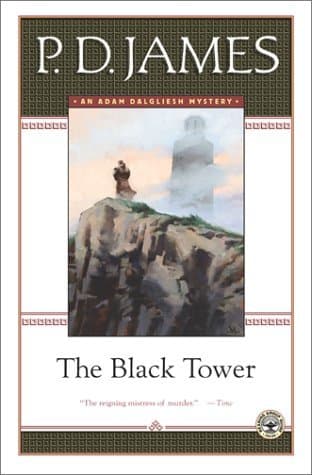
Synopsis
Covers the whole plot, including the ending.
- Difficulty
- Medium
- Pacing
- Moderate
- Mood
- Atmospheric, Suspenseful, Melancholy, Introspective
- Read it if
- You enjoy classic British police procedurals with a strong sense of atmosphere, intricate plotting, and psychological depth.
- Skip it if
- You prefer fast-paced, action-driven thrillers or shy away from stories with multiple deaths and a somber tone.
The Black Tower Plot Summary
Covers the whole plot, including the ending.
A Call for Help and a Journey to Toynton Grange
Adam Dalgliesh, still recovering from a serious illness in his London flat, receives an urgent and somewhat strange letter from his old friend, Father Michael Baddeley. Father Baddeley, now the chaplain at Toynton Grange, a private home for the disabled on the Dorset coast, asks Dalgliesh for advice on a serious matter. Despite being ill, Dalgliesh feels he must respond, driven by friendship and a feeling of unease. He drives to Toynton Grange, a remote and isolated place, expecting to find his friend in some minor trouble, but is unprepared for the dark secrets waiting for him.
Arrival and the Unsettling Discovery of Death
Upon reaching Toynton Grange, a forbidding and isolated building, Dalgliesh immediately notices its oppressive atmosphere. He meets Mr. Julius Court, the owner and director of the home, who tells him Father Baddeley died just days before Dalgliesh arrived. The death was officially ruled a suicide, with Baddeley having fallen from the Black Tower, a notable feature of the grounds. Dalgliesh, knowing his friend's personality, finds this explanation very suspicious. He also learns of another recent death, that of a patient named Grace Willison, who died from an overdose of medication, also called accidental or self-inflicted. The quick succession of deaths and the dismissive explanations immediately make Dalgliesh suspect the true nature of Toynton Grange.
Initial Investigations and the Suspicious Staff
Determined to find the truth behind his friend's death, Dalgliesh decides to stay at Toynton Grange pretending to be a relative of a prospective resident. He starts to quietly investigate, watching the staff and residents. He notices the tense relationships among the staff: the controlling Mr. Court, the seemingly fragile Miss Helen Rainer, the blunt Dr. Etherege, and the mysterious Christian, a male nurse. Dalgliesh finds that staff members are vague and often contradict each other in their accounts of Father Baddeley's last days. The residents, many severely disabled, offer broken or fearful insights, hinting at widespread fear and control within the institution. He learns about the strict routines and the residents' isolation.
The Death of Ursula Hollis
As Dalgliesh continues his quiet inquiries, another death happens at Toynton Grange. Ursula Hollis, a wheelchair-bound patient with a sharp mind and tongue, is found dead. Her death is first blamed on natural causes, but Dalgliesh, having seen her vitality and her growing willingness to share information with him, is sure it is murder. He suspects she was about to reveal something important about the previous deaths. This third death within a short time confirms Dalgliesh's belief that a killer operates within the Grange, systematically removing anyone who might expose the truth. The official dismissals of these deaths only strengthen his resolve to prove them murders.
Uncovering Motives and Secrets
Dalgliesh starts to look deeper into the backgrounds of the staff and the dead patients. He uncovers information about Toynton Grange's financial problems and Mr. Court's desperate need for money. He learns that Grace Willison had a large inheritance and that Ursula Hollis was also wealthy. Father Baddeley, he discovers, had been very worried about how patients were treated and had been writing a report detailing abuses and suspicious financial dealings. Dalgliesh also puts together the complex and often illegal personal relationships among the staff, including a secret affair involving Christian and Miss Rainer, and the long-standing, angry history between Court and Dr. Etherege. These discoveries begin to show a place full of greed, manipulation, and dark secrets.
The Attempt on Dalgliesh's Life
As Dalgliesh gets closer to the truth, the killer becomes aware of his investigations. An attempt is made on his life when his medication, prescribed for his recovery, is tampered with. He barely avoids a fatal overdose because of his careful habits and a growing sense of paranoia. This direct attack confirms to Dalgliesh that he is on the right track and that the killer is increasingly desperate and dangerous. The incident also shows the murderer's cunning and ruthlessness, willing to target Dalgliesh directly to protect their secrets. The isolation of Toynton Grange means Dalgliesh is mostly on his own, making his situation even more dangerous.
The Black Tower and the Final Confrontation
Dalgliesh, having carefully gathered evidence and noticed subtle clues, finally corners the killer in the Black Tower. He reveals that the initial deaths of Father Baddeley and Grace Willison were murders, planned to stop exposure of the home's bad practices and to get inheritances. Ursula Hollis was killed because she, too, was about to expose the truth. The killer, Christian, the male nurse, confesses to the murders, driven by greed and a twisted loyalty to Mr. Court, whom he was helping to fleece the wealthy patients. Christian had been systematically giving overdoses and staging suicides to cover his tracks. The confrontation is tense and dangerous, with Dalgliesh's life again at risk.
The Aftermath and the Unraveling of Toynton Grange
After Christian's confession and arrest, the full extent of the crimes and abuses at Toynton Grange comes out. Mr. Court is involved in the financial exploitation of the residents and covering up the murders. The home's kind image falls apart, revealing neglect, manipulation, and death beneath its supposed charitable exterior. The remaining staff are questioned, and the surviving residents are eventually moved to better care facilities. Dalgliesh, though tired by the experience, finds some peace in getting justice for his friend and the other victims. The case leaves a lasting mark on him, deepening his understanding of human wickedness and how fragile life is.
Principal Figures
Commander Adam Dalgliesh
Protagonist
Scotland Yard detective, recovering from illness, investigating his friend's death.
Commander Adam Dalgliesh is a highly intelligent and introspective detective from Scotland Yard, known for his poetic sensibilities and keen observational skills. He is introduced recuperating from a life-threatening illness, making him more vulnerable and reflective than usual. His personal connection to Father Baddeley drives his investigation, blurring the lines between professional duty and personal grief. Dalgliesh is meticulous, methodical, and possesses a strong moral compass, unwilling to let injustices go unpunished, even when it puts his own life at risk. He is an outsider at Toynton Grange, which allows him to see the institution with fresh, critical eyes.
Relationships: Father Michael Baddeley (old friend and the initial victim Dalgliesh seeks to avenge); Mr. Julius Court (antagonist, owner of Toynton Grange, complicit in the crimes); Christian (the primary antagonist and murderer)
Father Michael Baddeley
Victim/Catalyst
Chaplain at Toynton Grange, whose mysterious death prompts Dalgliesh's investigation.
Father Michael Baddeley is an elderly, kind-hearted, and morally upright Anglican priest. He serves as the chaplain at Toynton Grange, genuinely caring for the residents. His increasing unease with the practices and atmosphere of the home leads him to write to Dalgliesh, seeking advice on a matter he perceives as deeply disturbing. He is the first victim, his death initially ruled a suicide, but Dalgliesh knows him well enough to immediately doubt this explanation. His death serves as the primary catalyst for the entire plot, drawing Dalgliesh into the web of deceit and murder at the Grange. He represents the voice of conscience within the corrupt institution.
Relationships: Commander Adam Dalgliesh (close friend); Mr. Julius Court (colleague, but increasingly at odds due to Court's unethical practices); Residents of Toynton Grange (spiritual guide and advocate)
Mr. Julius Court
Antagonist
Owner and director of Toynton Grange, a charismatic but deeply corrupt figure.
Mr. Julius Court is the charismatic but ultimately morally bankrupt owner and director of Toynton Grange. He presents a facade of benevolent care for the disabled, but beneath this lies a man driven by financial desperation and a willingness to exploit his residents. He is cunning, manipulative, and adept at controlling information and appearances. Court is complicit in the murders, at least through his knowledge and cover-ups, as he benefits directly from the deaths of wealthy patients. He views the residents as assets and the institution as a means to maintain his lifestyle, even as it crumbles around him. His arrogance and self-preservation make him a formidable adversary.
Relationships: Christian (accomplice and lover); Dr. Etherege (colleague with a long-standing, resentful history); Father Michael Baddeley (colleague whose moral objections he silenced)
Christian
Antagonist
A male nurse at Toynton Grange, the cunning and ruthless murderer.
Christian is a male nurse at Toynton Grange and the primary antagonist and murderer. He is presented as quiet, seemingly efficient, but possesses a chilling ruthlessness and intelligence. He is deeply devoted to Mr. Court, with whom he shares a clandestine romantic relationship, and acts as Court's enforcer and co-conspirator in the scheme to exploit wealthy patients. Christian is responsible for administering the fatal overdoses to Father Baddeley, Grace Willison, and Ursula Hollis, meticulously staging them to appear as accidents or suicides. His motive is a combination of loyalty to Court and a desire for the financial benefits derived from the murders. He is cold, calculating, and capable of extreme violence.
Relationships: Mr. Julius Court (lover and accomplice in the murders); Miss Helen Rainer (colleague with whom he has a strained, competitive relationship); Commander Adam Dalgliesh (his ultimate opponent)
Miss Helen Rainer
Supporting
Head nurse at Toynton Grange, a conflicted and emotionally fragile woman.
Miss Helen Rainer is the head nurse at Toynton Grange, a woman burdened by her responsibilities and her own emotional vulnerabilities. She is conscientious in her duties but appears fragile and easily manipulated, particularly by Mr. Court. She has a complicated personal life, including an unrequited affection for Christian and a deep-seated unhappiness. Helen is aware of some of the questionable practices at the Grange, and her conscience is troubled, but her fear and lack of agency prevent her from speaking out. She represents the moral ambiguity of those who enable evil through inaction, eventually becoming a victim herself.
Relationships: Christian (unrequited affection and professional colleague); Mr. Julius Court (employer, whom she fears and is manipulated by); Dr. Etherege (colleague)
Dr. Eric Etherege
Supporting
The resident doctor at Toynton Grange, a cynical and embittered man.
Dr. Eric Etherege is the resident doctor at Toynton Grange, a cynical and embittered man with a long history of resentment towards Mr. Court. He is a competent doctor but deeply unhappy and prone to alcoholism. Etherege is aware of the suspicious deaths and the unethical practices at the Grange but is too jaded and fearful to take decisive action. His relationship with Court is fraught with hostility, stemming from past grievances. He provides Dalgliesh with some crucial, albeit reluctantly given, information, often through veiled remarks and observations. His character highlights the moral decay within the institution and the compromises people make to survive.
Relationships: Mr. Julius Court (long-standing professional rivalry and personal animosity); Miss Helen Rainer (colleague); Commander Adam Dalgliesh (reluctant informant)
Ursula Hollis
Victim
A wheelchair-bound patient at Toynton Grange, intelligent and perceptive.
Ursula Hollis is one of the patients at Toynton Grange, a wheelchair-bound woman with a sharp mind and a perceptive nature. Despite her physical disability, she is fiercely intelligent and observant, noticing details that others miss. She becomes a potential informant for Dalgliesh, as she senses something amiss about the deaths and the general atmosphere of the Grange. Her growing willingness to share her suspicions makes her a target for the killer. Her death is the third murder, solidifying Dalgliesh's conviction that a systematic elimination is taking place. She represents the vulnerable residents whose lives are exploited and extinguished by the corrupt staff.
Relationships: Father Michael Baddeley (confidant and spiritual guide); Commander Adam Dalgliesh (potential informant); Christian (her murderer)
Grace Willison
Victim
A wealthy patient at Toynton Grange, the second victim of the killer.
Grace Willison is another patient at Toynton Grange, a woman of considerable wealth whose death is initially dismissed as an accidental overdose. However, Dalgliesh quickly suspects foul play, as her death benefits the financially struggling institution and its director, Mr. Court. Her inheritance is a key motive for the murders, making her a pawn in the killer's scheme. Although she is already deceased upon Dalgliesh's arrival, her death, alongside Father Baddeley's, establishes the pattern of suspicious fatalities and highlights the financial motivations driving the crimes at Toynton Grange. She represents the vulnerability of the wealthy, isolated patients.
Relationships: Christian (her murderer); Mr. Julius Court (her exploiter)
Dorothea Maunsell
Supporting
A resident at Toynton Grange, a former teacher who struggles with her disability.
Dorothea Maunsell is a resident at Toynton Grange, a former teacher who struggles with the indignity and frustration of her disability. She is observant and intelligent, providing Dalgliesh with subtle clues and insights into the dynamics of the Grange. Her conversations with Dalgliesh reveal the oppressive atmosphere and the fear that permeates the home. Dorothea represents the mental and emotional suffering of the residents, and her quiet dignity in the face of her condition makes her a sympathetic character. She is one of the few residents Dalgliesh can truly communicate with, offering an internal perspective on the grim reality of the institution.
Relationships: Commander Adam Dalgliesh (confidante and source of information); Residents of Toynton Grange (fellow patient)
Themes & Insights
Justice and Moral Duty
The novel explores Dalgliesh's personal and professional commitment to justice. His investigation into Father Baddeley's death is a moral duty, driven by friendship and a strong sense of right and wrong. He feels he must uncover the truth for the vulnerable residents of Toynton Grange who cannot speak for themselves. This theme is clear in his willingness to risk his own life, still recovering from illness, to expose the evil at the institution's core. The book asks what true justice means in a system that first dismisses suspicious deaths.
“He knew that he would not rest until he had unearthed the truth, not only for Michael, but for all the others who had died in this house of secrets.”
Abuse of Power and Vulnerability
A main theme is the exploitation of vulnerable people by those in power. Toynton Grange, supposedly a caring home, is a small example of this abuse, where disabled residents, dependent on their caregivers, are systematically exploited and murdered for money. Mr. Court and Christian manipulate and control every part of the residents' lives, while the staff's fear and involvement continue the cycle of abuse. The novel clearly shows how easily trust can be broken and how the powerless can be silenced, emphasizing the ethical duties of those who care for society's most vulnerable.
“In this house, the weak were not protected; they were merely convenient.”
Isolation and Secrecy
The physical and psychological isolation of Toynton Grange is a key theme. The remote Dorset setting adds to the feeling of being trapped and allows crimes to go unnoticed. The institution itself is a closed world, creating an atmosphere of secrecy and suspicion among staff and residents. This isolation prevents outside examination and allows the perpetrators to keep up their respectable appearance. Dalgliesh's struggle to enter this isolated world shows how secrecy can lead to corruption and how hard it is to expose wrongdoing when a community is purposely cut off from the outside.
“The Grange was a self-contained world, its secrets as effectively guarded as if by a high, unscalable wall.”
Appearance Versus Reality
The novel constantly shows the difference between appearance and reality. Toynton Grange presents itself as a kind and caring home for the disabled, but beneath this image lies a dark reality of murder, financial exploitation, and neglect. Characters like Mr. Court project an image of professionalism and compassion, while secretly planning terrible crimes. Dalgliesh's job is to remove these layers of deception, revealing the sinister truth hidden behind polite manners and institutional rules. This theme highlights the danger of judging by appearances and the difficulty of telling real care from cynical manipulation.
“The veneer of benevolence was thin, easily scratched to reveal the cold, hard ambition beneath.”
Mortality and the Fragility of Life
Dalgliesh's own recent close call with death and his ongoing recovery fill the story with a strong sense of mortality and the fragility of human life. This personal experience makes him especially aware of the suspicious deaths at Toynton Grange, increasing his empathy for the victims. The novel explores how easily life can end and how quickly one can become vulnerable, especially when dependent on others. The deaths of the patients, often called natural or accidental, show how uncertain existence is for those who are already physically compromised.
“He knew, perhaps more than ever, how tenuous a hold one had on life, and how easily it could be snatched away.”
Plot Devices & Literary Techniques
The Black Tower
A symbolic and literal setting for death and confrontation.
The Black Tower is a prominent architectural feature of Toynton Grange, serving both as a literal location for one of the initial deaths (Father Baddeley's 'suicide') and as a powerful symbol. Its name evokes a sense of foreboding, isolation, and darkness, mirroring the grim secrets hidden within the institution. It represents the oppressive atmosphere and the looming threat of death that hangs over the Grange. The tower's height and isolation make it a fitting place for the final confrontation, a dramatic stage for the revelation of truth and the apprehension of the killer, emphasizing the climax of Dalgliesh's investigation.
The Isolated Setting (Toynton Grange)
A remote institution that enables secrecy and control.
Toynton Grange's remote location on the Dorset coast is a crucial plot device. Its isolation from outside scrutiny allows the staff, particularly Mr. Court and Christian, to operate with impunity, fostering an environment where crimes can be committed and covered up without immediate detection. This geographical detachment reinforces the theme of secrecy and vulnerability, as the residents are effectively cut off from the outside world. The oppressive atmosphere of the Grange, described with gothic undertones, mirrors the psychological entrapment felt by both the residents and the investigating Dalgliesh, making escape or intervention difficult.
Dalgliesh's Convalescence
The protagonist's weakened state, adding vulnerability and introspection.
Dalgliesh's recovery from a life-threatening illness is not merely background detail; it's a significant plot device. His physical weakness and ongoing need for medication make him vulnerable to the killer's attempts to silence him, heightening the stakes. More importantly, his convalescence forces him into a state of introspection and heightened sensitivity, allowing him to perceive subtle cues and emotional undercurrents that a fully robust detective might overlook. It also provides a personal motivation for his deep engagement with the case, as he grapples with his own mortality while seeking justice for others, making the investigation a form of therapeutic recovery.
The 'Perfect' Murder Scheme
A series of deaths designed to appear as natural causes or suicides.
The killer's method of operation—administering overdoses that mimic natural causes or staging suicides—is a central plot device. This 'perfect' murder scheme relies on the vulnerability of the victims (disabled patients or an elderly priest) and the isolation of the setting, making the deaths easily dismissible by local authorities. Dalgliesh's challenge is to dismantle this illusion, proving that these seemingly innocuous deaths are, in fact, meticulously planned murders. This device creates suspense and complexity, requiring Dalgliesh to rely on his intuition and meticulous observation rather than overt forensic evidence, as the evidence has been carefully obscured.
The Black Tower Quotes
“The dead are always with us, but they are not always silent.”
“In the black tower, secrets are buried deeper than bones.”
“Fear is a more potent weapon than any knife or gun.”
“Truth, like light, can be blinding when it finally emerges.”
“In the shadows of doubt, even the innocent can appear guilty.”
“A detective's greatest tool is not deduction, but patience.”
“The past is a prison if you let it hold you.”
“Evil often wears the mask of normalcy.”
“In every mystery, there is a key that unlocks more than one door.”
“Silence can scream louder than any accusation.”
“Justice is not always found in a courtroom; sometimes it's in the quiet resolve of those who seek it.”
“The human heart is the darkest mystery of all.”
“In the end, we are all prisoners of our own choices.”
Quiz
10 questions on the plot and the characters. Each answer comes with a short explanation.
Question 1
What is the primary reason Commander Dalgliesh travels to Toynton Grange at the beginning of the novel?
- To investigate a series of murders reported by the police
- To recuperate from his illness in a peaceful coastal setting
- To respond to a call for advice from his friend Father Baddeley
- To take over management of the home for the disabled
Show answer
C. To respond to a call for advice from his friend Father Baddeley Dalgliesh receives a call from Father Baddeley, an elderly friend who works as a chaplain at Toynton Grange, seeking advice. This prompts his initial visit, during which he discovers Baddeley has died.
Question 2
What is Toynton Grange, the setting of much of the novel?
- A seaside hotel for wealthy tourists
- A home for the disabled run as a caring community
- A military hospital where Dalgliesh was treated
- A remote monastery in the Scottish Highlands
Show answer
B. A home for the disabled run as a caring community Toynton Grange is described as a home for the disabled on the Dorset coast, purporting to be a caring community but hiding dark secrets.
Question 3
Who is Father Baddeley in relation to Commander Dalgliesh?
- His former police supervisor
- A suspect in the murders at Toynton Grange
- An elderly friend and chaplain at Toynton Grange
- A patient at the home who provides key clues
Show answer
C. An elderly friend and chaplain at Toynton Grange Father Baddeley is an elderly friend of Dalgliesh who works as a chaplain at Toynton Grange. His mysterious death motivates Dalgliesh's investigation.
Question 4
What discovery does Dalgliesh make upon arriving at Toynton Grange?
- That Father Baddeley has recently and mysteriously died
- That the home has been evacuated due to a storm
- That all patients have recovered and left the facility
- That Father Baddeley has moved to a different location
Show answer
A. That Father Baddeley has recently and mysteriously died Dalgliesh arrives to find that Father Baddeley has died recently under mysterious circumstances, along with a patient, sparking his investigation into the deaths.
Question 5
Why is Dalgliesh's life in danger during the investigation?
- Because he is still weak from his illness and vulnerable to attacks
- Because he uncovers secrets that threaten the killer's anonymity
- Because the local police force is corrupt and targets him
- Because he accidentally reveals his own criminal past
Show answer
B. Because he uncovers secrets that threaten the killer's anonymity As Dalgliesh investigates the deaths and uncovers the evil at Toynton Grange, he gets closer to identifying the killer, who then sees him as a threat and attempts to eliminate him.
Question 6
What theme is highlighted by the contrast between Toynton Grange's purported caring community and the actual events?
- The importance of family bonds in overcoming adversity
- The deception and evil that can lurk beneath a facade of benevolence
- The benefits of modern medical treatments for disabilities
- The role of religion in providing solace during crises
Show answer
B. The deception and evil that can lurk beneath a facade of benevolence The novel explores how institutions or individuals can present themselves as altruistic or caring while hiding malevolent intentions, a key theme in the mystery.
Question 7
In addition to Father Baddeley, who else has died at Toynton Grange before Dalgliesh's arrival?
- The head nurse of the facility
- One of the patients at the home
- The owner of Toynton Grange
- A local police officer investigating the case
Show answer
B. One of the patients at the home Along with Father Baddeley, a patient at Toynton Grange has also died, indicating that the deaths are not isolated incidents and hinting at foul play.
Question 8
What motivates Dalgliesh to continue his investigation despite the risks?
- A promise to the local authorities to solve the case quickly
- His determination to discover the truth about his friend's death
- A financial reward offered by the home's management
- His desire to prove his detective skills after his illness
Show answer
B. His determination to discover the truth about his friend's death Dalgliesh is driven by personal loyalty and a quest for justice, specifically wanting to uncover the truth behind Father Baddeley's mysterious death, which fuels his persistence.
Question 9
How does the setting of the Dorset coast contribute to the novel's atmosphere?
- It provides a cheerful backdrop that contrasts with the dark events
- Its isolation and ruggedness enhance the sense of danger and secrecy
- It symbolizes technological progress and modern society
- It serves as a busy hub that distracts from the investigation
Show answer
B. Its isolation and ruggedness enhance the sense of danger and secrecy The remote and desolate Dorset coast isolates Toynton Grange, amplifying the tension and making it easier for sinister activities to go unnoticed, key to the thriller elements.
Question 10
What does the 'evil at the heart of Toynton Grange' ultimately refer to in the context of the plot?
- A systemic neglect of patients due to budget cuts
- A conspiracy involving multiple murders and hidden motives among the residents or staff
- A supernatural curse affecting the building
- A political scandal related to the home's funding
Show answer
B. A conspiracy involving multiple murders and hidden motives among the residents or staff The phrase points to the underlying criminal activities, such as murders and deceit, perpetrated by individuals within Toynton Grange, which Dalgliesh works to expose.
The Black Tower FAQ
What is 'The Black Tower' about?
Commander Adam Dalgliesh investigates the mysterious death of his friend Father Baddeley at Toynton Grange, a home for the disabled on the Dorset coast. As he probes further, he uncovers additional deaths and dark secrets, revealing the home is not the caring community it appears to be, with his own life at risk as he confronts the evil within.
Why should I read 'The Black Tower'?
It offers a classic P.D. James mystery with psychological depth, set in an isolated, atmospheric location that heightens tension. Dalgliesh's personal vulnerability during his recuperation adds a unique layer to his investigation, making it a compelling blend of character study and intricate plot.
What is the background/setting of 'The Black Tower'?
The story is set at Toynton Grange, a remote home for the disabled on the Dorset coast, which creates a claustrophobic and suspicious atmosphere. The 'Black Tower' itself is a nearby landmark that symbolizes the darkness and isolation permeating the community.
What are the most memorable quotes?
Key quotes include Dalgliesh reflecting, 'Evil is always possible. Goodness is a difficulty,' highlighting the moral ambiguity. Another is Father Baddeley's warning, 'Toynton Grange is not what it seems,' which foreshadows the hidden dangers Dalgliesh uncovers.
What writing style does the author use?
P.D. James employs a precise, literary style with detailed descriptions of settings and complex character psychology. The narrative builds suspense slowly through dialogue and introspection, typical of her methodical approach to mystery.
What minor details add significant meaning?
The recurring mention of the Black Tower as a physical and symbolic presence underscores the themes of isolation and moral decay. Small details like the mismatched medications at Toynton Grange subtly hint at the negligence and malice underlying the deaths.
What are some subtle foreshadowing moments?
Early conversations about the 'accidental' death of a patient foreshadow the pattern of murders. Dalgliesh's initial sense of unease upon arriving at Toynton Grange, coupled with vague warnings from residents, subtly hints at the deeper conspiracy he will uncover.
What unexpected character connections exist?
Unexpected ties emerge between staff members and patients, such as hidden familial relationships or past conflicts that motivate the crimes. For instance, the connection between the chaplain's death and a patient's demise reveals a web of secrets linking multiple characters.
What are unspoken character motivations?
Characters like the home's administrator may be driven by greed or a desire to maintain control, while patients might hide resentment or fear. Dalgliesh's own motivation includes personal guilt over Father Baddeley's death, adding depth to his pursuit of truth.
What psychological complexities do characters exhibit?
Dalgliesh grapples with vulnerability from his illness, affecting his judgment and resilience. Residents of Toynton Grange show a mix of dependency and defiance, with some using their disabilities as masks for darker intentions, creating a complex psychological landscape.
What are the major emotional turning points?
Key moments include Dalgliesh's shock at discovering Father Baddeley's death was not natural, the emotional impact of subsequent murders on the community, and the climax where he confronts the killer, risking his own life for justice.
How do relationship dynamics evolve?
Dalgliesh's relationships shift from initial trust to suspicion as he uncovers deceit among staff and patients. The dynamics within Toynton Grange deteriorate from superficial harmony to overt conflict, revealing underlying tensions and alliances.
Which parts remain ambiguous or open-ended?
The exact motivations behind some secondary characters' actions may be left vague, and the full extent of the evil at Toynton Grange is hinted at but not fully detailed, leaving readers to ponder the depth of corruption.
What are controversial scenes or decisions?
Scenes involving the treatment of disabled patients and the ethical dilemmas around euthanasia or neglect spark debate. Dalgliesh's decision to continue investigating despite personal risk raises questions about duty versus self-preservation.
'The Black Tower' ending explained: how it ends & what it means
Dalgliesh identifies and confronts the killer, resolving the murders but exposing the pervasive evil at Toynton Grange. The ending suggests that such darkness can exist even in places meant for care, leaving a lingering sense of unease about human nature.
About the author

P.D. James was a British author known for her contributions to the mystery genre. Her notable works include "Death Comes to Pemberley," "Cover Her Face," "The Black Tower," "The Private Patient," and "An Unsuitable Job for a Woman," which often feature intricate plots and well-developed characters. James's writing has garnered significant recognition, including being appointed a life peer in the House of Lords.
Similar books
- Gaudy Night
Dorothy L. Sayers
4.2 (23k) average on GoodreadsHistorical FictionA classic Golden Age mystery featuring intellectual detective work and a strong sense of place.
- Angels & Demons
Dan Brown
3.9 (2.7M) average on GoodreadsThrillerA Harvard symbologist races through Rome's ancient sites, deciphering cryptic clues to unmask the Illuminati and stop a vengeful plot to destroy the Vatican with a stolen antimatter weapon.
- Gone Girl
Gillian Flynn
4.1 (2.3M) average on GoodreadsThrillerA wife's sudden disappearance on her fifth anniversary reveals a web of lies and psychological warfare, exposing the secrets within a seemingly perfect marriage.
- The Girl on the Train
Paula Hawkins
3.9 (2.1M) average on GoodreadsThrillerA woman’s fascination with a seemingly perfect couple she watches from her daily train commute leads her into a dark investigation when she witnesses something that shatters their idyllic image.
- The Da Vinci Code
Dan Brown
3.9 (1.9M) average on GoodreadsThrillerA symbologist and a cryptologist race through European landmarks, deciphering ancient codes and uncovering a conspiracy that could rewrite the foundations of Christianity.
- The Guest List
Lucy Foley
3.8 (1.3M) average on GoodreadsThrillerOn a remote Irish island, a glamorous wedding descends into a deadly whodunnit when a guest is found murdered, trapping everyone with their secrets as a storm rages.





Enjoyed the summary?
A summary gives you the shape of the book. The book itself has the detail, the examples and the voice.
Find The Black Tower on AmazonAs an Amazon Associate, BookBrief earns from qualifying purchases. How we're funded