
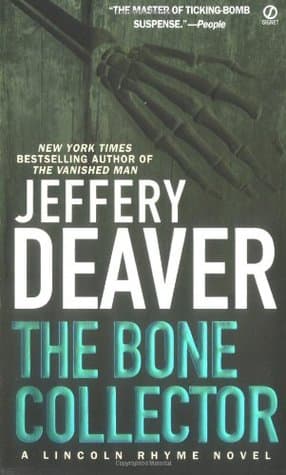
Synopsis
Covers the whole plot, including the ending.
- Difficulty
- Medium
- Pacing
- Fast
- Mood
- Suspenseful, Gritty, Intellectually stimulating, Dark
- Read it if
- You love intricate forensic puzzles, a brilliant but flawed detective, and a fast-paced hunt for a serial killer with a twisted motive.
- Skip it if
- You prefer less graphic descriptions of crime scenes or find detailed forensic procedures tedious.
The Bone Collector Plot Summary
Covers the whole plot, including the ending.
A Gruesome Discovery and a Desperate Plea
The novel opens with Lincoln Rhyme, a brilliant but quadriplegic former head of NYPD forensics, considering assisted suicide. His plans stop when his former partner, Detective Lon Sellitto, and his protégé, Detective Jerry Banks, arrive. They present a strange and gruesome case: a wealthy businessman, T.J. Colfax, and his girlfriend, Pamela Sloane, abducted from JFK Airport. Sloane's body is later found in a Queens railyard, her hand posed to point towards a railway signal, wearing a diamond ring that is not hers. The scene is arranged with seemingly minor clues, confusing traditional police methods. Sellitto, desperate, asks for Rhyme's expertise, despite his physical state and initial reluctance.
Amelia Sachs Joins the Investigation
Lincoln Rhyme, seeing the unique nature of the crime scene and the killer's carefulness, agrees to consult. He requires a dedicated crime scene investigator to collect evidence under his instruction. Detective Amelia Sachs, a young patrol officer with PTSD after a shooting, is the first on the scene where Pamela Sloane's body is found. Her carefulness and sharp observations, despite her distress, impress Rhyme. Despite her doubts about being 'eyes' for a bedridden man, Sachs is assigned to Rhyme, becoming his link to the physical investigation. Their first interactions are tense due to Rhyme's demanding nature and Sachs's inexperience with forensic collection.
The Second Victim and a Web of Clues
The media names the killer 'The Bone Collector.' He abducts and murders another victim, college student Colin Stanton, found drowned in the East River. The crime scene is again carefully arranged with obscure clues: old rope, a specific type of sand, and a piece of a historical map. Rhyme, working from his bed, guides Sachs through collecting these small pieces of evidence. Using his deductive reasoning and knowledge of forensics and New York history, Rhyme begins to understand the killer's method: he uses historical New York City crime scenes and landmarks as a guide, recreating elements from a forgotten era to stage his murders.
Decoding the Killer's Signature
As the investigation continues, Rhyme and Sachs, with Sellitto and Banks, realize the killer leaves clues that are not random objects but historical artifacts or references to obscure New York City history. Each victim connects to a specific historical event or location, often a past crime or tragedy. The killer is not just murdering; he stages elaborate, old-fashioned scenes. Rhyme deduces the killer uses an old, out-of-print book about New York City's forgotten past as his guide, targeting people who, in some way, represent these historical events. This discovery helps Rhyme predict the killer's next moves and the types of clues he might leave.
The Hunt for the Bone Collector
The team finds a pattern: the killer targets victims who have offended him or represent something he dislikes. They also realize the killer uses a specific antique railroad lantern as a signature. Through analysis of collected evidence – soil samples, fibers, insect fragments, and historical documents – Rhyme narrows the killer's operating area and builds a psychological profile. Sachs, overcoming her initial hesitation, becomes good at forensic collection, often anticipating Rhyme's needs and showing a natural talent for the work. Their professional relationship grows, marked by mutual respect despite Rhyme's demanding ways and Sachs's increasing confidence.
The Impersonation and the Trap
The Bone Collector, sensing the police are near, becomes bolder. He abducts another victim, a young girl, and stages a scene in a disused slaughterhouse. During the investigation of this scene, the killer, disguised as a taxi driver, tries to abduct Amelia Sachs. Sachs escapes, but the encounter shakes her and strengthens her resolve to catch the killer. This personal attack makes the investigation more urgent for both Rhyme and Sachs. The killer leaves a key clue at this scene: a piece of a unique, antique map, which Rhyme identifies as a rare map of old New York's sewer system, showing the killer's knowledge of the city's hidden places.
Unmasking the Killer: Richard Thompson
By cross-referencing historical records, the map fragment, and the killer's targets, Rhyme makes a breakthrough. He realizes the killer's identity: Richard Thompson, a former forensic specialist who worked under Rhyme years ago. Thompson, who became quadriplegic in a car accident, resented Rhyme's perceived lack of sympathy and his own ruined life. The clues at the crime scenes are not just historical references but personal taunts, aimed at Rhyme, showing Thompson's desire for revenge and to prove himself better. This realization deeply shocks Rhyme, who feels responsible for Thompson's turn.
The Final Confrontation
Having identified Thompson, the team rushes to catch him. However, Thompson, anticipating their moves, gets into Rhyme's secured Upper West Side brownstone. He disables the security and enters Rhyme's room, intending to murder him and complete his revenge. A tense standoff follows, with Rhyme, despite his paralysis, using his mind and limited tools to outwit Thompson. Sachs, rushing back to Rhyme's house after a feeling, arrives in time to confront Thompson, creating a dangerous three-way confrontation in Rhyme's bedroom.
The Killer's Demise and Aftermath
During the intense struggle in Rhyme's bedroom, Thompson tries to kill Rhyme with a knife. Amelia Sachs, showing bravery and quick thinking, steps in. A violent struggle occurs between Sachs and Thompson. Sachs, using her police training and determination, subdues Thompson, eventually shooting him dead. The immediate danger ends, and Rhyme is saved. The Bone Collector case closes, but the events leave a lasting impact on both Rhyme and Sachs. Rhyme, though physically unchanged, has an emotional shift, finding new purpose and respect for Sachs. Sachs finds her calling as a forensic investigator, having proven herself under extreme pressure.
A New Partnership Forged
After Thompson's death, Rhyme decides not to pursue assisted suicide. He sees Sachs's role in his survival and the investigation's success, and he sees a future where his mind can still help law enforcement. He offers Sachs a permanent position as his partner on future cases. Sachs, having found her calling and gained respect for Rhyme's brilliance, accepts. The novel ends with their unique partnership, setting the stage for future investigations, with Rhyme as the 'brain' and Sachs as his 'legs and eyes,' ready to tackle crime.
The Bone Collector Characters
Lincoln Rhyme
Protagonist
Brilliant, quadriplegic forensic criminalist, seeking purpose after a debilitating accident.
Lincoln Rhyme was once the top forensic criminalist for the NYPD, a genius whose mind could unravel the most complex cases. Four years prior to the novel's opening, a shelving unit collapsed on him, leaving him a quadriplegic with only limited movement in one finger and his head. Bitter, suicidal, and isolated, he initially resists re-entering the world of crime. However, the intellectual challenge of the Bone Collector case reignites his passion for forensics. He is demanding, arrogant, and often insensitive, but possesses an unparalleled deductive mind and encyclopedic knowledge of forensics, history, and the human psyche. He operates from his bed, guiding Sachs through every step of evidence collection.
Relationships: Amelia Sachs (professional partner, growing mutual respect and emotional bond); Lon Sellitto (former partner, friend, colleague); Thelma (dedicated nurse/caregiver); Richard Thompson (former protégé, now arch-nemesis)
Amelia Sachs
Protagonist/Supporting
NYPD patrol officer with a keen eye, reluctantly becomes Rhyme's indispensable 'eyes and ears'.
Amelia Sachs is a young, intelligent NYPD patrol officer who, at the start of the novel, is struggling with PTSD after being involved in a shooting. She is meticulous, observant, and possesses a natural aptitude for forensic work, despite her initial lack of formal training. She is assigned to be Rhyme's 'legs and eyes' at crime scenes, a role she initially resents due to Rhyme's demanding nature and her discomfort with the gruesome details. Over the course of the investigation, she develops remarkable skill in evidence collection and deduction, proving herself to be an invaluable partner to Rhyme. She is brave, determined, and empathetic, often clashing with Rhyme's detached approach.
Relationships: Lincoln Rhyme (professional partner, growing mutual respect and emotional bond); Lon Sellitto (superior officer, colleague); Jerry Banks (colleague)
Richard Thompson (The Bone Collector)
Antagonist
A serial killer meticulously staging historical crimes, driven by revenge against Lincoln Rhyme.
Richard Thompson, initially known only as 'The Bone Collector', is the brilliant and deranged antagonist of the novel. He is a former forensic technician who once worked under Lincoln Rhyme. Like Rhyme, he became a quadriplegic after an accident, but unlike Rhyme, he was left bitter and resentful, believing Rhyme abandoned him. He orchestrates elaborate murders, meticulously staging crime scenes with historical artifacts and clues related to obscure New York City history, all as a twisted game to taunt and challenge Rhyme. His motive is revenge and a desire to prove his intellectual superiority to Rhyme, whom he blames for his ruined life.
Relationships: Lincoln Rhyme (former mentor, object of obsession and revenge)
Detective Lon Sellitto
Supporting
NYPD Detective and Rhyme's former partner, acting as the primary police liaison.
Lon Sellitto is a seasoned NYPD detective and Lincoln Rhyme's former partner. He respects Rhyme's genius deeply and is the one who convinces him to return to police work, despite Rhyme's disability and cynicism. Sellitto is a pragmatic, by-the-book detective who often struggles with Rhyme's unconventional methods but trusts his judgment implicitly. He acts as the crucial link between Rhyme's isolated world and the wider police investigation, managing the resources and personnel. He is a loyal friend to Rhyme and a dedicated officer.
Relationships: Lincoln Rhyme (former partner, friend, colleague); Amelia Sachs (superior officer, colleague); Jerry Banks (partner, colleague)
Detective Jerry Banks
Supporting
Sellitto's younger, ambitious partner, assisting in the investigation.
Jerry Banks is Detective Sellitto's partner, a younger and ambitious police detective. He is initially skeptical of Rhyme's involvement due to his physical condition but quickly comes to respect Rhyme's abilities. Banks is diligent and hardworking, assisting Sellitto with the legwork of the investigation, interviewing witnesses, and following leads. He represents the more traditional police procedural approach, contrasting with Rhyme's forensic genius and Sachs's intuitive approach.
Relationships: Lon Sellitto (partner, colleague); Lincoln Rhyme (consulting expert); Amelia Sachs (colleague)
Thelma
Supporting
Rhyme's dedicated and fiercely protective nurse/caregiver.
Thelma is Lincoln Rhyme's primary nurse and caregiver. She is a no-nonsense, compassionate, and fiercely protective woman who manages all aspects of Rhyme's physical well-being. She often acts as a buffer between Rhyme and the outside world, enforcing routines and ensuring his comfort. She is deeply devoted to Rhyme, even enduring his often-abrasive personality, and plays a crucial role in maintaining his health and stability, allowing him to focus on the case. Her presence highlights Rhyme's extreme dependence and vulnerability.
Relationships: Lincoln Rhyme (patient/caregiver)
Dr. Berger
Supporting
Rhyme's physician, who assists with his medical care and assisted suicide plans.
Dr. Berger is Lincoln Rhyme's physician, a compassionate but pragmatic doctor who oversees Rhyme's complex medical needs. He is also aware of Rhyme's request for assisted suicide and is prepared to help him, albeit reluctantly, when Rhyme decides the time is right. His role underscores the severity of Rhyme's condition and the emotional depth of his despair at the beginning of the novel. He respects Rhyme's autonomy but also hopes for a change of heart.
Relationships: Lincoln Rhyme (patient/doctor)
Thom
Supporting
Rhyme's personal attendant, responsible for his computer and technological needs.
Thom is Rhyme's young, tech-savvy personal attendant. He operates Rhyme's sophisticated computer system, manages his communications, and assists with research. Thom is quiet, efficient, and highly skilled with technology, allowing Rhyme to interact with the world and access vast databases of information despite his physical limitations. He is an essential part of Rhyme's 'control center,' enabling his forensic work.
Relationships: Lincoln Rhyme (employer/attendant)
T.J. Colfax
Mentioned
The first victim abducted by the Bone Collector.
T.J. Colfax is a wealthy businessman and the first victim abducted by the Bone Collector, along with his girlfriend, Pamela Sloane. His abduction sets the entire plot in motion, drawing Rhyme into the case. Colfax is a symbolic victim for the Bone Collector, representing a certain type of perceived societal excess or offense that the killer targets.
Relationships: Pamela Sloane (girlfriend, fellow victim)
Pamela Sloane
Mentioned
Colfax's girlfriend and the first body discovered by the police.
Pamela Sloane is T.J. Colfax's girlfriend and the first victim whose body is found by the police. Her meticulously posed hand, pointing towards a signal, and the specific clues left on her person are what first alert Rhyme to the killer's unique and intricate methods. Her death is the catalyst for Rhyme's involvement and Sachs's introduction to the forensic world.
Relationships: T.J. Colfax (boyfriend, fellow victim)
The Bone Collector Themes
Redemption and Purpose
Redemption is central to Lincoln Rhyme's story. Initially despairing and considering assisted suicide due to his quadriplegia, the Bone Collector case gives him a chance to find purpose. His mind, once a source of professional pride, becomes his only tool for survival and justice. Through his work with Amelia Sachs, he rediscovers his worth and a reason to live, moving past his physical limits to a future where he can still contribute. This is clear in his decision to abandon suicide plans and form a lasting partnership with Sachs.
“He'd found a reason to live, after all. Or rather, a reason to keep living, to keep fighting. The work.”
The Mind vs. The Body
This theme explores the mind's power over physical limitations. Lincoln Rhyme is trapped in his body, dependent on others for physical needs. Still, his mind stays sharp, a weapon against the killer. The novel contrasts Rhyme's physical vulnerability with his mental strength. Amelia Sachs is his physical extension, the 'body' that carries out Rhyme's 'mind's' commands. The killer, Richard Thompson, mirrors Rhyme's physical state but shows the destructive side of a brilliant mind consumed by bitterness and revenge, highlighting this theme's duality.
“His body was a ruin, a sarcophagus of flesh and bone. But his mind... his mind was a weapon.”
Obsession and Revenge
Richard Thompson's motive as the Bone Collector is based on obsession and revenge. His murders are not just violence but a game meant to taunt and punish Lincoln Rhyme, whom he blames for his own paralysis and ruined life. Thompson's obsession with Rhyme's past cases and his desire to prove his intellectual superiority drives his crimes, making him a mirror of Rhyme's brilliance, but corrupted by malice. This theme shows the destructive power of unresolved grievances and personal vendettas.
“He'd known this would be a game, a challenge. But he hadn't known it was a personal one.”
Partnership and Trust
The relationship between Lincoln Rhyme and Amelia Sachs is a main part of the story. Their partnership starts with reluctance and tension, but quickly becomes one of deep mutual respect and reliance. Rhyme, the brilliant but immobile mind, depends on Sachs, his 'eyes and ears,' to accurately collect and interpret forensic evidence. Sachs, initially overwhelmed, learns to trust Rhyme's judgment and gains confidence in her own skills, becoming an essential part of the team. Their collaboration shows the power of complementary skills and trust forged under pressure.
“She was his hands, his legs, his eyes. And he, in turn, was her guide, her mentor, her anchor.”
The Past Haunting the Present
The killer's methods directly show this theme. The Bone Collector recreates parts of forgotten New York City history, especially obscure crimes and legends, to stage his murders. The clues he leaves are often historical artifacts or references, making Rhyme and Sachs look into the city's past to understand the present danger. This adds an intellectual challenge to the mystery and suggests that unresolved historical traumas or forgotten injustices can reappear in terrifying ways, influencing current events and people.
“The killer was a ghost, pulling threads from the past to weave a tapestry of death in the present.”
Plot Devices & Literary Techniques
The Quadriplegic Detective
A physically confined genius who solves crimes through remote direction.
This is the central conceit of the novel. Lincoln Rhyme's quadriplegia forces him to rely solely on his intellect and the observations of others. This device creates immense narrative tension as Rhyme cannot physically intervene or even visit crime scenes. It necessitates the creation of a unique partnership with Amelia Sachs, who acts as his physical proxy, translating his instructions into action. This limitation also amplifies Rhyme's psychological depth, showcasing his frustration, brilliance, and ultimate resilience. It forces the reader to experience the crime scenes through detailed verbal descriptions and the meticulous collection of minute evidence, emphasizing the power of forensic science over direct engagement.
The Meticulously Arranged Crime Scene
Crime scenes as elaborate puzzles designed to challenge the investigators.
The Bone Collector's signature is his highly theatrical and meticulous arrangement of crime scenes. These are not random acts of violence but carefully staged tableaux, replete with obscure historical clues, specific objects, and symbolic poses. This device serves multiple functions: it highlights the killer's brilliance and psychological complexity, it provides the 'puzzle' that only Rhyme's mind can solve, and it forces the investigators to look beyond the obvious, paying attention to the tiniest details. Each scene is a message, a taunt, and a piece of a larger historical narrative that the killer is recreating.
The 'Eyes and Ears' Proxy
Amelia Sachs acting as Rhyme's physical conduit to the outside world.
This device is intrinsically linked to Rhyme's quadriplegia. Amelia Sachs functions as Rhyme's physical extension, his 'eyes and ears' at the crime scenes. She must relay every detail, no matter how minute, back to Rhyme, who then processes the information. This creates a unique dynamic where the reader experiences the crime scenes through Sachs's observations, filtered through Rhyme's interpretive genius. It emphasizes the importance of communication, trust, and precise descriptive language in their partnership, transforming a potentially passive role into an active, indispensable one.
Historical Allusions and Obscure NYC Lore
Using forgotten New York City history as a key to the killer's motives and locations.
The killer's reliance on obscure New York City history and forgotten lore is a crucial plot device. Each crime scene is linked to a specific historical event, landmark, or legend, often from an old, rare book. This device provides a unique layer of intellectual challenge to the mystery, requiring Rhyme's extensive knowledge and research to decipher the killer's patterns. It also immerses the reader in the rich, often dark, history of New York, making the city itself a character in the investigation and adding depth to the killer's twisted logic.
The Bone Collector Quotes
“The bone collector is a man who collects bones, but not just any bones. He collects the bones of the dead to tell their stories.”
“I'm not a cripple. I'm a quadriplegic. There's a difference.”
“The evidence is everything. It never lies.”
“Sometimes the smallest detail can solve the biggest crime.”
“Fear is a tool. Use it, don't let it use you.”
“The city is a living organism, and every crime is a symptom of its disease.”
“You don't need legs to chase a killer. You need a mind.”
“The dead have no secrets, only the living do.”
“Every killer leaves a signature. You just have to know where to look.”
“Pain is temporary. Evidence is forever.”
“In this city, you're either the hunter or the hunted.”
“The truth isn't always pretty, but it's always necessary.”
“A mind in chains can still be free to solve puzzles.”
“Don't mourn the victims. Solve their murders.”
Quiz
10 questions on the plot and the characters. Each answer comes with a short explanation.
Question 1
What accident left Lincoln Rhyme physically and emotionally shattered?
- A car crash during a high-speed chase
- A fall from a building while investigating a crime scene
- A beam collapsing on him at a crime scene
- A shooting during an undercover operation
Show answer
C. A beam collapsing on him at a crime scene Lincoln Rhyme was injured when a beam collapsed on him at a crime scene, leaving him a quadriplegic and ending his career as an active forensic investigator.
Question 2
Who is Amelia Sachs in relation to Lincoln Rhyme?
- His former wife who helps with the investigation
- A police detective who becomes his partner and field investigator
- A journalist writing a story about his cases
- A nurse assigned to care for him after his accident
Show answer
B. A police detective who becomes his partner and field investigator Amelia Sachs is a police detective who becomes Lincoln Rhyme's field investigator, collecting evidence at crime scenes while he analyzes it from his bed, forming a crucial partnership.
Question 3
What is the killer's nickname in the book?
- The Bone Collector
- The Shadow Stalker
- The Midnight Killer
- The Puzzle Master
Show answer
A. The Bone Collector The killer is nicknamed 'The Bone Collector' because he leaves behind bones and skeletal remains as clues, challenging Rhyme to solve intricate puzzles based on forensic evidence.
Question 4
Why does the killer specifically target Lincoln Rhyme?
- Rhyme had arrested the killer's brother in a previous case
- The killer admires Rhyme's forensic skills and wants to challenge him
- Rhyme accidentally witnessed the killer's first murder
- The killer seeks revenge for Rhyme's role in a past investigation
Show answer
B. The killer admires Rhyme's forensic skills and wants to challenge him The killer, fascinated by forensic science, specifically targets Rhyme to engage in a battle of wits, leaving elaborate clues to test Rhyme's renowned investigative abilities.
Question 5
What historical element in New York City's past is connected to the killer's crimes?
- The construction of the Brooklyn Bridge
- The Great Depression-era breadlines
- Old railroad tunnels and infrastructure
- Prohibition-era speakeasies
Show answer
C. Old railroad tunnels and infrastructure The killer's clues and crimes are tied to New York City's old railroad tunnels and infrastructure, reflecting a dark historical chapter that Rhyme must decipher to solve the case.
Question 6
How does Lincoln Rhyme communicate and direct investigations despite his paralysis?
- Through a voice-activated computer system and head movements
- By writing notes with a special mouth-held device
- Using eye-tracking technology to control a cursor
- Through a series of coded blinks interpreted by an assistant
Show answer
A. Through a voice-activated computer system and head movements Rhyme uses a voice-activated computer system and limited head movements to communicate, analyze evidence, and direct Amelia Sachs and other investigators in the field.
Question 7
What is a key theme explored through Lincoln Rhyme's character?
- The corruption within police departments
- The triumph of intellect over physical limitation
- The dangers of technological advancement
- The importance of family in overcoming adversity
Show answer
B. The triumph of intellect over physical limitation Despite being quadriplegic, Rhyme's brilliant mind and forensic expertise allow him to solve complex crimes, highlighting how intellect can overcome severe physical limitations.
Question 8
What method does the killer use to communicate his clues to Rhyme?
- Encrypted emails sent directly to Rhyme's computer
- Phone calls with distorted voices
- Leaving physical evidence and puzzles at crime scenes
- Messages written in newspapers placed near Rhyme's home
Show answer
C. Leaving physical evidence and puzzles at crime scenes The killer leaves intricate physical evidence—such as bones, objects, and staged scenes—at crime locations, creating puzzles that Rhyme must solve to prevent further murders.
Question 9
What personal struggle does Amelia Sachs face during the investigation?
- A gambling addiction that distracts her from the case
- Conflicts with her family over her career choice
- Dealing with chronic pain from arthritis while working in the field
- A fear of enclosed spaces that hinders crime scene work
Show answer
C. Dealing with chronic pain from arthritis while working in the field Amelia Sachs suffers from arthritis, which causes her significant pain during long hours at crime scenes, adding a layer of personal challenge to her role as Rhyme's field investigator.
Question 10
How does the book's title 'The Bone Collector' relate to both the killer and Lincoln Rhyme?
- Both collect bones as trophies from their investigations
- It refers to Rhyme's hobby of collecting animal bones before his accident
- The killer collects bones as clues, while Rhyme collects forensic evidence to solve crimes
- It is a nickname given to Rhyme by the media for his forensic work
Show answer
C. The killer collects bones as clues, while Rhyme collects forensic evidence to solve crimes The title has a dual meaning: the killer literally collects and leaves bones as part of his crimes, while Rhyme metaphorically 'collects' forensic evidence and clues to solve the case, emphasizing their intellectual duel.
The Bone Collector FAQ
What is 'The Bone Collector' about?
The book follows quadriplegic forensic criminologist Lincoln Rhyme, who is pulled out of retirement when a serial killer known as 'The Bone Collector' begins leaving intricate crime scenes with clues tied to New York City's history. With the help of patrol officer Amelia Sachs, who becomes his eyes and legs at crime scenes, Rhyme must decipher the killer's puzzles before more victims die.
Why should I read 'The Bone Collector'?
It's a masterfully crafted forensic thriller with a unique protagonist—a brilliant but physically disabled detective—and a villain who creates elaborate, historical-themed crime scenes. The cat-and-mouse game is intense, the forensic details are fascinating, and the partnership between Rhyme and Sachs adds emotional depth to the procedural elements.
What is the background/setting of 'The Bone Collector'?
The story is set in modern-day New York City, with the killer's clues often referencing the city's dark historical past, such as its 19th-century transportation systems and abandoned infrastructure. Rhyme operates from his customized bedroom/lab on the Upper West Side, while Sachs investigates active crime scenes across the city.
What are the most memorable quotes?
Key quotes include Rhyme's mantra, 'The clue is the thing,' emphasizing forensic precision, and his reflection on disability: 'I'm not a cripple; I'm a resource.' The killer's taunting messages, like 'I am the bone collector. I strip life down to the bone,' also stand out for their chilling menace.
What writing style does the author use?
Jeffery Deaver employs a fast-paced, detail-oriented style with short chapters that alternate between Rhyme's forensic analysis, Sachs's field investigations, and the killer's perspective. The prose is technical yet accessible, building suspense through forensic puzzles and tight deadlines.
What minor details add significant meaning?
Small details like the killer's use of antique items (e.g., a 19th-century handcuff key) tie the crimes to New York's history, revealing his obsession with the past. Rhyme's meticulous cataloging of evidence in his computer system, 'The Criminalist's Database,' underscores his reliance on technology to compensate for his physical limitations.
What are some subtle foreshadowing moments?
Early scenes where Sachs hesitates to follow protocol at crime scenes foreshadow her eventual role as Rhyme's trusted partner. The killer's first clues involving historical artifacts hint at his larger motive tied to a personal vendetta against New York's forgotten history, which is fully revealed later.
What unexpected character connections exist?
It's revealed that the killer, a man named Richard Logan, has a personal connection to Rhyme's past accident, though not directly responsible—he was inspired by Rhyme's earlier forensic work. Additionally, Sachs's background as a former fashion model contrasts sharply with her gritty police work, adding depth to her character.
What are unspoken character motivations?
Rhyme's initial desire to die via assisted suicide is driven by his frustration over his disability, but the case reignites his purpose. Sachs is motivated by a need to prove herself beyond her patrol duties, seeking validation in high-stakes detective work. The killer is driven by a twisted desire to expose societal neglect of history, viewing his murders as a form of 'cleansing.'
What psychological complexities do characters exhibit?
Rhyme grapples with depression and intellectual arrogance, using his mind to dominate others as compensation for his physical helplessness. Sachs shows resilience but also vulnerability, struggling with the emotional toll of crime scenes. The killer displays a mix of genius-level planning and pathological obsession, making him a formidable adversary.
What are the major emotional turning points?
Key moments include Sachs saving a victim early on, proving her worth to Rhyme; Rhyme's decision to live fully again after solving the case; and the climax where Sachs confronts the killer alone, risking her life. Their growing mutual respect and partnership mark a significant emotional arc throughout the book.
How do relationship dynamics evolve?
Rhyme and Sachs start with a professional, skeptical rapport but develop a deep trust and interdependence—she becomes his physical extension, and he mentors her forensic skills. Their bond evolves into a platonic partnership that is central to the series, with Sachs eventually taking on more leadership in investigations.
Which parts remain ambiguous or open-ended?
The book leaves some ambiguity about the killer's full backstory and whether all his historical references were fully decoded. It also doesn't fully resolve Rhyme's long-term emotional recovery, setting up future books to explore his ongoing adjustment to disability and partnership with Sachs.
What are controversial scenes or decisions?
Some readers debate the ethics of Rhyme's initial suicidal thoughts and his sometimes harsh treatment of Sachs. The killer's graphic, historically themed murders—such as staging victims in antique settings—can be disturbing, raising questions about the portrayal of violence for suspense.
'The Bone Collector' ending explained: how it ends & what it means
The ending reveals the killer is Richard Logan, a man obsessed with New York's abandoned history, who is captured after a final confrontation. Rhyme decides against assisted suicide, finding new purpose in his work with Sachs. This signifies a theme of resilience and the power of intellectual pursuit over physical limitation, setting the stage for their future collaborations.
What deeper themes are explored in the book?
The novel delves into themes of disability and adaptation, as Rhyme uses technology and intellect to overcome physical barriers. It also critiques societal neglect of history, mirrored in the killer's motives, and explores the ethics of forensic science and the psychological toll of violent crime on investigators like Sachs.
About the author

Jeffery Deaver is an American author known for his work in the thriller genre. His notable books include "The Bone Collector," which introduces forensic detective Lincoln Rhyme, and "The Coffin Dancer," a gripping sequel that continues Rhyme's story. Deaver's intricate plots and attention to detail have garnered him a significant readership.
Similar books
- The Silence of the Lambs
Thomas Harris
4.2 (464k) average on GoodreadsThrillerFeatures a brilliant, incarcerated criminal helping a young female agent track a serial killer.
- Kiss the Girls
James Patterson
4.0 (313k) average on GoodreadsThrillerInvolves a genius detective tracking a cunning serial killer who leaves a trail of complex clues.
- Gone Girl
Gillian Flynn
4.1 (2.3M) average on GoodreadsThrillerPresents a complex cat-and-mouse game with a highly intelligent, manipulative antagonist.
- Angels & Demons
Dan Brown
3.9 (2.7M) average on GoodreadsThrillerA Harvard symbologist races through Rome's ancient sites, deciphering cryptic clues to unmask the Illuminati and stop a vengeful plot to destroy the Vatican with a stolen antimatter weapon.
- The Girl on the Train
Paula Hawkins
3.9 (2.1M) average on GoodreadsThrillerA woman’s fascination with a seemingly perfect couple she watches from her daily train commute leads her into a dark investigation when she witnesses something that shatters their idyllic image.
- The Da Vinci Code
Dan Brown
3.9 (1.9M) average on GoodreadsThrillerA symbologist and a cryptologist race through European landmarks, deciphering ancient codes and uncovering a conspiracy that could rewrite the foundations of Christianity.





Enjoyed the summary?
A summary gives you the shape of the book. The book itself has the detail, the examples and the voice.
Find The Bone Collector on AmazonAs an Amazon Associate, BookBrief earns from qualifying purchases. How we're funded