
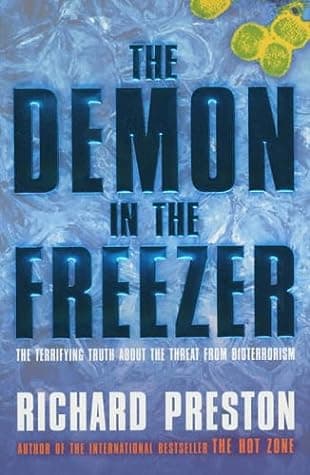
Core Idea
- Difficulty
- Medium
- Read it if
- You are fascinated by the intersection of virology, bioterrorism, public health policy, and the ethical dilemmas of modern science, presented with the tension of a thriller.
- Skip it if
- You prefer fictional thrillers over non-fiction accounts of scientific and historical events, or find detailed descriptions of diseases and biodefense topics unsettling.
Key Takeaways from The Demon in the Freezer
The Ghost of Smallpox
Eradicated, but not gone: the persistent threat of a weaponized historical plague.
Smallpox, eradicated in 1979, remains a threat because it could be used as a bioweapon. Even though it was eliminated globally, the virus still exists in official labs (CDC in Atlanta, Vector in Siberia) and, more concerning, in suspected illegal stashes held by hostile countries. The book shows scientists' fear that this contagious and deadly pathogen could be weaponized or genetically changed into a 'superpox' that existing vaccines cannot stop. This threat means constant watchfulness and research are needed, even for a virus thought to be a thing of the past. Eradication was a huge success, but storing samples, though needed for research, created a lasting weakness.
“The smallpox virus now resides, officially, in only two high-security freezers... But the demon in the freezer has been set loose.”
In the book: The existence of official smallpox stocks at the CDC and Vector, contrasted with the strong suspicion of illegal holdings by states like Iraq and North Korea, highlights the dual nature of its eradication – a public health triumph shadowed by a bioweapons nightmare.
Try this: Understand that 'eradicated' does not mean 'extinct' when it comes to biological agents, especially those with historical weaponization potential. Support funding for biodefense research and international treaties aimed at securing and destroying all remaining dangerous pathogens.
Related ideas: smallpox-eradication, bioweapons, viral-resurrection
The Anthrax Wake-Up Call
The 2001 anthrax attacks exposed critical gaps in national biodefense preparedness.
The anthrax attacks of October 2001 were a harsh wake-up call for the United States, showing that bioterrorism was a real danger. This event caused a major rethinking of national security, shifting attention and money towards biodefense. Before 9/11 and the anthrax letters, the US biodefense system was scattered and lacked funding. The attacks revealed weaknesses in public health response, intelligence gathering, and the creation of defenses. The book describes the urgent, often disorganized, response at places like USAMRIID, showing the immediate need for strong procedures, ways to diagnose diseases, and effective treatments against possible biological threats.
“The first major bioterror event in the United States... was a clarion call for scientists who work with 'hot' agents to find ways of protecting civilian populations against biological weapons.”
In the book: USAMRIID going into 'Delta Alert' on September 11th and activating emergency response teams immediately following the anthrax letters illustrates the rapid, high-stakes pivot in national security priorities and the sudden urgency thrust upon biodefense scientists.
Try this: Recognize that preparedness for 'black swan' events, especially in biodefense, requires sustained, proactive investment, not just reactive measures after an attack. Advocate for robust public health infrastructure and rapid-response capabilities.
Related ideas: anthrax-attacks, bioterrorism, national-biodefense
The Ethical Tightrope of Biodefense
Scientists grapple with the moral complexities of studying deadly pathogens to protect against them.
The book explores the ethical problems scientists like Peter Jahrling face when they work with the 'demons' they are trying to control. Bringing back live smallpox virus for research, even with top security, carries big risks and causes intense debate. Is it right to bring back an eradicated, deadly pathogen, possibly creating new dangers, to develop a defense? This conflict between the need to protect humanity from bioweapons and the risks of handling such agents is a main point. The book asks: at what point does defensive research accidentally help spread danger, or what if the virus escapes containment?
“Jahrling is leading a team of scientists doing controversial experiments with live smallpox virus at CDC... what may be at stake if his last bold experiment fails.”
In the book: Peter Jahrling's team conducting 'controversial experiments with live smallpox virus at CDC' directly illustrates the ethical tightrope walked by biodefense researchers. The mere act of reawakening the virus is a high-stakes gamble.
Try this: Engage in informed discussions about the ethics of 'dual-use research' – scientific work that can be used for both benevolent and malevolent purposes. Support stringent oversight and international cooperation to minimize risks while enabling crucial defensive research.
Related ideas: dual-use-research, bioethics, pathogen-containment
USAMRIID: The Biodefense Epicenter
Fort Detrick's complex history as both a bioweapons hub and a biodefense vanguard.
USAMRIID at Fort Detrick is a key, though historically complex, part of the US biodefense plan. Its past as the center of the US biological weapons program casts a long shadow, but its current role is only about protection. This shows a big change: from making offensive biological weapons to leading defensive countermeasures. The book presents USAMRIID as a high-stakes place where top scientists, like Peter Jahrling, work fast to create vaccines and treatments for the world's most dangerous pathogens. It is where advanced science meets national security, often under great pressure, especially after events like the anthrax attacks.
“Richard Preston takes us into the heart of Usamriid, the United States Army Medical Research Institute of Infectious Diseases at Fort Detrick, Maryland, once the headquarters of the U.S. biological weapons program and now the epicenter of national biodefense.”
In the book: The description of USAMRIID as 'once the headquarters of the U.S. biological weapons program and now the epicenter of national biodefense' encapsulates its complex history and current critical role.
Try this: Understand the importance of dedicated research institutions like USAMRIID in protecting against biological threats. Support the ongoing funding and security measures necessary for such facilities to operate effectively and safely.
Related ideas: usamriid, fort-detrick, biodefense-research
The Race Against Superpox
Genetic engineering's potential to create vaccine-resistant bioweapons demands urgent countermeasures.
One of the most frightening possibilities in the book is that hostile groups could genetically engineer a 'superpox' virus. This is not just about bringing back an old threat; it is about making the danger much worse. A smallpox strain made to resist existing vaccines would cancel out decades of public health successes and make current defenses useless. This situation puts huge pressure on scientists like Jahrling to create new antivirals and vaccines. This task requires understanding the virus at a genetic level and predicting possible changes. The arms race is not just about how much, but about quality and engineered deadliness.
“Jahrling is haunted by the thought that biologists in secret labs are using genetic engineering to create a new superpox virus, a smallpox resistant to all vaccines.”
In the book: The specific fear haunting Jahrling—that 'biologists in secret labs are using genetic engineering to create a new superpox virus, a smallpox resistant to all vaccines'—underscores the advanced and evolving nature of the bioweapons threat.
Try this: Support international efforts to monitor and regulate genetic engineering research to prevent its misuse. Invest in advanced scientific research to predict and counter potential engineered biothreats before they emerge.
Related ideas: superpox, genetic-engineering, antiviral-development
The Human Element of Hot Science
Behind the biohazards are dedicated, often eccentric, scientists driven by a profound sense of duty.
Preston makes the often-unknown world of biodefense human. Through people like Peter Jahrling, a virologist who worked on Ebola, the book shows the extraordinary individuals working at the forefront of this dangerous science. These are not anonymous researchers but dedicated professionals, often with unique personalities, who face big personal risks and work pressures. Their work needs not only brilliant scientific minds but also great courage, toughness, and a strong sense of responsibility to protect humanity. The book captures their daily lives, worries, and the excitement of solving viral mysteries, even with such high stakes.
“Peter Jahrling, the top scientist at Usamriid, a wry virologist who cut his teeth on Ebola, one of the world’s most lethal emerging viruses...”
In the book: The detailed characterization of Peter Jahrling, including his personality and his experience 'cutting his teeth on Ebola,' brings a crucial human dimension to the highly technical and dangerous field of virology and biodefense.
Try this: Appreciate the human cost and dedication involved in high-stakes scientific research, especially in fields like biodefense. Support programs that attract and retain top scientific talent in these critical areas.
Related ideas: virology, scientific-dedication, biodefense-personnel
Secrecy and Security
The extreme measures required to contain biological threats and the implications of ORCON clearance.
The world of biodefense is very secret, which is necessary given how catastrophic the agents involved can be. The book shows this through Peter Jahrling's ORCON security clearance, which gives him access to highly secret information on bioweapons. This level of secrecy shows the government's efforts to control sensitive information and keep it from falling into the wrong hands. However, it also brings up questions about transparency, public oversight, and the possibility of important information being kept separate. The security rules for labs handling pathogens like smallpox are extreme, showing the 'demon in the freezer's' danger and the constant fear of accidental release or theft.
“Peter Jahrling... has ORCON security clearance that gives him access to top secret information on bioweapons.”
In the book: Jahrling's ORCON security clearance, granting him access to 'top secret information on bioweapons,' exemplifies the extreme levels of secrecy and control surrounding biodefense intelligence and research.
Try this: Understand the delicate balance between necessary national security secrecy and public transparency in areas of high public risk. Advocate for robust internal oversight mechanisms within classified biodefense programs.
Related ideas: orcon-clearance, classified-information, biosecurity
The Ongoing FBI Investigation
The complex, protracted nature of bioterror investigations and the pursuit of accountability.
The book gives a rare look into the detailed and often difficult world of bioterrorism investigations, focusing on the FBI's efforts to track the anthrax attacks. Unlike regular crimes, bioterrorism leaves a unique and complex forensic trail, involving not just crime scene analysis but also microbiology, disease study, and national security intelligence. Preston's detailed account of the 'ongoing FBI investigation' shows how painstaking and multi-faceted these cases are. It reveals the difficulties of finding attackers, understanding their reasons, and preventing future attacks, all while dealing with scientific uncertainty and political pressure. Getting justice in such cases is a long process.
“Preston reports, in unprecedented detail, on the government’s response to the attacks and takes us into the ongoing FBI investigation.”
In the book: Preston's 'unprecedented detail' on the 'ongoing FBI investigation' into the anthrax attacks, based on interviews with top-level agents and Dr. Steven Hatfill, demonstrates the depth and complexity of these forensic and intelligence operations.
Try this: Appreciate the unique challenges of investigating bioterrorism and the need for specialized, interagency cooperation. Support resources for forensic science and intelligence gathering in the context of biological threats.
Related ideas: fbi-investigation, bioterrorism-forensics, intelligence-gathering
The Unseen Enemy
Biological weapons represent a threat that is invisible, insidious, and uniquely terrifying.
Biological weapons are different from conventional or nuclear threats because they are often invisible, silent, and can spread secretly before their effects are even known. This makes them especially terrifying. The 'demon in the freezer' comparison perfectly describes this unseen, hidden danger. Unlike a bomb, a virus can copy itself and spread quickly, turning people into unknowing carriers. The book highlights the psychological effect of such a threat, where fear and uncertainty can be as harmful as the pathogen itself. This requires a different kind of defense, one focused on finding threats early, responding quickly, and communicating with the public, in addition to medical treatments.
“The demon in the freezer has been set loose. It is almost certain that illegal stocks are in the possession of hostile states...”
In the book: The description of smallpox as 'the demon in the freezer' that 'has been set loose' encapsulates the invisible, insidious nature of biological threats, which can emerge from hidden sources and spread silently.
Try this: Cultivate critical thinking and avoid panic when faced with public health crises. Support robust public health communication strategies that balance transparency with reassurance during biological threats.
Related ideas: invisible-threat, pathogen-spread, public-health-communication
The Demon in the Freezer Quotes
“Smallpox is the worst disease ever to afflict humanity.”
“The demon in the freezer is smallpox, and it is waiting.”
“A single case of smallpox would be a global emergency.”
“The virus is a masterpiece of malevolent evolution.”
“We eradicated smallpox from the wild, but we kept it alive in laboratories.”
“Bioterrorism is not a future threat; it is a present reality.”
“The smallpox vaccine is a story of both triumph and tragedy.”
“In the wrong hands, smallpox could be the ultimate weapon.”
“The World Health Organization's eradication campaign was a feat of human cooperation.”
“Viruses do not respect borders.”
“We are playing with fire by keeping smallpox samples.”
“The memory of smallpox is fading, and with it, our vigilance.”
“A bioterror attack with smallpox would collapse healthcare systems.”
“Science gave us the power to eradicate smallpox, and science keeps it alive.”
Quiz
10 questions on the main ideas. Each answer comes with a short explanation.
Question 1
What is the primary setting and focus of 'The Demon in the Freezer'?
- The Centers for Disease Control in Atlanta and its public health initiatives
- Usamriid at Fort Detrick and the national biodefense efforts against biological weapons
- The FBI headquarters and its counterterrorism operations
- Russian virology institutes and their smallpox research
Show answer
B. Usamriid at Fort Detrick and the national biodefense efforts against biological weapons The book centers on Usamriid (United States Army Medical Research Institute of Infectious Diseases) at Fort Detrick, Maryland, which is described as the epicenter of national biodefense, focusing on protecting civilians from biological weapons like anthrax and smallpox.
Question 2
Who is Peter Jahrling and what is his main goal in the book?
- An FBI agent investigating the anthrax attacks
- A journalist reporting on bioterrorism events
- The top scientist at Usamriid aiming to develop a drug to combat smallpox
- A Russian virologist working at Vector Institute
Show answer
C. The top scientist at Usamriid aiming to develop a drug to combat smallpox Peter Jahrling is a wry virologist and the top scientist at Usamriid with ORCON security clearance. His most urgent priority is to develop a drug that can effectively treat smallpox, as he is haunted by the threat of engineered superpox viruses.
Question 3
According to the book, where are the official stocks of smallpox virus stored?
- Only at the CDC in Atlanta
- At the CDC in Atlanta and at Vector in Siberia
- In multiple secret labs across the United States
- Exclusively at Usamriid in Fort Detrick
Show answer
B. At the CDC in Atlanta and at Vector in Siberia The book states that smallpox was eradicated in 1979, and officially, the virus resides in only two high-security freezers: at the Centers for Disease Control in Atlanta and at Vector, a Russian virology institute in Siberia.
Question 4
What event prompted Usamriid to go into a state of Delta Alert?
- The discovery of illegal smallpox stocks in North Korea
- The September 11 terrorist attacks
- The first successful smallpox vaccination campaign
- A lab accident involving Ebola virus
Show answer
B. The September 11 terrorist attacks Usamriid went into Delta Alert on September 11, 2001, and later activated emergency response teams when anthrax letters were opened, highlighting the heightened biodefense measures following the terrorist attacks.
Question 5
What is the 'demon in the freezer' metaphor referring to in the book?
- The anthrax bacteria used in the 2001 attacks
- The smallpox virus and its potential as a biological weapon
- A fictional monster created for the thriller narrative
- The Ebola virus stored at Usamriid
Show answer
B. The smallpox virus and its potential as a biological weapon The 'demon in the freezer' symbolizes the smallpox virus, which, despite being officially contained, is feared to be in illegal stocks and could be engineered into a superpox virus, posing a grave bioterrorism threat.
Question 6
Why is Jahrling concerned about biologists in secret labs?
- They might accidentally release viruses during experiments
- They are using genetic engineering to create vaccine-resistant smallpox strains
- They are collaborating with Usamriid without proper oversight
- They are hoarding anthrax for personal research
Show answer
B. They are using genetic engineering to create vaccine-resistant smallpox strains Jahrling is haunted by the thought that biologists in secret labs are using genetic engineering to create a new superpox virus—a smallpox strain resistant to all vaccines—which underscores the book's theme of emerging bioweapon threats.
Question 7
What controversial experiments is Jahrling leading at the CDC?
- Testing anthrax vaccines on human volunteers
- Reawakening live smallpox virus for research purposes
- Developing biological weapons for defensive testing
- Investigating the origins of the Ebola virus
Show answer
B. Reawakening live smallpox virus for research purposes Jahrling leads a team doing controversial experiments with live smallpox virus at the CDC, reawakening it to study and develop countermeasures, which raises ethical and safety concerns as detailed in the book.
Question 8
Which of the following is NOT a source for Preston's reporting in the book?
- Interviews with top-level FBI agents
- Direct observations at Vector Institute in Siberia
- Interviews with Dr. Steven Hatfill
- Government reports on the anthrax attacks
Show answer
B. Direct observations at Vector Institute in Siberia Preston's reporting is based on interviews with FBI agents and Dr. Steven Hatfill, and government responses, but the book does not mention him conducting direct observations at Vector; it references Vector as a storage site for smallpox.
Question 9
What is the significance of ORCON security clearance for Jahrling?
- It allows him to publish his research without peer review
- It grants him access to top secret information on bioweapons
- It enables him to travel freely to hostile states like Iraq
- It exempts him from following lab safety protocols
Show answer
B. It grants him access to top secret information on bioweapons ORCON (Originator Controlled) security clearance gives Jahrling access to top secret information on biological weapons, which is crucial for his role in biodefense research and understanding threats like smallpox.
Question 10
How does the book frame the anthrax attacks of October 2001 in relation to biodefense?
- As a minor incident that was quickly resolved by local authorities
- As the first major bioterror event in the U.S., spurring urgent scientific efforts to protect civilians
- As a hoax designed to test government response systems
- As an isolated event with no lasting impact on biodefense policies
Show answer
B. As the first major bioterror event in the U.S., spurring urgent scientific efforts to protect civilians The book describes the anthrax attacks as the first major bioterror event in the United States, serving as a clarion call for scientists to enhance biodefense measures and protect civilian populations against biological weapons.
The Demon in the Freezer FAQ
What is 'The Demon in the Freezer' about?
The book is a nonfiction thriller that explores bioterror threats, focusing on the 2001 anthrax attacks and the ongoing danger of smallpox. It follows scientists at USAMRIID as they work to defend against biological weapons, detailing secret research and government responses.
Does 'The Demon in the Freezer' discuss real bioterror events?
Yes, it extensively covers the 2001 anthrax attacks in the U.S. as a major bioterror event, along with the historical context of smallpox eradication and current risks from illegal stockpiles in hostile states like Iraq and North Korea.
What is USAMRIID?
USAMRIID is the United States Army Medical Research Institute of Infectious Diseases at Fort Detrick, Maryland. It was once the center of the U.S. biological weapons program and is now the national hub for biodefense research against agents like anthrax and smallpox.
How different is 'The Demon in the Freezer' from 'The Hot Zone'?
While both by Richard Preston and focus on deadly viruses, 'The Demon in the Freezer' centers on bioterrorism and man-made threats like anthrax and smallpox, whereas 'The Hot Zone' deals with natural outbreaks of Ebola. The newer book emphasizes government and scientific responses to intentional attacks.
Does smallpox still exist?
Officially, smallpox was eradicated in 1979, with known stocks stored only at the CDC in Atlanta and Vector in Siberia. However, the book warns that illegal stocks likely exist in hostile states, and genetic engineering could create new, vaccine-resistant strains.
What is the 'Delta Alert' mentioned in the book?
Delta Alert is a high-security state activated by USAMRIID after 9/11 and during the anthrax attacks. It involves mobilizing emergency response teams to handle bioterror threats, showcasing the institute's role in national defense against biological weapons.
How does the book address the anthrax attacks?
It provides detailed reporting on the 2001 anthrax attacks, including the government's response and FBI investigations. Based on interviews with top agents and figures like Dr. Steven Hatfill, it reveals the challenges in managing such bioterror events.
What is Peter Jahrling's role in the book?
Peter Jahrling is a top virologist at USAMRIID with high security clearance. He leads controversial experiments with live smallpox virus at the CDC, aiming to develop treatments against potential superpox strains, highlighting the ethical dilemmas in biodefense research.
Does 'The Demon in the Freezer' suggest bioterror is a current threat?
Yes, it argues that bioterror remains a serious threat, with illegal smallpox stocks and genetically engineered viruses posing risks. The book urges vigilance and scientific innovation to protect civilian populations from future attacks.
How does the book compare bioterror to natural pandemics?
It contrasts bioterror as an intentional, man-made threat (e.g., anthrax attacks) with natural pandemics like Ebola. The focus is on how human actions, such as weaponizing viruses, create unique dangers that require specialized defense strategies.
Similar books
- Angels & Demons
Dan Brown
3.9 (2.7M) average on GoodreadsThrillerA Harvard symbologist races through Rome's ancient sites, deciphering cryptic clues to unmask the Illuminati and stop a vengeful plot to destroy the Vatican with a stolen antimatter weapon.
- Gone Girl
Gillian Flynn
4.1 (2.3M) average on GoodreadsThrillerA wife's sudden disappearance on her fifth anniversary reveals a web of lies and psychological warfare, exposing the secrets within a seemingly perfect marriage.
- The Girl on the Train
Paula Hawkins
3.9 (2.1M) average on GoodreadsThrillerA woman’s fascination with a seemingly perfect couple she watches from her daily train commute leads her into a dark investigation when she witnesses something that shatters their idyllic image.
- The Da Vinci Code
Dan Brown
3.9 (1.9M) average on GoodreadsThrillerA symbologist and a cryptologist race through European landmarks, deciphering ancient codes and uncovering a conspiracy that could rewrite the foundations of Christianity.
- The Guest List
Lucy Foley
3.8 (1.3M) average on GoodreadsThrillerOn a remote Irish island, a glamorous wedding descends into a deadly whodunnit when a guest is found murdered, trapping everyone with their secrets as a storm rages.
- The Shining
Stephen King
4.2 (1.1M) average on GoodreadsThrillerA recovering alcoholic accepts a caretaking job at a snow-bound, haunted hotel, where his son's psychic abilities reveal the sinister forces that drive him to madness and terrorize his family.






Enjoyed the summary?
A summary gives you the shape of the book. The book itself has the detail, the examples and the voice.
Find The Demon in the Freezer on AmazonAs an Amazon Associate, BookBrief earns from qualifying purchases. How we're funded