
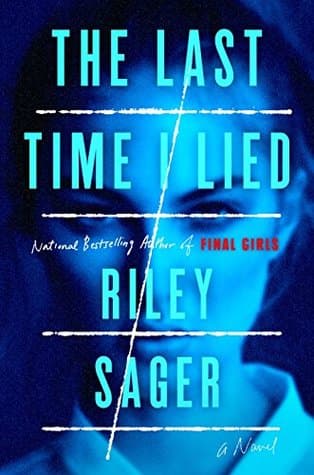
Synopsis
Covers the whole plot, including the ending.
- Difficulty
- Medium
- Pacing
- Moderate
- Mood
- Suspenseful, Mysterious, Eerie, Unsettling
- Read it if
- You love twisty, psychological thrillers with unreliable narrators, a camp setting, and a cold case mystery.
- Skip it if
- You prefer fast-paced action over slow-burn suspense and character-driven internal monologues.
The Last Time I Lied Plot Summary
Covers the whole plot, including the ending.
The Disappearance at Camp Nightingale
Fifteen years ago, a young Emma Davis attends Camp Nightingale for the first time. She shares a cabin with three older campers: Vivian, Natalie, and Allison. One night, after playing 'Two Truths and a Lie,' Emma wakes to see the other three girls quietly leaving the cabin. Vivian, the leader, turns back, shushes Emma, and closes the door. Emma falls back asleep, thinking they are playing a prank. The next morning, the girls are gone without a trace. A large search begins, but Vivian, Natalie, and Allison are never found, and the mystery closes the camp.
A Painting Instructor's Return
Fifteen years later, Emma Davis is a successful artist in New York City, known for her eerie landscape paintings with ghostly figures in white dresses, inspired by her past at Camp Nightingale. Francesca Harris-White, the wealthy owner of Camp Nightingale, sees Emma's work and recognizes the connection. Francesca, who inherited the camp, is reopening it and invites Emma to be a painting instructor for the summer. Emma accepts, seeing a chance to find out what happened, despite her fears and the dark memories the camp brings back.
Haunted Memories and Cryptic Clues
When Emma arrives at the newly renovated Camp Nightingale, she is assigned the same cabin she shared with Vivian, Natalie, and Allison. The camp feels familiar yet subtly changed. She soon finds a hidden security camera pointed directly at her cabin, making her question Francesca's real reasons for inviting her. As she moves around the camp, Emma starts having clear flashbacks and finds clues left by Vivian, including strange symbols and notes hidden in books. These clues hint at a darker history for the camp than she imagined and suggest Vivian knew more than she let on.
The Camp's Dark History Unveiled
Emma looks into the camp's records and local history, putting together the story of the Harris-White family. She learns about the original founders, a private couple, and discovers that the camp was not just a summer retreat but had a more cult-like past, especially with the 'White Dresses' girls' program, which focused on purity. Vivian's clues become more important, showing that the disappearance was not random but linked to the camp's hidden rituals and the Harris-White family's secrets. This suggests the girls found something they shouldn't have.
A Web of Deceit
As Emma continues her investigation, she confronts Francesca, who remains vague and defensive, her answers often conflicting. Emma also talks with other long-time camp staff, like the groundskeeper, who seem to know more than they say and are very loyal to Francesca. The security camera, the locked rooms, and the atmosphere of secrecy convince Emma that Francesca is covering something up, either to protect the camp's reputation or to hide her own involvement. Emma feels more isolated and threatened, realizing she is part of a dangerous situation.
The Truth of the Game
Through fragmented memories and Vivian's clues, Emma reconstructs the night of the disappearance. She remembers the last game of 'Two Truths and a Lie' they played. Vivian's 'lie' was actually a truth: 'I know a secret about this camp that could get us all killed.' This changes Emma's understanding, suggesting the girls were not just playing but were investigating something dangerous. The game becomes a key piece, revealing Vivian's desperate attempt to warn Emma and her friends about the danger they faced.
The Unmasking of the Perpetrator
Emma finally confronts Francesca, sharing all her discoveries about the camp's dark history and the Harris-White family's role. It is revealed that Francesca's mother, a former 'White Dresses' girl, was part of a twisted ritual and that Francesca was involved in keeping the secret. The disappearance of Vivian, Natalie, and Allison was not an accident, but a move to silence them after they uncovered the truth about the camp's past and its ongoing sinister practices, possibly involving the trafficking of young girls under the guise of an elite program.
A Deadly Confrontation
The confrontation escalates, and Emma is in danger. Francesca, desperate to protect her family's legacy and her own role, tries to silence Emma for good. A struggle happens within the isolated camp, mirroring the terror of Emma's childhood. Emma uses her intelligence and knowledge of the camp's layout to escape Francesca, fighting for her life against the woman who has been planning to cover up the past for years. The final confrontation brings Emma face-to-face with the deadly results of her investigation.
The Final Revelation
In a key moment, Emma's repressed memories return, revealing the complete truth of what happened fifteen years ago. It was not just Vivian, Natalie, and Allison who left the cabin; Emma herself, in a sleepwalking state from a drugged drink, was a witness, and perhaps an unwitting participant, in a ritual abduction. The 'White Dresses' were not just a uniform but a symbol of the girls chosen for these dark purposes. Emma realizes that a cult-like group within the camp, led by members of the Harris-White family, took the girls, and her memory was suppressed to protect those responsible.
Justice and Aftermath
Having fully recovered her memories and survived the ordeal, Emma gathers clear evidence against Francesca and the Harris-White family. The truth about the cult activities, the trafficking of girls, and the cover-up of the original disappearance is finally revealed. Francesca and her accomplices are arrested, and the dark legacy of Camp Nightingale comes to light. Emma, though deeply scarred, finds some peace. She continues her art, now with a new understanding of her past, turning her trauma into powerful, honest storytelling through her paintings, ensuring the truth is not forgotten.
The Last Time I Lied Characters
Emma Davis
Protagonist
A reclusive artist haunted by the disappearance of her friends at Camp Nightingale.
Emma is a talented artist who channels her childhood trauma into her work, creating evocative, dark paintings. She is introverted, observant, and driven by a deep-seated need for truth and closure regarding the vanishing of her friends. Despite her fears, she possesses a quiet resilience and a sharp intellect, which she uses to unravel the complex mystery of Camp Nightingale. Her past has left her with repressed memories and a cautious nature.
Relationships: Vivian (Closest friend and cabinmate at camp, a mentor figure.); Natalie (Cabinmate and friend at camp.); Allison (Cabinmate and friend at camp.); Francesca Harris-White (Camp owner, initially an employer/patron, later antagonist.)
Vivian
Supporting/Victim
The charismatic leader of the cabin, whose clues guide Emma's investigation.
Vivian was the oldest and most dominant girl in Emma's cabin at Camp Nightingale. She was intelligent, perceptive, and had a strong sense of curiosity, often pushing boundaries. She was the one who initially uncovered the dark secrets of Camp Nightingale and attempted to warn her friends. Her actions and cryptic messages from the past serve as the primary breadcrumbs for Emma's investigation, revealing her bravery and her tragic fate.
Relationships: Emma Davis (Friend and cabinmate; she tried to protect Emma.); Natalie (Friend and cabinmate.); Allison (Friend and cabinmate.)
Francesca Harris-White
Antagonist
The wealthy owner of Camp Nightingale, determined to protect its dark secrets.
Francesca is a sophisticated and manipulative socialite who inherited Camp Nightingale. She projects an image of benevolence and charm, but beneath it lies a ruthless determination to preserve her family's legacy and conceal the camp's disturbing history. She is cunning and controlling, inviting Emma back under false pretenses to monitor her, and resorting to extreme measures to prevent the truth from coming out. Her motivations are deeply rooted in family loyalty and a desire to maintain power.
Relationships: Emma Davis (Employer and manipulator, later adversary.); Her Family (Deeply loyal to her family's legacy and secrets.)
Natalie
Supporting/Victim
One of the three girls who disappeared with Vivian and Allison.
Natalie was one of the older girls in Emma's cabin. She is depicted as being a bit more reserved than Vivian but still part of the tight-knit trio. Her personality is less explored than Vivian's, but she is significant as one of the missing girls whose fate drives Emma's quest for answers. Her disappearance is a key part of the central mystery, representing the lost innocence of the camp.
Relationships: Emma Davis (Cabinmate and friend.); Vivian (Friend and cabinmate.); Allison (Friend and cabinmate.)
Allison
Supporting/Victim
Another of the three girls who vanished from Camp Nightingale.
Allison was the third of the older girls in Emma's cabin who disappeared. Like Natalie, her individual personality is less detailed, but she is crucial to the overarching mystery. She is part of the collective trauma that Emma experienced, and her absence fuels Emma's relentless pursuit of the truth. Her role is to represent another piece of the puzzle, another life tragically cut short by the camp's sinister activities.
Relationships: Emma Davis (Cabinmate and friend.); Vivian (Friend and cabinmate.); Natalie (Friend and cabinmate.)
The Groundsman
Supporting
A long-time camp employee who knows more than he lets on.
The groundsman is a quiet, stoic figure who has been working at Camp Nightingale for many years. He is fiercely loyal to the Harris-White family and the camp, often appearing suspicious and evasive when Emma asks questions. He represents the older generation's complicity in maintaining the camp's secrets and its dark legacy. His presence adds to the unsettling atmosphere and Emma's sense of being watched.
Relationships: Francesca Harris-White (Loyal employee.)
The Last Time I Lied Themes
The Trauma of Repressed Memory
The novel explores how traumatic events can be suppressed and how their return affects a person. Emma's inability to fully remember the night her friends disappeared is central to the mystery. Her art is an unconscious way for her to express these buried memories, and her return to Camp Nightingale forces her to face and unlock the full truth, showing how the mind protects itself and the pain of remembering. This appears in her fragmented flashbacks and the symbolic nature of her paintings.
“Sometimes the past is a ghost. Sometimes it’s a monster.”
The Deceptive Nature of Appearances
Camp Nightingale, which looks like a perfect summer retreat, hides a sinister history. Similarly, Francesca Harris-White, appearing as a kind patron, is revealed to be a ruthless antagonist. The 'Two Truths and a Lie' game itself works as a metaphor for this theme, where what seems true is a lie, and the hidden 'lie' holds the key to reality. This theme highlights the idea that beauty can hide evil, challenging the reader to look beyond the surface, as Emma must do to find the truth.
“The biggest lies are often told in silence.”
The Power of Art as Therapy and Truth-Telling
Emma's art is not just a job but a coping mechanism and a way to process her trauma. Her paintings, with their dark trees and ghostly figures, directly show her repressed memories and anxieties. By returning to the camp and investigating, her art changes from reflecting trauma to being a tool for discovery, as her insights from painting help her interpret clues and understand hidden stories. Ultimately, her art helps expose the truth and ensure justice.
“My paintings were always about the missing girls. They just didn’t know it yet.”
The Corruption of Innocence
The novel shows the loss of innocence for both Emma and the missing girls. Camp Nightingale, a place usually linked with childhood joy, is corrupted by dark rituals, manipulation, and the exploitation of young girls. The 'White Dresses' program, first presented as a path to purity, is shown to be a sinister front. The disappearance of Vivian, Natalie, and Allison represents the ultimate violation of childhood innocence, and Emma's journey aims to bring some justice for that lost purity.
“Camp Nightingale was supposed to be a place of sunshine and laughter. Instead, it became a graveyard of secrets.”
Plot Devices & Literary Techniques
Unreliable Narrator (Memory Suppression)
Emma's fragmented and repressed memories obscure the full truth of the past.
Emma Davis serves as an unreliable narrator due to her repressed memories of the night her friends disappeared. Her trauma has caused her to block out crucial details, leading her (and the reader) to initially believe a simpler, less sinister version of events. This device creates suspense and allows for a shocking revelation as her memories slowly return, challenging everything she thought she knew and forcing a re-evaluation of earlier clues and character interactions. It highlights the psychological impact of trauma.
The 'Two Truths and a Lie' Game
A seemingly innocent game that foreshadows the novel's central theme of deception.
The children's game 'Two Truths and a Lie' is a recurring motif and a significant plot device. It directly relates to the novel's core theme of deception and hidden truths. Vivian's final 'lie' in the game turns out to be a crucial truth, acting as a direct clue left for Emma. The game’s structure mirrors the narrative itself, where the reader must discern what is real and what is fabricated, both in Emma's memories and in the present-day events at Camp Nightingale.
Cryptic Clues and Foreshadowing
Hidden messages and unsettling details hint at the camp's dark past.
The novel employs numerous cryptic clues, primarily left by Vivian, such as symbols, notes in books, and seemingly innocuous statements that take on new meaning as Emma investigates. Additionally, unsettling details in the present-day camp, like the hidden security camera and the groundsman's evasiveness, serve as foreshadowing. These elements build suspense, guide Emma's investigation, and slowly reveal the sinister nature of Camp Nightingale and the Harris-White family, allowing the reader to piece together the mystery alongside the protagonist.
The Isolated Setting (Camp Nightingale)
The remote camp creates a claustrophobic and vulnerable atmosphere.
The remote and isolated setting of Camp Nightingale is a classic thriller device. Its distance from civilization enhances the sense of vulnerability and claustrophobia for Emma, especially as she uncovers its dark secrets. The natural surroundings, while beautiful, also contribute to the eerie atmosphere, making escape feel difficult. This isolation allows the antagonists to operate with less scrutiny and heightens the stakes for Emma as she realizes she is trapped within the very place that holds the key to her trauma.
The Last Time I Lied Quotes
“There are three sides to every story: yours, mine, and the truth.”
“Every lie we tell creates a debt, and that debt eventually has to be paid.”
“The past is never really past. It’s always there, lurking, waiting to pounce.”
“Sometimes the things we think we remember aren't what actually happened.”
“Grief is a funny thing. It sneaks up on you when you least expect it, even years later.”
“We all have secrets. Some are just buried deeper than others.”
“Fear has a way of making you see things that aren't there, and ignore the things that are.”
“The only thing worse than a lie is the truth you don't want to hear.”
“Some friendships are forged in fire, and some are just destined to burn.”
“You can run from your past, but you can't outrun it.”
“The mind is a powerful thing. It can protect you, but it can also betray you.”
“Sometimes the most dangerous people are the ones who seem the most harmless.”
“A secret is only a secret if you keep it to yourself.”
“The truth is rarely simple, and often much messier than we want it to be.”
Quiz
10 questions on the plot and the characters. Each answer comes with a short explanation.
Question 1
What was the name of the camp where Emma Davis and her friends went missing?
- Camp Evergreen
- Camp Nightingale
- Camp Whispering Pines
- Camp Shadowbrook
Show answer
B. Camp Nightingale The book explicitly states that the camp was called Camp Nightingale, and Emma returns there years later.
Question 2
What artistic medium does Emma Davis use to depict her past experiences at Camp Nightingale?
- Sculptures of cabins
- Charcoal sketches of the woods
- Massive canvases with dark leaves and ghostly shapes
- Photographs of old camp artifacts
Show answer
C. Massive canvases with dark leaves and ghostly shapes Emma's artistic success comes from her large paintings 'filled with dark leaves and gnarled branches that cover ghostly shapes in white dresses.'
Question 3
Who is Francesca Harris-White in relation to Camp Nightingale?
- A former camp counselor
- Emma's art dealer
- The socialite and wealthy owner of the camp
- A detective investigating the disappearances
Show answer
C. The socialite and wealthy owner of the camp Francesca Harris-White is described as the 'socialite and wealthy owner of Camp Nightingale' who recognizes Emma's paintings.
Question 4
What was the last thing Emma saw Vivian do before she disappeared?
- Waving goodbye from the dock
- Closing the cabin door and hushing Emma with a finger to her lips
- Leaving a note on Emma's bed
- Walking into the woods with a flashlight
Show answer
B. Closing the cabin door and hushing Emma with a finger to her lips The text states, 'The last she—or anyone—saw of them was Vivian closing the cabin door behind her, hushing Emma with a finger pressed to her lips.'
Question 5
What is the primary reason Emma agrees to return to Camp Nightingale as a painting instructor?
- To escape her life in New York
- To gain inspiration for new artwork
- To try to find out what really happened to her friends
- To earn a substantial amount of money
Show answer
C. To try to find out what really happened to her friends Emma sees her return as 'an opportunity to try to find out what really happened to her friends,' which is her main motivation.
Question 6
What unsettling discovery does Emma make regarding her cabin upon returning to Camp Nightingale?
- It has been completely renovated and is unrecognizable.
- There is a security camera pointed directly at it.
- Another group of campers has already occupied it.
- It contains old belongings of her missing friends.
Show answer
B. There is a security camera pointed directly at it. Upon her return, Emma 'discovers a security camera pointed directly at her cabin,' adding to the camp's eerie atmosphere.
Question 7
What game did Emma and her friends play regularly in their cabin?
- Hide and Seek
- Truth or Dare
- Two Truths and a Lie
- Never Have I Ever
Show answer
C. Two Truths and a Lie The description specifically mentions, 'Two Truths and a Lie. The girls played it all the time in their tiny cabin at Camp Nightingale.'
Question 8
What kind of clues does Emma find that Vivian left behind?
- A diary detailing their plans to run away
- Cryptic clues about the camp's twisted origins
- Sketches of the person who took them
- Letters addressed to her parents
Show answer
B. Cryptic clues about the camp's twisted origins Emma finds 'cryptic clues Vivian left behind about the camp's twisted origins,' indicating a deeper mystery.
Question 9
What is a central theme explored through Emma's investigation at Camp Nightingale?
- The importance of friendship above all else
- The struggle between artistic expression and commercial success
- The difficulty of discerning truth from lies when facing past events and present threats
- The healing power of nature and solitude
Show answer
C. The difficulty of discerning truth from lies when facing past events and present threats The narrative emphasizes Emma 'sorting through lies from the past while facing threats from both man and nature in the present,' highlighting the theme of truth vs. lies.
Question 10
What potential consequence does Emma face as she gets closer to the truth about Camp Nightingale?
- Losing her reputation as an artist
- A deadly price
- Forgetting her friends' faces
- Being forced to reopen the camp permanently
Show answer
B. A deadly price The summary concludes with, 'And the closer she gets to the truth about Camp Nightingale, the more she realizes it may come at a deadly price.'
The Last Time I Lied FAQ
What is the central mystery Emma Davis is trying to solve?
Emma Davis is attempting to uncover what truly happened to her cabin mates, Vivian, Natalie, and Allison, who vanished from Camp Nightingale fifteen years prior. She was the only one left behind and has carried the burden of their disappearance ever since, using her art as a way to process the trauma.
Who is Francesca Harris-White and what is her role in Emma's return to Camp Nightingale?
Francesca Harris-White is the wealthy socialite and owner of Camp Nightingale. She invites Emma back to the newly reopened camp as a painting instructor after seeing her art, which prominently features the camp's imagery. Her true motives are initially unclear, but she plays a pivotal role in bringing Emma back to the source of her trauma.
What is the 'Two Truths and a Lie' game and how does it relate to the book's title and themes?
The 'Two Truths and a Lie' game was a favorite pastime for Emma and her friends at Camp Nightingale, where players state three 'facts' and others guess the lie. This game directly mirrors the book's central theme of deception and the difficulty of discerning truth from falsehood, both in the past and present narratives, making everyone's accounts suspect.
What kind of art does Emma create, and how does it connect to her past?
Emma creates large-scale paintings filled with dark leaves and gnarled branches that obscure ghostly figures in white dresses. These recurring motifs are direct representations of her repressed memories and the enduring trauma of her friends' disappearance at Camp Nightingale, making her art a visual diary of her unresolved past.
What is the significance of Vivian's cryptic clues about Camp Nightingale's origins?
Vivian's cryptic clues hint at a much darker, twisted history behind Camp Nightingale than initially perceived. These clues suggest that the camp itself holds secrets and may have been involved in more than just the girls' disappearance, pushing Emma to investigate the institution's past, not just the individuals involved.
How does the 'sleeping pill' revelation impact Emma's reliability as a narrator?
The revelation that Emma was regularly given sleeping pills by her mother before camp, and possibly during, significantly undermines her reliability as a narrator. It suggests her memories of the night the girls disappeared could be hazy, fragmented, or even partially fabricated due to the drug's influence, making her own recollections suspect.
What hidden motive does Vivian have for orchestrating the girls' disappearance?
Vivian, driven by a desire to expose the abuses and dark secrets of Camp Nightingale, orchestrated the girls' disappearance as a dramatic statement. She believed that by making them vanish, she could force the truth about the camp's owner and the past events to come to light, even if it meant sacrificing their normal lives.
What is the true identity of 'Allison' and how does this affect Emma's understanding of the past?
The true identity of 'Allison' is revealed to be someone else entirely, a girl who was actually held captive by Vivian. This shocking twist means that one of Emma's core memories of her friends is a fabrication, forcing her to re-evaluate every detail of that fateful night and question who was truly involved.
How does the security camera pointed at Emma's cabin in the present day parallel and contrast with the past events?
The security camera pointed at Emma's cabin in the present creates a chilling parallel to her feeling of being watched and targeted, mirroring the vulnerability she experienced as a child. It contrasts with the past, however, by suggesting a deliberate, active threat from a known entity, rather than the mysterious disappearance of her friends.
How does Emma's artistic process serve as a coping mechanism for her trauma?
Emma's artistic process allows her to externalize and confront her deeply buried trauma. By painting the dark leaves, gnarled branches, and ghostly figures, she's visually processing her fragmented memories and emotions, giving form to her fears and enabling her to slowly piece together the truth without directly reliving it.
Discuss the psychological impact of survivor's guilt on Emma throughout the narrative.
Emma suffers profoundly from survivor's guilt, believing she was responsible for her friends' disappearance or that she should have done more. This guilt manifests as recurring nightmares, an obsession with the past, and a desperate need to find answers, driving her actions and coloring her perceptions of events.
How does the author use Emma's fragmented memories to build suspense and psychological tension?
The author masterfully uses Emma's fragmented, unreliable memories to create pervasive suspense and psychological tension. By presenting events through Emma's hazy recollection, the reader is constantly uncertain of what is real, mirroring Emma's own confusion and enhancing the sense of mystery and unease.
Analyze the theme of manipulation and betrayal as it applies to Vivian's actions.
Vivian's actions are deeply rooted in manipulation and betrayal, as she orchestrates a complex plan that deceives her friends and Emma. While her ultimate goal might have been to expose the camp, her methods involve lying to and endangering her closest companions, highlighting the morally ambiguous nature of her 'justice'.
To what extent is Emma's initial perception of Vivian as a caring friend accurate, and how does it evolve?
Emma initially perceives Vivian as a protective and caring friend, a leader within their group. This perception is shattered as Emma uncovers Vivian's manipulative plan and the extent of her deception, forcing Emma to confront the painful reality that her 'friend' was willing to sacrifice others for her own agenda.
Could Emma have truly prevented the girls' disappearance, or was she an unwitting pawn in a larger scheme?
While Emma carries immense guilt, she was largely an unwitting pawn in Vivian's elaborate scheme. As the youngest and most impressionable, she was easily manipulated and her sleepiness further ensured her compliance. Her ability to prevent the events was severely limited by her age and Vivian's meticulous planning.
Discuss the moral ambiguity of Vivian's actions. Was she a hero seeking justice or a villain who endangered her friends?
Vivian's actions present significant moral ambiguity. She aimed to expose a corrupt system and protect future campers, which could be seen as heroic. However, her willingness to manipulate, lie to, and endanger her friends, including a child, for her cause casts her as a morally complex figure, blurring the lines between hero and villain.
How does the setting of Camp Nightingale contribute to the overall atmosphere and themes of the novel?
Camp Nightingale, initially a place of childhood innocence, transforms into a claustrophobic and menacing setting. Its isolation, natural beauty concealing dark secrets, and the pervasive sense of history create an oppressive atmosphere that enhances themes of lost innocence, hidden truths, and the inescapable past.
What is the significance of the 'threats from both man and nature' mentioned in the synopsis?
The 'threats from both man and nature' signify the multifaceted dangers Emma faces. 'Man' refers to the human antagonists like Francesca and the conspirators involved in the camp's past, while 'nature' alludes to the oppressive, isolated wilderness of Camp Nightingale, which itself becomes a character, hindering Emma's progress and intensifying her fear.
How does the ending challenge or confirm the reader's understanding of truth and perception throughout the book?
The ending significantly challenges the reader's understanding of truth and perception by revealing how deeply manipulated Emma's memories were and how many layers of deception existed. It confirms that truth is often subjective and easily distorted, forcing the reader to re-evaluate every 'fact' presented earlier in the narrative.
About the author

Riley Sager is an author known for his suspenseful fiction, often featuring intricate plots and psychological twists. His notable works include "Lock Every Door," "The Last Time I Lied," and "Home Before Dark," which have garnered attention for their gripping narratives and engaging characters. Sager's writing often explores themes of mystery and the complexities of human relationships.
Similar books
- Then She Was Gone
Lisa Jewell
4.0 (209k) average on GoodreadsThrillerExplores a mother's fifteen-year search for her missing daughter, blending past and present narratives.
- The Woman in Cabin 10
Ruth Ware
3.7 (375k) average on GoodreadsThrillerA thriller set in an isolated location (a cruise ship) where the protagonist witnesses a possible murder that no one believes.
- Angels & Demons
Dan Brown
3.9 (2.7M) average on GoodreadsThrillerA Harvard symbologist races through Rome's ancient sites, deciphering cryptic clues to unmask the Illuminati and stop a vengeful plot to destroy the Vatican with a stolen antimatter weapon.
- Gone Girl
Gillian Flynn
4.1 (2.3M) average on GoodreadsThrillerA wife's sudden disappearance on her fifth anniversary reveals a web of lies and psychological warfare, exposing the secrets within a seemingly perfect marriage.
- The Girl on the Train
Paula Hawkins
3.9 (2.1M) average on GoodreadsThrillerA woman’s fascination with a seemingly perfect couple she watches from her daily train commute leads her into a dark investigation when she witnesses something that shatters their idyllic image.
- The Da Vinci Code
Dan Brown
3.9 (1.9M) average on GoodreadsThrillerA symbologist and a cryptologist race through European landmarks, deciphering ancient codes and uncovering a conspiracy that could rewrite the foundations of Christianity.




Enjoyed the summary?
A summary gives you the shape of the book. The book itself has the detail, the examples and the voice.
Find The Last Time I Lied on AmazonAs an Amazon Associate, BookBrief earns from qualifying purchases. How we're funded