
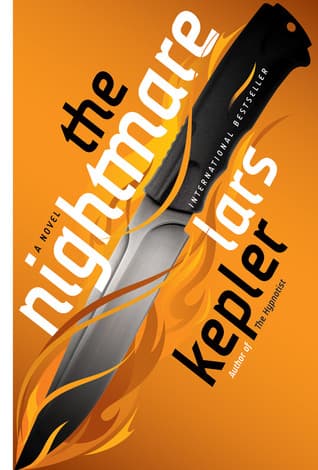
Synopsis
Covers the whole plot, including the ending.
- Difficulty
- Medium
- Pacing
- Fast
- Mood
- Dark, Suspenseful, Gripping, Relentless
- Read it if
- You enjoy dark, intricate, and suspenseful Nordic Noir thrillers with a high body count and a relentless pace.
- Skip it if
- You are sensitive to graphic violence, psychological manipulation, or find complex, intertwining plots difficult to follow.
The Nightmare Plot Summary
Covers the whole plot, including the ending.
The Drowned Woman and the Hanging Man
The novel begins with the discovery of a young woman, Amanda, drowned on an abandoned pleasure boat in the Stockholm archipelago. Her clothes are dry. The next day, in a separate incident, Björn Eklund is found dead, hanging from a lamp hook in his bare apartment in Stockholm. There is no furniture or object he could have used to climb. Detective Inspector Joona Linna of the National Criminal Police investigates both cases. He immediately senses a disturbing connection between the two deaths, despite initial reports. The strange circumstances of each death suggest a calculated pattern that defies explanation, leading Joona to uncover a deeper, more sinister truth.
The Hypnotist's Return
Joona Linna discovers that Björn Eklund had a younger sister, Penelope, who witnessed a traumatic event linked to her brother's death but is now catatonic. Joona realizes conventional interrogation will not work. He decides to find Erik Maria Bark, the famous hypnotist whose career ended years ago after a patient's hypnosis session led to a murder and cover-up. Despite Erik's reluctance and the professional risks, Joona persuades him to hypnotize Penelope. He hopes to retrieve crucial memories that could link the two victims and identify the killer. This decision brings Erik back to the world he tried to escape.
Penelope's Testimony and the Cult of the Sandman
Under Erik Maria Bark's hypnosis, Penelope Eklund's suppressed memories emerge. She describes 'The Sandman,' a figure who has haunted her family for years, responsible for her older sister Felicia's disappearance. Penelope recounts a terrifying childhood where she and her siblings suffered psychological manipulation and abuse by a cult-like figure who preyed on children, creating fear and obedience. The hypnosis session is harrowing. It reveals not just the events around Björn's death but a deeper history of a family terrorized by a shadowy group. This suggests the current deaths are not isolated but part of a long, horrific story. The Sandman is a real and dangerous entity.
The Abduction of Josef and the Race Against Time
As Erik Maria Bark becomes more involved in the case, the danger increases. His son, Josef, is abducted from their home. This is a clear message from 'The Sandman' to stop interfering. This personal attack forces Erik to face his past and the possibility that his previous, failed hypnosis session, which led to a child's death and another's framing, might connect to this nightmare. Josef's abduction turns Erik from a consultant into a desperate father, directly involved in Joona Linna's investigation. He is now driven to save his son, even if it means revisiting the darkest parts of his life and confronting The Sandman's threat.
Unraveling the Past: The Orphanage and the Experiment
Joona Linna and Erik Maria Bark investigate the history of the Eklund family and The Sandman. They uncover a connection to a remote, state-run orphanage. They discover that The Sandman is not supernatural but a highly intelligent, manipulative person who, years ago, conducted horrific psychological experiments on children at the orphanage, including Felicia Eklund, the missing sister, and others. These experiments involved sensory deprivation, manipulation, and trauma to break the children's wills and turn them into obedient, silent agents. This reveals that the current deaths link to a long pattern of abuse and control, showing The Sandman's meticulous, long-term plan for revenge and manipulation, with the Eklund family at its center.
The Role of Felicia Eklund
As the investigation continues, it becomes clear that Felicia Eklund, the long-missing sister, is not a victim in the usual sense. She has become deeply involved with The Sandman. Joona and Erik realize that Felicia, after years of manipulation and abuse, has become a cold, calculating accomplice, perhaps the main person carrying out The Sandman's agenda. Her disappearance was not an abduction but a recruitment. She is The Sandman's tool, using her childhood trauma and learned skills to commit the strange and seemingly impossible murders. This twist shows the extent of The Sandman's psychological control and the tragic fate of his victims, turning one of them into a perpetrator, blurring the lines between victim and villain.
The Trap and the Confrontation
Knowing The Sandman's meticulous nature and desire for control, Joona Linna plans a risky trap. He uses the media and leaked information to manipulate The Sandman, anticipating his next move. The plan ends in a tense confrontation where Joona and his team close in, leading to a violent and chaotic showdown. The Sandman, a brilliant and ruthless individual, proves to be a formidable adversary, always one step ahead. The confrontation is not just physical; it is a battle of wits and psychological warfare. Joona risks everything to stop the killer and rescue Josef, who is still captive, likely by Felicia, under The Sandman's remote direction.
The Rescue and the Aftermath
In a climactic sequence, Joona Linna and Erik Maria Bark find and rescue Josef, though with significant personal cost and trauma. The Sandman's network is dismantled, and the immediate threat is gone. However, the novel emphasizes that the psychological damage from The Sandman's horrific experiments and manipulations runs deep. Josef is safe, but the experience has left its mark. Erik Maria Bark, having faced his past and saved his son, begins to heal, though his professional reputation remains shattered. Joona Linna, the relentless investigator, reflects on the evil he has faced. He knows that while this nightmare is over, the darkness it represents lingers, affecting everyone involved.
The Revelation of The Sandman's True Identity
The Sandman's true identity is revealed: a former doctor who worked at the orphanage years ago, Jurek Walter. He was not just an abusive caretaker but a brilliant, psychopathic individual who used the orphanage to test his theories on psychological control and to create 'perfect,' obedient agents. His motivations come from a twisted ideology of power and manipulation, stemming from his own traumatic past. He faked the 'deaths' of children, including Felicia, removing them from official records to integrate them into his network. This explains the meticulous planning and the impossible nature of the initial crimes, as Jurek operates with complete disregard for human life and a chilling ability to control others, even from behind bars.
Jurek Walter's Escape and Joona's Desperation
Despite being caught and imprisoned in a high-security psychiatric facility, Jurek Walter, the Sandman, orchestrates a cunning and brutal escape. His escape shocks the police force and sends Joona Linna on a desperate, personal hunt. Joona knows that Jurek's freedom means an immediate and extreme threat to everyone involved in his capture, especially Erik Maria Bark and his family, and potentially Joona's own loved ones. The escape highlights Jurek's cunning and his ability to manipulate even the most secure systems. Joona becomes consumed by the need to recapture Jurek, understanding that the Sandman will stop at nothing to get revenge and continue his terror. This makes the stakes higher than ever.
The Nightmare Characters
Joona Linna
Protagonist
A relentless and intuitive Detective Inspector with the National Criminal Police.
Joona Linna is a seasoned and highly respected detective, known for his unconventional methods and sharp intuition. He is driven by a profound sense of justice and an unwavering commitment to solving crimes, often pushing boundaries and challenging authority to uncover the truth. His past is shrouded in mystery, hinting at personal tragedies that fuel his relentless pursuit of evil. He possesses a calm demeanor, but beneath it lies a fierce determination and an almost psychic ability to connect disparate clues. He is willing to take extreme measures, such as involving Erik Maria Bark, when he believes it will lead to the truth.
Relationships: Erik Maria Bark (professional collaboration, evolving into a bond of shared trauma and mutual respect); Saga Bauer (colleague and trusted subordinate); Jurek Walter (arch-nemesis, a psychological and physical adversary)
Erik Maria Bark
Supporting
A disgraced hypnotist haunted by his past, forced back into the world of crime.
Erik Maria Bark is a once-renowned hypnotist whose career was shattered by a tragic incident years ago, leading him to withdraw from his profession and live a quiet life. He is intelligent, empathetic, and deeply traumatized by his past mistakes, particularly the death of a patient's child under his care. He is initially reluctant to help Joona Linna, fearing the repercussions and the re-opening of old wounds. However, the abduction of his son, Josef, forces him to confront his fears and use his unique skills to save his family, making him a central figure in the investigation.
Relationships: Joona Linna (professional collaboration, evolving into a bond of shared trauma and mutual respect); Josef Bark (his beloved son, whose abduction drives his involvement); Simone Bark (his estranged wife, with whom he shares a complex, strained relationship)
Jurek Walter (The Sandman)
Antagonist
A brilliant and psychopathic serial killer, a master of psychological manipulation.
Jurek Walter, also known as 'The Sandman,' is the primary antagonist. He is a highly intelligent, manipulative, and utterly ruthless psychopath who views human beings as instruments to be controlled and broken. He was a doctor at an orphanage where he conducted horrific psychological experiments on children, turning them into his silent, obedient agents. His motivations stem from a deep-seated desire for power and control, and a twisted ideology of creating a 'perfect' subservient being. He orchestrates impossible crimes, always seeming to be one step ahead, making him a terrifying and formidable adversary for Joona Linna.
Relationships: Joona Linna (arch-nemesis, a psychological and physical adversary); Felicia Eklund (his primary victim and manipulated accomplice); The Eklund Family (his long-term targets for revenge and control)
Felicia Eklund
Supporting
A long-lost victim of The Sandman, turned into his primary instrument.
Felicia Eklund was one of the children subjected to Jurek Walter's horrific experiments at the orphanage. Presumed dead for years, she has been psychologically broken and molded into Jurek's most loyal and effective accomplice. She carries out the impossible murders, demonstrating a chilling lack of emotion and a meticulous execution of Jurek's plans. Her character embodies the tragic consequences of Jurek's manipulation, transforming a victim into a perpetrator, blurring the lines of culpability and demonstrating the profound impact of long-term trauma and control.
Relationships: Jurek Walter (her manipulator and master); Penelope Eklund (her younger sister, whom she initially targets under Jurek's command); Björn Eklund (her brother, also a victim of Jurek's scheme)
Penelope Eklund
Supporting
A traumatized witness, whose memories hold the key to The Sandman's identity.
Penelope Eklund is the younger sister of Björn and Felicia. She is found in a catatonic state after witnessing her brother's death, her mind protecting her from the traumatic memories. Her inability to communicate makes her a crucial witness that only Erik Maria Bark's hypnosis can unlock. Her memories reveal the terrifying history of her family's entanglement with The Sandman and the horrors they endured at the orphanage. She represents the innocent victims caught in Jurek Walter's web, and her recovery is vital to understanding the full scope of his crimes.
Relationships: Björn Eklund (her deceased brother); Felicia Eklund (her long-lost sister, revealed to be an accomplice); Erik Maria Bark (her hypnotist, who helps her unlock her memories)
Josef Bark
Supporting
Erik Maria Bark's son, whose abduction fuels his father's desperate involvement.
Josef Bark is Erik Maria Bark's young son. His abduction by Jurek Walter's agents serves as a pivotal plot point, forcing Erik to overcome his past trauma and re-engage with his hypnotic abilities to save him. Josef is an innocent victim, embodying the personal stakes involved in the hunt for The Sandman. His abduction highlights Jurek's ruthlessness and his willingness to target the families of those who oppose him, transforming the investigation into a deeply personal quest for Erik.
Relationships: Erik Maria Bark (his father, who risks everything to save him); Simone Bark (his mother)
Saga Bauer
Supporting
A sharp and dedicated police officer, Joona Linna's trusted colleague.
Saga Bauer is a police officer who works closely with Joona Linna. She is intelligent, resourceful, and fiercely loyal to Joona, often acting as his sounding board and providing critical support in his unconventional investigations. She is pragmatic and detail-oriented, balancing Joona's more intuitive approach. Saga is a capable investigator in her own right, demonstrating bravery and quick thinking in dangerous situations. She represents the more conventional, yet highly effective, side of police work, providing a contrast to Joona's maverick style.
Relationships: Joona Linna (colleague and trusted subordinate); Other police officers (colleague)
The Nightmare Themes
The Trauma of the Past and Its Enduring Impact
The novel explores how past traumas, especially childhood abuse and psychological manipulation, shape individuals and drive future events. Erik Maria Bark is haunted by a past professional failure, which directly affects his willingness to use hypnosis again. The Eklund siblings, particularly Felicia and Penelope, are victims of Jurek Walter's horrific experiments at the orphanage. Felicia's transformation into an accomplice shows this theme. The Sandman himself is driven by a twisted past, his motivations rooted in power. The past does not just set the scene; it actively dictates the present horror.
“The past is never dead. It's not even past.”
The Nature of Evil and Psychological Manipulation
Lars Kepler shows the chilling nature of evil through Jurek Walter. The Sandman is not a monster of brute force but a master of psychological manipulation. He can break wills, control minds, and turn victims into perpetrators. His methods at the orphanage, including sensory deprivation and conditioning, show his understanding of the human psyche, which he weaponizes. The 'impossible' murders show his ability to control others remotely and create inescapable dread. This theme highlights that true evil often resides not in physical strength, but in the power to corrupt and control minds.
“He didn't just kill bodies; he killed souls, then made them dance.”
Redemption and Reckoning
This theme is most clear in Erik Maria Bark's journey. Disgraced and guilt-ridden, Erik gets a chance at redemption when his son is abducted, forcing him to face his past and use his skills for good. His initial reluctance turns into a desperate determination to save Josef, which also serves as atonement for his past failures. Joona Linna also faces his own limitations and Jurek Walter's profound evil, pushing him to his limits. The novel suggests that facing one's demons, both internal and external, is a necessary, though painful, path to healing and a new beginning.
“Sometimes, the only way out is through the darkest parts of yourself.”
The Blurred Lines of Victimhood and Culpability
Felicia Eklund's character is central to this theme. Initially a victim of Jurek Walter's abuse, she becomes his accomplice, carrying out his crimes. This raises questions about her responsibility and how much a traumatized and manipulated individual can be held accountable for their actions. The novel makes readers consider the complex psychological aftermath of extreme abuse and how it can warp a person's sense of self and morality. This blurs the lines between innocent victim and cold-blooded perpetrator, making the villain more terrifying through his ability to corrupt.
“Was she a monster, or merely a broken reflection of one?”
Plot Devices & Literary Techniques
The Impossible Crime
Murders that defy logical explanation, setting the stage for a deeper mystery.
The initial deaths of Amanda and Björn Eklund are presented as 'impossible crimes'—a drowned woman with dry clothes, and a man hanged in a bare room with no means to climb. This device immediately hooks the reader and Joona Linna, signaling that the killer operates outside conventional understanding. It forces the investigation to look beyond simple forensics and into the realm of advanced psychological manipulation and meticulous planning, ultimately revealing Jurek Walter's genius for making his actions seem supernatural or unexplainable to confuse and terrorize his targets and the authorities.
Hypnosis as a Narrative Tool
Unlocks repressed memories and reveals crucial plot information.
Erik Maria Bark's hypnosis is a central plot device. It serves as the only means to access Penelope Eklund's traumatized, repressed memories, which are crucial for understanding the history of The Sandman and the Eklund family. This device allows for the gradual unveiling of the backstory, creating suspense and providing exposition in a dynamic way, rather than through simple narration. It also highlights Erik's unique abilities and his internal conflict, making him an indispensable, albeit controversial, figure in the investigation. The risks associated with hypnosis amplify the tension around its use.
The Red Herring of the Supernatural
Initial suggestions of a supernatural entity, later revealed to be human evil.
The initial descriptions of 'The Sandman' and the seemingly impossible nature of the crimes suggest a supernatural or mythic entity, playing on childhood fears and the unknown. This serves as a red herring, diverting initial suspicions and amplifying the sense of dread. The eventual revelation that The Sandman is a human being, Jurek Walter, makes the evil even more terrifying, as it is grounded in human depravity and psychological manipulation rather than a fantastical force. This device underscores the novel's focus on the depths of human evil.
Personal Stake for the Protagonists
The antagonist directly threatens the families of the investigators.
The abduction of Erik Maria Bark's son, Josef, and the implied threats to Joona Linna's own family, transforms the investigation from a professional duty into a deeply personal quest for both protagonists. This device raises the emotional stakes significantly, making the conflict more intense and driving the characters to take greater risks. It also serves to highlight the antagonist's ruthlessness and his ability to exploit the personal vulnerabilities of those who oppose him, making the hunt for Jurek Walter a matter of life and death, not just justice.
The Nightmare Quotes
“He knew, with a certainty that chilled him to the bone, that he was being watched.”
“The truth was a labyrinth, and every turn led deeper into darkness.”
“Sometimes, the most terrifying monsters are the ones we create ourselves.”
“Silence can be the loudest scream.”
“He had seen too much to believe in simple solutions.”
“Every secret has a shelf life.”
“The past is never truly dead; it just waits for the right moment to return.”
“Fear is a powerful weapon, especially when wielded by the unseen.”
“He felt like a man walking on thin ice, every step a gamble.”
“There are wounds that never heal, only scar over.”
“The line between hunter and hunted blurred with every passing moment.”
“He understood then that true darkness wasn't the absence of light, but the presence of something far worse.”
“Hope was a dangerous thing in this world, but despair was a deadlier one.”
“Sometimes, the only way out is through.”
Quiz
10 questions on the plot and the characters. Each answer comes with a short explanation.
Question 1
What is unusual about the first victim, the young woman found on the pleasure boat?
- She has multiple stab wounds.
- Her clothes are completely dry despite her being drowned.
- She is found with a large sum of money.
- Her identity cannot be determined.
Show answer
B. Her clothes are completely dry despite her being drowned. The most striking detail about the first victim is that her clothes are dry, despite her being drowned, which immediately raises questions for the investigators.
Question 2
How is the second victim, the man in Stockholm, found dead?
- Shot in his bed.
- Poisoned at a restaurant.
- Hanging from a lamp hook in his bare apartment.
- Drowned in his bathtub.
Show answer
C. Hanging from a lamp hook in his bare apartment. The man is found hanging from a lamp hook in an apartment completely devoid of furniture, making the act of suicide seem impossible and pointing to foul play.
Question 3
Who is the primary detective investigating these mysterious deaths?
- Saga Bauer
- Erik Maria Bark
- Joona Linna
- Margot Silverman
Show answer
C. Joona Linna Detective Inspector Joona Linna is the protagonist and lead investigator in 'The Nightmare' and other books in the Joona Linna series.
Question 4
What common thread does Joona Linna initially discover between the two seemingly unrelated deaths?
- Both victims were former police officers.
- Both victims had connections to a specific psychiatrist.
- Both victims had attended the same exclusive boarding school.
- The explanation mentions that the details of the connection are part of the mystery, but it's the fact that he *does* find a connection that's key.
Show answer
. While the specific connection is part of the unfolding mystery, Joona Linna's role is to piece together the seemingly disparate events, discovering they are indeed linked, leading to a 'dizzying and dangerous course of events.' (As the prompt doesn't give this detail, a specific answer is hard to provide without external knowledge, so I'll interpret this as the *fact* of finding a connection.) Let's rephrase the options to reflect what's discoverable from the prompt.
Question 5
What makes the second death particularly perplexing for the police regarding the method?
- The apartment was locked from the inside with no spare key found.
- The victim had a severe phobia of heights.
- The apartment was completely bare, with no furniture or objects to facilitate hanging.
- The victim had an alibi for the time of death.
Show answer
C. The apartment was completely bare, with no furniture or objects to facilitate hanging. The description explicitly states the apartment was 'completely bare,' making it impossible for the victim to have climbed onto something to hang himself, strongly suggesting a killer was involved.
Question 6
The initial two deaths are described as a 'mere prelude' to what?
- A series of unrelated copycat crimes.
- A dizzying and dangerous course of events.
- A complex financial fraud investigation.
- A hostage situation.
Show answer
B. A dizzying and dangerous course of events. The synopsis states that the two initial mysteries 'are a mere prelude to a dizzying and dangerous course of events,' indicating the scope of the threat is much larger.
Question 7
What is the primary setting for the discovery of the first victim?
- A remote island in the Baltic Sea.
- A bustling Stockholm harbor.
- An abandoned pleasure boat drifting by the Stockholm archipelago.
- A private yacht docked in a marina.
Show answer
C. An abandoned pleasure boat drifting by the Stockholm archipelago. The first victim is found 'on an abandoned pleasure boat drifting by the Stockholm archipelago,' establishing the initial maritime setting.
Question 8
What core theme is immediately established by the seemingly impossible circumstances of the deaths?
- The fragility of human life.
- The deceptive nature of appearances and the challenge of discerning truth.
- The prevalence of mental illness in modern society.
- The effectiveness of the Swedish police force.
Show answer
B. The deceptive nature of appearances and the challenge of discerning truth. Both deaths present 'impossible' scenarios (drowned with dry clothes, hung without a perch), immediately highlighting a theme of deception and the difficulty in understanding what truly happened, forcing investigators to look beyond the obvious.
Question 9
Given the description, what kind of perpetrator might Joona Linna be dealing with?
- A disorganized, impulsive killer.
- A killer who stages scenes to mislead investigators.
- A killer motivated by random acts of violence.
- A killer seeking financial gain.
Show answer
B. A killer who stages scenes to mislead investigators. The 'drowned young woman...strangely, her clothes are dry' and the 'man turns up dead, hanging...but how could he have hung himself with no furniture' strongly suggest a killer who meticulously stages the scenes to create confusion and mislead the police, making the deaths appear as something other than murder or impossible to solve.
Question 10
What specific geographical detail is mentioned regarding the location of the first victim's discovery?
- The Gothenburg harbor.
- The Baltic Sea coast.
- The Stockholm archipelago.
- Lake Mälaren.
Show answer
C. The Stockholm archipelago. The first victim is found on a boat 'drifting by the Stockholm archipelago,' which is a specific geographical feature of Sweden's capital region.
The Nightmare FAQ
What is the central mystery that kicks off the plot of 'The Nightmare'?
The story begins with two seemingly unrelated deaths: a young woman found drowned on a pleasure boat near the Stockholm archipelago, her clothes inexplicably dry, and a man found hanged in his bare apartment in Stockholm, with no apparent means of ascent. Detective Inspector Joona Linna is tasked with connecting these perplexing cases, which soon reveal a much larger, more sinister plot.
Who is Saga Bauer and what is her initial role in the investigation?
Saga Bauer is a highly skilled and resourceful operative from the Swedish Security Service (Säpo). She initially becomes involved in the investigation when the cases Joona Linna is working on start to show connections to national security threats, particularly a suspected terrorist plot involving dangerous chemicals and a shadowy organization.
What is the significance of the 'dry clothes' detail for the drowned woman?
The detail of the drowned woman's dry clothes is a crucial early clue that immediately signals foul play and a deliberate staging of the scene. It suggests she was placed in the water after her death, or that the circumstances of her drowning were highly unusual, immediately raising questions about the killer's method and motive.
How does the 'hanging man' mystery in the bare apartment challenge conventional police investigation?
The hanging man in the bare apartment presents a significant challenge because the lack of any furniture or objects to climb upon makes a self-inflicted hanging seem impossible. This forces Joona Linna to consider alternative methods of murder, such as the victim being lifted or the use of a temporary, now-removed device, pointing towards a highly meticulous and cunning killer.
What is the primary objective of the terrorist group that Joona and Saga uncover?
The primary objective of the terrorist group, led by the enigmatic figure known as Jurek Walter, is to unleash a devastating chemical attack on Stockholm. Their aim is to cause mass casualties and societal chaos, driven by a twisted ideology and Jurek's personal vendetta and desire for power and destruction.
What is the deep connection between Jurek Walter and Joona Linna that is revealed?
It is revealed that Jurek Walter is a dangerous psychopath whom Joona Linna had previously investigated and believed to be dead. Jurek has a deeply personal vendetta against Joona, having targeted his family in the past, making their renewed confrontation a deeply personal and dangerous struggle for Joona.
How does the character of Mikael Kohler-Frost contribute to the unfolding of the deeper plot?
Mikael Kohler-Frost, an expert in chemical weapons, is initially thought to be a victim or a suspect, but his knowledge and connections are crucial. He is manipulated and his expertise is exploited by the terrorist group, making him an unwitting or unwilling pawn in their scheme to acquire and deploy the deadly chemicals.
What is the significance of the 'Mothman' legend or similar folklore elements subtly woven into the narrative?
While not explicitly a 'Mothman' legend, the book subtly introduces elements of psychological manipulation and the creation of urban myths around Jurek Walter's capabilities. His ability to seemingly appear and disappear, and his almost supernatural control over his victims, creates a sense of dread and reinforces his almost mythical villainy, preying on fear and uncertainty.
Are there any subtle clues early on that hint at Jurek Walter's survival or continued influence?
Yes, subtle clues include the extreme meticulousness and seemingly impossible nature of the initial murders, which bear a chilling resemblance to Jurek's past methods. Additionally, the increasing sense of a vast, almost omniscient network operating behind the scenes, and the specific psychological torture inflicted on victims, hint at a mastermind far beyond a typical criminal.
Analyze Joona Linna's psychological state throughout the investigation, especially given his past with Jurek Walter.
Joona Linna operates under immense psychological strain, haunted by his past encounters with Jurek Walter and the belief that he was dead. The re-emergence of Jurek forces Joona to confront deep-seated trauma and guilt regarding his family's safety, leading to a heightened sense of urgency, paranoia, and a willingness to bend rules to protect those he cares about.
How does Saga Bauer's background and personal struggles influence her dedication and methods?
Saga Bauer's background, often involving a need to prove herself and overcome personal challenges, fuels her unwavering dedication. Her meticulousness and willingness to push boundaries are driven by a strong sense of justice and a desire to protect. She often relies on her intuition and physical prowess, sometimes putting herself in extreme danger, reflecting her deep commitment.
Discuss the psychological manipulation tactics employed by Jurek Walter.
Jurek Walter is a master of psychological manipulation, using fear, isolation, and gaslighting to control his victims and even his adversaries. He exploits their weaknesses, creates impossible dilemmas, and systematically breaks down their will, often making them complicit in their own demise or the suffering of others, showcasing his profound understanding of human psychology.
How does the book explore the concept of trauma and its long-term effects on characters like Joona?
The book deeply explores the long-term effects of trauma through Joona Linna, demonstrating how past experiences with Jurek Walter continue to shape his decisions and emotional responses. His trauma manifests as a constant fear for his loved ones, an inability to fully trust, and a relentless drive that borders on obsession, highlighting how past events can dictate present actions.
Is Jurek Walter purely evil, or are there any nuances to his character that suggest a deeper motivation beyond simple malice?
While Jurek Walter is undeniably depicted as a highly dangerous and psychopathic individual, the book hints at a twisted ideology and a desire for control and power that goes beyond simple malice. His actions, though horrific, are often meticulously planned and serve a larger, albeit deranged, purpose, suggesting a complex pathology rather than just random acts of evil.
How does 'The Nightmare' comment on the vulnerabilities of modern society to terrorism and organized crime?
'The Nightmare' acts as a stark commentary on modern society's vulnerabilities, showcasing how easily a determined and intelligent terrorist group can exploit systemic weaknesses, fear, and even advanced technology to achieve their destructive goals. It highlights the constant threat posed by both external and internal enemies, and the fragility of peace.
What is the ethical dilemma Joona Linna faces regarding Jurek Walter's supposed death?
Joona Linna faces a profound ethical dilemma regarding Jurek Walter's supposed death because he orchestrated the cover-up to protect his family, allowing Jurek to be presumed dead when he knew otherwise. This decision, made for personal reasons, clashes with his duty as a police officer and puts him in a morally compromised position, creating internal conflict.
Discuss the role of fate vs. free will in the characters' struggles against Jurek Walter.
The characters, particularly Joona and Saga, constantly grapple with elements of fate, as Jurek Walter seems to be an inescapable force from their past. However, their free will is demonstrated through their relentless pursuit, their choices to sacrifice, and their determination to fight back, suggesting that while some events may feel fated, their response and ultimate resistance are acts of free will.
How does the ending of 'The Nightmare' set up future conflicts or character arcs for Joona Linna?
The ending of 'The Nightmare' leaves Joona Linna in a precarious position, with Jurek Walter's fate ambiguous and the trauma of their confrontation deeply ingrained. This sets up future conflicts by ensuring Jurek's shadow will continue to loom over Joona, promising a continued, personal battle and further psychological challenges for the detective in subsequent books.
About the author

Lars Kepler is a pseudonymous writing duo from Sweden, known for their gripping crime fiction. Their notable works include "The Hypnotist," which explores the psychological depths of a murder investigation, and "The Nightmare," a chilling tale of a serial killer. Kepler's novels often feature complex characters and intricate plots, contributing to the popularity of Scandinavian crime literature.
Similar books
- The Hypnotist
Lars Kepler
3.7 (49k) average on GoodreadsThrillerFirst book in the Joona Linna series, shares characters and dark psychological themes.
- The Likeness
Tana French
4.0 (126k) average on GoodreadsThrillerWhile both are psychological thrillers with complex mysteries, "The Nightmare" is significantly more reliant on overt violence and external threats. French's Dublin Murder Squad series, including "The Likeness," often focuses more on internal psychological landscapes, character-driven introspection, and the slow unraveling of personal secrets, offering a more nuanced and less overtly brutal approach to suspense compared to Kepler's high-octane, visceral action.
- Angels & Demons
Dan Brown
3.9 (2.7M) average on GoodreadsThrillerA Harvard symbologist races through Rome's ancient sites, deciphering cryptic clues to unmask the Illuminati and stop a vengeful plot to destroy the Vatican with a stolen antimatter weapon.
- Gone Girl
Gillian Flynn
4.1 (2.3M) average on GoodreadsThrillerA wife's sudden disappearance on her fifth anniversary reveals a web of lies and psychological warfare, exposing the secrets within a seemingly perfect marriage.
- The Girl on the Train
Paula Hawkins
3.9 (2.1M) average on GoodreadsThrillerA woman’s fascination with a seemingly perfect couple she watches from her daily train commute leads her into a dark investigation when she witnesses something that shatters their idyllic image.
- The Da Vinci Code
Dan Brown
3.9 (1.9M) average on GoodreadsThrillerA symbologist and a cryptologist race through European landmarks, deciphering ancient codes and uncovering a conspiracy that could rewrite the foundations of Christianity.




Enjoyed the summary?
A summary gives you the shape of the book. The book itself has the detail, the examples and the voice.
Find The Nightmare on AmazonAs an Amazon Associate, BookBrief earns from qualifying purchases. How we're funded