
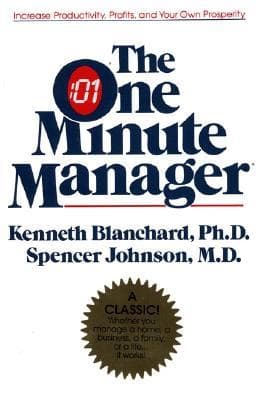
Core Idea
- Difficulty
- Easy
- Read it if
- You are a new manager, an experienced manager looking for a simple refresher on fundamental people management, or an individual contributor seeking to understand effective leadership principles.
- Skip it if
- You are looking for an in-depth, academic treatise on management theory, complex organizational psychology, or detailed strategic planning frameworks.
Key Takeaways from The One Minute Manager
One Minute Goals
Clear, concise goals drive performance and satisfaction.
Good management starts with 'One Minute Goals.' This means clearly and briefly defining each employee's main responsibilities and goals, ideally on one page with fewer than 250 words. Each goal should include a performance standard and a deadline. Many people work without knowing exactly what is expected, which leads to wasted effort and frustration. By making goals clear and easy to check, employees can track their own progress, and managers can quickly see what needs attention. This helps employees take ownership and gives them a clear target, greatly increasing their chances of success and job satisfaction.
“The best way to get people to produce is to let them know what you expect from them.”
In the book: The book illustrates this through the young manager's initial struggles with his team, who were working hard but not effectively because their goals were vague. Once 'One Minute Goals' were implemented, productivity increased because everyone knew exactly what they were supposed to achieve.
Try this: At the beginning of any new project or role, work with your team members to define their top 3-5 priorities. Ensure each priority has a measurable outcome and a deadline. Write these down, review them frequently, and keep them visible. Encourage employees to review their goals daily, taking just one minute to assess their progress.
Related ideas: goal-setting, performance-management, clarity
One Minute Praisings
Catch people doing something right and acknowledge it immediately.
'One Minute Praisings' are a strong way to encourage good behavior and build employee confidence. The key is to be immediate and specific. When you see an employee doing something right or making progress, give immediate, sincere praise. Do not wait for a formal review. State what they did well, explain how it helps the team or company, and then make a personal connection (a handshake or pat on the shoulder, if suitable and comfortable). This quick, positive feedback creates a strong link between good performance and recognition, motivating employees to repeat those actions. It shifts management from only solving problems to actively finding and celebrating successes.
“Help people reach their full potential. Catch them doing something right.”
In the book: The book contrasts the young manager's previous experience with managers who only focused on mistakes. The 'One Minute Manager' demonstrates how specific, immediate praise transformed his team's morale and performance, leading to a more positive and productive work environment.
Try this: Make it a daily habit to look for opportunities to praise your team members. When you see someone excel, immediately approach them, specifically mention what they did well, explain its positive impact, and express your appreciation. For example, 'Sarah, I noticed how you handled that difficult client call – your calm demeanor and quick thinking really diffused the situation and saved the account. Excellent work!'
Related ideas: positive-reinforcement, employee-recognition, feedback
One Minute Reprimands
Address mistakes promptly and directly, focusing on behavior not personal worth.
When performance is not good, 'One Minute Reprimands' offer a structured way to address the issue without discouraging the employee. This technique has two parts: first, immediately and directly state the mistake, explain its negative impact, and express your disappointment. This part should be firm and clear. Second, after a short silence, reaffirm your trust and belief in the employee's abilities, stressing that the mistake does not lessen their value but needs correction. The goal is to separate the person from the problem, making sure they understand the behavior is unacceptable while still feeling valued as an individual. This quick, targeted feedback keeps small issues from growing and reinforces accountability while protecting the employee's self-esteem.
“The first minute of a reprimand is to tell people what they did wrong. The second minute is to tell them how good they really are.”
In the book: The 'One Minute Manager' explains that the effectiveness of reprimands comes from their immediacy and the clear distinction made between the person and their behavior. He recounts how traditional, drawn-out reprimands often lead to resentment and defensiveness, whereas his method encourages a quicker return to productivity.
Try this: If an employee makes a mistake, address it promptly and privately. State the facts of the error and its consequences directly. Then, pause for a moment to let it sink in. Immediately follow up by reaffirming your belief in their potential and reminding them of their value to the team. For example: 'John, the report you submitted was late and contained several errors, which delayed our client presentation. I'm very disappointed by this. However, I know you're capable of much better work, and I trust you'll ensure this doesn't happen again.'
Related ideas: constructive-criticism, accountability, corrective-action
The Power of Immediacy
Feedback, positive or negative, is most effective when delivered promptly.
A main idea behind all three 'One Minute' techniques is the power of speed. The brain connects actions and their results more strongly when feedback is given as soon as possible after the event. Waiting for weekly meetings or yearly reviews lessens the effect of both praise and reprimands. Immediate feedback helps employees quickly understand what they did right or wrong, making it easier for them to repeat good behaviors or correct bad ones. This real-time correction prevents small problems from becoming habits and ensures that good performance is reinforced exactly when it happens, strengthening learning and motivation.
“Feedback is the breakfast of champions.”
In the book: The book frequently highlights how traditional management often delays feedback, making it less effective. The 'One Minute Manager' emphasizes that human behavior is shaped by immediate consequences, drawing parallels to behavioral psychology principles where timely rewards and punishments are most impactful.
Try this: Commit to providing feedback within minutes or hours of an observed action, rather than days or weeks. If you see something noteworthy, address it then and there. This requires being present and observant, rather than waiting for a scheduled review. Train yourself to give 'on-the-spot' feedback.
Related ideas: timely-feedback, behavioral-psychology, real-time-management
People Are Your Greatest Asset
Invest in your employees' growth and well-being for organizational success.
The 'One Minute Manager' philosophy believes employees are a company's most valuable asset. The techniques aim not just to improve productivity but also to create a positive, supportive work environment where people feel valued and empowered. By setting clear goals, giving frequent praise, and offering constructive reprimands, managers help employees build confidence, develop skills, and find satisfaction in their work. This human-centered approach recognizes that happy, confident, and well-directed employees are much more productive and loyal than those who feel ignored, criticized, or unsure about their roles. Investing in people directly leads to better business results.
“People who feel good about themselves produce good results.”
In the book: The young manager's transformation from a frustrated leader to an effective one is directly linked to his adoption of a more empathetic and supportive approach to his team, resulting in improved morale and tangible business results.
Try this: Beyond applying the 'One Minute' techniques, actively seek to understand your employees' career aspirations and challenges. Provide opportunities for growth, delegate meaningful tasks, and ensure they feel heard. Cultivate a culture where mistakes are learning opportunities and successes are celebrated. Show genuine care for their professional and personal well-being.
Related ideas: employee-empowerment, human-capital, organizational-culture
Management is a Partnership
Effective leadership involves collaboration and mutual understanding.
The book suggests that effective management moves from a top-down approach to one of partnership. The 'One Minute Manager' collaborates, not dictates. One Minute Goals are set with employees, not for them. Praisings acknowledge individual contributions, and reprimands, though firm, are given with respect for the individual. This collaborative spirit creates shared responsibility and mutual respect. Employees are more likely to invest in goals they helped create and be more open to feedback from a manager who treats them as a valuable partner rather than just a subordinate. This approach builds trust and creates a more engaged workforce.
“The one minute manager is a partner with his people.”
In the book: The conversation between the young manager and the 'One Minute Manager' consistently emphasizes the importance of working together with employees, rather than simply telling them what to do. The manager's success is attributed to his ability to get his team to 'buy into' the process.
Try this: When setting goals or addressing issues, involve your team members in the discussion. Ask for their input, listen to their perspectives, and incorporate their ideas where appropriate. Frame your role as a facilitator and supporter, helping them achieve their objectives rather than merely supervising them. Regularly check in, not just to review tasks, but to understand their challenges and offer support.
Related ideas: collaborative-leadership, employee-engagement, trust-building
Keep It Simple
Complexity often hinders, while simplicity empowers and clarifies.
One of the most important lessons from 'The One Minute Manager' is the power of simplicity. In a world often overwhelmed by complex management theories and rules, the book promotes a simple, easy-to-understand, and quick-to-use approach. The 'one minute' aspect is not literal, but emphasizes brevity, clarity, and efficiency. By reducing essential management tasks to simple, actionable steps—setting clear goals, giving immediate praise, and providing focused reprimands—managers can cut through complexity and get real results. This simplicity makes the techniques accessible to anyone, regardless of experience, and ensures they can be consistently applied without taking too much time or mental effort.
“Don't complicate things. Just do what works.”
In the book: The entire book is a testament to this principle, presenting complex behavioral science in a simple, narrative format. The three core techniques themselves are distilled into easily digestible, 'one minute' actions, demonstrating that effective management doesn't require elaborate systems.
Try this: Before implementing any new process or giving complex instructions, ask yourself: 'How can I simplify this?' Aim for clarity and conciseness in all your communications. Break down large projects into smaller, manageable 'one minute goals.' Avoid jargon and overly theoretical explanations. Focus on practical, observable behaviors and outcomes.
Related ideas: simplicity, efficiency, clarity
Self-Correction Through Feedback
Empower employees to monitor and adjust their own performance.
The main goal of the 'One Minute' techniques is to help employees become self-reliant. They should be able to monitor their own performance and make needed adjustments. By clearly defining 'One Minute Goals,' employees understand the target. Through 'One Minute Praisings,' they learn what success looks like. And with 'One Minute Reprimands,' they understand the boundaries. This consistent, immediate feedback, along with clear expectations, helps individuals become their own 'One Minute Managers.' They can quickly see when they are on track or off course, allowing for proactive self-correction. This reduces the need for constant manager oversight, freeing up the manager's time and developing more capable, independent team members.
“Help people win.”
In the book: The book explains that once employees internalize their goals and the feedback mechanisms, they become more self-sufficient. The young manager observes his team becoming more proactive in addressing issues and celebrating successes, even without his direct intervention.
Try this: Beyond just giving feedback, teach your team members how to give themselves 'One Minute Praisings' and 'One Minute Reprimands.' Encourage them to regularly review their own 'One Minute Goals' and reflect on their progress. Foster a culture where self-assessment and continuous improvement are valued. Ask 'What did you learn from this?' rather than just 'What did you do wrong?'
Related ideas: self-management, autonomy, continuous-improvement
Consistency is Key
Regular and predictable application makes the techniques effective.
The effectiveness of the One Minute Manager's techniques depends on their consistent use. They are not one-time fixes but ongoing practices that shape the daily work environment. Sporadic goal setting, rare praise, or inconsistent reprimands will weaken their impact and cause confusion. Employees do best with predictability and clear expectations. When managers consistently use these 'one minute' interactions, a culture of clarity, accountability, and positive reinforcement is built. This consistency builds trust and reinforces desired behaviors and performance standards over time, making the management process smooth and naturally part of the workflow.
“Don't be a sometime manager, be a full-time manager.”
In the book: The 'One Minute Manager' emphasizes that the techniques are 'secrets' only because they are simple, not because they are rarely used. He implies that their power comes from their routine, almost habitual application, contrasting this with managers who are inconsistent in their approach.
Try this: Integrate 'One Minute Goals,' 'One Minute Praisings,' and 'One Minute Reprimands' into your daily routine. Schedule a few minutes each morning to review team goals and identify opportunities for praise. Be vigilant for both successes and areas needing correction. Make a conscious effort to apply these techniques every day, not just when a problem arises or a big win occurs.
Related ideas: habit-formation, consistency, management-routine
Results Through Relationships
Strong interpersonal bonds amplify productivity.
Ultimately, the 'One Minute Manager' shows that great results come not from force or elaborate systems, but from strong, positive relationships based on trust and mutual respect. The 'one minute' interactions, though brief, are designed to be personal and impactful. They create a connection between manager and employee, fostering an environment where individuals feel seen, heard, and valued. This relational approach makes employees more willing to accept feedback, strive for excellence, and commit to company goals. When people feel cared for and respected, their motivation, loyalty, and overall productivity naturally increase, proving that 'people skills' are not minor skills but essential drivers of business success.
“Take a minute to look at your people. They're your most important resource.”
In the book: The book's narrative structure, following the young manager's journey, clearly shows that his initial struggles were due to a lack of connection and understanding with his team. His success comes when he shifts his focus from merely tasks to truly engaging with his people.
Try this: Beyond the formal 'one minute' techniques, make an effort to genuinely connect with your team members. Ask about their weekend, understand their challenges, and celebrate their personal milestones. Show empathy and support. Remember names, actively listen, and be approachable. These small, consistent gestures build rapport and strengthen the foundation for all other management interactions.
Related ideas: interpersonal-skills, emotional-intelligence, team-cohesion
The One Minute Manager Quotes
“People who feel good about themselves produce good results.”
“The best minute I spend is the one I invest in people.”
“Goals begin behaviors. Consequences maintain behaviors.”
“One Minute Goal Setting: We agree on the goals and the standards of good performance, and we write them down on a single page.”
“One Minute Praising: Catch people doing something right.”
“One Minute Reprimands: Reprimand the behavior, not the person.”
“Feedback is the breakfast of champions.”
“It takes only a minute to look at people's goals, and it takes only a minute to look at their performance.”
“Help people reach their full potential. Catch them doing something right.”
“Most managers spend 95% of their time on the 5% of their people who cause 95% of their problems.”
“The manager's job is to teach people how to manage themselves.”
“Praise people immediately. Tell people what they did right—be specific.”
“Reprimand people immediately. Tell people what they did wrong—be specific.”
“Make sure you tell people how much you value them.”
“One Minute Managers work with their people to set goals that are clear and concise, with performance standards that are specific and measurable.”
Quiz
10 questions on the main ideas. Each answer comes with a short explanation.
Question 1
According to 'The One Minute Manager', what is the first of the three practical secrets introduced in the book?
- One Minute Meetings
- One Minute Goals
- One Minute Reviews
- One Minute Decisions
Show answer
B. One Minute Goals The book explicitly states that the three practical secrets are One Minute Goals, One Minute Praisings, and One Minute Reprimands.
Question 2
What is the primary purpose of setting One Minute Goals?
- To create detailed project plans for every task.
- To ensure employees know what they are being asked to do and what good performance looks like.
- To identify areas for immediate termination.
- To allow managers to delegate all responsibility.
Show answer
B. To ensure employees know what they are being asked to do and what good performance looks like. One Minute Goals are about clearly defining expectations and performance standards so employees understand their objectives and how to achieve them.
Question 3
When should a One Minute Praising be delivered?
- Once a year during performance reviews.
- As soon as possible after observing good performance.
- Only when an employee exceeds expectations by a significant margin.
- During a scheduled weekly meeting.
Show answer
B. As soon as possible after observing good performance. The book emphasizes that One Minute Praisings should be delivered immediately after observing good performance to reinforce the desired behavior effectively.
Question 4
What is a key component of a One Minute Praising, as described in the book?
- Comparing the employee's performance to others.
- Telling people exactly what they did right and how it helps the organization.
- Suggesting areas for improvement immediately after the praise.
- Making the praise public to motivate other employees.
Show answer
B. Telling people exactly what they did right and how it helps the organization. A One Minute Praising involves specifically identifying what the employee did correctly and explaining the positive impact of their action, making the praise meaningful and actionable.
Question 5
How does 'The One Minute Manager' suggest dealing with a poor performance when delivering a One Minute Reprimand?
- Focus solely on the employee's personality flaws.
- Reprimand the person in front of their peers to create an example.
- Address the specific behavior, explain its negative impact, and then reaffirm the person's value.
- Ignore minor mistakes, hoping they will self-correct.
Show answer
C. Address the specific behavior, explain its negative impact, and then reaffirm the person's value. The One Minute Reprimand focuses on the specific behavior, explains the negative consequences, and crucially, ends with reaffirming the individual's value and separating their worth from the poor performance.
Question 6
What is the recommended length for a One Minute Goal?
- Multiple pages, covering all possible scenarios.
- A maximum of one page, clearly outlining the goal and performance standard.
- A verbal agreement only, without any written documentation.
- As long as necessary to include every minor detail.
Show answer
B. A maximum of one page, clearly outlining the goal and performance standard. One Minute Goals are designed to be concise, typically written on a single page, so they can be reviewed quickly and frequently.
Question 7
The book mentions studies in which fields to explain why its simple methods work so well?
- Economics and Political Science
- Astrophysics and Geology
- Medicine and the Behavioral Sciences
- Art History and Linguistics
Show answer
C. Medicine and the Behavioral Sciences The audio version of the book specifically states it presents studies in medicine and the behavioral sciences to explain the effectiveness of the One Minute Manager techniques.
Question 8
What is the underlying principle behind the effectiveness of One Minute Praisings and Reprimands, according to the book?
- Fear of authority leads to compliance.
- People prefer to be left alone and avoid interaction.
- Timely, specific feedback reinforces desired behaviors and corrects undesired ones effectively.
- Employees are primarily motivated by financial incentives.
Show answer
C. Timely, specific feedback reinforces desired behaviors and corrects undesired ones effectively. The core of the One Minute Manager's philosophy is that immediate and specific feedback, whether positive or corrective, is crucial for shaping and maintaining desired performance.
Question 9
Why is it important for a One Minute Manager to catch people 'doing something right'?
- To identify potential future leaders for promotion.
- Because positive reinforcement is more effective than punishment in shaping long-term behavior and building self-esteem.
- To gather evidence for annual performance reviews.
- To demonstrate the manager's constant surveillance.
Show answer
B. Because positive reinforcement is more effective than punishment in shaping long-term behavior and building self-esteem. The concept of 'catching people doing something right' is central to One Minute Praisings, emphasizing the power of positive reinforcement to encourage desired behaviors and build confidence, which is more sustainable than focusing solely on correcting errors.
Question 10
How does the One Minute Manager approach the concept of 'empowerment' through his techniques?
- By delegating all decision-making to employees without guidance.
- By setting clear goals, providing timely feedback, and fostering self-reliance, allowing employees to manage themselves effectively.
- By giving employees unlimited resources and no deadlines.
- By only interacting with employees during critical failures.
Show answer
B. By setting clear goals, providing timely feedback, and fostering self-reliance, allowing employees to manage themselves effectively. By clearly defining goals, providing frequent and specific feedback (both positive and corrective), and then trusting employees to perform, the One Minute Manager empowers individuals to take ownership of their work and manage themselves within those defined parameters.
The One Minute Manager FAQ
What is the core concept of The One Minute Manager?
The One Minute Manager introduces three practical secrets: One Minute Goals, One Minute Praisings, and One Minute Reprimands. These techniques aim to simplify management, improve communication, and boost productivity and job satisfaction for both managers and employees.
Does the 'One Minute' approach actually work in real-world business environments?
Yes, for over twenty years, millions of managers in diverse companies have successfully applied The One Minute Manager's techniques. These methods have led to increased productivity, higher job satisfaction, and greater personal prosperity for employees, demonstrating their effectiveness.
What are One Minute Goals and how do they function?
One Minute Goals involve clearly defining an employee's key goals and responsibilities, ideally in a way that can be read and reviewed in under a minute. This ensures mutual understanding and alignment, allowing employees to track their progress effectively.
How are One Minute Praisings different from traditional employee recognition?
One Minute Praisings are immediate, specific, and heartfelt acknowledgements of good work, delivered shortly after the positive action occurs. Unlike generic praise, they focus on the specific behavior and its positive impact, reinforcing desired actions quickly and effectively.
What is a One Minute Reprimand and when should it be used?
A One Minute Reprimand is a swift, direct, and specific correction of an undesirable behavior, immediately followed by reassurance and belief in the employee's value. It's used when an employee makes a mistake or deviates from expectations, addressing the behavior without attacking the person.
How does The One Minute Manager compare to other leadership or self-help books?
The One Minute Manager stands out for its extreme conciseness and actionable, story-driven approach. While many books offer broad theories, this book distills management into three immediately applicable techniques, making it highly practical for busy professionals.
Is this book only for managers, or can individual contributors benefit?
While primarily aimed at managers, individual contributors can also benefit by understanding how effective management works, enabling them to better set their own goals, seek feedback, and even apply the principles in personal productivity. The techniques foster better communication across all levels.
What scientific basis supports the methods described in the book?
The book and its accompanying audio present studies in medicine and the behavioral sciences that explain the underlying psychological principles. These studies clarify why the seemingly simple methods of immediate feedback, clear goals, and specific praise/reprimands are so effective in motivating and guiding human behavior.
How can I apply the One Minute principles to remote work or virtual teams?
The principles are highly adaptable to remote work; One Minute Goals can be shared digitally, One Minute Praisings can be delivered via quick messages or video calls, and One Minute Reprimands can be handled through private, direct communication. The key is maintaining immediacy and clarity, regardless of physical proximity.
About the author

Kenneth H. Blanchard is an American author and management expert known for his contributions to the field of leadership and management. He is best known for his book "The One Minute Manager," which offers practical advice on effective management techniques. Blanchard's work primarily focuses on non-fiction, particularly in the areas of business and personal development.
Similar books
- Who Moved My Cheese?
Spencer Johnson
3.8 (367k) average on GoodreadsBusinessOffers simple parables to illustrate key business and life lessons, focusing on adaptability and change.
- Good to Great: Why Some Companies Make the Leap... and Others Don't
James C. Collins
4.1 (131k) average on GoodreadsBusiness"The One Minute Manager" offers a micro-level, behavioral approach to daily management interactions, focusing on individual employee performance and immediate feedback. In contrast, Jim Collins' "Good to Great" operates at a macro-organizational level, analyzing long-term strategies, leadership characteristics (Level 5 Leadership), and systemic changes required for companies to achieve sustained superior performance. While Blanchard focuses on how a manager interacts with an employee, Collins examines the overarching culture, vision, and strategic discipline that differentiate truly great companies. "Good to Great" is research-intensive, drawing conclusions from extensive historical data, whereas "The One Minute Manager" is a narrative guide based on practical principles.
- Steve Jobs
Walter Isaacson
4.1 (957k) average on GoodreadsBusinessSteve Jobs was a visionary who fused creativity and technology to revolutionize six industries and shape our digital world.
- Freakonomics: A Rogue Economist Explores the Hidden Side of Everything
Steven D. Levitt
4.0 (709k) average on GoodreadsBusinessThis book uses economic principles to reveal the surprising incentives behind everything from drug dealing and real estate to cheating teachers and the decline of crime.
- The Tipping Point: How Little Things Can Make a Big Difference
Malcolm Gladwell
4.0 (690k) average on GoodreadsBusinessMalcolm Gladwell explains how small, targeted actions can start widespread changes in trends, behaviors, and ideas.
- Outliers: The Story of Success
Malcolm Gladwell
4.2 (556k) average on GoodreadsBusinessMalcolm Gladwell argues that true success is not just about individual talent, but about the hidden advantages of culture, opportunity, and unique experiences that shape extraordinary lives.





Enjoyed the summary?
A summary gives you the shape of the book. The book itself has the detail, the examples and the voice.
Find The One Minute Manager on AmazonAs an Amazon Associate, BookBrief earns from qualifying purchases. How we're funded