
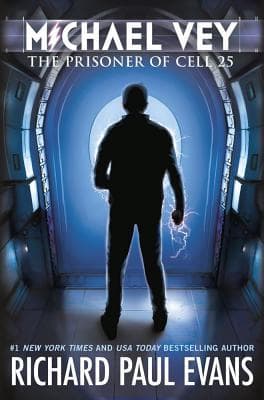
Synopsis
Covers the whole plot, including the ending.
- Difficulty
- Easy
- Pacing
- Fast
- Mood
- Exciting, Adventurous, Suspenseful, Hopeful
- Read it if
- You enjoy fast-paced YA thrillers with unique superpowers, a strong sense of friendship, and a clear good vs. evil conflict. Great for readers who like action-packed adventures with a sci-fi twist.
- Skip it if
- You prefer character-driven narratives over plot-driven action, or if you're looking for deep moral ambiguities rather than a straightforward heroic journey.
The Prisoner of Cell 25 Plot Summary
Covers the whole plot, including the ending.
A Shocking Discovery and a Mysterious Connection
Michael Vey, a fourteen-year-old with Tourette's syndrome, can secretly make and control electricity. He lives a normal life in Meridian, Idaho, with his mother. One day, a bully, Jack, pushes him too far, and Michael accidentally sends an electric shock. Taylor Ridley, a popular cheerleader, sees this. She later tells Michael she also has electric abilities—she can 'jam' or scramble thoughts and electrical signals. They realize their powers are similar, suggesting a shared beginning. Michael tells his best friend, Ostin Liss, a smart science student. Together, they start looking into the strange facts around their births, which both happened at Pasadena Children's Hospital.
The Elgen Academy and a Desperate Plea
While Michael, Taylor, and Ostin are at an arcade, Michael's mother is taken from their home. A note is left, demanding Michael's surrender. The note mentions 'The Elgen,' a secret group. With no other choice, Michael, Taylor, and Ostin follow clues to the Elgen Academy, a fancy but dark building in the Nevada desert. They learn that the Elgen, led by Dr. Hatch, made them and other 'electric children' using radiation treatments. Dr. Hatch plans to gather all the electric children, whom he calls 'Glows,' to use their powers for his own plans to rule the world. He thinks they are the next step in human evolution.
Infiltrating the Academy and Meeting the Glows
Michael, Taylor, and Ostin plan to get into the heavily guarded Elgen Academy. Ostin uses his intelligence to create a distraction, letting Michael and Taylor get inside. Once in, they find many other electric children, each with unique powers, such as super strength, invisibility, or the ability to make EMPs. Dr. Hatch and his cruel staff are holding these children captive and experimenting on them. Michael meets some of them, including Zeus, a strong electric user, and Nichelle, who can take in electricity. They quickly see how serious their situation is and the danger these children are in. This strengthens their resolve to save Michael's mother and the other Glows.
Dr. Hatch's Twisted Vision
Dr. Hatch, a charming but bad scientist, tells Michael his real intentions. He explains that the electric children were the result of a failed experiment with radiation therapy for cancer, which accidentally gave them their powers. Hatch sees them not as victims, but as tools for world power. He has been finding and collecting all the 'Glows,' planning to train them as his personal army. He shows Michael a world map, outlining his plans for conquest, starting with a new world order where the Glows, under his command, will rule. Hatch tries to convince Michael to join him, promising him power and a place by his side.
Betrayal and Imprisonment
Despite Dr. Hatch's attempts to convince him, Michael refuses to join. In a weak moment, Nichelle, one of the 'Glows' Michael had befriended, tells Dr. Hatch about Michael's attempts to gather the other electric children. Because of this, Michael is severely punished and put into Cell 25, a dark, isolated, and electrically shielded cell made to stop his powers and break his spirit. This imprisonment is a turning point. Michael faces extreme physical and mental pain, forcing him to face his fears and test how strong he is. He understands how cruel Hatch is and how badly he needs to escape.
Escape from Cell 25
While Michael is in Cell 25, Ostin and Taylor work hard from outside and inside the academy to plan his rescue. They manage to talk to some of the other 'Glows' who support Michael, including Zeus and Tessa. Using Ostin's intelligence and Taylor's jamming abilities, they create a distraction and turn off some of the academy's security systems. Michael, full of anger and determination, manages to break free from Cell 25, using a burst of his electric power. The escape is wild, with fights with Elgen guards and a race against time to meet his friends.
The Rescue of the Glows
After escaping Cell 25, Michael, joined by Taylor, Ostin, and a few other loyal 'Glows' like Zeus and Tessa, starts a full rebellion inside the Elgen Academy. They confront Dr. Hatch and his guards, using their combined electric powers to overpower the Elgen forces. The battle is fierce, with the 'Glows' showing their different abilities together. Michael's leadership is clear as he inspires the other children to fight for their freedom. During the chaos, they find Michael's mother, held captive in another part of the building, and free her, adding more urgency to their escape.
The Great Escape and the Pursuit
With Michael's mother saved and many of the 'Glows' freed, the group makes a desperate run for freedom, escaping the Elgen Academy. They use their powers and Ostin's quick thinking to get through the desert and avoid the Elgen forces chasing them. Dr. Hatch, angry about their escape and his plans being ruined, promises to hunt them down and get every 'Glow' back. The escape has costs; some 'Glows' are left behind or recaptured, and the group realizes their fight against the Elgen is not over. They are now on the run, knowing Hatch will stop at nothing to get control back.
A New Alliance and an Uncertain Future
After their daring escape, Michael, his mother, Taylor, Ostin, and the remaining freed 'Glows' find a temporary safe place. They realize they cannot live normal lives anymore and must stick together to protect themselves from Dr. Hatch and the Elgen. They form a temporary alliance, combining their unique abilities and resources. Michael becomes a natural leader, giving hope and determination to the group. They understand that Dr. Hatch's influence is wide and that he will chase them without stopping. The book ends with the group getting ready for future fights, knowing their fight for freedom and survival has just begun, setting up the next books in the series.
The Prisoner of Cell 25 Characters
Michael Vey
Protagonist
A fourteen-year-old with Tourette's and the ability to generate and control electricity.
Michael is an intelligent and compassionate teenager who struggles with Tourette's syndrome, which often makes him feel like an outcast. His secret electric powers are both a burden and a source of strength. Despite his initial shyness, he possesses a strong moral compass and a fierce loyalty to his friends and family. He quickly adapts to his extraordinary circumstances, demonstrating remarkable courage and leadership qualities when faced with Dr. Hatch's tyranny. His journey is one of self-discovery, as he learns to embrace his unique abilities and lead others.
Relationships: Ostin Liss (Best friend and intellectual ally); Taylor Ridley (Friend, fellow Glow, and eventual romantic interest); Mrs. Vey (Devoted mother); Dr. Hatch (Arch-nemesis and creator)
Taylor Ridley
Supporting
A popular cheerleader who can 'jam' electrical signals and people's thoughts.
Taylor is popular, outgoing, and initially seems like a typical high school cheerleader. However, she secretly possesses the ability to 'jam' electrical signals and disrupt people's thoughts, a power that makes her feel isolated. She quickly forms a bond with Michael, drawn by their shared secret. Taylor is quick-witted, resourceful, and brave, proving to be an invaluable ally in their fight against the Elgen. Her ability to manipulate thoughts is crucial for infiltration and deception, and she often provides emotional support to Michael.
Relationships: Michael Vey (Friend, fellow Glow, and eventual romantic interest); Ostin Liss (Friend and fellow team member)
Ostin Liss
Supporting
Michael's best friend and a scientific genius with vast knowledge.
Ostin is Michael's brilliant best friend, a walking encyclopedia of scientific facts and trivia. He is the brains of the operation, using his vast intellect and problem-solving skills to analyze situations, devise plans, and understand the scientific intricacies of the 'Glows' powers. Despite his lack of electric abilities, Ostin is incredibly brave and loyal, never hesitating to put himself in danger to help Michael and Taylor. His humor and logical thinking often provide much-needed levity and strategic insight.
Relationships: Michael Vey (Best friend and close confidant); Taylor Ridley (Friend and fellow team member)
Dr. Hatch
Antagonist
The charismatic and ruthless leader of the Elgen, who created and seeks to control the electric children.
Dr. Hatch is the primary antagonist, a brilliant but megalomaniacal scientist who founded the Elgen Academy. He is responsible for the radiation experiments that inadvertently created the 'Glows' and believes they are the key to a new world order under his control. Hatch is manipulative, charming, and utterly ruthless, capable of extreme cruelty under a veneer of sophistication. He sees the 'Glows' as tools to be exploited, not as individuals, and will stop at nothing to achieve his vision of global domination.
Relationships: Michael Vey (Creator and arch-nemesis); The Glows (Captor and controller)
Zeus (Jack)
Supporting
An electric child with powerful and volatile electrical abilities, initially loyal to Dr. Hatch.
Zeus, whose real name is Jack, is one of the more powerful 'Glows' at the Elgen Academy. He possesses a strong electric shock ability, similar to Michael's, but is initially more aggressive and loyal to Dr. Hatch, having been conditioned by him. He is a formidable opponent but eventually realizes the truth about Hatch's manipulation and joins Michael's rebellion. Zeus represents the internal struggle within the 'Glows' and their potential for both destruction and heroism.
Relationships: Michael Vey (Fellow Glow and eventual ally); Dr. Hatch (Captor and manipulator)
Nichelle
Supporting
An electric child with the ability to absorb electricity, who betrays Michael.
Nichelle is one of the 'Glows' at the Elgen Academy with the unique ability to absorb electricity, making her a dangerous opponent for Michael. She initially appears friendly to Michael, but her loyalty lies with Dr. Hatch, or perhaps with her own survival, leading her to betray Michael and reveal his plans to Hatch. Her betrayal highlights the difficult choices and fractured loyalties among the captive children. She is cunning and self-preserving, making her an unpredictable element.
Relationships: Michael Vey (Fellow Glow, betrayed him); Dr. Hatch (Allegiance to)
Tessa
Supporting
An electric child with the power to create light, who aids in the escape.
Tessa is one of the 'Glows' held captive at the Elgen Academy. Her unique ability allows her to generate light, which proves to be surprisingly useful during their escape from the dark confines of the facility. She is quieter than some of the other 'Glows' but shows courage and conviction in joining Michael's rebellion. Tessa represents the diversity of powers among the electric children and the way even seemingly minor abilities can contribute to the greater good.
Relationships: Michael Vey (Fellow Glow and ally); The Glows (Fellow captive)
Mrs. Vey
Supporting
Michael's loving and protective single mother, who is kidnapped by the Elgen.
Michael's mother is a kind and devoted single parent who has raised Michael with love and care, despite his Tourette's. She is unaware of his electric powers until she is abducted by the Elgen. Her kidnapping serves as a major catalyst for Michael's actions and his infiltration of the Elgen Academy. Her resilience and determination, even in captivity, inspire Michael. She represents the innocent victims caught in Dr. Hatch's schemes and the strong familial bonds that drive Michael.
Relationships: Michael Vey (Son)
Wade
Supporting
A bully at Meridian High who inadvertently triggers Michael's powers.
Wade is one of the bullies at Meridian High School who frequently torments Michael. His aggressive actions, particularly pushing Michael into a locker, inadvertently cause Michael to unleash his electric powers in public, leading to Taylor's discovery of their shared abilities. While not a major character in the larger plot against the Elgen, Wade's initial role is crucial in setting the story in motion and revealing Michael's secret to Taylor.
Relationships: Michael Vey (Bully)
The Prisoner of Cell 25 Themes
Identity and Self-Acceptance
The novel shows how Michael, Taylor, and the other 'Glows' deal with their special abilities and how these powers change who they think they are. Michael first feels isolated by his powers and Tourette's, but he learns to accept them as part of himself. The 'Glows' at the Elgen Academy also struggle with their identities, caught between being Dr. Hatch's tools and being themselves. This theme is key to Michael's journey as he changes from a shy teen to a confident leader.
“My name is Michael Vey, and the story I’m about to tell you is strange. Very strange. It’s my story.”
The Nature of Power and Responsibility
The book looks at the ethical side of having great power. Dr. Hatch shows how power can corrupt, using his science knowledge and the 'Glows' abilities for his own selfish, cruel goals. In contrast, Michael and his friends choose to use their powers for good, to protect others and fight for freedom. The story constantly asks how power should be used and the responsibility that comes with it, especially with abilities that could change the world. The 'Glows' must learn to control their powers and understand what they do.
“With great power comes great responsibility, Michael. You're living proof of that.”
Friendship and Loyalty
The strong bond between Michael, Taylor, and Ostin is a main part of the story. Their loyalty to each other, even when in extreme danger, allows them to overcome the big problems the Elgen create. Ostin, though he has no powers, never leaves his friends, using his intelligence to help them. Taylor's steady support for Michael is also important. This theme shows the strength that comes from working together and how important trust is when facing big challenges. It shows that real power often comes from being united.
“We're a team, Michael. Always.”
Good Versus Evil
At its heart, the novel is a classic fight between good and evil. Dr. Hatch and the Elgen are purely evil, wanting to control and use others for their own gain. Michael and his friends, the 'Glows' who fight Hatch, are good, fighting for freedom, justice, and their own lives. This theme is clear in the sharp difference between the Elgen Academy's fancy but controlling environment and the main characters' search for freedom. The moral choices characters make show which side they are on in this big conflict.
“He's evil, Michael. Pure evil.”
Freedom Versus Control
A main conflict is between the desire for freedom and the controlling force of oppression. Dr. Hatch wants to completely control the 'Glows' and eventually the world, seeing them as property. Michael and the other electric children, however, want to be independent and choose their own futures. Their whole journey is a struggle to escape Hatch's control and get their freedom back. Cell 25 itself is a strong symbol of this struggle, showing the ultimate control and Michael's fight to break free from it.
“We're not his prisoners. We're not his tools.”
Plot Devices & Literary Techniques
The 'Glows'
A group of children with unique electrical and other superhuman abilities.
The 'Glows' are the central plot device, as their existence and unique powers drive the entire narrative. They are the product of a radiation experiment at Pasadena Children's Hospital, making them both a scientific anomaly and a target. Each 'Glow' possesses a distinct ability, from Michael's electric shocks to Taylor's jamming and Zeus's powerful surges, creating a diverse set of skills crucial for both conflict and resolution. Their collective power is what Dr. Hatch covets and what Michael must unite to fight back.
Cell 25
An electrically shielded, isolated prison cell designed to nullify electric powers.
Cell 25 is a crucial symbolic and literal plot device. It represents Dr. Hatch's ultimate control and cruelty, designed specifically to break the spirit and nullify the powers of the electric children. Michael's imprisonment in Cell 25 is a turning point, forcing him to face his deepest fears and pushing him to his absolute limits. His eventual escape from it signifies his refusal to be controlled and his burgeoning strength, both physical and mental. It's a place of extreme torment and a catalyst for his resolve.
The Elgen Academy
A high-tech, secretive facility where Dr. Hatch holds and experiments on the 'Glows'.
The Elgen Academy serves as the primary setting for much of the novel's action, functioning as both a prison and a training ground for Dr. Hatch's electric army. Its high-tech security, luxurious facade, and underlying sinister purpose create an atmosphere of deceptive danger. The academy is where Michael and his friends must infiltrate, navigate, and ultimately escape, making it the focal point of the conflict between the protagonists and the antagonist. It symbolizes Hatch's power and the confinement of the 'Glows'.
Tourette's Syndrome
Michael's neurological condition, which he learns to control and use in conjunction with his powers.
Michael's Tourette's syndrome is not just a character trait but a significant plot device. It initially marks him as an outsider and is often linked to his accidental bursts of electrical power, creating a unique challenge for him to overcome. Over time, Michael learns to channel the energy and focus required to control his Tourette's into controlling his electric abilities, demonstrating a mastery over both his condition and his powers. This integration adds depth to his character and provides unique opportunities for plot development.
The Prisoner of Cell 25 Quotes
“If you only knew the things I’ve seen,’ he whispered. ‘The things that are coming.”
“Some powers are meant to be contained. Some are meant to destroy.”
“The world isn’t always what it seems, Michael. There are shadows just beyond the light.”
“Fear is a tool. It can be used to control, or it can be used to push you forward.”
“You can’t run from who you are, Michael. Not forever.”
“Sometimes, the greatest strength is not in fighting, but in knowing when to escape.”
“They want to break you. Don’t let them.”
“The truth is often hidden in plain sight, if you only know where to look.”
“You have a gift, Michael. A powerful, dangerous gift.”
“Hope is a powerful thing, Michael. Never lose it.”
“They think they know everything, but they don’t know us.”
“Even in the darkest cell, there’s always a way out, if you’re clever enough.”
“Some bonds are stronger than any prison walls.”
Quiz
10 questions on the plot and the characters. Each answer comes with a short explanation.
Question 1
What is Michael Vey's visible condition that makes him seem 'ordinary' to his peers at Meridian High School?
- Autism Spectrum Disorder
- Tourette's syndrome
- Dyslexia
- Severe allergies
Show answer
B. Tourette's syndrome The book explicitly states that Michael Vey has Tourette's syndrome, which is the only thing that seems to set him apart to others at Meridian High School before his powers are revealed.
Question 2
Who is the first other person Michael discovers also has special electric powers?
- His best friend, Ostin
- A new student named Jack
- A cheerleader named Taylor
- His science teacher, Mr. Hades
Show answer
C. A cheerleader named Taylor Michael initially thinks he's unique until he discovers that Taylor, a cheerleader, also possesses special electric powers.
Question 3
What is the primary motivation of the 'powerful group' that becomes interested in Michael and Taylor?
- To cure the electric children of their powers
- To study the children's abilities for scientific research
- To control the electric children and, through them, the world
- To protect the electric children from public exposure
Show answer
C. To control the electric children and, through them, the world The synopsis clearly states that the powerful group wants to control the electric children and, through them, the world.
Question 4
Besides Michael and Taylor, who is the third member of their core group investigating the origins of their powers?
- Taylor's best friend, Veronica
- Michael's friend, Ostin
- A mysterious mentor named Dr. Hatch
- His mother, Mrs. Vey
Show answer
B. Michael's friend, Ostin The story mentions that Michael, Taylor, and Michael's friend Ostin, team up to discover the truth about their powers.
Question 5
What kind of special powers does Michael Vey possess?
- Telekinetic abilities
- Invisibility and super speed
- Electric powers
- Mind-reading capabilities
Show answer
C. Electric powers The book description explicitly states, 'Michael has special powers. Electric powers.'
Question 6
What is the initial assumption Michael has about his electric powers?
- He inherited them from his parents.
- He acquired them through a science experiment gone wrong.
- He is the only person in the world with such abilities.
- They are a manifestation of his Tourette's syndrome.
Show answer
C. He is the only person in the world with such abilities. The text states, 'Michael thinks he's unique until he discovers that a cheerleader named Taylor also has special powers,' implying his initial assumption was that he was the only one.
Question 7
What is the central conflict that drives Michael and his friends' actions?
- Preventing a natural disaster caused by their powers.
- Uncovering the origin of their powers and evading a powerful group trying to control them.
- Competing in a secret tournament for super-powered individuals.
- Solving a local mystery unrelated to their abilities.
Show answer
B. Uncovering the origin of their powers and evading a powerful group trying to control them. Their investigation into how they got their powers brings them to the attention of a powerful group that wants to control them, creating the central conflict of survival and discovery.
Question 8
What makes Michael Vey's story 'strange' according to his own narration?
- The mundane nature of his daily life.
- The ordinary events that unfold around him.
- The extraordinary and unique circumstances of his electric powers and the subsequent events.
- The common struggles of being a teenager with Tourette's syndrome.
Show answer
C. The extraordinary and unique circumstances of his electric powers and the subsequent events. Michael Vey himself states, 'The story I’m about to tell you is strange. Very strange.' This refers to the unusual nature of his electric powers and the extraordinary adventure that unfolds because of them, not his ordinary life or condition.
Question 9
What aspect of Michael's character is highlighted as crucial for his survival against the powerful group?
- His physical strength and combat training.
- His academic achievements and high grades.
- His wits, powers, and reliance on friends.
- His ability to blend in and remain unnoticed.
Show answer
C. His wits, powers, and reliance on friends. The synopsis explicitly states, 'Michael will have to rely on his wits, powers, and friends if he’s to survive,' indicating these are crucial for overcoming the powerful group.
Question 10
The powerful group's desire to control the electric children and the world suggests a theme of:
- The importance of genetic diversity.
- The dangers of unchecked power and ambition.
- The benefits of scientific advancement.
- The struggle for individual freedom in a democratic society.
Show answer
B. The dangers of unchecked power and ambition. The group's goal to 'control the electric children – and through them the world' directly points to the theme of the corrupting influence and inherent dangers of unchecked power and ambition.
The Prisoner of Cell 25 FAQ
What is 'The Prisoner of Cell 25' about?
'The Prisoner of Cell 25' introduces Michael Vey, a seemingly ordinary fourteen-year-old with Tourette's syndrome, who secretly possesses electric powers. He discovers he's not alone when cheerleader Taylor also exhibits similar abilities. Together with his best friend Ostin, they uncover a sinister organization, the Elgen, that created them and seeks to control all 'electric children' to dominate the world.
Why should I read 'The Prisoner of Cell 25'?
You should read 'The Prisoner of Cell 25' for its thrilling blend of action, sci-fi, and a compelling underdog story. It features unique superpowers, a high-stakes global conspiracy, and explores themes of friendship and self-discovery, making it an engaging read for young adult and fantasy fans.
What is the background/setting of 'The Prisoner of Cell 25'?
The story begins in Meridian High School, a typical American high school setting, which quickly expands to include various secret facilities and advanced technological environments controlled by the mysterious Elgen organization. The contrast between Michael's normal life and the hidden world of electric children and their captors forms the core of the setting.
What writing style does the author use?
Richard Paul Evans employs a fast-paced, accessible writing style, often told from Michael Vey's first-person perspective, which lends an immediate and personal feel to the narrative. The language is straightforward, focusing on plot progression and character development, making it highly engaging for its young adult target audience.
What minor details add significant meaning?
Michael's Tourette's syndrome, initially presented as a challenge, subtly reinforces his uniqueness and resilience, contrasting with the extraordinary powers he possesses. The seemingly random 'ticking' can be seen as a metaphor for his hidden, powerful nature waiting to be unleashed, and often serves as a distraction from his true abilities.
What are some subtle foreshadowing moments?
Early on, Michael's inexplicable ability to short-circuit electronics or make lights flicker around him subtly foreshadows his true electric powers, even before he fully understands or controls them. Taylor's magnetic personality and unusual intuition also hint at her own unique abilities, preparing the reader for her eventual reveal.
What unexpected character connections exist?
The most significant unexpected connection is between Michael and Taylor, who discover they both gained their electric powers from the same mysterious event, linking them directly to the Elgen's experiments. This shared origin is the catalyst for their alliance and their quest to understand their past.
What are unspoken character motivations?
Dr. Hatch's motivation, while outwardly about creating a new world order, is deeply rooted in a desire for ultimate control and perhaps a twisted sense of intellectual superiority. His need to 'collect' and manipulate the electric children suggests a profound insecurity or god complex that drives his sinister agenda.
What psychological complexities do characters exhibit?
Michael Vey grapples with the complexity of his powers, moving from fear and secrecy to a sense of responsibility and growing confidence. His Tourette's adds another layer, forcing him to confront societal judgment while simultaneously harboring extraordinary abilities, creating an internal conflict between vulnerability and strength.
What are the major emotional turning points?
A major emotional turning point occurs when Michael and Taylor realize they are not alone in their abilities, leading to a sense of shared understanding and purpose. Another is their capture by the Elgen, which shatters their sense of security and forces them to confront the true danger of their existence and the importance of their bond.
How do relationship dynamics evolve?
Michael's relationship with Ostin evolves from a typical best friendship to one of deep reliance and shared peril, with Ostin acting as the brains of the operation. His dynamic with Taylor quickly shifts from a classmate crush to a powerful partnership built on mutual understanding and shared destiny, essential for their survival against the Elgen.
Which parts remain ambiguous or open-ended?
The full extent of the Elgen's global reach and the true nature of their ultimate plan for world domination are hinted at but not entirely revealed, leaving much to be explored in subsequent books. The exact number of 'electric children' and their diverse powers are also left somewhat open, suggesting many more discoveries.
What are controversial scenes or decisions?
Dr. Hatch's methods of 're-education' and torture in the Elgen academy, particularly the psychological manipulation and physical punishments inflicted upon the electric children, could be considered controversial due to their dark and unsettling nature within a young adult novel.
'The Prisoner of Cell 25' ending explained: how it ends & what it means
The book ends with Michael, Taylor, and Ostin, along with other electric children they've freed, escaping the Elgen's facility after a daring confrontation with Dr. Hatch. They are on the run, knowing that the Elgen will pursue them relentlessly. This ending signifies the beginning of a larger fight, establishing their status as fugitives and heroes, and setting the stage for future adventures and the ongoing battle against the Elgen's tyranny.
About the author
Richard Paul Evans is an American author known for his works of fiction, including "The Christmas Box," which gained significant popularity and has been adapted into a film. His other notable books include "The Prisoner of Cell 25," "Rise of the Elgen," "The Walk," "The Sunflower," and "Storm of Lightning." Evans often explores themes of hope and redemption in his storytelling.
Similar books
- The Hunger Games
Suzanne Collins
4.3 (6.4M) average on GoodreadsFantasyBoth novels feature young protagonists with unique abilities or circumstances who are exploited and hunted by powerful, malevolent organizations. While The Hunger Games focuses on survival in a dystopian game, The Prisoner of Cell 25 centers on escape and the discovery of a secret society of powered individuals. Collins' world-building is arguably more cohesive and politically charged, offering a sharper critique of societal structures.
- Angels & Demons
Dan Brown
3.9 (2.7M) average on GoodreadsThrillerA Harvard symbologist races through Rome's ancient sites, deciphering cryptic clues to unmask the Illuminati and stop a vengeful plot to destroy the Vatican with a stolen antimatter weapon.
- Gone Girl
Gillian Flynn
4.1 (2.3M) average on GoodreadsThrillerA wife's sudden disappearance on her fifth anniversary reveals a web of lies and psychological warfare, exposing the secrets within a seemingly perfect marriage.
- The Girl on the Train
Paula Hawkins
3.9 (2.1M) average on GoodreadsThrillerA woman’s fascination with a seemingly perfect couple she watches from her daily train commute leads her into a dark investigation when she witnesses something that shatters their idyllic image.
- The Da Vinci Code
Dan Brown
3.9 (1.9M) average on GoodreadsThrillerA symbologist and a cryptologist race through European landmarks, deciphering ancient codes and uncovering a conspiracy that could rewrite the foundations of Christianity.
- The Guest List
Lucy Foley
3.8 (1.3M) average on GoodreadsThrillerOn a remote Irish island, a glamorous wedding descends into a deadly whodunnit when a guest is found murdered, trapping everyone with their secrets as a storm rages.






Enjoyed the summary?
A summary gives you the shape of the book. The book itself has the detail, the examples and the voice.
Find The Prisoner of Cell 25 on AmazonAs an Amazon Associate, BookBrief earns from qualifying purchases. How we're funded