
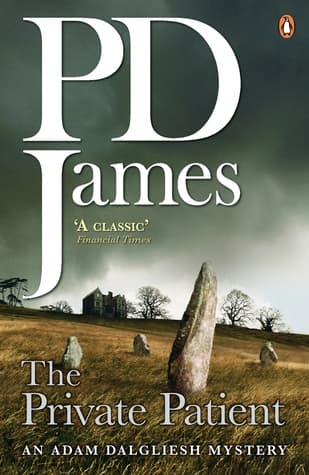
Synopsis
Covers the whole plot, including the ending.
- Difficulty
- Medium
- Pacing
- Moderate
- Mood
- Atmospheric, Suspenseful, Reflective, Introspective
- Read it if
- You enjoy classic British police procedurals with intricate plots, psychological depth, and a strong sense of atmosphere, particularly if you appreciate P.D. James's meticulous style and Commander Adam Dalgliesh's thoughtful deductions.
- Skip it if
- You prefer fast-paced thrillers with constant action, dislike detailed character studies, or find traditional, methodical mystery investigations too slow.
The Private Patient Plot Summary
Covers the whole plot, including the ending.
Rhoda Gradwyn's Final Appointment
Rhoda Gradwyn, a well-known investigative journalist known for her sharp comments and controversial articles, checks into Cheverell Manor, a private nursing home in Dorset. She is there for a facelift by the celebrated plastic surgeon, Mr. George Chandler-Powell. Cheverell Manor, a converted Elizabethan house, is run by Chandler-Powell and his sister, Caroline. After a successful operation and what seems like a good recovery, Gradwyn is found dead in her bed the next morning, strangled. At first, people think it is suicide, but the situation quickly suggests murder, leading to a call to Scotland Yard and Commander Adam Dalgliesh.
Dalgliesh Arrives at Cheverell Manor
Commander Adam Dalgliesh, with Detective Inspector Kate Miskin and Detective Sergeant Francis Benton-Smith, arrives at Cheverell Manor. They immediately notice the isolated beauty of the estate and the complex relationships among its residents and staff. Dalgliesh learns about Rhoda Gradwyn's difficult personality and her history of exposing scandals, which made her many enemies. The first interviews show unease and several possible suspects, each with a reason to want Gradwyn dead. The team sets up a temporary base at the manor to carefully examine the crime scene and interview everyone present during Gradwyn's stay.
Uncovering Motives and Secrets
Dalgliesh and his team begin to look into the lives of Cheverell Manor's residents and staff. Suspects appear: George Chandler-Powell, whose reputation Gradwyn might have threatened; his sister Caroline, who protects her brother and the manor; Emma Lavenham, Gradwyn's literary agent, who had a complex relationship with her client; and the other patients, including the quiet mystery writer Flavia Kinnaird, the outspoken elderly patient Miss Ulrica Friedman, and the former politician Marcus Dupayne. All of them had reasons to dislike Gradwyn or fear her revelations. The team also learns about Gradwyn's past investigations, especially one about a scandal from decades ago that ruined careers and lives.
The First Red Herring: The Manor's Past
The team discovers that Rhoda Gradwyn was researching an old scandal involving a prominent family, the De Vere's, who used to own Cheverell Manor. This scandal involved a murder and a cover-up, which Gradwyn was reportedly close to revealing. This line of inquiry leads Dalgliesh to consider suspects connected to this past event, including the manor's gardener, Dennis Tremlett, whose family was indirectly affected. While this provides a strong reason for some, the timing and details of Gradwyn's murder do not fit perfectly, suggesting this might be a distraction from the real killer.
The Second Murder: Dr. Marcus Dupayne
Just as the investigation seems to be moving forward, a second murder shocks Cheverell Manor. Dr. Marcus Dupayne, a former politician and patient recovering from a stroke, is found dead in his room, also strangled. This confirms that the killer is still in the manor and is targeting those connected to Gradwyn or her investigations. Dupayne had his own reasons to fear Gradwyn's revelations, especially about his political past. The second murder increases the pressure on Dalgliesh's team, showing how urgent it is to find the killer before another person dies.
The Role of Emma Lavenham
Emma Lavenham, Rhoda Gradwyn's literary agent and long-time friend, becomes a main person in the investigation. Her seemingly strong loyalty to Gradwyn is complicated by discoveries of a deeper, more resentful relationship. Emma felt exploited by Gradwyn, whose success she helped but did not share. Also, Emma knew about Gradwyn's habit of keeping detailed, often harmful, notes about people in her life, including Emma herself. This motive of resentment and self-preservation, along with her detailed knowledge of Gradwyn's habits and schedule, makes Dalgliesh scrutinize Emma closely.
The Confession and Its Aftermath
Under Dalgliesh's questioning, Emma Lavenham eventually confesses to Rhoda Gradwyn's murder. She describes how, driven by years of anger and a sudden impulse, she strangled Gradwyn with a silk scarf after a late-night argument. However, Emma strongly denies any involvement in Marcus Dupayne's death. Her confession, while identifying a perpetrator for the first murder, leaves the second murder unsolved and Dupayne's killer still at large. This adds a new layer of difficulty, making Dalgliesh consider if there are two murderers or if Emma is lying about Dupayne's death.
Dalgliesh's Revelation: The True Killer
Dalgliesh, not convinced by Emma's partial confession, continues to put together the evidence. He carefully re-examines the timeline, the physical evidence, and the psychological profiles of everyone involved. He realizes that the answer is in the small inconsistencies and the motive connecting both victims. Dalgliesh concludes that the killer is someone who had a strong, personal reason against Gradwyn, and then killed Dupayne to mislead suspicion or because Dupayne had found out the truth. He focuses on the long-standing resentments and the carefully built appearance of one of the manor's residents.
The Confrontation and Resolution
Dalgliesh confronts Caroline Chandler-Powell, George's sister and the calm manager of Cheverell Manor. He reveals that Caroline was the murderer of both Rhoda Gradwyn and Marcus Dupayne. Her reason came from a deep fear that Gradwyn was about to expose a secret from her past, specifically her part in a crime decades ago – the murder of her abusive father, which her family covered up. Gradwyn's notes and research were dangerously close to revealing this truth. Dupayne was killed because he had overheard Caroline speaking to Gradwyn shortly before the first murder, and she feared he would expose her. Caroline, trapped, confesses to both crimes, driven by a desperate need to protect her secret and her brother's reputation. Emma Lavenham's confession to Gradwyn's murder was a convenient, if temporary, distraction.
Aftermath at Cheverell Manor
With Caroline Chandler-Powell's confession, the truth of both murders at Cheverell Manor is finally clear. The peaceful appearance of the private nursing home is broken, revealing the dark secrets and resentments hidden beneath. Dalgliesh and his team finish their investigation, preparing the evidence for court. The remaining patients and staff are left to deal with the shocking revelations. Dalgliesh thinks about the nature of evil, the destructive power of secrets, and the tragic results of a life lived in fear. He leaves Cheverell Manor, the quiet beauty of the place now forever marked by the violence it saw, but with justice done.
Principal Figures
Commander Adam Dalgliesh
Protagonist
Head of Scotland Yard's Special Investigation Squad, a poet and astute detective.
Commander Adam Dalgliesh is a cerebral and introspective detective, known for his sharp intellect, calm demeanor, and poetic sensibilities. He approaches cases with meticulous precision, often observing subtle psychological nuances that others miss. While professional and detached, he possesses a deep understanding of human nature and motive. In 'The Private Patient,' he navigates the complex social dynamics of Cheverell Manor, using his quiet authority and keen observational skills to unravel the layers of deceit surrounding Rhoda Gradwyn's murder. He is driven by a profound sense of justice and a desire to understand the 'why' behind the crime.
Relationships: DI Kate Miskin (Subordinate and trusted colleague); DS Francis Benton-Smith (Subordinate and capable colleague)
Rhoda Gradwyn
Victim
An abrasive investigative journalist whose murder initiates the investigation.
Rhoda Gradwyn is the initial victim, a highly successful but widely disliked investigative journalist. Known for her ruthless exposes and sharp, often cruel, wit, she had a knack for uncovering damaging secrets and making powerful enemies. Her personality is described as both brilliant and abrasive, leaving a trail of resentment wherever she went. She checks into Cheverell Manor for a facelift, ostensibly for professional reasons, but also carrying with her a notebook full of potential new scandals. Her death is the catalyst for Dalgliesh's investigation, and her past actions and character provide the initial pool of suspects and motives.
Relationships: Emma Lavenham (Literary agent and resentful friend); George Chandler-Powell (Her plastic surgeon); Caroline Chandler-Powell (Her murderer)
George Chandler-Powell
Supporting
Renowned plastic surgeon and owner of Cheverell Manor.
George Chandler-Powell is a celebrated and highly respected plastic surgeon who owns and operates Cheverell Manor. He is portrayed as charming, professional, and dedicated to his work, but also somewhat detached and preoccupied with his reputation. He lives with his sister, Caroline, who manages the manor. His initial shock and distress over Gradwyn's murder are genuine, but Dalgliesh suspects he might have secrets or professional vulnerabilities that Gradwyn could have exploited. He is fiercely protective of his practice and his sister, creating a complex dynamic within the investigation.
Relationships: Caroline Chandler-Powell (Sister and business partner); Rhoda Gradwyn (Patient and victim)
Caroline Chandler-Powell
Antagonist
George's sister and the meticulous manager of Cheverell Manor, who is eventually revealed as the killer.
Caroline Chandler-Powell is George's older sister and the highly efficient, seemingly unflappable manager of Cheverell Manor. She is meticulous, organized, and fiercely protective of her brother and the manor's reputation. Beneath her composed exterior, she harbors deep-seated secrets and resentments, particularly regarding her family's past. She is initially presented as a supportive and capable figure, but her rigid control and guarded nature make her a person of interest. Her ultimate revelation as the murderer is a shocking twist, driven by a desperate need to prevent Gradwyn from exposing a decades-old family secret.
Relationships: George Chandler-Powell (Brother and business partner); Rhoda Gradwyn (Victim, whom she feared); Marcus Dupayne (Second victim)
Emma Lavenham
Supporting
Rhoda Gradwyn's literary agent, who confesses to the first murder.
Emma Lavenham is Rhoda Gradwyn's long-suffering literary agent and, for a time, her closest confidante. She appears devoted to Gradwyn but secretly harbors deep resentment and feelings of being exploited. Emma is intelligent, sensitive, and emotionally vulnerable, contrasting sharply with Gradwyn's hardened personality. She knows Gradwyn's habits and secrets intimately, including her private notes on individuals. Her confession to Gradwyn's murder, born from a moment of impulse and years of suppressed anger, initially complicates the investigation, serving as a red herring for Dalgliesh.
Relationships: Rhoda Gradwyn (Client and object of resentment)
Dr. Marcus Dupayne
Victim
A former politician and patient, the second murder victim at Cheverell Manor.
Dr. Marcus Dupayne is an elderly patient at Cheverell Manor, recovering from a stroke. A former politician, he retains a sharp mind and a critical, somewhat cynical, outlook. He had known Rhoda Gradwyn professionally and personally, and both disliked and feared her potential to expose aspects of his past. His murder, following Gradwyn's, escalates the tension and confirms the presence of a dangerous killer still within the manor. His death is crucial in shifting Dalgliesh's focus and revealing a more complex motive than initially assumed.
Relationships: Rhoda Gradwyn (Acquaintance and object of fear); Caroline Chandler-Powell (His murderer)
Miss Ulrica Friedman
Supporting
An elderly, outspoken patient with a sharp tongue and keen observational skills.
Miss Ulrica Friedman is an elderly, opinionated, and highly observant patient at Cheverell Manor. She is a fascinating, almost theatrical, character who delights in gossip and has a surprisingly sharp intellect. Despite her age and physical frailties, she misses little and often provides Dalgliesh with unexpected insights and observations, though sometimes clouded by her own biases. She represents the 'eyes and ears' of the manor, a seemingly harmless figure who nonetheless holds pieces of the puzzle.
Relationships: Rhoda Gradwyn (Fellow patient, whom she found irritating)
Flavia Kinnaird
Supporting
A reclusive mystery writer and patient at the manor.
Flavia Kinnaird is a quiet, reclusive patient at Cheverell Manor, known for writing popular mystery novels. She is recovering from an illness and prefers to keep to herself, observing the goings-on with a writer's eye. Her presence adds an interesting meta-narrative layer, as she is a 'detective' in her own right, albeit fictional. She provides Dalgliesh with a different perspective on human nature and the motivations behind crime, often drawing parallels to her own fictional plots. Her quiet nature hides a perceptive mind.
Relationships: Rhoda Gradwyn (Fellow patient, whom she observed)
DI Kate Miskin
Supporting
Dalgliesh's dedicated and insightful subordinate.
Detective Inspector Kate Miskin is a key member of Dalgliesh's team, known for her dedication, intelligence, and a strong sense of justice. She is diligent in her police work and often provides a grounded, practical perspective to Dalgliesh's more philosophical approach. She navigates the complex social dynamics of the manor with professional poise, conducting interviews and following leads with thoroughness. Her personal life, particularly her working-class background, sometimes provides a subtle contrast to the privileged world she investigates.
Relationships: Commander Adam Dalgliesh (Superior and mentor); DS Francis Benton-Smith (Colleague)
DS Francis Benton-Smith
Supporting
Dalgliesh's meticulous and efficient subordinate.
Detective Sergeant Francis Benton-Smith is another capable member of Dalgliesh's team. He is methodical, reliable, and possesses a keen eye for detail, making him an invaluable asset in the painstaking work of a murder investigation. He often handles the more logistical and technical aspects of the case, supporting Dalgliesh and Miskin with his thoroughness. He is observant and dedicated, contributing to the team's overall effectiveness in unearthing clues and interviewing witnesses.
Relationships: Commander Adam Dalgliesh (Superior); DI Kate Miskin (Colleague)
Themes & Insights
Secrets and Their Destructive Power
The novel explores how old secrets can grow and lead to violence. Caroline Chandler-Powell's desperate effort to keep her family's past crime hidden makes her murder Gradwyn, and then Dupayne. Rhoda Gradwyn herself thrives on exposing others' secrets, showing how truth can be both good and bad. The carefully kept appearance of Cheverell Manor shows the hidden lives and suppressed truths of its residents, demonstrating how the fear of being exposed can corrupt and destroy.
“Secrets are like cancers; they grow and spread until they consume everything.”
Justice and Morality
Dalgliesh deals with the complexities of justice, especially when the first crime (Caroline's past murder of her abusive father) has a morally unclear context. The novel asks if justice is only about legal punishment or also about understanding the human reasons behind actions. Gradwyn's 'justice' was often public shaming, while Dalgliesh seeks a more complete, even if painful, truth. The two murders force a look at different types of moral wrongdoing and the search for final accountability.
“Justice, Dalgliesh thought, was not always a matter of clear-cut right and wrong, but often a tangle of human frailties and desperate acts.”
The Nature of Identity and Appearance
Set in a plastic surgery clinic, the theme of appearance versus reality is central. Patients try to change how they look, hoping to change who they are or escape their past. Rhoda Gradwyn's facelift is ironic, as her inner flaws and destructive nature remain. The clean appearance of Cheverell Manor hides dark truths, like how characters present one face to the world while hiding their true selves. The desire to control one's image, both physical and social, drives many of the characters' actions and worries.
“People came here to shed an old skin, to become someone new. But the past, Dalgliesh knew, was not so easily excised.”
Resentment and Exploitation
The novel explores how long-term resentment can turn into violence. Emma Lavenham's confession, though a false lead for Dupayne's murder, comes from years of feeling used and overshadowed by Rhoda Gradwyn. Gradwyn herself is good at using others' weaknesses and secrets for her journalism. This theme shows the damaging effect of unequal power in relationships and how perceived wrongs, not dealt with, can lead to terrible outcomes.
“Resentment was a slow poison, accumulating drop by drop, until it finally overflowed.”
The Private vs. Public Self
The setting of a private nursing home, where public figures seek private treatment, highlights the tension between one's public self and private life. Rhoda Gradwyn, a public figure, is murdered in a supposedly private space, blurring these lines. The characters carefully protect their private lives and reputations, fearing public scrutiny and the exposure of their weaknesses. The investigation forces these private selves into the public eye, revealing the often sharp difference between how people present themselves and who they truly are.
“In a place dedicated to discreet transformation, the most potent secrets were not those of the body, but of the soul.”
Plot Devices & Literary Techniques
Closed Circle Mystery
Confines the suspects to a limited, isolated setting.
The entire murder investigation takes place within the isolated confines of Cheverell Manor, a private nursing home. This 'closed circle' or 'locked room' effect significantly limits the pool of suspects to the patients, staff, and immediate associates present at the time of the murders. This device heightens tension, forcing Dalgliesh to meticulously examine the relationships and secrets within this insular community, making every character a potential suspect and every interaction significant. It emphasizes the psychological drama over external action.
Red Herring
Misleading clues or suspects designed to divert the reader and detective.
The novel employs several red herrings. Initially, Gradwyn's extensive list of enemies from her journalistic career provides numerous potential culprits. More significantly, Emma Lavenham's confession to Gradwyn's murder serves as a major red herring, making it seem as though the case is partially solved while the true killer remains at large and commits a second murder. This device keeps the reader guessing and allows P.D. James to explore multiple character motivations before revealing the unexpected truth.
Journalistic Exposé as Catalyst
The victim's profession and past investigations drive the plot.
Rhoda Gradwyn's profession as an investigative journalist is not just a character detail; it's the primary catalyst for the entire plot. Her history of exposing scandals and her current research into a decades-old family secret directly provide the motive for her murder. Her very presence and her work threaten to unravel the carefully constructed lives and reputations of several characters, creating a rich tapestry of potential motives and placing her at the center of a web of danger. Her 'little black book' of notes becomes a central, symbolic plot device.
Dual Murder Mystery
The occurrence of a second murder complicates the initial investigation.
The initial murder of Rhoda Gradwyn sets the stage, but the subsequent murder of Dr. Marcus Dupayne significantly complicates Dalgliesh's investigation. This second death immediately refutes the idea of a single, isolated incident and forces the team to reconsider all previous assumptions. It implies either a second killer, or that the first killer is still at large and more dangerous than imagined. This device raises the stakes, creates new urgency, and provides additional layers of motive and opportunity for Dalgliesh to unravel, ultimately pointing towards a single, more desperate perpetrator.
Psychological Depth and Character Study
Focuses on the inner lives and motivations of characters.
P.D. James masterfully uses extensive character studies to build the mystery. Rather than relying solely on forensic evidence, the novel delves deeply into the psychological profiles, backstories, and complex relationships of the suspects. Dalgliesh's method often involves understanding the 'why' behind the crime, which necessitates understanding the characters' inner lives, their resentments, fears, and desires. This device makes the motives for murder deeply personal and psychologically plausible, enriching the narrative beyond a simple whodunit.
The Private Patient Quotes
“Murder is the ultimate invasion of privacy.”
“The past is never dead. It's not even past.”
“In every murder investigation, there are two stories: the one told by the dead and the one told by the living.”
“Secrets are like shadows; they grow longer as the light fades.”
“A surgeon's hands must be steady, but a detective's mind must be steadier.”
“The rich have their own kind of poverty—a poverty of trust.”
“Justice is not always found in a courtroom; sometimes it whispers in the corridors of power.”
“Fear is a more potent poison than any drug.”
“Every patient carries a diagnosis, but every person carries a story.”
“The truth is a mirror, and we are all afraid of what it might show.”
“In the end, we are all patients of our own choices.”
“A house of healing can become a house of horror when secrets fester.”
“The scalpel cuts both ways: it can save a life or conceal a crime.”
Quiz
10 questions on the plot and the characters. Each answer comes with a short explanation.
Question 1
Who is the victim murdered at the private nursing home in 'The Private Patient'?
- George Chandler-Powell
- Rhoda Gradwyn
- Adam Dalgliesh
- Emma Lavenham
Show answer
B. Rhoda Gradwyn Rhoda Gradwyn is the investigative journalist who is murdered after undergoing plastic surgery at the private clinic run by George Chandler-Powell, setting off the central mystery of the novel.
Question 2
What is the profession of George Chandler-Powell in the book?
- Police Commander
- Journalist
- Plastic Surgeon
- Private Detective
Show answer
C. Plastic Surgeon George Chandler-Powell is the famous plastic surgeon who runs the private nursing home where the murder occurs, making him a key figure in the investigation.
Question 3
Which character is Commander Adam Dalgliesh's romantic interest in this novel?
- Rhoda Gradwyn
- Emma Lavenham
- Kate Miskin
- Cordelia Gray
Show answer
B. Emma Lavenham Emma Lavenham is Dalgliesh's fiancée in this book, and their relationship adds a personal dimension to the story, though she is not directly involved in the murder case.
Question 4
Why was Rhoda Gradwyn at the private nursing home?
- To investigate a story
- To visit a friend
- To undergo plastic surgery
- To work as a nurse
Show answer
C. To undergo plastic surgery Rhoda Gradwyn was there to have a facial scar removed by Chandler-Powell, which is ironic given her murder shortly after the procedure.
Question 5
What role does the setting of the private nursing home play in the mystery?
- It provides a public space with many witnesses
- It isolates the suspects and creates a closed-circle scenario
- It is located in a busy city center
- It serves as Dalgliesh's headquarters
Show answer
B. It isolates the suspects and creates a closed-circle scenario The private nursing home is a secluded, elite setting that limits access, creating a classic closed-circle mystery where the suspects are confined together, heightening tension and suspicion.
Question 6
Which of Dalgliesh's team members plays a significant role in the investigation?
- Inspector Kate Miskin
- Sergeant Francis Benton-Smith
- Detective Inspector Massingham
- Cordelia Gray
Show answer
A. Inspector Kate Miskin Inspector Kate Miskin is a key member of Dalgliesh's team, assisting in the investigation and providing insights into the case, reflecting her established role in the series.
Question 7
What is a central theme explored through Rhoda Gradwyn's character?
- The joy of cosmetic surgery
- The pursuit of truth and secrets from the past
- The benefits of wealth and privilege
- The simplicity of rural life
Show answer
B. The pursuit of truth and secrets from the past Rhoda Gradwyn's work as an investigative journalist and her personal history involve uncovering truths and dealing with hidden secrets, which ties into the novel's exploration of past actions affecting the present.
Question 8
How does the murder weapon relate to the setting of the nursing home?
- It is a surgical instrument from the clinic
- It is a gun brought from outside
- It is a poison from the garden
- It is a blunt object from the library
Show answer
A. It is a surgical instrument from the clinic The murder weapon is a surgical instrument, specifically a scalpel, which is fitting for the medical setting and adds to the irony and thematic depth of the crime.
Question 9
What personal connection does Dalgliesh discover during the investigation that complicates the case?
- He finds out he is related to Chandler-Powell
- He uncovers a past link between the victim and a suspect from an old case
- He learns that Emma Lavenham is a suspect
- He realizes he treated the victim years ago
Show answer
B. He uncovers a past link between the victim and a suspect from an old case Dalgliesh discovers that the murder is connected to an older, unresolved case involving secrets and relationships among the suspects, highlighting the theme of past sins resurfacing.
Question 10
Which element of P.D. James's writing style is notably evident in 'The Private Patient'?
- Fast-paced action sequences
- Psychological depth and moral complexity
- Use of supernatural elements
- Focus on futuristic technology
Show answer
B. Psychological depth and moral complexity P.D. James is known for her psychological insight and exploration of moral dilemmas, which are central to this novel through its character motivations and the ethical questions raised by the murder and its investigation.
The Private Patient FAQ
What is 'The Private Patient' about?
The novel follows Commander Adam Dalgliesh and his team as they investigate the murder of Rhoda Gradwyn, a journalist who was killed after undergoing plastic surgery at Cheverell Manor, a private clinic run by the renowned surgeon George Chandler-Powell. The investigation uncovers secrets among the staff and patients, revealing hidden motives and past connections.
Why should I read 'The Private Patient'?
It's a classic P.D. James mystery that combines intricate plotting with deep psychological insight, featuring her iconic detective Adam Dalgliesh. The novel explores themes of privacy, identity, and the consequences of buried secrets, set against the atmospheric backdrop of a secluded manor clinic.
What is the background/setting of 'The Private Patient'?
The story is set primarily at Cheverell Manor, a private nursing home in Dorset, England, which serves as a clinic for wealthy patients undergoing plastic surgery. The isolated, manor-house setting creates a claustrophobic atmosphere where suspects are confined together, heightening the tension.
What are the most memorable quotes?
Notable quotes include Rhoda Gradwyn's reflection, 'I have no regrets. Regret is a useless emotion,' which hints at her past, and Dalgliesh's observation, 'Murder is the ultimate invasion of privacy,' tying into the novel's themes. These lines underscore the characters' motivations and the ethical dilemmas at play.
What writing style does the author use?
P.D. James employs a literary, descriptive style with precise prose, delving into characters' inner thoughts and the social dynamics of the setting. Her writing is methodical, building suspense through detailed observations and psychological depth rather than fast-paced action.
What minor details add significant meaning?
Details like Rhoda Gradwyn's scar, which she sought to remove through surgery, symbolize her desire to erase a traumatic past. The manor's history as a former convent adds layers of secrecy and redemption, mirroring the characters' hidden lives and the clinic's sanitized facade.
What are some subtle foreshadowing moments?
Early mentions of Rhoda's past as an investigative journalist hint at her uncovering dangerous secrets. The tension between staff members, such as Nurse Flavia Holland's resentment, foreshadows later conflicts. Descriptions of the isolated manor subtly suggest the inevitability of the murder.
What unexpected character connections exist?
It's revealed that George Chandler-Powell has a hidden connection to Rhoda Gradwyn through a past medical case, and staff members like the housekeeper have ties to local secrets. These connections slowly emerge, showing how the murder is rooted in intertwined histories rather than random violence.
What are unspoken character motivations?
Rhoda Gradwyn's surgery is driven by a desire to physically erase a scar linked to childhood trauma, symbolizing her attempt to control her past. George Chandler-Powell's perfectionism masks guilt over previous medical failures, while other characters are motivated by envy, greed, or a need for redemption.
What psychological complexities do characters exhibit?
Dalgliesh balances professional detachment with personal empathy, often reflecting on the human cost of crime. Rhoda Gradwyn displays resilience masking deep vulnerability, and suspects like the nurse show conflicted loyalties. The characters' psyches are layered, revealing how past experiences shape their actions.
What are the major emotional turning points?
Key moments include the discovery of Rhoda's body, which shocks the closed community, and revelations about her past that shift suspicion among the suspects. Dalgliesh's interviews uncover hidden emotions, leading to climactic confrontations where characters' facades crack under pressure.
How do relationship dynamics evolve?
Initial professional relationships at the clinic deteriorate into mistrust and accusation as the investigation progresses. Dalgliesh's team dynamics show collaboration and tension, while romantic or familial ties among characters are strained by secrets, ultimately leading to betrayals and alliances shifting.
Which parts remain ambiguous or open-ended?
The novel leaves some characters' futures uncertain, such as the resolution for minor suspects or the full impact of the murder on the clinic's reputation. Moral ambiguities around justice and privacy are not fully resolved, inviting readers to ponder the ethical implications.
What are controversial scenes or decisions?
Scenes involving the invasion of patients' privacy during the investigation raise ethical questions. Characters' decisions, like withholding evidence or manipulating others for personal gain, spark debate about morality in a closed, high-stakes environment where survival instincts clash with duty.
'The Private Patient' ending explained: how it ends & what it means
The ending reveals the murderer is someone within the clinic, motivated by a secret tied to Rhoda's past. Dalgliesh solves the case through careful deduction, leading to an arrest. It signifies that privacy is fragile and that buried truths inevitably surface, with justice prevailing but leaving emotional scars on the community.
About the author

P.D. James was a British author known for her contributions to the mystery genre. Her notable works include "Death Comes to Pemberley," "Cover Her Face," "The Black Tower," "The Private Patient," and "An Unsuitable Job for a Woman," which often feature intricate plots and well-developed characters. James's writing has garnered significant recognition, including being appointed a life peer in the House of Lords.
Similar books
- Gaudy Night
Dorothy L. Sayers
4.2 (23k) average on GoodreadsHistorical FictionA Golden Age mystery set in an academic women's college, known for its intellectual puzzles and nuanced character interactions.
- Killing Floor
Lee Child
4.0 (249k) average on GoodreadsThrillerIn stark contrast to "The Private Patient," "Killing Floor" is an action-oriented thriller prioritizing explosive sequences, a straightforward hero (Jack Reacher), and clear-cut villains. Child's novel aims for adrenaline-fueled entertainment and a simpler good-versus-evil narrative, whereas James offers a cerebral mystery with nuanced morality, intricate deduction, and villains whose motives are often deeply personal and complex rather than purely malevolent.
- Angels & Demons
Dan Brown
3.9 (2.7M) average on GoodreadsThrillerA Harvard symbologist races through Rome's ancient sites, deciphering cryptic clues to unmask the Illuminati and stop a vengeful plot to destroy the Vatican with a stolen antimatter weapon.
- Gone Girl
Gillian Flynn
4.1 (2.3M) average on GoodreadsThrillerA wife's sudden disappearance on her fifth anniversary reveals a web of lies and psychological warfare, exposing the secrets within a seemingly perfect marriage.
- The Girl on the Train
Paula Hawkins
3.9 (2.1M) average on GoodreadsThrillerA woman’s fascination with a seemingly perfect couple she watches from her daily train commute leads her into a dark investigation when she witnesses something that shatters their idyllic image.
- The Da Vinci Code
Dan Brown
3.9 (1.9M) average on GoodreadsThrillerA symbologist and a cryptologist race through European landmarks, deciphering ancient codes and uncovering a conspiracy that could rewrite the foundations of Christianity.





Enjoyed the summary?
A summary gives you the shape of the book. The book itself has the detail, the examples and the voice.
Find The Private Patient on AmazonAs an Amazon Associate, BookBrief earns from qualifying purchases. How we're funded