
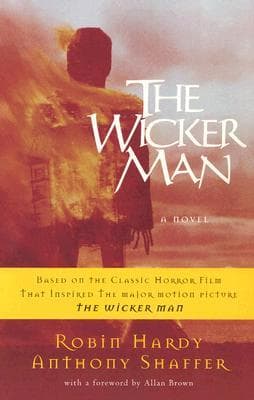
Synopsis
Covers the whole plot, including the ending.
- Difficulty
- Medium
- Pacing
- Moderate
- Mood
- Atmospheric, Unsettling, Suspenseful, Dark, Claustrophobic
- Read it if
- You enjoy folk horror, psychological thrillers, and stories where a protagonist is systematically isolated and gaslit by an entire community.
- Skip it if
- You dislike stories with a bleak, tragic ending or are sensitive to themes of pagan sacrifice and manipulation.
The Wicker Man Plot Summary
Covers the whole plot, including the ending.
The Missing Girl and the Summons
Police Sergeant Neil Howie, a Christian and celibate Highlands policeman, receives an anonymous letter from Summerisle, a remote Scottish island. The letter reports a young girl named Rowan Morrison missing. Despite his superior's doubts, Howie, driven by duty, decides to investigate. He flies to the island, a place known for its unusual, self-sufficient community. When he arrives, Howie immediately notices the islanders' strange customs and their unwillingness to help, which sets an uneasy tone for his investigation.
A Community of Secrets
Howie's first questions are met with denial. The islanders, including Rowan's supposed mother, Daisy, and the schoolmistress, Miss Rose, claim Rowan Morrison never existed. Howie visits the school, where he finds an empty desk and a roll book with Rowan's name. However, the children and Miss Rose say she was just 'imagined.' He sees the children learning about phallic symbols and pagan rituals, which makes him more uneasy. The island feels full of a hidden secret, and Howie's Christian beliefs conflict with the open paganism he sees.
Lord Summerisle's Influence
Frustrated by the lack of help, Howie seeks out Lord Summerisle, the island's leader. Summerisle's family started the island's unique farming system and pagan traditions. Lord Summerisle openly admits to the islanders' pagan beliefs, explaining their reliance on old gods for good harvests, but he denies knowing Rowan Morrison. He dismisses Howie's concerns as a misunderstanding of their culture, which makes Howie more suspicious that the community is against him. Howie is especially bothered by the islanders' casual acceptance of nudity and sexual freedom.
Unsettling Discoveries
Despite the islanders' united front, Howie finds small clues that Rowan did exist. He discovers a photograph of Rowan and later, a tooth he believes is hers, found near a ceremonial site. He also sees stranger and more openly sexual rituals as May Day gets closer, including a fertility dance with costumed villagers and a Maypole. The islanders' respect for nature and their gods takes on a darker tone, suggesting a more sinister reason for their festivities. Howie becomes convinced that Rowan has been taken for a ritual sacrifice.
The Serpent and the Maypole
As the May Day festival nears, Howie sees a disturbing ritual where a live snake is paraded through the village and then placed at the base of the Maypole. This act, along with the islanders' increasing celebration and open sexuality, further strengthens Howie's belief that he is in a place of deep sin and pagan ways. He sees these symbols as direct insults to his Christian faith and as signs of a human sacrifice to come. The islanders' collective joy and uncontrolled behavior contrast sharply with Howie's growing horror and isolation.
The Innkeeper's Daughter
During his stay at the Green Man Inn, Howie is subjected to the attempts of Willow MacGregor, the innkeeper's attractive daughter. She sings a provocative song through his wall and tries to get him into her bed. Howie, committed to his celibacy and Christian principles, resists her, seeing her as a temptation from the devil. His inner struggle shows his strict moral code and his growing feeling of being under attack by the island's paganism. This encounter further separates him from the islanders' way of life.
The Search for Rowan
Convinced that Rowan is being held captive and will be sacrificed, Howie increases his search. He believes the islanders are waiting for the perfect moment during the May Day festivities to offer her to their gods. He searches the island for hidden places or signs of her imprisonment. His desperate search leads him to believe he is running out of time, and he becomes more frantic as the May Day celebrations peak, strengthening his resolve to save the girl, no matter what it takes.
The Fool and the Sacrifice
On May Day, Howie sees a grand procession, with islanders dressed as animals and other figures. He sees a parade of fools and realizes this is his chance to join the ceremony. He overpowers one of the fools, puts on his costume, and joins the procession, hoping to find and rescue Rowan. His disguise allows him to move among the revelers unnoticed, giving him a view of the final stages of the ritual he is sure will involve human sacrifice.
The Discovery of Rowan
Disguised as the fool, Howie eventually spots a girl, who appears to be Rowan Morrison, tied and gagged inside a large wicker man structure. Believing he has found her, he rushes forward to save her, only to be ambushed by the islanders. The 'Rowan' he sees is not the real Rowan, but another girl, part of a trap. This moment of false hope quickly turns to a terrifying realization, as Howie understands the true nature of the islanders' plans and his own desperate situation.
The True Sacrifice
Howie is captured and stripped of his disguise. Lord Summerisle, Miss Rose, Willow, and the entire community reveal their deception. Rowan Morrison was never missing; she was a lure, a planned fiction meant to bring a suitable sacrifice to Summerisle. Howie, a virgin and a 'fool' in their eyes, is deemed the perfect offering to ensure a good harvest after several failed seasons. The islanders believe that by sacrificing a willing, yet unknowing, outsider, their gods will be pleased.
The Wicker Man
Howie is led to the colossal wicker man, a giant effigy made of branches and wood. Inside, animals are already trapped, awaiting their fate. The islanders bind Howie and place him within the structure, sealing his doom. He is surrounded by the joyous, chanting islanders, who see his death not as murder, but as a sacred act necessary for their survival. Howie, now fully aware of his horrifying fate, pleads with them, invoking his Christian God, but they do not listen.
The Fiery End
As the sun sets, Lord Summerisle gives the command, and the wicker man is set on fire. Flames quickly engulf the massive structure, trapping Howie inside. His screams are covered by the singing and chanting of the islanders, who celebrate their offering to the sun god. Howie's final moments show his strong faith clashing with the brutal reality of pagan sacrifice. The film ends with the image of the burning wicker man and the islanders' faces in the orange glow, their prayers for a good harvest echoing into the night.
The Wicker Man Characters
Sergeant Neil Howie
Protagonist
A devoutly Christian and celibate police sergeant investigating a missing girl.
Sergeant Howie is a rigid, moralistic, and deeply religious man, whose Christian faith dictates his every action and belief. He is celibate, abstains from alcohol, and holds strong convictions about law and order, and the sanctity of life. His sense of duty is paramount, driving him to Summerisle despite the skepticism of his superiors. He is initially portrayed as resolute and incorruptible, but his unwavering faith ultimately makes him an ideal, unwitting sacrifice for the pagan islanders.
Relationships: Lord Summerisle (Antagonistic; ideological clash, ultimately predator/prey); Willow MacGregor (Target of seduction, resisted by Howie); Miss Rose (Initial informant/deceiver, later revealed as conspirator)
Lord Summerisle
Antagonist
The charismatic and manipulative leader of the Summerisle community.
Lord Summerisle is the sophisticated, educated, and utterly ruthless patriarch of Summerisle. He is the architect of the island's unique pagan society, having revived ancient customs and agricultural practices. He presents himself as a benevolent leader, but his charm masks a cold, calculating intelligence. His primary motivation is the prosperity of his community, for which he is willing to commit human sacrifice. He is a master manipulator, orchestrating Howie's arrival and ultimate demise with chilling precision.
Relationships: Sergeant Neil Howie (Manipulator/victim, ideological opponent); Summerisle Community (Leader and spiritual guide, revered by the islanders)
Willow MacGregor
Supporting
The seductive innkeeper's daughter who attempts to tempt Howie.
Willow is a beautiful and uninhibited young woman, embodying the free-spirited and openly sexual nature of Summerisle's pagan culture. As the innkeeper's daughter, she is one of the first islanders to directly confront Howie's rigid morality, attempting to seduce him. Her role is to test Howie's celibacy and highlight the stark contrast between his repressed Christian values and the islanders' sensual lifestyle. She is a willing participant in the conspiracy against Howie.
Relationships: Sergeant Neil Howie (Seductress and later, a conspirator against him); Lord Summerisle (Loyal subject, participant in his plans)
Miss Rose
Supporting
The island's schoolmistress and a key conspirator.
Miss Rose is the seemingly mild-mannered schoolmistress of Summerisle. She is one of the first islanders Howie interrogates, providing misleading information about Rowan Morrison's existence and teaching the children overtly pagan lessons. Her calm demeanor and feigned ignorance are part of the elaborate deception to entrap Howie. She represents the insidious nature of the islanders' conspiracy, as even seemingly innocent figures are deeply embedded in their pagan practices and their plot.
Relationships: Sergeant Neil Howie (Deceiver and conspirator); Summerisle Community (Educator and loyal member)
Rowan Morrison
Mentioned
The 'missing' girl whose disappearance sparks Howie's investigation.
Rowan Morrison is the catalyst for the entire plot, yet she is largely an illusion. She is a young girl whose 'disappearance' is reported anonymously, luring Sergeant Howie to Summerisle. The islanders deny her existence, creating a mystery that Howie desperately tries to unravel. In reality, Rowan is not missing but is a willing participant in the islanders' grand deception, used as bait to draw in the 'perfect' sacrifice. Her true nature highlights the depth of the conspiracy.
Relationships: Sergeant Neil Howie (Bait for his sacrifice); Summerisle Community (Loyal member, participant in the deception)
Old Man Oak
Supporting
A village elder who offers cryptic warnings to Howie.
Old Man Oak is one of the few islanders who seems to show a flicker of genuine remorse or concern for Howie's fate, albeit cryptically. He offers vague warnings and observations about the island's ways, hinting at the danger Howie is in without directly betraying his community. He represents the older, perhaps more traditional, aspect of the pagan community, and his brief interactions with Howie underscore the depth of the islanders' collective secret.
Relationships: Sergeant Neil Howie (Cryptic warning giver)
The Wicker Man Themes
Clash of Ideologies: Christianity vs. Paganism
The main theme is the conflict between Sergeant Howie's Christian morality and Summerisle's ancient paganism. Howie's faith, celibacy, and belief in law are challenged and ultimately destroyed by the islanders' worship, fertility rites, and human sacrifice. The story shows how these two worldviews cannot exist together, with one eventually overcoming the other. The film criticizes the rigidity of strict belief when faced with a different, but equally strong, system.
“I will not have these people defile my God with their heathen rituals!”
The Nature of Sacrifice
The Wicker Man explores the idea of sacrifice, both religious and societal. For the islanders, Howie's sacrifice is a necessary act to ensure their land's fertility and their community's survival. It is presented as a 'willing' sacrifice, as Howie unknowingly 'volunteers' by coming to the island. For Howie, his death is a martyrdom, a final statement of his faith. The film looks at the ritual aspects of sacrifice, the reasons given by those performing it, and the irony of being chosen as an offering.
“For the good of the crops, for the land, for the fruit, for the harvest! For the Spring, for the Summer, for the Autumn, for the Winter!”
Deception and Manipulation
The entire plot depends on a deception planned by Lord Summerisle and the islanders. From the initial anonymous letter to the fake 'missing' Rowan Morrison, every interaction Howie has is part of a plan to lure him to the island for sacrifice. This theme highlights how effective collective manipulation can be and how an outsider can be completely isolated and controlled when an entire community conspires against them. Howie's inability to see through the facade until it is too late shows his vulnerability.
“You came here of your own free will. This is a sacrifice. A willing sacrifice.”
Community vs. Individual
The film explores the power of a unified community against one person. The islanders act as a single unit, bound by their shared beliefs and loyalty to Lord Summerisle. Howie, despite his authority as a policeman, is powerless against their collective will and traditions. This theme shows how an individual's rights and beliefs can be destroyed when faced with the overwhelming force of a communal, almost tribal, ideology.
“The life of the crops is the life of the island. And the life of the island is our life.”
Plot Devices & Literary Techniques
The Red Herring (Rowan Morrison)
The missing girl who is not truly missing, but a lure.
The character of Rowan Morrison functions as the ultimate red herring. Her supposed disappearance is the sole reason Sergeant Howie travels to Summerisle, setting the entire plot in motion. The islanders' consistent denial of her existence, coupled with Howie's 'discoveries' of evidence, keeps him fixated on finding her. This misdirection effectively blinds Howie to the true nature of his predicament, making him believe he is a detective solving a crime, rather than the intended victim of a ritual.
Dramatic Irony
The audience often knows or suspects more than Sergeant Howie.
Dramatic irony is prevalent throughout the story. The audience is often given subtle clues or a sense of unease about the islanders' intentions that Howie, due to his rigid worldview and focus on the 'missing girl,' fails to grasp. For example, the islanders' seemingly innocent songs or their discussions about 'a good harvest' take on sinister undertones for the audience, knowing Howie's ultimate fate. This creates a pervasive sense of dread and suspense, as we witness Howie unknowingly walk into his own doom.
Symbolism (The Wicker Man, animals, Maypole)
Objects and rituals carry deep, often pagan, symbolic meaning.
Various symbols are crucial to the narrative. The Wicker Man itself is the most potent symbol, representing both the pagan ritual of sacrifice and the islanders' connection to their ancient gods. Animals, often seen in costumes or as parts of the wicker man, symbolize fertility and the cycle of life and death. The Maypole and other phallic imagery represent fertility and the islanders' open sexuality. These symbols immerse the audience in the pagan world and contrast sharply with Howie's Christian iconography, highlighting the clash of ideologies.
Foreshadowing
Subtle hints and clues throughout the story that predict Howie's fate.
The narrative employs numerous instances of foreshadowing. Early on, the islanders' discussions about failed harvests and the need for a 'great sacrifice' subtly hint at Howie's impending doom. The children's lessons about the 'fool' and the 'sacrifice' directly prefigure his role. Even the innkeeper's daughter's song, with its suggestive lyrics, contains veiled warnings. These elements build a sense of inescapable dread, allowing the audience to piece together the puzzle before Howie does, amplifying the horror of his realization.
The Wicker Man Quotes
“Oh, God. Oh, Jesus Christ.”
“For the Earth, for the Sun, for the Moon, for the Stars, for the fruit, for the grain, for the meat, for the weal, for the woe, for the good, for the ill, for the life, for the death, for the life, for the death.”
“I will not be able to return, my dear Sergeant. I have a prior engagement.”
“You'll get no answer from them. They're all pagans here.”
“What are they going to do with me?”
“The apple tree is a sacred tree. It is a tree of knowledge and of life.”
“Come, we must make sure that the gods are appeased.”
“It is better that we sacrifice one man than that we should all starve.”
“The islanders are a simple folk, Sergeant. They believe in the old ways.”
“As the sun goes down, so too does the light of our old year die. And with the rising of the new sun, so too shall our new year be born.”
“This is a place where ancient gods still hold sway.”
“They're playing with him, Sergeant. Playing a deadly game.”
“The land is barren, Sergeant. We need a good harvest.”
“There are some things that are beyond your understanding, Sergeant.”
Quiz
10 questions on the plot and the characters. Each answer comes with a short explanation.
Question 1
What is the name of the remote Scottish island Sergeant Howie travels to?
- Winterisle
- Summerisle
- Springisle
- Autumnisle
Show answer
B. Summerisle Sergeant Howie travels to the remote Scottish island of Summerisle to investigate the disappearance of a young girl.
Question 2
What is Sergeant Howie's profession?
- Highlands Policeman
- Private Investigator
- Naval Officer
- Journalist
Show answer
A. Highlands Policeman Sergeant Neil Howie is specifically described as a Highlands policeman, on the trail of a missing girl.
Question 3
What annual festival is approaching on Summerisle during Howie's investigation?
- Harvest Festival
- Midsummer's Eve
- May Day
- Winter Solstice
Show answer
C. May Day The story explicitly states that 'As May Day approaches, strange, shamanistic and erotic events erupt around him.'
Question 4
What is Sergeant Howie's initial assumption about the missing girl's fate?
- She ran away with a lover.
- She has been abducted for human sacrifice.
- She drowned in the sea.
- She joined a traveling circus.
Show answer
B. She has been abducted for human sacrifice. Initially, Howie 'is convinced that the girl has been abducted for human sacrifice' due to the island's pagan practices.
Question 5
What kind of events begin to 'erupt around' Sergeant Howie as May Day approaches on Summerisle?
- Political protests and economic downturns.
- Scientific breakthroughs and technological advancements.
- Strange, shamanistic and erotic events.
- Community clean-up drives and charity fundraising.
Show answer
C. Strange, shamanistic and erotic events. The synopsis directly states that 'strange, shamanistic and erotic events erupt around him' as May Day draws near.
Question 6
What is the ultimate twist regarding Sergeant Howie's role in the island's rituals?
- He is revealed to be the true leader of the islanders.
- He discovers he is a long-lost relative of the missing girl.
- He finds that he may be the revellers' quarry.
- He successfully rescues the missing girl and escapes.
Show answer
C. He finds that he may be the revellers' quarry. The synopsis reveals the core twist: '—only to find that he may be the revellers' quarry...'
Question 7
The book is described as being adapted from a 'classic horror film.' When was this film released?
- 1978
- 1973
- 1968
- 1983
Show answer
B. 1973 The text states the book was 'first published in 1978, five years after the release of the classic horror film,' meaning the film was released in 1973.
Question 8
What key characteristic of the islanders' culture is hinted at through the 'shamanistic and erotic events' and the focus on May Day?
- Strict puritanical beliefs.
- Modern scientific rationalism.
- Pagan, nature-worshipping practices.
- Militant atheism.
Show answer
C. Pagan, nature-worshipping practices. The 'shamanistic and erotic events' combined with the May Day festival (a traditional pagan holiday) strongly suggest a culture rooted in ancient, nature-based, and potentially paganistic rituals.
Question 9
How does Sergeant Howie's initial conviction about human sacrifice contrast with the ultimate revelation of the plot?
- He was completely wrong; there was no sacrifice planned.
- He was correct about human sacrifice, but mistaken about the victim.
- His conviction for human sacrifice led him to join the islanders willingly.
- The sacrifice was a diversion for a different crime entirely.
Show answer
B. He was correct about human sacrifice, but mistaken about the victim. Howie's initial conviction is that the girl is for sacrifice. The twist reveals 'he may be the revellers' quarry,' meaning human sacrifice is indeed planned, but he is the intended victim, not the girl.
Question 10
Given the description, which of the following best describes the central conflict of the novel?
- A man's struggle against nature's harsh elements.
- A clash between modern law/order and ancient pagan beliefs.
- A detective's race against time to solve a series of murders.
- A community's fight for survival against external invaders.
Show answer
B. A clash between modern law/order and ancient pagan beliefs. Sergeant Howie, a 'Highlands policeman' representing modern law and order, is lured to an island where 'strange, shamanistic and erotic events' rooted in ancient traditions are taking place, culminating in his potential sacrifice. This highlights a direct conflict between his values and the islanders' pagan culture.
The Wicker Man FAQ
What is the central premise of 'The Wicker Man' novel?
The novel follows Police Sergeant Neil Howie, a devout Christian and virgin, as he investigates the disappearance of a young girl, Rowan Morrison, on the remote, pagan Scottish island of Summerisle. He believes she's been abducted for sacrifice, but as May Day approaches, he uncovers a deeper, more sinister plot orchestrated by the islanders and their enigmatic leader, Lord Summerisle.
Who is Police Sergeant Neil Howie and what are his key characteristics?
Neil Howie is a rigid, deeply religious police officer from the Scottish Highlands, characterized by his strong Christian faith, celibacy, and unwavering belief in law and order. His moral absolutism and strict personal code make him an outsider on Summerisle, setting him up for a profound culture clash and ultimate manipulation by the islanders.
What role does Lord Summerisle play in the unfolding events?
Lord Summerisle is the charismatic, intellectual, and manipulative leader of the island community, descended from an agriculturalist who introduced new crops and pagan traditions to the island. He orchestrates the entire 'missing girl' charade to lure Howie to Summerisle, intending for him to become the community's ultimate human sacrifice to appease their gods and ensure a bountiful harvest.
What is the significance of May Day in the novel's plot?
May Day is the central pagan festival on Summerisle, representing the climax of the islanders' rituals and the traditional time for their most potent sacrifices for fertility and harvest. Howie's arrival and the escalating strangeness he encounters are all timed to culminate on May Day, when the true purpose of his visit is chillingly revealed.
How does the novel portray the clash between Christianity and paganism?
The novel vividly contrasts Howie's rigid Christian morality with the islanders' ancient, nature-worshipping paganism, highlighting their differing views on sex, death, and divine authority. Howie sees the islanders' practices as blasphemous and barbaric, while they view his faith as a narrow, life-denying system, ultimately leading to his tragic downfall.
Are there any subtle clues about Howie's eventual fate early in the book?
Yes, several subtle clues hint at Howie's fate, such as the islanders' unusual interest in his virginity and his Christian beliefs, the repeated references to 'the stranger' in their songs, and the seemingly innocuous 'games' that mirror sacrificial rituals. The lack of genuine concern for Rowan's disappearance among the locals also suggests a predetermined outcome.
How does the community's economic reliance on apples connect to their pagan beliefs?
The island's economy is heavily dependent on its apple harvest, a detail that reinforces their fervent pagan worship focused on fertility and agricultural bounty. The perceived failure of the previous year's harvest directly motivates their desperate need for a 'proper' sacrifice, making Howie's arrival a calculated solution to their economic woes.
What is the significance of the various animal masks and costumes worn by the islanders?
The animal masks and costumes worn by the islanders during their rituals symbolize their deep connection to nature, their belief in animal spirits, and their desire to embody the fertility and power of the natural world. They also serve to dehumanize the participants, blurring the lines between human and animal, and contributing to the unsettling atmosphere for Howie.
How does the novel utilize sensory details to immerse the reader in Summerisle's atmosphere?
The novel extensively uses sensory details, from the smell of exotic flowers and burning fires to the sounds of pagan chants and unfamiliar music, and the sight of erotic dances and strange effigies. These details create a vivid, unsettling, and often disorienting atmosphere for Howie and the reader, emphasizing the alien nature of Summerisle.
Analyze Howie's psychological state as he uncovers the truth.
Howie experiences a gradual psychological unraveling, moving from initial disbelief and righteous indignation to increasing desperation, paranoia, and existential dread. His strict moral framework is utterly ill-equipped to comprehend the islanders' worldview, leading to a profound sense of isolation and powerlessness as his reality crumbles around him.
How does the novel explore themes of social conformity and manipulation?
The novel powerfully explores how an entire community can conform to a belief system, no matter how extreme, under the influence of a charismatic leader like Lord Summerisle. Howie is systematically manipulated by every islander he encounters, highlighting the psychological pressure of a unified, deceptive society against an individual outsider.
Discuss the psychological impact of the islanders' overt sexuality on Howie.
The islanders' overt, uninhibited sexuality, particularly scenes involving Willow MacGregor and the school children, profoundly disturbs Howie due to his strict Christian upbringing and celibacy. This constant barrage of what he perceives as sinful behavior serves to further alienate him and break down his psychological defenses, contributing to his mental anguish.
How does Howie's rigid moral code contribute to his tragic fate?
Howie's unwavering, inflexible moral code prevents him from adapting or understanding the pagan culture of Summerisle, making him a perfect, 'unblemished' sacrifice in the islanders' eyes. His inability to compromise or accept their worldview, combined with his virginity, makes him the ideal 'fool' to be ritually sacrificed, directly leading to his demise.
Is Lord Summerisle genuinely evil, or a product of his culture and beliefs?
Lord Summerisle is a complex character. While his actions are undeniably horrific, he genuinely believes he is acting for the good of his community and their survival, making him a product of his deeply ingrained cultural and pagan beliefs. His charisma and intellect allow him to rationalize his 'necessary' evil, blurring the lines of conventional morality.
Could Howie have escaped his fate, or was it predetermined from the moment he arrived?
The novel strongly suggests Howie's fate was largely predetermined, as the islanders meticulously planned every step of his arrival and investigation. While he makes attempts to escape, the unified nature of the community and the isolated setting of Summerisle make his chances of success virtually nonexistent, highlighting the theme of inescapable destiny.
What statement does the ending make about faith and sacrifice?
The ending makes a chilling statement about the dark extremes to which faith, whether pagan or otherwise, can lead. It suggests that any belief system, when taken to its most fervent and literal interpretation, can justify horrific acts of sacrifice in the name of a greater good or divine appeasement, leaving the reader to ponder the nature of fanaticism.
How does the novel's ending resonate with contemporary fears or societal issues?
The novel's ending resonates with contemporary fears about cults, misinformation, and the dangers of insular communities where dissenting voices are silenced. It also touches on concerns about environmental degradation and the desperation that can arise when communities face existential threats, leading to extreme measures and the erosion of individual rights.
Is Rowan Morrison a willing participant or an actual victim in the plot?
Rowan Morrison is revealed to be a willing participant in the elaborate deception, having been 'missing' as part of the carefully constructed ruse to lure Howie to Summerisle. Her feigned distress and subsequent reappearance are all calculated elements of the islanders' plan to ensure Howie's ultimate sacrifice.
Similar books
- Angels & Demons
Dan Brown
3.9 (2.7M) average on GoodreadsThrillerA Harvard symbologist races through Rome's ancient sites, deciphering cryptic clues to unmask the Illuminati and stop a vengeful plot to destroy the Vatican with a stolen antimatter weapon.
- Gone Girl
Gillian Flynn
4.1 (2.3M) average on GoodreadsThrillerA wife's sudden disappearance on her fifth anniversary reveals a web of lies and psychological warfare, exposing the secrets within a seemingly perfect marriage.
- The Girl on the Train
Paula Hawkins
3.9 (2.1M) average on GoodreadsThrillerA woman’s fascination with a seemingly perfect couple she watches from her daily train commute leads her into a dark investigation when she witnesses something that shatters their idyllic image.
- The Da Vinci Code
Dan Brown
3.9 (1.9M) average on GoodreadsThrillerA symbologist and a cryptologist race through European landmarks, deciphering ancient codes and uncovering a conspiracy that could rewrite the foundations of Christianity.
- The Guest List
Lucy Foley
3.8 (1.3M) average on GoodreadsThrillerOn a remote Irish island, a glamorous wedding descends into a deadly whodunnit when a guest is found murdered, trapping everyone with their secrets as a storm rages.
- The Shining
Stephen King
4.2 (1.1M) average on GoodreadsThrillerA recovering alcoholic accepts a caretaking job at a snow-bound, haunted hotel, where his son's psychic abilities reveal the sinister forces that drive him to madness and terrorize his family.





Enjoyed the summary?
A summary gives you the shape of the book. The book itself has the detail, the examples and the voice.
Find The Wicker Man on AmazonAs an Amazon Associate, BookBrief earns from qualifying purchases. How we're funded