
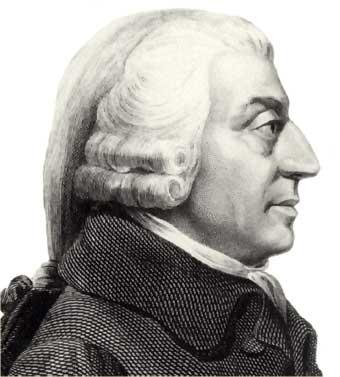
Adam Smith
Born: 06-15-1723
Adam Smith was an 18th-century Scottish economist and philosopher renowned for his groundbreaking work, "The Wealth of Nations." Often hailed as the father of modern economics, Smith introduced pivotal concepts like the invisible hand and free-market economics. His ideas laid the foundation for classical economics, influencing economic thought and policy. Smith's insightful analysis of human behavior and markets continues to shape economic theory and practice today.
Book summaries for books written by Adam Smith

Quotes
Man naturally desires, not only to be loved, but to be lovely.
The wise and virtuous man is at all times willing that his own private interest should be sacrificed to the public interest of his own particular order or society.
Resentment seems to have been given us by nature for a defence, and for a defence only.
The rich only select from the heap what is most precious and agreeable.
The great source of both the misery and disorders of human life, seems to arise from over-rating the difference between one permanent situation and another.
The great pleasure of conversation and society, besides, arises from a certain correspondence of sentiments and opinions.
No society can surely be flourishing and happy, of which the far greater part of the members are poor and miserable.
The real, revered, and impartial spectator is, upon no occasion, at a greater distance than amidst the violence and rage of contending parties.
The prudent man always studies seriously and earnestly to understand whatever he professes to understand, and not merely to persuade other people that he understands it.
The man of system, on the contrary, is apt to be very wise in his own conceit.
The propriety of action, the rule which Jupiter had given us for the direction of our conduct, requires us to sacrifice our own interests to the greater interests of others.
The prudent man is always sincere, and feels horror at the very thought of exposing himself to the disgrace which attends upon the detection of falsehood.