
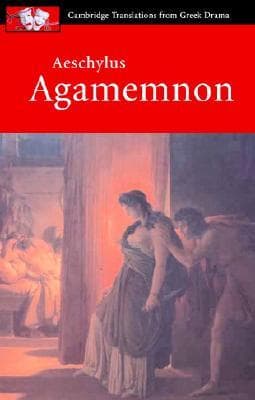
Synopsis
Covers the whole plot, including the ending.
- Difficulty
- Hard
- Pacing
- Slow
- Mood
- Tragic, Foreboding, Intense, Reflective
- Read it if
- You want to delve into the origins of Western tragedy, explore themes of justice, revenge, and the curse of inherited sin, or study a foundational text of Greek drama.
- Skip it if
- You prefer modern, fast-paced narratives with clear-cut heroes and villains, or struggle with dense, poetic language and a focus on moral dilemmas over action.
Agamemnon Plot Summary
Covers the whole plot, including the ending.
The Watchman's Vigil
The play begins with a Watchman on the palace roof in Argos, complaining about his long watch. For ten years, he has waited for a signal fire announcing Troy's fall, ever since Agamemnon and Menelaus went to war. He expresses his tiredness and fear of the ruling house, hinting at secrets within. Finally, he sees the beacon, signaling the Achaeans' victory. He celebrates but also hints at coming sorrow. He then leaves to tell Clytemnestra, the queen, quietly hoping for Agamemnon's safe return despite his bad feelings.
The Chorus Enters and Recounts the Past
The Chorus of Argive Elders enters, saying they are too old to fight. They recount Helen's abduction by Paris, which led Agamemnon and Menelaus, 'the twin kings of Atreus' line,' to gather an army against Troy. They describe the omen of two eagles eating a pregnant hare, which the prophet Calchas interpreted as a sign of victory but also a warning of Artemis's anger and a demand for a sacrifice. This foreshadows future tragic events and introduces the theme of divine justice and suffering.
Iphigenia's Sacrifice
The Chorus continues, focusing on Iphigenia's terrible sacrifice. The fleet was stuck at Aulis, and Calchas declared that only the sacrifice of Agamemnon's daughter, Iphigenia, could calm Artemis and let the ships sail. Torn between his duty as a general and his love for his child, Agamemnon chose to sacrifice Iphigenia, lured to Aulis by the false promise of marriage to Achilles. The Chorus describes her pleas and the brutal act, showing the great suffering and moral compromise that set the stage for Clytemnestra's revenge.
Clytemnestra's Announcement and the Chorus's Doubt
Clytemnestra enters, announcing Troy's fall, which she learned from the beacon chain. The Chorus, at first doubtful of a woman's word and the speed of the news, questions her. Clytemnestra passionately describes the relay of fire signals from Troy to Argos, naming the mountains and islands that carried the message. She then imagines the scene in Troy, with the victors celebrating and the defeated mourning. Despite her certainty, the Chorus still expresses cautious hope, fearing the news might be false or that the gods might be unhappy with the Greeks' actions.
The Herald's Arrival and Confirmation
A Herald arrives, exhausted but joyful, confirming Troy's fall and the army's imminent return. He describes the war's hardships and the joy of victory. He praises Agamemnon and the gods for their triumph. However, he also reveals the terrible storms that scattered the Greek fleet during their return, mentioning Menelaus's possible loss. Clytemnestra, pretending joy, sends a message to Agamemnon, urging his quick return. The Herald's news confirms the victory but also brings discord and loss, hinting at more suffering.
Agamemnon's Triumphant Return
Agamemnon arrives in a chariot with Cassandra, the Trojan princess and prophetess, now his captive. Clytemnestra gives a long, elaborate speech, claiming her love and loyalty, describing her lonely watch and anxieties during his absence. Her words are full of dramatic irony and hidden threats, as she feigns relief at his return. She then tells her attendants to spread purple tapestries, 'a path of crimson,' for Agamemnon to walk upon as he enters the palace. This is an honor but also a test of his pride and a symbolic trap.
The Tapestry Scene and Agamemnon's Hesitation
Agamemnon first hesitates to walk on the purple tapestries, recognizing it as an act of excessive pride, usually for gods, and fearing divine punishment. He says such an act would invite envy and scorn. However, Clytemnestra skillfully persuades him with flattery and emotional manipulation, questioning his masculinity and suggesting that only a coward would refuse such an honor. Yielding to her persistence, Agamemnon finally steps onto the crimson path, sealing his fate as he enters the palace. The Chorus sees this as a serious wrongdoing.
Cassandra's Prophecy of Doom
After Agamemnon enters the palace, Clytemnestra returns to bring Cassandra inside. Cassandra, cursed by Apollo to see the future but never be believed, stays outside, overwhelmed by visions. She predicts her own death and Agamemnon's murder, describing the bloody history of the house of Atreus, including Thyestes's feast and the murder of children. She cries out against Clytemnestra, calling her a 'lioness' and a 'two-footed lioness,' and reveals Orestes's coming revenge. The Chorus, though disturbed, struggles to understand her frantic prophecies.
Cassandra's Acceptance and Entry
Cassandra, having described the horrors to come and lamenting her own death, sees that resistance is useless. She acknowledges Apollo's curse and accepts her fate. With a final, chilling lament for Troy and her own life, she bravely walks into the palace, knowing it is her tomb. Her entry marks a point of no return. The audience now knows the doom awaiting Agamemnon and her inside the palace, a place she calls a 'slaughterhouse' and a 'den of blood.'
Agamemnon's Murder and Clytemnestra's Confession
Suddenly, Agamemnon's death cries are heard from inside the palace. The Chorus, in panic and confusion, debates what to do. The palace doors open to show Clytemnestra standing over the brutally murdered bodies of Agamemnon and Cassandra. She holds the blood-stained axe and defiantly confesses to the murders, describing in gruesome detail how she trapped Agamemnon in a net (or robe) and struck him many times. She justifies her actions as divine justice for Iphigenia's sacrifice and Agamemnon's infidelity with Cassandra, showing no remorse.
Aegisthus's Arrival and Justification
Aegisthus, Clytemnestra's lover and Agamemnon's cousin, enters, openly celebrating Agamemnon's death. He explains his motive for revenge: Agamemnon's father, Atreus, had murdered Aegisthus's brothers and fed them to his father, Thyestes, in a cannibalistic feast. Aegisthus sees Agamemnon's death as the just end of this long-standing blood feud and his own destiny to avenge his family. He proudly claims his role in the plot, saying he masterminded it, further solidifying the cycle of violence in the house of Atreus.
Clash with the Chorus and the Cycle of Vengeance
Aegisthus and the Chorus argue heatedly. The Chorus condemns Aegisthus as a coward who let a woman do his dirty work and threatens him with public stoning and exile. Aegisthus, in turn, asserts his authority as the new ruler, backed by his guards, and threatens the Chorus with imprisonment and hardship. Clytemnestra intervenes, urging Aegisthus to avoid more bloodshed and to rule wisely, suggesting they have done enough. The play ends with the Chorus lamenting the ongoing violence and anticipating Orestes's return for revenge, leaving the audience with a sense of unavoidable doom.
Principal Figures
Agamemnon
Protagonist/Tragic Hero
King of Argos, commander of the Greek forces at Troy, and a conquering hero.
Agamemnon is a powerful and respected king, a victorious general who has led the Achaeans to triumph over Troy. He is characterized by his sense of duty, which led him to sacrifice his daughter Iphigenia, but also by his hubris and his eventual moral corruption. He returns from war believing himself to be justly rewarded, unaware of the deep-seated resentment and vengeful plot awaiting him. His past actions, particularly the sacrifice of Iphigenia and his taking of Cassandra as a war prize, seal his tragic fate.
Relationships: Clytemnestra (Wife, but secretly his vengeful murderer); Iphigenia (Daughter, sacrificed by him); Cassandra (War prize, enslaved prophetess, murdered with him); Aegisthus (Cousin and rival, co-conspirator in his murder)
Clytemnestra
Antagonist/Avenging Figure
Queen of Argos, Agamemnon's wife, and his murderer.
Clytemnestra is a formidable and complex character, driven by a powerful desire for revenge. Her primary motivation is the sacrifice of her daughter Iphigenia by Agamemnon, which she considers an unforgivable act. She is intelligent, cunning, and ruthless, successfully orchestrating Agamemnon's murder and showing no remorse. She also aligns with Aegisthus, both for political power and likely for emotional support after years of perceived abandonment and betrayal. She is a symbol of female power and vengeance, challenging traditional gender roles.
Relationships: Agamemnon (Husband, whom she murders); Aegisthus (Lover and co-conspirator); Iphigenia (Daughter, whose sacrifice she avenges); Cassandra (Rival, concubine of Agamemnon, whom she murders)
Cassandra
Supporting/Prophetess
Trojan princess and prophetess, cursed to foresee the future but never to be believed.
Cassandra is a tragic figure, a prophetess cursed by Apollo. She possesses profound insight into the past and future horrors of the house of Atreus, including Agamemnon's impending murder and her own death. Despite her clear warnings, she is dismissed and disbelieved, intensifying her isolation and suffering. Her visions provide crucial exposition and heighten the dramatic tension, making the audience aware of the inescapable doom. She ultimately accepts her fate with courage, walking into the palace to her death.
Relationships: Agamemnon (Captive, concubine, and fellow victim); Clytemnestra (Her murderer and Agamemnon's wife)
Aegisthus
Antagonist/Avenging Figure
Agamemnon's cousin, Clytemnestra's lover, and co-conspirator in the murder.
Aegisthus is the son of Thyestes and thus a victim of Agamemnon's father, Atreus, who fed his brothers to Thyestes. He is driven by a deep-seated desire for revenge against the house of Atreus, seeing Agamemnon's death as the fulfillment of this long-standing blood feud. He is depicted as cowardly, allowing Clytemnestra to carry out the murder, but he is also assertive in claiming power after Agamemnon's death. He represents the continued cycle of vengeance and injustice that plagues the family.
Relationships: Clytemnestra (Lover and co-conspirator); Agamemnon (Cousin and victim of his revenge); Atreus (Agamemnon's father, who wronged his family)
Chorus of Argive Elders
Supporting/Commentator
The old men of Argos, serving as the voice of the community and moral conscience.
The Chorus represents the citizens of Argos, offering commentary, expressing fear, hope, and moral judgment throughout the play. They recall past events, such as the Trojan War and Iphigenia's sacrifice, and interpret the unfolding drama through a lens of traditional piety and justice. While they are unable to intervene physically, their lyrical odes provide historical context, foreshadowing, and reflections on divine will, human suffering, and the nature of justice. They are cautious, often hesitant, and ultimately powerless to stop the tragic events.
Relationships: Agamemnon (Their king, whom they respect but also fear for his hubris); Clytemnestra (Their queen, whose actions they condemn); Aegisthus (The new ruler, whom they openly defy)
Watchman
Mentioned/Minor
The first character on stage, awaiting the signal of Troy's fall.
The Watchman opens the play, setting a somber and foreboding tone. He has been on vigil for ten years, awaiting the signal fire that will announce the fall of Troy. He expresses weariness, fear of the ruling house, and hints at the underlying corruption and injustice within the palace. His initial joy at seeing the beacon is quickly tempered by a sense of impending doom, reflecting the play's overall mood of tragic inevitability.
Relationships: Agamemnon (His king, whose return he awaits); Clytemnestra (His queen, to whom he reports the signal)
Herald
Supporting
A messenger from the victorious Greek army, confirming Troy's fall.
The Herald arrives, confirming the news of Troy's fall and Agamemnon's imminent return. He describes the hardships of the war and the joy of victory, but also reveals the destructive storms that scattered the Greek fleet on their return journey, hinting at further divine displeasure. His arrival provides concrete news and allows Clytemnestra to solidify her plans, while also introducing a subtle note of impending disaster.
Relationships: Agamemnon (His commander); Clytemnestra (To whom he delivers the news)
Iphigenia
Mentioned/Victim
Agamemnon and Clytemnestra's daughter, sacrificed to appease Artemis.
Iphigenia is Agamemnon and Clytemnestra's daughter, whose sacrifice at Aulis is a central catalyst for Clytemnestra's vengeful actions. Though she never appears on stage, her tragic death is recounted in vivid detail by the Chorus and is constantly invoked by Clytemnestra as the primary justification for Agamemnon's murder. Her sacrifice represents the terrible cost of war and the moral compromises made by those in power, embodying the theme of inherited suffering and divine retribution.
Relationships: Agamemnon (Her father, who sacrificed her); Clytemnestra (Her mother, who avenges her death)
Themes & Insights
Justice and Vengeance
The play explores the unclear line between justice and revenge, especially within the blood feud in the house of Atreus. Clytemnestra says her murder of Agamemnon is divine justice for Iphigenia's sacrifice, while Aegisthus justifies his part as payback for Atreus's crimes against his father, Thyestes. However, these acts only continue the cycle of violence, leading to the prophecy of Orestes's revenge. The play questions if true justice can come from acts of revenge, suggesting such actions only bring more suffering, not resolution. This is clear in Clytemnestra's defiant confession, where she frames her brutal act as righteous repayment.
“For the old wrongs, a new wrong now, for children slain, children's blood.”
The Nature of Power and Leadership
Agamemnon examines the responsibilities and corrupting effects of power. Agamemnon, as a victorious king and military leader, makes the hard and morally questionable choice to sacrifice his daughter for his army and the war. His pride upon his return, especially when walking on the purple tapestries, shows the dangers of excessive pride in leadership. Clytemnestra, taking power after his death, shows an equally ruthless and manipulative form of leadership, though driven by different reasons. The play suggests that power, especially absolute power, often comes with a heavy moral cost and can lead to tyranny or more bloodshed, as seen in Aegisthus's immediate claim to control and threats to the Chorus.
“It is not for mortals to tread on embroidered splendors, to cast an eye of envy on the gods.”
Fate and Free Will
The play deals with how fate and free will interact. The inherited curse on the house of Atreus, from the crimes of past generations (Thyestes and Atreus), seems to destine its members to a cycle of suffering and violence. Cassandra's prophecies, though ignored, clearly outline the unavoidable doom. However, characters like Agamemnon and Clytemnestra also make choices, such as Agamemnon sacrificing Iphigenia and Clytemnestra murdering him, that actively contribute to their tragic fates. This raises the question of how much control individuals have over their destiny when bound by a terrible past and divine will. The Chorus often reflects on human suffering as a result of both divine decree and personal actions.
“Man's prosperity, if it oversteps due measure, brings forth an offspring of ruin.”
Gender Roles and Female Agency
Clytemnestra is a strong and unusual female character who goes against traditional gender roles. In a male-dominated society, she acts decisively, plans and carries out her husband's murder, and openly defies the male Chorus and Aegisthus. She shows intelligence, cunning, and a desire for power that challenges the submissive role typically given to women. Her actions make the audience confront the complexities of female agency, especially when driven by extreme grief and a desire for revenge. She is both hated and, in a twisted way, admired for her strength and determination. The Chorus's initial dismissal of her words as 'a woman's word' only highlights her eventual dominance.
“I spoke many words before to suit the moment—now I shall not be ashamed to speak their opposite.”
Plot Devices & Literary Techniques
Dramatic Irony
The audience knows more than the characters, creating tension.
Dramatic irony is a pervasive device, particularly through Clytemnestra's speeches and Cassandra's prophecies. Clytemnestra's declarations of love and loyalty to Agamemnon upon his return are chillingly ironic, as the audience is aware of her murderous intentions. Similarly, Cassandra's vivid predictions of the murders within the palace are understood by the audience, even as the Chorus struggles to comprehend them. This creates immense tension and suspense, as the audience anticipates the inevitable tragedy that the characters themselves are blind to or powerless to prevent.
Foreshadowing and Omens
Hints and signs that predict future events.
The play is rich with foreshadowing and omens that build a sense of inescapable doom. The Watchman's initial fear and 'song of sorrow' hint at coming tragedy. The omen of the eagles devouring the pregnant hare, interpreted by Calchas, warns of Artemis's wrath and the need for sacrifice, directly foreshadowing Iphigenia's death. Cassandra's prophecies, though disbelieved, explicitly detail Agamemnon's murder and the cycle of vengeance. Even the purple tapestries, while an honor, symbolize Agamemnon's hubris and his stepping onto a path of death, all serving to heighten the tragic inevitability.
The Crimson Tapestries (Prophane Hubris)
A symbolic trap and test of Agamemnon's pride.
The crimson tapestries laid out by Clytemnestra for Agamemnon to walk on are a powerful symbolic device. They represent a test of Agamemnon's hubris, as walking on such rich cloth was considered an act reserved for gods, inviting divine wrath. Clytemnestra manipulates him into this act, knowing it will be perceived as a transgression. By stepping on them, Agamemnon symbolically seals his fate, demonstrating his excessive pride and blurring the line between mortal and divine, making him ripe for the vengeance Clytemnestra is about to unleash.
The 'Net' or 'Robe' (Trap and Concealment)
The literal and metaphorical trap used to ensnare Agamemnon.
Clytemnestra describes how she trapped Agamemnon in a 'net' or 'robe' (often interpreted as a bathing robe or a specially woven garment) before striking him down. This serves as both a literal plot device, as it physically incapacitates him, and a powerful metaphor. The 'net' symbolizes the intricate trap she has woven for him over years of planning and resentment. It also represents the inescapable web of fate and vengeance that has entangled the house of Atreus, from which Agamemnon cannot escape.
Agamemnon Quotes
“For the great evils of the world, no one can find a cure.”
“Justice, however, guides the scales of judgment.”
“Many a time, a man whose cause is just will fail, and he who is unjust will prosper.”
“There are times when fear is good, and it must sit enthroned in the heart.”
“Who can say, with certainty, what is good for man?”
“The house itself, if it could speak, would tell a tale.”
“It is not for me to judge the works of men.”
“Out of the darkness, a light will spring.”
“The price of blood is blood.”
“When a man brings ruin on his house, he does so with open eyes.”
“The stain of blood is hard to wash away.”
“I say that for the wicked there is no escape.”
“There is a power that is greater than all others.”
“Woe to the house that harbors such a queen!”
Quiz
10 questions on the plot and the characters. Each answer comes with a short explanation.
Question 1
Which character first announces the fall of Troy to Clytemnestra?
- Agamemnon
- A Herald
- Cassandra
- A Watchman
Show answer
B. A Herald The Watchman sees the signal fires, but it is a Herald who arrives later to confirm Troy's fall to Clytemnestra and the Chorus.
Question 2
What is the primary reason Clytemnestra gives for murdering Agamemnon?
- His affair with Cassandra
- His sacrifice of their daughter Iphigenia
- His prolonged absence during the Trojan War
- His arrogance and hubris
Show answer
B. His sacrifice of their daughter Iphigenia Clytemnestra explicitly states that the murder is vengeance for Agamemnon's sacrifice of their daughter Iphigenia at Aulis.
Question 3
What color tapestries does Clytemnestra lay out for Agamemnon to walk on upon his return?
- White
- Purple
- Gold
- Red
Show answer
B. Purple Clytemnestra persuades Agamemnon to walk on purple tapestries, a symbol of divine status and a trap to invite hubris and his downfall.
Question 4
Which character possesses prophetic abilities but is cursed never to be believed?
- The Watchman
- Aegisthus
- Cassandra
- The Chorus Leader
Show answer
C. Cassandra Cassandra, brought back as Agamemnon's war prize, foresees her own death and Agamemnon's, but is condemned by Apollo to speak prophecies no one will believe.
Question 5
What is the primary theme explored through Agamemnon's decision to walk on the tapestries?
- The importance of marital loyalty
- The dangers of excessive pride (hubris)
- The inevitability of fate
- The power of a queen's persuasion
Show answer
B. The dangers of excessive pride (hubris) Agamemnon's reluctance and eventual decision to walk on the expensive, god-like tapestries is a classic example of hubris, defying mortal bounds and inviting divine wrath.
Question 6
Who is Clytemnestra's lover and accomplice in Agamemnon's murder?
- Menelaus
- Orestes
- Aegisthus
- Calchas
Show answer
C. Aegisthus Aegisthus is Clytemnestra's lover and her co-conspirator, motivated by his own family's history of vengeance against Agamemnon's father, Atreus.
Question 7
The 'beacon chain' of fires described by the Watchman symbolizes what?
- The spread of disease across Greece
- The swift communication of Troy's fall
- The signal for Agamemnon's fleet to return
- The lighting of funeral pyres for war dead
Show answer
B. The swift communication of Troy's fall The Watchman describes a chain of signal fires stretching from Troy to Argos, indicating the immediate news of the city's capture.
Question 8
How does Clytemnestra kill Agamemnon?
- She poisons his wine at a feast.
- She stabs him with an axe in his bath.
- She strangles him with a rope while he sleeps.
- She arranges for him to be ambushed by Aegisthus's men.
Show answer
B. She stabs him with an axe in his bath. Clytemnestra traps Agamemnon in the bath with a robe, then strikes him multiple times with an axe, a brutal and symbolic act of vengeance.
Question 9
The recurring motif of 'blood for blood' or 'justice through vengeance' foreshadows what future event in the Oresteia trilogy?
- The return of Helen to Sparta
- The trial of Orestes for matricide
- The construction of the Parthenon
- The reconciliation of the gods with humanity
Show answer
B. The trial of Orestes for matricide The cycle of violence and vengeance ('blood for blood') set in motion by Agamemnon's murder directly leads to Orestes' matricide in 'The Libation Bearers' and his subsequent trial in 'The Eumenides', where the cycle is finally broken.
Question 10
What is the primary role of the Chorus of Argive Elders in the play?
- To actively participate in the murder plot
- To provide comic relief and lighten the mood
- To offer commentary, express fear, and recall past events
- To serve as Agamemnon's loyal bodyguards
Show answer
C. To offer commentary, express fear, and recall past events The Chorus primarily provides moral and historical commentary, expressing their fears, doubts, and reflections on the unfolding tragedy, often recalling past events like the sacrifice of Iphigenia or the Trojan War.
Agamemnon FAQ
What is the central conflict of Aeschylus's 'Agamemnon'?
The central conflict revolves around the homecoming of King Agamemnon from the Trojan War and the retribution awaiting him at the hands of his wife, Clytemnestra. She seeks vengeance for his sacrifice of their daughter Iphigenia and his bringing of the prophetess Cassandra as a war prize, leading to a tragic cycle of violence within the House of Atreus.
Who is Clytemnestra, and what motivates her actions in the play?
Clytemnestra is Agamemnon's wife and the play's formidable antagonist. Her primary motivation is a burning desire for revenge against Agamemnon for sacrificing their daughter Iphigenia at Aulis to appease the gods for favorable winds to Troy. She also resents his prolonged absence and the insult of his bringing Cassandra home as a concubine, solidifying her resolve for murder.
What role does the Chorus of Argive Elders play in the drama?
The Chorus represents the concerned but ultimately powerless citizens of Argos. They provide background information, express moral judgments, lament the events unfolding, and offer a sense of traditional piety and community perspective. Their odes often reflect on themes of justice, fate, and the suffering caused by human actions, guiding the audience's emotional response.
How does the play establish a sense of foreboding and impending doom from its opening?
The play immediately establishes foreboding through the Watchman's weary monologue, his cryptic hints of a secret burden within the house, and the ominous signal fires announcing Agamemnon's return. The Chorus's recounting of Iphigenia's sacrifice and their anxieties about the consequences of the Trojan War further heighten the tension, signaling that the king's homecoming will not be joyous.
What is the significance of the 'beacon speech' and the relay of fires?
The beacon speech, delivered by the Watchman, details the elaborate relay of signal fires that announce Agamemnon's victory and return. This sequence symbolizes the rapid spread of news and the inescapable approach of fate, creating a sense of urgency and demonstrating Clytemnestra's meticulous planning and control over the events leading up to Agamemnon's arrival.
How does Aeschylus subtly foreshadow Agamemnon's death through the imagery of nets and traps?
Aeschylus employs recurring imagery of nets, snares, and traps to foreshadow Agamemnon's murder. Clytemnestra explicitly uses this imagery when describing how she will ensnare him, and the Chorus often speaks of the 'net of Atreus.' This motif highlights the inescapable nature of the trap Clytemnestra sets and the larger web of fate entangling the House of Atreus.
What is the 'tapestry scene' and its deeper implications for Agamemnon?
The tapestry scene involves Clytemnestra persuading Agamemnon to walk on crimson tapestries into the palace. This act is a hubristic display, typically reserved for gods, and symbolizes his arrogance and the 'blood-guilt' he carries. By treading on these precious cloths, Agamemnon seals his fate, walking into the 'net' Clytemnestra has laid and defying divine order, thus justifying his downfall in her eyes.
How does Cassandra's prophetic vision contribute to the dramatic tension and reveal hidden pasts?
Cassandra's prophetic vision, though disbelieved by the Chorus, explicitly details Agamemnon's impending murder and the horrific past deeds of the House of Atreus, including Thyestes's cannibalistic feast. Her visions serve as a direct, albeit unheeded, warning, intensifying the dramatic irony and revealing the deep-seated generational curse that drives the cycle of violence, making the audience complicit in her knowledge.
What is the significance of the Furies (Erinyes) in the context of the play and the larger Oresteia trilogy?
While not physically present, the Furies (Erinyes) are alluded to as the vengeful spirits of the dead, particularly Iphigenia, haunting the House of Atreus. They represent the inexorable force of blood-guilt and ancient justice. In the larger Oresteia, their role becomes explicit, pursuing Orestes for matricide, showcasing the play as the foundational act in a complex legal and moral struggle for a new form of justice.
Analyze Clytemnestra's psychological state: is she a cold-blooded killer or a woman driven to extremes by trauma?
Clytemnestra is a complex character, exhibiting traits of both. While her actions are premeditated and ruthless, her long-nurtured grief and rage over Iphigenia's sacrifice, coupled with Agamemnon's betrayal, suggest a deep psychological trauma that has hardened her. She rationalizes her murder as an act of justice, positioning herself as an avenging force rather than a mere criminal, revealing a distorted moral compass shaped by immense suffering.
How does Agamemnon's pride (hubris) contribute to his downfall?
Agamemnon's hubris is clearly demonstrated by his willingness to sacrifice Iphigenia for military glory and his arrogant strutting on the tapestries upon his return. His dismissal of Clytemnestra's warnings and his bringing of Cassandra further showcase his overweening pride and lack of self-awareness. This excessive pride blinds him to the dangers awaiting him, making him an easy target for Clytemnestra's vengeance and fulfilling a classic tragic pattern.
Discuss the psychological impact of war and its aftermath on the characters, particularly Agamemnon and Clytemnestra.
The Trojan War has profoundly scarred both Agamemnon and Clytemnestra. Agamemnon returns hardened and desensitized, having committed atrocities and endured immense suffering, which contributes to his emotional detachment and inability to foresee danger. Clytemnestra, left behind, has festered in her grief and rage, transforming her into a vengeful strategist. The war's trauma on both fuels their tragic collision, highlighting its destructive psychological legacy.
How does the play explore the concept of inherited guilt or the 'curse of the House of Atreus'?
The play heavily emphasizes the 'curse of the House of Atreus,' beginning with the ancestral crimes of Tantalus and Thyestes, whose acts of cannibalism and betrayal set a pattern of violence. Agamemnon's sacrifice of Iphigenia and Clytemnestra's subsequent matricide are portrayed not merely as individual choices but as inevitable links in a chain of inherited blood-guilt, suggesting that past sins demand future retribution, trapping generations in a cycle of suffering.
Is Clytemnestra presented as a feminist figure ahead of her time, challenging patriarchal norms, or simply a monstrous woman?
Clytemnestra can be interpreted both ways. She undeniably challenges patriarchal norms by seizing power, executing her husband, and openly asserting her authority in a male-dominated society. Her articulate defenses and strategic mind could be seen as proto-feminist. However, her brutal methods and lack of remorse also align with the archetype of a monstrous, unnatural woman, particularly from the perspective of the male Chorus, making her a deeply ambiguous figure of debate.
What is the play's stance on justice: is it divine, human, or a chaotic cycle of revenge?
The play initially presents justice as a chaotic cycle of personal revenge (lex talionis), where one violent act begets another, driven by divine forces like the Furies. Agamemnon's 'justice' for Troy leads to Clytemnestra's 'justice' for Iphigenia. However, the subsequent plays in the Oresteia trilogy move towards a more structured, human-administered justice system, suggesting that 'Agamemnon' depicts the brutal, primitive stage of justice before the establishment of civic law.
How does the play use dramatic irony to heighten the tragedy?
Dramatic irony is pervasive, heightening the tragedy by allowing the audience to understand the true danger Agamemnon faces while he remains oblivious. Examples include Clytemnestra's deceptively welcoming speeches, her 'beacon speech' which she attributes to joy but is actually a signal for murder, and Cassandra's ignored prophecies. This disparity between character knowledge and audience knowledge creates profound tension and pity as the inevitable unfolds.
Discuss the significance of blood imagery throughout the play.
Blood imagery permeates the play, symbolizing guilt, sacrifice, and the inescapable cycle of vengeance. It appears in descriptions of Iphigenia's sacrifice, the 'blood-drenched' House of Atreus, the crimson tapestries, and Clytemnestra's chilling descriptions of Agamemnon's murder. This recurring motif underscores the pervasive violence and the inherited blood-guilt that stains the family, making it a central thematic element.
What is the role of the gods in determining human fate within 'Agamemnon'?
The gods play a crucial, yet often ambiguous, role. They are invoked as agents of justice (e.g., Zeus punishing Troy), but their demands (like Artemis's for Iphigenia's sacrifice) also initiate cycles of human suffering. While characters like Clytemnestra claim divine sanction for their actions, the play also suggests that human choices, particularly those driven by hubris and revenge, are equally significant in shaping fate. The line between divine will and human agency is often blurred.
About the author

Aeschylus was an ancient Greek tragedian, and is often described as the father of tragedy. Academic knowledge of the genre begins with his work, and understanding of earlier Greek tragedy is largely based on inferences made from reading his surviving plays. According to Aristotle, he expanded the number of characters in the theatre and allowed conflict among them. Formerly, characters interacted only with the chorus.
Similar books
- Oedipus Rex
Sophocles
3.7 (171k) average on GoodreadsFictionAnother foundational Greek tragedy exploring fate, prophecy, and family curses.
- Medea
Euripides
4.1 (3k) average on GoodreadsPhilosophyFeatures a powerful female protagonist driven to extreme acts of revenge.
- Nineteen Eighty-Four
George Orwell
4.2 (5.5M) average on GoodreadsFictionWinston Smith dreams of truth and rebellion in a world where Big Brother watches all, but he confronts the terrifying power of a regime that controls not just actions, but thoughts.
- The Frozen River
Ariel Lawhon
4.4 (600k) average on GoodreadsFictionIn 1789 Maine, a heroic midwife's diary helps her expose a murder and get justice in a town that wants to silence her.
- A Man Called Ove
Fredrik Backman
4.4 (569k) average on GoodreadsFictionA stubborn widower, who lives by strict rules, finds his quiet world changed by a lively new family next door, making him face his past and find happiness in human connection.
- The Art of Racing in the Rain
Garth Stein
4.2 (452k) average on GoodreadsFictionThrough the eyes of Enzo, a wise and observant dog, a race car driver's family navigates a journey of love, loss, and resilience, learning that life's most important lessons often come in the curves, not just on the straightaways.





Enjoyed the summary?
A summary gives you the shape of the book. The book itself has the detail, the examples and the voice.
Find Agamemnon on AmazonAs an Amazon Associate, BookBrief earns from qualifying purchases. How we're funded