
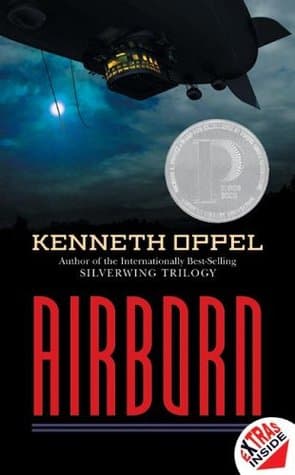
Synopsis
Covers the whole plot, including the ending.
- Difficulty
- Easy
- Pacing
- Fast
- Mood
- Adventurous, Exciting, Whimsical, Mysterious
- Read it if
- You love classic adventure stories with airships, pirates, and undiscovered creatures, reminiscent of Jules Verne.
- Skip it if
- You prefer hard science fiction or stories grounded in reality.
Airborn Plot Summary
Covers the whole plot, including the ending.
A Dying Man's Tale and a Cabin Boy's Resolve
Matt Cruse, a fifteen-year-old cabin boy on the luxury airship Aurora, is on night watch when he sees a damaged hot-air balloon. The Aurora's crew rescues the only person inside, an old man named Benjamin Molloy. Before he dies, Molloy tells Matt about magnificent, winged creatures that live in the sky, 'gossamer' beings he saw on a remote island. Matt is affected by this meeting, especially when Molloy gives him a small, carved wooden bird just before he dies. The captain is curious but says Molloy's story is from delirium. Matt feels a connection to the dying man's last words, which starts his imagination and a desire for discovery beyond his usual duties.
Kate de Vries, a Stubborn Heiress, Boards the Aurora
Six months after Molloy's death, the Aurora prepares for a transatlantic trip. One of the new passengers is Kate de Vries, a wealthy, determined girl Matt's age. To Matt's surprise, Kate is Benjamin Molloy's granddaughter. She has her grandfather's adventurous spirit and his interest in the sky creatures. She travels with her governess, Miss Nicely, but her real goal is to find the island her grandfather spoke of and prove his claims. Kate immediately has trouble with the ship's social rules and Matt's cabin boy status. However, her resolve to follow her grandfather's last clue starts to interest Matt, reminding him of Molloy's mysterious gift.
Pirates Attack and a Desperate Escape
During the transatlantic crossing, air pirates led by Captain Zepheniah Walken ambush the Aurora. The pirates, in smaller, faster airships, board the Aurora to steal its valuable cargo and passenger belongings. In the confusion, Matt, who Kate just scolded for sneaking into the cargo hold, tries to secure the ship's skiffs. Kate, wanting to escape, finds him. Together, they launch one of the skiffs, but it gets damaged. They drift away from the fight, barely avoiding capture, and are left alone in the sky. Their survival is uncertain, and they do not know where they are going.
Stranded on a Mysterious Island
Matt and Kate, drifting in the damaged skiff, have fewer supplies and face a difficult situation. After days, they see land — an uncharted island, covered in mist and thick jungle. They make a rough landing, crashing the skiff on the island's shore. As they explore, they find strange, glowing plants and animals, unlike anything they have seen. They realize this must be the island Benjamin Molloy described, the home of his 'sky creatures.' Their relief at finding land is quickly replaced by wonder and a growing sense of the island's unique and possibly dangerous nature.
First Encounter with the Sky Creatures
Exploring the island, Matt and Kate find a massive, old tree with branches reaching high into the sky. As they climb it, they finally see the creatures Benjamin Molloy spoke of: huge, jellyfish-like beings, glowing with an inner light, floating in the upper atmosphere. These 'aerofauna' are amazing, confirming Molloy's story and validating Kate's quest. However, their wonder comes with danger as they realize the creatures are not just passive but part of a complex ecosystem, and being on the island has risks. They watch the creatures, fascinated, from a safe distance, understanding the secret they have found.
A Perilous Rescue and a Pirate's Return
The Aurora, damaged but fixed, eventually arrives at the island, having tracked Matt and Kate's distress beacon. Captain Szpyrka and his crew rescue them, relieved they are alive. However, their reunion is short. Captain Walken and his pirates, who also tracked the Aurora, come to the island. Walken, curious about the Aurora's detour and the island's unusual nature, wants to use any discoveries there, especially the 'sky creatures' for their possible value. The island, once a safe place, becomes a battleground, with Matt and Kate caught in a fight for its secrets.
The Sky Creatures' Secret and Walken's Treachery
Matt and Kate, watching the aerofauna more closely, realize the creatures come to the island to lay their eggs in the special 'cloud trees.' These eggs give the creatures buoyancy, containing concentrated hydrium gas. Walken, hearing their talks and seeing the creatures, quickly understands their value. He plans to capture the aerofauna, or at least their eggs, for their hydrium, to gain wealth and power. He confronts Matt and Kate, demanding they tell him the exact location of the eggs and how to capture them. He threatens them and the Aurora's crew if they refuse.
A Race Against Time and a Desperate Plan
Realizing the harm Walken's plan would cause, Matt and Kate create a desperate strategy. They lead Walken and his pirates on a chase through the jungle and up the tall cloud trees, buying time. Their goal is not just to protect the aerofauna but also to disable Walken's airship, the 'Pandora,' which is docked on the island. They know that without his ship, Walken cannot move the creatures or their eggs. The story ends with a daring attempt to get into the Pandora, where they try to damage its engines and hydrium tanks, hoping to stop the pirate captain for good and save the sky creatures.
The Pandora's Downfall and the Creatures' Salvation
In a struggle aboard the Pandora, Matt and Kate manage to overload its hydrium engines and start a fire, causing the pirate airship to explode. Walken and his crew are killed or forced to leave the ship; their plans are stopped. The Aurora's crew, having fought off the remaining pirates, sees the Pandora's destruction. The aerofauna are saved, their ecosystem protected from human greed. Matt and Kate become heroes, their bond strong from their shared adventure and courage. The island's secret stays safe, protected by their actions and the silence they agree to keep, ensuring the creatures continue to exist.
Return to Civilization and a New Beginning
With the danger gone, the Aurora leaves the island, its secrets safe. Matt and Kate return to their lives, but both are changed. Matt, no longer just a cabin boy, has shown his bravery and resourcefulness, earning respect from Captain Szpyrka and a new purpose. Kate, having confirmed her grandfather's legacy, understands her place in the world better and appreciates Matt's courage and loyalty. Their adventure, though kept secret, connects them forever, and they promise to keep exploring the skies, perhaps even together, seeking new wonders and protecting the beauty of the airborn world they now know exists.
Airborn Characters
Matt Cruse
Protagonist
A resourceful cabin boy on the airship Aurora, driven by curiosity and a desire for adventure.
Matt is a fifteen-year-old cabin boy on the luxury airship Aurora. Orphaned and working his way up, he dreams of becoming an airship pilot. He is observant, quick-thinking, and deeply curious, especially after his encounter with the dying balloonist, Benjamin Molloy. Matt is initially self-conscious about his social status but proves his bravery and resourcefulness repeatedly. He possesses a strong moral compass, valuing life and discovery over personal gain. His practical skills, combined with his burgeoning sense of wonder, make him an ideal explorer of the skies.
Relationships: Kate de Vries (initially antagonistic, then close friends and partners in adventure); Captain Szpyrka (mentor and superior, later earns his respect); Benjamin Molloy (inspirational figure, his dying words set Matt's journey in motion)
Kate de Vries
Protagonist
A wealthy, intelligent, and headstrong heiress determined to prove her grandfather's incredible claims.
Kate is a privileged, intelligent, and fiercely independent girl, also fifteen. As Benjamin Molloy's granddaughter, she inherits his adventurous spirit and his unwavering belief in the existence of sky creatures. She is educated, articulate, and possesses a strong scientific curiosity, often challenging societal norms and expectations for young women of her standing. Kate is stubborn and sometimes imperious, but her determination and courage are undeniable. Her desire for proof drives much of the plot, and she quickly adapts to dangerous situations, becoming a capable partner to Matt.
Relationships: Matt Cruse (initially antagonistic, then close friends and partners in adventure); Benjamin Molloy (beloved grandfather, her quest is driven by his legacy); Miss Nicely (governess, often a source of comedic relief and a foil to Kate's adventurous spirit)
Benjamin Molloy
Supporting
A dying balloonist whose final words about sky creatures ignite the central mystery of the story.
Benjamin Molloy is an elderly, eccentric balloonist whose brief appearance at the beginning of the book is pivotal. He is rescued by the Aurora after his balloon is damaged, and on his deathbed, he recounts his incredible sighting of 'sky creatures' on a remote island to Matt Cruse, giving Matt a carved wooden bird. His claims, initially dismissed as delirium, become the driving force for both Matt and his granddaughter, Kate. Molloy represents the spirit of pure discovery and scientific curiosity, unburdened by commercial interests, and his legacy inspires the protagonists to pursue truth against skepticism.
Relationships: Matt Cruse (inspirational figure, catalyst for Matt's adventure); Kate de Vries (beloved grandfather, the source of her quest and determination)
Captain Szpyrka
Supporting
The stern but honorable captain of the Aurora, committed to duty and the safety of his ship.
Captain Szpyrka is the commanding officer of the luxury airship Aurora. He is a seasoned, disciplined, and somewhat gruff leader, deeply committed to the safety of his passengers and crew, and to the strict protocols of airship navigation. Initially skeptical of Molloy's claims and dismissive of Matt's curiosity, he is nevertheless a fair and just captain. He faces immense challenges during the pirate attack and the search for Matt and Kate. Despite his initial reservations, he eventually comes to respect Matt's bravery and resourcefulness, and ultimately aids in the protection of the aerofauna.
Relationships: Matt Cruse (superior and mentor, later respects his bravery); Mr. Baz (first officer, trusted subordinate)
Captain Zepheniah Walken
Antagonist
A ruthless and cunning air pirate captain, driven by greed and a desire for power.
Captain Walken is the primary antagonist of the story, a notorious air pirate known for his ruthlessness and tactical cunning. He commands the airship 'Pandora' and orchestrates the attack on the Aurora. Walken is driven by avarice, seeking to exploit any valuable discovery for his own gain, including the hydrium-rich aerofauna. He is intelligent and calculating, quick to understand the potential of the sky creatures. He represents the darker side of human ambition and the destructive potential of greed, contrasting with the protagonists' desire for discovery and preservation.
Relationships: Matt Cruse (antagonist, direct conflict); Kate de Vries (antagonist, direct conflict)
Miss Nicely
Supporting
Kate de Vries's governess, a prim and proper woman concerned with decorum and safety.
Miss Nicely is Kate de Vries's governess, a woman who embodies Victorian-era propriety and a strict adherence to social etiquette. She is constantly concerned with Kate's safety, health, and reputation, often to the point of being overprotective and a source of comedic relief. She struggles to understand Kate's adventurous spirit and scientific curiosity, frequently clashing with her charge's unconventional desires. Despite her fussy nature, she genuinely cares for Kate. Her presence highlights the contrast between the rigid social world and the boundless freedom of the skies.
Relationships: Kate de Vries (governess, provides supervision and often disagreement)
Mr. Baz
Supporting
The Aurora's first officer, a steadfast and loyal member of the crew.
Mr. Baz is the first officer of the Aurora, serving directly under Captain Szpyrka. He is a competent, reliable, and loyal member of the crew, dedicated to his duties and the smooth operation of the airship. He assists Captain Szpyrka in managing the crew and navigating the Aurora. While not as prominent as Matt or Kate, he represents the dependable backbone of the airship's operations and is crucial in the efforts to defend the Aurora during the pirate attack and to rescue Matt and Kate.
Relationships: Captain Szpyrka (subordinate and trusted officer)
The Aerofauna
Mentioned
Magnificent, giant, jellyfish-like creatures that drift through the upper atmosphere.
The aerofauna are the fantastical, colossal, winged creatures that reside in the upper atmosphere, first described by Benjamin Molloy. They are bioluminescent, float using internally generated hydrium gas, and are central to the book's mystery and conflict. They are depicted as majestic and beautiful, yet also part of a complex natural ecosystem, coming to a specific uncharted island to lay their eggs in 'cloud trees.' Their existence challenges human understanding of the natural world and their potential exploitation drives the antagonist's actions.
Relationships: Matt Cruse (object of wonder and protection); Kate de Vries (object of scientific study and protection); Captain Zepheniah Walken (target for exploitation)
Airborn Themes
Discovery and Exploration
The heart of 'Airborn' is about the excitement and responsibility of discovery. Matt and Kate are curious to uncover the secrets of their world, especially the aerofauna. Benjamin Molloy's first sighting starts their quest, pushing them beyond known limits and science. The uncharted island and its ecosystem represent the biggest reward of exploration, showing the wonder and danger of going into the unknown. The theme shows that real discovery is not just finding new things, but understanding and protecting them.
“The sky, Matt thought, was a place of endless secrets, and he had only just begun to scratch the surface.”
Class and Social Barriers
The novel shows the class structure on the Aurora, comparing Matt's position as a working-class cabin boy with Kate's wealthy background. Their first meetings show these social differences, with Kate often dismissing Matt because of his status. However, as they face dangerous situations together, these barriers disappear. This proves that courage, intelligence, and resourcefulness matter more than social standing. The shared adventure creates a bond of equality and respect, showing that true worth is in character, not birth or wealth.
““You're just a cabin boy,” she'd said, and the words had stung. But out here, in the sky, they were just two people, trying to survive.”
Environmentalism and Conservation
An important theme is protecting unique ecosystems and species from human use. The aerofauna and their home on the uncharted island are a fragile natural wonder. Captain Walken's desire to capture and use these creatures for their hydrium gas shows how destructive human greed can be. Matt and Kate's efforts to stop Walken and protect the aerofauna send a clear message about conservation. They advocate for preserving natural wonders rather than selling them. The choice to keep the island's location a secret strengthens this commitment to protection.
“Some things, Matt realized, were meant to be left alone, untouched by human hands, simply to exist in their own magnificent way.”
Courage and Resourcefulness
Throughout the story, both Matt and Kate show great courage and cleverness when facing danger. From escaping the pirate attack in a damaged skiff to surviving on an unknown island and finally damaging Walken's airship, their ability to think quickly and overcome problems is central to their survival and success. Matt's practical skills and airship knowledge combine with Kate's scientific mind and determination. This shows how different strengths help with problem-solving and bravery.
“It was amazing, Matt thought, what you could do when you had no choice but to do it.”
The Wonder of the Unknown
The whole idea of 'Airborn' is built on the appeal of the unknown. The sky itself is a vast, unexplored place, full of hidden wonders. Benjamin Molloy's stories, the discovery of the uncharted island, and the aerofauna, all create a sense of awe and possibility. The book encourages readers to believe there is always more to discover beyond what is known. This creates a sense of wonder and inspires a desire to look beyond familiar horizons. This theme often contrasts with the everyday or commercial parts of air travel.
“There were more things in heaven and earth, Matt knew, than had ever been dreamed of in his philosophy.”
Plot Devices & Literary Techniques
The Uncharted Island
A mysterious, previously undiscovered land that serves as the habitat for the aerofauna.
The uncharted island functions as a classic 'lost world' trope, a hidden sanctuary where the extraordinary exists untouched by civilization. It is the destination of Kate's quest and the setting for many of the story's most critical events. Its isolation and unique ecosystem, including the 'cloud trees' and bioluminescent flora, make it a character in itself, embodying the wonder and danger of the unknown. It is crucial for both the discovery of the aerofauna and the climactic confrontation with Captain Walken, serving as a crucible for Matt and Kate's development.
The Wooden Bird Carving
A small, symbolic gift from Benjamin Molloy that acts as a tangible link to the mystery.
The intricately carved wooden bird, given to Matt by the dying Benjamin Molloy, serves as a powerful symbol and a tangible plot device. It is a physical manifestation of Molloy's incredible story and a constant reminder for Matt of the sky creatures. For Kate, it is a piece of her grandfather's legacy and a clue. The bird acts as a beacon, drawing Matt into the mystery and solidifying his connection to Molloy's quest. It represents the truth of the unknown and the call to adventure, propelling the narrative forward and validating the protagonists' beliefs.
The Airship Aurora
A luxury airship that serves as the primary setting and a symbol of human ingenuity and class divides.
The Aurora is more than just a mode of transport; it is a meticulously detailed setting that establishes the world of 'Airborn.' As a luxury vessel, it showcases the technological advancements and the social stratification of this alternate reality. It is a 'floating city' with its own rules and hierarchy, which Matt must navigate. The Aurora is central to the plot as the target of the pirate attack, the means of rescue, and a symbol of the human world that contrasts with the wild, untamed skies. Its vulnerability and resilience are key to the story's tension and resolution.
Air Pirates (Captain Walken and the Pandora)
A formidable antagonist force that introduces conflict, danger, and a moral dilemma.
The air pirates, led by Captain Walken and his airship 'Pandora,' serve as the primary external conflict and antagonist force. They introduce immediate danger, forcing Matt and Kate into their adventure. Beyond simple villainy, Walken embodies the theme of greed and exploitation, contrasting sharply with the protagonists' desire for pure discovery. The pirates' existence highlights the lawlessness of the vast skies and the challenges faced by legitimate airships. Their threat forces Matt and Kate to develop their courage and resourcefulness, driving much of the plot's action and suspense.
Airborn Quotes
“The cloud cat was a creature of myth, a ghost of the air, and yet there it was, sleek and powerful, its fur shimmering like moonlight on water.”
“There was a thrill to the wind, a wild, untamed joy that sang in his blood.”
“The sky was not empty space. It was a sea, vast and deep, full of currents and storms, and its own strange, beautiful life.”
“It’s not just about the destination, you know. It’s about the journey. The air, the clouds, the wind… that’s where the real story is.”
“Sometimes, the most important discoveries are made by accident, by simply looking up when everyone else is looking down.”
“Fear is a good thing, Matt. It keeps you alive. But don’t let it stop you from doing what you need to do.”
“The airship was a living thing, a leviathan of the skies, groaning and sighing as it battled the wind.”
“There’s always a way, even when it seems like there isn’t. You just have to be clever enough to find it.”
“The world below was a patchwork quilt, a distant, silent land, while up here, the wind was a roaring symphony.”
“Some secrets are meant to stay hidden, for the good of everyone.”
“The wind was a sculptor, carving the clouds into fantastic shapes, ever-changing, never still.”
“He knew then that true adventure wasn't about finding something new, but about seeing the familiar with new eyes.”
“There are more things in heaven and earth, Horatio, than are dreamt of in your philosophy.”
“Every creak and groan of the ship was a story, every gust of wind a whisper from the boundless sky.”
Quiz
10 questions on the plot and the characters. Each answer comes with a short explanation.
Question 1
What is the name of the airship Matt Cruse works on as a cabin boy?
- The Zephyr
- The Stratosphere
- The Aurora
- The Sky-Sailor
Show answer
C. The Aurora Matt Cruse is a cabin boy on the Aurora, a huge airship that carries passengers across the skies.
Question 2
What unique characteristic does Matt Cruse believe about himself that makes him suited for life on an airship?
- He has exceptional night vision.
- He is convinced he's lighter than air.
- He can perfectly predict weather patterns.
- He has an innate sense of direction without instruments.
Show answer
B. He is convinced he's lighter than air. Matt imagines himself as buoyant as the hydrium gas that powers his ship, convinced he's lighter than air.
Question 3
Who does Matt Cruse meet one night who speaks of mysterious creatures drifting through the skies?
- A wealthy passenger with a vivid imagination.
- A rival airship captain.
- A dying balloonist.
- A seasoned pirate.
Show answer
C. A dying balloonist. Matt meets a dying balloonist who shares tales of beautiful creatures in the sky, initially dismissed as 'ravings'.
Question 4
What is the primary gas used to power the airships in the world of 'Airborn'?
- Helium
- Hydrogen
- Hydrium
- Aerium
Show answer
C. Hydrium The airships are powered by 'hydrium gas', a fictional element that allows them to float hundreds of feet above the ocean.
Question 5
What is the relationship between the dying balloonist and the character who later helps Matt understand the creatures?
- They are old sailing companions.
- They are father and daughter.
- The other character is the balloonist's granddaughter.
- They are mentor and apprentice.
Show answer
C. The other character is the balloonist's granddaughter. Matt realizes the balloonist's stories are true only after he meets the balloonist's granddaughter, who shares his interest in the sky creatures.
Question 6
What kind of beings are said to populate the air in this imagined world, beyond humans and their airships?
- Giant birds and flying fish.
- Transcontinental voyagers, pirates, and beings never before dreamed of.
- Weather spirits and cloud giants.
- Sentient air currents and sky dragons.
Show answer
B. Transcontinental voyagers, pirates, and beings never before dreamed of. The world of 'Airborn' is described as populated by 'transcontinental voyagers, pirates, and beings never before dreamed of by the humans who sail the skies'.
Question 7
What is a central theme explored in 'Airborn' as suggested by Matt's initial encounter and subsequent realization?
- The dangers of technological advancement.
- The conflict between different airship companies.
- The importance of believing in the impossible and exploring the unknown.
- The social hierarchy aboard airships.
Show answer
C. The importance of believing in the impossible and exploring the unknown. Matt initially dismisses the balloonist's stories as 'ravings', but later realizes they are true, highlighting a theme of open-mindedness and the discovery of the unknown.
Question 8
The description compares 'Airborn' to the works of which two classic adventure authors?
- H.G. Wells and Arthur Conan Doyle.
- Jules Verne and Robert Louis Stevenson.
- Mark Twain and Jack London.
- Rudyard Kipling and Edgar Allan Poe.
Show answer
B. Jules Verne and Robert Louis Stevenson. The book is described as a 'swashbuckling adventure reminiscent of Jules Verne and Robert Louis Stevenson', known for their tales of exploration and adventure.
Question 9
Why does Matt Cruse initially dismiss the dying balloonist's claims about sky creatures?
- He believes the old man is trying to trick him.
- He thinks the man's stories are simply the 'ravings' of a dying person.
- He has heard similar tall tales before and knows they are false.
- He is too focused on his duties as a cabin boy to pay attention.
Show answer
B. He thinks the man's stories are simply the 'ravings' of a dying person. The text states that Matt only realizes the man's 'ravings' may be true after meeting his granddaughter, implying he initially dismissed them as delusional due to the man's dying state.
Question 10
What type of literary genre does 'Airborn' primarily fall under, according to the description?
- Historical Fiction and Mystery.
- Fantasy, Children's, Science Fiction, Young Adult.
- Dystopian and Romance.
- Horror and Thriller.
Show answer
B. Fantasy, Children's, Science Fiction, Young Adult. The book is explicitly categorized as 'Fantasy, Children's, Science Fiction, Young Adult' in the provided description.
Airborn FAQ
What is Airborn about?
Airborn follows Matt Cruse, a cabin boy on the grand airship Aurora, as he navigates a world where colossal airships ferry passengers across oceans. His life takes an adventurous turn when he encounters a dying balloonist who speaks of mysterious sky creatures, a tale later corroborated by the balloonist's spirited granddaughter, Kate de Vries, leading them on a perilous quest to find these elusive beings.
Why should I read Airborn?
You should read Airborn for its thrilling blend of high-flying adventure, intricate world-building, and a captivating mystery. It offers a fresh take on steampunk-esque exploration with likable characters, pirate encounters, and the wonder of discovering new species, making it a perfect read for fans of Jules Verne and Robert Louis Stevenson.
What is the background/setting of Airborn?
The story is set in an alternate early 20th century, where humanity has mastered lighter-than-air travel, populating the skies with magnificent airships like the Aurora. The world is characterized by vast oceans, bustling port cities, and uncharted territories high above the clouds, creating an atmosphere of constant discovery and adventure.
What are the most memorable quotes?
One memorable quote is Matt's recurring thought, 'I'm lighter than air,' reflecting his deep connection to the sky and his aspiration to be part of the airship world. Another is from Kate, who asserts the importance of discovery: 'Some things are worth risking everything for, Matt. Discovery is one of them.' These quotes encapsulate the characters' core motivations and the book's adventurous spirit.
What writing style does the author use?
Kenneth Oppel employs an evocative and descriptive writing style that vividly brings the world of airships and sky creatures to life. His prose is fast-paced during action sequences yet takes time to immerse the reader in the grandeur of the setting and the emotional depth of the characters, often with a sense of wonder and adventure reminiscent of classic exploration novels.
What minor details add significant meaning?
The small detail of Matt's fascination with the hydrium gas that keeps the Aurora aloft, and his belief that he is 'lighter than air,' subtly foreshadows his innate connection to the sky and his eventual role in discovering the aerofauna. It grounds his character's aspirations in the mechanics of his world, making his journey feel more personal and destined.
What are some subtle foreshadowing moments?
The dying balloonist's cryptic last words about 'beautiful creatures' and 'paradise' are a direct foreshadowing of the aerofauna Matt and Kate later seek. Additionally, the initial skepticism from adults regarding the balloonist's claims subtly builds the tension and sense of uncovering a hidden truth that only the young protagonists are brave enough to pursue.
What unexpected character connections exist?
Beyond Matt and Kate's burgeoning partnership, the unexpected connection between the dying balloonist, Benjamin Molloy, and his granddaughter, Kate, serves as the catalyst for the entire adventure. Molloy's journals and observations provide the crucial link and motivation for Kate, and by extension Matt, to embark on their perilous quest, binding their fates through a shared legacy of discovery.
What are unspoken character motivations?
Matt's unspoken motivation is a deep-seated desire to prove himself and honor his late father's memory, who also worked on airships. While he loves his job, his pursuit of the aerofauna is also a quest to leave his mark and perhaps even to find something as grand as the sky itself, pushing past the confines of his cabin boy role.
What psychological complexities do characters exhibit?
Kate de Vries exhibits a complex mix of scientific rigor and emotional vulnerability. Her fierce determination to validate her grandfather's discoveries masks an underlying grief and a need to reconnect with his legacy, pushing her to take risks that sometimes border on reckless, driven by both intellectual curiosity and personal longing.
What are the major emotional turning points?
A major emotional turning point occurs when Matt and Kate first witness the aerofauna, the giant sky creatures. This moment transforms their skepticism and academic pursuit into profound awe and belief, solidifying their bond and commitment to protecting these magnificent beings, shifting their quest from discovery to preservation.
How do relationship dynamics evolve?
The relationship between Matt and Kate evolves from an initial clash of personalities—Matt the pragmatic cabin boy and Kate the headstrong young scientist—into a deep partnership built on mutual respect, shared adventure, and burgeoning affection. They learn to complement each other's strengths, with Matt providing practical skills and Kate offering intellectual drive, ultimately becoming inseparable allies.
Which parts remain ambiguous or open-ended?
While the immediate threat is resolved, the long-term implications of the aerofauna's discovery remain somewhat open-ended. The book concludes with the creatures' existence becoming known to a wider world, but the challenges of their protection from exploitation and the full impact of their presence on human society are left for future exploration, hinting at ongoing adventures.
What are controversial scenes or decisions?
One potentially controversial decision is Kate's insistence on pursuing the aerofauna despite the extreme dangers, including defying her guardian and putting Matt and the Aurora's crew at risk. While ultimately leading to a grand discovery, her single-minded pursuit could be seen as reckless, highlighting the tension between scientific ambition and safety.
Airborn ending explained: how it ends & what it means
Airborn concludes with Matt and Kate successfully revealing the existence of the majestic aerofauna to the world, thwarting the efforts of pirates who sought to exploit the creatures. They manage to document and protect the sky-whales, ensuring their survival. The ending signifies the triumph of discovery and preservation over greed, and solidifies Matt and Kate's roles as true adventurers and protectors of the sky, with their bond strengthened and a promise of more adventures to come.
About the author

Kenneth Oppel is a Canadian author known for his works of children's and young adult fiction. His notable books include "Airborn," "Silverwing," "Skybreaker," "This Dark Endeavor," "Sunwing," and "Starclimber," which often blend adventure with elements of fantasy and science fiction. Oppel's storytelling has garnered recognition among young readers and educators alike.
Similar books
- Leviathan
Scott Westerfeld
4.0 (15k) average on GoodreadsLiterary FictionFeatures an alternate history with steampunk technology and a young protagonist on an airship adventure.
- Around the World in Eighty Days
Jules Verne
3.9 (184k) average on GoodreadsLifestyleA classic adventure story with innovative transportation and daring escapades.
- A Wizard of Earthsea
Ursula K. Le Guin
4.0 (241k) average on GoodreadsFantasyLe Guin's A Wizard of Earthsea surpasses Airborn in its literary elegance and thematic depth. Le Guin's prose is more poetic, and her narrative explores complex themes of identity, balance, and responsibility with a profound, enduring grace, whereas Airborn focuses more on immediate adventure.
- Journey to the Center of the Earth
Jules Verne
3.9 (154k) average on GoodreadsFantasyAirborn shares Verne's spirit of grand adventure and scientific marvel, particularly in its detailed world-building and exploration of uncharted territories. However, Airborn updates the technological aesthetic to airships and introduces more overt fantasy elements (like sky creatures), giving it a distinct identity while maintaining a similar sense of discovery.
- Harry Potter and the Sorcerer's Stone
J.K. Rowling
4.5 (7M) average on GoodreadsFantasyRescued from a miserable life under the stairs, an orphaned boy discovers he's a wizard destined for a magical school, where he uncovers a dangerous secret tied to the dark wizard who murdered his parents.
- The Hunger Games
Suzanne Collins
4.3 (6.4M) average on GoodreadsFantasyIn a future where children fight to the death on live television, Katniss Everdeen volunteers for the arena, turning a death sentence into a fight for survival and a spark of rebellion.





Enjoyed the summary?
A summary gives you the shape of the book. The book itself has the detail, the examples and the voice.
Find Airborn on AmazonAs an Amazon Associate, BookBrief earns from qualifying purchases. How we're funded