

Synopsis
Covers the whole plot, including the ending.
- Difficulty
- Medium
- Pacing
- Moderate
- Mood
- Adventurous, wondrous, exploratory, educational, thrilling
- Read it if
- You love classic adventure stories, scientific exploration, and the thrill of the unknown with a sense of wonder.
- Skip it if
- You prefer modern, character-driven narratives, or find Victorian-era scientific explanations and pacing tedious.
Journey to the Center of the Earth Plot Summary
Covers the whole plot, including the ending.
The Cryptic Cipher
The story begins in Hamburg, Germany, where Professor Otto Lidenbrock, a famous but eccentric mineralogist, lives with his nephew and assistant, Axel. One day, Professor Lidenbrock buys an old Icelandic saga, 'Heimskringla,' by Snorri Sturluson. While looking at the book, he finds a coded parchment hidden inside. The parchment, written in runic script, is very hard to understand. After days of trying, Lidenbrock, with Axel's accidental help, finally breaks the code. The message, written by the 16th-century Icelandic alchemist Arne Saknussemm, describes a path to the center of the Earth through the crater of Snaefellsjökull, an extinct volcano in Iceland. The professor immediately says he will go on this dangerous journey, much to Axel's dismay.
Preparation and Departure
Professor Lidenbrock, consumed by the discovery, carefully prepares for the expedition. He buys many scientific instruments, supplies, and weapons, all while ignoring Axel's protests and fears. Axel, a timid and unwilling participant, tries to reason with his uncle, pointing out the huge dangers and scientific impossibilities of such a trip. However, Lidenbrock's decision is firm. They quickly pack their things and, with little fuss, leave Hamburg for Copenhagen, then continue their journey by ship to Reykjavík, Iceland. Their departure marks a definite commitment to Arne Saknussemm's incredible claim, with Axel's worry growing with every mile closer to the desolate Icelandic landscape.
Arrival in Iceland and Guiding Hand
When they arrive in Reykjavík, Professor Lidenbrock and Axel see the stark beauty and isolation of Iceland. They look for a local guide and are introduced to Hans Bjelke, a quiet, calm eider-duck hunter known for his strength, reliability, and ability to remain unfazed by any situation. Hans, with his loyal dog, Graüben, agrees to go with them on their dangerous journey for a small fee. His calm manner and practical skills quickly become very valuable, sharply contrasting with Lidenbrock's academic passion and Axel's nervousness. Hans proves to be an essential member of the expedition, providing calm and effective help in the face of the unknown.
Ascent of Snaefellsjökull
The team, now Professor Lidenbrock, Axel, and Hans, begins the difficult trek across the rugged Icelandic landscape towards Snaefellsjökull. The journey is hard, marked by bad weather and difficult ground. As they climb the slopes of the extinct volcano, Lidenbrock carefully searches for the specific crater mentioned in Saknussemm's code. The instructions say the entrance is revealed by the shadow of a peak at noon during the last days of June. After a tense wait and careful looking, they finally find the correct crater, which indeed casts a shadow pointing towards the designated opening. This discovery confirms Saknussemm's message and strengthens Lidenbrock's resolve, while Axel's fear grows.
Descent into the Abyss
With the entrance found, the three adventurers begin their descent into the dark, narrow shafts of Snaefellsjökull. They navigate dangerous passages, using ropes and their scientific instruments to measure depth and direction. The journey immediately has dangers, as they encounter crumbling rocks, suffocating darkness, and the heavy silence of the underground world. Axel, suffering from claustrophobia and fear, often expresses his doubts and worries, but Professor Lidenbrock's steady determination pushes them onward. Hans, always resourceful, ensures their safety with his steady hands and practical solutions, often saving them from dangerous falls or getting lost in the winding tunnels. Their descent marks the real start of their extraordinary journey.
Lost in the Labyrinth
During one particularly difficult part of the descent, Axel, disoriented and tired, gets separated from Professor Lidenbrock and Hans. He tumbles down a side shaft and finds himself completely alone in the crushing darkness, his lamp out. Panic sets in as he calls out, but his voice is swallowed by the vast silence. He wanders without direction, suffering from hunger, thirst, and the terrifying realization of his situation. His despair grows with each hour, believing he will die deep in the Earth. Miraculously, after what feels like forever, he hears his uncle's voice and, by following the echoes, is eventually reunited with his relieved companions, having learned a hard lesson about the dangers of the underground world.
The Central Sea
After continuing their descent for many days, enduring incredible hardships, the explorers come out into a huge cavern. To their surprise, they find themselves on the shores of a vast, lit underground sea, later named the Lidenbrock Sea. The cavern is lit by an unknown source, perhaps electrical phenomena, like an underground sun. The air is warm and breathable, and the shores are lined with prehistoric plants. Most remarkably, the sea is full of ancient, huge creatures — ichthyosaurs and plesiosaurs — fighting fiercely. This amazing discovery shatters all of Axel's previous scientific beliefs about the Earth's interior, confirming Saknussemm's incredible claims and pushing the limits of their understanding.
Voyage Across the Sea
To cross the huge Lidenbrock Sea, Hans cleverly builds a sturdy raft from the petrified wood found on the cavern's shores. The explorers begin a dangerous voyage across this underground ocean. During their journey, they face various dangers, including a terrifying battle between two monstrous marine reptiles, a huge storm with electric phenomena, and the unsettling vastness of the sea. They also discover a small island with a geyser and a forest of giant mushrooms. Professor Lidenbrock carefully charts their course and records their observations, while Axel deals with the awe and terror of seeing a living prehistoric world. Their navigation is guided by a compass, and by the hope of finding Saknussemm's further instructions.
Saknussemm's Mark and the Giant
After days drifting on the Lidenbrock Sea, they finally reach the opposite shore. Here, they make several surprising discoveries. They find a vast plain filled with the bones of prehistoric mammals, including mastodons, and, most incredibly, a perfectly preserved human skeleton. This discovery challenges all known theories of human evolution and the timeline of life on Earth. Nearby, carved into a rock face, are the initials 'A.S.' — Arne Saknussemm — confirming that he had indeed reached this point. Even more astonishing, they find a gigantic, ape-like human, a primitive man of huge size, looking after a herd of mastodons. This brief encounter with a living prehistoric human is a deep and terrifying moment for the explorers.
The Wrong Path and the Dynamite
Following Saknussemm's carved arrow, the explorers continue their journey into a new series of tunnels. However, the path soon becomes blocked by a massive rockfall. Professor Lidenbrock, desperate not to be stopped, decides to use dynamite to clear the obstruction. Despite Axel's strong protests about the danger, Lidenbrock goes ahead with the plan. The explosion, while clearing the path, also causes a massive earthquake. This seismic event opens a new, deeper crack, but also leads to an unexpected result: it drains the water from the Lidenbrock Sea, forcing them into a new, downward-sloping tunnel. The results of their actions are immediately and dramatically felt.
The Upward Journey
The earthquake and the subsequent draining of the Lidenbrock Sea lead them into a narrow, vertical shaft. They realize they are now trapped within a volcanic pipe. The temperature quickly rises, and they hear the ominous rumbling of an upcoming eruption. The ground beneath them begins to rise, pushed by the immense pressure of magma. The explorers are caught in the heart of an active volcano, experiencing the terrifying forces of nature. They are lifted upwards at an incredible speed, barely escaping being burned by the superheated rock and gases. Their journey to the center of the Earth is being violently reversed, becoming a desperate fight for survival against the very forces they wanted to explore.
Eruption and Return
After a terrifying ascent through the volcanic pipe, the explorers are violently ejected from the crater of an active volcano. They land, relatively unharmed, on the slopes of a mountain, finding themselves in a land of lush plants and warm sun. Confused and disoriented, they soon discover they have been expelled from Stromboli, a volcano on an island north of Sicily, Italy. Their journey has taken them not only through the Earth's interior but also across continents. Tired but successful, they are rescued by local villagers. Their incredible story, at first met with disbelief, eventually gains wide recognition, making Professor Lidenbrock a celebrated figure and forever changing Axel's view on life and adventure.
Journey to the Center of the Earth Characters
Professor Otto Lidenbrock
Protagonist
The brilliant, eccentric, and relentlessly determined German mineralogist.
Professor Lidenbrock is a man of immense intellect, an esteemed mineralogist and geologist, but equally known for his fiery temper and stubbornness. He possesses an insatiable thirst for knowledge and an unwavering belief in his own scientific theories, even when they defy conventional wisdom. His determination borders on obsession, driving him to pursue the journey to the Earth's center with single-minded focus, often at the expense of his nephew Axel's comfort or safety. He is a leader who inspires both awe and fear in his companions.
Relationships: Axel (Uncle and nephew, mentor and reluctant apprentice, often at odds due to Lidenbrock's impulsiveness and Axel's caution.); Hans Bjelke (Employer and employee, but also a relationship of mutual respect for Hans's practical skills.)
Axel
Protagonist/Narrator
Professor Lidenbrock's timid, skeptical, but ultimately brave nephew and assistant.
Axel serves as the narrator of the story, providing an often fearful and pragmatic perspective on the incredible events. He is initially a cautious, somewhat cowardly young man, prone to anxiety and deeply skeptical of his uncle's fantastical theories. He is grounded in conventional science and worries constantly about the dangers of the expedition. Despite his fears, he is loyal to his uncle and possesses a keen observational mind, often detailing the scientific and geological wonders they encounter. His internal monologues provide much of the book's emotional depth and humor.
Relationships: Professor Otto Lidenbrock (Nephew and uncle, assistant, and reluctant companion. Their dynamic is often one of Lidenbrock's command and Axel's hesitant obedience.); Hans Bjelke (Travel companion and friend, Axel develops deep respect for Hans's stoicism and reliability.); Graüben (His fiancée, providing a connection to the 'normal' world he leaves behind.)
Hans Bjelke
Supporting
The stoic, reliable, and indispensable Icelandic eider-duck hunter.
Hans is a man of few words but immense capability. He is an Icelandic eider-duck hunter hired as a guide for the expedition. His defining characteristics are his unwavering calm, strength, and practical resourcefulness. He is completely unflappable, facing every danger and hardship with quiet efficiency and a perpetually neutral expression. Hans is the group's anchor, providing physical labor, problem-solving, and a steady presence that often saves the lives of his more excitable companions. He represents the triumph of practical skill and resilience over academic theory or emotional distress.
Relationships: Professor Otto Lidenbrock (Employee, but also a respected and essential member of the team.); Axel (Travel companion, with Axel developing deep admiration and trust for Hans.)
Arne Saknussemm
Mentioned
The 16th-century Icelandic alchemist whose cryptic message inspires the journey.
Arne Saknussemm is a historical figure within the narrative, a 16th-century Icelandic alchemist and explorer whose coded message in an old manuscript guides Professor Lidenbrock's expedition. Though never seen alive, his presence is felt throughout the journey through his cryptic instructions and the physical evidence of his passage deep within the Earth. He represents the spirit of daring exploration and the knowledge of a forgotten past. His existence validates Lidenbrock's theories and drives the plot forward, making him the catalyst for the entire adventure.
Graüben
Supporting
Axel's sweet and supportive fiancée.
Graüben is Axel's fiancée and Professor Lidenbrock's ward. She is a kind, intelligent, and beautiful young woman who lives with Axel and the Professor in Hamburg. Although she does not accompany them on the journey, she plays a crucial role in the initial discovery of the cipher, as her knowledge of German helps Axel with a crucial step in its decipherment. She represents the domestic life and safety that Axel leaves behind, and his longing for her is a recurring thought during his perilous adventure. Her support and love are a quiet motivation for Axel to survive and return.
Relationships: Axel (Fiancée, a loving and supportive relationship.); Professor Otto Lidenbrock (Ward, a respectful and familial relationship.)
Journey to the Center of the Earth Themes
The Spirit of Scientific Exploration and Discovery
The novel is a powerful tribute to the human desire to explore the unknown and expand scientific understanding. Professor Lidenbrock shows this theme with his relentless search for Saknussemm's secret and his firm belief in the possibility of an inner world. The careful scientific observations, the collection of geological samples, and the constant measurement of depth and temperature all highlight the scientific method applied to an unprecedented adventure. The discovery of prehistoric life and geological wonders deep within the Earth (e.g., the Lidenbrock Sea, the mastodons, the giant human) are the ultimate rewards of this exploratory spirit, challenging common scientific thought and expanding the characters' (and the reader's) idea of what is possible.
“What a journey! What a discovery! What a magnificent spectacle!”
Man vs. Nature
A central theme is the conflict between human ambition and the overwhelming power of the natural world, especially the Earth's raw, wild forces. The explorers face countless natural obstacles: dangerous descents, suffocating darkness, extreme temperatures, lack of water, underground storms, and finally, a volcanic eruption. The Lidenbrock Sea, with its huge prehistoric creatures, further emphasizes nature's indifference to human presence. The journey is a constant fight for survival against the elements, showing humanity's vulnerability and strength. Even as they go deep into the Earth, they are ultimately at the mercy of its geological processes, as shown by their violent expulsion from Stromboli.
“We were completely in the hands of the elements, lost in the bosom of the terrestrial globe.”
The Conflict Between Empiricism and Theory
The novel explores the tension between established scientific theories and observed facts. Axel, at first a strong believer in empirical evidence, constantly refers to existing geological knowledge to argue against the journey's possibility. Professor Lidenbrock, while a scientist, is driven by a more daring, almost speculative, theory (Saknussemm's journey) that goes against contemporary science. As they descend, Axel's observations begin to contradict his learned theories, forcing him to face the limits of known science. The discovery of the Lidenbrock Sea, living prehistoric creatures, and even a primitive human deeply challenges and ultimately expands Axel's scientific worldview, showing that experience can override prior beliefs.
“All I knew about the earth's formation was overturned by this single fact.”
Courage and Perseverance
Despite the constant dangers and seemingly impossible obstacles, the characters show remarkable courage and persistence. Professor Lidenbrock's steady resolve is the driving force, never letting despair take hold. Axel, though initially timid, repeatedly overcomes his fear to continue the journey, showing a growing inner strength. Hans, with his quiet steadfastness, embodies persistence in its purest form, never complaining or faltering. Whether facing separation, thirst, hunger, or the fury of a volcanic eruption, their ability to push forward against all odds illustrates the human spirit's capacity for endurance and bravery when facing the unknown.
“To go forward, always forward!”
Plot Devices & Literary Techniques
The Cryptic Cipher
A coded message acting as the inciting incident and ongoing guide.
The runic cipher discovered by Professor Lidenbrock is the primary plot device that initiates the entire adventure. It serves as both a mystery to be solved and a literal map, providing the initial motivation and subsequent directions for the journey. Without Saknussemm's message, the expedition would never have begun. As the explorers delve deeper, further clues from Saknussemm (like his carved initials and arrows) continue to guide them, making the cipher an enduring presence throughout the narrative and maintaining the sense of a grand, pre-ordained quest.
The Unflappable Guide (Hans Bjelke)
A character whose consistent stoicism and practical skills resolve numerous crises.
Hans Bjelke functions as a vital plot device by consistently providing practical solutions and unwavering support in the face of extreme danger and uncertainty. His stoicism and resourcefulness often save the protagonists from perilous situations, whether it's building a raft, finding water, or navigating treacherous terrain. He acts as a foil to Lidenbrock's academic fervor and Axel's anxiety, grounding the narrative in practicality. His quiet competence ensures the continuation of the journey, preventing the expedition from failing due to logistical or physical challenges.
The Subterranean Sea (Lidenbrock Sea)
A vast underground ocean that reveals a world of prehistoric wonders.
The Lidenbrock Sea serves as a major plot device, marking a significant turning point in the narrative. Its discovery not only provides a new environment for exploration but also introduces the most fantastical elements of the story: prehistoric marine life, ancient forests, and even a primitive human. This vast expanse allows for a 'sea voyage' within the Earth, adding variety to the exploration and creating new challenges (storms, sea monsters). It profoundly shifts Axel's scientific understanding and escalates the sense of wonder and danger, pushing the boundaries of the imagined world.
The Volcanic Eruption
A natural disaster that provides a dramatic escape route from the Earth's interior.
The volcanic eruption is a critical plot device that serves as the climax and provides the means for the explorers' return to the surface. After their deliberate descent, the eruption offers a violent, uncontrolled ascent, creating immense tension and a race against time. This natural phenomenon, triggered partly by their own actions (the dynamite), demonstrates the Earth's immense power and unpredictability. It functions as a deus ex machina of sorts, providing a dramatic and scientifically plausible (within the novel's context) explanation for their unexpected emergence in a distant location, neatly concluding their impossible journey.
Journey to the Center of the Earth Quotes
“As long as the heart beats, as long as a human being has a will, he can't be said to be dead.”
“Science, my lad, is made up of errors, but of errors that it is useful to commit, because they lead little by little to the truth.”
“The sea! The sea! The sea!”
“One day, a great scholar, a man known to all the world, will find a way to descend into the bowels of the Earth.”
“It is not enough to be enterprising; one must also be prudent.”
“What a magnificent spectacle! What a sublime horror!”
“So, we were going to be the first to tread upon this virgin soil, the first to penetrate this mysterious world!”
“The earth is not a solid mass; it is composed of strata, of layers, of various materials.”
“We shall see what we shall see!”
“There are depths in the human heart that even a plummet cannot sound.”
“To the center of the Earth, then!”
“How many wonders are hidden in the abysses of the sea!”
“My uncle was not a man to be trifled with.”
“The most beautiful discoveries are made by chance.”
Quiz
10 questions on the plot and the characters. Each answer comes with a short explanation.
Question 1
What is the name of Professor Lidenbrock's nephew who accompanies him on the journey?
- Hans
- Axel
- Otto
- Gottfried
Show answer
B. Axel Professor Lidenbrock's nephew and the narrator of the story is Axel.
Question 2
What ancient document does Professor Lidenbrock discover that sparks his interest in a journey to the Earth's center?
- A Viking runestone
- A medieval alchemical text
- A Runic manuscript by Arne Saknussemm
- An ancient Greek scroll
Show answer
C. A Runic manuscript by Arne Saknussemm Professor Lidenbrock finds a coded message in a Runic manuscript written by the Icelandic alchemist Arne Saknussemm.
Question 3
Which real-life volcano serves as the entrance to the Earth's interior for the protagonists?
- Mount Vesuvius
- Mount Etna
- Snæfellsjökull
- Mount Fuji
Show answer
C. Snæfellsjökull The journey begins by descending into the crater of the Icelandic volcano Snæfellsjökull.
Question 4
What is the name of the stoic Icelandic guide hired by Professor Lidenbrock and Axel?
- Gudmund
- Bjorn
- Hans Bjelke
- Erik
Show answer
C. Hans Bjelke Hans Bjelke is the resourceful and calm eiderdown hunter who serves as their guide.
Question 5
What significant geological feature do the explorers discover deep within the Earth, providing them with a vast, illuminated space?
- A gigantic geode filled with crystals
- A vast underground ocean (the Lidenbrock Sea)
- A massive cavern of pure gold
- An immense lava tube
Show answer
B. A vast underground ocean (the Lidenbrock Sea) They discover a huge underground sea, which Professor Lidenbrock names the Lidenbrock Sea, complete with its own weather and prehistoric life.
Question 6
During their journey, what type of prehistoric creatures do Axel and Professor Lidenbrock observe battling in the underground sea?
- Mammoths and saber-toothed tigers
- Pterodactyls and Archaeopteryx
- Ichthyosaurs and Plesiosaurs
- Tyrannosaurus Rex and Triceratops
Show answer
C. Ichthyosaurs and Plesiosaurs In the Lidenbrock Sea, they witness a dramatic battle between an ichthyosaur and a plesiosaur, two marine reptiles.
Question 7
What is the primary scientific theory or concept that Professor Lidenbrock initially dismisses but is challenged by their discoveries?
- The theory of plate tectonics
- The existence of a hollow Earth
- The increasing heat towards the Earth's center (geothermal gradient)
- The concept of continental drift
Show answer
C. The increasing heat towards the Earth's center (geothermal gradient) A major scientific hurdle for the expedition is the expected increase in temperature with depth, which Verne addresses by suggesting the Earth's interior is not as hot as commonly believed, or that there are cooling mechanisms.
Question 8
How do the explorers eventually return to the surface of the Earth?
- They find a hidden elevator shaft built by Saknussemm.
- They are expelled through an active volcanic eruption.
- They retrace their steps back through Snæfellsjökull.
- They are rescued by a passing ship after surfacing in a remote ocean.
Show answer
B. They are expelled through an active volcanic eruption. Their journey ends when they are violently ejected from the Earth's interior through the Stromboli volcano in Italy, propelled by a volcanic eruption.
Question 9
What is the primary motivation for Professor Lidenbrock's relentless pursuit of the Earth's core, beyond mere scientific curiosity?
- To discover a new source of energy for mankind.
- To prove the existence of an ancient, advanced civilization.
- To achieve unprecedented scientific glory and validate Saknussemm's claims.
- To escape a personal scandal and find solace in exploration.
Show answer
C. To achieve unprecedented scientific glory and validate Saknussemm's claims. Professor Lidenbrock is driven by an insatiable desire for scientific discovery and the immense prestige that would come from being the first to journey to the Earth's center, validating the centuries-old inscription.
Question 10
What significant discovery do Axel and Professor Lidenbrock make that suggests the presence of a past or present intelligent being in the Earth's interior, aside from Saknussemm's inscription?
- A buried city with advanced technology.
- A colossal human skeleton and a primitive shepherd.
- Ancient cave paintings depicting advanced mathematics.
- A library of lost scientific texts.
Show answer
B. A colossal human skeleton and a primitive shepherd. They discover a colossal human skeleton (a 'pre-Adamite man') and later encounter a primitive, ape-like shepherd tending a herd of mastodons, suggesting life forms have existed or still exist in the deep Earth.
Journey to the Center of the Earth FAQ
What is the basic premise of 'Journey to the Center of the Earth'?
The novel follows Professor Otto Lidenbrock, an eccentric German mineralogist, who discovers a coded manuscript by the Icelandic alchemist Arne Saknussemm, claiming to have found a passage to the Earth's center. Along with his nephew Axel and their guide Hans, Lidenbrock embarks on a perilous descent through a volcanic tube in Iceland, encountering prehistoric creatures and geological wonders.
Who are the main characters and what are their roles in the journey?
Professor Otto Lidenbrock is the driving force, a brilliant but impetuous scientist determined to prove his theories. His nephew Axel is the reluctant narrator, initially fearful but growing in courage and scientific understanding throughout the ordeal. Hans Bjelke is their stoic, resourceful Icelandic guide, whose practical skills and unwavering loyalty are crucial for their survival.
What is the significance of the runic manuscript found by Professor Lidenbrock?
The runic manuscript, penned by Arne Saknussemm, contains an encoded message detailing a route to the Earth's center via the crater of Snaefellsjökull. It serves as the catalyst for the entire expedition, providing the initial scientific validation and the specific entry point that Professor Lidenbrock so eagerly seeks to follow.
Where does the journey begin and how do they descend into the Earth?
The journey begins in Hamburg, Germany, but the actual descent starts at the extinct volcano Snaefellsjökull in Iceland, specifically through one of its three chimneys. They navigate a labyrinthine series of passages, using ropes, picks, and eventually discovering a subterranean sea to continue their incredible voyage deeper into the planet.
What kind of prehistoric life do Axel, Lidenbrock, and Hans encounter deep within the Earth?
Deep within the Earth, they discover a vast subterranean ocean teeming with prehistoric creatures. They witness a fierce battle between an ichthyosaurus and a plesiosaurus, and later find a forest of giant mushrooms and a herd of mastodons. These encounters highlight the novel's blend of scientific speculation and fantastical adventure.
What is the 'Lidenbrock Sea' and how do the explorers navigate it?
The 'Lidenbrock Sea' is a vast, ancient subterranean ocean discovered by the adventurers thousands of feet below the surface. They construct a raft from petrified wood found on its shores to cross this sea, allowing them to continue their journey and explore its opposite side, where they discover more incredible wonders.
How does the novel explain the source of light within the Earth's interior?
The novel suggests the light emanates from atmospheric phenomena, specifically a form of electrical aurora borealis that illuminates the vast caverns and the subterranean sea. This 'central sun' concept allows for the existence of life and visibility in a world otherwise expected to be in complete darkness, blending scientific possibility with imaginative license.
What is the significance of the human skeleton and the giant's body found towards the end of their journey?
The human skeleton, identified as Arne Saknussemm's, confirms the alchemist's successful journey and provides a sense of connection to their predecessor. The later discovery of a 'giant's' body, a primitive hominid, suggests the existence of ancient humanoids coexisting with prehistoric fauna, adding another layer of wonder and scientific speculation about Earth's past.
How do the explorers return to the surface, and what causes their rapid ascent?
Their return to the surface is unplanned and violent, caused by an erupting volcano. They are expelled through a volcanic chimney in Stromboli, Italy, thousands of miles from their starting point. This dramatic ascent, driven by natural forces, provides a thrilling climax and an unexpected geographic twist to their journey.
How does Axel's initial fear and reluctance evolve throughout the expedition?
Axel begins as a timid, claustrophobic scholar, constantly worried about the dangers and doubting the feasibility of the journey. However, through sheer necessity and exposure to incredible wonders, he gradually develops courage, resilience, and a deeper appreciation for scientific discovery, becoming a more active and engaged participant in the adventure.
What psychological impact does the extreme isolation and danger have on Professor Lidenbrock?
Professor Lidenbrock, despite his scientific zeal, is not immune to the psychological pressures. He experiences moments of despair, particularly when they run out of water, but his indomitable will and scientific curiosity always prevail. His unwavering determination borders on obsession, driving him forward even in the face of near-certain death.
How does Hans's quiet stoicism serve as a psychological anchor for Axel and Lidenbrock?
Hans's calm demeanor, practical skills, and unfailing loyalty provide a crucial psychological anchor for the often-frantic Axel and the sometimes-obsessive Professor Lidenbrock. His quiet competence and steady presence offer reassurance and a sense of stability in the face of overwhelming and alien environments, balancing the more emotional responses of the other two.
What is the psychological effect of the vast, echoing spaces and the constant darkness on the characters?
The vast, echoing caverns and periods of intense darkness profoundly affect the characters, particularly Axel, inducing feelings of claustrophobia, agoraphobia, and existential dread. The sheer scale and alien nature of their surroundings challenge their sanity and perception of reality, forcing them to confront their deepest fears and adapt to an environment never meant for humans.
Is the novel primarily a scientific adventure or a fantastical journey, and why?
While grounded in scientific concepts and theories of geology and paleontology, the novel leans heavily towards a fantastical journey. The existence of a habitable inner world, living prehistoric creatures, and a 'central sun' pushes the boundaries of plausible science, creating an imaginative and awe-inspiring adventure rather than a strictly realistic one.
How does Verne use the character of Axel to make the scientific explanations accessible to the reader?
Axel serves as the relatable everyman, often confused or skeptical, allowing Professor Lidenbrock to explain complex geological and scientific concepts to him, and by extension, to the reader. His detailed narration, including his initial fears and growing understanding, acts as a bridge, making the scientific discussions digestible and engaging for a wider audience.
Does the ending, where they emerge from a different volcano, imply anything about the Earth's interior structure?
The ending, with their emergence from Stromboli, suggests a vast network of interconnected volcanic tubes and subterranean passages beneath the Earth's crust. It implies a more fluid and dynamic interior than might be initially imagined, challenging conventional geological understanding of the time and highlighting the unknown possibilities within the planet.
What is the ultimate message or theme Verne explores through this journey?
Verne explores themes of scientific discovery, the triumph of human will and curiosity against impossible odds, and the boundless wonders of the natural world, even in its most hidden corners. It's a celebration of exploration, challenging the limits of human knowledge and imagination, and the pursuit of the unknown for its own sake.
How does 'Journey to the Center of the Earth' reflect the scientific understanding and popular interests of Verne's era?
The novel reflects 19th-century interests in geology, paleontology, and the exploration of unknown territories, fueled by recent fossil discoveries and advancements in earth sciences. It taps into the era's fascination with scientific progress and the romantic notion of discovering lost worlds, blending current knowledge with imaginative speculation about what lay beneath the surface.
About the author
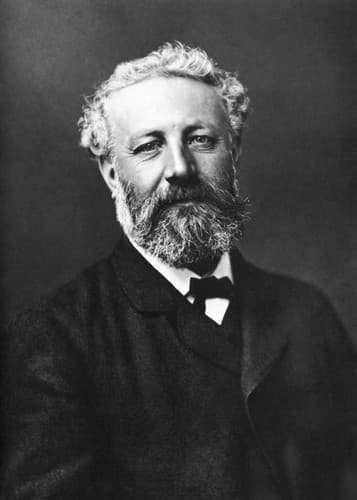
Jules Gabriel Verne was a French novelist, poet, and playwright. His collaboration with the publisher Pierre-Jules Hetzel led to the creation of the Voyages extraordinaires, a series of bestselling adventure novels including Journey to the Center of the Earth (1864), Twenty Thousand Leagues Under the Seas (1870), and Around the World in Eighty Days (1872). His novels, always well documented, are generally set in the second half of the 19th century, taking into account the technological advances of the time.
Similar books
- A Princess of Mars
Edgar Rice Burroughs
3.8 (51k) average on GoodreadsFantasyPioneering science fantasy with a focus on grand adventure and discovery in an alien environment.
- Harry Potter and the Sorcerer's Stone
J.K. Rowling
4.5 (7M) average on GoodreadsFantasyRescued from a miserable life under the stairs, an orphaned boy discovers he's a wizard destined for a magical school, where he uncovers a dangerous secret tied to the dark wizard who murdered his parents.
- The Hunger Games
Suzanne Collins
4.3 (6.4M) average on GoodreadsFantasyIn a future where children fight to the death on live television, Katniss Everdeen volunteers for the arena, turning a death sentence into a fight for survival and a spark of rebellion.
- 1984
George Orwell
4.2 (3.1M) average on GoodreadsPoliticsIn a future where surveillance and thought control are absolute, a man's search for truth clashes with the Party, showing that hope can be a form of rebellion.
- Divergent
Veronica Roth
4.2 (2.9M) average on GoodreadsFantasyIn a society divided by virtues, a sixteen-year-old's difference from the norm starts a rebellion that threatens her world.
- The Hobbit, or There and Back Again
J.R.R. Tolkien
4.3 (2.9M) average on GoodreadsFantasyA comfort-loving hobbit named Bilbo Baggins is whisked away by a mischievous wizard and a band of dwarves on an unexpected journey to reclaim stolen treasure from a fearsome dragon, discovering courage and a magical ring along the way.






Enjoyed the summary?
A summary gives you the shape of the book. The book itself has the detail, the examples and the voice.
Find Journey to the Center of the Earth on AmazonAs an Amazon Associate, BookBrief earns from qualifying purchases. How we're funded