
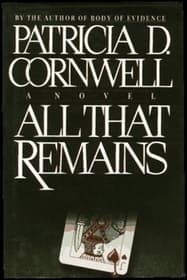
Synopsis
Covers the whole plot, including the ending.
- Difficulty
- Medium
- Pacing
- Moderate
- Mood
- Suspenseful, Dark, Analytical, Gritty
- Read it if
- You enjoy detailed forensic investigations, psychological thrillers, and strong female protagonists in the medical examiner genre.
- Skip it if
- You prefer lighthearted stories, explicit romance, or shy away from graphic descriptions of crime scenes and autopsies.
All That Remains Plot Summary
Covers the whole plot, including the ending.
The Latest Victims and the FBI's Arrival
Dr. Kay Scarpetta, Chief Medical Examiner of Virginia, is called to a scene where the remains of two young lovers, Deborah and Fred, have been found after being missing for months. This is the fourth such double murder in Richmond in two years. The bodies are badly decomposed and dismembered. Shortly after, the daughter of the President's new drug czar, Jill Harrington, and her boyfriend, Alexander Manchester, disappear from a secluded spot near the James River. This high-profile disappearance brings in the FBI, in the form of Special Agent Benton Wesley, which initially annoys Kay due to their different methods.
Initial Autopsies and Conflicting Theories
Kay and her assistant, Dr. Pete Marino, carefully examine Deborah and Fred's remains. Kay notes the precise, surgical dismemberment and the lack of trace evidence, pointing to an organized killer. She also finds evidence of sexual assault on the female victims. Benton Wesley, however, believes a satanic cult or thrill-killers are responsible, due to the ritualistic disposal of the bodies. Kay finds this assumption premature and focuses on forensic evidence, believing the meticulousness points to a single, intelligent perpetrator.
The Harrington Case Intensifies
Jill Harrington and Alexander Manchester's disappearance becomes a national priority. Governor Harvey, Jill's father, arrives in Richmond with his wife, adding political pressure to the investigation. Kay feels the strain as the FBI's presence grows, and the media focuses on the story. She continues her forensic work, hoping to find a link between the previous victims and the missing Jill and Alexander, but the lack of evidence at the disappearance site is frustrating.
A Breakthrough in Forensic Entomology
Kay uses forensic entomology, studying insects on the decomposed remains, to determine the approximate time of death and how long the bodies were exposed before being moved or buried. This advanced technique provides important information that contradicts some of the FBI's earlier timeline assumptions. She also finds subtle tool marks on the bones, suggesting the killer uses specialized instruments. This discovery confirms her belief in a single, skilled perpetrator who takes extreme measures to hide their tracks.
The Past Resurfaces: A Cold Case Link
As the investigation continues, Benton Wesley finds a very similar, unsolved double murder from years earlier in Florida, a case Kay had worked on. The details—young lovers, dismemberment, lack of evidence—are consistent. This discovery disturbs Kay, as it suggests the killer has a long history and has been operating undetected for years, possibly following her career. Re-examining this cold case opens new investigation paths and creates a personal connection for Kay.
Tracing a Suspect: Dr. Donatella
Through careful analysis of tool marks on the bones and a review of surgical instruments, Kay and Marino begin to suspect a medical professional. The Florida connection leads them to Dr. Steven Donatella, a brilliant but troubled former intern of Kay's from her time in Florida. Donatella had a fascination with anatomy and a history of erratic behavior. Kay remembers his ability to disarticulate bones precisely. The possibility that someone she once mentored could be responsible for these crimes is chilling for Kay.
The Killer's Modus Operandi Revealed
Kay concludes that the killer targets young, attractive couples in secluded areas, abducts them, holds them captive, tortures them, sexually assaults the women, then dismembers their bodies. The killer's precision and complete lack of forensic evidence suggest a highly intelligent, organized individual with medical knowledge and access to specialized tools. Kay believes the killer enjoys not just the act, but the challenge of avoiding capture, almost playing a game with law enforcement. The psychological profile points to a psychopath with deep issues.
The Confrontation and Climax
Kay, along with Benton Wesley and Pete Marino, tracks Dr. Steven Donatella to a remote cabin in the woods, where they believe he is holding Jill Harrington and Alexander Manchester. A tense confrontation occurs. Donatella, showing his psychopathic tendencies and a twisted admiration for Kay, taunts them with knowledge of his crimes. He has booby-trapped the cabin, creating a dangerous environment. Kay, using her forensic instincts and quick thinking, tries to outmaneuver him and save the victims, who are still alive but badly injured.
The Aftermath and Lingering Questions
Jill Harrington and Alexander Manchester are rescued, though severely traumatized and injured. Dr. Steven Donatella is killed in the struggle, ending his crimes. However, the experience leaves a deep mark on Kay. The realization that she had once worked with such a monster, and that he had followed her career, shakes her sense of security and professional detachment. The case shows the dark side of human nature and the psychological burden of being a medical examiner, even as it strengthens her dedication to justice.
Reflecting on the Personal Cost
Afterward, Kay reflects on the personal cost of her work. The case, with its high-profile victims and the personal connection to the killer, pushes her to her limits. She struggles with the psychological impact of witnessing such depravity and the constant pressure of her job. Her relationship with Benton Wesley, though initially difficult, develops into mutual respect. She reaffirms her commitment to forensic science, understanding that it is the only way to give a voice to victims and bring their killers to justice.
All That Remains Characters
Dr. Kay Scarpetta
Protagonist
Chief Medical Examiner of Virginia, brilliant forensic pathologist.
Dr. Kay Scarpetta is a highly intelligent, meticulous, and dedicated forensic pathologist. She possesses an almost obsessive commitment to her work, driven by a deep sense of justice for the deceased. Kay is analytical, methodical, and often relies on her intuition, honed by years of experience. She is fiercely independent and prefers to trust forensic evidence above all else, often clashing with law enforcement officials who prioritize other theories. Despite her professional stoicism, she carries the emotional weight of her cases, particularly when they involve heinous crimes against the innocent.
Relationships: Pete Marino (Subordinate and loyal detective, often her confidante); Benton Wesley (FBI profiler, initial professional friction turns into mutual respect and attraction); Steven Donatella (Former intern, now the psychopathic killer)
Special Agent Benton Wesley
Supporting
FBI profiler who assists in the investigation.
Benton Wesley is a seasoned and intelligent FBI profiler. He is calm, observant, and possesses a strong understanding of criminal psychology. Initially, he and Kay clash due to their differing professional approaches – Kay focuses on hard science, while Benton emphasizes psychological profiling and behavioral patterns. However, he quickly recognizes Kay's brilliance and integrity, and their professional relationship evolves into one of mutual respect and a subtle underlying attraction. He provides a crucial external perspective and resources from the FBI, aiding Kay in connecting the dots beyond the immediate forensic evidence.
Relationships: Kay Scarpetta (Professional colleague, developing mutual respect and attraction)
Detective Pete Marino
Supporting
Richmond Police Detective, Kay's loyal assistant.
Pete Marino is a gruff, street-smart Richmond Police Detective who often works closely with Kay. He is loyal to Kay and trusts her judgment implicitly, even if he sometimes struggles with the technical jargon of forensic science. Marino is practical, sometimes cynical, and possesses a no-nonsense approach to police work. He is fiercely protective of Kay and acts as her ground-level connection to the police force. Despite his rough exterior, he cares deeply about justice and the victims, providing a vital bridge between Kay's scientific world and the gritty realities of crime investigation.
Relationships: Kay Scarpetta (Subordinate and loyal colleague)
Dr. Steven Donatella
Antagonist
The psychopathic serial killer, a former medical intern of Kay's.
Dr. Steven Donatella is the brilliant yet deeply disturbed serial killer, a former medical intern whom Kay Scarpetta once mentored in Florida. He possesses an exceptional intellect and an uncanny precision, particularly in anatomy and surgery, which he perverts for his heinous crimes. Donatella is a psychopath, devoid of empathy, who views his victims as objects and the investigation as a game. He is meticulous in covering his tracks and takes pleasure in taunting law enforcement. His motive appears to be a complex mix of power, control, and a twisted form of intellectual challenge, perhaps even an obsession with Kay herself.
Relationships: Kay Scarpetta (Former mentor, now his target/adversary)
Jill Harrington
Mentioned
Daughter of the President's drug czar, a high-profile victim.
Jill Harrington is the daughter of Governor Harvey, the President's new drug czar. Her disappearance with her boyfriend, Alexander Manchester, elevates the case to national prominence and significantly increases the pressure on Kay and the investigative team. She represents the innocent victims of Donatella's spree, and her high profile intensifies the urgency of the search. Though she is not a central character in terms of narrative agency, her plight drives much of the plot's momentum and the emotional stakes for Kay.
Relationships: Alexander Manchester (Her boyfriend and co-victim); Governor Harvey (Her father)
Governor Harvey
Mentioned
Jill Harrington's father, the President's new drug czar.
Governor Harvey is Jill Harrington's father and a powerful political figure, having recently been appointed the President's new drug czar. His arrival in Richmond following his daughter's disappearance brings immense political pressure to the investigation. He embodies the external forces and public scrutiny that Kay and the team face, constantly demanding updates and results. His presence highlights the high stakes of the case and the challenges of conducting a thorough forensic investigation under intense political and media pressure.
Relationships: Jill Harrington (His daughter)
Lucy Farinelli
Mentioned
Kay's niece, a computer genius.
Lucy Farinelli is Kay Scarpetta's brilliant and technologically adept niece. Though not physically present for most of the narrative, her skills in computer forensics and data analysis are frequently mentioned and hinted at as a resource for Kay. She represents a different generation and a different kind of intelligence, often providing insights or assistance from afar that complement Kay's traditional forensic methods. Her presence serves to broaden Kay's support network and hint at future technological advancements in crime-solving.
Relationships: Kay Scarpetta (Her aunt)
All That Remains Themes
The Nature of Evil and Psychopathy
The novel explores the nature of psychopathy through Dr. Steven Donatella. His careful planning, lack of empathy, and ability to fit into society show how dangerous such individuals are. The theme emphasizes that evil can appear intelligent and normal, making it hard to detect until it is too late. Kay's struggle to understand Donatella, a former mentee, highlights the unsettling fact that even those trained to heal can harbor deep darkness, as seen in his precise dismemberment.
“Evil, Kay thought, was not an abstract concept but a tangible, suffocating presence that could corrupt the most brilliant minds.”
The Burden of Forensic Work and Justice
This theme shows the psychological and emotional toll on forensic professionals like Kay Scarpetta. Despite her dedication, Kay deals with the horrors she sees and the pressure to bring justice to victims. The detailed descriptions of autopsies and decomposition highlight the gruesome reality of her job. The pursuit of justice is not just a professional duty but a personal mission for Kay, often leading to isolation and internal conflict, especially when the killer has a personal connection, forcing her to confront humanity's dark side daily.
“The dead speak to me, Kay often said, but sometimes their voices were a cacophony of pain she could barely endure.”
Science vs. Intuition in Investigation
The novel shows how scientific methods and intuition work together to solve complex crimes. Kay Scarpetta represents a commitment to forensic science—facts, microscopic evidence, biological truths. Benton Wesley, the FBI profiler, uses a psychological approach, looking for patterns in behavior and motive. The story demonstrates that while science provides proof, intuition and profiling can guide investigators to apply science, requiring both for true breakthroughs, as seen in Kay and Benton's collaboration.
“Facts are stubborn things, Kay believed, but sometimes the most stubborn facts were those that resided in the dark corners of the human mind.”
The Past Haunting the Present
This theme is central to the plot, as the current Richmond murders are linked to an unsolved case from Kay's past in Florida. The reappearance of a killer she once knew, whose methods she had studied years ago, blurs the lines between her past professional life and her current investigation. This connection adds a personal dimension to Kay's pursuit of justice, forcing her to confront her own history and the possibility that she might have missed clues long ago. The killer's long history shows that unresolved darkness can resurface with devastating consequences.
“Sometimes the shadows of the past were not just memories, but tangible presences, waiting to strike again.”
Plot Devices & Literary Techniques
Red Herring
Misleading clues or suspects to divert attention.
Early in the investigation, the FBI, particularly Benton Wesley, initially pushes the theory of a satanic cult or a group of thrill-killers due to the ritualistic nature of the body disposals. This theory serves as a red herring, diverting attention from the meticulous, individualistic nature of the killer's work. Kay Scarpetta's skepticism and reliance on forensic evidence eventually steer the investigation away from this initial, plausible but incorrect, hypothesis.
Forensic Detail as Narrative Engine
Meticulous scientific procedures drive the plot and reveal the killer.
The novel heavily relies on Kay Scarpetta's detailed forensic analysis to advance the plot. Rather than traditional detective work, it's the examination of insect evidence, tool marks on bones, and decomposition rates that provide crucial breakthroughs. These scientific revelations not only offer clues about the killer's identity and methods but also build suspense and showcase Kay's brilliance, making the seemingly dry science a compelling narrative force.
Personal Connection to the Antagonist
The killer is a former acquaintance, heightening the stakes.
The revelation that Dr. Steven Donatella, the serial killer, was once Kay Scarpetta's medical intern in Florida serves as a powerful plot device. This personal connection significantly elevates the emotional and psychological stakes for Kay. It not only makes the killer's pursuit more urgent but also forces Kay to confront her own past and the unsettling reality that she once mentored a psychopath, adding a layer of guilt and personal responsibility to her professional duty.
High-Profile Victim
The disappearance of a politically connected individual increases pressure.
The abduction of Jill Harrington, the daughter of the President's new drug czar, serves as a critical plot device. Her high-profile status immediately escalates the case to national importance, bringing in the FBI and intensifying political and media pressure on Kay and the investigative team. This device compresses the timeline, forces faster action, and highlights the immense scrutiny under which forensic work and law enforcement operate, adding urgency and external conflict to the narrative.
All That Remains Quotes
“Love isn't something you can just turn off. It's like breathing.”
“Sometimes the hardest battles are the ones we fight inside ourselves.”
“A secret shared is no longer a secret, but a burden halved.”
“The future isn't written in stone; it's written in the choices we make today.”
“You can't outrun your past, but you can learn to live with it.”
“Hope is a fragile thing, but it's often all we have left.”
“Sometimes, the strongest people are the ones who aren't afraid to ask for help.”
“True love isn't about perfection; it's about accepting imperfections.”
“The greatest adventures often begin with a single, brave step.”
“Forgiveness isn't just for the other person; it's for yourself too.”
“Sometimes goodbye isn't forever, it's just a promise to meet again.”
“You don't truly know someone until you've seen them at their worst.”
“The most beautiful melodies are often born from the deepest silences.”
“Hearts can mend, but the scars will always tell a story.”
Quiz
10 questions on the plot and the characters. Each answer comes with a short explanation.
Question 1
What is the primary setting for the series of murders investigated by Dr. Kay Scarpetta in 'All That Remains'?
- Charlottesville, Virginia
- Richmond, Virginia
- Washington D.C.
- Norfolk, Virginia
Show answer
B. Richmond, Virginia The book explicitly states that the young lovers are dying in Richmond, Virginia, where Dr. Kay Scarpetta is based.
Question 2
How many couples had disappeared and were found as mutilated corpses before the president's drug czar's daughter went missing?
- Two couples
- Three couples
- Four couples
- Five couples
Show answer
C. Four couples The synopsis states, 'So far, four couples in the area have disappeared, only to be found months later as mutilated corpses.'
Question 3
Who is the central protagonist and medical examiner investigating the murders?
- Benton Wesley
- Pete Marino
- Dr. Kay Scarpetta
- Lucy Farinelli
Show answer
C. Dr. Kay Scarpetta Dr. Kay Scarpetta is explicitly named as the main character and medical examiner in the synopsis.
Question 4
What prompts Dr. Kay Scarpetta to realize time is short in her investigation?
- A new clue found at a crime scene
- The disappearance of the president's drug czar's daughter and her boyfriend
- A direct threat from the killer
- The discovery of a fifth couple's remains
Show answer
B. The disappearance of the president's drug czar's daughter and her boyfriend The synopsis states, 'When the daughter of the president's newest drug czar vanishes along with her boyfriend, Dr. Kay Scarpetta knows time is short.'
Question 5
What kind of evidence trail does Kay Scarpetta follow to connect the present homicides?
- A purely digital trail of online communications
- A macabre trail that ties the present crimes to a grisly crime in the past
- A series of anonymous letters sent to the police
- Eyewitness accounts from survivors
Show answer
B. A macabre trail that ties the present crimes to a grisly crime in the past The text mentions Kay 'Following a macabre trail of evidence that ties the present homicides to a grisly crime in the past.'
Question 6
What is a key characteristic mentioned about the murderer's ability, making Kay's job difficult?
- Their ability to impersonate their victims
- Their skill at eliminating clues
- Their exceptional physical strength
- Their use of advanced technology to evade capture
Show answer
B. Their skill at eliminating clues The synopsis highlights that the murderer 'is as skilled at eliminating clues as Kay is at finding them.'
Question 7
What type of relationship is indicated between the victims of the serial killer?
- They are all colleagues from the same workplace.
- They are members of the same family.
- They are young lovers.
- They are random individuals with no apparent connection.
Show answer
C. They are young lovers. The synopsis clearly states, 'young lovers are dying,' and refers to 'four couples' disappearing.
Question 8
What personal resources must Kay Scarpetta draw upon to track down the murderer?
- Her connections within the political sphere
- Her academic research and published theories
- Her own personal resources
- Assistance from a renowned private investigator
Show answer
C. Her own personal resources The text states, 'Kay must draw upon her own personal resources to track down a murderer.' This implies her inner strength, experience, and resilience.
Question 9
The description implies a thematic contrast between the murderer and Kay. What is it?
- The murderer's brute force versus Kay's intellectual prowess.
- The murderer's desire for chaos versus Kay's pursuit of order.
- The murderer's skill at eliminating clues versus Kay's skill at finding them.
- The murderer's hidden identity versus Kay's public profile.
Show answer
C. The murderer's skill at eliminating clues versus Kay's skill at finding them. The text directly states the murderer 'is as skilled at eliminating clues as Kay is at finding them,' setting up a direct thematic opposition in their respective abilities.
Question 10
What is the implied consequence of the victims being found 'months later' as mutilated corpses?
- It suggests the killer is highly organized and able to hide bodies for extended periods.
- It indicates the victims were held captive for months before being killed.
- It implies the police were deliberately withholding information from the public.
- It means the murders are likely committed by different individuals.
Show answer
A. It suggests the killer is highly organized and able to hide bodies for extended periods. The phrase 'found months later as mutilated corpses' strongly implies the killer's ability to dispose of bodies effectively and avoid immediate detection, highlighting their cunning and organization.
All That Remains FAQ
What is the central mystery Dr. Kay Scarpetta investigates in 'All That Remains'?
Dr. Kay Scarpetta investigates a series of brutal double homicides in Richmond, Virginia, where young couples disappear and are later found as mutilated corpses. The urgency escalates significantly when the daughter of the president's new drug czar, Deborah Harvey, vanishes with her boyfriend, prompting Scarpetta to race against time.
Who are some of the key characters involved in the investigation besides Dr. Kay Scarpetta?
Besides Dr. Kay Scarpetta, the Chief Medical Examiner, key characters include Captain Pete Marino, a gruff but dedicated detective, and Benton Wesley, an FBI profiler who provides crucial psychological insights. Lucy Farinelli, Scarpetta's niece, also plays a minor but significant role in the story.
What makes the disappearance of Deborah Harvey and Ted Eddings particularly significant to the plot?
The disappearance of Deborah Harvey and Ted Eddings is significant because Deborah is the daughter of the president's newly appointed drug czar, prompting immense political pressure and media scrutiny. This high-profile case elevates the stakes and places Kay Scarpetta under intense public and governmental scrutiny to solve the murders quickly.
How do the past and present crimes connect in the narrative?
The narrative reveals a macabre trail of evidence that ties the present homicides to a grisly crime from the past, specifically a murder that occurred at a place called Camp Peary, a highly secretive government facility. This past event provides the crucial motive and context for the current spree of killings, linking the killer's personal history to their present actions.
What is the primary setting for 'All That Remains' and how does it influence the atmosphere?
The primary setting for 'All That Remains' is Richmond, Virginia, which provides a backdrop of Southern gentility contrasting sharply with the horrific nature of the crimes. The city's blend of historical charm and modern urbanity creates an eerie atmosphere, particularly as the investigations delve into hidden, darker aspects of its community.
What is the significance of the specific mutilations found on the victims?
The specific mutilations found on the victims are not random; they are highly symbolic and deeply personal to the killer's psyche and past experiences. These ritualistic injuries provide critical clues to the FBI profiler, Benton Wesley, about the murderer's psychological state, motives, and the underlying trauma driving their actions.
How does Camp Peary, the 'Farm,' factor into the killer's background and motivation?
Camp Peary, often referred to as 'the Farm,' is revealed to be a clandestine government training facility where the killer, Mark James, was subjected to traumatic psychological conditioning and abuse. This experience at Camp Peary is the foundational trauma that fuels his rage and desire for revenge, directly motivating the serial murders.
Are there any subtle clues regarding the killer's identity or methods that Scarpetta initially misses?
Scarpetta initially struggles with the lack of conventional forensic evidence, as the killer is highly skilled at eliminating clues. However, subtle details like the specific types of bindings used, the meticulous cleanup of crime scenes, and the remote locations where bodies are found, hint at a perpetrator with specialized training and an extreme level of premeditation.
What is the role of the 'ghost' or 'phantom' figure that haunts the killer's mind?
The 'ghost' or 'phantom' figure is a hallucination or deeply ingrained psychological construct in the killer's mind, representing the tormentor from their past at Camp Peary. This spectral presence continually drives the killer's actions, reinforcing their distorted sense of justice and their compulsion to reenact past traumas on new victims.
How does the killer's perceived victim selection reflect their psychological profile?
The killer's perceived victim selection, targeting young lovers, reflects a deep-seated resentment and rage stemming from their own traumatic experiences related to betrayal and loss. Psychologically, they are likely projecting their past pain onto these couples, seeing them as symbols of innocence or happiness that were denied to them, thus making them targets for their violent retribution.
What psychological toll does the investigation take on Dr. Kay Scarpetta?
The investigation takes a significant psychological toll on Dr. Kay Scarpetta, pushing her to her limits due to the horrific nature of the crimes and the personal connection she feels to the young victims. The pressure from the president's office and the elusive nature of the killer also contribute to her stress, leading to moments of self-doubt and heightened anxiety.
How does Benton Wesley's profiling contribute to understanding the killer's mindset?
Benton Wesley's profiling is crucial; he helps Scarpetta understand the killer's highly organized yet deeply disturbed mindset by analyzing the meticulousness of the crimes and the symbolic mutilations. He posits that the killer is intelligent, has specialized training, and is driven by a profound, unresolved trauma, allowing the team to anticipate future actions.
What is the killer's core motivation, psychologically speaking?
The killer's core motivation is a profound desire for revenge and a distorted sense of justice, stemming from severe psychological trauma and abuse experienced during their past. They are driven by a need to reassert control and inflict the pain they endured onto others, particularly those they perceive as representing the happiness or innocence they lost.
Is the killer's portrayal sympathetic or purely villainous, from a psychological perspective?
From a psychological perspective, the killer's portrayal is complex, leaning towards tragic villainy rather than pure villainy. While their actions are undeniably horrific, the narrative delves into their traumatic past at Camp Peary, offering a glimpse into the origins of their severe psychological damage without excusing their heinous crimes.
How does the book explore the theme of government secrecy and its potential negative consequences?
'All That Remains' explores the theme of government secrecy by revealing how the clandestine activities at Camp Peary directly led to the psychological scarring and subsequent rampage of the killer. It suggests that unchecked secrecy and unethical experimentation can have devastating and far-reaching consequences for individuals and society.
What is the significance of the title 'All That Remains' in relation to the plot and themes?
The title 'All That Remains' is highly significant, referring to the mutilated remains of the victims, representing the physical evidence left behind. Metaphorically, it also alludes to the psychological 'remains' of the killer's shattered psyche after his traumatic past, and the lasting impact of grief and violence on the survivors and investigators.
Does the book offer a definitive resolution or leave room for ambiguity regarding certain aspects of the case?
The book offers a definitive resolution to the immediate case, identifying and confronting the killer, Mark James. However, it leaves room for ambiguity regarding the full extent of the government's complicity in creating such a disturbed individual and the long-term psychological aftermath for Kay Scarpetta, hinting at the lasting scars of such a brutal investigation.
How does the narrative challenge the reader's perception of justice?
The narrative challenges the reader's perception of justice by presenting a killer who is a product of severe systemic abuse and trauma, making his villainy complex. It forces consideration of whether justice is served by simply apprehending the perpetrator, or if the institutions that created him also bear responsibility, blurring the lines of clear-cut good and evil.
About the author

Patricia Cornwell is an American author known for her crime fiction, particularly featuring forensic science and investigative themes. Her notable works include "Body of Evidence," "The Body Farm," "Unnatural Exposure," "Black Notice," and "All That Remains," which explore complex characters and intricate plots within the genre. Cornwell's writing often reflects her background in journalism and her interest in criminal psychology.
Similar books
- The Silence of the Lambs
Thomas Harris
4.2 (464k) average on GoodreadsThrillerFeatures a brilliant female protagonist tracking a serial killer with psychological depth.
- Postmortem
Patricia Cornwell
4.0 (212k) average on GoodreadsThrillerAnother Kay Scarpetta novel, showcasing her forensic expertise and investigative style.
- Déjà Dead
Kathy Reichs
3.9 (133k) average on GoodreadsThrillerBoth feature female forensic anthropologists/pathologists as protagonists. Cornwell's Scarpetta, as Chief Medical Examiner, often operates within a more established, procedural framework in Virginia, whereas Reichs's Temperance Brennan frequently finds herself in more varied and often international settings, bringing a different dynamic to the forensic investigation process. Cornwell's early work, like 'All That Remains,' often feels more deeply rooted in the specific mechanics of a state medical examiner's office.
- Harry Potter and the Sorcerer's Stone
J.K. Rowling
4.5 (7M) average on GoodreadsFantasyRescued from a miserable life under the stairs, an orphaned boy discovers he's a wizard destined for a magical school, where he uncovers a dangerous secret tied to the dark wizard who murdered his parents.
- The Hunger Games
Suzanne Collins
4.3 (6.4M) average on GoodreadsFantasyIn a future where children fight to the death on live television, Katniss Everdeen volunteers for the arena, turning a death sentence into a fight for survival and a spark of rebellion.
- To Kill a Mockingbird
Harper Lee
4.3 (4.5M) average on GoodreadsHistorical FictionIn the 1930s Jim Crow South, Harper Lee writes about racial injustice, moral growth, and the quiet courage of a lawyer father, Atticus Finch, as seen through his young daughter's eyes.





Enjoyed the summary?
A summary gives you the shape of the book. The book itself has the detail, the examples and the voice.
Find All That Remains on AmazonAs an Amazon Associate, BookBrief earns from qualifying purchases. How we're funded