
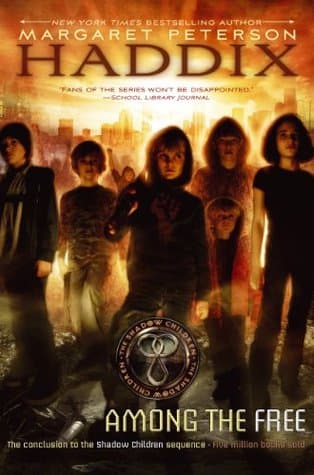
Synopsis
Covers the whole plot, including the ending.
- Difficulty
- Easy
- Pacing
- Moderate
- Mood
- Hopeful, Reflective, Suspenseful, Thought-provoking
- Read it if
- You've followed Luke's journey through the Shadow Children series and want to see how the overarching conflict resolves, or enjoy stories about societal change and the challenges of building a new government after a revolution.
- Skip it if
- You haven't read the previous books in the Shadow Children series, as this is the final installment and relies heavily on prior plot and character development.
Among the Free Plot Summary
Covers the whole plot, including the ending.
The Aftermath of the Attack
After the Population Police headquarters is bombed, Luke Garner, using the name Sebastian, finds himself in the ruins and confusion. He is separated from his friends and mentors, Nina and Oscar, and tries to understand what happened. The air is thick with smoke, and debris covers the ground. Luke, lost and alone, sees both fear and a growing sense of hope among survivors. He realizes his actions, even if accidental, played a big part in this event, and the weight of this responsibility begins to affect him. He tries to make sense of the new, uncertain reality.
Encounter with the Resistance
As Luke walks through the destroyed city, a group of resistance members finds him. They were working against the Population Police. They recognize him as Sebastian, the boy who entered the headquarters and accidentally started the rebellion. The resistance, led by Natalia, a serious but practical woman, explains that the bombing was a trigger, but the fight for freedom is not over. They see Luke as a symbol, an accidental hero who can inspire others, and they immediately include him in their plans for the future, which makes Luke uncomfortable and confused about his role.
The Provisional Government
Luke, guided by Natalia and the resistance, joins the new temporary government. He attends their secret meetings, often in makeshift places, where various groups and leaders try to build a new society. Luke watches the intense debates among leaders, including representatives from different regions and social classes. He sees how hard it is to unite people who were long oppressed and to create a fair system. Discussions focus on immediate needs like food and security, and the long-term goal of writing a new constitution, all while the threat of remaining Population Police loyalists exists.
Reunion and Revelation
Luke eventually has an emotional reunion with Nina and Oscar, who also survived the bombing. They share their experiences and tell Luke what he missed. Nina, deeply involved with the resistance, reveals more about the extensive network and years of planning to undermine the Population Police. Oscar, always practical, focuses on the challenges of rebuilding. Their reunion brings Luke relief, giving him familiar faces and a sense of belonging amid the changes. They discuss the future and their individual roles in the new society.
The Seeds of Division
As the temporary government tries to gain power and structure, Luke notices the internal divisions and power struggles among its members. Different leaders compete for influence, and conflicting ideas about how the new society should run appear. Some want immediate, radical changes, while others prefer a cautious, gradual approach. Luke sees the fragility of their new unity, fearing that the oppression they fought could return in a different form if these divisions are not resolved. He sees how easily power can corrupt, even with good intentions.
The Threat of a New Dictatorship
Luke, using his observation skills and lingering distrust from his past, suspects that some individuals in the temporary government are not as good as they seem. He overhears quiet talks and notices subtle behaviors that suggest a desire for personal power rather than collective good. Working quietly with Nina and Oscar, he finds evidence that certain groups are trying to centralize control, manipulate public opinion, and possibly create a new authoritarian rule, mirroring the system they overthrew. This discovery fills Luke with dread, realizing that freedom is not guaranteed just by removing the old regime.
A Call to Action
Facing the grim reality of a possible new dictatorship, Luke can no longer be a passive observer. He feels a deep responsibility to ensure the sacrifices made during the rebellion were not in vain. Despite his shyness and fear of public speaking, he understands that his unique position as a 'third child' and accidental hero gives his voice weight. He consults with Nina and Oscar, who support his decision to expose the manipulative individuals in the government. Luke realizes that true freedom requires constant watchfulness and a willingness to challenge injustice, even when it comes from within their own ranks.
The Public Address
At a public gathering where the temporary government plans to announce new, possibly restrictive policies, Luke Garner steps forward. Overcoming his fears, he gives an emotional speech, revealing the plans of those trying to seize power and warning people against falling under another form of oppression. He speaks from his heart, sharing his personal experience as a shadow child and his belief in true freedom and equality for all. His words resonate with the crowd, many of whom are former shadow children or suffered under the old regime. His honesty and bravery spark a new wave of determination among the people.
Challenging the Usurpers
Luke's powerful speech causes immediate reactions. Some corrupt leaders try to discredit him, but the crowd supports Luke. With Nina, Oscar, and other genuine resistance members, Luke presents the evidence they gathered, exposing the true intentions of those who sought to establish new autocratic rule. The public outcry is huge, forcing the would-be dictators to back down and face consequences. This confrontation is a key moment, showing the power of an informed and united public to resist oppression, even from within their own ranks. The temporary government must rethink its structure and leadership.
A New Beginning, Cautious Hope
With the corrupt elements removed, the temporary government begins to work toward establishing a democratic and fair society. Luke, now Luke Garner, is recognized not only as a symbol but as a voice for the previously voiceless. He, Nina, and Oscar remain involved, ensuring that new laws protect all citizens, especially the 'third children' who are now free to live openly. The path ahead is still long and challenging, but there is a clear sense of cautious hope for a future where everyone belongs. Luke, though changed, finds peace knowing he helped create a truly free world.
Principal Figures
Luke Garner / Sebastian
Protagonist
A third-born shadow child who inadvertently sparks a revolution and becomes a reluctant leader.
Luke Garner, formerly hiding as a 'third child,' has transformed into Sebastian, an identity he adopted while infiltrating the Population Police. He is initially shy, introspective, and struggles with the weight of his past and the new responsibilities thrust upon him. Despite his quiet nature, Luke possesses a strong moral compass and an innate sense of justice, deeply empathetic to the plight of others. He is resourceful and observant, skills honed during his years in hiding. His journey is one of self-discovery and finding his voice.
Relationships: Nina (Close friend and confidante, fellow resistance fighter); Oscar (Close friend and pragmatic ally); Natalia (Resistance leader who guides and mentors him in the new government)
Nina
Supporting
A former shadow child and experienced resistance fighter, Luke's trusted friend.
Nina is a resourceful and intelligent young woman who has been actively involved in the resistance movement for a significant period. She is practical, courageous, and possesses a strong understanding of political maneuvering. Nina acts as a mentor and confidante to Luke, offering guidance and support, especially in the chaotic aftermath of the rebellion. She is deeply committed to ensuring that the new society truly represents freedom and equality, having personally experienced the injustices of the old regime. Her experience makes her a valuable asset in navigating the complexities of the provisional government.
Relationships: Luke Garner (Close friend and fellow fighter); Oscar (Close friend and ally)
Oscar
Supporting
A pragmatic and loyal friend to Luke, offering a grounded perspective.
Oscar is a level-headed and pragmatic young man, serving as a grounding influence for Luke and Nina. He is less idealistic than some, often focusing on the practicalities and potential pitfalls of their situation. Oscar is loyal and reliable, providing a steady presence amidst the turmoil. He is analytical and observant, often seeing things others miss. While not as outspoken as Luke or as strategically minded as Nina, his common sense and unwavering support are invaluable to his friends. He represents the everyday citizen hoping for a better, stable future.
Relationships: Luke Garner (Close friend and ally); Nina (Close friend and ally)
Natalia
Supporting
A stern and experienced leader within the resistance movement.
Natalia is a key figure in the resistance, a seasoned leader who has dedicated her life to overthrowing the Population Police. She is pragmatic, decisive, and possesses strong leadership qualities. Natalia initially sees Luke as a symbol, an accidental hero whose presence can galvanize the populace. While she is focused on the strategic aspects of establishing the new government, she also shows a genuine concern for the welfare of the people. She mentors Luke, guiding him through the complexities of political transition, though she can be stern in her expectations.
Relationships: Luke Garner (Mentor and leader of the resistance who guides Luke)
Barbs
Mentioned
A former ally from the Population Police who aided Luke in the previous book.
Barbs is a character from the previous book, a Population Police officer who secretly opposed the regime and aided Luke. While not physically present in 'Among the Free,' her actions and the information she provided are implied to have been crucial in setting the stage for the rebellion. Her character represents the internal dissent within the old system and the possibility of unexpected allies. Her legacy contributes to the sense that the old regime was crumbling from within.
Relationships: Luke Garner (Former secret ally against the Population Police)
Mr. Hendrick
Antagonist
A manipulative and ambitious leader within the provisional government.
Mr. Hendrick is one of the more prominent figures within the provisional government who quickly reveals a desire for personal power rather than true democratic ideals. He is cunning, articulate, and skilled at manipulating public opinion. Hendrick represents the new threat to freedom, demonstrating how easily power can corrupt even those who seemingly fought for liberation. He tries to consolidate control and establish a new form of authoritarian rule, using the chaos of the transition to his advantage. He is a foil to Luke's selfless desire for true equality.
Relationships: Luke Garner (Antagonist, representing the new threat to freedom)
The Population Police
Antagonist (former)
The oppressive governing body that enforced the two-child policy.
The Population Police are the former authoritarian regime that enforced the strict two-child policy, leading to the persecution of 'third children' like Luke. Though their headquarters have been bombed and their power largely broken, their lingering influence and the fear they instilled still affect society. Their brutal methods and pervasive control shaped the world Luke grew up in. In this book, they represent the oppressive past that the new government strives to overcome, and the constant reminder of what could happen if vigilance is lost.
Relationships: Luke Garner (Oppressors of Luke and his family); The populace (Oppressors of the entire society)
Themes & Insights
The Fragility of Freedom
This theme explores the idea that achieving freedom is only the first step; maintaining it requires constant effort. After the Population Police are overthrown, Luke sees new power struggles and attempts at control emerge within the temporary government (Scene 5, 6). The narrative shows how easily good intentions can be corrupted by ambition, and how people, even after being freed, must remain active and questioning to prevent new forms of oppression. Luke's decision to speak out against the new potential tyrants (Scene 7, 8) directly shows this theme, proving that freedom is not a gift, but an ongoing struggle.
“Freedom isn't just the absence of chains; it's the constant work of ensuring no new ones are forged.”
The Power of the Individual Voice
Luke Garner, initially a hidden 'shadow child' who fears attention, eventually finds his voice and uses it to shape the new world. His accidental role in the rebellion and his status as a 'third child' give his words unique importance. Despite his shyness, he recognizes the need to speak truth to power, especially when new forms of tyranny appear (Scene 7). His public address (Scene 8) is a key moment, showing how one person, speaking from genuine experience and belief, can motivate people and prevent injustice. This theme emphasizes that even the most unassuming individuals can cause big change.
“Sometimes, the quietest voices hold the most truth, and when they finally speak, the world listens.”
Defining True Justice and Equality
The book explores the complex question of what makes a society truly just and equal after a revolution. With the old oppressive regime gone, the temporary government struggles with how to create a fair system for everyone, especially those who were marginalized, like the 'third children.' Luke observes the debates (Scene 3) and realizes that simply removing old laws is not enough; the new laws must embody true equality. The struggle against Mr. Hendrick (Scene 6, 9) shows the ongoing fight to ensure that the new society does not just replace one set of oppressors with another, but truly upholds the rights and dignity of all citizens, particularly the previously voiceless.
“Justice isn't just about punishing the wrongdoers. It's about building a world where wrongdoing can't easily take root again.”
The Weight of Responsibility
Luke deals significantly with the unintended results of his actions and the great responsibility placed on him. His entry into the Population Police headquarters, while accidental in its final outcome, led directly to the bombing and the revolution (Scene 1). He feels the weight of this, understanding that he is seen as a symbol, an accidental hero. This responsibility pushes him beyond his comfort zone, forcing him to face new threats and take on a leadership role he never sought (Scene 7). The theme explores how individuals, even when their actions are not planned, can be put into positions of great influence, and the moral obligation that comes with such power.
“Being a hero wasn't a choice; it was a burden, a responsibility he hadn't asked for but couldn't shirk.”
Plot Devices & Literary Techniques
Accidental Heroism
Luke's actions, though often unintentional, lead to profound societal changes.
Luke Garner's journey throughout the series, and especially in 'Among the Free,' is characterized by accidental heroism. He never sets out to be a leader or a revolutionary, but his desperate attempts to survive and uncover truth inadvertently trigger monumental events, such as the bombing of the Population Police headquarters. This device highlights that significant change can arise from unexpected sources and that ordinary individuals, through their personal struggles, can become catalysts for revolution. It positions Luke as a relatable protagonist who, despite his fears, is repeatedly thrust into extraordinary circumstances, forcing him to rise to the occasion.
Symbolic Figure
Luke, as a 'third child,' embodies the hopes and fears of the oppressed populace.
Luke's identity as a 'third child' makes him a powerful symbolic figure for the entire oppressed population. His mere existence, and later his public emergence, represents the defiance against the old regime's tyrannical laws. After the revolution, he becomes a symbol of the newly won freedom and the potential for a just society. This device allows the narrative to explore broader societal issues through the lens of one character's personal experience. His voice carries weight not just because of what he says, but because of who he is and what he represents to millions who were once silenced.
Internal Conflict vs. External Threat
The primary conflict shifts from fighting an external oppressor to internal struggles within the liberated society.
Initially, the conflict of the series was clearly external: the Population Police. In 'Among the Free,' this shifts dramatically. While the old regime is largely dismantled, the new and more insidious threat comes from within the provisional government itself (Mr. Hendrick and his faction). This plot device creates a more complex and nuanced conflict, demonstrating that achieving freedom is not the end of the struggle. It forces Luke and the other characters to confront the difficult truth that power can corrupt anyone, and vigilance against tyranny must be maintained even among allies. This elevates the stakes by making the enemy less obvious and more psychologically challenging to overcome.
Among the Free Quotes
“Freedom is a gift you give yourself.”
“The past is a story we tell ourselves. The future is a story we write.”
“Even in the darkest places, there is always a flicker of light.”
“Sometimes the greatest courage is simply to keep going.”
“The world is bigger than you think, and full of wonders you can't imagine.”
“You can't truly be free until you're free in your mind.”
“Every choice you make writes a new chapter in your life.”
“The truth, once seen, cannot be unseen.”
“It's not about what was, but what can be.”
“Even a small spark can light a great fire.”
“Fear can be a prison, but hope is the key.”
“Home isn't a place, it's the people you share it with.”
“The greatest treasures are not things, but experiences.”
“Sometimes, the only way forward is to let go of what holds you back.”
Quiz
10 questions on the plot and the characters. Each answer comes with a short explanation.
Question 1
What is the name of the organization that Luke inadvertently helps to overthrow in 'Among the Free'?
- The Agricultural Authority
- The Population Police
- The Genetic Oversight Committee
- The National Security Bureau
Show answer
B. The Population Police Luke has been fighting against the Population Police throughout the series, and in 'Among the Free,' his actions directly lead to their downfall and the overthrow of the government they represent.
Question 2
What is the primary motivation for Luke's actions throughout the Shadow Children series, culminating in 'Among the Free'?
- To gain personal power and influence
- To find a safe place for all third children to live openly
- To exact revenge on specific Population Police officers
- To become a leader in the new government
Show answer
B. To find a safe place for all third children to live openly Luke's driving force has always been to secure freedom and safety for himself and other third children, allowing them to live without fear of the Population Police.
Question 3
After the government is overthrown, what immediate challenge does Luke and the other characters face regarding the newly gained 'freedom'?
- Deciding on a national holiday to celebrate their victory
- Establishing a new leadership and a functional society
- Dealing with an invasion from a neighboring country
- Rebuilding all the damaged infrastructure instantly
Show answer
B. Establishing a new leadership and a functional society The synopsis explicitly states, 'But who is in charge now? And will this new freedom be everything they had hoped,' highlighting the immediate challenge of establishing a new, stable government.
Question 4
What is the significance of the title 'Among the Free' in relation to the series' overarching narrative?
- It refers to Luke's discovery of a hidden society of free people
- It symbolizes the potential state of society after the Population Police are overthrown
- It describes Luke's personal journey to escape from prison
- It highlights the freedom of expression allowed to artists in the new world
Show answer
B. It symbolizes the potential state of society after the Population Police are overthrown The title directly reflects the outcome of the rebellion, where the people are finally free from the oppressive government, and the story explores what that freedom truly means.
Question 5
How does Luke's identity as a 'third-born' directly impact the central conflict and his role in the rebellion?
- His third-born status makes him immune to the Population Police's laws
- His very existence is a defiance of the government, making him a natural leader for change
- He is granted special privileges due to his unique birth order
- He is only interested in his own survival, not the larger cause
Show answer
B. His very existence is a defiance of the government, making him a natural leader for change As a third-born, Luke is a direct victim of the oppressive laws, and his survival and fight for recognition inherently challenge the system, making him a symbol and catalyst for the rebellion.
Question 6
What is one of the complex questions or themes explored in 'Among the Free' regarding the aftermath of a revolution?
- The best way to distribute celebratory awards to the rebels
- Whether the new freedom will truly meet the people's hopes and expectations
- The architectural style for the new government buildings
- How to re-establish the old government with minor changes
Show answer
B. Whether the new freedom will truly meet the people's hopes and expectations The synopsis explicitly states, 'And will this new freedom be everything they had hoped,' indicating that the novel delves into the complexities and potential disappointments of post-revolutionary freedom.
Question 7
How does Luke's journey from hiding to actively fighting against the government develop his character by the end of 'Among the Free'?
- He remains shy and withdrawn, preferring to stay in the shadows
- He transforms from a fearful hidden child into a courageous catalyst for societal change
- He becomes power-hungry and seeks to control the new government
- He decides to leave the country and live a solitary life elsewhere
Show answer
B. He transforms from a fearful hidden child into a courageous catalyst for societal change Luke's entire arc in the series is about him emerging from hiding and taking increasingly active roles against the Population Police, culminating in him inadvertently setting off the rebellion.
Question 8
Considering the previous books in the Shadow Children series, what specific 'games' or deceptive practices did Luke often have to engage in that are referenced by the phrase 'ENOUGH GAMES' in the prompt?
- Playing board games with other third children to pass the time
- Engaging in elaborate disguises and secret identities to avoid detection by the Population Police
- Participating in sports competitions organized by the government
- Using coded language to communicate with his family members
Show answer
B. Engaging in elaborate disguises and secret identities to avoid detection by the Population Police The phrase 'ENOUGH GAMES' refers to the constant need for Luke and other shadow children to live under false pretenses, using aliases, disguises, and hiding their true identities to survive under the Population Police's rule.
Question 9
What moral dilemma might Luke face in the aftermath of the rebellion, given that he 'inadvertently' set it off?
- Whether to accept a medal of honor for his actions
- The responsibility of leadership and the consequences of his actions, even if unintended
- Choosing a new name for himself now that he is free
- Deciding which family members to invite to the victory celebration
Show answer
B. The responsibility of leadership and the consequences of his actions, even if unintended Setting off a rebellion 'inadvertently' implies that Luke didn't necessarily seek to lead or be responsible for the chaos and rebuilding that follows, presenting a moral dilemma of accountability for unintended consequences.
Question 10
How does the dystopian setting of the Shadow Children series, specifically the two-child policy, serve as a foundational element for the themes explored in 'Among the Free'?
- It creates an idyllic world where resources are perfectly managed
- It establishes the core injustice and oppression that fuels the desire for freedom and rebellion
- It is merely a background detail that has little impact on the plot
- It promotes strong family values by limiting family size
Show answer
B. It establishes the core injustice and oppression that fuels the desire for freedom and rebellion The two-child policy is the direct cause of Luke's existence as a 'shadow child' and the reason for the Population Police's oppressive control, making it the fundamental injustice that the entire series, and 'Among the Free,' seeks to overturn.
Among the Free FAQ
What is the central conflict Luke faces at the beginning of 'Among the Free'?
At the start of the book, Luke is deeply conflicted about whether to trust the new government and its promises of freedom. He struggles with the uncertainty of who is truly in charge after the overthrow of the Population Police and fears that the new regime might be just as oppressive, albeit in different ways, making him hesitant to fully embrace the changes.
How does Luke inadvertently trigger the rebellion against the Population Police?
Luke inadvertently triggers the rebellion by exposing the inner workings and corruption of the Population Police to a wider audience than intended. His actions, driven by a desire for truth and justice, reveal the extent of their deceit and cruelty, sparking widespread outrage and mobilizing the public to rise up against the oppressive regime, leading to its eventual downfall.
Who are some of the key allies or figures Luke interacts with during the transition to the new government?
During the transition, Luke interacts significantly with characters like Smits, a former Population Police officer who becomes an unlikely ally, and Nina, a determined young woman who shares his ideals for true freedom. These individuals help him navigate the complex political landscape and understand the nuances of the emerging leadership, influencing his decisions and perspective.
What immediate challenges arise after the Population Police are overthrown?
Immediately after the overthrow, the primary challenges include establishing a stable new government, ensuring food and resource distribution, and addressing the deep-seated fears and distrust among the populace. The power vacuum creates chaos, and various factions vie for control, making it difficult to unite everyone under a common vision for the future.
What is the significance of the 'Baron' identity that Luke sometimes uses?
The 'Baron' identity is significant as it represents Luke's past as a hidden third-born and his efforts to fight the system from within. It's a reminder of his clandestine origins and the risks he took, symbolizing his growth from a fearful child to a determined activist, and it often resurfaces when he needs to be discreet or strategic.
How do references to the 'Shadow Children' evolve throughout this final book?
References to 'Shadow Children' evolve from being a term of secrecy and oppression to one of recognition and, eventually, liberation. Initially, it denotes their hidden status and the danger they face; later, it becomes a symbol of the injustice they endured, and by the end, it transforms into a historical term, signifying their emergence into the open and the end of their persecution.
Are there any subtle indications of lingering Population Police sympathizers or remnants of their ideology?
Yes, there are subtle indications of lingering Population Police sympathizers through characters who express skepticism about the new freedom or advocate for strict controls in the name of order. These individuals often voice concerns about overpopulation or social instability, revealing that the ideology of the former regime still holds sway in certain segments of society, posing a potential threat to the fragile new order.
What is the role of the 'chip' or identification system in the newly formed society?
The role of the 'chip' or identification system is a point of contention and a test of the new society's commitment to freedom. While initially intended for order and resource allocation, its potential for surveillance and control raises concerns for Luke and others, hinting at the difficult balance between security and individual liberty that the new government must navigate to avoid repeating past mistakes.
How does Luke's upbringing as a hidden third-born influence his leadership style and decisions?
Luke's upbringing as a hidden third-born profoundly influences his leadership style, making him inherently distrustful of authority and deeply empathetic towards the marginalized. He prioritizes individual freedom and privacy, often questioning decisions that might compromise these values, and his personal experience with oppression fuels his determination to create a truly equitable society.
What psychological toll does the constant uncertainty and struggle for freedom take on Luke?
The constant uncertainty and struggle for freedom take a significant psychological toll on Luke, manifesting as anxiety, paranoia, and a deep-seated fear of betrayal. He grapples with survivor's guilt and the burden of responsibility, often feeling isolated despite being surrounded by allies, as he constantly questions who can truly be trusted in the volatile post-rebellion environment.
How do characters like Nina and Smits represent different psychological responses to the new freedom?
Nina represents an optimistic, proactive psychological response to freedom, eager to build a better future and trust in new systems. Smits, on the other hand, embodies a more cautious and world-weary perspective, scarred by his past involvement with the Population Police. He struggles with guilt and cynicism, highlighting the complex psychological aftermath of oppression and the varied ways individuals adapt to newfound liberty.
In what ways does Luke's desire for revenge or justice conflict with the need for reconciliation in the new society?
Luke's desire for justice often conflicts with the need for reconciliation in the new society as he struggles to forgive former oppressors or those who benefited from the old regime. While he seeks accountability for past wrongs, the pragmatic demands of nation-building require a degree of compromise and unity, forcing him to confront the tension between righteous anger and the practicalities of moving forward.
Is the ending of 'Among the Free' truly a 'happy ending' for all characters, or is it more nuanced?
The ending of 'Among the Free' is more nuanced than a simple 'happy ending.' While the Population Police are overthrown and Shadow Children are free, the new society faces immense challenges in establishing stability and true equality. Many characters, including Luke, carry emotional scars, and the future remains uncertain, suggesting that freedom is an ongoing struggle rather than a definitive endpoint.
What philosophical questions does the book raise about the nature of freedom and government?
The book raises profound philosophical questions about the nature of freedom, specifically whether true freedom can exist without order, and how much individual liberty can be sacrificed for collective security. It also explores the inherent dangers of unchecked power, even in a supposedly benevolent government, and debates the responsibilities of citizens in maintaining a just society.
How does the author use Luke's internal monologue to explore themes of trust and paranoia?
The author extensively uses Luke's internal monologue to explore themes of trust and paranoia by revealing his constant second-guessing of others' motives and his deep-seated fear of betrayal. His thoughts often oscillate between hope for a better future and cynical suspicion, providing a raw and intimate portrayal of the psychological impact of living under a totalitarian regime and the difficulty of rebuilding trust.
Could the new government, despite its good intentions, fall prey to similar authoritarian tendencies as the Population Police?
The book strongly suggests that the new government, despite its good intentions, could indeed fall prey to similar authoritarian tendencies. The lingering debates over surveillance, resource control, and the consolidation of power highlight the ever-present danger of even well-meaning leaders becoming oppressive. Luke's continued vigilance serves as a constant reminder of this potential pitfall.
What is the lasting message about individual agency and collective action conveyed by Luke's journey?
Luke's journey powerfully conveys the lasting message that individual agency, when combined with collective action, can bring about monumental change. His transformation from a hidden, fearful child to a catalyst for rebellion demonstrates that even the most marginalized individuals possess the power to challenge injustice, inspiring others to unite and fight for a shared vision of freedom.
About the author

Margaret Peterson Haddix is an American author known for her works of children's and young adult fiction. Some of her notable books include "Among the Hidden," "Just Ella," "Among the Impostors," "Among the Betrayed," "Running Out of Time," and "Among the Brave." Her stories often explore themes of identity, freedom, and the consequences of societal rules.
Similar books
- The Giver
Lois Lowry
4.1 (1.8M) average on GoodreadsFantasyExplores a dystopian society through the eyes of a young protagonist who questions societal norms and seeks change.
- Matched
Ally Condie
3.7 (653k) average on GoodreadsFantasyFeatures a young individual challenging a highly controlled society and government, leading to a fight for freedom.
- Uglies
Scott Westerfeld
3.9 (560k) average on GoodreadsFantasyA series where a protagonist discovers the dark truths behind their seemingly perfect society and works to dismantle oppressive systems.
- Harry Potter and the Sorcerer's Stone
J.K. Rowling
4.5 (7M) average on GoodreadsFantasyRescued from a miserable life under the stairs, an orphaned boy discovers he's a wizard destined for a magical school, where he uncovers a dangerous secret tied to the dark wizard who murdered his parents.
- The Hunger Games
Suzanne Collins
4.3 (6.4M) average on GoodreadsFantasyIn a future where children fight to the death on live television, Katniss Everdeen volunteers for the arena, turning a death sentence into a fight for survival and a spark of rebellion.
- 1984
George Orwell
4.2 (3.1M) average on GoodreadsPoliticsIn a future where surveillance and thought control are absolute, a man's search for truth clashes with the Party, showing that hope can be a form of rebellion.





Enjoyed the summary?
A summary gives you the shape of the book. The book itself has the detail, the examples and the voice.
Find Among the Free on AmazonAs an Amazon Associate, BookBrief earns from qualifying purchases. How we're funded