
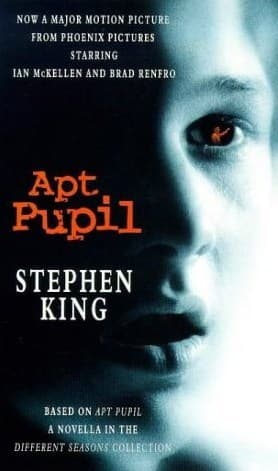
Synopsis
Covers the whole plot, including the ending.
- Difficulty
- Medium
- Pacing
- Moderate
- Mood
- Dark, Disturbing, Suspenseful, Psychological
- Read it if
- You enjoy psychological thrillers that explore the dark side of human nature and the corrupting influence of evil, with a focus on disturbing character studies.
- Skip it if
- You are sensitive to graphic descriptions of violence and atrocities, or prefer stories with clear moral boundaries and protagonists you can root for.
Apt Pupil Plot Summary
Covers the whole plot, including the ending.
Todd's Discovery and the Unholy Bargain
In 1974, sixteen-year-old Todd Bowden, a bright student in Southern California, becomes interested in the Holocaust. Through research, he identifies his elderly neighbor, Arthur Denker, as Kurt Dussander, a former SS commandant responsible for atrocities at the Patin concentration camp. Todd confronts Dussander, not to report him, but to blackmail him. Todd demands that Dussander tell him about his wartime experiences in detail, threatening to expose him if he refuses. Dussander, at first scared, agrees to Todd's demands. This starts a dark and disturbing relationship built on shared secrets and a mutual interest in evil.
The Education of Evil
Over the next few months, Todd often visits Dussander's home, making the old man describe the atrocities he committed during the war. Dussander, at first hesitant, soon enjoys reliving his past, detailing the torture, murder, and sadistic experiments he directed. Todd, in turn, becomes more engrossed. His grades suffer, and his personality changes. The stories start to haunt his dreams, but he cannot stop. Their dynamic changes; Dussander becomes a twisted teacher, and Todd his 'apt pupil,' learning about evil directly. Todd even makes Dussander wear a replica SS uniform while telling his stories.
The Cat and Mouse Game Escalates
Todd's school performance drops because of his obsession with Dussander. This leads to a required meeting with his school guidance counselor, Edward French. Todd pretends to be sick and stressed, convincing French that his problems are from academic pressure. Meanwhile, Dussander, under constant stress from Todd's demands and his past resurfacing, has a heart attack. Todd, instead of getting help, manipulates the situation, making sure Dussander recovers so their macabre sessions can continue. He even threatens Dussander with exposure if he tries to die, cementing his control over the old man's life and death.
The Homeless Man and the Experiment
As their relationship deepens, Todd's own cruelty appears. He starts torturing local cats, and then kills them. After an intense session with Dussander, Todd lures a homeless man into a deserted area and brutally murders him, feeling a rush of power. Dussander sees Todd's increasing depravity. He first fears for his own life but then feels his own cruel urges return. He starts luring and murdering homeless men himself, finding a new sense of purpose and power in these acts, mirroring Todd's own descent into violence.
Mr. French's Growing Suspicion
Edward French, Todd's guidance counselor, remains worried about Todd's continued academic decline and his increasingly detached and unsettling manner. He notices Todd's evasiveness and the subtle changes in his personality. French starts investigating Todd's life outside of school, eventually seeing Todd visit Dussander's house multiple times. He also notices Dussander's unusual appearance and reclusive nature. French's suspicions grow, but he lacks concrete evidence, only a strong feeling that something wrong is happening between the boy and the old man.
The Revelation and the Escape
Dussander has another, more severe, heart attack and is hospitalized. During his recovery, Morris Heisel, an elderly Jewish man who was a prisoner at Patin concentration camp, recognizes him. Heisel immediately identifies Dussander as the SS commandant responsible for terrible horrors. The news spreads quickly, and Dussander's true identity is revealed. Faced with immediate exposure and arrest, Dussander, pretending an emergency, escapes from the hospital before authorities can catch him.
The Hunt and the Suicide Pact
After his escape, Dussander, with nowhere else to go, goes to Todd's house. Todd, at first angry at Dussander's carelessness, reluctantly hides him in the basement. The police begin a large search for Dussander, increasing the pressure on Todd. As the search closes in and the situation becomes desperate, Dussander and Todd realize their time is ending. They make a suicide pact: if the police get close, they will kill themselves together, ensuring their secrets die with them and preventing Dussander from being caught alive.
French's Confrontation and the Deaths
Edward French, driven by his strong suspicions and observations, confronts Todd at his home, asking about his relationship with Dussander. French reveals he knows Dussander is a Nazi war criminal and that Todd has been hiding him. Panicked and trapped, Todd, in a rage, kills French with a shotgun. Hearing the commotion, Dussander, who was hiding in the basement, comes out. Realizing their pact must be fulfilled, Dussander, already weak, shoots himself. Todd, now completely unbalanced and with nothing left, then turns the shotgun on himself, ending his own life. The police arrive shortly after, finding the horrific scene.
Apt Pupil Characters
Todd Bowden
Protagonist/Antagonist
A seemingly normal teenager who develops a dangerous obsession with a Nazi war criminal.
Todd is a highly intelligent, initially well-adjusted high school student who becomes consumed by a fascination with the Holocaust. His morbid curiosity leads him to blackmail Kurt Dussander, an elderly Nazi war criminal, into recounting his atrocities. Todd is manipulative, cunning, and increasingly sadistic, deriving power and perverse pleasure from his control over Dussander and later from committing violent acts himself. He struggles with nightmares and a growing sense of guilt and fear, yet cannot escape the dark path he has chosen. He represents the seductive nature of evil and the ease with which a seemingly 'good' person can be corrupted.
Relationships: Kurt Dussander (Blackmailer/blackmailed, student/teacher, co-conspirators in murder); Edward French (Student/guidance counselor, ultimately victim/murderer)
Kurt Dussander (Arthur Denker)
Antagonist
A former SS commandant and concentration camp supervisor, living in hiding under an assumed identity.
Kurt Dussander is an elderly, seemingly frail man living a quiet life in California, but is in fact a notorious Nazi war criminal responsible for unimaginable atrocities. He is initially terrified and humiliated by Todd's discovery, but as he recounts his past, his old sadistic nature resurfaces. He finds a perverse enjoyment in reliving his power and even begins to commit murders again, mirroring Todd's own descent. Dussander is a master manipulator, even in his weakened state, and embodies pure, unrepentant evil, finding a twisted sense of purpose in his 'education' of Todd.
Relationships: Todd Bowden (Blackmailed/blackmailer, teacher/student, co-conspirators in murder); Morris Heisel (Victim/recognizer from Patin concentration camp)
Edward French
Supporting
Todd's observant high school guidance counselor who grows suspicious of his behavior.
Edward French is a conscientious and empathetic guidance counselor at Todd's high school. He genuinely cares about his students and becomes increasingly concerned by Todd's academic decline, evasiveness, and unsettling personality changes. French is a persistent and intuitive character, slowly piecing together the anomalies in Todd's life, eventually observing his visits to Dussander's house. He represents the moral conscience and the forces of good trying to intervene, ultimately becoming a victim of the evil he sought to uncover.
Relationships: Todd Bowden (Guidance counselor/student, ultimately victim/murderer)
Richard Bowden
Supporting
Todd's father, a busy and somewhat detached businessman.
Richard Bowden is Todd's father, a successful but often absent businessman. He is proud of Todd's intelligence and initial academic achievements but is largely oblivious to the dark secrets his son harbors. He represents the typical American suburban parent, focused on external success and failing to see the inner turmoil and corruption developing within his child. His lack of deeper engagement with Todd's emotional life allows Todd's relationship with Dussander to flourish unchecked.
Relationships: Todd Bowden (Father/son); Monica Bowden (Husband/wife)
Monica Bowden
Supporting
Todd's mother, who is also largely unaware of his secret life.
Monica Bowden is Todd's mother, a well-meaning but equally oblivious parent. Like her husband, she is proud of Todd's academic success and does not delve deeply into the reasons for his sudden decline. She is more emotionally expressive than Richard but still fails to recognize the profound psychological changes occurring in her son. Her focus on superficial aspects of Todd's well-being contributes to the isolation in which Todd's dark obsession can thrive.
Relationships: Todd Bowden (Mother/son); Richard Bowden (Wife/husband)
Morris Heisel
Mentioned
An elderly concentration camp survivor who recognizes Dussander.
Morris Heisel is an elderly Jewish man, a survivor of the Patin concentration camp where Kurt Dussander served as commandant. He is instrumental in Dussander's eventual identification when he recognizes the old man in the hospital. Heisel represents the enduring trauma of the Holocaust and the persistent memory of its victims, serving as a catalyst for Dussander's exposure and the climax of the story.
Relationships: Kurt Dussander (Victim/perpetrator)
The Homeless Man
Mentioned
A nameless victim of Todd's escalating violence.
The homeless man is an anonymous figure whom Todd lures and murders in a deserted area. He serves as a critical plot point, marking Todd's transition from psychological manipulation to overt, physical violence. His murder signifies Todd's complete surrender to his dark impulses and his mirroring of Dussander's past atrocities.
Apt Pupil Themes
The Seduction and Corrupting Power of Evil
The novel explores how evil can be appealing and how easily a normal person can be corrupted. Todd is first drawn to Dussander's stories out of curiosity, but this interest quickly turns into a twisted enjoyment and then participation in evil. Dussander, in turn, finds renewed purpose and power in reliving his past and influencing Todd, showing that evil can keep itself going. Both characters go deeper into depravity, showing how interest in evil can lead to embracing it.
“It was like watching a snake swallow a mouse. Horrible, yet fascinating. And in a strange way, beautiful.”
Identity and Performance
Both Todd and Dussander live double lives, always acting for the outside world while keeping dark secrets. Dussander pretends to be a frail, harmless old man, 'Arthur Denker,' to hide his past as Kurt Dussander, the SS commandant. Todd also maintains the image of a 'good student and son' while secretly having a macabre relationship with a war criminal and committing terrible acts. This theme shows how fragile identity can be and how easily it can be created and taken apart, revealing the monstrous depths that can exist beneath a calm surface. Their acting is important for keeping their secrets.
“He was a Nazi. He had been a Nazi. And now he was Arthur Denker. Which was the real man?”
The Intergenerational Transmission of Trauma and Evil
The story suggests a disturbing link between past horrors and their ability to affect future generations. Todd, born decades after the Holocaust, becomes obsessed with its atrocities, and in doing so, 'inherits' a form of Dussander's evil. Dussander, through his stories, acts as a twisted teacher, passing on his cruel legacy to Todd. This theme explores how historical trauma, when not understood, can appear in new, equally destructive ways, creating a cycle of violence that crosses time.
“He had tasted the dark meat, and it was good.”
Power and Control
The dynamic between Todd and Dussander constantly changes, defined by a struggle for power and control. At first, Todd has power through blackmail. However, as Dussander relives his past and Todd gets more involved in the dark tales, Dussander gains psychological control over Todd, becoming a twisted teacher. Telling the stories of atrocities, and later committing new murders, gives both characters a strong sense of power. Their relationship is a constant negotiation of dominance, showing how addictive control can be and how it corrupts.
“The power was intoxicating, like a drug. He had never felt so alive.”
Plot Devices & Literary Techniques
The Confessional Narrative
Dussander's detailed recounting of his wartime atrocities to Todd.
This device is central to the novel, as Dussander's forced confessions serve as the primary catalyst for Todd's psychological corruption. By making Dussander vividly describe the horrors of the Holocaust, Todd not only feeds his morbid curiosity but also becomes intimately familiar with the mechanics of evil. This narrative act is not merely informational; it is performative and transformative, as Dussander re-experiences his past power and Todd internalizes the lessons of sadism, blurring the lines between listener and participant, and ultimately fueling their mutual descent into depravity.
The Mentor/Pupil Dynamic
The evolving relationship between Dussander as a twisted teacher and Todd as his 'apt pupil.'
This device highlights the corrupting influence of an evil mentor on a susceptible student. Initially, Todd forces Dussander into the role of narrator, but as the stories unfold, Dussander subtly assumes the role of a teacher of evil, guiding Todd's understanding and even encouraging his dark impulses. Todd, the 'apt pupil,' readily absorbs these lessons, demonstrating a terrifying capacity for learning and applying the principles of sadism. This dynamic is crucial for illustrating the intergenerational transmission of evil and the ease with which it can be taught and learned.
Symbolism of the SS Uniform
Todd's demand for Dussander to wear a replica SS uniform during their sessions.
The SS uniform symbolizes the re-emergence of Dussander's true, monstrous identity and the psychological power it holds. By forcing Dussander to wear it, Todd not only humiliates him but also compels him to fully embody the persona of the war criminal, making the stories more 'real' and visceral. For Dussander, donning the uniform rekindles his lost sense of power and sadism, transforming him from a frail old man back into the commandant. For Todd, it intensifies the experience, solidifying his role as the orchestrator of this dark theatrical performance and deepening his immersion in the evil.
The Unreliable Narrator (Subtle)
The narrative primarily follows Todd's perspective, colored by his increasingly disturbed state.
While not overtly an unreliable narrator, the story is largely filtered through Todd's subjective experience and his deteriorating mental state. His perceptions of Dussander, his own motivations, and the moral implications of their actions are presented from his increasingly skewed viewpoint. This subtly influences the reader's understanding, drawing them into Todd's twisted reality and making his descent into evil feel more immediate and chilling. The reader witnesses events as Todd processes them, adding to the psychological horror and moral ambiguity of the narrative.
Apt Pupil Quotes
“I'm not doing anything, I'm just watching.”
“He knew it for a certainty, and the certainty was like a great cold wind blowing through him.”
“The past is a ghost, the future a dream, and all we ever have is now.”
“He had opened a door, and now he was afraid to look through it.”
“There was a darkness in him, and he knew it, and he embraced it.”
“The truth was not a thing that could be easily contained.”
“He had found someone who understood, someone who shared his fascination with the grotesque.”
“The uniform was a disguise, the smile a lie, the man beneath a monster.”
“It was like watching a snake, fascinating and horrifying at the same time.”
“The game, once started, could not be easily stopped.”
“He wanted to know everything, to soak it all in, to understand the mechanics of pure evil.”
“There were things in the world that were better left undisturbed.”
“He had become his own monster, a reflection of the one he had sought out.”
“The past has a way of catching up to you, no matter how fast you run.”
Quiz
10 questions on the plot and the characters. Each answer comes with a short explanation.
Question 1
What does Todd Bowden initially discover about Mr. Dussander that sparks his interest?
- He sees Dussander committing a minor crime.
- He recognizes Dussander from a historical documentary about World War II.
- He finds old Nazi memorabilia in Dussander's trash.
- A friend tells him a rumor about Dussander's past.
Show answer
B. He recognizes Dussander from a historical documentary about World War II. Todd recognizes Dussander from a picture in a book about Nazi war criminals, specifically identifying him as Kurt Dussander, a former SS-Hauptsturmführer.
Question 2
What is Todd's primary demand of Dussander once he confronts him?
- He wants Dussander to pay him money to keep his secret.
- He wants Dussander to confess his crimes to the authorities.
- He wants Dussander to tell him stories about his time in the concentration camps.
- He wants Dussander to help him with his history homework.
Show answer
C. He wants Dussander to tell him stories about his time in the concentration camps. Todd is morbidly fascinated by Dussander's past and demands to hear detailed accounts of the atrocities committed in the concentration camps, threatening to expose him if he refuses.
Question 3
How does Todd ensure Dussander's cooperation and prevent him from fleeing?
- He threatens to harm Dussander's family.
- He obtains compromising photos of Dussander.
- He fabricates a story about having told his parents, making Dussander believe more people know.
- He threatens to expose Dussander to the authorities and also forces him to perform Nazi salutes and wear his old uniform, which he photographs.
Show answer
D. He threatens to expose Dussander to the authorities and also forces him to perform Nazi salutes and wear his old uniform, which he photographs. Todd uses the threat of exposure as leverage, but also psychologically tortures Dussander by forcing him to relive his past, including wearing a uniform and performing salutes, which Todd documents.
Question 4
What is the initial impact of Todd's interactions with Dussander on his academic performance?
- His grades drop significantly due to distraction.
- His grades improve, particularly in history, due to his intense focus.
- His grades remain unchanged, but his behavior becomes erratic.
- He starts cheating on tests to maintain his good grades.
Show answer
B. His grades improve, particularly in history, due to his intense focus. Initially, Todd's grades improve, especially in history, as his 'lessons' with Dussander give him a unique and disturbing insight into the subject matter, making him seem like an 'apt pupil'.
Question 5
What psychological effect does the relationship with Todd have on Dussander?
- He feels immense guilt and seeks redemption.
- He becomes increasingly paranoid and fearful of exposure.
- He finds a sense of paternal affection for Todd.
- He slowly regains his humanity and remorse.
Show answer
B. He becomes increasingly paranoid and fearful of exposure. Dussander, though initially resistant, is forced to relive his past and becomes increasingly paranoid about Todd's control and the potential for his secret to be revealed. He experiences nightmares and a return of his darker impulses.
Question 6
How does Todd's behavior outside of his interactions with Dussander begin to change?
- He becomes more withdrawn and isolated from his friends.
- He develops a fascination with small animals and tortures them.
- He starts volunteering for community service to offset his inner turmoil.
- He becomes obsessed with physical fitness and sports.
Show answer
B. He develops a fascination with small animals and tortures them. As Todd delves deeper into Dussander's evil, he begins to exhibit sadistic tendencies himself, starting with the torture and killing of stray cats, reflecting his growing moral decay.
Question 7
What is the ultimate fate of Mr. Dussander?
- He is arrested and extradited to face justice.
- He escapes Todd's control and disappears.
- He commits suicide after being exposed by a former concentration camp victim.
- He is killed by Todd in a moment of rage.
Show answer
C. He commits suicide after being exposed by a former concentration camp victim. Dussander is eventually recognized in the hospital by a former concentration camp victim, which leads to his exposure. Faced with capture, he takes his own life by cutting his wrists.
Question 8
What role does the guidance counselor, Edward French, play in the story?
- He uncovers Todd's secret and reports him.
- He attempts to help Todd with his declining grades and strange behavior, unknowingly becoming entangled in his lies.
- He is a former military man who recognizes Dussander.
- He advises Todd to seek therapy for his violent tendencies.
Show answer
B. He attempts to help Todd with his declining grades and strange behavior, unknowingly becoming entangled in his lies. Edward French notices Todd's sudden academic decline and increasingly erratic behavior, including his strange interest in history and his emotional outbursts. He tries to help Todd, but Todd manipulates him, drawing him into his web of deceit and eventually killing him.
Question 9
Which of the following themes is most central to 'Apt Pupil'?
- The importance of historical preservation.
- The corrupting influence of evil and the ease with which it can spread.
- The struggle for redemption and forgiveness.
- The unbreakable bond between mentor and student.
Show answer
B. The corrupting influence of evil and the ease with which it can spread. A central theme is how Todd, initially 'apt' and seemingly normal, is gradually corrupted by his exposure to Dussander's evil and his active participation in reanimating it. The story explores the seductive nature of power and the ease with which a seemingly good person can descend into depravity.
Question 10
How does Todd finally deal with Edward French when he becomes too inquisitive?
- He confesses everything to French and asks for help.
- He manipulates French into believing Dussander is his ailing grandfather.
- He murders French and stages it to look like a suicide or accident.
- He threatens French's family to ensure his silence.
Show answer
C. He murders French and stages it to look like a suicide or accident. When French presses too hard and gets too close to the truth, Todd lures him into an isolated area and shoots him, making it appear as if French had been caught in a hunting accident or committed suicide. This act solidifies Todd's complete embrace of evil.
Apt Pupil FAQ
What is 'Apt Pupil' about?
'Apt Pupil' tells the chilling story of Todd Bowden, a seemingly ordinary high school student who discovers his elderly neighbor, Kurt Dussander, is a Nazi war criminal. Instead of reporting him, Todd blackmails Dussander into recounting his horrific wartime experiences, initiating a disturbing symbiotic relationship that corrupts them both.
Why should I read 'Apt Pupil'?
You should read 'Apt Pupil' for its unflinching exploration of the seductive nature of evil and its psychological depth. It delves into how ordinary people can be drawn into depravity and the lasting trauma of war, offering a disturbing yet compelling look at the dark side of human nature.
What is the background/setting of 'Apt Pupil'?
The story is primarily set in the seemingly idyllic suburban landscape of Southern California during the late 1970s and early 1980s. This ordinary, sun-drenched setting starkly contrasts with the horrific wartime atrocities recounted by Dussander, highlighting how evil can fester unnoticed in plain sight.
What are the most memorable quotes?
One memorable quote is Dussander's chilling observation, 'The truth is that I am a monster. And I am not.' This encapsulates his complex denial and the lasting horror he represents. Another is Todd's realization, 'He was a monster and I was his apt pupil,' acknowledging his own descent into darkness.
What writing style does Stephen King use in 'Apt Pupil'?
Stephen King employs a direct, psychological, and often unsettling writing style in 'Apt Pupil.' He uses vivid internal monologues and detailed descriptions to immerse the reader in the characters' deteriorating mental states, building tension through their increasingly depraved interactions and the lingering threat of exposure.
What minor details add significant meaning?
The detail of Todd's meticulous organization of his schoolwork and his sudden decline in grades after meeting Dussander subtly reflects his internal chaos. Also, Dussander's obsession with cleaning his house and maintaining a pristine exterior masks the internal filth of his past and present actions.
What are some subtle foreshadowing moments?
Early on, Todd's fascination with serial killers and the macabre, even before he discovers Dussander's past, foreshadows his willingness to engage with pure evil. Dussander's feigned heart attacks also subtly foreshadow his manipulative nature and his eventual, strategic use of his perceived frailty.
What unexpected character connections exist?
A truly unexpected connection is the bond formed between Todd and Dussander, which evolves from blackmail into a twisted form of mentorship and codependency. Both characters, despite their age difference, find a perverse understanding and dark satisfaction in their shared secret and escalating acts of cruelty.
What are unspoken character motivations?
Todd's unspoken motivation is a deep-seated curiosity about evil and a desire for power and control, perhaps stemming from adolescent insecurities, which Dussander expertly exploits. Dussander, in turn, is driven by a need to relive his past atrocities, find a perverse form of absolution through confession, and reclaim a sense of power he lost in hiding.
What psychological complexities do characters exhibit?
Todd exhibits a complex descent into sociopathy, marked by a growing detachment from empathy and an increasing enjoyment of cruelty, both towards animals and humans. Dussander displays profound psychological fragmentation, living a double life and grappling with his monstrous past while maintaining a facade of normalcy, often projecting his guilt onto Todd.
What are the major emotional turning points?
A major turning point is when Todd forces Dussander to wear a uniform and march, signifying Todd's complete control and Dussander's re-engagement with his past. Another is Todd's decision to murder a vagrant, marking his transition from passive observer of evil to active participant, cementing his corruption.
How do relationship dynamics evolve?
The relationship dynamics evolve from an initial power imbalance where Todd blackmails Dussander, to a strange codependency where each manipulates the other. Eventually, their roles blur, and they become mirror images, both corrupted by their shared secret and mutual understanding of evil, culminating in a destructive, inescapable bond.
Which parts remain ambiguous or open-ended?
The true extent of Dussander's war crimes is hinted at but never fully detailed, leaving much to the reader's imagination regarding the horrors he committed. Also, the precise psychological trigger for Todd's initial fascination with Dussander and his subsequent rapid descent into depravity remains somewhat ambiguous, suggesting a latent darkness within him.
What are controversial scenes or decisions?
The most controversial scenes involve Todd's escalating acts of animal cruelty and, later, the murder of the vagrant, which are depicted with disturbing detail. Dussander's decision to actively encourage Todd's dark impulses rather than seeking redemption or repentance is also highly controversial, highlighting his unrepentant nature.
'Apt Pupil' ending explained: how it ends & what it means
The story ends with Todd Bowden, now a successful college student, descending into a random killing spree on the freeway with a rifle, driven by an uncontrollable urge for violence. This signifies that his 'education' under Dussander has completed his transformation into a full-fledged psychopath. Dussander's earlier death from a drug overdose, likely self-induced or a consequence of his failing health and the stress of exposure, leaves Todd alone with his learned evil, illustrating the inescapable and pervasive nature of the corruption he embraced.
About the author

Stephen Edwin King is an American author of horror, supernatural fiction, suspense, crime, science-fiction, and fantasy novels. Described as the "King of Horror", his books have sold more than 350 million copies as of 2006, and many have been adapted into films, television series, miniseries, and comic books. King has published over 65 novels/novellas, including seven under the pen name Richard Bachman, and five non-fiction books. He has also written approximately 200 short stories, most of which have been published in book collections.
Similar books
- The Silence of the Lambs
Thomas Harris
4.2 (464k) average on GoodreadsThrillerExplores a twisted mentor-mentee relationship with a serial killer and the psychological impact of evil.
- Lord of the Flies
William Golding
3.7 (2.3M) average on GoodreadsYoung AdultExamines the inherent darkness and capacity for evil within seemingly innocent individuals.
- Misery
Stephen King
4.2 (499k) average on GoodreadsThrillerFeatures a captive protagonist under the psychological and physical torment of another character.
- Angels & Demons
Dan Brown
3.9 (2.7M) average on GoodreadsThrillerA Harvard symbologist races through Rome's ancient sites, deciphering cryptic clues to unmask the Illuminati and stop a vengeful plot to destroy the Vatican with a stolen antimatter weapon.
- Gone Girl
Gillian Flynn
4.1 (2.3M) average on GoodreadsThrillerA wife's sudden disappearance on her fifth anniversary reveals a web of lies and psychological warfare, exposing the secrets within a seemingly perfect marriage.
- The Girl on the Train
Paula Hawkins
3.9 (2.1M) average on GoodreadsThrillerA woman’s fascination with a seemingly perfect couple she watches from her daily train commute leads her into a dark investigation when she witnesses something that shatters their idyllic image.





Enjoyed the summary?
A summary gives you the shape of the book. The book itself has the detail, the examples and the voice.
Find Apt Pupil on AmazonAs an Amazon Associate, BookBrief earns from qualifying purchases. How we're funded