
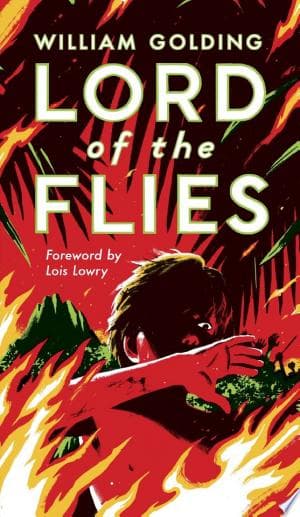
Synopsis
Covers the whole plot, including the ending.
- Difficulty
- Medium
- Pacing
- Moderate
- Mood
- Dark, Suspenseful, Philosophical, Disturbing
- Read it if
- You enjoy thought-provoking allegories about human nature, psychological thrillers, or stories exploring the darker aspects of society and leadership.
- Skip it if
- You prefer lighthearted stories, avoid violence and despair, or are sensitive to themes of childhood trauma and the loss of innocence.
Lord of the Flies Plot Summary
Covers the whole plot, including the ending.
The Island and the Conch
After a plane crash leaves British schoolboys stranded on a deserted tropical island, Ralph and Piggy meet. Piggy, smart but physically weak, finds a conch shell, which Ralph uses to call all the other survivors. They hold an assembly, and Ralph is elected leader over Jack Merridew, the head chorister, who instead leads the hunters. They make rules, including that the conch allows the speaker to talk. The boys are excited about their freedom, but a younger boy mentions seeing a 'snake-thing' or 'beastie,' which introduces the first hint of fear.
Exploration and the Signal Fire
Ralph, Jack, and Simon explore the island, confirming it is uninhabited and has plenty of fruit. They are amazed by its beauty and the possibility of adventure. When they return, Ralph stresses the need for rescue, suggesting a signal fire on the mountain peak. The boys, full of enthusiasm, use Piggy's spectacles to light a huge, uncontrolled fire. It quickly burns out of control, destroying a large part of the forest and, sadly, a younger boy who was playing near the flames. This chaotic event is the first major failure of their new society.
Diverging Priorities and Growing Tensions
Weeks pass, and the initial order begins to break down. Ralph struggles to keep the signal fire going and build shelters. He is often frustrated by the boys' lack of help, especially Jack's. Jack and his choir, now hunters, become more focused on tracking and killing pigs. Their first successful hunt, though providing meat, causes them to neglect the signal fire, which goes out just as a ship passes. Ralph angrily confronts Jack about the missed rescue opportunity. Piggy openly criticizes Jack, leading Jack to hit him and break one of his spectacle lenses, increasing tension.
The 'Beast' and Escalating Fear
The fear of the 'beastie' returns and grows, especially among the younger boys. During an assembly, Ralph tries to calm them, but Jack uses their fears, saying his hunters will protect them. Piggy logically dismisses the beast, while Simon mysteriously suggests the beast might be 'only us.' A dead parachutist, moved by the wind, lands on the mountain and gets caught in trees, looking like a shadowy figure. Samneric, on fire duty, mistake the dead pilot for the beast. They run back to camp in terror and confirm its presence to the other boys, further fueling their fears.
The Hunt for the Beast and Jack's Rebellion
Driven by fear, Ralph leads a search party, including Jack, to the unexplored castle rock, thinking the beast lives there. They find no beast but discover a defensible cave. Ralph insists on returning to the mountain to relight the signal fire, but Jack wants to hunt the beast. Back at the beach, Jack calls an assembly, openly challenging Ralph's leadership and calling him a coward. When the boys do not vote Ralph out, Jack, embarrassed, says he is leaving the group to start his own tribe, inviting anyone who wants to hunt with him. Several older boys, drawn by the promise of meat and freedom from rules, join Jack.
Jack's Tribe and the Lord of the Flies
Jack's tribe settles at Castle Rock, painting their faces with clay and living a more primitive, savage life focused on hunting. They kill a sow brutally, putting its head on a sharpened stick as an offering to the 'beast.' Simon sees this gruesome act and hallucinates the pig's head speaking to him, calling itself the 'Lord of the Flies.' This encounter shows Simon the beast's true nature: not an outside monster, but the evil and savagery inside people. Simon collapses, overwhelmed by this discovery.
Simon's Revelation and Tragic Death
After recovering, Simon climbs the mountain and finds the 'beast' is the dead parachutist. He realizes the boys' fear is wrong and rushes down to the beach to tell them. Meanwhile, Ralph, Piggy, and Samneric, the last of Ralph's group, attend a feast hosted by Jack. During a violent storm, Jack's tribe, fueled by their painted faces, the feast, and a frantic dance, chant and act out the pig hunt. When Simon stumbles out of the jungle, meaning to share his news, the boys, mistaking him for the beast in their hysteria, brutally beat and stab him to death.
Descent into Savagery and Piggy's Demise
After Simon's murder, Ralph and Piggy struggle to understand the horror, losing hope. Jack's tribe, now completely savage, raids Ralph's camp to steal Piggy's spectacles, which are needed for making fire. Ralph, Piggy, and Samneric confront Jack at Castle Rock, demanding the glasses back and trying to appeal to reason and the conch's power. Jack's tribe refuses. In the chaos, Roger, Jack's cruel enforcer, rolls a large boulder down the cliff, hitting Piggy, who falls to his death on the rocks below. The conch, the symbol of order, is shattered at the same time.
The Hunt for Ralph
With Piggy dead and the conch destroyed, Ralph is alone, a target for Jack's tribe. He hides in the jungle, watching the increasingly savage rituals of the painted boys. Samneric, captured and tortured by Jack's tribe, are forced to reveal Ralph's hiding place. Jack orders the entire island to be set on fire to force Ralph out. Ralph, desperate, avoids his pursuers, fighting for his life as the island burns around him. This fire symbolizes the complete breakdown of order and the victory of primal instincts.
Rescue and the Return to Civilization
As the island burns and Ralph is driven to the beach, exhausted and cornered, he collapses. He looks up to see a British naval officer standing over him. The officer, having seen the smoke from the burning island, has come to investigate. The sudden appearance of an adult, representing the civilized world, breaks the illusion of the boys' isolated savagery. Ralph, overwhelmed with emotion and the reality of what happened, begins to weep for the loss of innocence, the darkness in people, and the death of Piggy. The other boys, now looking like dirty, tear-stained children, also begin to cry, their painted faces stark against their sudden return to reality.
Lord of the Flies Characters
Ralph
Protagonist
The elected leader, representing civilization and order.
Ralph is initially elected chief due to his charisma, size, and the symbolic power of the conch. He strives to maintain order, prioritize rescue through a signal fire, and build shelters. He represents the civilizing instinct and democratic leadership. Despite his good intentions, he struggles to assert authority against Jack's growing influence and the boys' descent into savagery. He is initially naive about human nature but eventually faces the brutal reality of the boys' inherent evil. His arc is a tragic journey from innocent leader to hunted outcast, forced to confront the darkness within humanity.
Relationships: Piggy (Close ally and intellectual advisor); Jack (Rival and antagonist, representing savagery); Simon (Loyal supporter and quiet observer)
Jack Merridew
Antagonist
The charismatic choir leader who devolves into a savage dictator.
Jack is the head chorister, initially vying for leadership but accepting the role of hunter. He quickly becomes obsessed with hunting, painting his face, and shedding the constraints of civilization. He represents the primal, savage instincts within human nature and the allure of power. His charisma and ability to provide meat draw many boys away from Ralph's ordered society. He thrives on fear and manipulation, ultimately leading his tribe in brutal acts of violence, including the deaths of Simon and Piggy. His arc is a descent from a somewhat disciplined boy to a bloodthirsty tyrant.
Relationships: Ralph (Primary rival for leadership); Roger (Loyal, sadistic lieutenant); Piggy (Object of scorn and bullying)
Piggy
Supporting
The intelligent, rational, but physically vulnerable boy.
Piggy is an overweight, asthmatic, and intelligent boy who represents intellect, reason, and the scientific aspect of civilization. He is the most adult-like among the boys, often offering practical solutions and advocating for rules, but his physical weakness and social awkwardness make him an easy target for Jack's bullying. His spectacles are crucial for lighting the signal fire, symbolizing knowledge and technology. Despite his clear-sightedness, his voice of reason is consistently ignored or mocked, leading to his tragic death and the shattering of the conch, signifying the complete breakdown of logic and order.
Relationships: Ralph (Close confidant and intellectual partner); Jack (Victim of Jack's cruelty and disdain)
Simon
Supporting
The introspective, spiritual boy who understands the true nature of the 'beast'.
Simon is a quiet, observant, and spiritual boy who often retreats to a secret glade. He is an outcast but possesses a profound intuitive understanding of the island and the boys' deteriorating state. He is the only one who truly grasps that the 'beast' is not an external entity but the inherent evil within human nature itself, a realization he gains during his hallucinatory conversation with the 'Lord of the Flies.' His attempt to reveal this truth to the other boys tragically results in his brutal murder, highlighting the boys' inability to confront their own darkness and the destruction of innocence and spiritual insight.
Relationships: Ralph (Supportive and loyal, though quiet); Lord of the Flies (Confrontational, revelatory interaction)
Roger
Supporting
Jack's sadistic lieutenant, representing inherent cruelty.
Roger is initially a quiet and secretive boy, but he quickly devolves into one of the most sadistic and cruel characters. He represents the innate human capacity for cruelty and the unchecked power that emerges when societal rules are removed. He is the first to actively enjoy tormenting the littluns, and later, he becomes Jack's enforcer, taking pleasure in violence. His deliberate act of rolling the boulder that kills Piggy signifies his complete embrace of savagery and his role as the ultimate instrument of Jack's tyrannical rule. He embodies the darkest aspects of human nature, unbound by conscience.
Relationships: Jack (Loyal enforcer and lieutenant); Piggy (His ultimate victim, symbolizing the destruction of reason)
Samneric (Sam and Eric)
Supporting
Identical twins, representing the struggle between loyalty and fear.
Sam and Eric are identical twins who are inseparable and often finish each other's sentences. They are initially loyal to Ralph and the signal fire, representing the desire for safety and rescue. They are among the last to remain with Ralph's group, but their fear ultimately leads them to be coerced and tortured by Jack's tribe. Their forced betrayal of Ralph's hiding place highlights the vulnerability of even the most loyal individuals when confronted with overwhelming force and the breakdown of order. They represent the common person caught between opposing forces, ultimately succumbing to fear.
Relationships: Ralph (Initially loyal followers); Jack (Forced into his tribe through intimidation)
Littluns
Supporting
The younger boys, symbolizing vulnerability and susceptibility to fear.
The littluns are the group of younger boys, mostly unnamed, who spend their days playing and eating fruit. They are largely ineffectual in the boys' society, often ignored by the older boys. They are the most susceptible to fear, particularly of the 'beastie,' and their nightmares and anxieties fuel the growing paranoia on the island. They represent the innocent, vulnerable population easily swayed by fear and charisma, making them easy prey for Jack's manipulative tactics and the developing savagery. Their collective presence underscores the loss of childhood innocence on the island.
Relationships: Ralph (Rely on his leadership for protection); Jack (Attracted to his tribe for food and protection from the beast)
Naval Officer
Mentioned
The adult who rescues the boys, representing the return of civilization.
The Naval Officer appears at the very end of the novel, having been drawn to the island by the smoke from the boys' signal fire (ironically, the fire meant to destroy Ralph, not signal rescue). He represents the adult world, civilization, law, and order. His presence immediately shatters the boys' savage illusion, reducing them from painted warriors to 'little boys' in his eyes. His arrival brings an abrupt end to their reign of terror, but his naive question about 'fun and games' highlights his ignorance of the true horror that has unfolded, suggesting that even adult civilization has its own forms of savagery, albeit more organized ones.
Relationships: Ralph (The figure who brings Ralph back to the adult world)
Lord of the Flies Themes
Civilization vs. Savagery
This is the novel's main theme. Ralph, Piggy, and the conch represent civilization, order, and democracy, seeking rules, rescue, and reason. Jack and his hunters, with their painted faces, primitive rituals, and focus on hunting, show savagery, primal instincts, and authoritarianism. The gradual loss of Ralph's authority and the success of Jack's tribe illustrate Golding's belief that civilization is fragile. Without outside rules, people will become barbaric. The burning island at the end shows the complete destruction of any order.
“'Which is better—to have rules and agree, or to hunt and kill?”
Loss of Innocence
The boys start as innocent schoolboys, excited by adventure. However, the hard parts of survival, the fear of the beast, and the appeal of power slowly take away their innocence. Simon's death, a brutal act by almost all the boys, marks the permanent loss of their childhood and moral sense. By the end, when the naval officer arrives, the boys are no longer innocent children but traumatized individuals. They weep for 'the end of innocence, the darkness of man's heart, and the fall through the air of the true, wise friend called Piggy.' Their experiences make them face the evil within humanity.
“Ralph wept for the end of innocence, the darkness of man's heart, and the fall through the air of the true, wise friend called Piggy.”
The Nature of Evil
Golding explores the idea that evil is a part of human nature, not something outside. This is shown by the 'beast.' At first feared as a monster, Simon's discovery that 'the beast is only us' clarifies that the real evil is inside the boys. The Lord of the Flies, the pig's head on a stick, explicitly tells Simon this. Roger's cruel tendencies and Jack's bloodlust show how easily this inherent evil can appear and take over when there are no societal structures or moral codes. The boys' fall into savagery shows the darkness within people.
“Fancy thinking the Beast was something you could hunt and kill! You knew, didn't you? I'm part of you?”
Power and Leadership
The novel looks at different kinds of leadership and how power can corrupt. Ralph represents democratic leadership, using rules, agreement, and the conch. Jack, however, shows authoritarianism, appealing to the boys' basic desires for immediate satisfaction, hunting, and protection from fear. His leadership is based on intimidation and charisma, not reason. The conflict between Ralph and Jack shows how easily a group can move from rational rule to a tyrannical system driven by fear and violence. Jack's rise to power shows the dangers of unchecked power and the appeal of a leader who plays on emotions.
“I'm chief,' said Ralph, 'because you chose me. And we were going to have a signal fire, to keep us safe. And you'll all be rescued if you do what I say.”
Plot Devices & Literary Techniques
The Conch Shell
Symbol of democracy, order, and civilized discourse.
The conch shell is introduced early in the novel as a tool for summoning the boys and establishing order. It symbolizes democratic rule, free speech, and the power of reasoned debate. Whoever holds the conch has the right to speak, and others must listen. Its gradual loss of authority, from being respected to being mocked, and its ultimate destruction when Piggy is killed, directly parallels the boys' descent into savagery and the collapse of their civilized society. Its shattering marks the final triumph of anarchy and brutality over order.
Piggy's Spectacles
Symbol of intellect, technology, and rational thought.
Piggy's spectacles are initially used to light the signal fire, symbolizing intellectual power, scientific knowledge, and the ability to harness nature for productive purposes (like rescue). When Jack's tribe steals them, it represents the appropriation and perversion of intellect for savage ends (lighting fires for cooking and destruction) and the triumph of brute force over reason. The breaking of one lens foreshadows the damage to their civilized society, and their complete theft signifies the complete disregard for intelligence and the ultimate blinding of reason within the group.
The Signal Fire
Symbol of hope, rescue, and connection to civilization.
The signal fire is Ralph's primary focus throughout the novel, symbolizing the boys' hope for rescue, their connection to the civilized world, and their commitment to long-term goals. Its maintenance represents their collective effort and discipline. When the fire is neglected or goes out, it signifies the boys' diminishing hope and their increasing embrace of immediate gratification and savagery. Ironically, the fire that ultimately attracts the naval officer is a destructive wildfire set by Jack's tribe to hunt Ralph, highlighting the perverse way salvation arrives amid total destruction.
The 'Beast'
Symbol of primal fear and the inherent evil within humanity.
The 'beast' begins as a vague fear among the littluns, evolving into a perceived monster on the island. Initially, it symbolizes the unknown and the boys' primal anxieties. However, Simon's realization, confirmed by the Lord of the Flies, that the 'beast' is not an external entity but the inherent savagery and evil within human nature itself, is a pivotal moment. It represents the psychological manifestation of their own fears and darker impulses, which they project onto an external enemy, ultimately leading them to commit horrific acts, including Simon's murder, in their frenzied attempts to appease or defeat it.
Lord of the Flies Quotes
“Maybe there is a beast... maybe it's only us.”
“The thing is - fear can't hurt you any more than a dream.”
“We did everything adults would do. What went wrong?”
“The rules are the only thing we've got!”
“Kill the pig. Cut her throat. Spill her blood.”
“I'm not going to be part of Ralph's lot—”
“What are we? Humans? Or animals? Or savages?”
“The world, that understandable and lawful world, was slipping away.”
“Fancy thinking the Beast was something you could hunt and kill!”
“Ralph wept for the end of innocence, the darkness of man's heart.”
“You're a beast and a swine and a bloody, bloody thief!”
“We've got to have rules and obey them. After all, we're not savages.”
“The conch exploded into a thousand white fragments and ceased to exist.”
“Which is better—to have rules and agree, or to hunt and kill?”
Quiz
10 questions on the plot and the characters. Each answer comes with a short explanation.
Question 1
What object do the boys use to call assemblies on the island?
- A conch shell
- A large drum made from a hollow log
- A whistle fashioned from bamboo
- A bell salvaged from the crashed plane
Show answer
A. A conch shell The conch shell, discovered by Ralph and Piggy early in the novel, becomes a powerful symbol of order and civilization. When blown, it summons all the boys to assemblies, and holding it grants the right to speak.
Question 2
Who is the first boy to suggest that a 'beast' might exist on the island?
- Piggy
- Jack
- A littlun
- Simon
Show answer
C. A littlun One of the younger boys, referred to as a 'littlun,' first mentions seeing a 'beastie' or snake-thing in the jungle at night. This fear spreads among the boys and becomes a central conflict.
Question 3
What is the primary reason the boys initially fail to maintain the signal fire?
- They run out of dry wood
- Jack's hunters neglect it to go hunting
- Ralph forbids its use to conserve resources
- Piggy accidentally extinguishes it
Show answer
B. Jack's hunters neglect it to go hunting Jack and his hunters, obsessed with killing a pig, leave the fire unattended. This causes it to go out just as a ship passes the island, missing a crucial chance for rescue and highlighting the conflict between civilization and savagery.
Question 4
What does Simon discover when he investigates the supposed 'beast' on the mountain?
- A wild boar that the boys mistook for a monster
- The dead body of a pilot still attached to his parachute
- An ancient tribal altar left by previous inhabitants
- A cave filled with poisonous snakes
Show answer
B. The dead body of a pilot still attached to his parachute Simon climbs the mountain alone and finds the corpse of a dead pilot, whose parachute lines get tangled in the rocks. The wind causes the body to move, which the boys had mistaken for a living beast.
Question 5
Which character represents intellectualism and rationality but is often ignored or mocked by the other boys?
- Ralph
- Piggy
- Simon
- Samneric
Show answer
B. Piggy Piggy, with his glasses (used to start fires) and logical suggestions, symbolizes science and reason. However, he is overweight, asthmatic, and socially awkward, leading the boys to dismiss his ideas and bully him.
Question 6
What event causes the final split between Ralph's group and Jack's tribe?
- Jack stealing Piggy's glasses to make fire
- Simon's death during the frenzied dance
- Ralph accusing Jack of letting the signal fire go out
- The littluns refusing to choose sides in a vote
Show answer
A. Jack stealing Piggy's glasses to make fire Jack raids Ralph's camp to steal Piggy's glasses, the only means of making fire on the island. This act of theft and aggression solidifies the divide, leaving Ralph with only a few loyal followers while most boys join Jack's savage tribe.
Question 7
In the novel's climax, what are the hunters using to try to smoke Ralph out of his hiding place?
- A controlled burn of the underbrush
- Torches made from wooden spears
- Smoke from a large bonfire
- They set the entire island on fire
Show answer
D. They set the entire island on fire Jack's tribe, in their savage pursuit of Ralph, intentionally starts a massive fire that spreads across the island. This ironically leads to their rescue when a passing naval ship sees the smoke, but it also demonstrates their complete descent into destructiveness.
Question 8
What is the symbolic meaning of the 'Lord of the Flies' as revealed in Simon's hallucination?
- It represents the hope of rescue and civilization
- It is a manifestation of the beast, embodying the inherent evil within humans
- It symbolizes the island's natural wildlife and dangers
- It acts as a warning from the dead pilot's spirit
Show answer
B. It is a manifestation of the beast, embodying the inherent evil within humans The 'Lord of the Flies' is the name Simon gives to the pig's head mounted on a stick, which Jack's tribe leaves as an offering to the beast. In Simon's vision, it speaks to him, revealing that the beast is not an external creature but the darkness inside each human.
Question 9
How does the naval officer's reaction upon rescuing the boys ironically reflect the novel's themes?
- He scolds them for their childish games, unaware of the murders that occurred
- He immediately arrests Jack for leading the savage tribe
- He praises their resourcefulness in surviving on the island
- He is horrified and reports the events to authorities as war crimes
Show answer
A. He scolds them for their childish games, unaware of the murders that occurred The officer, representing the adult world and civilization, dismisses the boys' brutal behavior as mere 'fun and games.' This irony underscores Golding's theme that the savagery on the island mirrors the larger violence of the war-torn adult society from which the officer comes.
Question 10
Which pair of twins remain loyal to Ralph until they are captured and forced to join Jack's tribe?
- Bill and Roger
- Sam and Eric
- Henry and Johnny
- Maurice and Percival
Show answer
B. Sam and Eric Sam and Eric, often referred to collectively as 'Samneric,' are twins who initially support Ralph's leadership and help maintain the signal fire. However, after Piggy's death, they are captured by Jack's tribe and coerced into revealing Ralph's hiding place, symbolizing the final collapse of loyalty and order.
Lord of the Flies FAQ
What is 'Lord of the Flies' about?
The novel follows a group of British schoolboys stranded on a deserted island after their plane crashes during a wartime evacuation. Initially attempting to establish order with Ralph as leader and Piggy as his advisor, the boys gradually descend into savagery under Jack's influence, culminating in violent conflicts, the murder of Simon, and the hunting of Ralph before their rescue by a naval officer.
Why should I read 'Lord of the Flies'?
It's a profound exploration of human nature, civilization versus savagery, and the fragility of social order. Through the boys' rapid descent into brutality, Golding challenges optimistic views of innocence and progress, making it essential for understanding psychological and societal dynamics. Its allegorical depth and timeless themes continue to provoke discussion about morality, power, and identity.
What is the background/setting of 'Lord of the Flies'?
Set during an unspecified war, likely World War II, the story takes place on an uninhabited tropical island in the Pacific Ocean. The isolation and lack of adult supervision create a microcosm where the boys must govern themselves, with the island's lush beauty contrasting sharply with the darkness of their actions as their society collapses.
What are the most memorable quotes?
Key quotes include Piggy's 'Which is better—to have rules and agree, or to hunt and kill?' highlighting the conflict between civilization and savagery, and Simon's realization 'Maybe there is a beast... maybe it's only us,' revealing the true nature of evil. The naval officer's final remark 'I should have thought that a pack of British boys... would have been able to put up a better show than that' underscores the irony of their rescue amidst chaos.
What writing style does the author use?
Golding employs a stark, allegorical style with vivid, often brutal imagery to depict the boys' psychological unraveling. The prose shifts from descriptive passages of the island's beauty to tense, action-driven scenes, using symbolism (like the conch and the Lord of the Flies) to explore deeper themes of evil and human nature without overt moralizing.
What minor details add significant meaning?
The broken spectacles of Piggy symbolize the loss of rationality and clarity as savagery takes over. The gradual deterioration of the boys' clothing and hygiene mirrors their moral decay, while the 'beast from air' (a dead parachutist) represents the external threat of war that ironically parallels their internal violence.
What are some subtle foreshadowing moments?
Early scenes foreshadow later violence, such as Roger throwing stones near Henry but avoiding hitting him, hinting at his eventual role in Piggy's murder. The boys' initial fear of a 'beastie' and their obsession with hunting pigs subtly predict the shift from play to real brutality, culminating in Simon's death during a frenzied dance.
What unexpected character connections exist?
Ralph and Jack, though opposites in leadership, share a deep, unspoken rivalry that drives the plot, with Jack's charisma appealing to primal instincts versus Ralph's focus on rescue. Simon, often seen as an outsider, serves as a Christ-like figure whose insights connect the boys' fears to their own inner darkness, bridging the symbolic and literal narratives.
What are unspoken character motivations?
Jack's desire for power and dominance is driven by insecurity and a need to prove himself beyond choirboy discipline, leading him to reject Ralph's authority. Piggy's loyalty to Ralph stems from his own vulnerability and hope for order, while Roger's sadistic tendencies are hinted at early but fully unleashed as societal restraints vanish.
What psychological complexities do characters exhibit?
Ralph struggles with the burden of leadership and guilt over the group's descent, showing a conflict between idealism and pragmatism. Simon experiences visions and isolation, suggesting a sensitivity to truth that others ignore, while the 'littluns' represent collective fear and innocence corrupted by the older boys' actions.
What are the major emotional turning points?
The failure to maintain the signal fire after a ship passes marks a shift from hope to despair, intensifying Ralph and Jack's rift. Simon's murder during the storm, mistaken for the beast, is a point of no return into savagery, and Piggy's death with the conch shatters any remaining pretense of civilization, leaving Ralph hunted like an animal.
How do relationship dynamics evolve?
Initially cooperative under Ralph's leadership, relationships fracture as Jack's tribe gains followers through fear and primal appeal. Alliances shift from democratic discussions to tribal loyalty, with friendships like Ralph and Piggy's becoming strained by pressure, while bonds among hunters strengthen through shared violence and ritual.
Which parts remain ambiguous or open-ended?
The exact nature of the 'beast' is left ambiguous—whether it's a psychological manifestation, the dead parachutist, or the Lord of the Flies itself—inviting interpretation. The boys' future after rescue is unclear, leaving readers to ponder if they can reintegrate into society or are permanently scarred by their experiences.
What are controversial scenes or decisions?
Simon's murder, where the boys in a frenzied dance mistake him for the beast and beat him to death, sparks debate over collective guilt versus individual responsibility. Jack's decision to lead a hunt for Ralph, treating him as prey, raises questions about the limits of savagery and whether the boys have completely lost their humanity.
'Lord of the Flies' ending explained: how it ends & what it means
The novel ends with Ralph being hunted by Jack's tribe, who set the island on fire, leading to their rescue by a naval officer. The officer's arrival ironically highlights the boys' regression to savagery amidst a world at war, suggesting that civilization is a thin veneer over inherent brutality. Ralph's tears symbolize the loss of innocence and the haunting realization of human darkness.
What is the significance of the title 'Lord of the Flies'?
The title refers to the pig's head on a stick that Jack's tribe offers to the beast, which Simon hallucinates speaking to him. It symbolizes the inherent evil within humanity—'Lord of the Flies' is a translation of 'Beelzebub,' a biblical demon—and represents the boys' descent into savagery as they worship primal instincts over reason.
How does the conch symbolize order and its breakdown?
The conch initially represents democracy and civilization, as Ralph uses it to call assemblies and give speakers the right to talk. Its destruction when Roger kills Piggy with a boulder marks the complete collapse of order, symbolizing the end of rational discourse and the triumph of brute force over law.
What role does fear play in the boys' actions?
Fear of the unknown 'beast' drives the boys to irrationality, fueling Jack's rise to power as he offers protection through hunting and violence. This fear escalates from childish nightmares to paranoia, culminating in Simon's murder and the tribe's brutal rituals, showing how terror can erode community and provoke savagery.
Is 'Lord of the Flies' an allegory for society?
Yes, it serves as a powerful allegory for the breakdown of societal structures. The island microcosm mirrors broader themes like the conflict between democracy (Ralph) and dictatorship (Jack), the loss of innocence in war, and the inherent evil in human nature, challenging optimistic views of progress and civilization.
How do the 'littluns' reflect the group's moral state?
The 'littluns' represent the vulnerable and impressionable members of society, often ignored by the older boys. Their nightmares and trivial concerns early on evolve into participation in violent acts, showing how savagery spreads and corrupts even the innocent, highlighting the pervasive nature of the group's moral decay.
About the author

Sir William Gerald Golding was a British novelist, playwright, and poet. Best known for his debut novel Lord of the Flies (1954), he published another twelve volumes of fiction in his lifetime. In 1980, he was awarded the Booker Prize for Rites of Passage, the first novel in what became his sea trilogy, To the Ends of the Earth. He was awarded the 1983 Nobel Prize in Literature.
Similar books
- Animal Farm
George Orwell
4.0 (2.7M) average on GoodreadsPoliticsExplores political allegory and the corruption of power in a seemingly simple setting.
- The Hunger Games
Suzanne Collins
4.3 (6.4M) average on GoodreadsFantasyFeatures young protagonists in a fight for survival, confronting societal breakdown and violence.
- A Clockwork Orange
Anthony Burgess
4.0 (601k) average on GoodreadsThrillerDelves into the nature of good and evil, free will, and societal control through a disturbing lens.
- Robinson Crusoe
Daniel Defoe
3.7 (248k) average on GoodreadsHistorical FictionUnlike Defoe's Robinson Crusoe, which emphasizes human ingenuity, resilience, and the triumph of civilization over nature through individual effort, Lord of the Flies posits a darker view. Golding subverts the traditional island survival narrative by demonstrating how, even in an isolated paradise, the innate savagery within humanity can destroy order, rather than build it. While Crusoe builds a new society, Golding's boys dismantle one.
- The Coral Island
R.M. Ballantyne
3.7 (4k) average on GoodreadsChildren'sGolding's novel is often seen as a direct rebuttal to R.M. Ballantyne's The Coral Island. Ballantyne's Victorian adventure story portrays shipwrecked British boys who maintain their moral integrity, Christian values, and civilizing influence, ultimately overcoming adversity through pluck and resourcefulness. Golding explicitly challenges this optimistic view, arguing that such innocence is a naive fantasy, and that without external societal structures, human beings, even children, are prone to violence and barbarity. Golding strips away Ballantyne's romanticism to reveal a more cynical, yet arguably more realistic, human core.
- Harry Potter and the Sorcerer's Stone
J.K. Rowling
4.5 (7M) average on GoodreadsFantasyRescued from a miserable life under the stairs, an orphaned boy discovers he's a wizard destined for a magical school, where he uncovers a dangerous secret tied to the dark wizard who murdered his parents.





Enjoyed the summary?
A summary gives you the shape of the book. The book itself has the detail, the examples and the voice.
Find Lord of the Flies on AmazonAs an Amazon Associate, BookBrief earns from qualifying purchases. How we're funded