
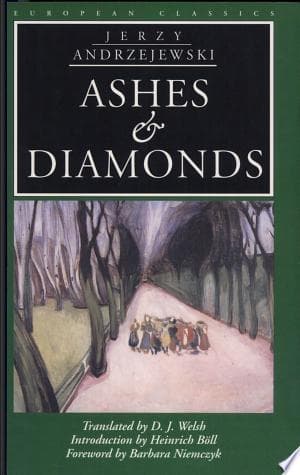
Synopsis
Covers the whole plot, including the ending.
- Difficulty
- Medium
- Pacing
- Moderate
- Mood
- Bleak, Reflective, Tense, Tragic
- Read it if
- You are interested in the moral complexities and human cost of political transitions and post-war conflict, particularly in Eastern Europe.
- Skip it if
- You prefer lighthearted stories or unambiguous heroes and villains.
Ashes and Diamonds Plot Summary
Covers the whole plot, including the ending.
The Assassination Attempt and its Aftermath
On May 8, 1945, in the town of Ostrowiec, Maciek Chelmicki, a young Home Army (AK) soldier, and his leader, Andrzej Kossecki, ambush a car. They believe it carries Szczuka, a high-ranking Communist official. However, they kill two innocent cement workers instead. This failed assassination is a stark opening, showing the chaos and moral confusion of post-war Poland. This event makes Maciek face the harsh truth of his mission and its unintended results, while Andrzej deals with the operational failure and wider political issues for their underground group.
Arrival at the Monopol Hotel
After the failed attempt, Szczuka, the communist target, arrives safely at the Monopol Hotel in Ostrowiec. He is there for a victory celebration for the war's end and to secure the new Communist power. The hotel becomes a central place, a small version of fractured Polish society. Many characters gather, including Pieniążek, the hotel owner; Drewnowski, Szczuka's opportunistic secretary; and other local officials and citizens, all dealing with the changing political scene. This gathering creates a tense mood, as different ideas and personal goals clash.
Maciek's Internal Conflict
After the failed ambush, Maciek and Andrzej return to the hotel and get rooms. Maciek is deeply troubled by the senseless killing of the workers and starts to question if their resistance is effective or right. He feels more and more separate from his comrades' enthusiasm, wanting a normal life away from the constant threat of violence. This inner struggle is a main theme, as Maciek's youthful ideals meet the harsh realities of a war that has become an uncertain peace, making him rethink his loyalties and future.
Meeting Krystyna
At the Monopol Hotel, Maciek meets Krystyna, a barmaid. Their meeting quickly turns into a tender, though short, romance. Krystyna represents a possible escape for Maciek – a glimpse of a future free from the violence and political plots that have shaped his life. Their talks often move away from the immediate political tension, focusing instead on personal wishes, dreams, and the chance of a shared future. This relationship strongly contrasts Maciek's grim mission, showing his desire for normalcy and love, and deepening his inner conflict between duty and personal happiness.
The Second Order
Andrzej receives new, clear orders from his superiors to complete Szczuka's assassination. This new command puts great pressure on both him and Maciek. Andrzej, though perhaps also tired, stays committed to his duty, seeing it as part of their fight for an independent Poland. Maciek, however, feels more and more conflicted. The new order forces him to face his moral doubts again, increasing his desire to drop the mission and live with Krystyna, but also reminding him of the strong bonds of loyalty and duty that connect him to his past.
The Victory Banquet
The victory banquet for the war's end happens in the hotel. It is a scene of forced celebration, with speeches, toasts, and music, but underneath, political tensions remain. Szczuka, though seemingly victorious, is a target. Drewnowski, his secretary, tries to gain favor with the new government, showing his opportunistic nature. Various local officials and citizens attend, some truly celebrating, others just adapting. The banquet serves as a stage where the new order tries to show its power, while the old order, through Maciek and Andrzej, waits in the shadows, ready to disrupt it.
Maciek's Dilemma Deepens
Maciek's inner struggle grows as he weighs his love for Krystyna and his desire for a peaceful future against his strong sense of duty to his comrades and his past. He spends time with Krystyna, imagining a life with her, which makes more violence even more terrible. Yet, the pressure from Andrzej and the deep-seated discipline of a soldier's life are strong forces. He tries to find a way out, perhaps by just leaving, but the weight of his commitment to his cause and his comrades is hard to shake, pushing him closer to the inevitable act.
The Assassination of Szczuka
Despite his deep hesitation, Maciek follows orders. He confronts Szczuka and shoots him. The act is quick and brutal, without the clumsiness of the earlier failed attempt. Szczuka dies, a victim of the ongoing conflict. This assassination is a key moment, marking Maciek's firm commitment to his past and his tragic inability to escape the cycle of violence. It is a somber and unavoidable end to his inner struggle, showing the destructive power of ideological conflict and the personal cost of such actions.
The Escape and the Chase
Right after killing Szczuka, Maciek tries to flee Ostrowiec. He is desperate to escape the results of his actions and the oppressive mood of the town. However, his escape is quickly noticed. A chase begins, involving Soviet soldiers and Polish militia. Maciek, confused and wounded, finds himself trapped. This pursuit is a frantic and chaotic sequence, showing the relentless grip of the political forces at play and Maciek's ultimate inability to outrun his fate, emphasizing the tragic certainty of his death.
Maciek's Death
Maciek, wounded and tired from the chase, stumbles into a field of garbage and dies. He is shot by a random burst of machine-gun fire from a passing patrol, a meaningless and almost accidental end to a life consumed by ideological conflict. His death is not heroic but tragically useless, a symbol of the many lives lost in the chaotic aftermath of war. Bleeding out in the trash, Maciek represents the 'ashes' of a generation, their sacrifices seemingly forgotten or made meaningless by the 'diamonds' of a new, uncertain future.
The Aftermath for Others
After Maciek's death, life in Ostrowiec continues, though with the lingering memory of the recent violence. Andrzej Kossecki, Maciek's commander, deals with the loss of his subordinate and the uncertain future of their cause. Krystyna, the barmaid, is heartbroken and alone, her brief hope for a different future shattered. Drewnowski continues his opportunistic actions, adapting to the new political climate. The other characters in the hotel leave, each returning to their own struggles and compromises, showing that while one man's tragedy ends, the larger societal and political conflicts continue.
Principal Figures
Maciek Chelmicki
Protagonist
A young, disillusioned Home Army soldier tasked with a final assassination.
Maciek is a former Home Army fighter, youthful yet hardened by years of underground warfare. He embodies the tragic figure of a generation caught between two wars – the fight against Nazi occupation and the emerging conflict against the Soviet-backed Communist regime. He is fundamentally decent but deeply scarred, yearning for a normal life and love, specifically with Krystyna. His internal conflict between duty, loyalty to his comrades, and his growing weariness of violence is the heart of the novel. He represents the 'ashes' of a heroic past, destined to be consumed by the new political fire.
Relationships: Andrzej Kossecki (Commander and comrade-in-arms); Krystyna (Love interest, symbol of hope for a peaceful future); Szczuka (Political target, ideological enemy)
Andrzej Kossecki
Supporting
Maciek's commanding officer, steadfast in his commitment to the anti-Communist resistance.
Andrzej is Maciek's superior in the Home Army, a more pragmatic and hardened soldier. He represents the unwavering commitment to the anti-Communist cause, even in the face of dwindling hope. While he may share some of Maciek's weariness, his sense of duty and loyalty to the underground movement is paramount. He is less prone to personal introspection than Maciek, focusing instead on the mission and the strategic implications of their actions. He embodies the continued, albeit increasingly desperate, resistance against the new political order.
Relationships: Maciek Chelmicki (Subordinate and comrade); Szczuka (Political target)
Szczuka
Antagonist/Target
A high-ranking Communist official, representing the new political power.
Szczuka is a dedicated Communist official, a veteran of the pre-war left-wing movement, and a symbol of the new Soviet-backed regime establishing itself in Poland. He is portrayed as a figure of conviction, genuinely believing in the cause he serves, even if his methods are ruthless. He is the embodiment of the 'new order' that Maciek and his comrades are fighting against. His presence in Ostrowiec for the victory celebrations underscores the shifting power dynamics and the inevitability of Communist rule, making him a prime target for the lingering resistance.
Relationships: Maciek Chelmicki (Assassin's target); Drewnowski (Secretary and opportunistic subordinate)
Krystyna
Supporting
A barmaid at the Monopol Hotel, who offers Maciek a glimpse of a different future.
Krystyna is a barmaid at the Monopol Hotel, a figure of innocence and hope amidst the political turmoil. She represents the possibility of a normal, peaceful life for Maciek, a life free from violence and ideological conflict. Her brief romance with Maciek is a poignant contrast to the grim reality of his mission. She is not deeply involved in the political machinations but serves as a crucial emotional anchor for Maciek, highlighting his profound longing for connection and escape. Her presence underscores the human cost of war and political upheaval.
Relationships: Maciek Chelmicki (Love interest)
Drewnowski
Supporting
Szczuka's opportunistic secretary, embodying the shifting loyalties of the era.
Drewnowski is Szczuka's secretary, a character defined by his opportunism and lack of genuine conviction. He is a 'survivor' who readily adapts to whichever political wind blows strongest, eager to ingratiate himself with the new Communist authorities. He is a sycophant, driven by self-interest and a desire for personal advancement, rather than any strong ideological belief. Drewnowski serves as a cynical commentary on the moral compromises and shifting loyalties that characterized post-war Poland, highlighting the fragility of principles in times of profound change.
Relationships: Szczuka (Boss and object of sycophancy)
Pieniążek
Supporting
The owner of the Monopol Hotel, a neutral observer trying to navigate the new reality.
Pieniążek is the owner of the Monopol Hotel, a relatively neutral figure trying to keep his business afloat amidst the political upheaval. He represents the ordinary citizen caught in the crossfire of ideological conflict, attempting to adapt to the new reality without fully committing to either side. He is concerned with practical matters and maintaining order in his establishment, which serves as a temporary sanctuary and a microcosm of the divided nation. His interactions reveal the anxieties and compromises of everyday life under a shifting political landscape.
The Two Cement Workers
Mentioned
Innocent victims of Maciek's first botched assassination attempt.
These two unnamed cement workers are the tragic, accidental victims of Maciek and Andrzej's initial assassination attempt on Szczuka. Their deaths are senseless and serve as a stark opening to the novel, immediately establishing the moral ambiguity and destructive nature of the ongoing conflict. They represent the innocent lives caught and crushed in the gears of ideological warfare, highlighting the profound human cost of such struggles and deepening Maciek's internal moral crisis.
Themes & Insights
The Futility of Violence and Resistance
The novel powerfully shows how pointless and exhausting continued armed struggle is in a changed political situation. Maciek's journey is a path to disillusionment, as his violent acts, first based on patriotic duty, become more and more senseless and disconnected from any clear, achievable goal. The failed first assassination of innocent workers, and Maciek's own undignified death in a garbage heap, show that the 'heroic' resistance of the past now only creates more suffering, with no meaningful result. The 'ashes' of war leave only destruction, not victory.
“What had been heroic in the forests and in the underground now seemed merely desperate, futile, and destructive.”
Moral Ambiguity and Shifting Loyalties
Andrzejewski expertly shows a world where good and evil are not clear. Characters like Maciek are driven by duty and patriotism, yet their actions cause innocent deaths and continued bloodshed. Conversely, the 'enemy' – Szczuka – is not a simple villain but a man of conviction, though his ideas are seen as oppressive by others. Drewnowski's opportunism and Pieniążek's quiet compromises further show how people navigate a world where loyalty changes and survival often beats strict rules, forcing a re-evaluation of ethical choices after the war.
“In this new world, it was hard to tell who was truly a hero and who was simply a killer.”
The Weight of the Past vs. Hope for the Future
Maciek is a tragic figure caught between the heroic, though violent, past of the Home Army and a desperate wish for a peaceful future with Krystyna. The 'ashes' of his past commitments and wartime experiences constantly pull him back, stopping him from embracing the 'diamonds' of a new, ordinary life. His short romance with Krystyna symbolizes this hope for normalcy, but his strong sense of duty and the inescapable cycle of violence ultimately keep him from it. The novel suggests that for some, the past's hold is too strong for a clean break into a new future.
“He longed for a life where love was not a fleeting moment between acts of death.”
The Dawn of a New Political Order
The novel is set precisely when Poland changes from Nazi occupation to Soviet-backed Communist rule. The Monopol Hotel becomes a small version of this big political shift. The victory celebration, meant to show the triumph of the new order, is full of tension and the lingering presence of the old resistance. Characters like Szczuka represent the rising power, while Maciek embodies the dying parts of the old order. The novel explores the anxieties, compromises, and brutal realities of this change, showing how a new government asserts its power and tries to erase its opposition.
“The war was over, but a new war had just begun, a war for the soul of Poland.”
Plot Devices & Literary Techniques
The Monopol Hotel as a Microcosm
The hotel serves as a condensed representation of postwar Polish society.
The Monopol Hotel is not merely a setting but a crucial plot device. It acts as a microcosm, bringing together diverse characters from all strata of postwar Polish society – Communists, former resistance fighters, opportunists, ordinary citizens, and the innocent. This confined space allows for intense interactions, ideological clashes, and personal dramas to unfold, reflecting the larger political and social turmoil gripping the nation. The hotel's various rooms and common areas symbolize the different factions and their struggles, making it a vivid stage for the novel's central conflicts.
Symbolism of 'Ashes and Diamonds'
The title itself acts as a central metaphor for the novel's themes.
The title 'Ashes and Diamonds' is a potent symbol. 'Ashes' represent the destruction, futility, and moral debris left by war and the dying resistance, embodied by Maciek's tragic fate and the senselessness of his actions. 'Diamonds' symbolize the hard, unyielding reality of the new Communist order, the future being forged, or perhaps the fleeting moments of beauty and hope (like Maciek's love for Krystyna) that are crushed by the surrounding chaos. The interplay of these two elements encapsulates the novel's central themes of loss, transition, and the search for meaning in a broken world.
Dramatic Irony
The audience is often aware of dangers and outcomes unknown to the characters.
Dramatic irony is frequently employed to heighten tension and underscore the tragic inevitability of events. For instance, the audience knows from the outset that Maciek and Andrzej have mistakenly killed innocent men, while they believe they've hit their target. Later, the audience is aware of Maciek's mission to kill Szczuka, while Szczuka himself is oblivious to the immediate danger. This device builds suspense and emphasizes the characters' limited perspectives within a larger, predetermined narrative of violence and political change, making their struggles more poignant as their fates unfold.
The Clock Tower
A recurring visual motif symbolizing the relentless march of time and fate.
The clock tower in Ostrowiec appears at significant moments, often subtly, but its presence is impactful. It symbolizes the relentless march of time, particularly the transition from one era to another, and the inevitability of fate. Its chimes mark crucial moments, such as the initial assassination attempt and Maciek's final hours. The clock's indifferent ticking contrasts sharply with the frantic human struggles below, suggesting that despite all the political upheaval and personal tragedy, time moves on, ushering in the new order whether individuals are ready or not.
Ashes and Diamonds Quotes
“The war is over, now the real war begins.”
“Each of us carries his own cross. Some carry it for themselves, others for others, and still others for an idea.”
“There are times when one must simply choose: either you are with us or against us. There is no middle ground.”
“What is freedom? For some, it's the right to choose their own chains.”
“History is not made by saints, but by men who are often flawed, often cruel, but always human.”
“We are like ashes and diamonds. The ashes are all that remains of the past, and the diamonds are what we hope to build for the future. But sometimes, the diamonds are just more ashes.”
“One can kill a man, but one cannot kill an idea.”
“The greatest tragedy is not to die, but to live without a purpose.”
“Everyone wants to be right, but few want to understand.”
“The weight of the past is often heavier than the promise of the future.”
“We are all caught in a trap, and there is no way out.”
“Sometimes, the most dangerous enemy is not the one you fight, but the one you become.”
“To forget is a luxury we cannot afford.”
Quiz
10 questions on the plot and the characters. Each answer comes with a short explanation.
Question 1
Which specific historical period immediately following World War II does 'Ashes and Diamonds' depict in Poland?
- The German occupation period (1939-1945)
- The period of Soviet influence and the establishment of People's Poland (spring 1945)
- The pre-war democratic era (1918-1939)
- The Solidarity movement era (1980s)
Show answer
B. The period of Soviet influence and the establishment of People's Poland (spring 1945) 'Ashes and Diamonds' is set in the spring of 1945, precisely when Poland was transitioning to People's Poland under Soviet influence, a crucial moment in its post-war history.
Question 2
What is the primary setting for the convergence of various characters in the novel, described as a 'microcosm of an uprooted world'?
- A bustling train station in Warsaw
- A remote monastery in the countryside
- A provincial town's chief hotel
- A newly established government office
Show answer
C. A provincial town's chief hotel The novel explicitly states that various characters converge on 'a provincial town's chief hotel,' which serves as the central hub and symbolic setting.
Question 3
Which of the following groups is NOT explicitly mentioned as converging on the novel's central setting?
- Communists and nationalists
- Thieves and black marketeers
- Servants and fading aristocrats
- Foreign journalists and war correspondents
Show answer
D. Foreign journalists and war correspondents The provided description lists 'Communists, socialists, and nationalists; thieves and black marketeers; servants and fading aristocrats; veteran terrorists and bands of murderous children.' Foreign journalists are not mentioned.
Question 4
The novel explores the moral ambiguities and conflicts faced by individuals in post-war Poland. What central theme is best represented by the clash between 'veteran terrorists' and 'bands of murderous children'?
- The generational divide in fashion trends
- The enduring appeal of historical monuments
- The corrupting influence of violence and the breakdown of societal norms across generations
- The development of new agricultural practices
Show answer
C. The corrupting influence of violence and the breakdown of societal norms across generations The phrase 'veteran terrorists and bands of murderous children bewitched by the lure of crime and adventure' directly points to the pervasive and corrupting nature of violence and the erosion of moral boundaries in the post-war environment, affecting both experienced fighters and the youth.
Question 5
What is the broader political context described in the novel that contributes to the 'uprooted world' feeling?
- Poland's thriving capitalist market economy
- The nation's smooth and peaceful transition to democracy
- The nation's transformation to People's Poland, marked by political and social upheaval
- Poland's isolation from international political affairs
Show answer
C. The nation's transformation to People's Poland, marked by political and social upheaval The description explicitly states the nation 'is in the throes of its transformation to People's Poland,' indicating a tumultuous and politically charged period.
Question 6
How does the novel portray the socio-economic landscape of post-war Poland through its diverse cast of characters?
- As a stable society with a strong middle class and clear social hierarchies
- As a society where pre-war social structures remain largely intact and unchallenged
- As a fractured society with remnants of old classes (fading aristocrats) coexisting with new illicit economies (black marketeers) and political factions
- As a uniformly impoverished society with no distinctions between its members
Show answer
C. As a fractured society with remnants of old classes (fading aristocrats) coexisting with new illicit economies (black marketeers) and political factions The description highlights the presence of 'fading aristocrats,' 'servants,' 'thieves and black marketeers,' and various political factions, illustrating a complex, fractured, and transforming socio-economic landscape.
Question 7
The novel's title, 'Ashes and Diamonds,' often refers to the destruction and potential for beauty or value in post-war chaos. What specific aspect of the historical context does this metaphor most likely emphasize?
- The literal remnants of bombed-out cities and the discovery of precious jewels within them
- The contrast between the devastation of war and the enduring human spirit or values that can emerge from it
- The process of cremation rituals and the symbolic use of diamonds in mourning
- The economic struggle to rebuild industries based on coal (ashes) and mining for diamonds
Show answer
B. The contrast between the devastation of war and the enduring human spirit or values that can emerge from it The title 'Ashes and Diamonds' is a powerful metaphor for the devastation of war ('ashes') and the enduring, perhaps hidden, beauty, value, or human spirit ('diamonds') that can still exist or emerge amidst such destruction and chaos.
Question 8
The description mentions 'veteran terrorists' and 'bands of murderous children bewitched by the lure of crime and adventure.' This suggests a pervasive culture of violence. What might be the underlying cause for such widespread 'lure of crime and adventure' among children in this specific post-war context?
- A sudden surge in popularity of adventure novels and films among Polish youth
- The destabilizing effects of war, breakdown of social order, and perhaps the normalization of violence experienced during conflict
- A government-sponsored program encouraging children to engage in paramilitary activities for national defense
- The influence of new educational theories promoting risk-taking and rebellion
Show answer
B. The destabilizing effects of war, breakdown of social order, and perhaps the normalization of violence experienced during conflict The 'lure of crime and adventure' among children in a post-war setting strongly implies the profound impact of war, which can lead to a breakdown of traditional social structures, moral codes, and expose children to violence, making such activities seem 'adventurous' or necessary for survival.
Question 9
The novel is set in 1945, a year of significant political transition in Poland. Given the description, what kind of political climate would a character who is a 'fading aristocrat' likely experience or represent?
- A resurgence of their former power and influence as the new regime values their historical lineage.
- A comfortable integration into the new communist system, maintaining their wealth and status.
- A struggle to adapt to a changing social order, loss of privilege, and potential persecution under the new communist government.
- Complete apathy towards political changes, focusing solely on personal pleasures.
Show answer
C. A struggle to adapt to a changing social order, loss of privilege, and potential persecution under the new communist government. In 1945, with the establishment of People's Poland (a communist state), 'fading aristocrats' would typically represent a declining class, often facing expropriation, loss of social standing, and potential hostility from the new regime which sought to dismantle old class structures.
Question 10
The phrase 'a microcosm of an uprooted world' refers to the provincial town's chief hotel. What does 'uprooted world' specifically suggest about the state of Polish society in 1945?
- The literal relocation of entire towns due to war damage, with people living in temporary shelters.
- A society where traditional values, social structures, and individual identities have been profoundly disrupted and displaced by war and political change.
- A world where agriculture has failed, forcing people to abandon their farms and seek new livelihoods.
- A society focused on exploring its ancient historical roots and reconnecting with its past.
Show answer
B. A society where traditional values, social structures, and individual identities have been profoundly disrupted and displaced by war and political change. 'Uprooted world' metaphorically signifies a society where people's lives, communities, and established norms have been torn from their foundations due to the immense disruptions of war and the radical political transformation to People's Poland. It implies a loss of stability and a search for new bearings.
Ashes and Diamonds FAQ
What is the central conflict in 'Ashes and Diamonds' and when does it take place?
'Ashes and Diamonds' is set in Poland in May 1945, immediately after World War II, as the country transitions to a Communist government. The central conflict revolves around the struggle between the anti-Communist underground Home Army, represented by Maciek Chełmicki, and the newly established Communist authorities, epitomized by Szczuka, a veteran Communist leader.
Who is Maciek Chełmicki and what is his primary mission?
Maciek Chełmicki is a young, disillusioned former Home Army fighter tasked with assassinating Szczuka, a high-ranking Communist official. Despite his weariness with violence and a growing desire for a normal life, Maciek feels bound by duty and a sense of loyalty to his anti-Communist cause and comrades, making his mission a profound personal and moral dilemma.
Who is Szczuka, and what makes him a significant character?
Szczuka is a veteran Communist leader and Maciek's assassination target. He represents the new political order attempting to establish itself in post-war Poland. His determination and unwavering belief in the Communist future, despite his personal losses and the chaos around him, make him a symbol of the ideological forces shaping the nation.
How does Krystyna Rozbicka influence Maciek's actions and internal struggle?
Krystyna Rozbicka is a barmaid at the Monopol Hotel with whom Maciek develops a brief, intense romantic relationship. Her presence offers Maciek a glimpse of a potential future free from violence and duty, deepening his internal conflict and making him question the purpose and cost of his mission against Szczuka.
What role does the Monopol Hotel play in the novel's setting?
The Monopol Hotel serves as a microcosm of post-war Polish society, bringing together a diverse cast of characters: Communists, nationalists, black marketeers, and ordinary citizens. It's a neutral yet tense ground where political factions briefly coexist, highlighting the social upheaval and moral ambiguity of the era.
What is the significance of the repeated motif of the burning glasses of vodka?
The burning glasses of vodka, often drunk by Maciek and his comrades in memory of fallen friends, symbolize the fiery, destructive nature of their past and ongoing struggle. It represents both their shared sacrifice and the lingering bitterness and grief that fuels their actions, contrasting sharply with the fleeting moments of peace Maciek experiences.
How does the novel subtly foreshadow Maciek's ultimate fate?
Maciek's fate is foreshadowed through several details, such as his weariness with violence, his longing for a normal life, and the repeated imagery of destruction and decay. The initial botched assassination, where he kills two innocent cement workers instead of Szczuka, also hints at the tragic futility and misdirection of his violent path.
Are there any deeper symbolic meanings behind the 'ashes and diamonds' title?
The title 'Ashes and Diamonds' refers to a Polish romantic poet Cyprian Norwid's verse, suggesting that beneath the ashes of war and destruction, there are still valuable 'diamonds' of human spirit, ideals, and perhaps even a future to be found. It encapsulates the novel's exploration of beauty and destruction, hope and despair, within the post-war chaos.
What is the implied fate of Andrzej, Maciek's superior, after Maciek's death?
After Maciek's death, Andrzej's fate is left ambiguous but heavily implied. Having lost his last active subordinate and with the anti-Communist resistance effectively collapsing, he faces either capture, further futile struggle, or a forced retreat into obscurity. His earlier conversation with Maciek about the changing times suggests he might ultimately surrender or go into hiding.
Analyze Maciek's psychological state throughout his mission.
Maciek is deeply conflicted, exhibiting signs of post-traumatic stress and moral exhaustion. He is torn between his ingrained loyalty to the Home Army and a growing yearning for peace, love, and a normal life. His actions are driven by duty, but his internal monologues reveal profound disillusionment and a sense of the futility of continued violence.
How does Szczuka's psychology contrast with Maciek's?
Szczuka, though also weary from years of struggle, possesses an unwavering ideological conviction that Maciek lacks. He is a man of the past, dedicated to the Communist future, willing to sacrifice personally for the cause. His psychology is one of steadfast belief and duty, contrasting with Maciek's existential doubt and desire for personal freedom.
Explore the psychological impact of war on the younger generation, as seen in the novel.
The novel portrays the younger generation, particularly Maciek, as deeply scarred by war, leading to a profound sense of nihilism and a struggle to adapt to peacetime. They are conditioned to violence and find it difficult to envision a future outside of conflict, leading to a tragic cycle of destruction even as the war officially ends.
How does the novel portray the moral ambiguity of its characters, particularly Maciek?
The novel masterfully portrays Maciek's moral ambiguity. While he is an assassin, his internal struggle, his capacity for love with Krystyna, and his weariness with violence make him a sympathetic figure. He is not a villain, but a product of his circumstances, forced into terrible choices by the brutal political landscape.
Is Maciek Chełmicki a tragic hero or a victim of circumstance?
Maciek can be seen as both. He embodies the tragic hero's fall from grace, driven by duty to a doomed cause, yet his death is also a result of the overwhelming historical forces and political circumstances beyond his control. His choices, though personal, are deeply shaped by the trauma and ideology of his era.
Does the novel offer any hope for Poland's future, or is it purely pessimistic?
While the novel is undeniably bleak, depicting a nation ravaged by war and ideological conflict, it's not entirely devoid of hope. The brief, tender moments between Maciek and Krystyna, and the underlying suggestion that life, despite its horrors, continues, offer a faint glimmer. However, the dominant tone is one of profound pessimism regarding the immediate future.
How does the film adaptation by Andrzej Wajda interpret the novel's ending differently, if at all?
Andrzej Wajda's film adaptation largely remains faithful to the novel's tragic ending, with Maciek's senseless death in the garbage dump. However, the film often amplifies the visual symbolism and Maciek's existential angst, perhaps making his final moments even more poignant and a starker commentary on the futility of his sacrifice than the book's prose.
What is the novel's stance on the effectiveness of violent resistance in post-war Poland?
The novel strongly suggests that violent resistance, at least from the Home Army's perspective in 1945, is largely futile and self-destructive. Maciek's mission ultimately achieves nothing but his own death and the deaths of innocents. The narrative implies that the tide of history has turned, and continued violence only perpetuates suffering without changing the political outcome.
To what extent is 'Ashes and Diamonds' a political allegory for Poland's post-war identity?
'Ashes and Diamonds' functions as a powerful political allegory, representing Poland's struggle to define its identity amidst the ashes of war and the imposition of a new political order. The characters embody the conflicting ideologies and moral dilemmas of a nation torn between its past, its traumatic present, and an uncertain future under Soviet influence.
About the author
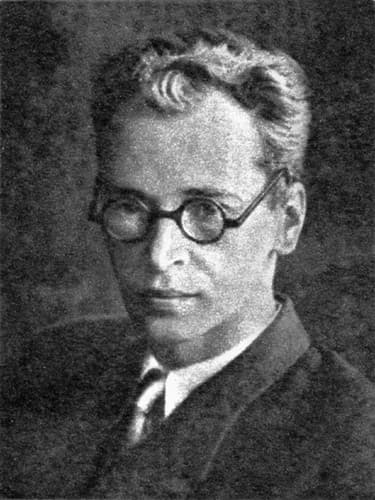
Jerzy Andrzejewski was a prolific Polish writer. His works confront controversial moral issues such as betrayal, the Jews and Auschwitz in the wartime. His novels, Ashes and Diamonds, and Holy Week, have been made into film adaptations by the Oscar-winning Polish director Andrzej Wajda. Holy Week and Ashes and Diamonds have both been translated into English. His novel The Gates of Paradise was translated into English by James Kirkup and published by Panther Books with the anglicised spelling "George Andrzeyevski".
Similar books
- A Farewell to Arms
Ernest Hemingway
3.8 (263k) average on GoodreadsHistorical FictionFocuses on a soldier's disillusionment with war and a doomed romance amidst conflict.
- Darkness at Noon
Arthur Koestler
4.0 (26k) average on GoodreadsPoliticsDelves into the psychological and moral dilemmas of individuals caught in totalitarian political systems.
- Nineteen Eighty-Four
George Orwell
4.2 (5.5M) average on GoodreadsFictionWinston Smith dreams of truth and rebellion in a world where Big Brother watches all, but he confronts the terrifying power of a regime that controls not just actions, but thoughts.
- The Frozen River
Ariel Lawhon
4.4 (600k) average on GoodreadsFictionIn 1789 Maine, a heroic midwife's diary helps her expose a murder and get justice in a town that wants to silence her.
- A Man Called Ove
Fredrik Backman
4.4 (569k) average on GoodreadsFictionA stubborn widower, who lives by strict rules, finds his quiet world changed by a lively new family next door, making him face his past and find happiness in human connection.
- The Art of Racing in the Rain
Garth Stein
4.2 (452k) average on GoodreadsFictionThrough the eyes of Enzo, a wise and observant dog, a race car driver's family navigates a journey of love, loss, and resilience, learning that life's most important lessons often come in the curves, not just on the straightaways.





Enjoyed the summary?
A summary gives you the shape of the book. The book itself has the detail, the examples and the voice.
Find Ashes and Diamonds on AmazonAs an Amazon Associate, BookBrief earns from qualifying purchases. How we're funded