
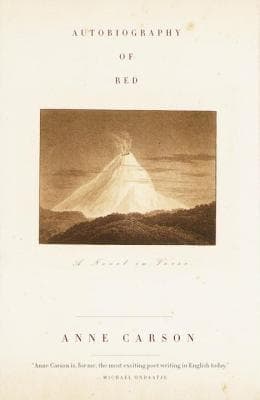
Synopsis
Covers the whole plot, including the ending.
- Difficulty
- Medium
- Pacing
- Moderate
- Mood
- Lyrical, Melancholy, Introspective, Poetic, Mythic
- Read it if
- You enjoy experimental literary fiction that blends poetry, myth, and a coming-of-age story, with a focus on art and identity.
- Skip it if
- You prefer traditional narrative structures, clear genre boundaries, or a fast-paced plot.
Autobiography of Red Plot Summary
Covers the whole plot, including the ending.
Geryon's Early Life and Autobiographical Genesis
Geryon, a small, winged red monster, begins writing his autobiography at five. He lives with his distant, often violent older brother and his well-meaning but ineffective mother. His early writings detail both the ordinary and unusual parts of his life, including his struggles with his body and his brother's constant teasing. He finds comfort in observing and thinking, often feeling like an outsider in his family and the world. His mother tries to understand him, but her efforts are often clumsy against his brother's cruelty.
The Introduction of Herakles
As Geryon grows up, he develops a love for photography, using his camera as a shield and a way to see the world from his unique view. One day, while taking pictures, he meets Herakles, a charming, older boy with a wild spirit. Herakles is immediately drawn to Geryon's unusual looks and quiet intensity. Their first meetings are full of a growing attraction, and Geryon, despite his shyness, is deeply interested in Herakles's strong personality and easy confidence. This meeting marks a turning point, bringing romance and vulnerability into Geryon's solitary life.
The First Romance and Abrupt Departure
Geryon and Herakles start a passionate, if unusual, relationship. Herakles shows Geryon new experiences and a sense of belonging Geryon has never known. Their time together is intense and joyful, filled with desire and companionship. Geryon falls deeply in love, believing he has found his soulmate. But Herakles, being a drifter, suddenly leaves Geryon one day without a word. This sudden departure breaks Geryon's heart and leaves him confused, dealing with the pain of being left and the strength of his unreturned love.
Years of Solitude and Artistic Development
After Herakles leaves, Geryon puts his pain and longing into his photography, developing his artistic voice. He travels to different places, including Argentina, trying to understand himself and the world through his camera. These years involve much thought and creative growth. He learns to live with his unique identity, becoming more comfortable with himself, even as Herakles's memory stays with him. His photography becomes more complex, showing his changing emotions and his search for meaning.
Reunion in Buenos Aires
Years later, Geryon, now an accomplished photographer, is in Buenos Aires for an exhibition. To his surprise, he sees Herakles, who is now with a woman named Ancash. The reunion is awkward and full of unspoken feelings. Geryon is overcome with old hurt, renewed longing, and the shock of seeing Herakles again. Herakles, for his part, seems to acknowledge the past but is reserved. This chance meeting disrupts Geryon's carefully built peace and forces him to face the lasting effect of their past relationship.
The Tango and the Unspoken
Geryon spends time watching Herakles and Ancash, noticing how they interact. He sees Herakles dancing the tango with Ancash, a dance that shows passion and connection, further highlighting Geryon's feeling of being left out and his longing. Despite the years, Geryon's feelings for Herakles are still strong and complex. He struggles to match the Herakles he loved with the man in front of him, who seems both familiar and changed. The unspoken history between them creates an intense tension for Geryon.
A Shared Moment and a Trip
During their time in Buenos Aires, Geryon and Herakles share a moment of understanding, perhaps a touch or a look, that hints at their unresolved connection. This moment leads Herakles to invite Geryon and Ancash on a trip to a volcano. Geryon accepts, hoping for some kind of closure or explanation, despite the pain of being with Herakles and his new partner. The journey to the volcano shows a descent into the strong emotions under their surface interactions.
The Volcano and the Truth
The three travel to the volcano, a place of stark beauty that reflects Geryon's inner turmoil. Here, raw emotions surface. Geryon confronts Herakles, not necessarily with words, but through his art and his presence. The setting allows for a deeper look at their shared history and Herakles's effect on Geryon's life. The volcano, a place of creation and destruction, becomes a symbol for Geryon's passionate heart and his own emotional landscape.
Ancash's Perspective and Departure
Ancash, sensing the complex history between Geryon and Herakles, offers Geryon a different view of Herakles's character and reasons. She reveals parts of Herakles Geryon hadn't considered, helping him see Herakles not just as a lover who left him, but as a complex, perhaps flawed, person. This insight, combined with the release at the volcano, helps Geryon start to let go of his idealized image of Herakles and find a way to a more mature understanding of love and loss. Ancash eventually leaves, leaving Geryon and Herakles alone for a final, unspoken goodbye.
Geryon's Artistic Breakthrough
After the encounter at the volcano, Geryon experiences an artistic breakthrough. His experiences—his early suffering, his intense love for Herakles, the pain of being left, and the complexities of their reunion—power his creative mind. He no longer just records but turns his life into art. He finds a way to show his unique perspective, his unusual beauty, and his deep capacity for love and sorrow through his photography, moving past his personal pain to create something universal and powerful.
The Mythic Undercurrents and Geryon's Identity
Throughout the story, Geryon's life is linked with hints of the ancient Greek myth of Geryon, a three-bodied monster killed by Herakles. Geryon, the character, deals with this mythic weight, seeing himself as a modern version. By the end, Geryon fully accepts his identity as a winged red monster, seeing it not as a curse but as a part of his artistic vision. He combines his personal story with the myth, finding strength and purpose in his unusualness and his artistic calling, creating his own mythic journey of self-discovery and creation.
Autobiography of Red Characters
Geryon
Protagonist
A winged red monster and aspiring photographer, navigating love, loss, and identity.
Geryon is a sensitive, introspective, and artistic young man who also happens to be a winged red monster. He is shy and often feels like an outsider, burdened by his unique appearance and a difficult childhood marked by an abusive brother. His primary coping mechanism and passion is photography, through which he attempts to understand and capture the world around him. He possesses a deep capacity for love and devotion, which makes Herakles's abandonment particularly devastating. His journey is one of self-discovery, learning to embrace his monstrousness as integral to his artistic identity.
Relationships: Herakles (First love, source of both immense joy and profound heartbreak.); Mother (Affectionate but ineffectual, struggles to understand him.); Brother (Abusive and tormenting figure in his childhood.); Ancash (Herakles's later partner, who offers Geryon a new perspective.)
Herakles
Supporting/Antagonist (initially)
A charismatic, restless drifter who captures Geryon's heart.
Herakles is a charming, cavalier young man with a restless spirit and a tendency to drift. He is magnetic and confident, drawing people to him, including Geryon. While he genuinely cares for Geryon, his inability to commit and his transient nature lead him to abandon Geryon, causing immense pain. He is an embodiment of both passion and detachment. His reappearance years later forces Geryon to confront unresolved feelings, but Herakles himself remains somewhat enigmatic, never fully explaining his past actions.
Relationships: Geryon (Object of Geryon's intense love and longing, both lover and catalyst for pain.); Ancash (His partner during the second part of the narrative.)
Mother (Geryon's)
Supporting
Geryon's affectionate but often helpless mother.
Geryon's mother is portrayed as well-meaning and affectionate, but ultimately ineffectual in protecting Geryon from his brother's abuse or truly understanding his unique nature. She tries to connect with him, often through clumsy attempts at conversation or by providing simple comforts, but she lacks the strength or insight to fully support him in his struggles. Her presence highlights Geryon's isolation and his need to find his own path.
Relationships: Geryon (Mother-son, characterized by affection and a degree of misunderstanding.)
Brother (Geryon's)
Mentioned/Antagonist
Geryon's abusive older brother.
Geryon's older brother is a source of constant torment and abuse in Geryon's childhood. He is cruel and violent, exploiting Geryon's vulnerability and unique physical appearance. While not a present character in the latter half of the book, his impact on Geryon's early life is profound, contributing to Geryon's feelings of isolation and his defensive posture towards the world. He represents the harsh realities and cruelty Geryon faces.
Relationships: Geryon (Abusive sibling relationship.)
Ancash
Supporting
Herakles's partner in Argentina, who offers Geryon a new perspective.
Ancash is Herakles's partner during Geryon's reunion with him in Argentina. She is perceptive and kind, sensing the unspoken history between Geryon and Herakles. She offers Geryon a different, more grounded perspective on Herakles's character, helping Geryon to move past his idealized image of his former lover. Her presence provides a contrast to Geryon's intense emotional world and acts as a catalyst for Geryon's eventual emotional release and understanding.
Relationships: Herakles (Romantic partner.); Geryon (Brief, empathetic connection, providing insight.)
Autobiography of Red Themes
The Nature of Love and Loss
The book explores first love, the pain of being left, and the lasting impact of a deep connection. Geryon's strong feelings for Herakles are shown with raw honesty, making his later heartbreak clear. The reunion in Buenos Aires highlights how past loves continue to shape the present, making Geryon face unresolved emotions and the pain of unfulfilled desire. The story suggests that love, even lost love, can drive personal and artistic growth, turning sadness into creative energy.
“He fell in love. He was a monster. He was a boy. He was a boy in love with a monster. He was a monster in love with a boy. He was a boy in love with a boy.”
Identity and Otherness
Geryon's identity as a winged red monster is central, symbolizing feeling different and alone. His physical difference reflects his internal struggles with self-acceptance and feeling like an outsider. The story follows his journey from being bothered by his difference to accepting it as a unique part of himself and a source of his art. His 'monstrousness' is not a flaw but an essential part of his identity, letting him see the world from a distinct view. This theme connects with anyone who has felt 'other.'
“He lived inside his own skin and the skin was red and had wings.”
Art as a Means of Self-Discovery and Survival
Photography is Geryon's main way of expressing himself and a key tool for navigating his inner and outer worlds. His camera acts as both a shield and a lens, letting him observe life from a distance while capturing its essence. Through his art, Geryon processes his pain, explores his identity, and turns his suffering into something beautiful and meaningful. Creating becomes a way for him to understand himself, to say what words cannot, and to find purpose and belonging in a world that often alienates him. His autobiography itself is an act of artistic self-creation.
“He wanted to take a picture of the inside of his soul.”
The Reinterpretation of Myth
Carson retells the ancient Greek myth of Geryon and Herakles, changing it from a tale of heroic conquest into a modern love story. The original myth's violence and clear hero/villain dynamic are reversed, with Geryon as a sensitive character and Herakles as a complex, unclear figure. This new interpretation lets the novel explore vulnerability, desire, and the human condition through a mythic lens, showing how old stories can still be meaningful today. The 'monstrous' Geryon is made human, and the 'heroic' Herakles is shown to be flawed.
“A monster is not a human being. A monster is a type of dream.”
Memory and the Past's Persistence
The story often looks into Geryon's memories, especially of his childhood and his first love with Herakles. The past is not fixed but a living thing that keeps influencing Geryon's current experiences and emotions. The reunion with Herakles forces Geryon to confront these persistent memories and the unresolved feelings they carry. The autobiography format itself stresses remembering and reinterpreting the past, showing how personal history shapes identity and how one's story can change over time. The pain of being left, though years old, is felt again with full force.
“Memory is a kind of monster.”
Plot Devices & Literary Techniques
Autobiographical Format
The story is presented as Geryon's personal memoir, written from childhood to adulthood.
This device offers an intimate, first-person perspective into Geryon's thoughts, feelings, and experiences. It allows readers direct access to his unique voice and worldview, emphasizing his introspection and artistic sensibility. The fragmented, sometimes poetic nature of the 'autobiography' reflects Geryon's developing consciousness and his struggle to articulate his identity. It also provides a chronological framework while allowing for lyrical digressions and philosophical musings, blurring the lines between prose and poetry.
The Myth of Geryon and Herakles
The story explicitly references and reworks the ancient Greek myth as an underlying framework.
This device adds layers of intertextuality and symbolic meaning. By casting the protagonist as the 'monster' Geryon and his lover as 'Herakles,' the novel subverts traditional heroic narratives and explores the complexities of power dynamics, desire, and vulnerability. The myth acts as both a parallel and a counterpoint to the modern story, allowing for a commentary on how ancient stories continue to inform and shape human experience, and how they can be reinterpreted to explore contemporary themes like queer love and identity.
Photography as Metaphor and Medium
Geryon's passion for photography is a central element, serving as both a narrative tool and a symbolic lens.
Photography functions as Geryon's primary means of engaging with and understanding the world. It symbolizes his desire to capture and preserve moments, to see beauty in the mundane, and to create meaning from his experiences. The camera acts as a barrier, allowing him to observe from a distance, but also as a bridge, connecting him to his subjects and his own emotions. It represents the artistic process of transforming raw experience into a crafted image, mirroring Geryon's own journey of self-creation.
The Volcano
A recurring symbol representing raw emotion, creation, and destruction.
The volcano appears both literally as a destination for Geryon, Herakles, and Ancash, and metaphorically throughout the narrative. It symbolizes the volatile, powerful, and often destructive nature of Geryon's emotions, particularly his love and pain. It represents a place of intense internal pressure and potential eruption, mirroring the 'volcanic terrain' of Geryon's soul. The journey to the volcano acts as a cathartic climax, allowing for emotional release and a confrontation with deep-seated feelings, leading to Geryon's artistic breakthrough.
Autobiography of Red Quotes
“He was a boy who could make things, but he was not a boy who could make things happen.”
“To be a monster is to be a mutation in the order of the world. I am a monster. I am a mutation.”
“You remember too much, my mother said to me. But how can you forget enough?”
“Love, like a carefully chosen lie, gets you through the day.”
“Desire is a kind of house. It has walls, it has windows. It has a roof, it has a door. It has a bed. It has a body.”
“What is the sound of one heart breaking? It is the sound of a thousand hearts breaking.”
“Every time he put on his wings, he felt a strange sadness. They were a part of him, but they were also a burden.”
“He lived in a world where things happened, but he did not feel that he was part of them.”
“The past is a foreign country; they do things differently there.”
“He knew that the world was full of terrible beauty, and that he was one of its creatures.”
“To be seen is to be loved, he thought. But to be understood, that is another thing.”
“He saw himself as a book whose pages had been torn out and scattered by the wind.”
“There are some things you can't undo. And some things you can't outrun.”
“He had a hunger for knowledge, a hunger for experience, a hunger for all the things that made up a life.”
Quiz
10 questions on the plot and the characters. Each answer comes with a short explanation.
Question 1
What mythological figure does Geryon represent in Anne Carson's 'Autobiography of Red'?
- Minotaur
- Griffin
- The winged red monster Geryon from Greek myth
- Cyclops
Show answer
C. The winged red monster Geryon from Greek myth The book is a re-creation of the ancient Greek myth of Geryon, a winged red monster.
Question 2
What is Geryon's primary artistic passion and method of expression throughout the book?
- Painting large canvases
- Composing music
- Writing poetry
- Photography, particularly of volcanoes
Show answer
D. Photography, particularly of volcanoes Geryon finds solace and expresses himself through photography, often focusing on volcanic landscapes.
Question 3
Who is the 'cavalier drifter' that Geryon falls in love with and who later reappears in his life?
- Anaximander
- Herakles
- Pythagoras
- Socrates
Show answer
B. Herakles Herakles is the young man who Geryon falls in love with, and who leaves him before returning years later.
Question 4
What significant event causes Geryon to embark on a journey that unleashes his creative imagination to its fullest extent?
- His mother's death
- A confrontation with his abusive brother
- The reappearance of Herakles and the renewed pain of desire
- Winning a prestigious photography award
Show answer
C. The reappearance of Herakles and the renewed pain of desire The reappearance of Herakles forces Geryon to confront his pain and desire, which ultimately fuels his creative journey.
Question 5
At what age does Geryon begin writing his autobiography?
- Ten
- Fifteen
- Five
- Twenty
Show answer
C. Five The summary states that Geryon 'reveals the volcanic terrain of his fragile, tormented soul in an autobiography he begins at the age of five.'
Question 6
What is the nature of Geryon's relationship with his brother?
- It is a supportive and loving relationship.
- His brother is abusive, leading Geryon to escape him.
- They are estranged but eventually reconcile.
- His brother is largely absent from his life.
Show answer
B. His brother is abusive, leading Geryon to escape him. The description mentions Geryon 'escapes his abusive brother,' indicating a negative relationship.
Question 7
How does the book blend genres, according to the description?
- It is a historical fiction and a travelogue.
- It is a scientific treatise and a memoir.
- It is both a novel and a poem.
- It is a drama and a comedy.
Show answer
C. It is both a novel and a poem. The description explicitly states it is 'both a novel and a poem,' highlighting its unique genre-bending nature.
Question 8
What central theme is explored through Geryon's journey of self-discovery and artistic expression?
- The importance of academic achievement.
- The pursuit of political power.
- An artist coming to terms with the 'fantastic accident of who he is'.
- The inevitable decline of mythical creatures.
Show answer
C. An artist coming to terms with the 'fantastic accident of who he is'. The summary concludes by stating the book is 'a profoundly moving portrait of an artist coming to terms with the fantastic accident of who he is,' which is Geryon's central struggle.
Question 9
How does Geryon's mother's character contribute to his upbringing?
- She is stern and disciplinarian, enforcing strict rules.
- She is largely absent, leaving Geryon to fend for himself.
- She is affectionate but ineffectual, unable to protect him from his brother.
- She actively encourages his artistic pursuits and defends him.
Show answer
C. She is affectionate but ineffectual, unable to protect him from his brother. The summary notes Geryon escapes his 'affectionate but ineffectual mother,' suggesting she cares for him but lacks the ability to prevent his brother's abuse.
Question 10
What specific characteristic of Geryon's 'soul' is highlighted by the description of his autobiography?
- Its unwavering resilience and strength.
- Its 'volcanic terrain' reflecting a fragile, tormented nature.
- Its calm and serene disposition.
- Its logical and pragmatic tendencies.
Show answer
B. Its 'volcanic terrain' reflecting a fragile, tormented nature. The description states Geryon 'reveals the volcanic terrain of his fragile, tormented soul,' directly linking his inner world to these descriptors.
Autobiography of Red FAQ
What is the core premise of 'Autobiography of Red'?
'Autobiography of Red' reimagines the ancient Greek myth of Geryon, a winged red monster, as a modern coming-of-age story. It follows Geryon as he chronicles his life, experiences abuse, discovers photography, and navigates a complex romantic relationship with Herakles, all while grappling with his unique identity.
Who is Geryon and what makes him unique?
Geryon is the protagonist, a young boy who is literally a winged red monster. He writes his autobiography starting at age five, documenting his internal and external struggles, including an abusive brother, an ineffectual mother, and his artistic development through photography, which becomes a crucial outlet for his identity.
How does Herakles impact Geryon's life?
Herakles enters Geryon's life as a charismatic, enigmatic drifter who becomes Geryon's first significant love. Their intense but ultimately fleeting relationship leaves Geryon deeply infatuated and later heartbroken, serving as a major catalyst for his emotional and artistic development.
What role does photography play in Geryon's journey?
Photography becomes Geryon's primary artistic medium and a way for him to process and understand the world around him. He uses his camera to capture moments, explore his identity, and create his own narrative, ultimately leading him to Sicily to photograph volcanoes, which mirrors his internal 'volcanic terrain.'
How does the book blend poetry and prose?
Anne Carson, an award-winning poet, crafts the book in a unique hybrid style, seamlessly integrating poetic language, imagery, and structure within a narrative prose framework. This blend creates a rich, lyrical reading experience that elevates the storytelling beyond a traditional novel.
What is the significance of the original Geryon myth to the modern story?
The book draws heavily from Stesichoros's fragmentary poem 'Geryoneis,' which describes Herakles's slaying of Geryon. Carson subverts this myth by making Geryon the autobiographer and by transforming the violent encounter into a complex, queer love story, exploring themes of vulnerability and creation rather than just destruction.
Are there other mythological figures or allusions present beyond Geryon and Herakles?
Yes, while Geryon and Herakles are central, the narrative also subtly incorporates elements like Orthros, Geryon's two-headed dog, and allusions to other mythical landscapes or creatures through Geryon's own monstrous nature and the evocative descriptions of his world. These elements ground the contemporary story in its ancient origins.
What is the meaning behind Geryon's red color and wings?
Geryon's red color and wings are literal manifestations of his mythical origins, but they also symbolize his otherness, vulnerability, and artistic sensitivity in the modern world. The 'red' can evoke passion, anger, and the rawness of his emotional experiences, while the 'wings' represent a potential for flight, escape, and transcendence.
How does the book explore the concept of 'autobiography'?
The book challenges the traditional idea of autobiography by presenting it through the lens of a mythical, monstrous figure. Geryon's 'autobiography' is not just a chronological recounting but a deeply subjective, fragmented, and artistic exploration of his inner world, emphasizing the constructed nature of self-narration.
How does Geryon's childhood trauma, particularly from his brother, manifest in his adult life?
Geryon's early abuse from his brother leaves lasting psychological scars, contributing to his introversion, self-doubt, and a tendency towards emotional fragility. This trauma influences his guardedness and his intense longing for connection, which he seeks, often unhealthily, in his relationship with Herakles.
What psychological significance does Herakles's abandonment have on Geryon?
Herakles's initial abandonment deeply wounds Geryon, reinforcing feelings of unworthiness and rejection. This experience fuels Geryon's subsequent artistic journey, particularly his fascination with capturing fleeting moments and his pursuit of understanding love and loss through his photography and travels.
How does Geryon's 'monstrous' identity contribute to his psychological state?
Geryon's identity as a winged red monster creates a profound sense of isolation and otherness. This physical difference contributes to his internal struggles with self-acceptance, fuels his introspection, and leads him to find solace and expression in his unique artistic perspective, making him an outsider artist.
In what ways does Geryon's artistic pursuit serve as a coping mechanism?
Geryon's photography acts as a crucial coping mechanism, allowing him to externalize his internal turmoil and find order in a chaotic world. By framing and capturing images, he gains a sense of control and perspective, transforming his pain and observations into meaningful artistic expressions.
Is Herakles truly malicious, or is his behavior a reflection of something else?
Herakles is often perceived as a catalyst for Geryon's pain, but his character is more complex. He embodies a certain kind of untamed, transient masculinity that, while hurtful to Geryon, also represents a raw, uninhibited freedom. His actions might be read less as malice and more as a reflection of his own impulsivity and inability to commit.
How does the book challenge traditional notions of love and relationships?
The book presents a non-traditional love story between two complex, flawed individuals, Geryon and Herakles. It explores the messy, often painful, aspects of desire, infatuation, and longing, suggesting that love doesn't always conform to societal expectations or result in a 'happy ending,' but can still be profoundly transformative.
What is the ultimate significance of Geryon's journey to Sicily and photographing volcanoes?
Geryon's journey to Sicily to photograph volcanoes symbolizes his confrontation with his own internal 'volcanic terrain' – his powerful, often destructive emotions. It represents a culmination of his artistic and personal growth, where he learns to harness his inner fire and transform it into creative output, achieving a form of self-acceptance.
How does the ending of the book leave the reader feeling about Geryon's future?
The ending is open-ended but suggests a sense of artistic and personal liberation for Geryon. While his relationship with Herakles remains complex, Geryon has embraced his identity, found his artistic voice, and is actively creating his own narrative. It implies a future where he continues to explore and express himself, despite past hurts.
Does the book offer a definitive resolution to Geryon's struggles?
The book doesn't offer a neat, definitive resolution in a conventional sense. Instead, it portrays Geryon's journey as an ongoing process of self-discovery and artistic expression. While he achieves significant growth and self-acceptance, the complexities of his past and his unique identity are shown to be continuous facets of his existence.
About the author

Anne Patricia Carson is a Canadian poet, essayist, translator, classicist, and professor.
Similar books
- Orlando
Virginia Woolf
3.9 (61k) average on GoodreadsFantasyExplores identity and time through an unconventional narrative and poetic language.
- Circe
Madeline Miller
4.3 (343k) average on GoodreadsFantasyA modern re-imagining of a Greek myth from a character's perspective, focusing on self-discovery.
- Bluets
Maggie Nelson
4.3 (19k) average on GoodreadsBiographyA poetic and philosophical exploration of love, loss, and the color blue, with a unique structure.
- A Little Life
Hanya Yanagihara
4.3 (212k) average on GoodreadsLiterary Fiction"Autobiography of Red" shares with "A Little Life" a deep dive into the psychological landscape of a protagonist shaped by early trauma and complex relationships. Both novels explore the enduring impact of love, friendship, and suffering on an individual's life. However, Carson's work distinguishes itself through its experimental form, blending poetry and myth, whereas Yanagihara's is a more traditional, albeit sprawling, realist narrative. While both evoke profound emotional responses, Carson's approach is more elliptical and intellectual, relying on suggestive imagery and classical allusions, while Yanagihara's is more direct and visceral in its depiction of pain and resilience.
- Harry Potter and the Sorcerer's Stone
J.K. Rowling
4.5 (7M) average on GoodreadsFantasyRescued from a miserable life under the stairs, an orphaned boy discovers he's a wizard destined for a magical school, where he uncovers a dangerous secret tied to the dark wizard who murdered his parents.
- The Hunger Games
Suzanne Collins
4.3 (6.4M) average on GoodreadsFantasyIn a future where children fight to the death on live television, Katniss Everdeen volunteers for the arena, turning a death sentence into a fight for survival and a spark of rebellion.



Enjoyed the summary?
A summary gives you the shape of the book. The book itself has the detail, the examples and the voice.
Find Autobiography of Red on AmazonAs an Amazon Associate, BookBrief earns from qualifying purchases. How we're funded