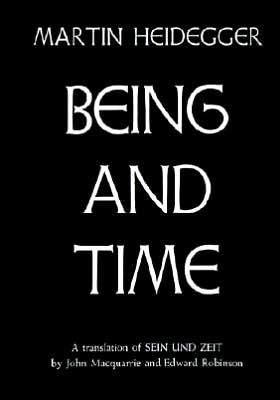
"Being and Time" Quiz

"Being and Time" by Martin Heidegger explores the nature of human existence (Dasein) and seeks to clarify the meaning of Being itself through an analysis of temporality and everyday experience.
philosophy | 589 pages | Published in 1927
Play the quiz
Test your knowledge about the book "Being and Time". We have come up with 9 quiz questions for the book. Hit play and start testing your knowledge. Each correctly answered question gives one point.
9 questions available
Essay questions
These essay questions are meant to be used as a starting point for your essay or research paper.
- Discuss the concept of 'Being-in-the-world' as developed by Heidegger in Being and Time. How does this concept challenge traditional Cartesian dualism?
- Analyze Heidegger’s notion of 'Dasein' and its significance for understanding human existence.
- Explain the importance of 'authenticity' (Eigentlichkeit) in Heidegger’s philosophy. How does one achieve authenticity according to Being and Time?
- Heidegger places great emphasis on the concept of 'Being-towards-death.' How does this idea shape his overall philosophy of existence?
- Compare and contrast Heidegger’s interpretation of 'time' with previous philosophical notions of temporality.
- How does Heidegger critique the 'ontological difference' between Being and beings? Why is this distinction central to his project?
- Discuss the role of 'care' (Sorge) in Being and Time. How does it function as a fundamental structure of Dasein?
- Examine Heidegger’s analysis of 'everydayness' (Alltäglichkeit) and its implications for understanding human experience.
- What is the 'They' (das Man) in Heidegger’s philosophy? How does it relate to concepts of selfhood and conformity?
- Analyze the methodological approach Heidegger employs in Being and Time. How does phenomenology inform his investigation?
- Heidegger claims that the question of the meaning of Being has been neglected in Western philosophy. Assess his reasons for this claim and his proposed solution.
- Discuss the interplay between 'facticity,' 'existentiality,' and 'fallenness' in Heidegger’s existential analytic.
- How does Heidegger’s concept of 'thrownness' (Geworfenheit) contribute to his understanding of human existence?
- Explore the significance of 'temporality' (Zeitlichkeit) for Heidegger’s account of Being. How does temporality shape Dasein’s understanding of itself?
- Critically evaluate the influence of Being and Time on later existentialist and phenomenological thinkers.