
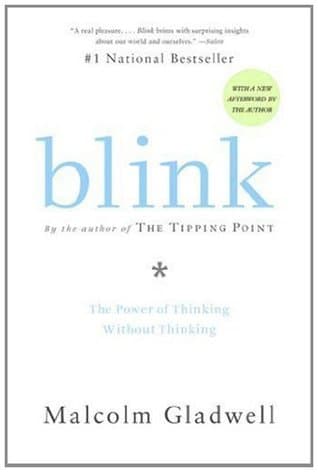
Core Idea
- Difficulty
- Easy
- Read it if
- You are curious about the mechanics of intuition, snap judgments, and unconscious decision-making, and how these processes can be harnessed or misunderstood in everyday life and professional settings.
- Skip it if
- You prefer highly detailed, academic psychological studies, or are looking for a prescriptive, step-by-step guide to improving decision-making rather than a narrative exploration of the topic.
Key Takeaways from Blink
The Power of Thin-Slicing
Our brains make accurate judgments from minimal information in an instant.
Thin-slicing is the unconscious ability to find key information from a small amount of experience. It is the brain's capacity to find patterns and make accurate quick judgments based on seconds of observation, often without us realizing it. This is not guesswork; it is a sophisticated, fast pattern recognition system refined through experience and evolution. Gladwell argues that these instant decisions can be as, or even more, reliable than prolonged, deliberate analysis, especially where deep expertise exists. The quality of these quick judgments depends on an expert's ability to focus on important details and ignore irrelevant information.
“The ability of our unconscious to find patterns in situations and behavior based on very narrow slices of experience.”
In the book: Gladwell details the work of psychologist John Gottman, who can predict with over 90% accuracy whether a marriage will last after observing a couple interact for just a few minutes, identifying key 'Four Horsemen' behaviors (criticism, contempt, defensiveness, stonewalling).
Try this: Trust your gut feelings more, especially in areas where you possess deep expertise. Practice active observation to train your unconscious to pick up on critical cues more effectively. When faced with a decision, quickly identify the absolute essential variables rather than getting bogged down in exhaustive data.
Related ideas: thin-slicing, unconscious-cognition, pattern-recognition
The Locked Door: The Pitfalls of Overthinking
Excessive analysis can hinder, rather than help, effective decision-making.
While thin-slicing is powerful, conscious overthinking often weakens its effectiveness, a phenomenon Gladwell calls 'the locked door.' This refers to times when we have an intuitive understanding or an accurate quick judgment, but our conscious mind, looking for logical reasons or more data, dismisses it. This can lead to worse outcomes, especially in high-pressure or unclear situations. The conscious mind, while good for complex, step-by-step problem-solving, can be a disadvantage when speed and intuitive pattern recognition are most important. The challenge is knowing when to trust intuition and when to think more deeply.
“There are moments, particularly in times of stress, when haste does not make waste, when our snap judgments and first impressions can offer a much more meaningful means of making sense of the world.”
In the book: The unfortunate case of the New Coke launch, where extensive focus group data, designed to analytically assess preferences, failed to capture the nuanced, emotional connection consumers had with the original Coca-Cola, leading to a massive commercial failure.
Try this: Learn to distinguish between situations that require careful deliberation and those where your immediate intuition is likely more accurate. Practice mindfulness to become more aware of your initial reactions before your conscious mind starts to rationalize them away. Don't always feel compelled to explain every decision; sometimes, 'I just know' is a valid reason.
Related ideas: overthinking, cognitive-bias, intuitive-decision-making
The Power of the Unconscious
Our instantaneous judgments often stem from a deeply informed, unconscious process.
Gladwell argues that our quick judgments are not random or magical, but rather the result of a sophisticated, efficient unconscious mind. This 'adaptive unconscious' quickly and silently processes large amounts of information, using our experiences, knowledge, and biases to form immediate conclusions. It is a system built for speed and efficiency, helping us navigate complex social and physical environments without feeling overwhelmed. The quality of this unconscious processing depends heavily on the quality of our experiences and training. Experts, through years of practice, train their unconscious to notice subtle, important cues that novices miss.
“Our unconscious is a powerful force, but it's also a delicate one. It's good at making snap judgments, but it's also susceptible to all kinds of influences.”
In the book: The Getty Museum's acquisition of the 'kouros' statue. Expert art historians and archaeologists immediately felt a 'gut feeling' that it was a fake, despite scientific tests initially suggesting authenticity. Their unconscious had processed subtle cues (e.g., the fingernails, the patina) that didn't align with their vast experience of ancient Greek sculpture.
Try this: Cultivate expertise in your field, as deep knowledge trains your unconscious to make better snap judgments. Pay attention to how your body reacts to situations – sometimes, a physical feeling is your unconscious trying to communicate. Be aware that your unconscious can also harbor biases, so actively seek diverse perspectives to challenge your initial reactions.
Related ideas: adaptive-unconscious, expertise, intuition
The Folly of First Impressions
Initial judgments, while powerful, can be profoundly shaped by subtle and often irrelevant biases.
While thin-slicing can be very accurate, it is not perfect. Gladwell shows how our first impressions, especially of people, can be greatly affected by superficial cues and unconscious biases. Things like appearance, tone of voice, or even a person's name can trigger stereotypes and associations that lead to inaccurate or unfair judgments. These biases operate without our conscious awareness, making them hard to detect and correct. Understanding this vulnerability is important for making fairer and more objective decisions, especially in hiring, legal judgments, or social interactions. The challenge is recognizing when our quick reactions come from real insight versus societal conditioning.
“The first impression can be a powerful thing, but it can also be a misleading thing.”
In the book: The case of Warren Harding, who was elected president largely because he 'looked presidential.' His imposing stature and dignified appearance created a powerful first impression that overshadowed his actual qualifications and intellectual shortcomings, leading to a largely ineffective presidency.
Try this: Actively challenge your first impressions, especially when they involve people. Implement 'blind' processes (e.g., blind auditions, anonymized resumes) where possible to remove superficial cues. Cultivate empathy and seek out information that contradicts your initial assumptions to counteract unconscious biases.
Related ideas: unconscious-bias, first-impressions, stereotypes, prejudice
Structured Spontaneity: The Art of Knowing When to Trust Your Gut
True expertise involves knowing when to rely on intuition and when to pause for analysis.
The book does not advocate for impulsive decision-making; instead, it aims to explain when quick judgments are most reliable. This 'structured spontaneity' is a mark of true expertise. Experts do not just react; they have developed a sophisticated mental framework that lets them instantly interpret complex situations and respond correctly. This framework is built through years of practice and exposure to various scenarios, training the unconscious mind to recognize patterns. The best decision-makers have learned to quickly filter information, identify the few critical signals that matter, and act on them, while others get lost in irrelevant details.
“The key to good decision making is not to make them too quickly, but to make them at the right speed.”
In the book: Firefighters, particularly incident commanders, make life-or-death decisions in chaotic, rapidly evolving situations. They don't have time for extensive deliberation; instead, they rely on 'recognition-primed decision-making,' where their experience allows them to instantly recognize a situation and recall an appropriate response.
Try this: For critical decisions, cultivate deep domain expertise. Engage in deliberate practice that exposes you to a wide range of scenarios, training your intuition. In high-stakes situations, trust your trained gut, but always be prepared to course-correct if new information emerges.
Related ideas: expertise, recognition-primed-decision-making, deliberate-practice
The Importance of Context and Environment
The setting and subtle cues profoundly influence our snap judgments.
Gladwell illustrates how the environment and subtle contextual cues can greatly change our quick judgments and behaviors, often without our conscious awareness. This shows that our quick reactions are not purely internal; they interact deeply with our surroundings. Seemingly minor details, from the order of information presented to background noise, can prepare us to think or act in specific ways. Understanding this environmental influence is important for designing better decision-making processes and for being aware of how external factors might subtly manipulate our perceptions and choices. It highlights the need to be mindful of how we frame a situation.
“Our unconscious thoughts and feelings are not entirely private. They are influenced by the world around us.”
In the book: The controversial shooting of Amadou Diallo, an unarmed man, by four plainclothes NYPD officers. Gladwell suggests that the officers' split-second decision was influenced by a 'priming' effect – the high-stress, dangerous environment of the Bronx at night, combined with the officers' training and expectations, led them to misinterpret Diallo's actions.
Try this: Be mindful of the environment in which you make important decisions; try to create a calm, neutral space. When evaluating situations, consciously consider what external factors might be influencing your perception. Design environments (e.g., meeting rooms, workspaces) to elicit desired behaviors and reduce negative biases.
Related ideas: contextual-influence, environmental-cues, priming-effect
Mind-Reading and the Power of Expression
Subtle non-verbal cues reveal true intentions and emotions.
Our ability to 'mind-read'—to quickly and accurately infer others' thoughts and feelings—is a prime example of thin-slicing in social interactions. Gladwell shows that this skill relies heavily on interpreting subtle, often brief non-verbal cues: microexpressions, body language, tone of voice, and even pauses in speech. These 'thin slices' of behavior can reveal more about a person's true state than their spoken words. Developing this sensitivity is important for effective communication, negotiation, and building strong relationships. It involves training ourselves to notice and correctly interpret these rapid, often unconscious signals.
“The ability to mind-read, to correctly interpret the feelings and intentions of others, is not a magical gift but a skill that can be learned and honed.”
In the book: Psychologist Paul Ekman's work on microexpressions, showing that universal facial expressions of emotion (anger, fear, disgust, surprise, happiness, sadness, contempt) flash across our faces in fractions of a second, often before we're consciously aware of them, and can be accurately read by trained observers.
Try this: Actively observe people's non-verbal cues in conversations – pay attention to their eyes, mouth, posture, and vocal tone. Practice identifying microexpressions. Be aware of your own non-verbal communication and how it might be perceived by others. Engage in active listening to pick up on subtle vocal shifts.
Related ideas: non-verbal-communication, microexpressions, emotional-intelligence
The Tyranny of the Immediate
Fixating on the present can blind us to larger patterns and long-term consequences.
Gladwell subtly warns that while thin-slicing is powerful, relying too much on immediate impressions can lead to missing the broader context or failing to predict future outcomes. Focusing too intensely on the 'now' can prevent us from seeing wider trends or the combined effect of small decisions. This 'tyranny of the immediate' happens when our rapid pattern recognition is so effective at a small level that it fails to zoom out and consider bigger implications. It is a reminder that even the most expert intuition needs to be balanced with a strategic, longer-term view, especially in complex systems where cause and effect are not immediately clear.
“Sometimes, the very thing that makes us good at thin-slicing in one context can make us blind in another.”
In the book: The example of poker players who become exceptionally good at reading tells and making instantaneous decisions based on current game state, but might still struggle with long-term strategic planning or managing their bankroll effectively over many sessions.
Try this: After making a snap judgment, take a moment to consider its potential long-term consequences. Periodically step back from immediate tasks to reflect on the broader context and strategic goals. Don't let short-term 'wins' blind you to potential long-term risks or opportunities.
Related ideas: short-sightedness, strategic-thinking, long-term-perspective
Training the Blink: Cultivating Better Intuition
Our snap judgments can be improved through deliberate practice and feedback.
The good news is that our ability for effective thin-slicing is not fixed; it can be greatly improved. Gladwell emphasizes that developing better intuition involves deliberate practice and getting accurate, timely feedback. This means exposing oneself to a wide range of relevant experiences, actively reflecting on the results of quick judgments, and learning to tell the difference between reliable intuitive hits and mere biases or random guesses. It is about building a strong internal database of patterns and responses, allowing the adaptive unconscious to become more sophisticated and accurate over time. This continuous learning distinguishes true experts from those who simply have a lot of experience.
“The only way to improve our ability to thin-slice is to practice, to make mistakes, and to learn from them.”
In the book: Gladwell's discussion of tennis coaches who can 'read' a player's serve and predict a double-fault before the ball is even hit. This ability is honed through countless hours of observing serves, recognizing subtle tells in body mechanics, and receiving immediate feedback on the outcome of each serve.
Try this: Seek out experiences that challenge your intuition and provide clear feedback. After making a snap decision, reflect on why you made it and what the outcome was. Keep a journal of your intuitive decisions and their results to identify patterns and areas for improvement. Actively seek mentorship from those with highly developed intuition in your field.
Related ideas: deliberate-practice, feedback-loop, intuitive-development
Transparency vs. Accuracy: The Unexplainable Genius
The most accurate snap judgments are often the hardest to rationally articulate.
One of the most thought-provoking ideas in 'Blink' is that the best quick judgments, born from deep expertise and sophisticated thin-slicing, are often the hardest to explain logically. When an expert 'just knows' something, their unconscious has processed many variables and recognized a pattern that would be very difficult, if not impossible, for the conscious mind to explain step-by-step. This creates a tension between the need for transparency (being able to explain a decision) and the pursuit of accuracy (making the best possible decision). Gladwell suggests that in many important fields, we might need to value the accuracy of 'unexplainable genius' over the comfort of fully transparent, but potentially less effective, rationalizations.
“The task of making sense of a split-second decision is not a trivial one.”
In the book: The art experts who instantly recognized the Getty kouros as a fake couldn't immediately pinpoint *why*. They had a gut feeling that something was 'off' based on years of experience, but articulating the precise reasons took time and conscious effort, and even then, it felt incomplete compared to their initial conviction.
Try this: When you have a strong intuitive hit, don't dismiss it just because you can't immediately articulate its logical basis. In team settings, foster an environment where 'gut feelings' from experts are respected, even if they can't be fully explained at first. Learn to trust your own expertise, even when it feels ineffable.
Related ideas: ineffable-knowledge, expert-intuition, transparency-dilemma
Blink Quotes
“The adaptive unconscious is like a giant computer that quickly and quietly processes a lot of information for us, and the computer is designed to do a specific job.”
“We have, as human beings, a storytelling problem. We're a bit too quick to come up with explanations for things we don't really have an explanation for.”
“Our unconscious is a powerful force. But it's also a delicate one. It's good at what it does only if we respect its limits.”
“The key to good decision making is not knowledge. It is understanding. We are drowning in information, while starving for wisdom.”
“Truly successful decision making relies on a balance between deliberate and instinctive thinking.”
“The first two seconds of looking at a work of art are what matter most.”
“When we thin-slice, we are taking a very narrow slice of experience and making a judgment from it.”
“We often know more than we can tell.”
“Sometimes the best way to solve a problem is to not think about it.”
“The power of the blink is that it is not about what we say, but about what we don't say.”
“The really good decision makers are the ones who know how to manage their blink.”
“To be good at thin-slicing, you have to be able to filter out the irrelevant and focus on the relevant.”
“We have been taught that the best way to arrive at a decision is to gather as much information as possible and to spend as much time as possible in careful consideration.”
“The truth about snap judgments is that they are not always wrong. In fact, sometimes they are more accurate than careful deliberation.”
Quiz
10 questions on the main ideas. Each answer comes with a short explanation.
Question 1
According to Gladwell in 'Blink,' what is the primary ability that great decision-makers have perfected?
- The ability to gather and analyze the most comprehensive data sets.
- The art of 'thin-slicing,' filtering essential information from a multitude of variables.
- The skill of deliberating over choices for extended periods to ensure accuracy.
- The capacity to explain their intuitive decisions logically to others.
Show answer
B. The art of 'thin-slicing,' filtering essential information from a multitude of variables. Gladwell argues that great decision-makers excel at 'thin-slicing,' which involves quickly extracting the most crucial information from complex situations, rather than processing all available data.
Question 2
Which of the following is NOT presented as a failure of 'blink' in the book?
- The election of Warren Harding.
- The launch of 'New Coke'.
- The shooting of Amadou Diallo by police.
- The success of the Volkswagen Beetle.
Show answer
D. The success of the Volkswagen Beetle. The book explicitly lists the election of Warren Harding, 'New Coke,' and the shooting of Amadou Diallo as examples of the failures of 'blink' or snap judgments. The Volkswagen Beetle is not mentioned in this context.
Question 3
What kind of expert is mentioned in 'Blink' who can recognize a fake antiquity at a glance, demonstrating the power of rapid cognition?
- A forensic art analyst.
- An art historian specializing in provenance.
- An antiquities expert.
- A restoration specialist.
Show answer
C. An antiquities expert. Gladwell describes antiquities experts who possess an intuitive ability to discern genuine artifacts from fakes almost instantly, highlighting the concept of 'thin-slicing' in action.
Question 4
Gladwell introduces a psychologist who can predict the longevity of a marriage based on a very brief observation of a couple. What specific method or observation is central to this psychologist's predictive power?
- Analyzing their financial stability and joint assets.
- Observing specific 'Four Horsemen' of destructive communication patterns.
- Reviewing their individual personality test results.
- Assessing their shared hobbies and interests.
Show answer
B. Observing specific 'Four Horsemen' of destructive communication patterns. The psychologist, John Gottman, is highlighted for his ability to predict marital success by observing specific negative communication patterns, which he termed the 'Four Horsemen' (criticism, contempt, defensiveness, and stonewalling), during short interactions.
Question 5
The book discusses how our unconscious mind processes information rapidly. What term does Gladwell use to describe this kind of rapid, intuitive decision-making?
- Cognitive overload.
- Deliberate analysis.
- Thinking without thinking.
- Analytical reasoning.
Show answer
C. Thinking without thinking. The subtitle of the book itself is 'The Power of Thinking Without Thinking,' directly referring to the rapid, intuitive, and often unconscious decision-making processes that Gladwell explores.
Question 6
Gladwell argues that sometimes the best decisions are those that are impossible to explain to others. What implication does this have for traditional business decision-making processes?
- It validates the importance of always having a detailed, logical rationale for every decision.
- It suggests that relying solely on explicit, data-driven explanations can sometimes hinder effective decision-making.
- It promotes a culture where only charismatic leaders can make decisions.
- It implies that all decisions should be made purely on gut feeling without any data.
Show answer
B. It suggests that relying solely on explicit, data-driven explanations can sometimes hinder effective decision-making. Gladwell's point is that highly effective intuitive decisions, based on expertise and 'thin-slicing,' may not always have a clear, step-by-step logical explanation. This challenges traditional business environments that demand explicit justifications for all choices, suggesting that an over-reliance on such explanations can sometimes obscure the validity of good snap judgments.
Question 7
In the context of 'Blink,' what is the danger of 'overthinking' or prolonged deliberation when faced with certain types of decisions?
- It always leads to a more accurate and well-informed decision.
- It can sometimes obscure the crucial patterns identified by the unconscious mind, leading to worse outcomes.
- It is only problematic for simple, trivial choices, not complex ones.
- It ensures that all possible biases are eliminated from the decision-making process.
Show answer
B. It can sometimes obscure the crucial patterns identified by the unconscious mind, leading to worse outcomes. Gladwell argues that in many situations, particularly those requiring rapid insight from expertise, overthinking can interfere with the intuitive judgments of the unconscious mind, leading to confusion or even incorrect decisions by focusing on irrelevant details.
Question 8
The book explores how experts develop their 'blink' abilities. What is a crucial element Gladwell emphasizes for cultivating this powerful intuition?
- Minimizing exposure to diverse experiences to avoid confusion.
- Engaging in extensive, repetitive practice and exposure within a specific domain.
- Relying solely on innate talent without the need for formal training.
- Actively suppressing emotional responses during decision-making.
Show answer
B. Engaging in extensive, repetitive practice and exposure within a specific domain. Gladwell consistently shows that the 'blink' ability of experts, whether it's a tennis coach or an art expert, is not merely innate but cultivated through years of intense practice, exposure, and experience in their specific field, allowing their unconscious to recognize patterns instantly.
Question 9
One of the key arguments in 'Blink' is that our unconscious mind can sometimes be more rational than our conscious mind. What does Gladwell suggest is a potential downside or bias of our conscious, deliberate thought processes?
- It is always perfectly objective and free from external influences.
- It is prone to being overwhelmed by too much information or getting sidetracked by irrelevant details.
- It consistently makes decisions faster than the unconscious mind.
- It lacks the ability to learn from past experiences.
Show answer
B. It is prone to being overwhelmed by too much information or getting sidetracked by irrelevant details. Gladwell illustrates that while our conscious mind is powerful, it can be easily overwhelmed by excessive information or distracted by details that aren't critical, leading to poorer decisions than the unconscious, which can 'thin-slice' and focus on what truly matters.
Question 10
Considering the lessons from 'Blink,' how might a business leader best apply the concept of 'thin-slicing' to improve hiring decisions?
- By conducting extremely long, multi-day interview processes with numerous panel members.
- By focusing on a few critical, predictive indicators observed early in an interaction, rather than an exhaustive list of qualifications.
- By ignoring all subjective impressions and relying solely on quantifiable metrics.
- By having a strict, standardized script for all interviews that leaves no room for improvisation.
Show answer
B. By focusing on a few critical, predictive indicators observed early in an interaction, rather than an exhaustive list of qualifications. Applying 'thin-slicing' to hiring would involve training interviewers to identify a few truly predictive signals or patterns in candidates early on, rather than trying to process every piece of information or adhere to overly rigid processes. This leverages intuitive expertise.
Blink FAQ
What is 'thin-slicing' as discussed in Blink?
'Thin-slicing' refers to our ability to find patterns in events based on very narrow slices of experience. It's the unconscious process of filtering essential information from a vast amount of data, allowing for rapid and often accurate judgments.
Does intuition always lead to good decisions?
While intuition can be incredibly powerful and accurate, it's not infallible. Gladwell highlights instances where 'blink' judgments fail, often due to biases, lack of relevant experience, or misinterpretations of subtle cues. Understanding its limitations is as important as recognizing its strengths.
How is Blink different from 'The Tipping Point'?
While both books explore hidden patterns in human behavior, 'The Tipping Point' focuses on how ideas and trends spread rapidly. 'Blink' shifts the focus inward, examining the hidden psychology behind our immediate, unconscious decisions and the power of first impressions.
Can I improve my 'blink' decision-making skills?
Yes, Gladwell suggests that improving 'blink' skills involves gaining expertise in a specific domain, learning to recognize truly relevant information, and being aware of potential biases. Practice and focused experience can refine your unconscious decision-making abilities.
What are some examples of successful 'blink' decisions discussed in the book?
The book features compelling examples such as the art experts who instantly identified a fake ancient Greek statue and the psychologist who could predict marital success based on short observations. These cases illustrate the power of rapid, unconscious assessment.
Are there situations where 'thinking without thinking' is detrimental?
Absolutely. Gladwell presents cases like the shooting of Amadou Diallo and the failure of New Coke where rapid cognition led to errors due to prejudice, incomplete information, or miscontextualization. These instances highlight the dangers of relying solely on intuition without critical awareness.
How can businesses apply the concepts from Blink?
Businesses can leverage 'Blink' by understanding the importance of first impressions in customer interactions, designing intuitive user experiences, and trusting the trained instincts of experienced professionals. It also encourages creating environments where 'thin-slicing' can be effective and unbiased.
Does 'Blink' suggest that deep analysis is unnecessary?
Not entirely. 'Blink' argues that for certain types of problems, particularly those requiring rapid judgment based on expertise, extensive analysis can actually hinder good decision-making. However, it also acknowledges that complex problems still benefit from careful, deliberate thought, especially in setting the stage for effective intuition.
What is the role of expertise in 'thinking without thinking'?
Expertise is crucial for effective 'thinking without thinking.' It allows individuals to develop a vast internal database of patterns and cues, enabling them to 'thin-slice' accurately and make rapid, informed judgments in their field without conscious deliberation.
About the author
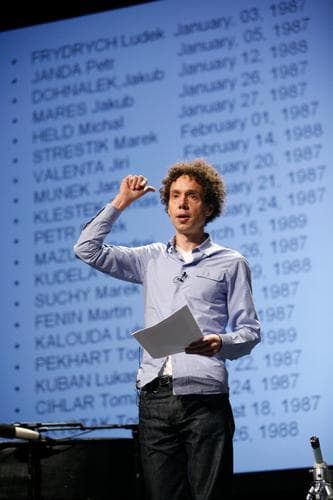
Malcolm Gladwell is a Canadian journalist and author known for his exploration of social science and human behavior. His notable works include "The Tipping Point," which examines how small actions can lead to significant changes, and "Outliers," which investigates the factors contributing to high levels of success. Other influential titles include "Blink," "David and Goliath," and "Talking to Strangers."
Similar books
- Outliers: The Story of Success
Malcolm Gladwell
4.2 (556k) average on GoodreadsBusinessAnother Gladwell book that explores hidden patterns and factors influencing success, using narrative examples to illustrate social science concepts.
- Steve Jobs
Walter Isaacson
4.1 (957k) average on GoodreadsBusinessSteve Jobs was a visionary who fused creativity and technology to revolutionize six industries and shape our digital world.
- Freakonomics: A Rogue Economist Explores the Hidden Side of Everything
Steven D. Levitt
4.0 (709k) average on GoodreadsBusinessThis book uses economic principles to reveal the surprising incentives behind everything from drug dealing and real estate to cheating teachers and the decline of crime.
- The Tipping Point: How Little Things Can Make a Big Difference
Malcolm Gladwell
4.0 (690k) average on GoodreadsBusinessMalcolm Gladwell explains how small, targeted actions can start widespread changes in trends, behaviors, and ideas.
- The Subtle Art of Not Giving a F*ck: A Counterintuitive Approach to Living a Good Life
Mark Manson
3.9 (530k) average on GoodreadsBusinessEmbrace your flaws and stomach life's lemons, because true happiness isn't about relentless positivity, but about choosing what truly matters to give a f*ck about.
- The 7 Habits of Highly Effective People: Powerful Lessons in Personal Change
Stephen R. Covey
4.1 (524k) average on GoodreadsBusinessThis book presents seven habits that help people live more effective, purposeful lives.






Enjoyed the summary?
A summary gives you the shape of the book. The book itself has the detail, the examples and the voice.
Find Blink on AmazonAs an Amazon Associate, BookBrief earns from qualifying purchases. How we're funded