

Synopsis
Covers the whole plot, including the ending.
- Difficulty
- Medium
- Pacing
- Moderate
- Mood
- Thought-provoking, Dark, Speculative, Intense, Philosophical
- Read it if
- You enjoy thought-provoking science fiction exploring complex social issues, unique alien biologies, and the human condition.
- Skip it if
- You prefer light-hearted or fast-paced action-oriented sci-fi, or are uncomfortable with themes of bodily horror, societal breakdown, and ethical ambiguity.
Bloodchild and Other Stories Plot Summary
Covers the whole plot, including the ending.
Bloodchild: Gan's Fear and Duty
On the Tlic Preserve, a human colony on an alien planet, Gan, a young Terran male, lives under the protection of the Tlic, an insect-like alien species. He is chosen to host the eggs of T'Gatoi, a high-ranking Tlic. The story begins with Gan's growing fear as the time for his 'joining' nears. He sees another male Terran, Bram Lomas, suffering greatly during childbirth, which makes his own fear stronger. T'Gatoi, Gan's protector, tries to reassure him, stressing the honor and need for their shared relationship. Gan's sister, Qui, also prepares for her role as a host, though with less fear than her brother. The Terrans depend on the Tlic for survival, having been saved from a dying Earth, but this comes at the cost of their reproductive freedom.
Bloodchild: The Birth and the Choice
The day for Gan's implantation arrives. He watches Lomas, a male Terran, in extreme pain as T'Gatoi removes the mature larvae from his body. The sight of the moving larvae and the open wound deeply traumatizes Gan, increasing his resistance. He briefly considers suicide to escape his fate. T'Gatoi, sensing his distress, offers him a choice: she will implant him, or she will implant his younger sister, Qui, instead. This manipulation forces Gan to face his responsibilities and his love for his family. In the end, he chooses to accept the implantation himself, driven by a desire to protect Qui and maintain their delicate balance with the Tlic. He understands this is a necessary sacrifice for his people's survival.
Speech Sounds: Rye's Isolated World
In a post-apocalyptic Los Angeles, a mysterious illness has left most of humanity unable to speak, read, or write, reducing communication to gestures and grunts. Rye, a woman who still understands some language, lives alone, always cautious of the random, violent outbursts that mark human interaction. The lack of communication has caused widespread aggression and a breakdown of social rules. She longs for connection and information, but the world offers little of either. Her days are spent isolated, broken by brief, tense meetings with others, where misunderstandings often turn violent. She carries a gun for self-defense, a necessity in this brutal new world where simple interactions can become deadly.
Speech Sounds: A Glimmer of Connection
While on a bus, Rye meets Obsidian, a man who, like her, seems to have a higher level of thought than most. He can communicate with some complexity, though still limited, and shows a surprising gentleness. Their shared ability to understand and express themselves, even imperfectly, sparks a careful hope in Rye. They find comfort in each other's presence, a rare thing in their silent world. Obsidian offers her protection and a feeling of belonging she hasn't had in years. This meeting is a turning point for Rye, as she begins to believe that real human connection might still be possible, even amid the widespread devastation of their society. They begin to travel together, seeking a safer place.
Speech Sounds: Tragedy and a New Beginning
Rye and Obsidian's journey together ends tragically when they see a violent fight between two other people. Obsidian tries to stop the situation but is fatally wounded. Rye, heartbroken by his loss, is left alone again. However, she then finds two children who seem to be Obsidian's, also affected by the disease but showing some clarity. Despite her grief, Rye feels an immediate urge to protect them. She decides to take them in, seeing the potential for a new kind of family and a renewed sense of purpose. This act of kindness offers a small sign of hope for the future, suggesting that even with great loss, humanity's ability to care remains.
Amnesty: Noah's Interrogation
Noah, a human woman, is being questioned by representatives of a human corporation, the Corporate, who are suspicious of her close ties to the alien Gaal. The Gaal are an insect-like species who have settled on Earth, offering humans a symbiotic, though controlling, existence. Noah explains that the Gaal took her as a child and raised her, teaching her their language and customs. This experience has given her a unique understanding of their motives and biology, making her a valuable, yet mistrusted, go-between. The Corporate sees the Gaal as invaders and Noah as a possible traitor, questioning her loyalty and the true nature of her relationship with the aliens. Noah's testimony is a defense of her choices and a plea for understanding between the two species.
Amnesty: The Gaal's Symbiosis
Noah describes how the Gaal bring humans into their society. Humans are 'paired' with a Gaal, forming a deep mental and emotional bond. This bond offers humans protection, food, and a sense of belonging, but at the cost of some individual freedom. Humans are also physically changed, gaining better senses and abilities, but becoming dependent on the Gaal. Noah stresses that the Gaal, though alien, are not evil; they are driven by a strong instinct for survival and expansion. She argues that the Gaal's presence gives humanity a chance to adapt and evolve, rather than face extinction. Her story challenges the human view of the Gaal as purely hostile, highlighting the complex, co-dependent nature of their relationship. She explains the good and bad parts of this partnership.
Amnesty: Bridging Two Worlds
Noah, now a respected leader among the humans who live with the Gaal, acts as a link between the two species. She understands that both humans and Gaal are vulnerable and that their survival is connected. She advocates for mutual understanding and respect, arguing that continued conflict will only cause more suffering. Her experiences allow her to see the humanity in the Gaal and the alienness in some human reactions. She highlights the Gaal's ability to offer a unique form of healing and connection that humans cannot provide for themselves. The story ends with her efforts to create lasting peace, one that recognizes the sacrifices made by both sides and embraces the possibility of a shared future, despite their deep differences. She works to prevent more human-Gaal conflict.
The Book of Martha: God's Challenge
Martha, a solitary writer, is visited by God, who gives her an extraordinary and difficult task: to save humanity from its self-destructive ways. God explains that humanity is headed for unavoidable destruction, driven by its flaws, and Martha is chosen to create a plan to stop this. Martha is at first overwhelmed and doubtful, asking why she, an ordinary person, has been chosen for such an impossible mission. God assures her that she has the unique perspective and empathy needed. This divine intervention forces Martha to confront not only the huge problems facing humanity but also her own beliefs about good, evil, and free will. She has a limited time to come up with a workable solution.
The Book of Martha: The Burden of Choice
Martha struggles with the huge responsibility given to her. She considers different approaches, from subtle changes to more drastic actions, each with its own ethical problems. She questions whether 'saving' humanity means keeping it in its current form, or if a more drastic change is needed. She debates the morality of taking away human free will, even if it leads to a more peaceful existence. Martha also wrestles with her own biases and limits, realizing that any solution she creates will be subjective. Her inner conflict shows the complexities of large-scale altruism and the difficulty of defining universal good. She spends days and nights agonizing over her decision, consulting her own moral compass.
The Book of Martha: A Modest Proposal
After much thought, Martha presents her plan to God. Instead of a grand, sweeping change, she suggests a more subtle, yet deep, intervention: to gently improve humanity's capacity for empathy and connection. Her plan involves a gradual, almost unnoticeable shift in human psychology, encouraging people to understand and value each other more deeply. She believes that true salvation comes not from forced obedience, but from fostering real compassion and a shared sense of responsibility. God accepts her proposal, acknowledging its elegance and its respect for human choice. Martha's solution shows her belief in humanity's potential for good, even with its flaws, and her understanding that lasting change comes from within.
The Evening and the Morning and the Night: Lynn's Affliction
Lynn, a young woman, lives with 'Duryea-Gode Disease' (DGD), a genetic condition that causes sufferers to compulsively mutilate themselves. The disease appears in late adolescence, leading to a life of pain, isolation, and constant watchfulness against self-harm. Lynn's parents, who are carriers, struggle with guilt and the burden of caring for their afflicted daughter. Society views DGD sufferers with fear, often separating them. Lynn and other 'Duryeas' are often institutionalized or live in special communities, constantly monitored to prevent them from harming themselves. Lynn tries to find meaning and control in her life despite the constant threat of the disease, seeking ways to manage her impulses and connect with others who understand her struggle.
The Evening and the Morning and the Night: The 'Slaughterhouse'
Lynn works at a facility nicknamed the 'Slaughterhouse,' a place where advanced DGD sufferers, unable to control their urges, are cared for. Despite the grim reality of her job, Lynn finds a strange sense of belonging among those who share her illness. She learns to cope with the disturbing sights and sounds, finding empathy for the residents. Through her work, she gains a deeper understanding of the disease's progression and its devastating impact. The facility also acts as a community for those with DGD, offering a shared experience and solidarity that is missing in the outside world. Lynn's work is a form of self-therapy, allowing her to face her own fears about the future of her disease.
The Evening and the Morning and the Night: A Glimmer of Hope
Despite the bleakness of DGD, Lynn discovers that some sufferers, especially those in advanced stages, can turn their compulsive urges into a unique form of abstract, self-referential art. This unexpected development offers a deep sense of hope and beauty amid the suffering. Lynn recognizes the artistic value and emotional depth in these creations, seeing them as a sign of the enduring human spirit. She begins to advocate for the recognition and preservation of this art, believing it can offer a new understanding of DGD and a way for sufferers to express themselves beyond their disease. This discovery gives Lynn a new purpose, changing her view of DGD from a purely destructive force to one that can, surprisingly, encourage creativity.
Bloodchild and Other Stories Characters
Gan
Protagonist
A young Terran man chosen to host Tlic eggs in 'Bloodchild'.
Gan is a sensitive and intelligent young Terran male living on a Tlic Preserve. He is deeply devoted to his family, particularly his sister Qui, and to T'Gatoi, his Tlic protector and surrogate mother. He is initially terrified of the 'joining' ceremony, where he will be implanted with Tlic eggs, due to the pain and the perceived loss of control. His internal conflict stems from his primal fear of the alien process versus his understanding of its necessity for his people's survival. He is observant and empathetic, capable of both deep revulsion and profound understanding.
Relationships: T'Gatoi (Symbiotic partner, surrogate mother, protector); Qui (Younger sister, whom he protects); Bram Lomas (Fellow Terran, whose suffering he witnesses)
T'Gatoi
Supporting
A high-ranking Tlic who partners with Gan in 'Bloodchild'.
T'Gatoi is a powerful and ancient Tlic, an intelligent, insect-like alien. She is Gan's protector and surrogate mother, embodying both the alien and maternal aspects of the Tlic-Terran symbiosis. She genuinely cares for Gan and his family, but her actions are driven by the biological imperative of her species and the need to maintain the delicate balance of their co-existence. She is patient, manipulative, and deeply wise, understanding the fears of the Terrans while also ensuring the survival of her own kind. She represents the complex morality of survival and the blurring lines between predator and protector.
Relationships: Gan (Symbiotic partner, 'son' figure); Terrans (Protected species, hosts for her kind)
Rye
Protagonist
A woman navigating a silent, violent world in 'Speech Sounds'.
Rye is a resilient and observant woman living in a post-apocalyptic Los Angeles where most people have lost the ability to speak or read. She retains some of her cognitive and linguistic abilities, which makes her both unique and isolated. She is pragmatic and self-reliant, carrying a gun for protection, but also deeply longs for connection and understanding. Her experiences have made her wary, but she still possesses a capacity for empathy and hope. She represents the enduring human spirit in the face of profound societal collapse and the desperate need for communication.
Relationships: Obsidian (Brief romantic and intellectual partner); Children (Obsidian's) (Adopted charges, new family)
Obsidian
Supporting
A man who connects with Rye in 'Speech Sounds'.
Obsidian is a man who, like Rye, has retained some of his linguistic and cognitive faculties after the plague. He is calm, gentle, and capable of a deeper level of communication than most in their ravaged world. His presence offers Rye a rare sense of hope and connection. He is protective and empathetic, willing to intervene in conflicts, even at great personal risk. He represents the potential for humanity to rebuild and reconnect, even in the most dire circumstances. His brief appearance is pivotal in Rye's journey, showing her that genuine connection is still possible.
Relationships: Rye (Brief romantic and intellectual partner); Children (His likely children, whom Rye later protects)
Noah
Protagonist
A human liaison between humanity and the alien Gaal in 'Amnesty'.
Noah is a human woman who was 'paired' with the alien Gaal as a child, giving her a unique, hybridized perspective. She serves as a crucial, yet mistrusted, intermediary between the two species. She is intelligent, articulate, and deeply empathetic, capable of understanding both human fear and Gaal motivations. Her experiences have given her enhanced senses and a profound understanding of symbiosis. She is driven by a desire for peace and mutual understanding, constantly navigating the prejudices and suspicions of both sides. She embodies the challenges and possibilities of interspecies communication and co-existence.
Relationships: The Gaal (Symbiotic partners, adoptive species); The Corporate (Humans) (Skeptical interrogators, opposing faction)
Martha
Protagonist
A writer chosen by God to save humanity in 'The Book of Martha'.
Martha is a solitary and thoughtful writer, chosen by God to devise a plan to save humanity from its self-destructive path. She is intelligent, introspective, and possesses a strong moral compass. Initially overwhelmed by the impossible task, she grapples with the ethical dilemmas of divine intervention and the true meaning of 'saving' humanity. She is a deep thinker, carefully considering the long-term consequences of any action. Martha represents the power of individual thought and the immense burden of responsibility, but also the potential for subtle, profound solutions to grand problems.
Relationships: God (Divine authority, taskmaster)
Lynn
Protagonist
A young woman living with a self-mutilating genetic disease in 'The Evening and the Morning and the Night'.
Lynn is a young woman afflicted with Duryea-Gode Disease (DGD), a genetic condition that causes compulsive self-mutilation. She is resilient, introspective, and determined to find meaning and control in a life defined by pain and societal stigma. She works in a facility for advanced DGD sufferers, seeking understanding and a sense of belonging among those who share her fate. Lynn possesses a keen artistic sensibility, eventually discovering a unique form of expression within the DGD community. She embodies the struggle for dignity and purpose in the face of an incurable, devastating illness.
Relationships: Her Parents (Guilty, protective, also carriers); Other Duryeas (Fellow sufferers, community)
Duryeas (collective)
Supporting
Individuals suffering from Duryea-Gode Disease.
The 'Duryeas' are the collective term for individuals afflicted with Duryea-Gode Disease (DGD), a genetic condition causing compulsive self-mutilation. They represent a marginalized and feared segment of society, often segregated or institutionalized due to the disturbing nature of their illness. Despite their suffering, some Duryeas, particularly in advanced stages, find a unique and profound way to channel their compulsions into a form of abstract art. They symbolize the enduring human spirit's capacity for creation even amidst profound destruction, and the societal challenge of understanding and integrating those who are different.
Relationships: Lynn (Fellow sufferer, and their advocate)
Bloodchild and Other Stories Themes
Symbiosis and Co-dependence
This theme explores the complex, often uncomfortable, relationships where two species or individuals rely on each other for survival. It blurs the lines between protector and dependent, highlighting the sacrifices needed for mutual existence. In 'Bloodchild,' the Terrans' survival on the Tlic Preserve depends entirely on their agreement to host Tlic eggs, a gruesome but necessary exchange. Noah in 'Amnesty' shows this, having been 'paired' with a Gaal, gaining benefits but losing some control. These stories question if such relationships are true partnerships or a form of kind control, and if a species can truly be free when its existence is tied to another.
“You are my family. You are my children. You are my people. I am your Tlic. And you are my Terran.”
The Nature of Humanity and Communication
Butler often examines what defines humanity, especially when facing extreme situations or alien contact. The loss or change of communication is a key part. In 'Speech Sounds,' the inability to speak or read takes away humans' basic tools for connection, leading to widespread violence and a return to primal instincts. Rye's struggle to connect and her bond with Obsidian highlight the basic human need for understanding. Noah in 'Amnesty' represents a new kind of human, one able to bridge large communication and biological gaps, suggesting that humanity's definition is flexible and adaptable.
“Sometimes I wonder if it isn't better to be one of the silent ones. At least they don't know what they're missing.”
Survival and Adaptation
A repeated theme is the strong drive to survive and the often drastic changes needed to do so. Whether it's the Terrans in 'Bloodchild' accepting a parasitic relationship, or humanity in 'Speech Sounds' turning to primal communication and violence, Butler shows how far life will go to continue. Noah in 'Amnesty' represents an extreme change, becoming a hybrid being to ensure her people's future. These stories highlight that survival often demands compromises, moral uncertainties, and transformations that challenge old ideas of self and species. It is about evolving, not just enduring.
“We are a people who have survived by becoming something new.”
Empathy and Connection Across Difference
Despite the darkness, Butler consistently explores the potential for empathy and understanding, even across big biological or psychological differences. Gan's complex relationship with T'Gatoi, where fear slowly gives way to a form of love and understanding, is central to 'Bloodchild.' Rye's brief but deep connection with Obsidian in 'Speech Sounds' offers a glimmer of hope in a world without it. Martha's solution in 'The Book of Martha' is specifically to improve human empathy. This theme suggests that real connection, even with those very different, is humanity's greatest strength and perhaps its only path to salvation.
“It was as though she had always known him, had always been waiting for him.”
The Ethics of Intervention and Control
Butler's stories often look at the moral complexities of controlling or interfering in the lives of others, whether for their 'own good' or for a species' survival. In 'Bloodchild,' the Tlic control the Terrans' reproduction and existence, a kind but absolute power. Martha in 'The Book of Martha' deals with the ultimate ethical problem of interfering with humanity's free will to save it. The Corporate in 'Amnesty' tries to control Noah and the Gaal-human relationship. These stories make readers consider the reasons for, and results of, using power over others, even with good intentions.
“Who are you to decide what is good for all of humanity?”
Plot Devices & Literary Techniques
Symbiotic Relationship
A mutually beneficial, yet often unsettling, co-existence between different species.
This device is central to 'Bloodchild' and 'Amnesty.' In 'Bloodchild,' the Terrans provide hosts for Tlic eggs, while the Tlic provide protection and a home. This is framed as a necessary survival mechanism but is deeply unsettling due to the Tlic's parasitic nature. In 'Amnesty,' humans 'pair' with the Gaal, gaining enhanced abilities and protection but becoming dependent. This device allows Butler to explore themes of co-dependence, sacrifice, and the blurring lines between freedom and subjugation, forcing characters and readers to question the true nature of 'mutual benefit' when one party holds significantly more power.
Post-Apocalyptic Setting
A world ravaged by a catastrophic event, forcing humanity to adapt or perish.
Used prominently in 'Speech Sounds,' the post-apocalyptic setting, brought about by a mysterious plague that destroys language, serves to strip humanity down to its most basic elements. This allows Butler to examine fundamental questions about communication, social order, and the human capacity for both violence and connection when societal structures collapse. The ravaged landscape and the constant threat of violence amplify the characters' struggles and make any glimmer of hope or connection profoundly impactful, highlighting the fragility of civilization and the enduring strength of the human spirit.
Genetic Mutation/Disease
A biological alteration that profoundly impacts individuals and society.
In 'The Evening and the Morning and the Night,' the Duryea-Gode Disease (DGD) is a genetic condition causing compulsive self-mutilation. This device creates immediate conflict for the protagonist, Lynn, and for society's perception of those afflicted. It allows Butler to explore themes of bodily autonomy, societal stigma, the search for dignity amidst suffering, and the unexpected ways in which people can find meaning and even art within their affliction. The disease acts as both a literal and metaphorical barrier, forcing characters to confront the limits of control over their own bodies and destinies.
Divine Intervention
A supernatural force directly influences human affairs, often with a specific task.
This device is the core of 'The Book of Martha,' where God appears to Martha and tasks her with saving humanity. It allows Butler to explore grand philosophical and ethical questions about free will, destiny, and the nature of good and evil on a cosmic scale. By giving an ordinary individual such immense power and responsibility, the story delves into the psychological burden of playing God and the complexities of defining and achieving 'salvation' for an entire species. It provides a unique lens through which to examine humanity's flaws and potential for redemption.
Bloodchild and Other Stories Quotes
“I was of age, but I was not ready.”
“We were not meant to be free. We were meant to be useful.”
“Love is a drug, and I am an addict.”
“Embrace difference. Embrace change. But do not embrace violence.”
“Nothing ever goes away until it teaches us what we need to know.”
“To survive, you must be able to adapt. To adapt, you must be able to think.”
“Power always thinks it has a great soul and vast views beyond the comprehension of the weak.”
“We are a questioning species, always asking 'why?'”
“Knowledge is a deadly weapon, if you use it wrong.”
“The only way to make a new world is to break the old one.”
“We're all just trying to make sense of the chaos, one way or another.”
“There are no monsters, only people who are afraid.”
“The past is a ghost that haunts the present.”
“To deny what you are is to deny life itself.”
Quiz
10 questions on the plot and the characters. Each answer comes with a short explanation.
Question 1
In the story 'Bloodchild,' what is the primary reason the Tlic keep humans (Terrans) on their preserve?
- As companions and laborers for their homes.
- To serve as hosts for their parasitic larvae.
- For scientific study of human biology.
- To protect them from other alien species.
Show answer
B. To serve as hosts for their parasitic larvae. The Tlic use humans as hosts for their eggs, which hatch into larvae that consume the host from the inside, a process that is both symbiotic and horrifying.
Question 2
Which of the following awards did the story 'Bloodchild' win?
- Locus Award and World Fantasy Award
- Hugo Award and Nebula Award
- Philip K. Dick Award and British Science Fiction Award
- Mythopoeic Award and Arthur C. Clarke Award
Show answer
B. Hugo Award and Nebula Award As mentioned in the book's description, 'Bloodchild' is a New York Times Notable Book and won both the Hugo and the Nebula awards.
Question 3
In 'Speech Sounds,' what affliction has spread across humanity?
- A disease that causes blindness and deafness.
- A neurological condition that impairs speech and literacy.
- A plague that reduces physical strength and coordination.
- A mental illness that causes extreme paranoia and aggression.
Show answer
B. A neurological condition that impairs speech and literacy. The central premise of 'Speech Sounds' is a pandemic that has stripped most of humanity of their ability to speak, read, and write, leading to a breakdown of society.
Question 4
What is the primary theme explored in the story 'The Book of Martha'?
- The ethics of genetic engineering.
- The burden and responsibility of divine power.
- The search for extraterrestrial life.
- The consequences of technological advancement.
Show answer
B. The burden and responsibility of divine power. Martha is granted the ability and responsibility by God to save humanity from itself, forcing her to grapple with immense power and the ethical dilemmas it presents.
Question 5
In 'Amnesty,' what is Noah's role in the relationship between humans and the alien species, the Communities?
- She is a warrior leading the human resistance against them.
- She is a diplomat and translator, negotiating their co-existence.
- She is a scientist studying their biological weaknesses.
- She is a captive being experimented on by the aliens.
Show answer
B. She is a diplomat and translator, negotiating their co-existence. Noah works to bridge the gap between humans and the Communities, understanding both sides after having lived with the aliens, making her a crucial negotiator.
Question 6
What common characteristic defines the alien species in 'Bloodchild' and 'Amnesty' regarding their interaction with humans?
- They are entirely benevolent and protective of humans.
- They are purely hostile, seeking to eradicate humanity.
- They establish a co-dependent, often exploitative, relationship with humans.
- They are indifferent to humans, avoiding all contact.
Show answer
C. They establish a co-dependent, often exploitative, relationship with humans. Both the Tlic in 'Bloodchild' and the Communities in 'Amnesty' form relationships with humans that are characterized by mutual reliance, but often with the aliens holding more power or using humans for their own biological needs.
Question 7
In 'Speech Sounds,' what specific social consequence arises from the loss of communication abilities?
- The formation of highly advanced telepathic communities.
- A return to pre-industrial farming societies.
- Widespread violence, chaos, and the breakdown of societal order.
- The development of new, complex sign languages universally.
Show answer
C. Widespread violence, chaos, and the breakdown of societal order. Without the ability to communicate effectively, people resort to primal instincts, leading to frequent misunderstandings, frustration, and outbursts of violence.
Question 8
What unique physical characteristic do the Tlic in 'Bloodchild' possess that is crucial to their reproductive cycle?
- They have wings that allow them to fly long distances.
- They have multiple arms and legs, making them highly agile.
- They possess an ovipositor, a tube used to implant eggs into hosts.
- Their skin changes color to camouflage with their surroundings.
Show answer
C. They possess an ovipositor, a tube used to implant eggs into hosts. The ovipositor is a key anatomical feature of the Tlic, allowing them to inject their eggs directly into human hosts for gestation.
Question 9
Considering the collection's overall tone and Butler's authorial stance as described, which of the following best encapsulates a recurring thematic element across these stories?
- The inherent goodness of humanity and its potential for utopia.
- The inevitable triumph of reason and scientific progress over adversity.
- The fragility of societal order and the complex, often dark, aspects of human nature.
- The simple beauty of nature and humanity's harmonious place within it.
Show answer
C. The fragility of societal order and the complex, often dark, aspects of human nature. The description highlights Butler as an 'unblinking pessimist hoping to be proven wrong,' and her stories frequently explore societal breakdown, difficult choices, and the darker aspects of human and alien interactions, reflecting the fragility of order.
Question 10
In 'The Book of Martha,' what moral dilemma does Martha face when considering how to save humanity from itself?
- Whether to force humanity into a single, unified global government.
- Whether to subtly guide humanity towards self-improvement or to impose drastic, potentially harmful changes.
- Whether to reveal God's existence to all of humanity or keep it a secret.
- Whether to destroy all advanced technology to return humanity to a simpler state.
Show answer
B. Whether to subtly guide humanity towards self-improvement or to impose drastic, potentially harmful changes. Martha grapples with the ethical tightrope of 'saving' humanity by either gently nudging them towards better choices or making more forceful, potentially freedom-limiting interventions, showcasing the difficulty of wielding such power.
Bloodchild and Other Stories FAQ
What is the central premise of the titular story, 'Bloodchild'?
'Bloodchild' explores a symbiotic yet parasitic relationship between humans (Terrans) and an insect-like alien species called Tlic. Terrans live on the Tlic planet and are protected, but male Terrans are used as hosts for Tlic grubs, undergoing a painful impregnation process that is essential for Tlic reproduction and Terran survival within the Tlic hierarchy.
Who are Gan and T'Gatoi in 'Bloodchild', and what is their relationship?
Gan is a young male Terran, the protagonist of 'Bloodchild', who is destined to carry Tlic eggs. T'Gatoi is a high-ranking Tlic official and Gan's family's 'owner' or protector. Their relationship is complex, blending affection, familial duty, and a deep, unsettling power dynamic inherent in the Tlic-Terran biological arrangement, as T'Gatoi is also the one who will implant her eggs into Gan.
What is the core conflict in 'Speech Sounds'?
'Speech Sounds' depicts a post-apocalyptic world where a mysterious plague has stripped most of humanity of their ability to speak, read, or write, and often their ability to reason. The story follows Rye, who retains some speech, as she navigates a world filled with mute, often violent, individuals and struggles to find connection and meaning amidst the pervasive communication breakdown.
What is 'Amnesty' about, and who is Noah?
'Amnesty' focuses on Noah, a human woman who acts as a negotiator and cultural liaison between humans and an alien species known as the 'Communities' or 'Garthlings'. These aliens have invaded Earth, and Noah, having been 'employed' by them after a period of intense learning and adaptation, understands their ways and tries to bridge the communication gap between the two species to ensure human survival.
What unique challenge does Martha face in 'The Book of Martha'?
In 'The Book of Martha', Martha is visited by God and given the immense, solitary task of saving humanity from itself. She is granted the ability to intervene and guide humanity towards a better future, but she must do so without revealing her divine mandate, and she struggles with the overwhelming responsibility and the ethical dilemmas of shaping human destiny.
How does the symbolism of the 'egg' manifest differently across stories like 'Bloodchild' and 'Speech Sounds'?
In 'Bloodchild', the Tlic egg is a literal, biological entity representing reproduction, control, and a horrifying form of intimacy, central to the Tlic-Terran relationship. In 'Speech Sounds', while not literal, the idea of a 'seed' or 'potential' for communication is shattered, and the 'rebirth' of meaningful interaction is fragile, hinting at a metaphorical 'egg' of civilization broken and struggling to reform.
Are there subtle hints in 'Bloodchild' about the Tlic's true intentions or long-term plan for Terrans beyond reproduction?
While not explicitly stated as a 'plan', the story implies the Tlic view Terrans primarily through their reproductive utility, but also as cherished dependents. T'Gatoi's actions, like giving Gan a painless alternative for his brother, suggest a desire to maintain the Terran population's health and cooperation, indicating a long-term, if paternalistic, co-dependency rather than outright enslavement or extermination.
How does Noah's 'amnesia' or memory manipulation in 'Amnesty' impact her perspective and reliability as a narrator?
Noah's memories of her time with the Communities are not entirely her own; they are shaped and 'enhanced' by the aliens to facilitate her role as a negotiator. This manipulation raises questions about the authenticity of her empathy and her understanding of human-alien relations, suggesting her perspective is a carefully constructed bridge rather than a purely human viewpoint, making her a somewhat unreliable but crucial narrator.
What psychological impact does the 'Bloodchild' process have on Gan and other Terran males?
The 'Bloodchild' process, while framed as an honor and a necessity, deeply traumatizes Terran males. Gan experiences intense fear, revulsion, and a sense of violation, even with T'Gatoi's care. This creates a profound psychological duality: they are both cherished and exploited, leading to complex feelings of love, resentment, and a forced acceptance of their predetermined biological role.
How does the loss of communication in 'Speech Sounds' affect human identity and social structures?
The loss of speech and literacy in 'Speech Sounds' shatters human identity, reducing individuals to primal instincts and hindering complex thought. Social structures collapse into tribalism and violence, as cooperation and empathy are severely diminished without the means to express or understand nuanced emotions and intentions. Identity becomes defined by physical survival and basic needs.
What are the psychological burdens Martha faces in 'The Book of Martha' when given divine responsibility?
Martha grapples with immense psychological burdens: isolation, as she cannot share her secret; the terror of making the wrong choices for all humanity; and the moral weight of interfering with free will. She experiences doubt, fear, and a profound sense of loneliness, knowing that the fate of the world rests solely on her shoulders and her imperfect human judgment.
How does the concept of 'symbiosis' in 'Bloodchild' challenge traditional notions of power and consent?
'Bloodchild' profoundly challenges traditional power and consent by presenting a 'symbiosis' where one species' survival is contingent on the forced reproduction of another. While the Tlic provide protection, the Terrans lack true agency in their reproductive roles, blurring the lines between mutual benefit and exploitation, and forcing readers to question where consent truly lies under extreme duress.
Is 'Speech Sounds' ultimately pessimistic or does it offer a glimmer of hope for humanity?
'Speech Sounds' is largely pessimistic, portraying humanity's descent into near-animalistic behavior. However, the brief, poignant connection between Rye and Obsidian, and Rye's subsequent decision to care for the orphaned children, offers a fragile glimmer of hope. It suggests that even in extreme desolation, the human capacity for empathy and connection, however limited, can endure and potentially rebuild.
To what extent can the aliens in 'Amnesty' be considered benevolent or malevolent?
The aliens in 'Amnesty' are neither purely benevolent nor malevolent; they are complex. They are invaders who exploited human vulnerabilities and manipulated Noah, but they also offer humans protection and a new way of life under their guidance. Their actions are driven by their own biological and cultural imperatives, making them morally ambiguous and challenging simple categorization.
How does 'The Book of Martha' explore the ethical dilemmas of divine intervention and free will?
'The Book of Martha' directly confronts the ethical dilemmas of divine intervention by tasking Martha with saving humanity without overriding free will. Martha struggles with how to guide humanity towards self-improvement without coercion, questioning whether any imposed 'good' can truly be good if it removes human agency, highlighting the inherent paradox of benevolent control.
What is the significance of the 'pain' experienced by both Gan and T'Gatoi in 'Bloodchild'?
The 'pain' is central to the Tlic-Terran bond. Gan's physical pain during the implantation and grub removal is horrifying, yet it's also paralleled by T'Gatoi's emotional 'pain' or distress at harming him, especially when she offers the alternative to his brother. This shared experience of suffering, albeit different in nature, solidifies their co-dependent, almost familial, connection and underscores the story's themes of sacrifice and difficult love.
How does Butler use the concept of 'otherness' in 'Bloodchild' and 'Amnesty' to comment on human society?
Butler uses the 'otherness' of the Tlic and the Communities to reflect on human xenophobia, fear of the unknown, and the struggle for communication and coexistence. In 'Bloodchild', the Tlic force humans to confront their own biological vulnerability and role reversal. In 'Amnesty', the alien 'employers' highlight humanity's inability to govern itself and its potential for adaptability when faced with a dominant 'other', forcing a re-evaluation of what constitutes humanity.
About the author
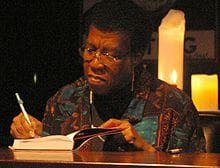
Octavia E. Butler was an American science fiction writer known for her exploration of complex themes such as race, gender, and identity. Her notable works include "Kindred," a time-travel narrative addressing slavery, and the "Patternist" series, which begins with "Mind of My Mind." Other significant titles in her catalog include "Parable of the Talents," "Wild Seed," "Adulthood Rites," and "Bloodchild and Other Stories."
Similar books
- Stories of Your Life and Others
Ted Chiang
4.2 (66k) average on GoodreadsFantasyExplores complex philosophical and ethical questions through diverse speculative fiction scenarios.
- Annihilation
Jeff VanderMeer
4.0 (5k) average on GoodreadsFantasyFeatures mysterious alien life forms and explores the unsettling aspects of nature and human interaction with the unknown.
- The Left Hand Of Darkness
Ursula K. Le Guin
4.1 (120k) average on GoodreadsFantasyWhile both explore gender and alien cultures, Butler's 'Bloodchild' is more visceral and directly confronts issues of body horror, consent, and reproductive exploitation in a way Le Guin's more allegorical approach generally avoids. Butler's narratives often leave less room for comfortable interpretation.
- Harry Potter and the Sorcerer's Stone
J.K. Rowling
4.5 (7M) average on GoodreadsFantasyRescued from a miserable life under the stairs, an orphaned boy discovers he's a wizard destined for a magical school, where he uncovers a dangerous secret tied to the dark wizard who murdered his parents.
- The Hunger Games
Suzanne Collins
4.3 (6.4M) average on GoodreadsFantasyIn a future where children fight to the death on live television, Katniss Everdeen volunteers for the arena, turning a death sentence into a fight for survival and a spark of rebellion.
- 1984
George Orwell
4.2 (3.1M) average on GoodreadsPoliticsIn a future where surveillance and thought control are absolute, a man's search for truth clashes with the Party, showing that hope can be a form of rebellion.





Enjoyed the summary?
A summary gives you the shape of the book. The book itself has the detail, the examples and the voice.
Find Bloodchild and Other Stories on AmazonAs an Amazon Associate, BookBrief earns from qualifying purchases. How we're funded