
Estimated read time: 10 min read
One Sentence Summary
Miles Vorkosigan must navigate political intrigue, impersonation, and family secrets when he encounters his own clone on a critical mission to Earth.
Table of Contents
Introduction
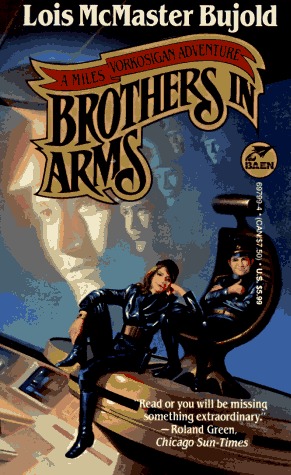
Imagine a universe where clones, cosmic politics, and mistaken identities collide—welcome to Brothers in Arms by Lois McMaster Bujold. This Hugo and Nebula-nominated gem isn't your average space adventure. Instead, Bujold masterfully blends sharp wit, action, and deep philosophical questions into a narrative that has captivated both literary critics and sci-fi enthusiasts since its 1989 publication.
Brothers in Arms is the fifth entry in the acclaimed "Vorkosigan Saga," but don't worry—Bujold's writing is so immersive and accessible, you can jump in here and still enjoy the ride. The story follows the irrepressible Miles Vorkosigan, whose life is complicated enough by his dual identities as a Barrayaran nobleman and mercenary admiral. But when a clone with his own face appears, things get truly chaotic.
Whether you're a college student looking for a thrilling read or a lecturer seeking a discussion-rich narrative, this book offers high-stakes action, ethical quandaries, and Bujold's signature humor. Now, let's dive into the universe of Brothers in Arms, where even the most brilliant plans can go spectacularly sideways.
Historical Context
Set in a distant future where humanity has colonized many planets, Brothers in Arms taps into the anxieties and hopes of the late 20th century. Published at the tail end of the Cold War, the book channels the era's fascination with espionage, identity, and technological progress. Cloning, a primary plot point, echoes real-world debates from the 1980s about genetic engineering and bioethics.
Bujold’s universe is also shaped by historical echoes: the rigid, aristocratic society of Barrayar recalls Imperial Russia, while the cosmopolitan chaos of Earth reflects the melting-pot anxieties and ambitions of our own world. The book’s release in 1989—just before the Berlin Wall fell—adds an extra layer of resonance, as it explores themes of fragmentation, loyalty, and what it means to belong.
Brief Synopsis
Plot Overview
Miles Vorkosigan, a physically fragile but mentally formidable officer, lands on Earth with his Dendarii mercenaries after a risky rescue mission. He's juggling multiple identities: as Admiral Naismith, commander of the Dendarii, and as Lord Vorkosigan, heir to an aristocratic Barrayaran family. All he wants is to get his troops paid and return home, but Earth’s political labyrinth and his father’s diplomatic mission complicate everything.
When Miles stumbles upon evidence of a plot involving a clone—created to assassinate or replace him—he’s thrust into a web of espionage, family loyalty, and existential crisis. The novel’s centerpiece is his encounter with the clone, forcing both to grapple with questions of identity, humanity, and freedom.
Setting
The story is set primarily in late-21st-century Earth, specifically London and New York, reimagined as bustling megacities teeming with intrigue. Earth, in Bujold’s vision, is a patchwork of old institutions and futuristic technologies. The contrast between Earth’s democratic chaos and Barrayar’s militaristic rigidity provides a rich backdrop for Miles’s adventures.
The atmosphere is tense and fast-paced: think “James Bond in space,” but with more existential dread and fewer martinis.
Main Characters
Here’s a quick guide to the main players in Brothers in Arms:
| Name | Role | Key Traits | Importance to Plot |
|---|---|---|---|
| Miles Vorkosigan | Protagonist; Barrayaran noble/spy | Brilliant, witty, physically disabled, dual-identity | Central; drives all major plotlines |
| The Clone (Mark) | Miles’s genetic duplicate | Confused, traumatized, searching for identity | Catalyst for themes of self and belonging |
| Aral Vorkosigan | Miles’s father; Barrayaran Regent | Stern, principled, politically savvy | Symbol of authority and family loyalty |
| Cordelia Vorkosigan | Miles’s mother; former Betan officer | Compassionate, pragmatic, fiercely protective | Emotional anchor for Miles |
| Elli Quinn | Dendarii officer; Miles’s love interest | Resourceful, loyal, sharp-tongued | Adds romantic tension and tactical support |
| Simon Illyan | Barrayaran Security Chief | Analytical, loyal, world-weary | Helps unravel the espionage plot |
| Galeni | Barrayaran Security Officer | Ambitious, conflicted | Embodies generational and national tension |
| Dendarii Mercenaries | Miles’s loyal crew | Diverse, tough, pragmatic | Provide both comic relief and action |
Plot Summary
Arrival and Complications
Miles arrives on Earth with the Dendarii mercenaries, planning a quick stop to collect payment owed for a previous mission. But bureaucratic delays, political intrigue, and the presence of his Barrayaran parents (involved in delicate negotiations at the embassy) swiftly complicate matters.
Miles expertly juggles his dual roles: as Admiral Naismith to the Dendarii and as Lord Vorkosigan to the embassy—a high-wire act that’s equal parts hilarious and nerve-wracking.
The Shadow Self
Things take a sharp turn when Miles discovers evidence of a plot to create a clone—his genetic double—intended for an assassination or impersonation scheme. This revelation forces Miles into a desperate race against time, as he tries to outmaneuver both his enemies and his own government’s suspicions.
The clone, raised in isolation and told he is nothing but a tool, becomes the emotional and philosophical heart of the novel. His journey from object to self-aware individual is both harrowing and uplifting.
Double Trouble
The climax unfolds in a series of tense confrontations and mistaken-identity hijinks. Miles and his clone come face-to-face, leading to a complex dance of trust, betrayal, and reluctant alliance. Their interactions—by turns funny, poignant, and terrifying—force both to question what makes a person unique.
Meanwhile, the Dendarii mercenaries, the Barrayaran embassy staff, and Earth’s various intelligence agencies all converge in a chaotic, action-packed finale.
Resolution
While the novel avoids a neat resolution, it ends on a note of hope and ambiguity. The clone, now named Mark, claims his own identity, and Miles is left to reckon with the responsibilities and privileges that come with being himself.
Themes and Motifs
Bujold packs Brothers in Arms with thought-provoking themes:
| Theme | Description | Relevance to Broader Context |
|---|---|---|
| Identity and Selfhood | What defines a person—genes, experience, or something deeper? | Ties to debates on cloning and autonomy |
| Family and Loyalty | The joys and burdens of belonging to a family or group | Reflects Cold War and postwar anxieties |
| Free Will vs. Destiny | Are we the sum of our circumstances, or do we choose our paths? | Universal philosophical question |
| Ethics of Technology | The dangers and possibilities of genetic engineering | Mirrors real-world bioethical debates |
| Power and Responsibility | The costs of leadership and the weight of command | Resonates with political and military history |
| Alienation and Belonging | The search for connection in a fragmented world | Timeless, but especially relevant to students and outsiders |
Motifs like doubles, mirrors, and masks run throughout the book, underscoring its questions about authenticity and deception. Bujold also weaves humor and irony into even the darkest moments, reminding readers that self-awareness is often the best antidote to existential dread.
Literary Techniques and Style
Bujold’s style is a dazzling blend of:
- Witty Dialogue: Characters banter with the kind of repartee that would make Oscar Wilde jealous.
- Tight, Fast-Paced Prose: The narrative never lags, keeping readers on the edge of their seats.
- Deep Psychological Insight: Bujold excels at showing the internal conflicts of her characters, making even the wildest sci-fi premise feel emotionally real.
- Multiple Perspectives: While Miles dominates the story, the narrative occasionally shifts to other viewpoints, adding depth and complexity.
- Symbolism and Irony: The clone serves as both literal doppelganger and metaphor for the self-doubt that plagues anyone trying to live up to family expectations.
Bujold’s humor is another hallmark—she never lets the story get too grim, and her characters’ resilience in the face of absurdity is both inspiring and relatable.
Author's Background
Lois McMaster Bujold grew up surrounded by science fiction—her father was a noted engineer and technical editor for the "Ohio State University Research Foundation." Bujold’s early immersion in both technical and literary worlds is evident in her work, which blends rigorously imagined technology with rich character studies.
She published her first Vorkosigan novel, Shards of Honor, in 1986, quickly building a reputation for her insightful, character-driven approach to space opera. Bujold has won multiple Hugo, Nebula, and Locus awards—a testament to her impact on the genre.
Her legacy is felt not just in the realm of science fiction, but in discussions about disability, identity, and what it means to be human. Brothers in Arms is a perfect example: it’s as much about the struggles of self-acceptance as it is about daring escapes and interstellar intrigue.
Key Takeaways
- Identity is complex: Genetics and upbringing both matter, but selfhood is ultimately constructed through choices and relationships.
- Family can be both anchor and burden: Navigating loyalty and independence is a universal challenge.
- Technology’s ethical dimensions are as important as its capabilities: Cloning, in particular, raises profound questions about autonomy.
- Resilience requires humor: Even in the darkest moments, laughter is a powerful survival tool.
- Leadership is lonely and costly: True command means facing hard truths and making personal sacrifices.
Reader's Takeaway
Brothers in Arms offers both a thrilling ride and a space for deep reflection. Readers are likely to come away:
- Entertained: The book is packed with action, clever twists, and snappy dialogue.
- Challenged: The ethical questions it raises about identity and technology will stick with you long after the last page.
- Moved: Miles’s struggles with disability, family, and self-worth are handled with empathy and insight.
- Inspired: Bujold’s message is that even when you feel like a misfit—or a literal duplicate—you can claim your own destiny.
Conclusion
Brothers in Arms is more than just another entry in a beloved series. It’s a smart, funny, and ultimately profound meditation on what makes us who we are. Lois McMaster Bujold deftly balances space battles and family drama, existential crises and laugh-out-loud moments.
For college students and lecturers alike, this novel offers a treasure trove of discussion topics: from the ethics of cloning to the demands of leadership, from the search for belonging to the power of humor. Whether you’re reading for pleasure, research, or classroom debate, Brothers in Arms is a journey well worth taking.
So, why not pick up a copy and join Miles Vorkosigan as he navigates the wildest identity crisis in the galaxy? You just might find yourself laughing, thinking, and—most importantly—wondering what it truly means to be yourself.
Brothers in Arms FAQ
What is 'Brothers in Arms' by Lois McMaster Bujold about?
'Brothers in Arms' is a science fiction novel that follows Miles Vorkosigan as he navigates political intrigue, identity crises, and dangerous plots in an interstellar setting. The story focuses on Miles encountering his own clone, leading to issues of identity, loyalty, and family.
Is 'Brothers in Arms' part of a series?
Yes, 'Brothers in Arms' is part of the Vorkosigan Saga series by Lois McMaster Bujold. It is one of the middle books in the series and continues the adventures of Miles Vorkosigan.
Do I need to read the previous books in the Vorkosigan Saga before 'Brothers in Arms'?
While each book can be enjoyed on its own, reading previous books such as 'The Warrior's Apprentice' and 'Borders of Infinity' will provide more context and enhance your understanding of the characters and ongoing storylines.
Who are the main characters in 'Brothers in Arms'?
The main characters include Miles Vorkosigan, his clone (referred to as Mark), and supporting figures such as Elli Quinn and Ivan Vorpatril. The novel explores the relationships and conflicts among these characters.
What themes are explored in 'Brothers in Arms'?
The novel explores themes such as identity, family, loyalty, ethics in cloning, and the struggle to define oneself when faced with one's literal double.
Is 'Brothers in Arms' suitable for young readers?
'Brothers in Arms' is generally aimed at adult and young adult readers due to its complex themes and some mature content, but it does not contain explicit violence or sexuality.
What genre is 'Brothers in Arms'?
'Brothers in Arms' is a science fiction novel, and it combines elements of space opera, military fiction, and character-driven drama.
How does 'Brothers in Arms' connect to the rest of the Vorkosigan Saga?
The events in 'Brothers in Arms' have significant consequences for later books in the series, especially regarding the character of Mark and Miles's personal journey.
Has 'Brothers in Arms' won any awards?
'Brothers in Arms' was nominated for the Hugo Award for Best Novel and is highly regarded among fans of the Vorkosigan Saga.
Where can I find 'Brothers in Arms'?
'Brothers in Arms' is widely available in print, ebook, and audiobook formats through major booksellers and libraries.