
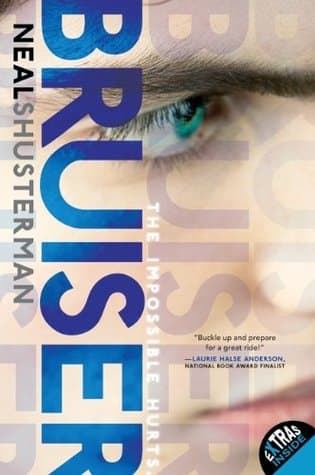
Synopsis
Covers the whole plot, including the ending.
- Difficulty
- Medium
- Pacing
- Moderate
- Mood
- Thought-provoking, Melancholy, Hopeful, Unique
- Read it if
- You enjoy thought-provoking YA fantasy with a unique magic system, explore themes of sacrifice and empathy, and appreciate a blend of romance and family drama.
- Skip it if
- You prefer lighthearted reads without heavy emotional themes or find the concept of pain absorption unsettling.
Bruiser Plot Summary
Covers the whole plot, including the ending.
Brontë Meets Bruiser, Tennyson's Disapproval
The story begins with Brontë and Tennyson, fraternal twins. They react to Brontë's new relationship with Brewster Rawlins, called 'Bruiser.' Tennyson is immediately wary and disapproving. He has heard rumors that Bruiser is a loner, dangerous, and possibly responsible for his parents' deaths. Brontë, however, likes Bruiser's quiet intensity and mysterious nature. She looks past the rumors and wants to know him. Tennyson, protective of his sister and doubting Bruiser's reputation, watches him closely, expecting the worst. Brontë feels more and more drawn to her mysterious boyfriend.
Unusual Healings and Shared Pain
Soon after Brontë starts dating Bruiser, she and Tennyson experience strange things. Small injuries, like scrapes and bruises, heal almost instantly. Tennyson, a wrestler, notices his aches and pains from practice disappear overnight. A cut on Brontë's hand vanishes without a trace. They first think it is coincidence or youth, but the speed and completeness of the healings happen too often to ignore. Meanwhile, Bruiser looks increasingly tired and gets unexplained bruises and cuts, mirroring the injuries his new friends had experienced.
The First Revelation: Bruiser's Burden
Brontë worries more about Bruiser's health. She confronts him, asking what is happening. Bruiser finally tells her his ability: he is a 'bruiser,' a person who absorbs physical and emotional pain, injuries, and even the effects of aging from those he loves. He explains this is why he avoids close relationships, as carrying others' suffering is a huge and dangerous burden. Brontë is shocked and sad, realizing her own quick healings and Tennyson's fast recovery from wrestling injuries have directly caused Bruiser's serious condition.
Tennyson's Disbelief and Growing Guilt
When Brontë tries to explain Bruiser's ability to Tennyson, he does not believe her. He thinks it is a made-up story or a delusion. He accuses Brontë of being naive and manipulated by Bruiser. However, as Bruiser's health gets much worse, and Tennyson remembers his own unexplained recoveries, he starts to see the truth. A bad wrestling injury that heals overnight, along with seeing Bruiser's body show a similar injury, makes Tennyson face the reality of Bruiser's burden. He feels guilty, realizing his own enjoyment of a pain-free life came at Bruiser's expense.
Caring for Bruiser and the 'Buffer'
Overwhelmed by guilt and love, Brontë and Tennyson decide they must protect Bruiser. They learn that the 'absorption' happens through closeness and emotional connection. So, they try to keep their distance, which is hard for Brontë. They also realize Bruiser has been living alone, avoided by the community and his only living relative, his Uncle Hoyt. They find Hoyt, hoping he can help or understand. Hoyt, a stern and distant man, is hesitant but eventually reveals he is also a 'bruiser.' He has lived alone to protect himself and others. He agrees to take Bruiser in, acting as a 'buffer' to absorb some pain, as bruisers can absorb from each other.
A Life Without Pain and Its Consequences
With Bruiser and Uncle Hoyt living together, the twins' quick healing abilities lessen, but they still have much less pain. They notice how this affects them: Tennyson becomes careless in wrestling, no longer fearing injury; Brontë feels a strange distance from minor hurts. They realize that pain, both physical and emotional, has a purpose. It teaches caution, empathy, and resilience. Without it, they feel incomplete, almost less human. This time shows the great cost of Bruiser's sacrifice, not just to him, but also to the normal human experience of those he cares for.
The Burden of Old Age and Hoyt's Sacrifice
Uncle Hoyt, helping Bruiser, takes on a huge burden from his nephew. Hoyt also volunteers at a nursing home, where he connects with elderly residents. This leads to him unknowingly absorbing the physical decay and illnesses of old age from them, adding to his already overwhelming load. His health quickly declines, showing the many severe conditions of the elderly. Bruiser sees his uncle's decline and understands how much his own ability can hurt when not managed carefully. The twins, seeing Hoyt suffer, realize how difficult a bruiser's life is.
The Desperate Plan: Sharing the Load
As Uncle Hoyt is close to death from the accumulated burden, and Bruiser is still suffering, Brontë and Tennyson realize they must act. They understand that a bruiser's ability grows with strong emotional connection. They decide to form a 'circle' of care, planning to temporarily absorb some of Bruiser's immense pain and suffering. This will give both him and Hoyt a chance to recover. This is a scary idea, as they will experience all the injuries and illnesses Bruiser has carried. But they are willing to risk it out of love and guilt. They prepare for the difficult experience, knowing it is their only chance to save their loved ones.
The Painful Transfer and Its Aftermath
Brontë and Tennyson connect deeply with Bruiser, and the transfer of his accumulated pain begins. They are immediately overwhelmed by a rush of physical and emotional agony—broken bones, deep cuts, chronic illnesses, and great sadness. The experience is agonizing and almost breaks them. It forces them to face the real difficulty of Bruiser's life. During this intense process, Bruiser's body starts to heal, and he regains strength. The twins emerge from the ordeal physically hurt and emotionally changed. They also have a deep understanding and empathy for Bruiser, having briefly experienced his life.
A New Beginning, a Shared Future
After the painful transfer, Bruiser and Uncle Hoyt recover, though slowly. The experience has created a strong bond between the four of them. They decide to live together, creating a small, controlled 'buffer' system. The twins, now fully aware of the consequences, learn to manage their emotional connections and closeness to Bruiser. They accept that they will sometimes bear some pain, but it is a shared burden of love. The ending suggests a future where Bruiser can live a more normal life, surrounded by people who understand and care for him, sharing his unique gift and its challenges, finding a balance between connection and protection.
Bruiser Characters
Brewster 'Bruiser' Rawlins
Protagonist
A mysterious outcast with the ability to absorb others' pain and suffering.
Brewster Rawlins is the titular 'Bruiser,' a quiet and enigmatic teenager with a profound and dangerous supernatural ability: he literally absorbs the physical and emotional pain, injuries, and even the effects of aging from those he cares about. This power has made him a loner, as he fears harming others or being overwhelmed by their suffering. He is deeply empathetic and carries immense guilt and loneliness. His life is a constant battle to control his ability and protect those he loves, even if it means isolating himself. He is a tragic figure, burdened by a gift that is both a blessing and a curse.
Relationships: Brontë (Girlfriend, deep emotional connection); Tennyson (Brother of Brontë, initially skeptical, later a close friend and confidant); Uncle Hoyt (Estranged uncle, also a bruiser, mentor and fellow sufferer)
Brontë
Protagonist
Tennyson's twin sister, drawn to Bruiser's mystery and determined to understand him.
Brontë is Tennyson's fraternal twin sister, characterized by her adventurous spirit, open-mindedness, and deep empathy. Unlike her brother, she is not swayed by rumors and is willing to look beyond appearances. She is the first to connect with Bruiser and is fiercely protective of him, driven by a powerful love and desire to help. Her journey involves grappling with the reality of Bruiser's power, experiencing the strange benefits of his absorption, and ultimately making the sacrifice to share his burden. She represents unconditional love and the willingness to face difficult truths.
Relationships: Brewster 'Bruiser' Rawlins (Boyfriend, deep emotional connection); Tennyson (Twin brother, close bond, often at odds but ultimately supportive); Uncle Hoyt (Bruiser's uncle, a figure of guidance and shared experience)
Tennyson
Protagonist
Brontë's twin brother, initially skeptical and protective, later understanding and supportive.
Tennyson is Brontë's fraternal twin, a wrestler who is initially skeptical, cynical, and highly protective of his sister. He is wary of Bruiser and prone to judging him based on rumors. His character arc involves a significant shift from suspicion and denial to acceptance, empathy, and ultimately, self-sacrifice. He experiences the benefits of Bruiser's power firsthand, which forces him to confront the truth and his own guilt. Tennyson represents the struggle to accept the unbelievable and the journey from self-interest to profound compassion, realizing the value of pain and the importance of shared burdens.
Relationships: Brewster 'Bruiser' Rawlins (Initially rival/suspicious, later close friend and ally); Brontë (Twin sister, close bond, often at odds but ultimately supportive); Uncle Hoyt (Bruiser's uncle, a figure of shared experience and understanding)
Uncle Hoyt
Supporting
Bruiser's estranged uncle, who shares the same unique ability.
Uncle Hoyt is Brewster's estranged paternal uncle, who also possesses the 'bruiser' ability. He lives a solitary life, having learned the painful lessons of his power and the necessity of isolation to protect himself and others. He is initially gruff and distant, having been hardened by his experiences. However, he eventually takes in Bruiser, offering guidance and acting as a 'buffer' to absorb some of Bruiser's pain. His character illustrates the long-term consequences and immense sacrifices associated with being a bruiser, ultimately making a profound sacrifice for his nephew.
Relationships: Brewster 'Bruiser' Rawlins (Nephew, shares the same ability, mentor figure); Brontë (Bruiser's girlfriend, he initially views her with suspicion but later accepts her); Tennyson (Brontë's brother, he initially views him with suspicion but later accepts him)
Mom (of Brontë and Tennyson)
Supporting
The twins' mother, a loving but sometimes overly busy parent.
The twins' mother is a loving and concerned parent, though often preoccupied with her own life and work. She is generally supportive of her children but remains unaware of the supernatural events unfolding around them. Her character highlights the contrast between the mundane concerns of everyday life and the extraordinary secret the twins are keeping. She represents the 'normal' world that Bruiser's ability disrupts, and her inability to understand the true nature of Bruiser's problems underscores the isolation of the 'bruisers.'
Dad (of Brontë and Tennyson)
Supporting
The twins' father, a laid-back and sometimes absent-minded parent.
The twins' father is portrayed as laid-back and somewhat less observant than their mother. He is a good-natured parent but, like his wife, is completely oblivious to the supernatural abilities affecting his children and Bruiser. His presence helps to maintain the semblance of a normal family life, providing a contrast to the hidden anxieties and dangers the twins face. He represents the everyday world, unable to comprehend the extraordinary secret, further emphasizing the isolation of those who bear such burdens.
Cody
Supporting
Tennyson's wrestling teammate and friend.
Cody is Tennyson's friend and wrestling teammate. He serves as a typical peer character, providing a sounding board for Tennyson's frustrations and observations about Bruiser. Cody is initially part of the general school consensus regarding Bruiser's 'weirdness.' His reactions and conversations with Tennyson help to flesh out the social dynamics of the school and the rumors surrounding Bruiser. He also experiences some minor, inexplicable healings due to his proximity to Tennyson, unknowingly benefiting from Bruiser's power.
Relationships: Tennyson (Wrestling teammate and friend)
Auntie Mae
Mentioned
Bruiser's deceased great-aunt, also a bruiser.
Auntie Mae is mentioned as Bruiser's great-aunt who also possessed the 'bruiser' ability. She represents a past generation of bruisers and the tragic consequences of their power. Her story, as recounted by Uncle Hoyt, serves as a cautionary tale, illustrating the immense suffering and eventual death that can result from uncontrolled absorption. Her existence confirms that Bruiser's ability is not unique but part of a lineage, adding depth to the mythology of the bruisers.
Relationships: Brewster 'Bruiser' Rawlins (Great-nephew, shares the same ability); Uncle Hoyt (Nephew, shares the same ability, remembers her suffering)
Bruiser Themes
The Burden of Empathy and Compassion
This theme is central to the novel. It looks at the extreme physical and emotional cost of deep empathy. Bruiser literally takes on the pain of others, showing how much care can become an unbearable burden. When Brontë and Tennyson also experience this burden, they learn that true empathy means not just feeling for someone, but understanding and sharing their suffering. The book asks readers to consider the limits of compassion and the sacrifices made by those who carry the weight of others' pain. It shows that too much empathy can be harmful without proper boundaries or support.
“Pain teaches us. It’s how we learn. It’s how we grow. Without it, we’re just… empty.”
The Nature and Purpose of Pain
The novel explores why pain exists and its role in human experience. At first, the twins enjoy the freedom from pain that Bruiser's ability gives them. However, they soon realize this absence makes them feel distant and reckless. Tennyson, a wrestler, loses his caution without the fear of injury. The story suggests that pain, both physical and emotional, is necessary for growth, learning, and developing empathy. It serves as a teacher, a warning system, and part of what makes us fully human, making its absence a form of loss.
“How could I ever truly know what it meant to live, if I never had to suffer?”
Isolation vs. Connection
Bruiser's life is defined by being alone, a direct result of his power. He chooses to be by himself to protect others and himself from the overwhelming burden of connection. The story explores the deep loneliness that comes with such a choice and the human need for connection, even if it costs a lot. The twins' efforts to break Bruiser's isolation and share his burden show the power of love and friendship to overcome even the biggest barriers. The ending suggests that true connection involves shared vulnerabilities and burdens, not just shared joys.
“He didn’t want friends, because friends always got hurt. He didn’t want to care, because caring always brought pain.”
Sacrifice and Selflessness
Sacrifice is a repeated theme. Bruiser constantly sacrifices himself to absorb the pain of those he loves. Uncle Hoyt also shows this by taking on Bruiser's burden and, sadly, the illnesses of the elderly. Finally, Brontë and Tennyson make a great sacrifice by willingly absorbing Bruiser's accumulated pain. This shows their deep love and willingness to suffer for another. The theme explores the idea that love often requires a personal cost and that true selflessness can lead to deep understanding and connection, even with great personal suffering.
“Love wasn’t about being with someone. It was about sacrificing for someone. Giving up your own happiness for someone else’s.”
The Ethics of Power and Responsibility
The novel raises ethical questions about power and the responsibility that comes with it. Bruiser's ability is a strong force that can heal or harm. The story explores the moral problems in such a power: should he use it? How should he control it? The characters deal with the effects of Bruiser's power, both good (healing the twins) and bad (his own suffering, Hoyt's decline). It makes the characters, and the reader, think about the ethical implications of having an ability that can greatly change others' lives, and the heavy moral weight of using or even having such a gift.
“It was a gift, yes, but it was also a curse. A terrible, wonderful, devastating curse.”
Plot Devices & Literary Techniques
Supernatural Ability (Bruiser's Gift)
The central magical element driving the plot and character development.
The core plot device is Bruiser's unique supernatural ability to absorb the physical injuries, emotional pain, and even the effects of aging from those he cares about. This power is the catalyst for all major plot points, from the twins' miraculous healings to Bruiser's deteriorating health, and ultimately the desperate measures taken to save him. It creates both conflict and connection, forcing characters to confront extreme ethical and emotional dilemmas. The rules and limitations of this ability (e.g., proximity, emotional connection, and the cumulative effect) are gradually revealed, shaping the narrative's progression and the characters' actions.
First-Person Plural Narration (alternating)
Told from the alternating perspectives of Brontë and Tennyson.
The story is told using alternating first-person perspectives, primarily from Brontë and Tennyson. This allows the reader to experience the events and Bruiser's mystery from two distinct viewpoints, highlighting their individual reactions, internal conflicts, and evolving understanding of Bruiser's power. Brontë's chapters often convey empathy and romantic connection, while Tennyson's offer skepticism, protectiveness, and a more grounded, analytical approach. This dual perspective enriches the emotional depth and provides a comprehensive view of the unfolding events and the complex dynamics within the sibling relationship and with Bruiser.
Dramatic Irony
The reader and some characters know Bruiser's secret while others remain oblivious.
Dramatic irony is employed through the knowledge disparity among characters. The reader, along with Brontë and later Tennyson, understands the true reason behind their rapid healings and Bruiser's declining health, while their parents and other secondary characters remain completely unaware. This creates tension and highlights the isolation of the characters who bear the secret. It also underscores the profound burden Bruiser carries, as he must suffer in silence to protect those who cannot comprehend his sacrifice, adding layers of pathos to his character and the twins' eventual guilt.
The 'Buffer' System
A mechanism for managing the bruiser's ability by distributing the absorbed pain.
The 'buffer' system, which involves another bruiser (Uncle Hoyt) or a group of deeply connected individuals (the twins), is a crucial plot device introduced to manage and mitigate the devastating effects of Bruiser's ability. It provides a glimmer of hope and a solution to the seemingly insurmountable problem of Bruiser's suffering. This device not only offers a practical way for Bruiser to survive but also serves as a metaphor for shared burdens in relationships, emphasizing that love and connection can alleviate even the most profound suffering when faced collectively. It introduces a functional, albeit painful, way to live with the supernatural power.
Bruiser Quotes
“I am a bruiser. I take the pain of others. I absorb it, and I make it my own.”
“Sometimes the only way to heal is to hurt.”
“Love isn't about taking away someone's pain; it's about being there while they endure it.”
“We all have scars. Some are just more visible than others.”
“The world doesn't need another hero. It needs someone who can shoulder its pain.”
“You can't save everyone, but you can try to save the ones who matter.”
“Pain shared is pain halved, but only if someone is willing to carry it.”
“I didn't choose this power. It chose me, and now I have to live with it.”
“The strongest people aren't those who show no pain, but those who bear it for others.”
“Sometimes the quietest people have the loudest battles inside.”
“You can't love someone without taking a piece of their pain.”
“Healing isn't about erasing the wound; it's about learning to live with the scar.”
“The world breaks everyone, and afterward, some are strong at the broken places.”
“We are all bruisers in our own way, carrying wounds we never asked for.”
Quiz
10 questions on the plot and the characters. Each answer comes with a short explanation.
Question 1
What is Brewster 'Bruiser' Rawlins' supernatural ability in the book?
- He can read minds and predict the future
- He absorbs the physical and emotional pain of those he cares about
- He can heal others instantly with a touch
- He becomes invisible when he feels strong emotions
Show answer
B. He absorbs the physical and emotional pain of those he cares about Brewster's ability is to absorb both physical injuries and emotional pain from people he cares about, which manifests as the injuries appearing on his own body and him experiencing their emotional trauma.
Question 2
Why is Brewster initially voted 'Most Likely to Get the Death Penalty' by his classmates?
- Because he has a criminal record for violent offenses
- Because he is quiet, isolated, and has a intimidating appearance
- Because he threatened another student publicly
- Because he comes from a family with a history of crime
Show answer
B. Because he is quiet, isolated, and has a intimidating appearance Brewster is misunderstood by his peers due to his quiet, solitary nature and rough appearance, leading to unfair assumptions and the cruel yearbook title.
Question 3
How does Brontë first become aware of Brewster's unusual ability?
- She sees bruises appear on Brewster after she gets hurt
- Brewster confesses his secret to her early in their relationship
- Her brother Tennyson discovers it through research
- She reads about it in Brewster's diary
Show answer
A. She sees bruises appear on Brewster after she gets hurt Brontë notices that minor injuries she sustains heal rapidly, and she later observes corresponding bruises or injuries appearing on Brewster's body, leading her to suspect his ability.
Question 4
What is the primary reason Brewster tries to avoid forming close relationships?
- He fears his ability will be exploited by others
- He worries that caring for people will cause him to absorb their pain, which could overwhelm him
- He believes he is unworthy of friendship due to his family background
- He has been instructed by his uncle to remain isolated
Show answer
B. He worries that caring for people will cause him to absorb their pain, which could overwhelm him Brewster's ability activates when he cares about someone, causing him to involuntarily take on their physical and emotional suffering, which has led him to isolate himself as a protective measure.
Question 5
How does Tennyson's attitude toward Brewster change over the course of the story?
- He remains suspicious and hostile toward Brewster throughout
- He starts as protective and disapproving but grows to understand and respect Brewster
- He becomes jealous of Brewster's relationship with Brontë and tries to sabotage it
- He ignores Brewster completely until forced to interact by Brontë
Show answer
B. He starts as protective and disapproving but grows to understand and respect Brewster Initially overprotective of his sister Brontë, Tennyson is wary of Brewster but gradually learns about his ability and the burdens he carries, leading to empathy and a shift in their relationship.
Question 6
What significant event causes Brewster to be hospitalized and reveal the extent of his ability to others?
- He absorbs a severe injury from Brontë after a car accident
- He takes on the pain from multiple people at once during a crisis, leading to critical condition
- He is attacked by bullies who discover his secret
- He accidentally reveals his ability while trying to help a stranger
Show answer
B. He takes on the pain from multiple people at once during a crisis, leading to critical condition A pivotal moment occurs when Brewster absorbs injuries and emotional trauma from several people he cares about simultaneously, resulting in a life-threatening situation that forces his secret into the open.
Question 7
Which theme is most central to the conflict Brewster faces with his family, particularly his uncle?
- The importance of academic achievement and social status
- The struggle between using his ability for personal gain versus protecting himself
- Exploitation and sacrifice, as his family pressures him to use his ability for their benefit
- The challenge of hiding supernatural powers in a normal world
Show answer
C. Exploitation and sacrifice, as his family pressures him to use his ability for their benefit Brewster's uncle and other family members have historically taken advantage of his ability, forcing him to absorb their pain and suffering, which highlights themes of exploitation and the ethics of sacrifice.
Question 8
What literary device is prominently used through the alternating perspectives of Brontë, Tennyson, Brewster, and Cody in the narrative?
- Foreshadowing, to hint at future events in the plot
- Multiple first-person points of view, to explore different characters' experiences and growth
- Third-person omniscient narration, to provide an objective overview
- Epistolary format, using letters and diaries to tell the story
Show answer
B. Multiple first-person points of view, to explore different characters' experiences and growth The novel employs multiple first-person narrators—Brontë, Tennyson, Brewster, and his brother Cody—allowing readers to gain insight into each character's thoughts, emotions, and development regarding Brewster's ability.
Question 9
In what way does Cody, Brewster's younger brother, uniquely relate to Brewster's ability?
- Cody is immune to Brewster's ability and cannot be affected by it
- Cody has a similar ability but in reverse, causing pain to others
- Cody is aware of and deeply affected by the burden Brewster carries, often trying to protect him
- Cody exploits Brewster's ability for his own benefit without remorse
Show answer
C. Cody is aware of and deeply affected by the burden Brewster carries, often trying to protect him Cody, as Brewster's brother, is acutely aware of the physical and emotional toll of Brewster's ability. He often attempts to shield Brewster from additional pain, showing a protective and empathetic relationship.
Question 10
How does the resolution of the novel address the ethical dilemma of Brewster's ability?
- Brewster learns to control his ability completely, using it only when he chooses
- Brewster decides to isolate himself permanently to avoid hurting others
- The characters reach an understanding that involves setting boundaries and shared responsibility, rather than Brewster bearing all the pain alone
- Brewster's ability is magically removed, returning him to a normal life
Show answer
C. The characters reach an understanding that involves setting boundaries and shared responsibility, rather than Brewster bearing all the pain alone The story concludes with a nuanced resolution where Brewster, Brontë, Tennyson, and others acknowledge the complexity of his ability. They work towards a balance where Brewster is not solely responsible for absorbing pain, emphasizing themes of empathy, connection, and mutual support.
Bruiser FAQ
What is 'Bruiser' by Neal Shusterman about?
'Bruiser' follows twins Brontë and Tennyson as they discover their new friend Brewster 'Bruiser' Rawlins has a supernatural ability: he absorbs the physical and emotional pain of those he cares about. As Brontë dates Brewster and Tennyson befriends him, they experience miraculous healings but gradually realize Brewster is suffering their injuries and trauma himself, leading to a moral dilemma about their relationship with him.
Why should I read 'Bruiser'?
This book offers a unique blend of fantasy, romance, and ethical exploration, centered on a powerful metaphor for empathy and sacrifice. Through Brewster's ability to absorb pain, Shusterman delves into themes of love, family dynamics, and the consequences of taking on others' burdens, making it both emotionally resonant and thought-provoking for young adult and adult readers alike.
What is the background/setting of 'Bruiser'?
The story is set in a contemporary suburban environment, primarily focusing on the lives of high school students Brontë and Tennyson, and the isolated Brewster who lives with his abusive uncle. The ordinary setting contrasts sharply with Brewster's supernatural ability, highlighting the impact of his power on everyday relationships and conflicts.
What are the most memorable quotes from 'Bruiser'?
Key quotes include Brewster's realization, 'I take away the pain, but I don't take away the memory,' and Brontë's reflection, 'Sometimes the people who are hardest to love are the ones who need it most.' These lines encapsulate the novel's themes of sacrifice, memory, and compassion.
What writing style does Neal Shusterman use in 'Bruiser'?
Shusterman employs a multi-perspective narrative, alternating between the viewpoints of Brontë, Tennyson, Brewster, and his younger brother Cody. This style deepens character development and allows readers to experience the emotional and physical effects of Brewster's ability from different angles, enhancing the story's impact.
What minor details add significant meaning in 'Bruiser'?
Small details like Brewster's constant wearing of long sleeves to hide injuries, or the way he avoids physical contact initially, subtly hint at his power and the pain he endures. These elements build tension and foreshadow the revelation of his ability to absorb others' suffering.
What are some subtle foreshadowing moments in 'Bruiser'?
Early scenes where Brontë and Tennyson's minor injuries heal quickly after interacting with Brewster foreshadow his power. Additionally, Brewster's reluctance to form close relationships and his mysterious absences hint at the physical toll his ability takes, setting up the later conflicts.
What unexpected character connections exist in 'Bruiser'?
An unexpected connection is between Brewster's abusive uncle and the twins' family, as their involvement with Brewster forces them to confront issues of neglect and protection. Also, the bond between Brewster and his younger brother Cody reveals how Brewster's ability affects his role as a caretaker, adding layers to his character.
What are unspoken character motivations in 'Bruiser'?
Brewster is motivated by a deep-seated fear of causing harm and a desire to protect others, even at his own expense, stemming from his traumatic home life. Brontë is driven by a need to understand and heal Brewster, while Tennyson's initial skepticism masks a growing protectiveness toward both his sister and Brewster.
What psychological complexities do characters exhibit in 'Bruiser'?
Brewster exhibits a martyr complex, willingly suffering for others due to low self-worth. Brontë grapples with guilt over benefiting from Brewster's pain, and Tennyson struggles with jealousy and responsibility. These complexities explore themes of empathy, sacrifice, and the ethics of relationships.
What are the major emotional turning points in 'Bruiser'?
Key turning points include when Brontë and Tennyson fully realize Brewster is absorbing their injuries, the moment Brewster collapses from accumulated pain, and the climax where they must decide whether to continue relying on his ability or find another way to help him, leading to emotional growth and resolution.
How do relationship dynamics evolve in 'Bruiser'?
Brontë and Brewster's romance evolves from curiosity to deep care, strained by the burden of his power. Tennyson and Brewster's relationship shifts from hostility to friendship as Tennyson understands Brewster's sacrifices. The twins' sibling dynamic is tested but ultimately strengthened through their shared experiences with Brewster.
Which parts of 'Bruiser' remain ambiguous or open-ended?
The origin of Brewster's ability is never fully explained, leaving it as a metaphorical element rather than a detailed fantasy mechanism. Additionally, the long-term impact on Brewster's health and the future of his relationships are left somewhat open, allowing readers to ponder the ongoing consequences of his sacrifices.
What are controversial scenes or decisions in 'Bruiser'?
Controversial moments include the twins' initial decision to keep using Brewster's ability despite knowing it harms him, and Brewster's choice to continue absorbing pain out of a sense of duty. These scenes spark debate about the ethics of accepting help that causes suffering and the limits of self-sacrifice.
'Bruiser' ending explained: how it ends & what it means
The ending sees Brewster distancing himself to recover, with Brontë and Tennyson learning to support him without exploiting his ability. It signifies a balance between empathy and self-preservation, suggesting that true care involves allowing others to heal on their own terms rather than bearing their burdens entirely.
About the author

Neal Shusterman is an American author known for his contributions to young adult fiction. His notable works include "Unwind," "The Toll," "Everlost," "Challenger Deep," "UnDivided," and "Bruiser," which explore themes of identity, morality, and the human experience. Shusterman has received various awards for his writing, including the National Book Award for "Challenger Deep."
Similar books
- Unwind
Neal Shusterman
4.2 (192k) average on GoodreadsThrillerExplores complex ethical dilemmas and body horror in a dystopian YA setting.
- The Fault in Our Stars
John Green
4.2 (3.6M) average on GoodreadsYoung AdultFeatures a poignant romance intertwined with themes of illness, sacrifice, and emotional depth.
- The Hunger Games
Suzanne Collins
4.3 (6.4M) average on GoodreadsFantasyThe Hunger Games offers a dystopian YA narrative with a strong focus on survival and rebellion, characterized by its relentless, high-stakes pacing and clear external conflict. In contrast, Bruiser delves more into internal, ethical dilemmas and the psychological burden of a unique power, with a less urgent, more reflective pace. While both feature protagonists facing extraordinary circumstances, Katniss's struggle is overtly against an oppressive system, whereas Tennyson's battle is often with the implications of his own existence and the choices it forces upon others.
- Miss Peregrine's Home for Peculiar Children
Ransom Riggs
3.9 (977k) average on GoodreadsFantasyBoth Bruiser and Miss Peregrine's Home for Peculiar Children feature protagonists with extraordinary abilities and explore themes of otherness and belonging. However, Riggs's work heavily relies on found photographs to build its unique atmosphere and narrative, creating a sense of historical mystery and gothic fantasy. Bruiser, while also fantastic, grounds its narrative in more contemporary ethical questions and the immediate social impact of Tennyson's power, without the same reliance on a distinct visual aesthetic. Riggs's 'peculiars' are often found in a safe haven, whereas Tennyson's 'gift' is a constant, unavoidable burden in the everyday world.
- Harry Potter and the Sorcerer's Stone
J.K. Rowling
4.5 (7M) average on GoodreadsFantasyRescued from a miserable life under the stairs, an orphaned boy discovers he's a wizard destined for a magical school, where he uncovers a dangerous secret tied to the dark wizard who murdered his parents.
- 1984
George Orwell
4.2 (3.1M) average on GoodreadsPoliticsIn a future where surveillance and thought control are absolute, a man's search for truth clashes with the Party, showing that hope can be a form of rebellion.





Enjoyed the summary?
A summary gives you the shape of the book. The book itself has the detail, the examples and the voice.
Find Bruiser on AmazonAs an Amazon Associate, BookBrief earns from qualifying purchases. How we're funded