
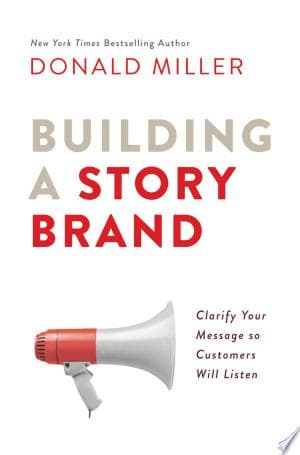
Core Idea
- Difficulty
- Easy
- Read it if
- You are a business owner, marketer, or entrepreneur struggling to articulate your value proposition, find your marketing messages aren't converting, or need a clear, actionable framework to simplify your brand's communication.
- Skip it if
- You are looking for highly technical SEO or social media tactics, or you already have a crystal-clear, customer-centric marketing message that consistently converts.
Key Takeaways from Building a StoryBrand
The Customer is the Hero, Not Your Brand
Shift your marketing narrative to center on the customer's journey and aspirations.
Many businesses mistakenly make their brand the hero, talking about features and achievements. This self-focused story fails because customers want a guide to help them, not another hero. By focusing on the customer, a brand helps them succeed. This builds a strong, empathetic connection that drives engagement and loyalty, moving beyond simple sales to meaningful customer relationships.
“The customer is the hero, not your brand. When we position our customer as the hero and ourselves as the guide, we will be recognized as a trusted resource.”
In the book: Miller illustrates this by contrasting traditional, brand-centric websites with those that clearly articulate the customer's problem and how the brand helps them overcome it, showing how the latter consistently outperforms the former in conversions.
Try this: Reframe all your marketing copy, from website headlines to social media posts, to speak directly to your customer's desires and challenges. Use 'you' language more than 'we' or 'our.'
Related ideas: storybrand-framework, customer-centric-marketing, hero-arc
Identify the Customer's Core Problem
Every compelling story starts with a problem your customer is trying to solve.
People buy solutions to problems, not just products. Miller stresses that a brand must clearly define the customer's problem, not just the surface issue (e.g., 'I need a new CRM'), but also the deeper feelings (e.g., 'I feel disorganized and inefficient,' 'I believe my business should be growing faster'). By explaining these problem layers, a brand shows deep understanding and empathy, making its solution much more appealing. A vague problem means a vague solution, which means no sales.
“Every hero is trying to overcome some external, internal, and philosophical problem.”
In the book: Miller details how Apple successfully tapped into the internal problem of 'feeling uncreative or limited by technology' rather than just the external problem of 'needing a computer,' which resonated deeply with their target audience.
Try this: Conduct brainstorming sessions to articulate the external, internal, and philosophical problems your ideal customer faces. Use these insights to craft problem-focused messaging that immediately hooks your audience.
Related ideas: problem-solution-framework, customer-pain-points, empathetic-marketing
Position Your Brand as the Guide
Your role is to offer clear direction and a proven plan, not to steal the spotlight.
When the customer is the hero, the brand becomes a trusted guide. A guide has two key traits: empathy and authority. Empathy comes from understanding the hero's struggle, and authority comes from competence and a proven record. Most importantly, the guide gives the hero a clear, actionable plan to follow. Without a plan, the hero feels lost and does nothing. This framework makes the brand a supportive partner, building trust and encouraging the customer to act.
“The guide has authority, empathy, and offers a plan. They are not the hero; they help the hero win.”
In the book: Miller points to classic movie examples like Yoda in Star Wars or Dumbledore in Harry Potter to illustrate the archetypal guide: someone who offers wisdom, a plan, and encourages the hero without doing the work for them.
Try this: Develop a clear, simple 'plan' (e.g., a three-step process, a consultation, a free trial) that customers can follow. Highlight your expertise and experience in a way that serves the customer's journey, not just to boast.
Related ideas: brand-archetypes, trusted-advisor, call-to-action
Provide a Clear Plan of Action
Overcome customer confusion and inaction with a simple, actionable roadmap.
Confusion is a major barrier to customer conversion. When customers do not know what to do next, they do nothing. Miller emphasizes offering a clear, simple plan that shows the steps to engage with your brand and reach their goal. This plan removes obstacles and makes it easier for customers to commit. A well-explained plan simplifies the buying journey and builds confidence, ensuring customers know what to expect and how to succeed with your product or service.
“Customers don’t buy the best products; they buy the products they can understand the fastest.”
In the book: Miller cites examples of websites that have significantly increased conversions by simplifying their 'how it works' section into three easily digestible steps, rather than a dense paragraph or complex infographic.
Try this: Create a 3-5 step plan for customers to work with you. Display this plan prominently on your website, in marketing materials, and during sales conversations. Make each step clear and concise.
Related ideas: customer-journey-mapping, sales-funnel, clarity-in-marketing
Issue a Call to Action (CTA)
Don't just inform; explicitly tell customers what you want them to do.
Many businesses avoid direct calls to action, fearing they seem pushy. However, Miller argues that not having a clear call to action (CTA) harms the customer, leaving them unsure of the next step. A strong CTA provides direction and momentum, leading the customer to the desired outcome. There are two types: direct CTAs (e.g., 'Buy Now,' 'Sign Up') and transitional CTAs (e.g., 'Download a Free Guide,' 'Watch a Demo'). Both are important, but a direct CTA is essential for sales. Without clear instructions, even interested customers can get lost, missing opportunities.
“If you confuse, you’ll lose. If you don’t ask people to do business with you, they won’t.”
In the book: Miller shares case studies where adding or refining clear, prominent 'Buy Now' or 'Schedule a Consultation' buttons on websites dramatically increased conversion rates, sometimes by over 100%.
Try this: Ensure every piece of marketing material has a clear, singular call to action. Use strong verbs and make the CTA visually prominent. Don't be afraid to ask for the sale.
Related ideas: conversion-rate-optimization, marketing-funnel, user-experience
Communicate the Stakes: Success and Failure
Clearly articulate what the customer stands to gain and what they risk losing.
Humans respond to what is at stake. Miller says a good story (and good marketing) must clearly show what success looks like if the customer uses the brand, and what failure means if they do not. This is not about fear, but about showing real consequences and rewards. When customers understand the positive change waiting for them and the negative outcomes they can avoid, their motivation to act increases greatly. This story element adds emotional weight and urgency, making the brand's solution essential.
“Every hero is trying to avoid a tragic ending and achieve a happy one.”
In the book: Miller uses the example of a security system company that highlights the peace of mind and safety (success) while subtly reminding customers of the potential for theft and loss (failure) without being overly negative.
Try this: In your messaging, paint a vivid picture of what your customer's life will look like *after* using your product/service (the 'win') and gently remind them of the problems that persist if they don't (the 'lose').
Related ideas: emotional-marketing, value-proposition, loss-aversion
Simplify Your Brand Message
Clarity trumps cleverness; confused customers don't buy.
In a world of too much information, simplicity is key. Miller's main idea is that the human brain tries to save energy, and complex messages require too much effort to understand. Brands that use jargon, clever taglines, or unclear language make customers work too hard. This mental effort leads to disinterest. A simple, clear message that answers three questions (What do you offer? How does it make my life better? What do I need to do?) is much better at cutting through the noise and getting attention.
“If you confuse, you’ll lose. The human brain is trying to conserve calories.”
In the book: Miller recounts how many businesses, including his own, have transformed their marketing by distilling their complex offerings into a single, straightforward sentence or a simple three-point value proposition, leading to immediate increases in customer comprehension and conversion.
Try this: Review all your marketing materials with a critical eye for clarity. Can a 5th grader understand what you do? Eliminate jargon and focus on direct, benefit-oriented language.
Related ideas: brand-messaging, elevator-pitch, cognitive-load
Create a 'One-Liner' for Instant Clarity
Condense your entire brand story into a memorable, impactful sentence.
The 'One-Liner' is a powerful tool for quick communication and team alignment. It is a short, strong sentence that covers your customer's problem, your solution, and the positive result. This is more than a tagline; it is a mini-story that immediately explains your value. By forcing yourself to put your whole offering into one sentence, you gain clarity, and your team understands your brand's core message. This ensures consistency in all communication and makes it easy for customers to grasp what you do and why it matters.
“If you can’t say it in a sentence, you can’t sell it.”
In the book: Miller details how he uses the 'One-Liner' in every client engagement, often starting with it, because it immediately reveals gaps in clarity and forces the team to articulate their value succinctly. He shows how even complex B2B services can be simplified.
Try this: Develop your brand's One-Liner using the formula: Character + Problem + Plan + Success. Practice saying it until it feels natural and use it consistently in introductions and brief descriptions.
Related ideas: elevator-pitch, value-proposition, brand-identity
Build a StoryBrand Sales Funnel
Design a clear path from initial interest to loyal customer.
A StoryBrand sales funnel guides the customer through their journey. This means placing calls to action and relevant messages at each step. From awareness (understanding the problem) to engagement (offering a plan) to conversion (direct CTA) and finally loyalty (customer transformation), each step must be clear and match the brand story. A well-built funnel reduces friction, educates the customer, and builds trust, leading to more sales and repeat business by making the customer feel supported at every stage.
“The greatest enemy to customer conversion is a cluttered and confusing customer journey.”
In the book: Miller outlines a practical three-stage funnel (Identity, Relationship, Transaction) and shows how companies have optimized their websites, email sequences, and social media ads to align with each stage, resulting in higher lead quality and sales.
Try this: Map out your current customer journey. Identify where your brand is confusing or failing to guide the customer. Realign your website, email campaigns, and social media content to clearly follow the StoryBrand framework.
Related ideas: sales-funnel, customer-journey-mapping, marketing-automation
Use StoryBrand to Transform Your Website
Your website should be a clear, compelling guide, not a confusing brochure.
For most businesses, the website is the main way to connect with potential customers. Miller argues that most websites are ineffective because they ignore story principles. They lack a clear hero, problem, guide, plan, or call to action, leading to high bounce rates and low sales. A StoryBrand-optimized website uses clear, simple language, prominent calls to action, and visuals that support the customer's journey. It immediately communicates value, empathy, and direction, turning an online presence into an active sales and relationship-building tool that guides the customer to success.
“Your website should tell people what you do, how you make their lives better, and what they need to do to buy your products.”
In the book: Miller provides a checklist for website optimization, showing how elements like a clear headline, an obvious call-to-action button 'above the fold,' and problem-solution-outcome sections dramatically improve user experience and lead generation.
Try this: Audit your website using the StoryBrand framework. Ensure your header clearly states your value proposition, your plan is visible, and your calls to action are unmistakable. Prioritize clarity over extensive detail.
Related ideas: web-design, user-experience, landing-page-optimization
Building a StoryBrand Quotes
“People don't buy the best products; they buy the products they can understand the fastest.”
“The customer is the hero, not your brand.”
“If you confuse, you lose.”
“Every human being is trying to solve a problem.”
“A story is a sense-making device.”
“Your customer is walking around with a giant question mark above their head. Answer it for them.”
“A brand that clarifies its message will experience a surge in growth.”
“People are looking for a guide to help them overcome their challenges.”
“Marketing is just clarifying your message.”
“Customers don't care about your story; they care about their own.”
“If you don't tell people what you do, they won't know.”
“The greatest enemy to your business is the noise.”
“Every potential customer is looking for a way to transform.”
“A clear call to action is essential.”
Quiz
10 questions on the main ideas. Each answer comes with a short explanation.
Question 1
According to Donald Miller, what is the primary reason marketers and business owners struggle to effectively connect with customers?
- Lack of diverse marketing channels.
- Using the wrong words to talk about their product.
- Insufficient advertising budget.
- Over-reliance on social media marketing.
Show answer
B. Using the wrong words to talk about their product. Miller emphasizes that 'if you use the wrong words to talk about your product, nobody will buy it,' highlighting miscommunication as the core problem.
Question 2
What is the core purpose of the StoryBrand Framework?
- To increase product development efficiency.
- To simplify a brand message so people understand it.
- To analyze market trends and competitor strategies.
- To automate customer service interactions.
Show answer
B. To simplify a brand message so people understand it. One of the key teachings of Building a StoryBrand is 'How to simplify a brand message so people understand it,' which is central to the framework's goal.
Question 3
How many universal elements of powerful stories does Donald Miller teach businesses to use in the StoryBrand process?
- Five
- Six
- Seven
- Eight
Show answer
C. Seven The book explicitly states that Miller 'teaches marketers and business owners to use the seven universal elements of powerful stories.'
Question 4
What happens when a business lacks a clear, distinct message, according to the StoryBrand premise?
- Customers will conduct more thorough research before purchasing.
- Customers will not understand what you can do for them and will be unwilling to engage.
- Customers will seek out personalized recommendations from the business.
- Customers will assume the product is high-end and exclusive.
Show answer
B. Customers will not understand what you can do for them and will be unwilling to engage. The text states, 'Without a clear, distinct message, customers will not understand what you can do for them and are unwilling to engage, causing you to lose potential sales.'
Question 5
Donald Miller emphasizes that in a world of constant distractions, what has become nearly impossible for business owners?
- To innovate new product lines quickly.
- To effectively cut through the noise to reach their customers.
- To maintain a consistent brand image across all platforms.
- To gather real-time customer feedback.
Show answer
B. To effectively cut through the noise to reach their customers. Miller notes that 'it has become near-impossible for business owners to effectively cut through the noise to reach their customers' due to constant distractions.
Question 6
Which of the following is NOT explicitly mentioned as something Building a StoryBrand teaches its readers?
- The real reason customers make purchases.
- How to conduct in-depth market research.
- How to create the most effective messaging for websites and social media.
- The seven universal story points all humans respond to.
Show answer
B. How to conduct in-depth market research. The book outlines four key teachings, and 'How to conduct in-depth market research' is not one of them. The focus is on messaging and customer understanding.
Question 7
What is the ultimate competitive advantage gained by companies that use Miller's proven process?
- Lower operational costs.
- Faster product innovation cycles.
- Engaging with existing customers.
- Dominating new market segments.
Show answer
C. Engaging with existing customers. The text states, 'His proven process has helped thousands of companies engage with their existing customers, giving them the ultimate competitive advantage.'
Question 8
The StoryBrand Framework is described as a 'proven solution to the struggle business leaders face when talking about their companies.' What specific consequence does this struggle lead to?
- Increased employee turnover.
- Loss of potential sales and opportunities for customer engagement.
- Difficulty securing investment capital.
- Negative media coverage.
Show answer
B. Loss of potential sales and opportunities for customer engagement. The book explicitly links the struggle in talking about companies to 'causing you to lose potential sales, opportunities for customer engagement, and much more.'
Question 9
Donald Miller's system is said to help businesses 'engage and truly influence customers.' What is the underlying mechanism by which this influence is achieved?
- By offering the lowest prices in the market.
- By creating complex, data-driven marketing campaigns.
- By using the seven universal elements of powerful stories.
- By focusing solely on product features and specifications.
Show answer
C. By using the seven universal elements of powerful stories. The core of the StoryBrand methodology is 'to use the seven universal elements of powerful stories to dramatically improve how they connect with customers and grow their businesses,' which leads to engagement and influence.
Question 10
The book mentions that the StoryBrand Framework helps businesses make millions. This financial success is directly attributed to what specific improvement in their marketing efforts?
- Reducing overhead costs through automation.
- More effectively connecting with customers and preventing lost revenue.
- Diversifying investment portfolios.
- Acquiring competitor businesses.
Show answer
B. More effectively connecting with customers and preventing lost revenue. The introduction states that marketers struggle to 'effectively connect with their customers, costing them and their companies millions in lost revenue.' The StoryBrand Framework addresses this by helping them connect effectively, thus preventing these losses and leading to financial gains.
Building a StoryBrand FAQ
What is the core concept of the StoryBrand Framework?
The StoryBrand Framework simplifies your brand's message by positioning your customer as the hero of a story, with your brand acting as their guide. This approach helps customers understand how your product or service solves their problems and improves their lives.
Does the StoryBrand Framework work for all types of businesses?
Yes, the StoryBrand Framework is designed to be universally applicable. It has helped everyone from multibillion-dollar corporations to small business owners, politicians, and even rock bands to clarify their message and connect with their audience.
What are the seven universal story points Donald Miller refers to?
These seven story points form the narrative arc that humans instinctively respond to, helping businesses craft compelling messages. They include a character with a problem, who meets a guide, is given a plan, called to action, and ultimately avoids failure to achieve success.
How is Building a StoryBrand different from other marketing books?
Unlike many marketing books that focus on tactics or trends, Building a StoryBrand provides a foundational, evergreen framework based on the timeless power of storytelling. It emphasizes clarity and customer-centric messaging over complex strategies.
What is the real reason customers make purchases, according to StoryBrand?
Customers don't buy the best products; they buy the products they can understand the fastest. They make purchases to solve a problem and improve their lives, and they gravitate towards brands that clearly articulate how they can help.
How can I simplify my brand message using the StoryBrand principles?
You simplify your message by identifying your customer's core problem, positioning your brand as the empathetic guide, and offering a clear plan and call to action. This removes confusion and makes your value proposition immediately obvious.
Can StoryBrand help with website content and social media messaging?
Absolutely. The StoryBrand Framework provides a direct blueprint for creating effective messaging across all marketing channels, including websites, brochures, social media, and email campaigns, ensuring consistency and clarity.
Why is it so important to clarify your message in today's market?
In a world saturated with information and distractions, customers have a limited attention span. A clear, concise message is crucial to cut through the noise, prevent customer confusion, and ensure they understand how you can help them.
Similar books
- Marketing Made Simple
Donald Miller
4.2 (3k) average on GoodreadsBusinessA direct follow-up that provides a step-by-step guide to implementing the StoryBrand framework into a sales funnel.
- Ogilvy on Advertising
David Ogilvy
4.2 (12k) average on GoodreadsMarketingDavid Ogilvy's guide to creating advertising that sells and lasts, sharing his wisdom on Madison Avenue.
- Alchemy
Rory Sutherland
4.2 (9k) average on GoodreadsPsychologyRory Sutherland's 'Alchemy' shows how advertising ideas, behavioral science, and funny stories prove that the best solutions come from ignoring logic and trying irrational approaches.
- Principles of Marketing
Gary Armstrong
4.1 (3k) average on GoodreadsMarketingThis edition shows how modern marketing thrives on creating customer value and building lasting relationships, using the latest digital and social media strategies.
- Never Lose a Customer Again
Joey Coleman
4.2 (1k) average on GoodreadsMarketingMastering the 'First 100 Days' after a purchase is key to building lasting customer loyalty, turning new buyers into advocates through focused emotional engagement.
- How to Write Copy That Sells
Ray Edwards
4.2 (1k) average on GoodreadsMarketingLearn to write persuasive copy that sells without sounding like a salesperson, turning your words into an effective tool across all platforms.


Enjoyed the summary?
A summary gives you the shape of the book. The book itself has the detail, the examples and the voice.
Find Building a StoryBrand on AmazonAs an Amazon Associate, BookBrief earns from qualifying purchases. How we're funded