
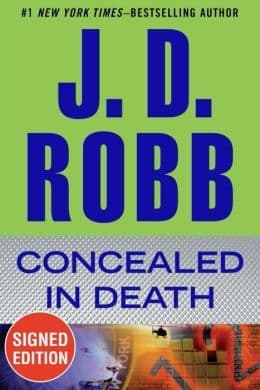
Synopsis
Covers the whole plot, including the ending.
- Difficulty
- Medium
- Pacing
- Moderate
- Mood
- Suspenseful, Gritty, Determined, Emotional
- Read it if
- You love intricate police procedurals with a futuristic twist, strong female protagonists, and a blend of mystery and romance.
- Skip it if
- You dislike graphic crime scene descriptions or prefer standalone mysteries over long-running series.
Concealed in Death Plot Summary
Covers the whole plot, including the ending.
The Discovery at The Sanctuary
During the demolition of a dilapidated Manhattan building, a property Roarke recently acquired, Roarke himself swings a sledgehammer into a wall. He uncovers two human skeletons, wrapped in plastic sheeting, hidden inside. He immediately calls his wife, Lieutenant Eve Dallas, who arrives with her team, including Detective Delia Peabody. The initial discovery quickly grows as further investigation reveals more bodies, eventually totaling twelve sets of remains, all young women. The building, a former church, was known as 'The Sanctuary' in the mid-2040s, a makeshift shelter for troubled teenagers. This sets the stage for Eve's investigation into decades-old murders.
Establishing the Victims' Identities
Eve Dallas and her team, including the newly assigned forensic anthropologist Dr. Petra DeWinter, begin the difficult process of identifying the twelve victims. Dr. DeWinter's skill in skeletal analysis provides details about the victims' ages, approximate time of death, and possible trauma. Through these forensic findings and the recovery of a few personal items, Eve starts to build profiles for each girl. The initial findings suggest they were all teenagers or young adults, many showing signs of difficult lives, linking them to The Sanctuary's history as a refuge for runaways and at-risk youth. The challenge is immense, as decades have passed since their deaths.
Interviewing The Sanctuary's Founders
Eve and Peabody track down the original founders and operators of The Sanctuary: Brother Michael, a former priest, and Sister Elizabeth, a nun who ran the daily operations. They are now elderly and retired, but their memories of the shelter and the teenagers who passed through its doors are clear, though often painful. Brother Michael and Sister Elizabeth offer insight into The Sanctuary's culture, the types of children it served, and the challenges they faced. They recall specific girls who lived there, including some who mysteriously vanished. Their accounts paint a picture of a well-meaning but often overwhelmed institution, operating on a small budget and dealing with difficult, vulnerable youth.
Uncovering Connections and Disappearances
As Eve and her team investigate, they confirm that several identified victims were residents of The Sanctuary who were reported missing in the mid-2040s. One victim is Marlo 'Tattoo' Johnson, a tough street girl known for dealing drugs, whose disappearance was largely overlooked. Another is Felicia 'Flick' Dawson, the runaway daughter of wealthy doctors, whose parents had searched for her. The differences in how these disappearances were handled — some investigated, others largely ignored — show past systemic failures. Eve also learns that many of the girls came from troubled backgrounds, making their disappearances less likely to trigger extensive investigations at the time.
The Role of Dr. Mira
Eve consults with Dr. Charlotte Mira, the police department's top profiler, to understand the killer's mind. Dr. Mira analyzes the crime scene, the victims' profiles, and the method of concealment. She concludes that the killer is likely male, someone who had access to The Sanctuary, and has a strong sense of self-righteousness and a need for control. The specific way the bodies were wrapped and hidden suggests a careful, perhaps ritualistic, approach, pointing to a killer who saw himself as a 'cleanser' or 'punisher.' Dr. Mira's profile helps Eve narrow down potential suspects and understand the psychological reasons behind the acts.
A Shocking Personal Connection
During her investigation, Eve uncovers a shocking link between some of the victims and someone she knows: Nadine Furst, a prominent journalist and friend. It is revealed that Nadine's sister, Carla, was a resident at The Sanctuary during the period the murders occurred. While Carla is not among the identified victims, her presence there and subsequent disappearance create a deeply personal stake in the case for Eve. This revelation adds another layer of urgency to the investigation, as Eve feels an even stronger need to uncover the truth, not just for the victims but also for Nadine and her family.
Nadine's Past and Carla's Story
Eve interviews Nadine Furst, who, though hesitant, opens up about her painful past and her sister Carla's struggles. Nadine reveals that she herself spent some time at The Sanctuary with Carla, though she managed to escape and build a new life. She shares memories of Carla, describing her as vulnerable but spirited, and the circumstances that led them to the shelter. Nadine also recounts the atmosphere within The Sanctuary, the various residents, and the staff members, including a seemingly kind but subtly unsettling counselor named Thomas Waverly. Her insights provide a firsthand account of life inside the shelter and possible clues about the killer.
Focusing on Thomas Waverly
As Eve compiles information from Brother Michael, Sister Elizabeth, and Nadine, a consistent name emerges: Thomas Waverly. Waverly was a seemingly kind and dedicated counselor at The Sanctuary, often seen as a mentor by many of the girls. However, subtle inconsistencies in his accounts, combined with his known presence during the disappearances, start to raise red flags for Eve. She learns that Waverly had a troubled past, including allegations of inappropriate behavior that were never fully prosecuted. His psychological profile, as developed by Dr. Mira, also matches the killer's likely characteristics, making him the prime suspect.
The Confrontation and Confession
Eve Dallas, with growing evidence and a clear psychological profile, confronts Thomas Waverly. Initially, Waverly maintains his facade of a kind caregiver, but under Eve's questioning, his composure breaks. He eventually confesses to the murders, revealing his belief that he was 'saving' the girls from their sinful lives and ensuring their 'purity' by ending their existence. He details how he lured the girls, killed them, and carefully hid their bodies within The Sanctuary's walls, believing his actions were righteous. His confession is chilling, showing the depth of his delusion and depravity.
Justice and Aftermath
With Thomas Waverly's confession, Eve Dallas and her team arrest him. The news of the long-hidden murders and the killer's identity shocks the community, especially those who knew The Sanctuary. The victims' families, some of whom had given up hope, finally receive answers and some closure. Eve reflects on the tragic lives of the young women and the evil that pretended to be salvation. The case closes a dark chapter, but the victims' memories and the impact of Waverly's actions remain, reminding Eve of the lasting presence of both good and evil in the world.
Concealed in Death Characters
Lieutenant Eve Dallas
Protagonist
A driven and intuitive homicide detective with a traumatic past.
Eve Dallas is a highly skilled and dedicated homicide lieutenant for the NYPD. Orphaned and abused as a child, she carries deep emotional scars but channels her trauma into an unwavering pursuit of justice. She is fiercely intelligent, often relying on her gut instincts as much as evidence. Her relationship with her billionaire husband, Roarke, provides her with stability and love, though she remains grounded in her work. She struggles with social graces and often expresses herself bluntly, but her compassion for victims is profound. Her drive to solve cases is almost obsessive, especially when children or vulnerable individuals are involved.
Relationships: Roarke (Husband and primary support system, intellectual and emotional partner.); Detective Delia Peabody (Partner and close friend, often providing comic relief and emotional support.); Dr. Charlotte Mira (Psychological consultant and mentor, often helps Eve process difficult cases.); Nadine Furst (Journalist and friend, becomes personally involved in the case.)
Roarke
Supporting
Billionaire businessman and Eve's devoted, resourceful husband.
Roarke is a self-made Irish billionaire, a former street thief who built an empire. He is incredibly intelligent, charming, and possesses a vast network of connections and resources that often aid Eve in her investigations. He is deeply devoted to Eve, providing her with unconditional love and unwavering support, often understanding her unspoken thoughts. Despite his dark past, he is fiercely protective of those he cares about. His discovery of the bodies at The Sanctuary directly triggers the investigation, making him an integral part of the plot from the outset. He frequently offers insights and practical help, leveraging his technological expertise and financial power.
Relationships: Lieutenant Eve Dallas (Wife and soulmate, provides emotional stability and intellectual partnership.); Summerset (Household manager and confidante.)
Detective Delia Peabody
Supporting
Eve's loyal and compassionate partner, offering a human touch to investigations.
Peabody is Eve's primary partner, a loyal and competent detective with a more conventional background than Eve. She often acts as Eve's emotional sounding board and provides a vital human perspective to the grim realities of their work. Peabody is observant, empathetic, and possesses a dry wit that often lightens the mood. She is dedicated to her job and admires Eve's abilities, constantly learning from her. Her relationship with her boyfriend, McNab, is stable and loving. In this case, Peabody's empathetic nature helps her connect with witnesses and victims' families, and she often handles the more administrative or interpersonal aspects of the investigation.
Relationships: Lieutenant Eve Dallas (Partner and mentor, close friend.); Detective Ian McNab (Boyfriend and fellow detective.)
Thomas Waverly
Antagonist
The seemingly benevolent former counselor of The Sanctuary, revealed as the serial killer.
Thomas Waverly was a counselor at The Sanctuary during the mid-2040s, presenting himself as a kind, dedicated, and spiritual mentor to the troubled teenage girls. He cultivated an image of a compassionate figure, earning trust and respect. However, beneath this facade lay a deeply disturbed and self-righteous individual who believed he was performing a divine service by 'cleansing' the girls of their perceived sins. His motive was a twisted form of religious zealotry and a profound need for control, leading him to murder and meticulously conceal the bodies of twelve young women. He is manipulative and initially presents as innocent, making his eventual reveal all the more shocking.
Relationships: The Sanctuary Victims (His victims, whom he believed he was 'saving.'); Nadine Furst (Knew her and her sister Carla from The Sanctuary.)
Nadine Furst
Supporting
Prominent journalist and friend of Eve, whose personal history intertwines with the case.
Nadine Furst is a well-respected and tenacious journalist who frequently works with Eve on high-profile cases. She is intelligent, articulate, and possesses a strong moral compass. In 'Concealed in Death,' Nadine's personal history becomes critically relevant when it's revealed that her sister, Carla, was a resident of The Sanctuary during the time of the murders. Nadine herself also spent a brief period there. This connection gives her a unique, painful perspective on the victims and the institution, providing Eve with invaluable firsthand accounts and emotional insight. She struggles with the painful memories but ultimately aids Eve in her pursuit of the truth.
Relationships: Lieutenant Eve Dallas (Professional contact and friend.); Carla Furst (Younger sister, disappeared from The Sanctuary.)
Dr. Petra DeWinter
Supporting
A new forensic anthropologist whose expertise is crucial to identifying the victims.
Dr. Petra DeWinter is a newly assigned forensic anthropologist to the NYPD, brought in specifically for her expertise in analyzing skeletal remains. She is highly professional, meticulous, and possesses a calm, scientific demeanor. Her contributions are vital to the investigation, as she is able to extract crucial information from the decades-old skeletons, including approximate ages, causes of death, and identifying characteristics, which helps Eve and her team put names to the victims. She represents the cutting edge of forensic science, providing the objective data that complements Eve's intuitive detective work.
Relationships: Lieutenant Eve Dallas (Professional colleague, providing forensic expertise.)
Brother Michael
Supporting
One of the original founders of The Sanctuary, providing historical context.
Brother Michael was a former priest and one of the founders of The Sanctuary. Now elderly, he provides Eve with a historical perspective on the shelter, its mission, and the challenges they faced. He genuinely believed in helping troubled youth, but his recollections also highlight the limitations and potential vulnerabilities of the institution. He is a man of faith, grappling with the knowledge that such evil could have occurred under his watch. His memories, though sometimes hazy with age, are crucial in establishing a timeline and identifying key individuals who worked or resided at The Sanctuary.
Relationships: Sister Elizabeth (Co-founder of The Sanctuary.)
Sister Elizabeth
Supporting
The nun who managed the daily operations of The Sanctuary, offering detailed recollections.
Sister Elizabeth was a nun who ran the day-to-day operations of The Sanctuary alongside Brother Michael. She had more direct, hands-on interaction with the teenage girls who lived there. Her memory is sharper than Brother Michael's regarding specific individuals and daily routines. She is a compassionate woman, deeply affected by the rediscovery of the bodies and the betrayal of trust. Her detailed accounts of the girls, the staff, and the general atmosphere within The Sanctuary are invaluable to Eve's investigation, helping to humanize the victims and piece together the timeline of their disappearances. She provides crucial insights into Thomas Waverly's past behavior.
Relationships: Brother Michael (Co-founder of The Sanctuary.)
Marlo 'Tattoo' Johnson
Mentioned
One of the identified victims, a tough street girl from The Sanctuary.
Marlo Johnson, known as 'Tattoo' due to her prominent ink, was one of the twelve victims found in the walls of The Sanctuary. She was a tough, street-smart teenager who dealt drugs and lived a hard life. Her disappearance decades prior went largely uninvestigated, a tragic reflection of society's oversight of vulnerable youth. Her identification helps Eve paint a clearer picture of the types of girls who resided at the shelter and became targets of the killer.
Relationships: The Sanctuary Residents (Fellow residents at the shelter.)
Felicia 'Flick' Dawson
Mentioned
One of the identified victims, a runaway from a well-to-do family.
Felicia Dawson, nicknamed 'Flick,' was another of the identified victims from The Sanctuary. Unlike Marlo, Felicia came from a wealthy family, but she was a troubled runaway. Her parents had actively searched for her after her disappearance, making her case one of the few that received some attention at the time. Her story highlights that the killer preyed on a range of vulnerable girls, regardless of their background, as long as they were within the confines of The Sanctuary.
Relationships: The Sanctuary Residents (Fellow residents at the shelter.)
Concealed in Death Themes
The Concealment of Evil
This theme is central, both literally and figuratively. The bodies of the twelve victims are hidden within The Sanctuary's walls, reflecting how the killer, Thomas Waverly, hid his monstrous nature behind a facade of kindness and spiritual guidance. The decades-long silence about the disappearances also represents a societal hiding of vulnerable youth's plight. Eve's investigation removes these layers of concealment, exposing the dark truth that lingered for years. The theme explores how evil can hide in plain sight, often within trusted institutions or individuals, and the impact of its eventual revelation.
“Evil isn't a thing. It's an absence of good. A void. And you fill it with whatever darkness you can imagine.”
Vulnerability and Exploitation
The novel explores the vulnerability of at-risk teenagers, especially runaways and those from troubled backgrounds, and how they can be exploited by those in positions of trust. The girls at The Sanctuary sought refuge and guidance, only to become victims of the person meant to care for them. Their marginalized status meant their disappearances were often overlooked or dismissed, highlighting systemic failures to protect them. Eve, with her own history of childhood trauma, feels a deep personal connection to this vulnerability, driving her pursuit of justice for those who had no voice.
“They were just kids. Lost kids. And he preyed on that.”
Justice for the Forgotten
A core theme is the pursuit of justice for individuals whose lives and deaths were largely forgotten or ignored. The twelve victims of The Sanctuary had been missing for decades, their cases cold and abandoned. Eve Dallas's investigation brings their stories back, giving names and faces to the remains, and ensuring that their lives—and the horrific manner of their deaths—are finally acknowledged. This theme shows that every life has value and deserves justice, regardless of societal status or how much time has passed. It is about speaking for the dead who can no longer speak for themselves, bringing closure to long-suffering families.
“No one gets forgotten on my watch. Not if I can help it.”
The Nature of Good and Evil
The novel explores the complex nature of good and evil, particularly how they can exist together or be twisted. The Sanctuary was founded with good intentions by Brother Michael and Sister Elizabeth to help troubled youth. Yet, inside its walls, ultimate evil appeared through Thomas Waverly, who rationalized his horrific acts as divine 'cleansing.' This contrast forces characters and readers to confront how easily good intentions can be corrupted and how evil can pretend to be virtue. It explores the psychological depths of depravity and the capacity for human cruelty, contrasted with the enduring fight for justice.
“He thought he was God. He thought he was pure. And he killed them because he thought they weren't.”
Plot Devices & Literary Techniques
Forensic Anthropology
The use of skeletal analysis to identify long-dead victims and determine causes of death.
The introduction of Dr. Petra DeWinter and her expertise in forensic anthropology is a critical plot device. Since the victims have been dead for decades and are reduced to skeletal remains, traditional forensic methods are limited. Dr. DeWinter's ability to extract information about age, gender, potential trauma, and even approximate time of death from bones is essential for identifying the victims and reconstructing the crime. This device not only provides crucial evidence but also highlights the scientific advancements in solving cold cases, making the seemingly impossible task of identifying forgotten victims achievable.
Personal Connection (Nadine Furst)
A trusted friend's past links directly to the crime, raising the stakes for the protagonist.
The revelation that Nadine Furst's sister, Carla, resided at The Sanctuary and subsequently disappeared, and that Nadine herself spent time there, serves as a powerful personal connection plot device. This connection elevates the emotional stakes for Eve, moving the case beyond a purely professional duty into a deeply personal quest for justice for a friend's family. It provides Eve with invaluable insider information about The Sanctuary's environment and inhabitants, while also forcing Nadine to confront painful memories, adding a layer of emotional depth and urgency to the investigation.
The 'Sanctuary' as a Setting
A place of supposed refuge that becomes a site of horror and betrayal.
The setting of 'The Sanctuary' itself is a significant plot device. Its name implies a place of safety, healing, and spiritual solace for troubled youth. This benevolent facade creates a stark and horrifying contrast with the reality of it being a mass grave and the site of immense betrayal. The irony of the name amplifies the horror of the crimes, emphasizing how trust was violated and vulnerability exploited. The decaying building, as a physical representation of forgotten promises and concealed evil, serves as a powerful backdrop for the unfolding mystery and the eventual revelation of truth.
Flashbacks/Recollections
Characters' memories of the past provide crucial clues for the present investigation.
The use of flashbacks and detailed recollections from characters like Brother Michael, Sister Elizabeth, and especially Nadine Furst is a vital plot device. Since the crimes occurred decades ago, direct evidence is scarce. The investigation relies heavily on the imperfect but often illuminating memories of those who were present at The Sanctuary. These recollections, pieced together by Eve, provide character profiles of the victims, insights into the dynamics of the shelter, and crucial details about the staff, including the killer. They allow the past to gradually unfold in the present, guiding Eve toward the truth despite the passage of time.
Concealed in Death Quotes
“I don’t want to be the one to tell you this, but you are not going to be happy here. Not with him. Because you’re not the kind of woman who can be happy with a man who thinks he owns you.”
“You don't need to be pretty for me. You just need to be you.”
“Sometimes the past is a cage, and sometimes it's a compass.”
“There’s a difference between being a victim and letting yourself be one.”
“The dead don't lie, but the living sure as hell do.”
“You can’t fix what you don’t acknowledge.”
“He didn’t just love her, he respected her. And that, Eve thought, was the real foundation.”
“Justice isn't always fair, but it's the best we've got.”
“Grief was a tricky beast. It didn't always roar; sometimes it just gnawed.”
“The city never slept, and neither did its demons.”
“Trust was earned, not given, especially in her line of work.”
“Sometimes the bravest thing you can do is ask for help.”
“The truth was messy, complicated, and rarely fit into neat little boxes.”
“You can't outrun your own head, Lieutenant.”
Quiz
10 questions on the plot and the characters. Each answer comes with a short explanation.
Question 1
What is the initial discovery made by Roarke when he begins demolition in the decrepit building?
- A hidden stash of old money
- Two skeletons wrapped in plastic
- An ancient, valuable artifact
- A secret passage leading to another building
Show answer
B. Two skeletons wrapped in plastic Roarke's initial sledgehammer swing reveals two skeletons, triggering Eve Dallas's investigation.
Question 2
What was the name of the makeshift shelter for troubled teenagers that once occupied the building?
- The Haven
- The Refuge
- The Sanctuary
- The Oasis
Show answer
C. The Sanctuary The building was known as 'The Sanctuary,' a crucial detail for Eve's investigation into the victims' past.
Question 3
Who is the primary protagonist and lead detective investigating the murders?
- Mavis Freestone
- Lieutenant Eve Dallas
- Dr. Charlotte Mira
- Nadine Furst
Show answer
B. Lieutenant Eve Dallas Lieutenant Eve Dallas is the central character and lead detective in the 'In Death' series, including this novel.
Question 4
What kind of professional helps Eve put names and faces to the remains found in the building?
- A renowned psychologist
- A retired police officer with historical knowledge
- The force's new forensic anthropologist
- A specialist in digital forensics
Show answer
C. The force's new forensic anthropologist The new forensic anthropologist plays a key role in identifying the victims through scientific analysis of the remains.
Question 5
What is the primary characteristic shared by all the victims found in the building?
- They were all involved in illegal gambling rings.
- They were all young girls.
- They were all former employees of Roarke's company.
- They were all connected to a specific organized crime family.
Show answer
B. They were all young girls. All the victims identified are young girls who had stayed at The Sanctuary, highlighting a pattern in the killer's choice.
Question 6
What is the approximate time period when 'The Sanctuary' was in operation, according to the recollections Eve gathers?
- Late 2030s
- Mid-2040s
- Early 2050s
- Late 2020s
Show answer
B. Mid-2040s The shelter operated in the mid-2040s, providing a crucial timeline for Eve's investigation.
Question 7
What kind of connection does Eve eventually discover between the victims and someone she knows?
- A past romantic relationship with one of the victims
- A shared investment in a business venture
- A personal link to a friend or acquaintance of Eve's
- A professional connection through a previous case
Show answer
C. A personal link to a friend or acquaintance of Eve's Eve's discovery of a personal connection to someone she knows raises the stakes and adds a layer of complexity to the case.
Question 8
What is the overarching theme Eve is determined to expose through her investigation, as hinted at in the synopsis?
- The corruption within the city's political system
- The secrets of 'The Sanctuary' and the evil concealed in one human heart
- The dangers of unchecked technological advancement
- The resilience of the human spirit in times of crisis
Show answer
B. The secrets of 'The Sanctuary' and the evil concealed in one human heart Eve's ultimate goal is to uncover the truth behind The Sanctuary and expose the individual responsible for the heinous crimes.
Question 9
How many murders does Eve Dallas ultimately realize she has to solve after her initial crime scene assessment?
- Two
- Six
- Ten
- Twelve
Show answer
D. Twelve While Roarke initially finds two skeletons, Eve's thorough investigation reveals a total of twelve victims.
Question 10
Which character initiates the discovery of the bodies by beginning the demolition process?
- Eve Dallas
- Commander Whitney
- Roarke
- Feeney
Show answer
C. Roarke Eve's husband, Roarke, is the one who swings the sledgehammer and uncovers the first two skeletons.
Concealed in Death FAQ
What is the central crime Lieutenant Eve Dallas investigates in 'Concealed in Death'?
Eve Dallas investigates the discovery of twelve skeletal remains, wrapped in plastic, found hidden behind a wall during a demolition project initiated by her husband, Roarke. The victims are identified as young girls who resided at a makeshift shelter called The Sanctuary in the mid-2040s.
Who initially discovers the bodies, and what is his role in the plot?
Roarke, Eve's husband, discovers the first two skeletons while swinging a sledgehammer during the demolition of a long-empty New York building. His discovery initiates the entire investigation and he frequently provides resources and support to Eve throughout the case.
What was 'The Sanctuary' and why is it significant to the case?
The Sanctuary was a makeshift shelter for troubled teenagers in the mid-2040s, located in the very building where the bodies are found. It is significant because all twelve victims were young girls who lived there, making the shelter the central location for Eve's investigation into their disappearances and murders.
How does Eve identify the victims, given the passage of time?
Eve identifies the victims through a combination of tracking down the people who ran The Sanctuary for their recollections and utilizing the expertise of the force's new forensic anthropologist. This dual approach helps put names and faces to the long-deceased remains.
What kind of teenagers were the victims, and what commonality did they share?
The victims were diverse, including a tattooed tough girl involved in illegal drugs and the runaway daughter of wealthy doctors. Despite their different backgrounds, they all shared the commonality of being troubled teenagers seeking shelter at The Sanctuary, and ultimately, losing their chance for a better life.
What specific 'hidden detail' connects Eve to one of the victims or the case?
Eve discovers a connection between the victims and someone she knows, which is a pivotal moment in the investigation. This personal link intensifies her determination to solve the case, making it more than just another homicide for her.
Are there any specific forensic techniques or technologies highlighted in the investigation?
The novel highlights the crucial role of a new forensic anthropologist who helps Eve put names and faces to the remains. This suggests advanced anthropological techniques are employed, along with standard police procedural work, to analyze the long-hidden skeletal evidence.
How does the author use the setting of a 'decrepit, long-empty New York building' to enhance the mystery?
The decrepit, long-empty building provides a chilling backdrop, symbolizing forgotten lives and concealed secrets. Its abandoned state allows the bodies to remain undiscovered for decades, heightening the suspense and making the eventual discovery more impactful and gruesome.
What role does Roarke's background in demolition and construction play in the plot beyond the initial discovery?
Beyond the initial discovery, Roarke's extensive knowledge of construction and building structures likely provides valuable insights into how the bodies were concealed and how the building was used. His resources and technical expertise often aid Eve in navigating complex physical spaces and logistics related to her cases.
How does Eve's past as an abused child influence her approach to this particular case involving young, vulnerable victims?
Eve's own traumatic past as an abused child deeply resonates with the vulnerability of the young victims, making her exceptionally determined and emotionally invested. This personal connection fuels her relentless pursuit of justice, ensuring no stone is left unturned in revealing the 'evil concealed in one human heart'.
What psychological impact does discovering a personal connection to the victims have on Eve?
Discovering a personal connection to the victims profoundly impacts Eve, transforming the case from a standard investigation into a deeply personal quest for justice. This connection likely intensifies her focus, resolve, and possibly her anger, as she confronts the perpetrator's cruelty.
How does the psychological profile of the killer, suggested by the long-term concealment of multiple bodies, contribute to the suspense?
The long-term concealment of multiple bodies suggests a highly methodical, cold, and possibly unremorseful killer, hinting at a deep-seated psychopathy. This profile creates intense suspense, as Eve must confront a perpetrator capable of such sustained depravity and careful planning.
What is the psychological significance of 'The Sanctuary' turning into a death trap for the teenagers it was meant to help?
The Sanctuary's transformation from a place of refuge to a death trap is a profound psychological twist, symbolizing betrayal of trust and ultimate vulnerability. It highlights the devastating impact when institutions designed for protection become sources of ultimate harm, preying on those who need help the most.
How does the title 'Concealed in Death' reflect the themes of the novel beyond the literal concealment of bodies?
The title 'Concealed in Death' reflects not only the physical concealment of the bodies but also the hidden truths, forgotten lives, and the 'evil concealed in one human heart.' It speaks to the long-buried secrets of The Sanctuary and the obscured motives behind the murders.
What moral or ethical questions does the existence of 'The Sanctuary' and its eventual downfall raise?
The existence of 'The Sanctuary' raises questions about the responsibility of care providers, the vulnerability of troubled youth, and the potential for corruption within institutions designed to help. Its downfall highlights the ethical failures when oversight is lacking and predators exploit those in their care.
Does the novel suggest a broader societal commentary on forgotten or marginalized youth?
Yes, by focusing on 'troubled teenagers,' runaways, and those dealing with illegal drugs, the novel implicitly comments on marginalized youth who often fall through societal cracks. Their forgotten status in the decrepit building underscores a societal failure to protect and remember its most vulnerable members.
How does the blend of 'Thriller, Mystery, Science Fiction, Romance' genres uniquely contribute to this particular installment?
The blend of genres allows 'Concealed in Death' to offer a multifaceted experience: the mystery drives the plot, thriller elements build suspense, science fiction provides the futuristic setting and advanced forensics, while the underlying romance between Eve and Roarke offers emotional grounding amidst the darkness, showcasing their unwavering partnership.
What might be the author's message about the persistence of evil, even in a futuristic society?
The author's message suggests that despite technological advancements and a futuristic setting, fundamental human evil persists, capable of preying on the vulnerable. The discovery of decades-old murders in 2061 emphasizes that progress in society does not eradicate the darker aspects of human nature.
About the author

J.D. Robb is a pseudonym for author Nora Roberts, known for her work in the romance and suspense genres. She is particularly recognized for the "In Death" series, which includes titles such as "Naked in Death," "Glory in Death," "Immortal in Death," "Rapture in Death," "Ceremony in Death," and "Holiday in Death." These novels blend elements of crime fiction with futuristic settings and strong character development.
Similar books
- Naked in Death
J.D. Robb
4.1 (167k) average on GoodreadsThrillerFirst book in the same series, establishing the world and characters.
- The Silent Patient
Alex Michaelides
4.1 (507k) average on GoodreadsThrillerFeatures a gripping mystery with a focus on uncovering past secrets and psychological suspense.
- Still Life
Louise Penny
3.9 (2k) average on GoodreadsLiterary FictionAnother series with strong character development and a focus on community secrets within a mystery framework.
- The Likeness
Tana French
4.0 (126k) average on GoodreadsThrillerWhen pitted against Tana French's The Likeness, 'Concealed in Death' lacks the profound psychological depth and literary complexity. French's novel delves into themes of identity, self-deception, and the blurring of self with a more philosophical and artful narrative structure, making Robb's work, while engaging, feel more commercially oriented and less experimentally structured in its exploration of manipulation and identity.
- Angels & Demons
Dan Brown
3.9 (2.7M) average on GoodreadsThrillerA Harvard symbologist races through Rome's ancient sites, deciphering cryptic clues to unmask the Illuminati and stop a vengeful plot to destroy the Vatican with a stolen antimatter weapon.
- Gone Girl
Gillian Flynn
4.1 (2.3M) average on GoodreadsThrillerA wife's sudden disappearance on her fifth anniversary reveals a web of lies and psychological warfare, exposing the secrets within a seemingly perfect marriage.




Enjoyed the summary?
A summary gives you the shape of the book. The book itself has the detail, the examples and the voice.
Find Concealed in Death on AmazonAs an Amazon Associate, BookBrief earns from qualifying purchases. How we're funded