
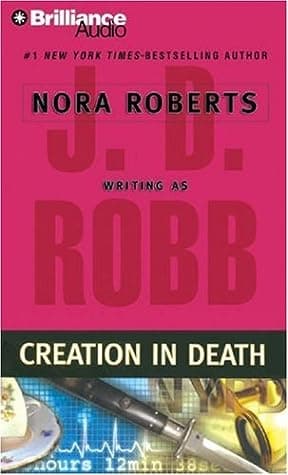
Synopsis
Covers the whole plot, including the ending.
- Difficulty
- Medium
- Pacing
- Fast
- Mood
- Suspenseful, Gritty, Intense, Romantic
- Read it if
- You enjoy futuristic police procedurals with a strong romantic subplot, intricate mysteries, and a relentless hunt for a serial killer.
- Skip it if
- You prefer fantasy over sci-fi elements, or find detailed descriptions of torture and violence too disturbing.
Creation in Death Plot Summary
Covers the whole plot, including the ending.
The Return of The Groom
Lieutenant Eve Dallas responds to a gruesome crime scene in her futuristic New York City. The victim, a young brunette named Tara, is found arranged, arms spread, with signs of prolonged torture. Carved into her torso is the exact time of her suffering. A silver ring is on her left hand. The scene reminds Eve of 'The Groom' case nine years ago, a serial killer who killed four people in fifteen days before disappearing. Eve and her mentor, Detective Commander Feeney, had worked on that case, only for the killer to vanish, resurfacing elsewhere with similar killings.
A Personal Connection
The investigation into Tara's murder quickly shows a personal link: Tara worked for Roarke, Eve's billionaire husband. Eve involves Roarke in the case, which proves helpful. As they investigate, it becomes clear 'The Groom' has made this return personal. The victim's body was washed with products from a store Roarke owns, and she was laid out on a sheet made by his company. This deliberate taunt means the killer is not just back but is targeting Eve and her life, raising the stakes of the hunt.
Feeney's History and the Killer's MO
With 'The Groom's' return, Eve is determined to stop him. She and Feeney review the files from nine years ago, confirming the killer's style: precise body arrangements, specific torture methods, carved death times, and the silver ring. They understand 'The Groom' enjoys his victims' prolonged suffering and the careful staging of his crime scenes. The killer's past pattern suggests he acts quickly, meaning another victim is likely already taken or soon will be. They must predict his next move.
Roarke's Expertise and Resources
Roarke, using his resources and technology, helps the investigation. He uses his security teams, private databases, and advanced surveillance to track leads related to the products and sheet found at the crime scene. His involvement is not just personal; it helps the police with resources they would not normally have. His understanding of complex systems and ability to think outside standard law enforcement complements Eve's instincts, speeding up data analysis and the search for the killer.
Anticipating the Next Victim
Familiar with 'The Groom's' methods and his rapid escalation in past sprees, Eve knows he has already taken his next victim. The pressure grows as the team works to find targets, analyze patterns, and predict where the killer might strike. They review past victims' profiles, looking for commonalities beyond the obvious, hoping to find a clue that leads them to the next woman before it is too late. The race against time is intense, with every moment potentially bringing another woman closer to Tara's fate.
The Killer's Ultimate Challenge
As Eve and her team get closer, they realize 'The Groom' is not just repeating old patterns; he is changing. He wants a bigger challenge, a kidnapping that will test his skills and give him great satisfaction. This shows arrogance and a desire to prove his mastery. The target is likely someone important, someone whose disappearance would shock the city, solidifying his reputation. The stakes are higher, making the hunt more desperate and dangerous for Eve and her team.
Eve Becomes the Target
The personal nature of the recent murder and the deliberate use of Roarke's products point to a deeper motive: 'The Groom' is after Eve herself. He is not just returning to his old hunting grounds; he is challenging the detective who almost caught him nine years ago. His actions are a twisted form of courtship, drawing Eve into his game. This realization adds a terrifying layer to the investigation, making Eve not just the hunter but also the potential prey. The killer's ultimate satisfaction would come from outsmarting and capturing her.
The Hunt Intensifies
With Eve's life possibly at risk, the hunt becomes more intense. Detectives, helped by Roarke's security and tech experts, work constantly, following every lead. They check surveillance footage, analyze data, and interview anyone who might have seen something. The city's resources are fully used, creating a large search. The tension is clear as time runs out, not just for the unknown next victim, but for Eve as well, as 'The Groom's' game reaches its end.
A Glimmer of Hope
Amidst the pressure and dwindling time, a breakthrough happens. Perhaps through Roarke's tech or Feeney's review of old evidence, new information appears – a small change in the killer's pattern, a forgotten detail from the past, or specific forensic evidence linked to the products used. This lead, though small, provides a direction, narrowing the search and giving Eve and her team hope in their desperate pursuit.
The Confrontation
The lead brings Eve to a confrontation with 'The Groom.' The killer likely chose the location for its meaning or advantage. This encounter is the result of years of pursuit and the immediate threat to Eve's life and the latest victim's life. The confrontation is a tense, dangerous battle of wits and strength, where Eve must use all her training, instincts, and determination to stop the serial killer who has haunted her for so long. The outcome will decide 'The Groom's' fate and the safety of his captive.
Principal Figures
Lieutenant Eve Dallas
Protagonist
A tough, driven homicide detective haunted by past cases.
Eve Dallas is a highly skilled and intuitive homicide detective with the New York City Police and Security Department. She is fiercely dedicated to justice, often pushing herself to the brink to solve crimes. Haunted by a traumatic past, she channels her pain and anger into a relentless pursuit of perpetrators. Her analytical mind, combined with a sharp wit and deep empathy for victims, makes her an formidable investigator. Despite her often gruff exterior, she possesses a strong moral compass and deep loyalty to her friends and husband.
Relationships: Roarke (Husband, partner in life and sometimes in crime-solving, deep love and trust.); Commander Feeney (Mentor, partner, surrogate father figure, deep professional respect and personal bond.)
Roarke
Supporting
Billionaire businessman and Eve's devoted, resourceful husband.
Roarke is a self-made Irish billionaire with vast business interests spanning technology, real estate, and more. He is brilliant, cunning, and possesses an extensive network of resources, both legal and less so. Devoted to Eve, he often uses his considerable influence and technological prowess to aid her investigations, blurring the lines between private citizen and law enforcement asset. He is fiercely protective of Eve and their life together, and his dark past gives him a unique understanding of the criminal mind, which he applies to help Eve catch killers.
Relationships: Lieutenant Eve Dallas (Wife, deep love, trust, and mutual respect; co-investigator in personal cases.)
Commander Jack Feeney
Supporting
Eve's former partner, mentor, and head of the Electronic Crimes Unit.
Commander Jack Feeney is Eve's long-time mentor and former partner, now heading the Electronic Crimes Unit. He is a seasoned, no-nonsense detective with a sharp mind for forensics and digital evidence. Feeney played a crucial role in Eve's development as a detective and holds a paternal affection for her. He is steadfast, reliable, and provides a calming, experienced presence, especially when Eve is emotionally invested in a case. His expertise in technology is invaluable, particularly in a future New York City where digital footprints are paramount.
Relationships: Lieutenant Eve Dallas (Mentor, former partner, surrogate father figure, deep professional respect and personal bond.)
The Groom (Serial Killer)
Antagonist
A meticulous, sadistic serial killer who targets women and tortures them.
The Groom is a highly intelligent and dangerously meticulous serial killer who derives immense pleasure from the prolonged torture and ritualistic staging of his female victims. He is a master of evasion, having disappeared for years only to resurface globally, always leaving his signature: a silver ring, carved time of death, and a precisely arranged body. His motives are rooted in a profound sense of control and a twisted artistic vision, seeing his crimes as masterpieces. His return to New York is a deliberate challenge to Eve Dallas, whom he views as a worthy adversary in his deadly game.
Relationships: Lieutenant Eve Dallas (Obsessive adversary, target of his twisted game.)
Tara (Victim)
Mentioned
The first victim of The Groom's return, an employee of Roarke.
Tara is the young brunette victim whose murder kicks off the investigation. She is an employee of Roarke, making her death particularly personal to Eve and her husband. Her body is found meticulously arranged, bearing all the hallmarks of 'The Groom's' previous victims, including signs of prolonged torture, the carved time of death, and a silver ring. Her death serves as the catalyst for Eve's renewed hunt for the serial killer and highlights the killer's deliberate taunt towards Roarke and Eve.
Relationships: Roarke (Employer/employee.)
Themes & Insights
The Persistence of Evil
This theme shows how evil, once present, can lie hidden only to reappear stronger. 'The Groom's' return after nine years, continuing his patterns globally, shows that some forms of depravity are not easily stopped. Eve's failure to catch him years ago highlights the lasting impact of such evil, forcing her to face a past trauma and renew her commitment to preventing its spread. The careful nature of the killer's staging shows how deep and unwavering his malice is.
“Eve had seen this crime scene before... The Groom had come back to where he started.”
The Blurring of Personal and Professional
The novel explores the difficulties Eve faces when her personal life meets her professional duties. The victim is an employee of her husband, Roarke, and the crime scene uses products from Roarke's companies, forcing her personal and professional worlds to merge. This blurring makes the investigation personal, increasing the stakes and emotional toll for Eve, as she is not just solving a case, but protecting her life and loved ones from a killer who has made it a personal attack.
“When it turns out that The Groom’s most recent victim was employed by Eve’s billionaire husband, Roarke, she brings him onto the case. A move that proves fitting when it becomes chillingly clear that the killer has made it personal.”
Obsession and Pursuit
Both the main character and the killer are driven by strong obsessions. 'The Groom' is obsessed with his 'art' and the precise execution of his murders, as well as an escalating challenge, ultimately targeting Eve. Eve, in turn, is obsessed with bringing justice to victims and stopping the killer, especially given her past failure with 'The Groom' and his current personal attack. This shared obsession creates a high-stakes game, where each move is calculated and personal, fueling the pursuit until one side wins.
“His sights are set on the biggest challenge of his illustrious career - an abduction that will test his skills and that promises to give him satisfaction as he’s never known.”
The Nature of Justice
The book looks at what justice means when facing extreme evil. Eve's pursuit of 'The Groom' is not just about catching a criminal; it is about restoring balance, honoring the dead, and preventing future crimes. The killer's belief in his 'creation' challenges human dignity and the rule of law. The story explores whether justice is only about punishment, or if it also involves overcoming a predator who thinks he is untouchable, and protecting society from such a threat.
“With the Groom’s monstrous return, Eve is determined to finish him once and for all.”
Plot Devices & Literary Techniques
The Serial Killer's Signature
A recurring set of unique elements left at each crime scene.
The Groom's signature – the artfully arranged body, the carved time of death, signs of prolonged torture, and the silver ring – serves as a crucial plot device. It immediately identifies the killer, linking the current murder to the past spree and establishing the antagonist's consistent, ritualistic modus operandi. This signature allows Eve and Feeney to quickly recognize the returning threat and provides specific forensic and psychological clues for their investigation, setting the tone for the entire mystery and emphasizing the killer's arrogance and meticulousness.
Personal Connection/Taunt
The killer deliberately targets those connected to the protagonist.
The killer's use of products from Roarke's companies and the victim's employment by him act as a direct personal taunt to Eve and Roarke. This device elevates the stakes from a routine homicide investigation to a deeply personal vendetta, making Eve not just the hunter but also a potential target. It forces Roarke into an active role in the investigation, leveraging his resources and intellect, and adds a layer of emotional intensity and urgency to Eve's pursuit, as she is fighting not just for justice, but for her own life and the safety of her loved ones.
The Unfinished Business of the Past
A past failure or unresolved case resurfaces to challenge the protagonist.
The return of 'The Groom' represents unfinished business from Eve's past, a case that haunted her and Feeney for years. This device creates immediate dramatic tension and personal investment for Eve, as she's confronted with a failure she couldn't resolve previously. It allows for character development by forcing Eve to revisit her past trauma and demonstrate her growth as a detective. The unresolved nature of the previous spree fuels her determination to catch him this time, giving the narrative a strong emotional core and a sense of a reckoning.
Creation in Death Quotes
“The dead don't care about your feelings, Dallas. They just want justice.”
“Roarke was a man who moved in shadow and light, a master of both, and she, Eve, was the woman who walked beside him.”
“Sometimes the best way to catch a monster is to think like one, but never to become one.”
“She was a cop, through and through. It was in her bones, in her blood, in every beat of her damaged heart.”
“Love didn't make you weak; it made you strong enough to face anything.”
“The future was always uncertain, but that didn't mean you stopped fighting for a better one.”
“He didn't just love her; he saw her, truly saw her, every broken piece and every shining shard.”
“Justice wasn't a perfect system, but it was the only one they had, and it was worth bleeding for.”
“The past was a ghost, but sometimes it reached out and grabbed you, reminding you it was never truly gone.”
“There were a million ways to kill, but only a few to truly live.”
“Fear was a choice, and she refused to make it.”
“He was her anchor, her safe harbor, in a world that often felt like a storm.”
“Every victim had a story, and it was her job to make sure it was heard.”
“The city never slept, and neither did its darkness.”
Quiz
10 questions on the plot and the characters. Each answer comes with a short explanation.
Question 1
What distinguishing mark is carved into the torso of the Groom's victims?
- The victim's name
- A cryptic symbol
- The time it took her to die
- The killer's initials
Show answer
C. The time it took her to die The text states, 'Carved into her torso is the time it took her to die - in hours, minutes, and seconds.'
Question 2
What item is placed on the third finger of the left hand of the Groom's victims?
- A gold locket
- A silver ring
- A wedding band
- A small flower
Show answer
B. A silver ring The description mentions, 'And on the third finger of her left hand has been placed a silver ring.'
Question 3
How long ago did Eve Dallas first encounter 'The Groom' killer?
- Five years earlier
- Seven years earlier
- Nine years earlier
- Eleven years earlier
Show answer
C. Nine years earlier The text states, 'Eve is catapulted back to a case nine years earlier, when a man whom the media tagged “The Groom” put the city on edge.'
Question 4
Why does Eve bring her husband, Roarke, onto the case?
- Roarke is a trained detective and offers his expertise.
- The most recent victim worked for one of Roarke's companies.
- Roarke has a personal connection to one of the previous victims.
- Eve needs Roarke's financial resources to fund the investigation.
Show answer
B. The most recent victim worked for one of Roarke's companies. The passage explains, 'When it turns out that The Groom’s most recent victim was employed by Eve’s billionaire husband, Roarke, she brings him onto the case.'
Question 5
What evidence indicates that The Groom has made the current case 'personal' for Eve and Roarke?
- The killer left a note addressed directly to Eve.
- The victim was found in their personal residence.
- The corpse was prepared with products and materials from Roarke's companies.
- The killer specifically targeted a friend of Eve's.
Show answer
C. The corpse was prepared with products and materials from Roarke's companies. The text states, 'The corpse was washed in products from a store Roarke owns and laid out on a sheet his company manufactures.'
Question 6
Who is Feeney to Eve Dallas?
- Her commanding officer
- Her current partner on the force
- Her friend and mentor, and former partner
- A medical examiner assisting with the case
Show answer
C. Her friend and mentor, and former partner The passage describes Feeney as 'her partner Feeney, her friend and mentor,' in reference to the original Groom case.
Question 7
What is the primary motivation stated for The Groom's return to the city where he started?
- To evade capture by international authorities.
- To settle an old score with Eve Dallas.
- To take on 'the biggest challenge of his illustrious career' by abducting someone specific.
- To find a new base of operations for his crimes.
Show answer
C. To take on 'the biggest challenge of his illustrious career' by abducting someone specific. The text states, 'But his sights are set on the biggest challenge of his illustrious career - an abduction that will test his skills and that promises to give him satisfaction as he’s never known.'
Question 8
What is the primary characteristic of The Groom's victims that Eve notes when seeing the first crime scene of his return?
- They are all elderly women.
- They are all prominent public figures.
- They are young brunettes, artfully arranged, and show signs of prolonged torture.
- They are all found indoors, in their own homes.
Show answer
C. They are young brunettes, artfully arranged, and show signs of prolonged torture. The opening sentence describes the victim as 'the artfully arranged body of a young brunette, arms spread, palms up, body marked by the signs of prolonged and painful torture,' which matches the previous victims.
Question 9
What does Eve's immediate reaction to the first crime scene of The Groom's return indicate about her past experience with him?
- She is completely unfamiliar with his methods.
- She recognizes the pattern and understands his modus operandi.
- She believes it's a copycat killer, not the original Groom.
- She is overwhelmed by fear and unable to process the scene.
Show answer
B. She recognizes the pattern and understands his modus operandi. The text states, 'Eve has seen this crime scene before' and later, 'Familiar with his methods, she knows that he has already grabbed his next victim,' indicating deep recognition.
Question 10
What is the ultimate goal Eve sets for herself regarding The Groom's return?
- To understand his psychological motivations.
- To protect Roarke's business interests from further damage.
- To finish him once and for all and stop his killing spree.
- To prevent him from leaving the city again.
Show answer
C. To finish him once and for all and stop his killing spree. The passage concludes with Eve's determination: 'With the Groom’s monstrous return, Eve is determined to finish him once and for all.'
Creation in Death FAQ
What is the central mystery Eve Dallas faces in 'Creation in Death'?
Eve Dallas is hunting 'The Groom,' a serial killer who resurfaces after nine years, mimicking his past methods of torturing and meticulously arranging his victims. The central mystery deepens when the killer's latest victim is connected to Eve's husband, Roarke, making the case intensely personal and pushing Eve to finally stop him.
Who is 'The Groom' and what are his signature methods?
'The Groom' is a serial killer who targets young brunettes, subjecting them to prolonged and painful torture before artfully arranging their bodies. He carves the exact time of death onto their torsos and places a silver ring on their left ring finger, a chilling ritual that marks his victims.
How does Roarke become involved in the investigation?
Roarke becomes involved when the Groom's most recent victim is discovered to have been an employee of his company. The killer further implicates Roarke by using products from his stores and sheets manufactured by his company to prepare the crime scene, making it clear he is targeting Eve through her husband.
What is the significance of the silver ring found on the victims?
The silver ring is a signature detail of 'The Groom,' placed on the third finger of his victims' left hands. While its exact symbolic meaning to the killer isn't immediately clear, it serves as a consistent identifier of his work and a chilling 'wedding' to his victims, emphasizing his twisted fantasy.
How does this case connect to Eve's past and her mentor, Feeney?
This case directly connects to Eve's past because 'The Groom' was a killer she and her mentor, Commander Feeney, investigated nine years prior. They failed to catch him then, and his reappearance forces them to confront that unresolved failure, intensifying Eve's determination to bring him to justice.
What hidden detail about the crime scenes points to The Groom's personal targeting?
The hidden detail that points to The Groom's personal targeting is the use of Roarke's company products. The victim was washed with cleansers from a Roarke-owned store and laid out on a sheet manufactured by Roarke's company, a deliberate choice to link the crime directly to Eve's husband.
Is there a specific 'creation' theme beyond the title that the killer embodies?
Beyond the title, the killer embodies a twisted 'creation' theme by meticulously crafting his crime scenes and victims. He 'creates' his ideal bride through torture and ritualistic arrangement, transforming living women into his macabre art, and even carves the 'creation' time (death time) onto their bodies.
How does the carving of the death time on the victim's torso function as a clue or message?
The carving of the death time in hours, minutes, and seconds on the victim's torso serves as a chilling signature and a taunt. It indicates the killer's meticulous planning and control, highlighting the prolonged suffering of his victims and potentially signaling his precise, almost scientific, approach to his 'craft.'
What psychological impact does The Groom's return have on Eve?
The Groom's return has a profound psychological impact on Eve, triggering memories of her past failure to apprehend him and intensifying her drive to succeed this time. The personal connection through Roarke also pushes her emotional boundaries, making her more vulnerable yet fiercely determined.
How does Roarke's involvement affect Eve's professional objectivity?
Roarke's involvement severely tests Eve's professional objectivity, as the killer's personal attacks through him make the case deeply emotional. While she strives for impartiality, her protective instincts for Roarke and her desire for vengeance against the killer become powerful motivators, blurring the lines of her usual detachment.
What psychological traits does 'The Groom' exhibit based on his methods?
'The Groom' exhibits extreme narcissism, a desire for absolute control, and a profound lack of empathy. His meticulous planning, ritualistic torture, and 'artful' presentation of victims suggest he views them as objects for his gratification and a means to assert his power.
How does the killer choose his victims, and what does this reveal about his psychology?
The killer chooses young brunettes, likely reflecting a specific fantasy or a past trauma linked to this demographic. This preference reveals a rigid, obsessive psychology, where his victims are interchangeable archetypes fulfilling his disturbed 'bride' fantasy rather than individuals.
Is The Groom's 'biggest challenge' a literal abduction, or something more symbolic?
The Groom's 'biggest challenge' is presented as a literal abduction that will test his skills and provide ultimate satisfaction, strongly implying he intends to abduct and 'claim' a high-profile target. However, it also carries symbolic weight, representing his desire to 'capture' the attention and defeat of Eve Dallas herself.
Could the title 'Creation in Death' imply the killer sees himself as an artist?
Yes, the title 'Creation in Death' strongly implies the killer views himself as a macabre artist. He 'creates' his victims through torture and meticulous arrangement, transforming them into his vision of perfection. The time carved on their bodies further emphasizes his 'craft' and control over the 'creation' process.
What is the significance of The Groom returning to where he started?
The significance of The Groom returning to where he started is multi-layered. It suggests a desire to complete his 'masterpiece,' to taunt Eve and Feeney directly, and perhaps to elevate his notoriety by challenging the very detectives who failed to catch him initially, proving his ultimate superiority.
How does the theme of time, specifically 'time running out,' play into the narrative?
The theme of time is crucial, highlighted by the killer carving the exact death time on victims and the constant race against the clock to save his next victim. For Eve, 'time is running out' not only for the unknown woman but also for her to finally close this nine-year-old case and prevent more deaths.
Does the book suggest a deeper connection between The Groom and Roarke beyond the victim's employment?
While the immediate connection is through the victim's employment and the use of Roarke's products, the narrative hints at a deeper, more personal challenge from The Groom. The killer's escalating focus on Roarke's assets and his ultimate target suggest he's deliberately provoking and confronting Eve through her deepest personal connection.
About the author

J.D. Robb is a pseudonym for author Nora Roberts, known for her work in the romance and suspense genres. She is particularly recognized for the "In Death" series, which includes titles such as "Naked in Death," "Glory in Death," "Immortal in Death," "Rapture in Death," "Ceremony in Death," and "Holiday in Death." These novels blend elements of crime fiction with futuristic settings and strong character development.
Similar books
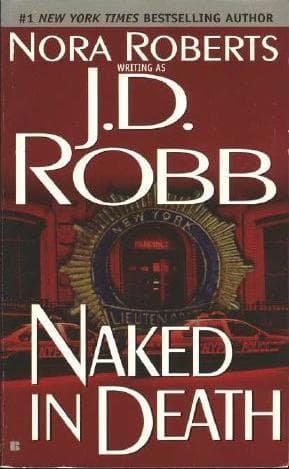
- Naked in Death
J.D. Robb
4.1 (167k) average on GoodreadsThrillerFirst book in the same series, establishing the characters and setting.
- The Silence of the Lambs
Thomas Harris
4.2 (464k) average on GoodreadsThrillerFeatures a brilliant detective pursuing a methodical, psychologically complex serial killer.
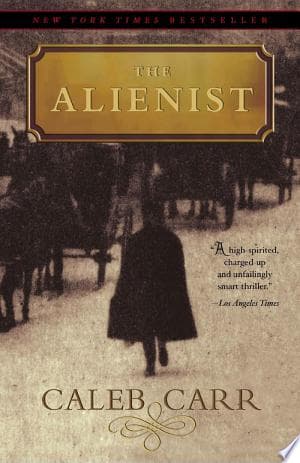
- The Alienist
Caleb Carr
4.1 (182k) average on GoodreadsFictionWhile both 'Creation in Death' and 'The Alienist' feature brilliant, unconventional investigators pursuing serial killers with unique modi operandi, Carr's novel is a historical thriller deeply rooted in 19th-century psychology and forensics, lacking the futuristic science fiction elements of Robb's work. 'The Alienist' prioritizes the meticulous, early psychological profiling and social commentary, whereas Robb balances futuristic technology with character-driven emotional arcs. Robb's series also integrates a prominent romance, which is largely absent in Carr's more academically focused approach to crime solving.
- Gone Girl
Gillian Flynn
4.1 (2.3M) average on GoodreadsThrillerBoth novels explore complex criminal minds and feature significant plot twists, but Flynn's 'Gone Girl' is a standalone psychological thriller focusing on marital deception and media manipulation, employing unreliable narrators and a darker, more cynical tone. Robb's 'Creation in Death' is part of a long-running series with established characters and a more traditional mystery structure, albeit with futuristic elements. While both delve into the 'personal connection' theme, Flynn's approach is more about the internal psychological warfare between spouses, whereas Robb's explores the external threat posed by a serial killer to a community and its protectors. Flynn's work is characterized by its moral ambiguity, contrasting with Robb's more clear-cut heroes and villains, despite the complexity of their motivations.
- Angels & Demons
Dan Brown
3.9 (2.7M) average on GoodreadsThrillerA Harvard symbologist races through Rome's ancient sites, deciphering cryptic clues to unmask the Illuminati and stop a vengeful plot to destroy the Vatican with a stolen antimatter weapon.
- The Girl on the Train
Paula Hawkins
3.9 (2.1M) average on GoodreadsThrillerA woman’s fascination with a seemingly perfect couple she watches from her daily train commute leads her into a dark investigation when she witnesses something that shatters their idyllic image.




Enjoyed the summary?
A summary gives you the shape of the book. The book itself has the detail, the examples and the voice.
Find Creation in Death on AmazonAs an Amazon Associate, BookBrief earns from qualifying purchases. How we're funded