

Core Idea
- Difficulty
- Medium
Key Takeaways from David and Goliath
The Advantage of Disadvantage
What appears as a weakness can often be a hidden strength, and vice-versa.
Gladwell's main idea is that perceived disadvantages often bring unique benefits. The story of David and Goliath shows this: Goliath's size and armor, which seemed like strengths, made him slow and vulnerable to David's speed and weapon. David's small size and lack of traditional weapons made him innovate and use a different kind of strength. This idea appears in examples like the entrepreneur with dyslexia who develops better problem-solving skills or the 'desirable difficulty' of learning in a tough environment. This insight helps leaders rethink their own 'weaknesses' and those of their rivals.
“The act of facing overwhelming odds can fundamentally change the way people think about the world.”
In the book: The story of David and Goliath; the 'inverted-U curve' principle applied to class size in schools, showing that beyond a certain point, more resources (smaller classes) can become a disadvantage; the example of individuals with dyslexia who develop enhanced spatial reasoning and entrepreneurial drive.
Try this: Leaders should critically evaluate the true impact of their perceived limitations. Instead of trying to overcome a disadvantage by conventional means, explore how it can force unconventional and ultimately superior strategies. Encourage teams to embrace 'desirable difficulties' as catalysts for innovation.
The Power of the Remote Weapon
Distance and indirect approaches can neutralize overwhelming physical might.
Gladwell examines the military context of the David and Goliath story, showing that David's sling was a deadly weapon, launching projectiles as fast as a modern handgun. Goliath, a heavily armored soldier, was built for close combat but unprepared for a projectile attacker. This shows a key strategy: direct confrontation against a stronger opponent often fails. Weaker parties can win by changing the rules, using tools and methods that cancel out the opponent's strengths and use their weaknesses. This applies to business, politics, and personal conflicts.
“The sling is not a slingshot. It’s a devastating weapon.”
In the book: Gladwell's detailed analysis of the sling as a weapon, citing historical military capabilities; the use of unconventional tactics by the civil rights movement against the Alabama police force in Birmingham, leveraging media and non-violence to expose brutality.
Try this: When facing a dominant competitor, avoid direct, head-on competition in their chosen arena. Instead, identify their blind spots and develop 'remote weapons' – strategies, technologies, or business models that render their traditional strengths irrelevant or disadvantageous. Think disruptively.
Optimal Difficulty: The Inverted-U Curve
Too much or too little of a good thing can be detrimental; there's an optimal middle ground.
This is one of the book's strongest ideas, showing that many good traits or conditions follow an 'inverted-U curve.' For example, a good amount of challenge or difficulty can build resilience and growth, but too little (comfort) or too much (extreme trauma) can be harmful. Gladwell applies this to school class sizes (too small can isolate, too large is ineffective), parental wealth (too little causes hardship, too much can create complacency), and the 'Big Pond/Little Pond' effect in education, where being a top student at a less prestigious university might be better than struggling at an elite one. This concept suggests that 'more is better' isn't always true.
“There are times and places where it is better to be a small fish in a big pond than a big fish in a small pond.”
In the book: The research on optimal class sizes; the 'relative deprivation' theory explaining why students at less selective schools may thrive more than those at highly selective ones; the examples of successful individuals who experienced moderate adversity rather than extreme hardship or extreme privilege.
Try this: Identify areas in your life or organization where the 'more is better' fallacy might be at play. Seek the optimal balance rather than maximizing a single variable. For personal development, embrace challenges that are difficult but not insurmountable. For leadership, understand that providing too many resources or too little pressure can hinder growth.
The Legitimacy of Authority
Power without fairness and respect ultimately crumbles.
Gladwell argues that authority, whether from government, parents, or institutions, works best when it seems fair. When those in power enforce rules randomly, inconsistently, or unfairly, they lose the trust and cooperation of the people they govern. The 'three strikes' law in California is an example; it led to more violent crime because offenders, facing life sentences for minor offenses, had nothing to lose. In contrast, authorities seen as fair, open, and respectful of rights tend to get more cooperation, even with strict rules. This idea helps explain social movements and effective leadership.
“Authority, in the end, is granted to the deserving.”
In the book: The unintended consequences of California's 'three strikes' law; the story of the civil rights movement in Birmingham, where police brutality backfired by galvanizing public support for the protestors; the 'procedural justice' research showing that people are more likely to accept an unfavorable outcome if they perceive the process as fair.
Try this: Leaders must prioritize fairness, transparency, and consistency in their decision-making and rule enforcement. Understand that exercising power without legitimacy breeds resentment and rebellion. Build trust by explaining decisions, listening to concerns, and treating everyone with respect, even when delivering difficult news.
Embracing the 'Disability' as a Strength
Many individuals considered 'disabled' possess unique strengths cultivated by their challenges.
Gladwell highlights many stories of people who, despite or because of learning disabilities like dyslexia, succeeded greatly. He argues that overcoming these challenges often forces the development of other skills – like better spatial reasoning, problem-solving, or delegation – which become strong assets. For instance, many successful entrepreneurs have dyslexia, having learned to see the world differently and think creatively. This challenges the medical view of disability and focuses on strengths, suggesting society often misunderstands or undervalues these unique ways of thinking. While this argument doesn't fully address the systemic barriers faced by disabled people, it powerfully reframes individual ability.
“When we think about people who struggle with something, we have a very narrow view of what struggle means. We assume that it’s always a bad thing.”
In the book: The stories of successful dyslexic entrepreneurs and lawyers who developed exceptional oral communication or strategic thinking skills; the example of David Boies, a prominent lawyer with dyslexia who excels at oral argument.
Try this: Shift perspective from viewing 'disabilities' or 'weaknesses' as purely negative. Explore how these challenges might be fostering unique skills, perspectives, or resilience. For leaders, create inclusive environments that recognize and leverage diverse cognitive styles, rather than trying to fit everyone into a single mold.
The Limits of Overwhelming Force
Applying too much force or resources can be counterproductive, leading to unintended consequences.
This idea builds on the inverted-U curve and 'desirable difficulty.' Gladwell shows how overwhelming power can blind the powerful to their weaknesses and lead to predictable, often ineffective, strategies. The British military's initial use of force in Northern Ireland only made the conflict worse. Similarly, overprotective parents or overly resourced schools can accidentally remove chances for resilience and self-reliance. The book suggests that powerful entities often fail not from lack of strength, but because their great strength stops them from adapting, innovating, or understanding the real challenge from the underdog.
“What the powerful fail to see is that the act of being powerful has a corrupting quality.”
In the book: The British Army's initial failed tactics in Northern Ireland and their eventual shift to more nuanced, community-based policing; the example of parents inadvertently hindering their children's development by removing all obstacles; the 'Big Pond/Little Pond' effect where too much competition can be demotivating.
Try this: Resist the temptation to always apply maximum force or resources to a problem. Sometimes, constraints and limitations foster creativity and efficiency. For leaders, be wary of the 'curse of plenty' – ensuring that abundant resources don't lead to complacency or a lack of strategic agility. Encourage calculated risks and learning from failure.
The Power of Moral Courage
True courage often lies in defying accepted norms and standing up for principles, even against immense pressure.
Gladwell presents individuals who showed great moral courage, often against tough odds. He points to civil rights activists in Birmingham, Alabama, who faced brutal repression with non-violence, and French villagers in Le Chambon who sheltered Jewish refugees during WWII. These acts of defiance were not reckless but principled, based on a strong moral compass. This idea shows that winning against powerful forces isn't always about physical strength or clever tactics; it can be about firm commitment to a cause and a willingness to endure hardship for what is right. This is a strong message for anyone facing ethical problems or unfair systems.
“Courage is not something that you have or don't have. It's something you learn.”
In the book: The story of the civil rights movement in Birmingham, Alabama, and the strategic non-violence employed by Martin Luther King Jr.; the remarkable story of the villagers of Le Chambon-sur-Lignon, who collectively decided to hide thousands of Jews from the Nazis.
Try this: Cultivate a strong moral compass and be prepared to act on your convictions, even when unpopular or difficult. Leaders should foster environments where ethical behavior is rewarded and dissent is heard, recognizing that moral courage can be a powerful force for positive change within organizations and society.
The Value of 'Near Misses' and Trauma
Experiencing significant adversity, if not overwhelming, can build resilience and purpose.
Gladwell explores how people who survive significant hardship, like losing a parent early or having a 'near miss' with disaster, often develop great resilience, empathy, and a strong sense of purpose. This isn't to praise suffering, but to recognize that overcoming adversity can build character and drive. The difference is between 'overwhelming' trauma that crushes someone and 'significant' hardship that, with enough support, can be navigated and turned into a strength. This idea questions the common avoidance of all struggle and suggests a nuanced view of pain and growth. This argument, however, needs careful handling to avoid blaming victims or downplaying real suffering.
“What we think of as a disadvantage is not always a disadvantage. And what we think of as an advantage is not always an advantage.”
In the book: The 'dose-response' relationship of trauma, where moderate adversity can be beneficial, but extreme trauma is detrimental; the stories of individuals who lost parents early but went on to achieve great success, attributing some of their drive to that experience.
Try this: While not seeking out trauma, recognize that navigating difficult experiences can be a profound source of learning and growth. Support individuals through their struggles, helping them process and learn from adversity rather than shielding them entirely. Foster a culture of resilience and post-traumatic growth.
The Underdog's Freedom to Innovate
Without the burden of tradition or expectations, underdogs are free to experiment and redefine success.
Powerful entities often work within existing rules, limited by past successes, reputation, and stakeholder expectations. Underdogs, in contrast, have little to lose. This freedom allows them to try radical approaches, use unconventional strategies, and redefine what success means. Vivek Ranadivé, who coached a girls' basketball team to victory by using a full-court press throughout the game, despite the usual advice to save energy, perfectly shows this. His team, without traditional talent, won by changing the game's rules. This is a strong lesson for startups, challengers, and anyone looking to disrupt an established order.
“The very thing that gave the giant strength was also a handicap.”
In the book: The story of Vivek Ranadivé coaching his underdog basketball team to victory by completely defying conventional basketball strategy; the historical examples of smaller nations or groups winning against larger forces by employing novel tactics.
Try this: When you are the underdog, resist the urge to mimic the giant. Instead, leverage your freedom to innovate. Challenge assumptions, experiment with unconventional strategies, and be willing to redefine the playing field. Encourage a culture of bold experimentation and a 'nothing to lose' mentality.
Challenging the Definition of 'Victory'
Our perception of what constitutes success or failure often dictates our approach and outcome.
This final idea combines many of the book's themes. Gladwell suggests that our cultural ideas of strength, weakness, advantage, and disadvantage often hide other paths to success. The 'Big Pond/Little Pond' effect is a prime example: many think attending an elite university is always better, even if it means struggling, rather than being a top student at a less famous school. By questioning these societal ideas and using a different definition of 'victory,' individuals and groups can find unexpected ways to succeed. This encourages a critical look at our goals and how we measure success, leading to a more nuanced and empowering view.
“We spend too much time thinking about the way things are supposed to be and not enough time thinking about the way things could be.”
In the book: The 'Big Pond/Little Pond' effect and its implications for academic and career success; the overarching narrative of David and Goliath, where David's unconventional 'victory' redefines what winning means against a traditional warrior.
Try this: Regularly question your own and society's definitions of success and failure. Are you pursuing goals that genuinely serve you, or are they externally imposed? Be open to redefining what 'winning' looks like, especially when facing seemingly insurmountable challenges. Focus on creating your own terms of engagement.
Quiz
10 questions on the main ideas. Each answer comes with a short explanation.
Question 1
What is the central theme explored in Malcolm Gladwell's 'David and Goliath'?
- The importance of technological innovation in business.
- How seemingly weaker or smaller entities can overcome stronger or larger ones.
- The psychological effects of social media on individuals.
- The history of ancient warfare and its impact on modern strategy.
Show answer
B. How seemingly weaker or smaller entities can overcome stronger or larger ones. The book's subtitle, 'Underdogs, Misfits, and the Art of Battling Giants,' and the core premise of the text focus on how the weak can defeat the strong.
Question 2
Which of the following is NOT mentioned as a source of examples in 'David and Goliath'?
- The world of business
- Modern political elections
- Sports
- Cutting-edge psychology
Show answer
B. Modern political elections While the book draws from business, sports, culture, and psychology, modern political elections are not explicitly listed as a source of examples in the provided summary.
Question 3
According to the text, what aspect of our goals can significantly influence our sense of success?
- Their financial profitability
- Their alignment with societal trends
- Their difficulty level
- Their cultural determination
Show answer
D. Their cultural determination The summary states, 'and how our goals (often culturally determined) can make a huge difference in our ultimate sense of success.'
Question 4
Malcolm Gladwell is also known for which of his previous bestselling books?
- Sapiens, Homo Deus, and 21 Lessons for the 21st Century
- Thinking, Fast and Slow and Nudge
- The Tipping Point, Blink, and Outliers
- Freakonomics and SuperFreakonomics
Show answer
C. The Tipping Point, Blink, and Outliers The provided text explicitly mentions 'In his #1 bestselling books The Tipping Point, Blink, and Outliers, Malcolm Gladwell has explored the ways we understand and change our world.'
Question 5
The book 'David and Goliath' is described as being in many ways the most ______ and ______ book Malcolm Gladwell has ever written.
- academic, theoretical
- entertaining, fictional
- practical, provocative
- simple, straightforward
Show answer
C. practical, provocative The text concludes by stating, 'David and Goliath is in many ways the most practical and provocative book Malcolm Gladwell has ever written.'
Question 6
Gladwell's exploration in 'David and Goliath' challenges the conventional understanding of what?
- The definition of intelligence
- The relationship between effort and reward
- The advantages typically associated with strength and size
- The impact of luck on success
Show answer
C. The advantages typically associated with strength and size The book's core theme is about how the weak can defeat the strong and the small can match the giant, directly challenging the assumed advantages of strength and size.
Question 7
The book suggests that 'misfits' might have an advantage in certain situations. What does this imply about their perspective?
- They are less likely to be noticed by opponents.
- They are more adaptable due to their unconventional thinking.
- They possess superior physical abilities.
- They are naturally more aggressive.
Show answer
B. They are more adaptable due to their unconventional thinking. While not explicitly stated in the summary, the concept of 'misfits' battling giants implies that their unconventional nature or perspective might offer an advantage, often stemming from a different way of thinking or operating.
Question 8
Gladwell's previous work, such as 'The Tipping Point,' primarily focused on:
- The economic systems of developing nations.
- The rapid spread of trends and ideas.
- The biological evolution of the human species.
- The philosophical underpinnings of morality.
Show answer
B. The rapid spread of trends and ideas. The summary states that in 'The Tipping Point,' Gladwell explored 'the ways we understand and change our world,' which aligns with the idea of how trends and ideas spread rapidly.
Question 9
The phrase 'art of battling giants' suggests that overcoming large obstacles requires more than just brute force. What might it imply is also needed?
- Technological superiority
- Strategic thinking and unconventional approaches
- A larger army or workforce
- Greater financial resources
Show answer
B. Strategic thinking and unconventional approaches The term 'art' implies skill, strategy, and perhaps creativity, rather than just raw power. Battling giants suggests a need for cleverness and unconventional tactics.
Question 10
Considering the examples drawn from 'cutting-edge psychology,' what might Gladwell be investigating regarding the underdog's mindset?
- The physiological effects of stress on performance.
- The cognitive biases that lead to overconfidence in the strong.
- The genetic predispositions for success.
- The impact of childhood trauma on adult behavior.
Show answer
B. The cognitive biases that lead to overconfidence in the strong. Psychological research often explores cognitive biases. In the context of David and Goliath, examining how the 'giant's' perceived strength might lead to overconfidence, or how the 'underdog's' perceived weakness might foster different psychological strategies, is a likely area of exploration.
David and Goliath FAQ
What is the main theme of David and Goliath?
The main theme of "David and Goliath" is that perceived disadvantages can often be turned into advantages. Gladwell explores how underdogs, misfits, and those facing apparent obstacles can develop unique strengths and strategies to overcome seemingly insurmountable odds.
What are some key examples used in the book?
Gladwell draws on a wide range of examples, including the biblical story of David and Goliath, the civil rights movement, the challenges faced by dyslexic individuals, and the strategies of various athletes and business leaders who have succeeded against the odds.
How does Gladwell define 'giants' and 'davids'?
In the context of the book, 'giants' are typically those who are powerful, successful, or in positions of authority, often perceived as having every advantage. 'Davids' are those who are seen as weaker, less fortunate, or facing significant disadvantages, but who possess unique qualities or circumstances that allow them to challenge the giants.
Can David and Goliath be applied to business leadership?
Absolutely. The book offers numerous insights for business leaders, particularly in understanding competitive strategy, the advantages of being an underdog, and how to foster innovation by embracing unconventional approaches and recognizing the hidden strengths of their teams.
What is the role of 'advantages of disadvantages' in the book?
Gladwell argues that certain disadvantages, such as dyslexia or growing up in a difficult environment, can foster resilience, creativity, and a different way of thinking that ultimately becomes a significant advantage when facing challenges.
How does the book challenge conventional wisdom about success?
The book challenges the idea that power, resources, and conventional advantages always lead to victory. It suggests that sometimes, being at a disadvantage, having less to lose, or facing adversity can be the very catalyst for innovation and ultimate success.
Is David and Goliath a self-help book?
While not a traditional self-help book, "David and Goliath" offers practical insights and a reframed perspective on challenges, empowering readers to see their own perceived weaknesses as potential strengths and to approach obstacles with a more strategic and optimistic outlook.
What is the connection between 'desirable difficulties' and success?
Gladwell introduces the concept of 'desirable difficulties,' which are challenges that, while uncomfortable, ultimately lead to greater learning, growth, and achievement. These are the obstacles that forge stronger individuals and lead to more profound successes.
How does the book relate to historical events?
Gladwell uses historical events, like the story of the Protestant Reformation or the struggles of certain social movements, to illustrate how underdogs and unexpected leaders have historically overcome powerful established systems and individuals.
What makes David and Goliath different from Gladwell's other books?
While sharing Gladwell's signature style of storytelling and exploration of social science, "David and Goliath" is often considered more directly practical and provocative, offering actionable insights into how individuals and organizations can leverage perceived weaknesses for strategic advantage.
About the author
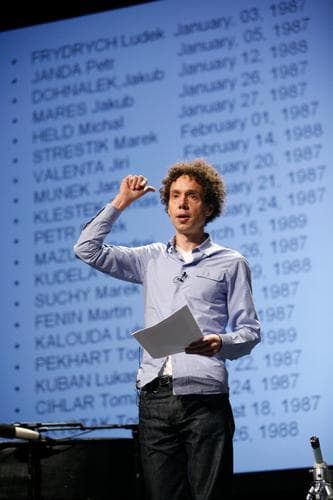
Malcolm Gladwell is a Canadian journalist and author known for his exploration of social science and human behavior. His notable works include "The Tipping Point," which examines how small actions can lead to significant changes, and "Outliers," which investigates the factors contributing to high levels of success. Other influential titles include "Blink," "David and Goliath," and "Talking to Strangers."
Similar books
- Outliers: The Story of Success
Malcolm Gladwell
4.2 (556k) average on GoodreadsBusiness"Outliers" is perhaps the most direct comparison, as it shares Gladwell's signature narrative style and a similar thematic focus on the hidden factors contributing to success. Both books dissect success, but "Outliers" largely attributes it to environmental factors, opportunities, and the '10,000-hour rule,' suggesting that success is often a product of circumstance rather than innate talent alone. "David and Goliath," however, shifts the focus more towards how perceived disadvantages can be leveraged into advantages, emphasizing resilience, strategic thinking, and the transformative power of adversity. While "Outliers" explores the conditions that create giants, "David and Goliath" explores how to battle them, often by redefining what constitutes a 'giant' or a 'weapon'.
- Steve Jobs
Walter Isaacson
4.1 (957k) average on GoodreadsBusinessSteve Jobs was a visionary who fused creativity and technology to revolutionize six industries and shape our digital world.
- Freakonomics: A Rogue Economist Explores the Hidden Side of Everything
Steven D. Levitt
4.0 (709k) average on GoodreadsBusinessThis book uses economic principles to reveal the surprising incentives behind everything from drug dealing and real estate to cheating teachers and the decline of crime.
- The Tipping Point: How Little Things Can Make a Big Difference
Malcolm Gladwell
4.0 (690k) average on GoodreadsBusinessMalcolm Gladwell explains how small, targeted actions can start widespread changes in trends, behaviors, and ideas.
- The Subtle Art of Not Giving a F*ck: A Counterintuitive Approach to Living a Good Life
Mark Manson
3.9 (530k) average on GoodreadsBusinessEmbrace your flaws and stomach life's lemons, because true happiness isn't about relentless positivity, but about choosing what truly matters to give a f*ck about.
- The 7 Habits of Highly Effective People: Powerful Lessons in Personal Change
Stephen R. Covey
4.1 (524k) average on GoodreadsBusinessThis book presents seven habits that help people live more effective, purposeful lives.






Enjoyed the summary?
A summary gives you the shape of the book. The book itself has the detail, the examples and the voice.
Find David and Goliath on AmazonAs an Amazon Associate, BookBrief earns from qualifying purchases. How we're funded